For the following questions answer them individually
Molality ($$m$$) of $$3M$$ aqueous solution of NaCl is : (Given : Density of solution $$= 1.25 \text{ g mL}^{-1}$$, Molar mass in $$\text{gmol}^{-1}$$: Na $$- 23$$, Cl $$- 35.5$$)
The ratio $$\frac{K_P}{K_C}$$ for the reaction : $$CO_{(g)} + \frac{1}{2} O_{2(g)} \rightleftharpoons CO_{2(g)}$$ is :
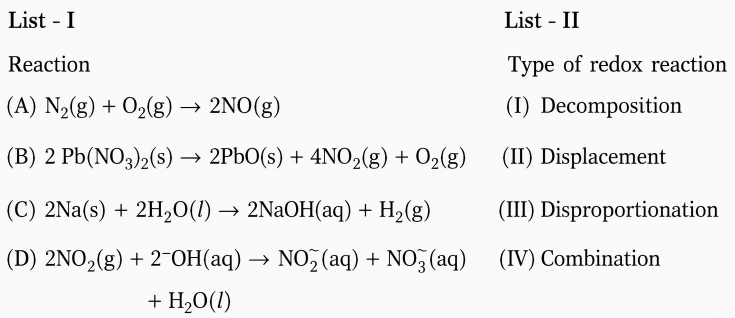
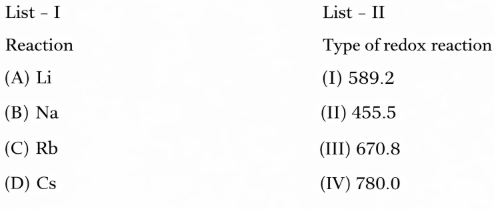
Match List - I with List - II.
Choose the correct answer from the options given below :
The number of ions from the following that are expected to behave as oxidising agent is : $$Sn^{4+}, Sn^{2+}, Pb^{2+}, Tl^{3+}, Pb^{4+}, Tl^{+}$$
Evaluate the following statements related to group 14 elements for their correctness. (A) Covalent radius decreases down the group from C to Pb in a regular manner. (B) Electronegativity decreases from C to Pb down the group gradually. (C) Maximum covalance of C is 4 whereas other elements can expand their covalance due to presence of d orbitals. (D) Heavier elements do not form $$p\pi - p\pi$$ bonds. (E) Carbon can exhibit negative oxidation states. Choose the correct answer from the options given below :
The correct statement among the following, for a "chromatography" purification method is :
The incorrect statement regarding the geometrical isomers of 2-butene is :
How can an electrochemical cell be converted into an electrolytic cell?
Arrange the following elements in the increasing order of number of unpaired electrons in it. (A) Sc (B) Cr (C) V (D) Ti (E) Mn. Choose the correct answer from the options given below :
The correct IUPAC name of $$[PtBr_2(PMe_3)_2]$$ is :
Given below are two statements : Statement I : $$PF_5$$ and $$BrF_5$$ both exhibit $$sp^3d$$ hybridisation. Statement II : Both $$SF_6$$ and $$[Co(NH_3)_6]^{3+}$$ exhibit $$sp^3d^2$$ hybridisation. In the light of the above statements, choose the correct answer from the options given below :
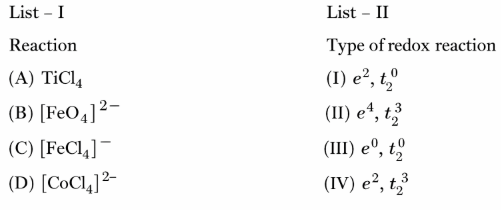
Match List - I with List - II.

Choose the correct answer from the options given below :
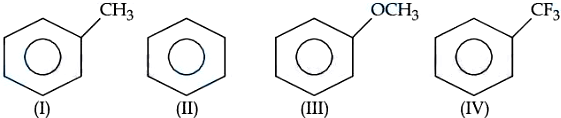
The correct arrangement for decreasing order of electrophilic substitution for above compounds is :
Consider the given reaction, identify the major product "P". $$CH_3 - COOH \xrightarrow{(i) LiAlH_4 \; (ii) PCC \; (iii) HCN/OH^{-} \; (iv) H_2O/OH^{-}, \Delta}$$ "P"
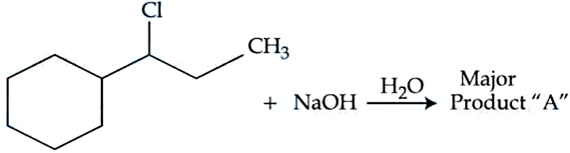
Consider the above chemical reaction. Product "A " is :
The major products formed A and B respectively are:
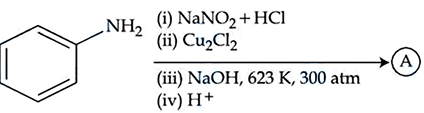
Identify the product (A) in the following reaction.
During the detection of acidic radical present in a salt, a student gets a pale yellow precipitate soluble with difficulty in $$NH_4OH$$ solution when sodium carbonate extract was first acidified with dil. $$HNO_3$$ and then $$AgNO_3$$ solution was added. This indicates presence of :
Match List - I with List - II.

Choose the correct answer from the options given below :

The incorrect statements regarding enzymes are : (A) Enzymes are biocatalysts. (B) Enzymes are non-specific and can catalyse different kinds of reactions. (C) Most Enzymes are globular proteins. (D) Enzyme - oxidase catalyses the hydrolysis of maltose into glucose. Choose the correct answer from the option given below :
Consider the following reactions $$NiS + HNO_3 + HCl \rightarrow A + NO + S + H_2O$$. $$A + NH_4OH + H_3C - C(=N-OH) - C(=N-OH) - H_3C \rightarrow B + NH_4Cl + H_2O$$. The number of protons that do not involve in hydrogen bonding in the product $$B$$ is ___________.
For hydrogen atom, energy of an electron in first excited state is $$-3.4 \text{ eV}$$, K.E. of the same electron of hydrogen atom is $$x \text{ eV}$$. Value of $$x$$ is ___________ $$\times 10^{-1} \text{ eV}$$. (Nearest integer)
An amine (X) is prepared by ammonolysis of benzyl chloride. On adding p-toluenesulphonyl chloride to it the solution remains clear. Molar mass of the amine (X) formed is ___________ $$\text{gmol}^{-1}$$. (Given molar mass in $$\text{gmol}^{-1}$$: C : 12, H : 1, O : 16, N : 14)
For the reaction at $$298 \text{ K}$$, $$2A + B \rightarrow C$$. $$\Delta H = 400 \text{ kJ mol}^{-1}$$ and $$\Delta S = 0.2 \text{ kJ mol}^{-1} \text{K}^{-1}$$. The reaction will become spontaneous above ___________ K.
Consider the two different first order reactions given below $$A + B \rightarrow C$$ (Reaction 1) $$P \rightarrow Q$$ (Reaction 2). The ratio of the half life of Reaction 1 : Reaction 2 is $$5 : 2$$. If $$t_1$$ and $$t_2$$ represent the time taken to complete $$\frac{2}{3}^{rd}$$ and $$\frac{4}{5}^{th}$$ of Reaction 1 and Reaction 2, respectively, then the value of the ratio $$t_1 : t_2$$ is ___________ $$\times 10^{-1}$$ (nearest integer). [Given : $$\log_{10}(3) = 0.477$$ and $$\log_{10}(5) = 0.699$$]
Among $$VO_2^{+}$$, $$MnO_4^{-}$$ and $$Cr_2O_7^{2-}$$, the spin-only magnetic moment value of the species with least oxidising ability is ___________ BM (Nearest integer). (Given atomic number $$V = 23, Mn = 25, Cr = 24$$)
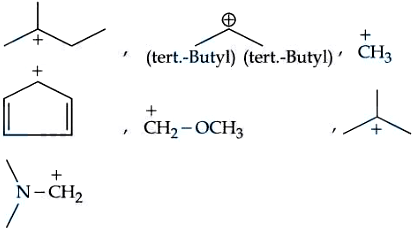
Number of carbocations from the following that are not stabilized by hyperconjugation is __________
_
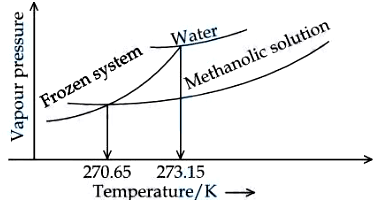
When '$$x$$' $$\times 10^{-2}$$ mL methanol (molar mass $$= 32 \text{ g}$$; density $$= 0.792 \text{ g/cm}^3$$) is added to $$100 \text{ mL}$$ water (density $$= 1 \text{ g/cm}^3$$), the following diagram is obtained. $$x =$$ ___________ (nearest integer).
[Given : Molal freezing point depression constant of water at $$273.15 \text{ K}$$ is $$1.86 \text{ K kg mol}^{-1}$$]
Total number of species from the following with central atom utilising $$sp^2$$ hybrid orbitals for bonding is ___________. $$NH_3$$, $$SO_2$$, $$SiO_2$$, $$BeCl_2$$, $$C_2H_2$$, $$C_2H_4$$, $$BCl_3$$, $$HCHO$$, $$C_6H_6$$, $$BF_3$$, $$C_2H_4Cl_2$$
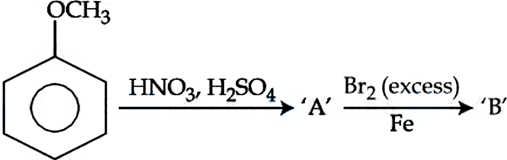
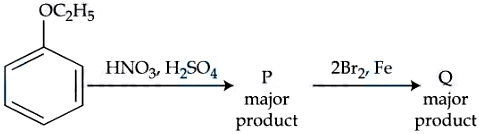
The ratio of number of oxygen atoms to bromine atoms in the product Q is ___________ $$\times 10^{-1}$$.