
Join Our JEE Preparation Group
Prep with like-minded aspirants; Get access to free daily tests and study material.
Sign in
Please select an account to continue using cracku.in
↓ →
Join Our JEE Preparation Group
Prep with like-minded aspirants; Get access to free daily tests and study material.
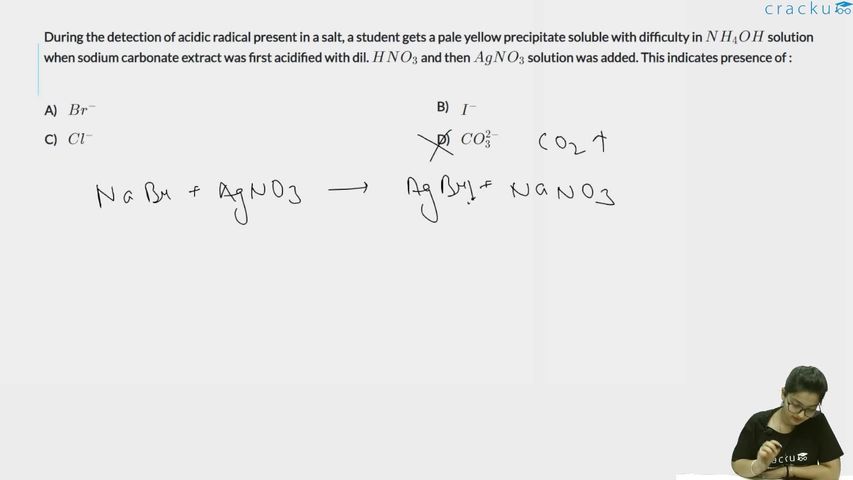
During the detection of acidic radical present in a salt, a student gets a pale yellow precipitate soluble with difficulty in $$NH_4OH$$ solution when sodium carbonate extract was first acidified with dil. $$HNO_3$$ and then $$AgNO_3$$ solution was added. This indicates presence of :
We need to identify the acidic radical that gives a pale yellow precipitate soluble with difficulty in NH$$_4$$OH when tested with AgNO$$_3$$. When the sodium carbonate extract of a salt is acidified with dilute HNO$$_3$$ and treated with AgNO$$_3$$, the halide ions form silver halide precipitates with characteristic colours and solubilities: AgCl (from Cl$$^-$$) gives a white curdy precipitate easily soluble in dilute NH$$_4$$OH (forms soluble [Ag(NH$$_3$$)$$_2$$]Cl), AgBr (from Br$$^-$$) gives a pale yellow precipitate soluble with difficulty in NH$$_4$$OH (partially soluble, requires concentrated NH$$_4$$OH), and AgI (from I$$^-$$) gives a yellow precipitate insoluble in NH$$_4$$OH.
Since the observed precipitate is pale yellow, Cl$$^-$$ is ruled out and Br$$^-$$ is consistent; moreover, its solubility with difficulty in NH$$_4$$OH matches AgBr, whereas AgI would be completely insoluble and AgCl would dissolve easily.
Furthermore, CO$$_3^{2-}$$ would not give a precipitate with AgNO$$_3$$ in acidic medium, as it reacts with acid to form CO$$_2$$, eliminating Option (4).
The correct answer is Option (1): Br$$^-$$.
Was this solution helpful?
Click on the Email ☝️ to Watch the Video Solution
Create a FREE account and get:
_1.webp)

Educational materials for JEE preparation

Ask our AI anything

AI can make mistakes. Please verify important information.
AI can make mistakes. Please verify important information.
