NSEP 2021 Question Paper

For the following questions answer them individually

Consider the process of the melting of a spherical ball of ice originally at $$0^\circ\text{C}$$. Assuming that the heat is being absorbed uniformly through the surface and the rate of absorption is proportional to the instantaneous surface area. Which of the following is true for the radius $$r$$ of the ice ball at any instant of time? Assume that the initial radius of the ice ball at $$t = 0$$ is $$r = R_0$$ and that the shape of the ball always remains spherical during melting. Also assume that $$L$$ and $$\rho$$ are respectively the latent heat and density of ice at $$0^\circ\text{C}$$.
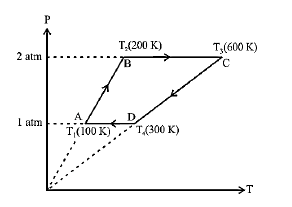
The work done by three moles of an ideal gas in the cyclic process $$ABCD$$ shown in the diagram is approximately. Given that $$T_1 = 100\ \text{K}$$, $$T_2 = 200\ \text{K}$$, $$T_3 = 600\ \text{K}$$ and $$T_4 = 300\ \text{K}$$.

image

The molar specific heat capacity of a certain gas is expressed as $$C = C_V + \alpha\frac{P}{T}$$. The equation of state for the process can be written as, where $$\alpha$$ and $$A$$ are constants.

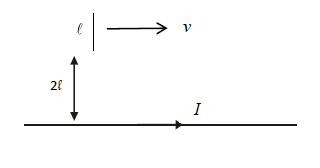
A metal bar of length $$\ell$$ moves with a velocity $$v$$ parallel to an infinitely long straight wire carrying a current $$I$$ as shown in the figure. If the nearest end of the perpendicular bar always remains at a distance $$2\ell$$ from the current carrying wire, the potential difference in volt between two ends of the moving bar is

image

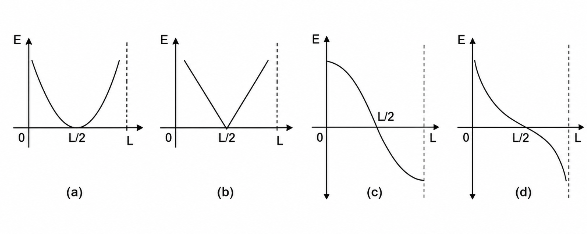
Two point charges $$+Q$$ each are located at $$(0,0)$$ and $$(L,0)$$ at a distance $$L$$ apart on the $$x$$-axis. The electric field $$E$$ in the region $$0 < x < L$$ is best represented by

image

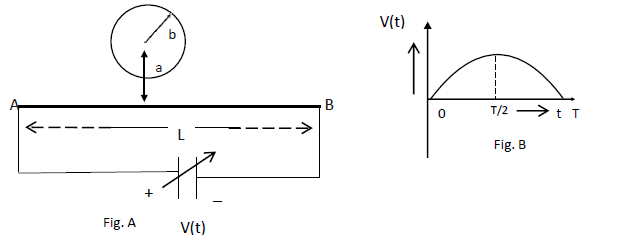
A long straight wire $$AB$$ of length $$L$$ with $$L \gg a$$ and $$L \gg b$$ and resistance $$R$$ is connected to a time varying source of emf $$V(t)$$. The variation of applied emf $$V(t)$$ with time is shown in Fig. B. A circular metallic loop of radius $$r=b$$ is placed coplanar with the current carrying wire with its centre at a distance $$a$$ from the axis of the wire as shown. The induced current in the loop is

image

A simple circuit consists of a known resistance $$R_A = 2\ \text{M}\Omega$$ and an unknown resistance $$R_B$$, both in series with a battery of $$9\ \text{V}$$ and negligible internal resistance. When the voltmeter is connected across $$R_A$$, it measures $$3\ \text{V}$$, but when the same voltmeter is connected across $$R_B$$ it reads $$4.5\ \text{V}$$. The voltmeter measures $$9\ \text{V}$$ across the battery. Considering that the voltmeter has a finite resistance $$r$$, the correct option is

The optical powers of the objective and the eyepiece of a compound microscope are $$100\ \text{D}$$ and $$20\ \text{D}$$ respectively. The microscope magnification being equal to $$50$$ when the final image is formed at $$d = 25\ \text{cm}$$ i.e, the least distance of distinct vision. If the separation between the objective and the eyepiece is increased by $$2\ \text{cm}$$, the magnification of the microscope will be

A hollow non-conducting cone of base radius $$R = 50\ \text{cm}$$ and semi vertical angle $$15^\circ$$ has been uniformly charged on its curved surface up to three-fourth of its slant length from base with a surface charge density $$\sigma = 2.5\ \mu\text{C}/\text{m}^2$$. The electric field produced at the location of the vertex of the cone is

A freely falling spherical rain drop gathers moisture while (maintaining its spherical shape all the way) from the atmosphere at a rate $$\frac{dm}{dt}=kt^2$$, where $$t$$ is the time and $$m$$ is the instantaneous mass of the drop. The constant is $$k = 12\ \text{g}/\text{s}^3$$. If the drop, of initial mass $$m_0 = 2\ \text{g}$$, starts falling from rest, the instantaneous velocity exactly after $$5\ \text{s}$$ shall be, ignoring air friction and air buoyancy.

Two planets, each of mass $$M$$ and radius $$R$$, are positioned at rest in space with their centres a distance $$4R$$ apart. You wish to fire a projectile from the surface of one planet to the other. The minimum initial speed for which this may be possible is

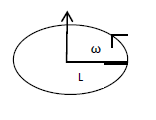
A thin uniform metallic rod of length $$L$$ and radius $$R$$ rotates with an angular velocity $$\omega$$ in a horizontal plane about a vertical axis passing through one of its ends. The density and the Young's modulus of the material of the rod are $$\rho$$ and $$Y$$ respectively. The elongation in its length is

image

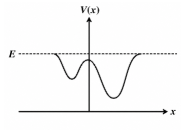
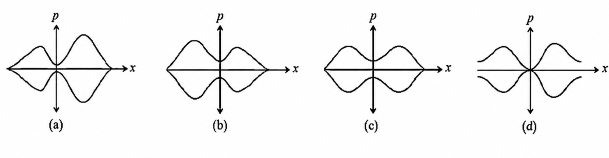
Consider a particle of mass $$m$$ with a total energy $$E$$ moving in a one dimensional potential field. The potential $$V(x)$$ is plotted against $$x$$ in the figure beside. The plot of momentum-position graph of this particle is qualitatively best represented by. All plots are symmetrical about the $$x$$-axis.

imageimage

Knowing that parallel currents attract, the inward pressure on the curved surface of a thin walled, long hollow metallic cylinder of radius $$R = 50\ \text{cm}$$ carrying a current $$i = 2\ \text{A}$$ parallel to its axis distributed uniformly over the entire circumference, is

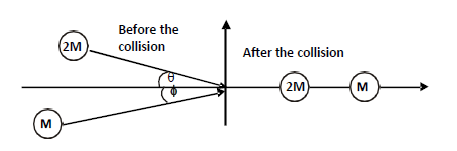
Two masses move on a collision path as shown. Before the collision the object with mass $$2M$$ moves with a speed $$v$$ making an angle $$\theta = \sin^{-1}(3/5)$$ with the $$x$$-axis while the object with mass $$M$$ moves with a speed $$\frac{3}{2}v$$ making an angle $$\phi = \sin^{-1}(4/5)$$ with the $$x$$-axis. After the collision the object of mass $$2M$$ is observed to be moving to the right along the $$x$$-axis with a speed $$\frac{4}{5}v$$. There are no external forces acting during the collision. The correct option is

image

A large hemispherical water tank of radius $$R$$ is filled with water initially up to a height $$h=R/2$$. The water starts dripping out through a small orifice of cross section area $$a$$ at its spherical bottom. The time taken to get the tank completely empty, neglecting viscosity, is

If Pascal $$\text{Pa}$$, the unit of pressure, volt $$\text{V}$$, the unit of potential, and meter represented by $$L$$, the unit of length, are taken as fundamental units, the dimensional formula for the permittivity $$\varepsilon_0$$ of free space is expressed as

A cycle wheel of mass $$M$$ and radius $$R$$ fitted with a siren at a point on its circumference is mounted with its plane vertical on a horizontal axle at about $$3\ \text{ft}$$ above the ground. An observer stands in the vertical plane of the wheel at $$100\ \text{m}$$ away from the axle on a horizontal platform. The siren emits a sound of frequency $$1000\ \text{Hz}$$ and the wheel rotates clockwise with a uniform angular speed $$\omega=\pi\ \text{rad}/\text{s}$$. Initially at $$t=0\ \text{s}$$ the siren is nearest to the observer and moves downwards. The observer records the highest pitch of sound for the first time after, taking the speed of sound in air as $$330\ \text{m}/\text{s}$$.

On a right angled transparent triangular prism $$ABC$$, when a ray of light is incident on face $$AB$$, parallel to the hypotenuse $$BC$$, it emerges out of the prism grazing along the surface $$AC$$. If instead the ray is made incident on face $$AC$$, parallel to the hypotenuse $$CB$$, it gets totally reflected on face $$AB$$. The refractive index $$\mu$$ of the material of the prism is

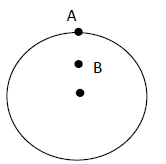
A circular disc of radius $$R = 10\ \text{cm}$$ is uniformly rolling on a horizontal surface with a velocity $$v = 4\ \text{m}/\text{s}$$ of centre of mass without slipping. The time taken by the disc to have the speed of point $$A$$, which lies on the circumference, equal to the present speed of point $$B$$, where point $$B$$ lies midway between centre and point $$A$$, is

image

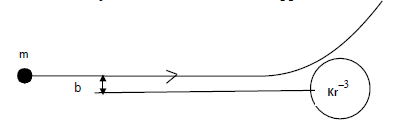
As shown in the figure, a particle of mass $$m = 10^{-10}\ \text{kg}$$ moving with velocity $$v_0 = 10^5\ \text{m}/\text{s}$$ approaches a stationary fixed target with impact parameter $$b$$ from a large distance. If the fixed rigid target has a core with repulsive central force $$F(r)=K/r^3$$, where constant $$K>0$$, and the particle scatters elastically, the closest distance of approach, if numerically $$K=b^2$$, is

image

If the specific activity of $$\mathrm{C}^{14}$$ nuclide in a certain ancient wooden toy is known to be $$3/5$$ of that in a recently fallen tree of the same class, the age of the ancient wooden toy is. The half life of $$\mathrm{C}^{14}$$ is $$5570\ \text{years}$$.

Statement I - Work done in bringing a charge $$q$$ from infinity to the center of a uniformly charged non-conducting solid sphere of radius $$R$$ with a total charge $$Q$$ is zero.
Statement II - The potential difference between the centre and the surface of the uniformly charged non-conducting solid sphere of radius $$R$$ with a total charge $$Q$$ is $$\frac{1}{4\pi\varepsilon_0}\frac{Q}{2R}$$.

Statement I - The current flowing through a $$p$$-$$n$$ junction is more in forward bias than that in the reverse bias.
Statement II - The diffusion current, dominant in forward bias, is more than the drift current, dominant in the reverse bias.

A simple pendulum consisting of a small bob of mass $$m$$ attached to a massless inextensible string of length $$\ell = 2\ \text{m}$$, hanging vertically from the ceiling, is oscillating in a vertical plane with an angular amplitude $$\theta_m$$ such that the maximum tension in its string is three times the minimum tension in the string, so $$T_{\max}=3T_{\min}$$. The correct options are

Two small masses $$m$$ and $$M$$ lie on a large horizontal frictionless circular track of radius $$R$$. The two masses are free to slide on the track but constrained to move along a circle. Initially the two masses are tied by a thread with a compressed spring between them, with the spring of negligible length being attached with neither mass. The compressed spring stores a potential energy $$U_0$$. At time $$t=0$$ the thread is burnt and the two masses are released to run opposite to each other leaving the spring behind. The total mechanical energy remains conserved. On the circular track the two masses make a head on perfectly elastic collision. Take $$M=2m$$ for all calculations. Which options are correct

The electric field component of an electromagnetic wave is expressed as $$\mathbf{E}=(3\hat{\mathbf{j}}+b\hat{\mathbf{k}})\times10^{-3}\sin\left[10^7(x+2y+3z-\beta t)\right]$$ in SI units. Taking $$c=3\times10^8\ \text{m}/\text{s}$$ as the speed of electromagnetic wave in vacuum, choose the correct options.

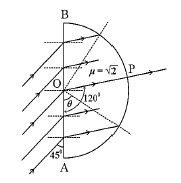
A parallel beam of light is made incident as shown on the flat diametric plane of a transparent semi-circular thin sheet of thickness $$t$$ with $$t \ll R$$ and refractive index $$\mu=\sqrt2$$ at an angle of $$45^\circ$$. As a result of refraction, the light enters the semi-circular sheet and comes out at its curved surface. Here $$\theta$$ is the angle between the vertical diameter $$AB$$ and the concerned radius of the semicircular sheet of radius $$R$$.

image

A certain rod of uniform area of cross section $$A$$ with $$A=1.0\ \text{cm}^2$$ and length $$2\ \text{m}$$ is thermally insulated on its lateral surface. The thermal conductivity $$K$$ of the material of the rod varies with temperature $$T$$ as $$K=\alpha/T$$, where $$\alpha$$ is a constant. The two ends of the rod are maintained at temperatures $$T_1=90^\circ\text{C}$$ and $$T_2=10^\circ\text{C}$$. The correct options are

Positronium is a short-lived bound state with lifetime approximately $$10^{-9}\ \text{s}$$ of an electron and a positron, a positively charged particle with mass and charge equal in magnitude to an electron, revolving round their common centre of mass. If $$E_0$$, $$v_0$$ and $$a_0$$ are respectively the ground state energy, the orbital speed of electron in first orbit and the radius of the first $$n=1$$ Bohr orbit for Hydrogen atom, the corresponding quantities $$E$$, $$v$$ and $$a$$ for positronium are

A thin double convex lens of radii of curvature $$R_1=20\ \text{cm}$$ and $$R_2=60\ \text{cm}$$ is made of a transparent material of refractive index $$\mu=1.5$$. Choose the correct options.

A thick hollow cylinder of height $$h$$ and inner and outer radii $$a$$ and $$b$$ with $$b>a$$, made up of a poorly conducting material of resistivity $$\rho$$, lies coaxially inside a long solenoid at its middle. The radius of the solenoid is larger than $$b$$. Throughout the interior of the solenoid, a uniform time varying magnetic field $$B=\beta t$$ is produced parallel to the solenoid axis, where $$\beta$$ is a constant. In this time varying magnetic field

Join CAT 2026 course by 5-Time CAT 100%iler

Crack CAT 2026 & Other Exams with Cracku!