The value of $$\frac{3+\sqrt{6}}{8\sqrt{3}-2\sqrt{12}-\sqrt{32}+\sqrt{50}-\sqrt{27}}$$ is
Sign in
Please select an account to continue using cracku.in
↓ →
Join Our JEE Preparation Group
Prep with like-minded aspirants; Get access to free daily tests and study material.
The value of $$\frac{3+\sqrt{6}}{8\sqrt{3}-2\sqrt{12}-\sqrt{32}+\sqrt{50}-\sqrt{27}}$$ is
Simplifying the denominator, $$-2\sqrt{12}=-4\sqrt{3}$$, $$-\sqrt{32}+\sqrt{50}=-4\sqrt{2}+5\sqrt{2}=\sqrt{2}$$ and $$-\sqrt{27}=-3\sqrt{3}$$, so the denominator becomes $$8\sqrt{3}-4\sqrt{3}-3\sqrt{3}+\sqrt{2}=\sqrt{3}+\sqrt{2}$$. Rationalizing, $$\frac{3+\sqrt{6}}{\sqrt{3}+\sqrt{2}}\times\frac{\sqrt{3}-\sqrt{2}}{\sqrt{3}-\sqrt{2}}=\frac{3\sqrt{3}-3\sqrt{2}+\sqrt{18}-\sqrt{12}}{1}=\frac{3\sqrt{3}-3\sqrt{2}+3\sqrt{2}-2\sqrt{3}}{1}=\sqrt{3}$$.
A train moving with a constant speed crosses a stationary pole in 4 seconds and a platform 75 m long in 9 seconds. The length of the train is (in meters)
If the train has length $$L$$ and speed $$v$$, crossing the pole gives $$L=4v$$, and crossing the platform gives $$L+75=9v$$. Substituting, $$4v+75=9v$$, so $$v=15$$ and $$L=4\times15=60$$ meters.
One of the factors of $$9x^2 - 4z^2 - 24xy + 16y^2 + 20y - 15x + 10$$ is
Grouping, $$9x^2-24xy+16y^2=(3x-4y)^2$$, and writing $$u=3x-4y$$, the expression becomes $$u^2-4z^2-5u+10z$$, which factors as $$(u-2z)(u+2z-5)$$. Substituting back gives $$(3x-4y-2z)(3x-4y+2z-5)$$, so $$3x-4y-2z$$ is a factor.
The natural number which is subtracted from each of the four numbers $$17, 31, 25, 47$$ to give four numbers in proportion is
Let $$k$$ be the number subtracted, so $$\frac{17-k}{31-k}=\frac{25-k}{47-k}$$. Cross multiplying gives $$799-64k=775-56k$$, so $$24=8k$$, giving $$k=3$$.
The solution to the equation $$5(3^x) + 3(5^x) = 510$$ is
Testing $$x=3$$: $$5(3^3)+3(5^3)=5(27)+3(125)=135+375=510$$, which satisfies the equation. Since the left side is strictly increasing in $$x$$, this is the unique solution, $$x=3$$.
If $$(x+1)^2 = x$$, the value of $$11x^3 + 8x^2 + 8x - 2$$ is
Expanding gives $$x^2+x+1=0$$, so $$x^2=-x-1$$. Then $$x^3=x\cdot x^2=x(-x-1)=-x^2-x=(x+1)-x=1$$. Substituting, $$11x^3+8x^2+8x-2=11(1)+8(-x-1)+8x-2=11-8x-8+8x-2=1$$.
There are two values of $$m$$ for which the equation $$4x^2 + mx + 8x + 9 = 0$$ has only one solution for $$x$$. The sum of these two value of $$m$$ is
Combining the $$x$$ terms gives $$4x^2+(m+8)x+9=0$$. For exactly one solution, the discriminant is zero: $$(m+8)^2-4(4)(9)=0$$, so $$(m+8)^2=144$$ and $$m=4$$ or $$m=-20$$. Their sum is $$4+(-20)=-16$$.
The number of zeros in the product of the first 100 natural numbers is
The number of trailing zeros in $$100!$$ equals the number of times 5 divides into it: $$\left\lfloor\frac{100}{5}\right\rfloor+\left\lfloor\frac{100}{25}\right\rfloor=20+4=24$$.
The length of each side of a triangle in increased by 20% then the percentage increase of area is
Since area scales with the square of the side length, the new area is $$(1.2)^2=1.44$$ times the original, which is a $$44\%$$ increase.
The number of pairs of relatively prime positive integers $$(a, b)$$ such that $$\frac{a}{b} + \frac{15b}{4a}$$ is an integer is
Writing the sum as $$\frac{4a^2+15b^2}{4ab}$$, divisibility forces $$a$$ to divide 15 and $$b$$ to divide 4 with $$b$$ even, giving candidates $$a\in\{1,3,5,15\}$$, $$b\in\{2,4\}$$. Checking each coprime pair against $$4ab \mid 4a^2+15b^2$$ shows only $$b=2$$ works for every value of $$a$$, giving the 4 pairs $$(1,2),(3,2),(5,2),(15,2)$$.
The four digit number $$8ab9$$ is a perfect square. The value of $$a^2 + b^2$$ is
A square ending in 9 between 8009 and 8999 must have a root ending in 3 or 7, and checking values in that range, $$93^2=8649$$ is the only fit. So $$a=6$$, $$b=4$$, giving $$a^2+b^2=36+16=52$$.
$$a, b$$ are positive real numbers such that $$\frac{1}{a} + \frac{9}{b} = 1$$. The smallest value of $$a + b$$ is
By the Cauchy-Schwarz inequality, $$(a+b)\left(\frac{1}{a}+\frac{9}{b}\right) \geq (1+3)^2 = 16$$. Since $$\frac{1}{a}+\frac{9}{b}=1$$, this gives $$a+b \geq 16$$, with equality achievable, so the smallest value is 16.
$$a, b$$ real numbers. The least value of $$a^2 + ab + b^2 - a - 2b$$ is
Setting the partial derivatives to zero, $$2a+b-1=0$$ and $$a+2b-2=0$$, gives $$a=0$$, $$b=1$$. Since the quadratic form is positive definite, this is the minimum, and substituting gives $$0+0+1-0-2=-1$$.
I is the incenter of a triangle $$ABC$$ in which $$\angle A = 80^\circ$$. $$\angle BIC =$$
The incenter satisfies the standard identity $$\angle BIC = 90^\circ + \frac{\angle A}{2}$$, so $$\angle BIC = 90^\circ + 40^\circ = 130^\circ$$.
In the adjoining figure $$ABCD$$ is a square and $$DFEB$$ is a rhombus. $$\angle CDF =$$
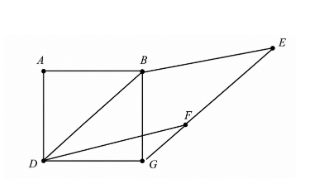
TO BE FILLED - figure required
$$ABCD$$ is a square. $$E, F$$ are points on $$BC, CD$$ respectively and $$\angle EAF = 45^\circ$$. The value of $$\frac{EF}{BE+DF}$$ is
This is a standard square configuration: rotating triangle $$ABE$$ by $$90^\circ$$ about $$A$$ so that $$AB$$ maps onto $$AD$$ shows that $$EF$$ exactly equals $$BE+DF$$, since the $$45^\circ$$ angle condition makes triangle $$AEF$$ congruent to the rotated triangle. So the ratio $$\frac{EF}{BE+DF}$$ is 1.
The average of 5 consecutive natural numbers is 10. The sum of the second and fourth of these numbers is
Since the average of 5 consecutive numbers is 10, the middle number is 10, so the numbers are 8, 9, 10, 11, 12. The second and fourth numbers are 9 and 11, which sum to 20.
The number of natural number $$n$$ for which $$n^2 + 96$$ is a perfect square is
Writing $$n^2+96=k^2$$ gives $$(k-n)(k+n)=96$$, and since both factors must be even, setting $$k-n=2p$$, $$k+n=2q$$ gives $$pq=24$$. The factor pairs $$(1,24),(2,12),(3,8),(4,6)$$ each give a valid natural number $$n=q-p$$, namely $$23, 10, 5, 2$$, giving 4 values.
$$n$$ is an integer and $$\sqrt{\frac{3n-5}{n+1}}$$ is also an integer. The sum of all such $$n$$ is
Setting $$\frac{3n-5}{n+1}=k^2$$ and rewriting gives $$n=-1+\frac{8}{3-k^2}$$, so $$3-k^2$$ must divide 8. Checking divisors of 8 for values where $$3-k^2$$ gives a perfect square $$k^2$$, the valid cases are $$k=1$$ (giving $$n=3$$) and $$k=2$$ (giving $$n=-9$$). The sum of all such $$n$$ is $$3+(-9)=-6$$.
$$\frac{a}{b}$$ is a fraction where $$a, b$$ have no common factors other 1. $$b$$ exceeds $$a$$ by 3. If the numerator is increased by 7, the fraction is increased by unity. The value of $$a + b$$
Since $$b=a+3$$, increasing the numerator by 7 increases the fraction by $$\frac{7}{b}$$, which must equal 1, so $$b=7$$ and $$a=4$$. These are coprime, so $$a+b=4+7=11$$.
If $$x = \sqrt[3]{2} + \frac{1}{\sqrt[3]{2}}$$ then the value of $$2x^3 - 6x$$ is
Writing $$t=\sqrt[3]{2}$$ so $$x=t+\frac{1}{t}$$, the identity $$x^3=t^3+\frac{1}{t^3}+3x$$ gives $$x^3-3x=t^3+\frac{1}{t^3}=2+\frac{1}{2}=\frac{5}{2}$$. So $$2x^3-6x=2\left(\frac{5}{2}\right)=5$$.
The angle of a heptagon are $$160^\circ, 135^\circ, 185^\circ, 140^\circ, 125^\circ, x^\circ, x^\circ$$. The value of $$x$$ is
The interior angles of a heptagon sum to $$(7-2)\times180^\circ=900^\circ$$. Adding the five known angles gives $$160+135+185+140+125=745$$, so $$2x=900-745=155$$, giving $$x=77.5$$.
$$ABC$$ is a triangle and $$AD$$ is its altitude. If $$BD = 5DC$$, then the value of $$\frac{3(AB^2-AC^2)}{BC^2}$$ is
Since $$AD$$ is the common altitude, $$AB^2-AC^2=BD^2-DC^2$$. Taking $$DC=x$$ and $$BD=5x$$ gives $$BC=6x$$ and $$BD^2-DC^2=25x^2-x^2=24x^2$$. So $$\frac{3(AB^2-AC^2)}{BC^2}=\frac{3(24x^2)}{36x^2}=2$$.
As sphere is inscribed in a cube that has surface area of $$24\text{cm}^2$$. A second cube is then inscribed within the sphere. The surface area of the inner cube (in $$\text{cm}^2$$) is
The outer cube's side satisfies $$6s^2=24$$, so $$s=2$$, and the inscribed sphere has radius 1 and diameter 2. This diameter equals the inner cube's space diagonal, so if the inner cube has side $$a$$, $$a\sqrt{3}=2$$, giving $$a^2=\frac{4}{3}$$. Its surface area is $$6a^2=6\times\frac{4}{3}=8$$.
A positive integer $$n$$ is multiple of 7. If $$\sqrt{n}$$ lies between 15 and 16, the number of possible values (s) of n is
The condition means $$225<n<256$$. The multiples of 7 in this range are $$231, 238, 245, 252$$, giving 4 possible values.
The value of $$x$$ which satisfies the equation $$\frac{\sqrt{x+5}+\sqrt{x-16}}{\sqrt{x+5}-\sqrt{x-16}} = \frac{7}{3}$$ is
By componendo and dividendo, $$\frac{\sqrt{x+5}}{\sqrt{x-16}}=\frac{7+3}{7-3}=\frac{5}{2}$$, so $$\frac{x+5}{x-16}=\frac{25}{4}$$. Solving, $$4(x+5)=25(x-16)$$ gives $$420=21x$$, so $$x=20$$.
$$M$$ man do a work in $$m$$ days. If there had been $$N$$ men more, the work would have been finished $$n$$ days earlier, then the value of $$\frac{m}{n} - \frac{M}{N}$$ is
The total work is $$Mm$$ man-days, and with $$M+N$$ men it takes $$m-n$$ days, so $$Mm=(M+N)(m-n)$$. Expanding and simplifying gives $$Mn=N(m-n)$$, so $$\frac{M}{N}=\frac{m-n}{n}=\frac{m}{n}-1$$, which rearranges to $$\frac{m}{n}-\frac{M}{N}=1$$.
The sum of the digit of a two number is 15. If the digits of the given number are reversed, the number is increased by the square of 3. The original number is
With tens digit $$t$$ and units digit $$u$$, $$t+u=15$$, and reversing increases the number by $$9$$: $$(10u+t)-(10t+u)=9$$, giving $$u-t=1$$. Solving together gives $$u=8$$, $$t=7$$, so the original number is 78.
When expanded the units place of $$(3127)^{173}$$ is
The units digit of 3127 is 7, and powers of 7 cycle through units digits 7, 9, 3, 1 with period 4. Since $$173=4\times43+1$$, $$(3127)^{173}$$ has the same units digit as $$7^1$$, which is 7.
If $$a \colon (b+c) = 1 \colon 3$$ and $$c \colon (a+b) = 5 \colon 7$$, then $$b \colon (c+a)$$ is
Let $$S=a+b+c$$. From the first ratio, $$b+c=3a$$, so $$S=4a$$. From the second, $$7c=5(a+b)=5(S-c)$$, so $$12c=5S$$, giving $$c=\frac{5S}{12}$$. Then $$b=S-a-c=S-\frac{S}{4}-\frac{5S}{12}=\frac{S}{3}$$, and $$c+a=\frac{5S}{12}+\frac{S}{4}=\frac{2S}{3}$$. So $$b \colon (c+a) = \frac{S}{3} \colon \frac{2S}{3} = 1 \colon 2 = 0.5$$.
Predict your JEE Main percentile, rank & performance in seconds
Educational materials for JEE preparation