If $$x \neq y \neq z$$ with $$x + y + z = 0$$ and $$x^3 + x + 1 = 0$$, $$y^3 + y + 1 = 0$$, $$z^3 + z + 1 = 0$$, then the numerical value of $$x^9 + y^9 + z^9$$ is
Sign in
Please select an account to continue using cracku.in
↓ →
Join Our JEE Preparation Group
Prep with like-minded aspirants; Get access to free daily tests and study material.
If $$x \neq y \neq z$$ with $$x + y + z = 0$$ and $$x^3 + x + 1 = 0$$, $$y^3 + y + 1 = 0$$, $$z^3 + z + 1 = 0$$, then the numerical value of $$x^9 + y^9 + z^9$$ is
Since $$x, y, z$$ are distinct and each satisfies $$t^3 + t + 1 = 0$$, they are the three roots of that cubic, so $$x + y + z = 0$$, $$xy + yz + zx = 1$$ and $$xyz = -1$$. Writing $$p_k = x^k + y^k + z^k$$, Newton's identities give $$p_1 = 0$$, $$p_2 = -2$$, $$p_3 = -3$$ and the recurrence $$p_k = -p_{k-2} - p_{k-3}$$ for $$k \geq 4$$. This yields $$p_4 = 2$$, $$p_5 = 5$$, $$p_6 = 1$$, $$p_7 = -7$$, $$p_8 = -6$$ and finally $$p_9 = -p_7 - p_6 = 7 - 1 = 6$$.
The number of natural numbers $$n$$ satisfying the equation $$\frac{8^n - 2^n}{6^n - 3^n} = 2$$ is
For $$n = 1$$ the left side is $$\frac{8 - 2}{6 - 3} = 2$$, so $$n = 1$$ works. The equation is equivalent to $$8^n - 2^n = 2 \times 6^n - 2 \times 3^n$$, and for $$n = 2$$ the two sides are $$60$$ and $$54$$, with the left side growing faster afterwards because $$8^n$$ dominates. Hence the equality holds for exactly one natural number.
A right circular cone is cut into three parts of volume $$v_1, v_2, v_3$$ from the vertex respectively, by giving two cuts parallel to the base, which trisect the altitude of the cone. Then $$v_1 \colon v_2 \colon v_3 =$$
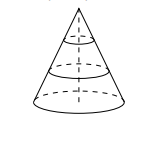
The cuts create cones similar to the whole cone with linear ratios $$\frac{1}{3}$$, $$\frac{2}{3}$$ and $$1$$, so the cumulative volumes from the vertex are in the ratio $$1^3 \colon 2^3 \colon 3^3 = 1 \colon 8 \colon 27$$. Subtracting successive cumulative volumes gives $$v_1 = 1$$, $$v_2 = 8 - 1 = 7$$ and $$v_3 = 27 - 8 = 19$$. Hence $$v_1 \colon v_2 \colon v_3 = 1 \colon 7 \colon 19$$.
In the adjoining figure, AOB is a diameter of the circle with center O. Point M is the mid-point of chord CD. $$\angle CDO = 32^\circ$$, $$\angle DBE = 35^\circ$$ and $$\angle BEO = x^\circ$$, then $$x =$$
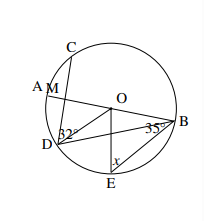
Since $$OC = OD$$, triangle OCD is isosceles, so $$\angle OCD = \angle ODC = 32^\circ$$ and $$\angle COD = 116^\circ$$. The mid-point M of chord CD lies on the diameter AB, so AB is perpendicular to CD and C, D are symmetric about AB, making arc AC and arc AD each $$58^\circ$$. The inscribed angle $$\angle DBE = 35^\circ$$ gives arc DE $$= 70^\circ$$, so arc EB $$= 180^\circ - 58^\circ - 70^\circ = 52^\circ$$, i.e. $$\angle EOB = 52^\circ$$. As $$OE = OB$$, $$x = \frac{180 - 52}{2} = 64$$.
During a wartime, a group of $$n$$ soldiers had enough food to last for 30 days. After 10 days, 50 more soldiers joined. If the food now can only last for 16 days, the value of $$n$$ is
After 10 days the remaining food would have fed the original $$n$$ soldiers for 20 more days, which is $$20n$$ soldier-days. With $$n + 50$$ soldiers it lasts 16 days, so $$20n = 16(n + 50)$$. This gives $$4n = 800$$ and $$n = 200$$.
Let $$\triangle ABC$$ be a right-angled triangle, $$\angle ABC = 90^\circ$$, $$AB = 5$$ cm, $$BC = 12$$ cm. Squares ABPD and BCEQ are drawn in the exterior of the $$\triangle ABC$$. DR is drawn perpendicular to line AC at R and ES is perpendicular to the line AC at S. Let $$DR = h_1$$ and $$ES = h_2$$, then $$\frac{h_1 + h_2}{AC} =$$
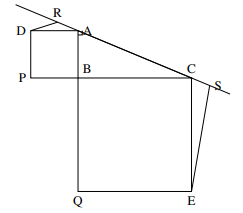
Take $$B = (0,0)$$, $$A = (0,5)$$, $$C = (12,0)$$, so $$AC = 13$$ and the line AC is $$5x + 12y - 60 = 0$$. The exterior squares put $$D = (-5,5)$$ and $$E = (12,-12)$$, so $$h_1 = \frac{|-25 + 60 - 60|}{13} = \frac{25}{13}$$ and $$h_2 = \frac{|60 - 144 - 60|}{13} = \frac{144}{13}$$. Their sum is $$\frac{169}{13} = 13$$, so $$\frac{h_1 + h_2}{AC} = \frac{13}{13} = 1$$.
If $$(\sqrt{2})^{\sqrt{x}} - (\sqrt{2})^{\sqrt{y}} = 48$$, where $$x$$ and $$y$$ are natural numbers, then the value of $$x + y$$ is
The equation is $$2^{\frac{\sqrt{x}}{2}} - 2^{\frac{\sqrt{y}}{2}} = 48$$, and writing $$48 = 2^4(2^2 - 1)$$ shows the only way to express 48 as a difference of two powers of 2 is $$2^6 - 2^4$$. Hence $$\frac{\sqrt{x}}{2} = 6$$ and $$\frac{\sqrt{y}}{2} = 4$$, giving $$\sqrt{x} = 12$$ and $$\sqrt{y} = 8$$, so $$x = 144$$ and $$y = 64$$. Therefore $$x + y = 208$$.
$$x$$ and $$y$$ are real numbers which satisfy $$x^2 + y^2 + 2x + 6y + 10 = 0$$. Then the numerical value of $$\frac{x + y}{x - y}$$ is
Completing squares gives $$(x + 1)^2 + (y + 3)^2 = 0$$, and a sum of two real squares vanishes only when each is zero. Hence $$x = -1$$ and $$y = -3$$. Then $$\frac{x + y}{x - y} = \frac{-4}{2} = -2$$.
If $$x = \frac{\sqrt{101} + 1}{2}$$, then find the value of $$(x^3 - 26x - 23)^5$$
From $$2x - 1 = \sqrt{101}$$ we get $$4x^2 - 4x + 1 = 101$$, so $$x^2 = x + 25$$. Then $$x^3 = x \cdot x^2 = x^2 + 25x = 26x + 25$$, so $$x^3 - 26x - 23 = 25 - 23 = 2$$. Therefore the required value is $$2^5 = 32$$.
In the adjoining figure, AOB is a diameter of the circle with center O. QR is a chord and the tangents to the circle at points Q and R include an angle of measure $$72^\circ$$. Chords BQ and AR intersect at P, then the measure of $$\angle RPB$$ is
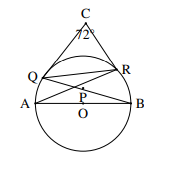
The radii to Q and R are perpendicular to the two tangents, so the angle between the tangents and the central angle are supplementary, giving $$\angle QOR = 180^\circ - 72^\circ = 108^\circ$$, so arc QR is $$108^\circ$$. Q and R lie on the semicircle from A to B, so arc AQ plus arc RB $$= 180^\circ - 108^\circ = 72^\circ$$. The angle between the two intersecting chords equals half the sum of the intercepted arcs, so $$\angle RPB = \frac{72^\circ}{2} = 36^\circ$$.
If the arithmetic mean of two numbers is 25 and their geometric mean is 24, then an equation with the given numbers as its roots, is
The arithmetic mean 25 gives a sum of $$50$$ and the geometric mean 24 gives a product of $$24^2 = 576$$. A quadratic with these roots is $$x^2 - (\text{sum})x + (\text{product}) = 0$$. Hence the equation is $$x^2 - 50x + 576 = 0$$.
The number of real values of $$x$$ satisfying the equation $$\frac{3x^2 - 21x}{x^2 - 7x} = x - 4$$ is
For $$x \neq 0$$ and $$x \neq 7$$ the left side simplifies as $$\frac{3x(x - 7)}{x(x - 7)} = 3$$, so the equation becomes $$3 = x - 4$$, giving $$x = 7$$. But $$x = 7$$ makes the original denominator zero, so it is not admissible. Hence there is no real solution.
The average marks obtained by Sunil in 6 subjects is 88. On subsequent verification, it was found that the marks obtained by him in a subject was wrongly copied as 86 instead of 68. The correct average marks obtained by him is $$(ab)_{10}$$, that is a two-digit number in base 10. Then $$a^2 + b^2 =$$
The recorded total is $$6 \times 88 = 528$$, and correcting the entry gives $$528 - 86 + 68 = 510$$. The correct average is $$\frac{510}{6} = 85$$, so $$a = 8$$ and $$b = 5$$. Hence $$a^2 + b^2 = 64 + 25 = 89$$.
The graph of $$x^2 + y^2 = 25$$ is plotted in a real $$xy$$-plane. The number of points $$(x, y)$$ on this graph such that both $$x$$ and $$y$$ are integers, is
The only ways to write 25 as a sum of two squares are $$25 = 0 + 25 = 9 + 16$$. From $$0 + 25$$ we get the four points $$(\pm 5, 0)$$ and $$(0, \pm 5)$$, and from $$9 + 16$$ we get the eight points $$(\pm 3, \pm 4)$$ and $$(\pm 4, \pm 3)$$. Altogether there are 12 lattice points.
If $$f(n + 1) = \frac{2f(n) + 1}{2}$$ for all natural numbers $$n$$ and $$f(1) = \frac{1}{2}$$, then $$-f(1) + f(2) - f(3) + f(4) - f(5) + \cdots - f(99) + f(100) =$$
The recurrence is $$f(n + 1) = f(n) + \frac{1}{2}$$ with $$f(1) = \frac{1}{2}$$, so $$f(n) = \frac{n}{2}$$. Grouping the sum in pairs, each pair contributes $$f(2k) - f(2k - 1) = \frac{1}{2}$$. There are 50 such pairs, so the total is $$50 \times \frac{1}{2} = 25$$.
In $$\triangle ABC$$, $$\angle ACB = 30^\circ$$, $$AB = 5$$ cm. Then the circumradius of $$\triangle ABC$$ is
By the extended sine rule, $$\frac{AB}{\sin C} = 2R$$ where R is the circumradius. Here $$\frac{5}{\sin 30^\circ} = \frac{5}{\frac{1}{2}} = 10 = 2R$$. Hence $$R = 5$$ cm.
If $$\frac{\sqrt{60} + \sqrt{95} + \sqrt{228} + 12}{\sqrt{5} + 2\sqrt{12} + \sqrt{19}} = \frac{\sqrt{a} + \sqrt{b}}{c}$$, where $$a, b$$ are square-free natural numbers and $$c$$ is a natural number, then the value of $$a + b + 7c =$$
Put $$p = \sqrt{5}$$, $$q = \sqrt{12}$$, $$r = \sqrt{19}$$, so the numerator is $$pq + pr + qr + q^2 = (p + q)(q + r)$$ and the denominator is $$(p + q) + (q + r)$$. The quotient is therefore $$\frac{1}{\frac{1}{p + q} + \frac{1}{q + r}}$$, and rationalising gives $$\frac{1}{p+q} + \frac{1}{q+r} = \frac{2\sqrt{3} - \sqrt{5}}{7} + \frac{\sqrt{19} - 2\sqrt{3}}{7} = \frac{\sqrt{19} - \sqrt{5}}{7}$$. Hence the expression equals $$\frac{7}{\sqrt{19} - \sqrt{5}} = \frac{\sqrt{19} + \sqrt{5}}{2}$$, so $$a = 19$$, $$b = 5$$, $$c = 2$$ and $$a + b + 7c = 38$$.
Let $$\frac{3x - 25}{x^2 - 5x + 6} = \frac{a}{x - 3} + \frac{b}{x - 2}$$ be an identity on $$x$$. Then the numerical value of $$b - a$$ is
Since $$x^2 - 5x + 6 = (x - 2)(x - 3)$$, clearing denominators gives $$3x - 25 = a(x - 2) + b(x - 3)$$. Putting $$x = 3$$ gives $$-16 = a$$, and putting $$x = 2$$ gives $$-19 = -b$$, so $$b = 19$$. Hence $$b - a = 19 + 16 = 35$$.
In the adjoining figure, ABC is a right-angled triangle. $$\angle ABC = 90^\circ$$, $$AB = 18$$ cm, $$BC = 24$$ cm. There are three squares drawn externally on the hypotenuse AC as shown, such that AC would be the sum of the side lengths of these squares. Area of two of these squares is $$225$$ $$\text{cm}^2$$ and $$64$$ $$\text{cm}^2$$ respectively, as indicated in the figure. Then the area of the shaded region = _______ $$cm^{2}$$
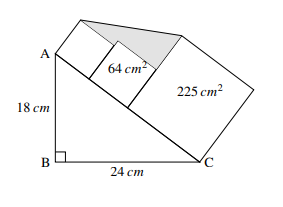
By Pythagoras, $$AC = \sqrt{18^2 + 24^2} = \sqrt{324 + 576} = 30$$ cm. The two known squares have sides $$\sqrt{225} = 15$$ cm and $$\sqrt{64} = 8$$ cm, and the three side lengths add up to AC, so the third square has side $$30 - 15 - 8 = 7$$ cm. Its area, the shaded region, is $$7^2 = 49$$ $$\text{cm}^2$$.
We say that a positive integer is arithmetically sequenced if its digits, in order, form an arithmetic sequence. Then the number of 4-digit positive integers which are arithmetically sequenced, is
Write the digits as $$a, a + d, a + 2d, a + 3d$$ with $$a \geq 1$$ and every digit between 0 and 9. For $$d = 0, 1, 2$$ the leading digit can take 9, 6 and 3 values respectively, and $$d \geq 3$$ is impossible. For $$d = -1, -2, -3$$ there are 7, 4 and 1 choices, and $$d \leq -4$$ is impossible. The total is $$9 + 6 + 3 + 7 + 4 + 1 = 30$$.
The smallest positive integer $$(abc)_{10}$$, in base 10, $$a, b, c$$ are digits, with $$500 > (abc)_{10} > 150$$ such that the number formed by all possible arrangements (for example $$(bac)_{10}$$, $$(cba)_{10}$$) of all the digits of $$(abc)_{10}$$, is prime, is
Every arrangement must be prime, so no digit may be even or equal to 5, leaving digits from $$\{1, 3, 7, 9\}$$. Testing the candidates between 150 and 500 in increasing order, numbers such as 173 and 179 fail because $$371 = 7 \times 53$$ and $$791 = 7 \times 113$$ are composite. The first number that survives is 199, since $$199$$, $$919$$ and $$991$$ are all prime.
Let circle-1 and circle-2 are orthogonal circles. The length of an arc measuring $$60^\circ$$ of circle-1 is equal to the length of an arc measuring $$45^\circ$$ of circle-2. Then the ratio of the area of square on the line-segment joining their centres to the area of square on the radius of circle-1, in its simplest form, is
[Note: Let two distinct circles are intersecting in different points. If their tangents at the point of intersection are perpendicular to each other, then the circles are said to be Orthogonal circles]
Equal arc lengths give $$\frac{60}{360} \times 2\pi r_1 = \frac{45}{360} \times 2\pi r_2$$, so $$r_2 = \frac{4}{3} r_1$$. For orthogonal circles the tangents at a common point are perpendicular, so the radii there are perpendicular and $$d^2 = r_1^2 + r_2^2 = r_1^2 + \frac{16}{9}r_1^2 = \frac{25}{9}r_1^2$$. The required ratio of the two squares is $$\frac{d^2}{r_1^2} = \frac{25}{9}$$, that is $$25 \colon 9$$, which is about $$2.78$$.
If $$m$$ and $$n$$ are the roots of the equation $$x^2 + 2mx + 5n = 0$$, $$m \neq 0$$, $$n \neq 0$$, then the sum of roots of this equation is
The sum of the roots gives $$m + n = -2m$$, so $$n = -3m$$, and the product gives $$mn = 5n$$, so $$m = 5$$ because $$n \neq 0$$. Then $$n = -15$$ and the sum of the roots is $$m + n = 5 - 15 = -10$$, which indeed equals $$-2m$$.
P is a point in the interior of an equilateral $$\triangle ABC$$. Line-segments PD, PE, PF are the perpendiculars drawn from P to the sides BC, CA, AB respectively with D lies on side BC, E lies on side CA and F lies on side AB. If $$PD = 6$$ cm, $$PE = 8$$ cm, $$PF = 10$$ cm, then area of the triangle ABC is _____ $$cm^2$$
By Viviani's theorem the three perpendicular distances add up to the altitude, so $$h = 6 + 8 + 10 = 24$$ cm. For an equilateral triangle of side $$a$$, $$h = \frac{\sqrt{3}}{2}a$$, so $$a = \frac{48}{\sqrt{3}} = 16\sqrt{3}$$ cm. The area is $$\frac{\sqrt{3}}{4}a^2 = \frac{\sqrt{3}}{4} \times 768 = 192\sqrt{3}$$ $$\text{cm}^2$$, which is about $$332.55$$ $$\text{cm}^2$$.
Let the product $$12 \times 15 \times 16 = 3146$$ in base $$b$$, where $$b$$ is a real number. Then the sum $$s = 12 + 15 + 16$$ in base $$b$$ is
In base $$b$$ the factors are $$b + 2$$, $$b + 5$$, $$b + 6$$ and the product is $$3b^3 + b^2 + 4b + 6$$, so $$b^3 + 13b^2 + 52b + 60 = 3b^3 + b^2 + 4b + 6$$. This reduces to $$b^3 - 6b^2 - 24b - 27 = 0$$, which is satisfied by $$b = 9$$. The sum is $$3b + 13 = 40$$ in decimal, and $$40 = 4 \times 9 + 4$$, so in base 9 the sum is written as 44.
If $$\frac{4^x}{2^{x+y}} = 8$$ and $$\frac{9^{x+y}}{3^y} = 243$$, then $$x^2 + xy + 7y^2 =$$
The first equation gives $$2^{2x - x - y} = 2^3$$, so $$x - y = 3$$, and the second gives $$3^{2x + 2y - y} = 3^5$$, so $$2x + y = 5$$. Adding, $$3x = 8$$, so $$x = \frac{8}{3}$$ and $$y = -\frac{1}{3}$$. Then $$x^2 + xy + 7y^2 = \frac{64}{9} - \frac{8}{9} + \frac{7}{9} = \frac{63}{9} = 7$$.
Let $$a_1, a_2, a_3, \ldots, a_n$$ be all natural numbers and also $$n \in \mathbb{N}$$ such that $$a_1 + a_2 + a_3 + \cdots + a_n = 1000$$. When $$a_1 \times a_2 \times a_3 \times \cdots \times a_n$$ would be maximum, then $$n =$$
To maximise a product with a fixed sum, the parts must be 2s and 3s, with as many 3s as possible, since $$3^2 > 2^3$$ for the same total 6 and a part of 4 or more can be split without loss. As $$1000 = 3 \times 332 + 4$$ and the leftover 4 is taken as $$2 + 2$$, the maximum product is $$3^{332} \times 2^2$$. This uses $$332 + 2 = 334$$ numbers.
If $$x = 2026$$ and $$y = \frac{1}{1013}$$, then the value of $$\left( \frac{x^2 + 1}{y}\right)\left(\frac{y^2 + 1}{x}\right) + \left( \frac{x^2 - 1}{y}\right)\left( \frac{y^2 - 1}{x}\right)$$ is
Using $$(A + B)(C + D) + (A - B)(C - D) = 2(AC + BD)$$ with $$A = x^2$$, $$B = \frac{1}{y}$$, $$C = y^2$$, $$D = \frac{1}{x}$$, the expression equals $$2\left(x^2y^2 + \frac{1}{xy}\right)$$. Here $$xy = 2026 \times \frac{1}{1013} = 2$$, so $$x^2y^2 = 4$$ and $$\frac{1}{xy} = \frac{1}{2}$$. The value is $$2\left(4 + \frac{1}{2}\right) = 9$$.
If $$\frac{1}{3^2 + 1} + \frac{1}{4^2 + 2} + \frac{1}{5^2 + 3} + \cdots = \frac{a}{b}$$, where $$a$$ and $$b$$ are coprime natural numbers, then $$a + b =$$
The general term is $$\frac{1}{n^2 + n - 2} = \frac{1}{(n - 1)(n + 2)} = \frac{1}{3}\left(\frac{1}{n - 1} - \frac{1}{n + 2}\right)$$ for $$n = 3, 4, 5, \ldots$$. The series telescopes, leaving $$\frac{1}{3}\left(\frac{1}{2} + \frac{1}{3} + \frac{1}{4}\right) = \frac{1}{3} \times \frac{13}{12} = \frac{13}{36}$$. Since 13 and 36 are coprime, $$a + b = 13 + 36 = 49$$.
$$n$$ is a natural number such that $$(n + 17)$$ and $$(n - 40)$$ both are perfect square numbers, then the square-root of greatest possible value of $$(n - 40)$$ is
Let $$n + 17 = p^2$$ and $$n - 40 = q^2$$, so $$p^2 - q^2 = 57$$ and $$(p - q)(p + q) = 57 = 3 \times 19$$. The factor pairs $$1$$ and $$57$$ give $$p = 29$$, $$q = 28$$, while $$3$$ and $$19$$ give $$p = 11$$, $$q = 8$$. The greatest value of $$n - 40$$ is $$28^2 = 784$$, whose square root is 28.
Predict your JEE Main percentile, rank & performance in seconds
Educational materials for JEE preparation