Sign in
Please select an account to continue using cracku.in
↓ →

Join Our JEE Preparation Group
Prep with like-minded aspirants; Get access to free daily tests and study material.
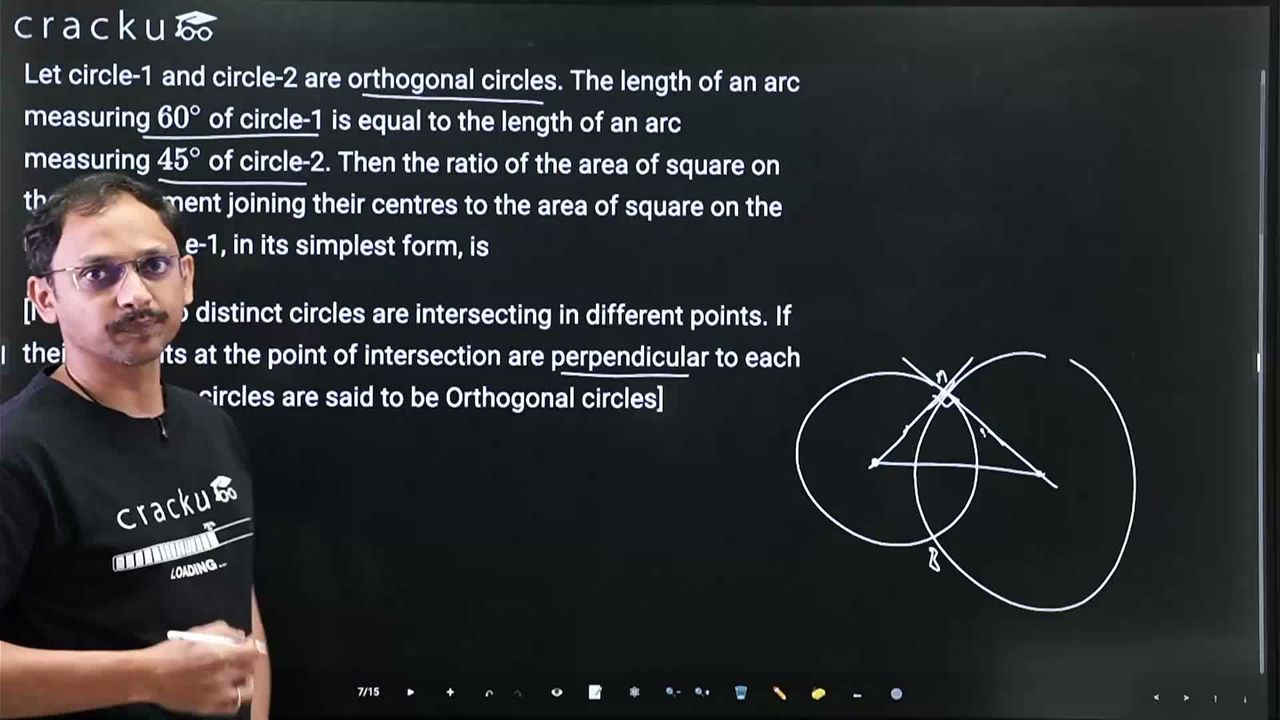
Let circle-1 and circle-2 are orthogonal circles. The length of an arc measuring $$60^\circ$$ of circle-1 is equal to the length of an arc measuring $$45^\circ$$ of circle-2. Then the ratio of the area of square on the line-segment joining their centres to the area of square on the radius of circle-1, in its simplest form, is
[Note: Let two distinct circles are intersecting in different points. If their tangents at the point of intersection are perpendicular to each other, then the circles are said to be Orthogonal circles]
Correct Answer: $$\large \frac{25}{9}$$
Equal arc lengths give $$\frac{60}{360} \times 2\pi r_1 = \frac{45}{360} \times 2\pi r_2$$, so $$r_2 = \frac{4}{3} r_1$$. For orthogonal circles the tangents at a common point are perpendicular, so the radii there are perpendicular and $$d^2 = r_1^2 + r_2^2 = r_1^2 + \frac{16}{9}r_1^2 = \frac{25}{9}r_1^2$$. The required ratio of the two squares is $$\frac{d^2}{r_1^2} = \frac{25}{9}$$, that is $$25 \colon 9$$, which is about $$2.78$$.
Was this solution helpful?
Click on the Email ☝️ to Watch the Video Solution
_1.webp)
Predict your JEE Main percentile, rank & performance in seconds

Educational materials for JEE preparation

Ask our AI anything

AI can make mistakes. Please verify important information.
AI can make mistakes. Please verify important information.
 91- 6303239042