Sign in
Please select an account to continue using cracku.in
↓ →

Join Our JEE Preparation Group
Prep with like-minded aspirants; Get access to free daily tests and study material.
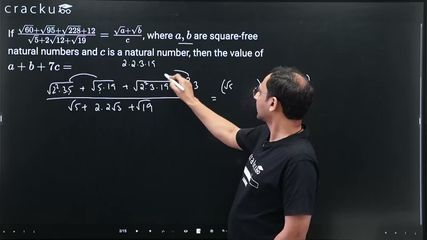
If $$\frac{\sqrt{60} + \sqrt{95} + \sqrt{228} + 12}{\sqrt{5} + 2\sqrt{12} + \sqrt{19}} = \frac{\sqrt{a} + \sqrt{b}}{c}$$, where $$a, b$$ are square-free natural numbers and $$c$$ is a natural number, then the value of $$a + b + 7c =$$
Correct Answer: 38
Put $$p = \sqrt{5}$$, $$q = \sqrt{12}$$, $$r = \sqrt{19}$$, so the numerator is $$pq + pr + qr + q^2 = (p + q)(q + r)$$ and the denominator is $$(p + q) + (q + r)$$. The quotient is therefore $$\frac{1}{\frac{1}{p + q} + \frac{1}{q + r}}$$, and rationalising gives $$\frac{1}{p+q} + \frac{1}{q+r} = \frac{2\sqrt{3} - \sqrt{5}}{7} + \frac{\sqrt{19} - 2\sqrt{3}}{7} = \frac{\sqrt{19} - \sqrt{5}}{7}$$. Hence the expression equals $$\frac{7}{\sqrt{19} - \sqrt{5}} = \frac{\sqrt{19} + \sqrt{5}}{2}$$, so $$a = 19$$, $$b = 5$$, $$c = 2$$ and $$a + b + 7c = 38$$.
Was this solution helpful?
Click on the Email ☝️ to Watch the Video Solution
_1.webp)
Predict your JEE Main percentile, rank & performance in seconds

Educational materials for JEE preparation

Ask our AI anything

AI can make mistakes. Please verify important information.
AI can make mistakes. Please verify important information.
 91- 6303239042