Keep the curiosity alive
1 Fill in the blanks:
(i) The solution used in a Voltaic cell is called ______.
Solution
A Voltaic cell converts chemical energy into electrical energy. It consists of two different metal plates (electrodes) dipped in a conducting liquid. This conducting liquid is usually a dilute acid, base or salt solution that allows ions to move between the electrodes, thereby completing the circuit inside the cell.
Such a conducting solution which participates in the chemical reactions of the cell is called an electrolyte. In the original Voltaic cell, dilute sulphuric acid $$(\mathrm{H_2SO_4})$$ is used as the electrolyte between the copper and zinc plates.
Answer
(ii) A current carrying coil behaves like a ______ .
Solution
When electric current flows through a straight wire, a magnetic field is produced around the wire. If the wire is wound into a coil (many circular loops kept close together), the magnetic fields due to each loop add up in the same direction along the axis of the coil.
As a result the coil produces a strong, uniform magnetic field very similar to that produced by a bar magnet, having a North pole at one end and a South pole at the other. This is exactly why a small compass needle brought near such a coil deflects, and why an iron nail placed inside the coil becomes a temporary magnet (an electromagnet).
Therefore, a current-carrying coil behaves like a magnet (bar magnet).
Answer
2 Choose the correct option:
(i) Dry cells are less portable compared to Voltaic cells. (True/False)
Solution
A Voltaic cell has two metal plates dipped in a liquid electrolyte (usually dilute sulphuric acid). Because the electrolyte is a liquid, the cell must be kept upright in an open container; if it is tilted the liquid spills and if it is shaken the acid can splash. So a Voltaic cell cannot easily be carried from place to place.
A dry cell, on the other hand, uses a moist paste of chemicals sealed inside a metal or plastic case. There is no liquid to spill, the cell can be held in any position, and it is small and light. This is why dry cells are used in torches, remote controls, clocks and toys.
Hence dry cells are actually more portable than Voltaic cells, so the given statement is False.
Answer
(ii) A coil becomes an electromagnet only when electric current flows through it. (True/False)
Solution
An electromagnet is a coil of insulated wire, usually wound over a soft iron core. It behaves as a magnet only as long as an electric current is passing through the coil. The moment the current is switched off, the magnetic field around the coil disappears and the iron core loses its magnetism almost completely. This ability to be switched ON and OFF is exactly what distinguishes an electromagnet from an ordinary bar magnet.
So the statement is True.
Answer
(iii) An electromagnet, using a single cell, attracts more iron paper clips than the same electromagnet with a battery of 2 cells. (True/False)
Solution
The strength of an electromagnet increases when the electric current passing through its coil increases. When two cells are connected in series (a battery of 2 cells), their voltages add up and drive a larger current through the same coil than a single cell would. A larger current produces a stronger magnetic field around the coil and inside the iron core.
Therefore the electromagnet powered by a 2-cell battery is stronger and picks up more paper clips than the same electromagnet powered by only one cell. The statement in the question claims the opposite, so it is False.
Answer
3
An electric current flows through a nichrome wire for a short time.
(i) The wire becomes warm.
(ii) A magnetic compass placed below the wire is deflected.
Choose the correct option:
- (a) Only (i) is correct
- (b) Only (ii) is correct
- (c) Both (i) and (ii) are correct
- (d) Both (i) and (ii) are not correct
Solution
Whenever electric current flows through any conductor, two effects are produced at the same time:
- Heating effect: The electrical energy is partly converted into heat because of the resistance of the wire. Nichrome has a much higher resistance than copper, so it becomes noticeably warm quite quickly. Hence statement (i) is correct.
- Magnetic effect: The current in the wire sets up a magnetic field around it. A compass needle placed below (or above) the wire is a tiny magnet, and it aligns itself with this field, so it gets deflected from its usual North–South position. Hence statement (ii) is also correct.
Both effects appear at the same time and do not depend on the material being nichrome (the magnetic effect is produced by any current-carrying conductor). So the correct option is (c) Both (i) and (ii) are correct.
Answer
4
Match the items in Column A with those in Column B.
| Column A | Column B |
|---|---|
| (i) Voltaic cell | (a) Best suited for electric heater |
| (ii) Electric iron | (b) Works on magnetic effect of electric current |
| (iii) Nichrome wire | (c) Works on heating effect of electric current |
| (iv) Electromagnet | (d) Generates electricity by chemical reactions |
Solution
We match each item with the correct description in Column B:
- (i) Voltaic cell → (d) Generates electricity by chemical reactions. A Voltaic cell has copper and zinc plates in dilute sulphuric acid; a chemical reaction inside the cell separates charges and drives a current in the external circuit.
- (ii) Electric iron → (c) Works on heating effect of electric current. The current passes through a high-resistance heating element inside the electric iron; the element gets very hot and the heat is transferred to the base of the iron.
- (iii) Nichrome wire → (a) Best suited for electric heater. Nichrome has a high resistance and does not melt or oxidise easily even at high temperatures, so it produces plenty of heat safely and is used as the heating element in heaters, toasters, irons, geysers, etc.
- (iv) Electromagnet → (b) Works on magnetic effect of electric current. Current flowing in a coil around a soft-iron core produces a magnetic field which magnetises the core. The core loses its magnetism when the current is switched off — a direct application of the magnetic effect of current.
Answer
| Column A | Column B |
|---|---|
| (i) Voltaic cell | (d) Generates electricity by chemical reactions |
| (ii) Electric iron | (c) Works on heating effect of electric current |
| (iii) Nichrome wire | (a) Best suited for electric heater |
| (iv) Electromagnet | (b) Works on magnetic effect of electric current |
5
Nichrome wire is commonly used in electrical heating devices because it
- (i) is a good conductor of electricity.
- (ii) generates more heat for a given current.
- (iii) is cheaper than copper.
- (iv) is an insulator of electricity.
Solution
Let us look at each option:
- (i) is a good conductor of electricity — copper and aluminium are much better conductors than nichrome, so this is not the special reason for using nichrome.
- (ii) generates more heat for a given current — this is correct. Nichrome is an alloy that has high resistance and a very high melting point $$(\approx 1400^{\circ}\mathrm{C})$$, and it does not get spoiled by heat or air. So when the same current is sent through it, it opposes the current strongly and gives out much more heat than an ordinary wire, without melting.
- (iii) is cheaper than copper — nichrome is actually more expensive than copper; cost is not the reason.
- (iv) is an insulator of electricity — this is wrong. If nichrome were an insulator, no current would pass through it at all and no heat would be produced.
Hence the correct reason is (ii).
Answer
6 Electric heating devices (like an electric heater or a stove) are often considered more convenient than traditional heating methods (like burning firewood or charcoal). Give reason(s) to support this statement considering societal impact.
Solution
Electric heating devices convert electrical energy directly into heat with the help of a high-resistance element (like nichrome). Compared to burning firewood, cow-dung cakes or charcoal, this gives several advantages that matter to society:
- Clean and pollution-free indoors: Burning firewood or charcoal releases smoke, soot and harmful gases such as carbon monoxide, which cause coughing, eye irritation and serious lung diseases — especially for the women and children who spend long hours in the kitchen. An electric heater or stove produces no smoke inside the house, so indoor air stays clean.
- Protects forests and the environment: Firewood and charcoal are obtained by cutting trees. Their large-scale use leads to deforestation, soil erosion and increase of carbon-dioxide in the atmosphere. Electric heating does not need trees to be cut, so it helps in conserving forests.
- Easy and quick to use: Just switching on a plug gives instant heat, whereas firewood must be collected, dried, kindled and constantly fed. This saves a lot of time and labour, particularly for women and children who traditionally do this work.
- Controllable and safer: The temperature can be increased or decreased with a knob, and the heater can be switched off in a moment. There are no open flames and no burning embers, so the danger of accidental fires and burns is much less.
- No storage of fuel and no ash to clean: There is no need to store bundles of firewood or bags of charcoal; there is also no ash, smoke stains or soot to clean up.
Because of all these reasons, electric heating devices are cleaner, healthier, safer and more time-saving for society than traditional heating methods.
Answer
7

(i) Draw an arrow on the diagram to show the path of the electric current.
Solution
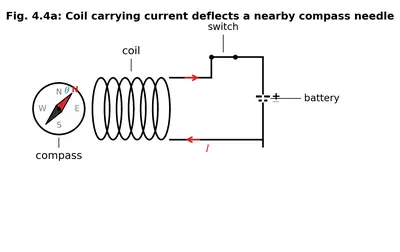
By convention, electric current in a circuit is taken to flow from the positive (+) terminal of the cell, through the external wire and the coil, and back into the negative (−) terminal of the cell. So on the diagram of Fig. 4.4a, arrows should be marked on the connecting wires starting from the + terminal of the battery, going through the switch, then round the coil in the same sense throughout, and finally returning to the − terminal of the battery. All the arrows on the wire must point the same way as one goes round the circuit — the current follows a single closed loop.
Answer
(ii) Explain why the compass needle moves when current flows.
Solution
A compass needle is nothing but a tiny, light bar magnet balanced on a pointed pivot. When there is no current in the coil, the only magnetic influence on the needle is that of the Earth, so it settles down in the North–South direction.
As soon as the switch is closed, an electric current flows through the coil. This current-carrying coil produces its own magnetic field around it — this is called the magnetic effect of electric current. Near the coil, the magnetic field of the coil is much stronger than the Earth's magnetic field. The tiny magnet inside the compass tries to line up with this new, stronger magnetic field. In doing so, it turns away from its original North–South direction, and we say the needle has been deflected.
The moment the current is switched off, the coil's magnetic field disappears, and the needle again lines up with the Earth's field in the North–South direction.
Answer
(iii) Predict what would happen to the deflection if you reverse the battery terminals.
Solution
The direction of the magnetic field produced by a current depends on the direction in which the current is flowing. When we interchange the two terminals of the battery, the current in the coil starts flowing in the opposite direction. Because of this, the North and South poles produced by the coil also get interchanged, and the whole magnetic field around the coil is reversed.
The compass needle, which was earlier pulled to (say) one side, now feels a magnetic field in the opposite direction near it, so it swings to the other side. The size of the deflection remains the same as before (because the strength of the current has not changed), but its direction is reversed. If the needle earlier deflected towards the east, it will now deflect towards the west by roughly the same angle.
Answer
8 Suppose Sumana forgets to move the switch of her lifting electromagnet model to OFF position (in introduction story). After some time, the iron nail no longer picks up the iron paper clips, but the wire wrapped around the iron nail is still warm. Why did the lifting electromagnet stop lifting the clips? Give possible reasons.
Solution
Two things need to be explained here: (a) the wire is still warm — this means some current is still flowing in the coil, so the circuit itself is not broken; (b) even so, the electromagnet is no longer able to lift the paper clips. The strength of an electromagnet depends on the amount of current flowing through the coil, so we need to look at reasons that reduce the current or the magnetic pull.
Because the switch was left ON for a long time, the following things are likely to have happened:
- The cells have run down. The chemicals inside the dry cells slowly get used up when a current is drawn continuously. As the cells become weak, the voltage they can provide falls. A smaller voltage drives a smaller current through the coil, and a smaller current produces a much weaker magnetic field. A small amount of current is still enough to keep the wire slightly warm (heating effect), but not enough to hold up the paper clips against gravity.
- The coil has become hot and its resistance has increased. The continuous flow of current warms the coil (heating effect). Warm metal wires have a higher resistance, so even less current flows for the same voltage — again weakening the magnetic effect.
- The insulation of the wire may have got damaged. If the coil becomes very hot, the thin coating on the wire can melt in places. Two neighbouring turns then touch each other and the current short-circuits across them, effectively reducing the number of active turns in the coil. Fewer turns → weaker electromagnet.
All these effects reduce the current (or the effective number of turns) enough for the electromagnet to lose its lifting power, while a small current continues to flow and keep the wire warm.
Answer
9
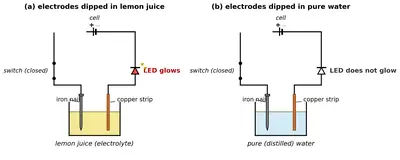
(a) A circuit with an iron nail and a copper strip dipped in lemon juice, connected to an LED and a switch.
(b) A circuit with an iron nail and a copper strip dipped in pure water, connected to an LED and a switch.

Solution
In both arrangements, the iron nail and copper strip act as two different metal electrodes. Whether or not the arrangement works like a simple Voltaic cell — that is, whether an electric current flows through the LED and lights it up — depends on the liquid in which the electrodes are dipped. The liquid must be a good electrolyte: it must contain many free ions that can carry charges between the electrodes.
(a) Lemon juice: Lemon juice contains citric acid, which readily splits up into positive and negative ions in water. These ions move between the copper and iron electrodes, so the combination behaves like a Voltaic cell. A small electric current flows in the circuit, and the LED glows (usually dimly, but it does glow).
(b) Pure water: Pure (distilled) water has almost no dissolved salts or acids. It contains extremely few ions and is a very poor conductor of electricity. The two electrodes cannot set up any appreciable current through such a liquid, so no significant current flows in the circuit and the LED does not glow.
Hence the LED will glow only in case (a).
Answer
10 Neha keeps the coil exactly the same as in Activity 4.4 but slides the iron nail out, leaving only the coiled wire. Will the coil still deflect the compass? If yes, will the deflection be more or less than before?
Solution
Any current-carrying wire, whether it is straight, bent or wound into a coil, produces a magnetic field around it. So even without the iron nail inside, the coil will continue to produce a magnetic field the moment current is switched on, and this field will still deflect the nearby compass needle. Hence yes, the compass will still show a deflection.
However, when the iron nail was present inside the coil, the nail got magnetised by the coil's field and itself became a strong temporary magnet. So the combined magnetic field (coil + magnetised iron nail) was much stronger than the field due to the coil alone. In fact, the iron core can multiply the magnetic effect several times.
When the nail is pulled out, only the coil's own (much weaker) magnetic field acts on the compass. So the needle will still deflect, but by a smaller angle than before.
Answer
11
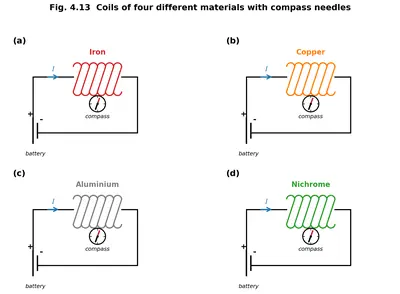
We have four coils, of similar shape and size, made up from iron, copper, aluminium, and nichrome as shown in Fig. 4.13. When current is passed through the coils, compass needles placed near the coils will show deflection.
- (i) Only in circuit (a)
- (ii) Only in circuits (a) and (b)
- (iii) Only in circuits (a), (b), and (c)
- (iv) In all four circuits

Solution
The magnetic effect of an electric current is a general property — a magnetic field is produced around any wire that is carrying an electric current, no matter what metal the wire is made of. Iron, copper, aluminium and nichrome are all conductors, so a current can flow through each of them, and each will therefore set up a magnetic field around itself.
Because all four coils have the same shape and the same size, and the same current is being passed through them, the field near each coil will be strong enough to deflect the nearby compass needle. The strength of the deflection may vary a little from coil to coil (nichrome, for example, has a higher resistance so the current in it will be somewhat smaller than in copper or aluminium for the same voltage), but a deflection will be observed in every case.
(Note: this question is about the deflection of a compass, i.e. the magnetic effect. It is not asking whether the coil itself gets magnetised. Even though iron is the only material among these that can be permanently magnetised, that has nothing to do with the compass being deflected.)
Hence the correct option is (iv) In all four circuits.
Answer