 91- 6303239042


Intext Questions
1 How does heat get transferred in these materials?
Solution
Step 1 – Identify each kind of material
In everyday life we mainly handle three physical states of matter:
- Solids (for example, a metal rod, an iron spoon).
- Liquids (for example, water, milk, oil).
- Gases (for example, the air around us, the gas inside a balloon).
Step 2 – Recall the three mechanisms of heat transfer
- Conduction – transfer of heat from the hotter part of a body to the colder part through successive molecular collisions without actual movement of the material as a whole.
- Convection – transfer of heat by actual movement of the material (bulk motion of fluid).
- Radiation – transfer of heat in the form of electromagnetic waves; no medium is required.
Step 3 – Match each material with the appropriate mechanism
| Material (state) | Main way in which heat travels | Reason (Class 7 level) |
|---|---|---|
| Solid (e.g. metal rod) | Conduction | Molecules are tightly packed; they vibrate and pass on energy to neighbouring molecules. |
| Liquid (e.g. water) | Convection | Heated liquid becomes lighter (less dense), rises; cooler, heavier liquid sinks, setting up convection currents. |
| Gas (e.g. air) | Convection | Like liquids, gases flow; warm air rises and cool air takes its place, forming convection currents. |
| Vacuum or transparent medium (space between Sun and Earth) | Radiation | There is no material medium; heat reaches us as infrared radiation. |
Step 4 – State the summary
Hence, heat is transferred mainly by conduction in solids, by convection in liquids and gases, and by radiation through empty space (and also through any medium that allows radiant energy to pass).
Answer
In solids heat travels by conduction; in liquids and gases it travels by convection; through a vacuum (or when no medium is required) it travels by radiation.
2 Why is the smoke going up?
Solution
Goal Explain, step by step, why the column of smoke produced by a candle, match-stick or chulha always moves upward through the air.
Step 1 – Heating the air
The flame heats the surrounding air and the tiny soot particles mixed in it. Because of this heating, the temperature of that parcel of air rises from the room value (say $$T_1$$) to a higher value (say $$T_2$$).
Step 2 – Thermal expansion of a gas
For a gas at nearly constant pressure (atmospheric pressure), a rise in temperature makes it expand. The same mass $$m$$ of air now occupies a larger volume $$V_2$$ instead of its original volume $$V_1$$.
Step 3 – Density falls
Density is defined as $$\rho = \dfrac{m}{V}$$. Because $$V_2 > V_1$$ while the mass stays the same, the density of the hot, smoky air becomes
$$\rho_\text{hot} = \dfrac{m}{V_2} < \rho_\text{cold} = \dfrac{m}{V_1}.$$
Step 4 – Buoyant force becomes larger than weight
Every volume $$V$$ of the smoke experiences an upward buoyant (Archimedes) force equal to the weight of the cooler air it displaces:
$$F_b = \rho_\text{cold}\,V g.$$
The actual weight of the same volume of hot, smoky air is
$$W = \rho_\text{hot}\,V g.$$
Since $$\rho_\text{cold} > \rho_\text{hot}$$, we get
$$F_b - W = (\rho_\text{cold} - \rho_\text{hot}) V g > 0,$$
which means a net upward force acts on the smoke.
Step 5 – Convection current
The net upward force accelerates the hot air; it rises, and cooler room air rushes in below to replace it. This circulating motion of air created by temperature (and hence density) differences is called convection.
Conclusion
Because the smoke is carried by hot air whose density is lower than that of the surrounding cooler air, the buoyant force on it exceeds its weight, so it moves upward.
Answer
The smoke rises because it is mixed with hot air. Heating makes that air expand, lowering its density; the surrounding cooler, denser air then exerts a greater buoyant force than the smoke’s own weight, so a net upward force pushes the smoke up in a convection current.
3 How does heat transfer take place in liquids? Do liquids also rise up when heated like air?
Solution
Step 1 : Recall the three ways in which heat can move
Heat can travel by conduction, convection or radiation. In fluids (liquids and gases) the chief mode is convection.
Step 2 : What triggers convection in a liquid?
Consider a beaker of water kept on a burner. The flame first heats the layer of water that is just above the bottom of the beaker.
• When that layer is heated, its temperature $$T$$ rises.
• Almost all substances expand on heating, so the volume $$V$$ of that portion of water increases.
• Because mass $$m$$ remains the same, its density $$\rho$$ becomes
$$\rho = \frac{m}{V}$$
Since $$V$$ has increased, $$\rho$$ decreases; the hot water is now lighter (less dense) than the surrounding cold water.
Step 3 : Why does the lighter liquid rise?
A fluid element that is lighter than the fluid around it experiences a net upward force called buoyant force or up-thrust. Hence the hot, light liquid moves upward.
Step 4 : How is the space refilled?
The region that has just been vacated near the bottom is now filled by cooler, heavier liquid from the sides. This cooler liquid reaches the flame, gets heated and rises, while fresh cool liquid again moves down. Thus a continuous convection current is set up inside the beaker.
Step 5 : Do liquids rise up on heating in the same way as air?
- Yes. The basic mechanism—expansion on heating → decrease in density → upward movement under buoyancy—is common to both gases and liquids.
- However, liquids are far denser than gases, and their coefficient of expansion is smaller. Therefore their rise is slower and less pronounced than that of air, but the principle is exactly the same.
Conclusion
Heat is transmitted in liquids mainly by convection. The parts of the liquid that get heated become lighter and rise up, while the cooler, heavier parts sink, setting up a convection current—just as happens in air.
Answer
Heat travels through liquids chiefly by convection. The layer that becomes hot expands, its density falls, so it is pushed upward by buoyancy; cooler, denser liquid moves down to take its place. Thus liquid does rise on heating, exactly like air, though the effect is slower because liquids expand less than gases.
4 I wonder how heat from the fire reaches us?
Solution
Step 1 ‒ Recall the three ways by which heat energy can travel
- Conduction — transfer of heat through a substance by molecular collisions. It needs the substance itself to be in contact from the hot end to the cold end.
- Convection — transfer of heat by actual movement of the fluid (liquid or gas) itself. Warm, less-dense portions rise and cool, denser portions sink, setting up a convection current.
- Radiation — transfer of heat in the form of electromagnetic waves. It can travel through vacuum and therefore does not need any medium.
Step 2 ‒ Check each mode for a camp-fire situation
- Conduction? The air between the fire and our body is a poor conductor. Moreover, we are not touching the flames, so almost no heat reaches us by conduction.
- Convection? Hot air produced by the fire indeed rises. Unless we stand exactly above the fire, that rising column of hot air does not flow sideways to us, so convection contributes very little when we stand in front of the fire.
- Radiation? The burning wood and glowing charcoal are at a high temperature $$T_{\text{fire}}\!\gt\!T_{\text{body}}$$. All hot objects emit electromagnetic waves, mainly infrared. These waves travel in straight lines at the speed of light and
reach our skin even through the surrounding air. When our skin absorbs the waves, the energy is converted back into internal energy, so the skin’s temperature rises and we feel warmth.
Step 3 ‒ State the dominant mechanism
Therefore, the heat we feel while sitting in front of a fire is predominantly carried by radiation; only a small amount is carried by convection if some hot air drifts toward us. No significant conduction is involved.
Answer
Mostly by radiation: the fire emits infrared waves that travel through air and warm our skin; convection and conduction play almost no direct role for someone sitting beside a fire.
5 Why is it more comfortable to wear white or light-coloured clothes during summers and dark-coloured clothes during winters?
Solution
Step 1 : Recall how heat reaches us from the Sun
The Sun is far away, so heat cannot come by conduction or convection; it comes mainly by radiation. Radiant heat travels as electromagnetic waves that can be absorbed, reflected or transmitted by any object that receives them.
Step 2 : Define the optical properties of a surface
For any surface the fractions of the incident radiant energy add up to 1:
$$a + r + t = 1$$
where
$$a$$ = absorptivity (fraction absorbed),
$$r$$ = reflectivity (fraction reflected),
$$t$$ = transmissivity (fraction transmitted).
For an opaque cloth, $$t \approx 0$$, so the relation reduces to
$$a + r = 1$$
Step 3 : Compare light-coloured and dark-coloured cloth
- White or light colours: These surfaces reflect most of the incident radiation, so $$r \rightarrow 1$$ and therefore $$a \rightarrow 0$$.
- Black or dark colours: These act almost like a “black body”; they absorb most of the incident radiation, so $$a \rightarrow 1$$ and $$r \rightarrow 0$$.
Step 4 : Link absorption to rise in temperature
The energy actually absorbed per unit area per second is
$$Q = a \, E_{\text{in}}$$
where $$E_{\text{in}}$$ is the solar energy falling on the cloth. The larger the value of $$a$$, the more heat the cloth (and hence our body) gains, and the hotter we feel.
Step 5 : Apply the reasoning to seasons
- Summer
Outdoor temperature is already high; we wish to minimise extra heating. Choosing light-coloured or white clothes keeps $$a$$ small, so very little solar heat is absorbed. Most radiation is reflected, keeping the body cooler and therefore more comfortable. - Winter
When the weather is cold we want to gain or retain heat. Dark clothes have a high $$a$$, so they absorb more of the Sun’s radiation during the day and even the thermal radiation present indoors. This extra absorbed energy warms the cloth and the thin layer of air trapped near the skin, helping us feel warmer.
Step 6 : Summarise the argument
Comfort depends on how much radiant heat the cloth absorbs. Light colours reflect and so keep us cool in summer; dark colours absorb and so keep us warm in winter.
Answer
White or light-coloured clothes reflect most of the Sun’s radiant heat and absorb very little, so they keep the body cooler in summer. Dark-coloured clothes absorb a large fraction of the incident radiation and therefore gain more heat, helping the body stay warm in winter.
6 How does water seep through the surface of the Earth?
Solution
Step 1 : Rainwater falls on the land
When it rains, the entire volume of water that reaches the ground cannot stay on the surface. A part of it immediately begins to move downward under the pull of gravity.
Step 2 : Finding spaces between soil particles
Soil is never a continuous solid block. It is made up of tiny mineral grains, decayed plant material (humus) and air pockets. The empty spaces between these particles are called pores.
Step 3 : Infiltration — soaking into the upper soil
Rainwater slowly slips into these pores. The slow entry of water from the surface into the upper layer of soil is called infiltration.
Step 4 : Percolation — deeper downward movement
After the topsoil becomes moist, water continues to travel further down through successive layers of soil, sand, gravel and cracked rock. This deeper, relatively faster movement is called percolation.
Step 5 : Collection above an impermeable layer (water table)
Eventually the downward-moving water meets a hard, non-porous rock layer that it cannot pass through. Water begins to fill all the pores just above this layer, forming an underground store known as groundwater. The upper surface of this saturated zone is the water table.
Thus, rainwater seeps through the Earth first by infiltration into the pore spaces of the soil and then by percolation to deeper layers until it is stored as groundwater.
Answer
By infiltration and percolation — rainwater first soaks into the pores of surface soil and then continues to move downward through the layers of earth until it collects as groundwater above an impermeable rock layer.
Let Us Enhance Our Learning
1
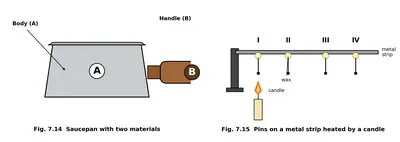
(i)
Your father bought a saucepan made of two different materials, A and B, as shown in Fig. 7.14. The materials A and B have the following properties—
- (a) Both A and B are good conductors of heat
- (b) Both A and B are poor conductors of heat
- (c) A is a good conductor and B is a poor conductor of heat
- (d) A is a poor conductor and B is a good conductor of heat
Solution
The saucepan in Fig. 7.14 has two distinguishable parts:
- Part A – the main body or base that has to receive heat from the stove and pass it quickly to the food.
- Part B – the handle that we hold with our hand.
For safe use, the handle must not become very hot.
Therefore the two parts must have opposite thermal properties:
- The body/base (A) must be a good conductor of heat so that cooking is fast.
- The handle (B) must be a poor conductor (insulator) so that very little heat reaches our hand.
This matches option (c): A is a good conductor and B is a poor conductor of heat.
Answer
(c)
(ii)
Pins are stuck to a metal strip with wax and a burning candle is kept below the rod, as shown in Fig. 7.15. Which of the following will happen?
- (a) All the pins will fall almost at the same time
- (b) Pins I and II will fall earlier than pins III and IV
- (c) Pins I and II will fall later than pins III and IV
- (d) Pins II and III will fall almost at the same time
Solution
The metal strip is heated from the left end (below pin I). Heat travels along the strip by conduction.
Conduction always carries thermal energy from the hotter region to the colder region. Hence the portion near the flame becomes hot first, so the wax holding pin I melts earliest, followed successively by pins II, III and finally IV.
Thus pins I and II (nearest the flame) will fall earlier than pins III and IV.
This agrees with option (b).
Answer
(b)
(iii)
A smoke detector is a device that detects smoke and sounds an alarm. Suppose you are fitting a smoke detector in your room. The most suitable place for this device will be:
- (a) Near the floor
- (b) In the middle of a wall
- (c) On the ceiling
- (d) Anywhere in the room
Solution
Smoke consists of hot air mixed with tiny carbon particles. Hot air is less dense than cold air, so it rises upward in the room by convection.
The highest point inside a closed room is the ceiling. A smoke detector should therefore be fitted on the ceiling so that the rising smoke reaches it first and the alarm sounds quickly.
Hence option (c) is most suitable.
Answer
(c)
2 A shopkeeper serves you cold lassi in a tumbler. By chance, the tumbler had a small leak. You were given another tumbler by the shopkeeper to put the leaky tumbler in it. Will this arrangement help to keep the lassi cold for a longer time? Explain.
Solution
Given
- A tumbler holding cold lassi has a small leak.
- The leaky tumbler is placed inside a second tumbler.
We have to decide whether this double-tumbler arrangement keeps the lassi cold for a longer time.
Step 1 – Why does the lassi become warm at all?
The surrounding air is warmer than the cold lassi. Heat always flows from a hotter region to a colder region, so heat passes from the warm air through the wall of the tumbler into the lassi, mainly by conduction.
Step 2 – A single tumbler conducts heat fairly quickly
A tumbler is usually made of metal, glass or thick plastic. These materials let heat pass through their walls fast enough, so the lassi begins to warm up after a short time.
Step 3 – What does the second tumbler add?
When the leaky tumbler is placed inside another tumbler, a thin layer of air is trapped between the two walls. Heat from the outside must now travel along the path:
outside air → wall of outer tumbler → trapped air → wall of inner tumbler → lassi
Step 4 – Air is a very poor conductor of heat
As we have learnt in this chapter, still air is one of the poorest conductors of heat – that is why hollow bricks, woollen clothes and double-walled flasks all work as insulators. The trapped air between the two tumblers therefore blocks most of the heat from reaching the inner tumbler.
Step 5 – Convection in the trapped air is also small
The gap between the two tumblers is narrow, so the air inside it cannot circulate freely. With very little movement of air, almost no heat is carried by convection either.
Step 6 – Effect on the lassi
Since much less heat enters per second than before, the lassi warms up much more slowly. In other words, it stays cold for a longer time.
Conclusion
Yes, the arrangement helps. The layer of still air trapped between the two tumblers is a very poor conductor of heat and acts as an insulator, so heat from the warm surroundings reaches the cold lassi very slowly and the drink remains cold for a longer time.
Answer
Yes. Putting the leaky tumbler inside another tumbler traps a thin layer of still air between the two walls. Air is a very poor conductor of heat, and the narrow gap also prevents convection. So heat from the warm surroundings now flows into the lassi much more slowly than through a single tumbler, and the lassi stays cold for a longer time.
3 State with reason(s) whether the following statements are True [T] or False [F].
(i) Heat transfer takes place in solids through convection.
Solution
Heat can be transferred in three ways – conduction, convection and radiation.
Convection needs the bulk, macroscopic motion of material. In a solid the atoms or molecules are held in fixed positions; they can only vibrate about their mean positions, so bulk motion is impossible. Consequently the only important mode of heat flow in solids is conduction, in which neighbouring particles pass on their vibrational energy.
Because the condition required for convection (actual movement of particles) cannot be met in a solid, no heat transfer by convection can occur there.
Therefore the statement is False.
Answer
False – in solids heat is transferred by conduction, not convection.
(ii) Heat transfer through convection takes place by the actual movement of particles.
Solution
When part of a fluid (liquid or gas) is heated it expands, becomes less dense and rises; the surrounding cooler, denser fluid sinks to take its place. These rising and sinking columns set up a circulation current that carries thermal energy with the actual moving fluid particles. Hence, by definition, convection involves the physical movement of the medium’s particles.
Thus the statement is True.
Answer
True – convection transfers heat through the bulk movement of the fluid particles themselves.
(iii) Areas with clay materials allow more seepage of water than those with sandy materials.
Solution
Sandy soil is made of relatively large, loosely packed grains. The large pores between the grains allow water to percolate quickly, so sandy areas show high seepage.
Clay consists of extremely fine particles that pack very tightly, leaving only minute pores. These tiny pores greatly resist the passage of water, giving clayey soil low permeability.
Hence clayey areas actually allow less seeping of water than sandy areas, so the statement is False.
Answer
False – sandy soil allows more seepage, clayey soil much less.
(iv) The movement of cooler air from land to sea is called land breeze.
Solution
At night land cools faster than the adjacent sea. Air above the land therefore becomes cooler and denser than the air above the sea. The cooler, heavier air moves horizontally from the land towards the sea; simultaneously the relatively warmer sea air rises. This flow of cool air from the land to the sea is called a land breeze.
So the description given in the statement matches the definition of a land breeze, making it True.
Answer
True – land breeze is the flow of cooler air from land towards sea.
4 Some ice cubes placed in a dish melt into water after sometime. Where do the ice cubes get heat for this transformation?
Solution
Step 1 – Identify what has to happen for ice to melt
To change solid ice at its melting point ( $$0\,{}^{\circ}\text{C}$$ ) into liquid water at the same temperature, a certain fixed amount of heat, called its latent heat of fusion, must be supplied to the ice. The ice itself cannot supply this heat because it is the colder body.
Step 2 – Recall the direction of heat flow
Heat always flows spontaneously from a hotter region to a colder region until thermal equilibrium is reached. In an ordinary room the air, the dish, the table and even our hands are all at a temperature higher than $$0\,{}^{\circ}\text{C}$$; therefore they act as sources of heat for the ice.
Step 3 – Path of heat transfer
- Conduction: The dish (in direct contact with the ice) conducts heat into the ice.
- Convection: Warmer air in the room transfers heat to the ice surface.
- Radiation: A small amount of heat is also radiated from the surroundings to the ice.
Conclusion
The required heat comes entirely from the warmer surroundings—the dish, the air and any other object that is at a higher temperature than the ice.
Answer
The ice cubes absorb the necessary heat from their warmer surroundings—namely the dish, the air in the room and any nearby objects—and this heat (supplied by conduction, convection and radiation) melts the ice into water.
5 A burning incense stick is fixed, pointing downwards. In which direction would the smoke from the incense stick move? Show the movement of smoke with a diagram.
Solution
Step 1 ‒ Recall the principle of convection in air
Air, like all fluids, becomes lighter when heated because its density $$\rho$$ decreases. The warm, lighter air moves upwards, while cooler, heavier air rushes in to take its place. This circulation of air caused by a difference in temperature is called convection.
Step 2 ‒ Identify the hot and cold regions around the incense stick
An incense stick contains glowing, red-hot charcoal at its tip. Even when the stick is fixed pointing downwards, the hot tip still heats the surrounding air and the smoke particles mixed with it.
Step 3 ‒ Predict the motion of smoke
Because the air–smoke mixture near the burning tip is hot, its density is smaller ($$\rho_{\text{hot}} < \rho_{\text{cold}}$$). Hence the buoyant force on this lighter air pushes it upward. The smoke therefore rises vertically, opposite to the direction in which the stick is pointing.
Step 4 ‒ Describe the diagram to draw
Draw a vertical line to represent a wall or stand. From it, sketch the incense stick slanting downward. At the lower end mark a small red glow (the burning tip). From the tip draw several wavy arrows going upwards to show the path of the rising smoke. Around the tip, you may shade a small region to indicate heated air. Label the arrows “smoke + hot air rises” and, near the sides, draw small arrows pointing towards the tip to show cooler air moving in.
Answer
The smoke will move upward (opposite to the downward-pointing stick) because the hot air and smoke formed at the burning tip are lighter and rise due to convection.
6
Solution
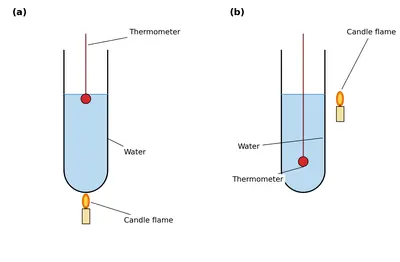
Given: Two identical test-tubes are filled with the same amount of water.
• In Fig. 7.16(a) the candle flame is just below the bottom of the tube, while the thermometer bulb is near the upper part of the water column.
• In Fig. 7.16(b) the candle flame is held near the upper part of the tube, while the thermometer bulb is near the lower part of the water column.
Key ideas from the chapter
- Water is a very poor conductor of heat; most heat transfer in it takes place by convection.
- When a layer of water is heated from below, its temperature rises, its density $$\rho$$ decreases and the lighter, hot water rises. Cooler, denser water from above moves down to take its place. Thus a continuous convection current sets up and soon the entire liquid becomes hot.
- If the upper layer is heated, the hot water stays on top (it is already lighter than the cold water below). No convection currents can start, so heat hardly reaches the lower layers; they remain almost at the initial temperature.
Applying the ideas
- Fig. 7.16(a)
• Heating is from below ⇒ Convection currents form.
• Hot water carried upwards surrounds the thermometer bulb.
• The whole column of water soon attains a high temperature. - Fig. 7.16(b)
• Heating is from above ⇒ No convection possible (light hot water cannot sink).
• Only the water near the flame becomes hot; lower layers (together with the thermometer bulb) stay nearly cold because heat has to reach them only by conduction, which is extremely slow in water.
Conclusion
The thermometer in Fig. 7.16(a) will register a much higher temperature than the one in Fig. 7.16(b).
Answer
Thermometer in Fig. 7.16(a) records the higher temperature because convection currents spread the heat through the whole water column when the test-tube is heated from below.
7
Solution
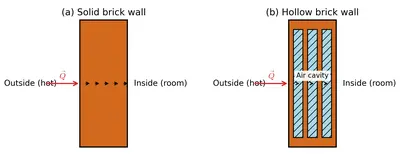
Concept involved — Conduction of heat
- Heat flows from the hotter side of a body to the colder side mainly by conduction in solids.
- The rate of this flow depends on the material’s thermal conductivity $$k$$. A small value of $$k$$ means the material is a poor conductor (good insulator).
- Air has a very low thermal conductivity, much lower than that of ordinary brick.
Quantitative picture (optional for curiosity)
The rate at which heat flows through a slab is
\[ \dfrac{Q}{t} = kA\dfrac{\Delta T}{d} \]
where
- $$Q/t$$ = heat flow per second,
- $$A$$ = area of the wall,
- $$\Delta T$$ = temperature difference between outside and inside,
- $$d$$ = thickness of the wall.
If the space inside the brick is filled with air, we replace the larger $$k$$ of solid brick by the tiny $$k$$ of air, so $$\dfrac{Q}{t}$$ becomes much smaller. In other words, far less heat can reach the inner surface.
Application to hollow bricks
- Each brick is moulded with cavities (hollows).
- These hollows trap air that cannot circulate, so convection is also suppressed.
- Because air is a poor conductor and the cavities lengthen the path of heat flow, the outer wall behaves like a thick thermal insulator.
- Thus, even when the outer surface is very hot under the sun, the inner surface remains comparatively cool.
Result
Houses built with such bricks stay cooler in hot climates, reducing the need for artificial cooling and saving energy.
Answer
Hollow bricks enclose still air, and air is a very poor conductor of heat; hence only a little heat can pass by conduction from the hot outside surface to the inside, keeping the house cool in hot regions.
8 Explain how large water bodies prevent extreme temperature in areas around them.
Solution
Concept needed from the chapter
- Heat is the energy that flows because of a temperature difference.
- When a substance is supplied heat, the temperature rise it shows depends on its specific heat capacity – the heat needed to raise the temperature of 1 kg of that substance through 1 °C.
For any material we write
$$Q = m\,c\,\Delta T$$
- Q = heat supplied or lost (in joule, J)
- m = mass (in kg)
- c = specific heat capacity (in J kg−1°C−1)
- ΔT = rise or fall in temperature (in °C)
Step 1 : Compare the specific heat capacities
The specific heat capacity of water is very large: $$c_{\text{water}} \approx 4200\;\text{J kg}^{-1}\,°\text{C}^{-1}$$
Typical dry soil or rock has only about $$c_{\text{land}} \approx 800\;\text{J kg}^{-1}\,°\text{C}^{-1}$$
Therefore, to raise the temperature of 1 kg of water by 1 °C we need almost five times as much heat as we need for 1 kg of land.
Step 2 : What happens in the daytime?
- Both land and the adjoining sea (or lake) receive the same sunshine.
- Because $$c_{\text{land}}$$ is small, the land’s temperature rises quickly: a small Q gives a big $$\Delta T$$.
- Because $$c_{\text{water}}$$ is large, the water warms only a little: the same Q gives a much smaller $$\Delta T$$.
- Thus the air over the land becomes hotter than the air over the water and rises, setting up a sea breeze that brings cooler air from the water towards the land. That keeps the coastal air temperature from shooting up.
Step 3 : What happens at night?
- The land and water both start losing heat by radiation.
- Because the land had stored much less heat, it cools down swiftly – again a small Q (now negative) gives a large fall $$\Delta T$$.
- Water, having stored a lot of heat during the day, releases it slowly (large m c means small $$\Delta T$$), so it stays warmer than the land.
- The warmer air over the sea now rises and cooler air from the land flows out as a land breeze; the warm sea air that drifts land-ward raises the night-time temperature of the coastal region.
Step 4 : Net effect through the year
The same principle applies to seasonal heating in summer and cooling in winter. Because of its high $$c$$, the huge mass of water acts like a thermal reservoir. It absorbs extra heat in summer without becoming very hot and releases stored heat in winter without becoming very cold.
Final explanation
Coastal areas therefore experience a moderate climate – neither very hot in summer nor very cold in winter – while places far from large water bodies, whose ground cannot store as much heat, face more extreme temperatures.
(A student may draw a labelled diagram showing land, sea, sea-breeze arrows for daytime and land-breeze arrows for night-time.)
Answer
Because water has a very high specific heat capacity, a large water body must absorb or release a great deal of heat to change its temperature appreciably. In the day the sea warms only slightly and cool sea air flows towards the hotter land (sea breeze), limiting the daytime rise. At night the stored heat in the water is released slowly; the sea then stays warmer than the land and warm air drifts shore-ward (land breeze), preventing a sharp fall. Thus coastal regions remain moderate in both summer and winter, escaping extreme temperatures.
9 Explain how water seeps through the surface of the Earth and gets stored as groundwater.
Solution
Step 1 — Rain or melting snow reaches the ground
Whenever it rains, or when snow melts, a part of that water runs off on the surface to join streams and rivers. Another part falls directly on the soil.
Step 2 — Infiltration: water enters the soil
The uppermost layer of the ground is usually loose and full of tiny air spaces (pores) between the soil particles. Gravity pulls the rainwater downward and the water fills these pores. This slow downward entry of water through the soil surface is called infiltration.
Step 3 — Percolation: water moves deeper
Below the topsoil there are deeper layers made of sand, gravel or cracked rocks that also contain interconnected pores and cracks. Water that has already infiltrated continues to trickle down through these spaces. This deeper downward movement is known as percolation.
Why can the water keep going down?
- Gravity pulls it further into the ground.
- The pores and cracks form continuous pathways, so water can flow through them.
Step 4 — Meeting an impermeable layer
Eventually the percolating water reaches a zone of rock that has very few or no pores (for example, solid granite or a layer of clay). Such rock is called impermeable because water cannot pass through it.
Step 5 — Formation of the water table and groundwater
When water can go no farther, it starts to accumulate in the permeable layers just above the impermeable rock. These saturated layers act like a huge natural reservoir called an aquifer. The upper surface of this saturated zone is known as the water table. All the water stored below this level is called groundwater.
Step 6 — Use of groundwater
Wells, tube-wells, springs and some lakes obtain their water from this underground store. When we pump a well, we are actually bringing this stored groundwater back to the surface.
Summary
Rainwater first infiltrates into loose surface soil, then percolates through deeper permeable rocks until it is stopped by an impermeable layer. The water that collects above this layer forms the underground reservoir we call groundwater.
Answer
Rainwater seeps through the tiny pores of soil (infiltration) and continues downward through permeable rocks (percolation). It stops when it reaches an impermeable rock layer, accumulates above it and forms an underground reservoir called groundwater.
10 The water cycle helps in the redistribution and replenishment of water on the Earth. Justify the statement.
Solution
Step 1 Recalling what the water cycle is
The water cycle (also called the hydrological cycle) is the continuous movement of water between the Earth’s surface and the atmosphere under the action of the Sun’s heat energy. The main processes involved are:
- Evaporation (and transpiration from plants)
- Condensation in the atmosphere
- Precipitation (rain, snow, hail, etc.)
- Collection at the surface followed by run-off and infiltration
Step 2 How heat starts the cycle
Solar heat supplies the latent heat of vaporisation, so surface water from oceans, rivers, lakes, soil and leaves changes to water vapour. Warm air currents then carry this vapour upward.
Step 3 Formation of clouds (condensation)
At higher, cooler altitudes the vapour loses heat, condenses on tiny dust particles and forms clouds. During condensation, the latent heat of condensation is released into the surrounding air.
Step 4 Precipitation brings the water down again
When cloud droplets grow large enough they fall as precipitation. Because winds can travel long distances, the rain or snow may fall hundreds or even thousands of kilometres away from the place where the water originally evaporated.
Step 5 Collection, run-off and infiltration
- Part of the precipitation flows over the land as surface run-off, feeding streams and rivers.
- Some collects in lakes, ponds and reservoirs.
- Some seeps into the ground (infiltration), recharging underground aquifers.
- Eventually, most of this water returns to the oceans, where it can evaporate again, closing the cycle.
Step 6 Justification – Redistribution of water
- About 90 % of global evaporation occurs from oceans, but roughly 30 % of the world’s rainfall takes place over land. Hence ocean water vapour is carried by winds and falls over continents, redistributing it geographically.
- Snowfall in polar and high-mountain regions stores water as ice. Melting glaciers later release it to rivers, carrying it to plains that never had an ocean coastline.
Step 7 Justification – Replenishment of water
- Rain and snow replenish surface sources such as rivers, lakes and wetlands that lose water constantly by evaporation and human use.
- Infiltration refills underground water tables; without this recharge wells and springs would soon dry up.
- Plants regain the water they lose by transpiration, keeping terrestrial life possible.
Step 8 Conclusion
The Sun-driven water cycle perpetually lifts water from one part of the Earth, moves it through the atmosphere and returns it elsewhere, thus:
- Redistributing water from oceans to far-off lands and from high altitudes to low.
- Replenishing natural reservoirs (rivers, lakes, groundwater, glaciers) that would otherwise be depleted.
Therefore the statement, “The water cycle helps in the redistribution and replenishment of water on the Earth,” is fully justified.
Answer
The Sun-driven water cycle evaporates water mainly from oceans, carries the vapour through winds, condenses it into clouds and returns it as precipitation far and wide. The rain and snow that fall over land refill rivers, lakes, underground aquifers and even glaciers, while run-off returns part of the water to the sea. Thus the cycle (i) shifts water from one region to another, achieving redistribution, and (ii) continually tops up natural water stores, achieving replenishment. Hence the statement is justified.


