 91- 6303239042


Let Us Enhance Our Learning
1 Which of the following statements are the characteristics of a physical change?
(i) The state of the substance may or may not change.
(ii) A substance with different properties is formed.
(iii) No new substance is formed.
(iv) The substance undergoes a chemical reaction.
(a) (i) and (ii)
(b) (ii) and (iii)
(c) (i) and (iii)
(d) (iii) and (iv)
Solution
Step 1 – Recall the defining features of a physical change
In a physical change:
- The identity and chemical composition of the substance remain the same; hence no new substance is produced.
- Only physical properties such as shape, size, colour or state (solid ↔ liquid ↔ gas) may change. These changes are usually reversible by simple physical means.
Step 2 – Examine each given statement
| Statement | True / False for a physical change? | Reason |
|---|---|---|
| (i) The state of the substance may or may not change. | True | Change of state (e.g. ice → water) is a typical physical change, but sometimes even the state remains the same (e.g. cutting paper). |
| (ii) A substance with different properties is formed. | False | That describes a chemical change, where new substances with new properties appear. |
| (iii) No new substance is formed. | True | This is the key feature of every physical change. |
| (iv) The substance undergoes a chemical reaction. | False | By definition physical changes do not involve chemical reactions. |
Step 3 – Pick the option that lists only the true statements
True statements: (i) and (iii)
Option (c) corresponds to these two statements.
Therefore, the correct choice is option (c).
Answer
(c) (i) and (iii)
2 Predict which of the following changes can be reversed and which cannot be reversed. If you are not sure, you may write that down. Why are you not sure about these?
(i) Stitching cloth to a shirt
Solution
When we stitch pieces of cloth together we pierce them with a needle and permanently lock them with thread. Even if we remove the stitches later, the cloth pieces will already have needle holes, creases and trimmed edges; they will not regain exactly the same condition in which they were before stitching.
Therefore the change is not capable of being brought back to the original state in the true sense.
Answer
Cannot be reversed (irreversible change)
(ii) Twisting of straight string
Solution
A straight string becomes twisted only by changing its shape. If we rotate it in the opposite direction, the string becomes straight again and no material is lost or changed.
Answer
Can be reversed (reversible change)
(iii) Making idlis from a batter
Solution
While steaming idli batter, the proteins in rice and lentils coagulate and a porous solid idli is formed. These are chemical changes brought about by heat; once the batter has set into an idli, we cannot convert it back into the original liquid batter.
Answer
Cannot be reversed (irreversible change)
(iv) Dissolving sugar in water
Solution
On dissolving sugar in water we get a solution, but no new substance is formed. If we gently evaporate the water, sugar crystals can be obtained again; conversely the crystals can be redissolved. Hence the process can proceed in either direction.
Answer
Can be reversed (reversible change)
(v) Drawing water from a well
Solution
Taking water out of a well only changes its position. If we pour the same water back, the situation is the same as before the water was drawn; the water itself has not changed.
Answer
Can be reversed (reversible change)
(vi) Ripening of fruits
Solution
Ripening involves production of new pigments, sugars, flavours and softening of cell walls inside the fruit— all are chemical changes. Once ripe, the fruit cannot go back to its unripe state.
Answer
Cannot be reversed (irreversible change)
(vii) Boiling water in an open pan
Solution
When water boils, it only changes its physical state from liquid to vapour. If the vapour is collected and cooled, it condenses back to liquid water. Thus, although the vapour may escape from an open pan, in principle the change can be reversed by condensation.
Answer
Can be reversed (reversible change)
(viii) Rolling up a mat
Solution
Rolling merely bends the mat; unrolling restores it to its previous shape. No new substance is formed and the material remains the same.
Answer
Can be reversed (reversible change)
(ix) Grinding wheat grains to flour
Solution
Grinding cuts the grain into tiny flour particles and destroys the seed structure. We cannot combine the powder again to make whole grains; hence the original state cannot be restored.
Answer
Cannot be reversed (irreversible change)
(x) Forming of soil from rocks
Solution
Weathering breaks rocks through physical and chemical processes over years to form soil particles. The reverse (making the same rock out of loose soil) is not naturally possible under ordinary conditions.
Answer
Cannot be reversed (irreversible change)
3 State whether the following statements are True or False. In case a statement is False, write the correct statement.
(i) Melting of wax is necessary for burning a candle. (True/False)
Solution
When a candle is first lighted, the small initial flame:
- melts the solid wax immediately surrounding the wick; this is a physical change.
- The molten wax rises through the wick by capillary action and then vaporises (turns to gas). Only the wax vapour actually burns, combining with oxygen to give heat, light, $$\mathrm{CO_2}$$ and $$\mathrm{H_2O}$$.
- If the wax did not melt, it could not reach the wick in liquid form and therefore could not vaporise and burn. Hence melting is an essential preliminary step for continuous burning.
Therefore the given statement is correct.
Answer
True
(ii) Collecting water vapour by condensing involves a chemical change. (True/False)
Solution
Condensation is simply the change of state of a substance from gas to liquid. For water it can be written as
$$\mathrm{H_2O(g)} \; \longrightarrow \; \mathrm{H_2O(l)}$$
No new substance with a different chemical composition is formed; only the physical state changes. The process is easily reversible by heating (evaporation), a hallmark of a physical change.
Hence the given statement is false.
Correct statement: Collecting water vapour by condensing involves a physical change.
Answer
False — Condensing water vapour is a physical change, not a chemical one.
(iii) The process of converting leaves into compost is a chemical change. (True/False)
Solution
Leaves are converted to compost by the action of bacteria, fungi and other decomposers. During this decomposition:
- The large, complex molecules present in leaves break down into simpler substances like humic acids, nitrates, $$\text{CO}_2$$, etc.
- The change is irreversible and produces entirely new materials with new properties.
Such changes, involving formation of new substances, are classified as chemical changes. Hence the statement is correct.
Answer
True
(iv) Mixing baking soda with lemon juice is a chemical change. (True/False)
Solution
Baking soda (sodium hydrogen carbonate, $$\mathrm{NaHCO_3}$$) reacts with citric acid present in lemon juice. The simplified overall reaction is
$$\mathrm{NaHCO_3} + \text{citric acid} \longrightarrow \mathrm{Na^+} \text{ salt} + \mathrm{H_2O} + \mathrm{CO_2(g)}$$
Evidence of a chemical change:
- Effervescence due to new gas, $$\mathrm{CO_2}$$.
- Irreversible under ordinary conditions.
- Formation of new substances (salt and water).
Therefore the statement is correct.
Answer
True
4 Fill in the blanks in the following statements:
(i) Nalini observed that the handle of her cycle has got brown deposits. The brown deposits are due to _______, and this is a _______ change.
Solution
When iron or steel articles such as the handle of a bicycle come in contact with moist air (oxygen + water vapour), a slow chemical reaction takes place.
The iron $$\mathrm{(Fe)}$$ reacts with oxygen and moisture to form reddish-brown flakes of iron(III) oxide-hydrate, commonly called rust.
The formation of rust involves the creation of new substances, so its original composition cannot be regained by simple physical means. Hence it is categorised as a chemical change.
Therefore,
- Brown deposit → rusting (iron oxide)
- Type of change → chemical change
Answer
rusting; chemical
(ii) Folding a handkerchief is a _____________ change and can be _______.
Solution
When we fold a handkerchief, only its shape and size (appearance) change; no new substance is formed and the material of the cloth remains the same.
Changes in which the identity of the substance does not change are called physical changes.
Because we can open the folds at any time and get back exactly the same handkerchief, the change can be reversed.
Answer
physical; reversed
(iii) A chemical process in which a substance reacts with oxygen with evolution of heat is called _______, and this is a _______ change.
Solution
A reaction in which a substance combines with oxygen releasing heat (and often light) is termed combustion. For example, burning of fuels such as LPG, candle wax or coal.
Since new substances such as $$\mathrm{CO_2}$$, $$\mathrm{H_2O}$$, etc., are produced, the process is a chemical change.
Answer
combustion; chemical
(iv) Magnesium, when burnt in air, produces a substance called _______. The substance formed is _______ in nature. Burning of magnesium is a _______ change.
Solution
Magnesium ribbon burns in air with a dazzling white flame and reacts with the oxygen present to form a white ash.
Chemical equation: $$\mathrm{2\,Mg + O_2 \rightarrow 2\,MgO}$$
The white powder formed is magnesium oxide, written as $$\mathrm{MgO}$$.
When $$\mathrm{MgO}$$ is dissolved in water it forms $$\mathrm{Mg(OH)_2}$$, which turns red litmus blue, showing that it is basic in nature.
Because a new substance is produced and the process cannot be undone by simple physical means, burning of magnesium is a chemical change.
Answer
magnesium oxide; basic; chemical
5 Are the changes of water to ice and water to steam, physical or chemical? Explain.
Solution
Step 1 ‒ Recall the two kinds of changes
• Physical change: only the physical state, shape or size changes; no new substance is formed, and the change is usually reversible.
• Chemical change: a new substance with a new chemical composition appears; the change is generally irreversible by simple physical means.
Step 2 ‒ Change of water to ice
When liquid water is cooled to 0 °C, it freezes:
The molecular formula on both sides is still $$\mathrm{H_2O}$$. Only the arrangement of molecules and the distance between them change. If the ice is warmed again, it melts back to liquid water. Hence, the change is reversible and no new substance is produced → physical change.
Step 3 ‒ Change of water to steam
On heating to 100 °C, water boils to give steam (water vapour):
Again the chemical identity remains $$\mathrm{H_2O}$$. Cooling the steam condenses it back to liquid water, so the process is reversible and no new substance forms → physical change.
Step 4 ‒ Conclusion
Both freezing and boiling of water involve only a change of physical state (liquid ↔ solid or liquid ↔ gas). Since the composition $$\mathrm{H_2O}$$ is unchanged and the changes are reversible, both are physical changes.
Answer
Water → ice and water → steam are both physical changes, because the substance remains $$\mathrm{H_2O}$$ and the processes are reversible.
6 Is curdling of milk a physical or chemical change? Justify your statement.
Solution
Step 1 – Recall the two kinds of changes.
- A physical change affects only the physical state, size or shape of a substance. The substance itself (its chemical composition) remains the same and the change is usually reversible.
- A chemical change produces one or more new substances with different properties and composition. Such a change is generally irreversible.
Step 2 – What happens when milk curdles?
- Milk contains the sugar lactose and the proteins casein and whey proteins.
- When a little curd (or a few drops of lemon) is mixed with warm milk, helpful bacteria enter the milk. These bacteria convert lactose into lactic acid.
- The produced lactic acid lowers the pH of milk; the casein molecules gather together and form a semi-solid mass that we call curd / yoghurt.
Thus new substances – mainly lactic acid and coagulated casein proteins – are formed. This alters:
- Composition – milk (sweet) → curd (sour because of lactic acid).
- Taste and smell – both become tangy.
- Texture – liquid milk becomes semi-solid curd.
Step 3 – Test for reversibility.
Once milk has set into curd it cannot be converted back to fresh milk by any simple physical means such as heating, cooling or filtering. This irreversibility is a typical sign of a chemical change.
Conclusion.
Since curdling of milk produces new substances with new properties, involves a permanent change in composition and is not easily reversible, it is classified as a chemical change.
Answer
Curdling of milk is a chemical change because new substances (mainly lactic acid and coagulated proteins) are formed, giving curd a different composition, taste and texture, and the process cannot be reversed to obtain the original milk.
7 Natural factors, such as wind, rain, etc., help in the formation of soil from rocks. Is this change physical or chemical and why?
Solution
Step 1 — Recall the two kinds of changes
- Physical change: The substance keeps the same chemical composition; only its shape, size, or state changes. No new substance is produced.
- Chemical change: The original substance is converted into one or more new substances having different chemical compositions.
Step 2 — Describe what happens to rocks
When rocks are exposed to natural factors such as wind, flowing water (rain or rivers), temperature differences, and the actions of plant roots, they gradually break down into smaller and smaller pieces. This slow breaking process is called weathering.
Step 3 — Compare with the definitions
- The pieces obtained after weathering (gravel, sand, silt, clay) have the same chemical composition as the original rock. Only the size and shape of the particles change.
- No new chemical substance (like a different mineral or compound) is formed in this mechanical breakdown.
Step 4 — Classify the change
Because the composition remains unchanged and only the physical form alters, the formation of soil from rocks under the action of wind and rain is a physical change.
Step 5 — Conclude
Thus, natural weathering of rocks into soil is physical, not chemical, since no new substance is produced; only the size and texture of the rock fragments vary.
Answer
The formation of soil from rocks by wind, rain, etc., is a physical change because only the size and shape of the rock pieces alter; their chemical composition stays the same, so no new substance is formed.
8
Read the following story titled 'Eco-friendly Prithvi', and tick the most appropriate option(s) given in the brackets. Provide a suitable title of your choice for the story.
Prithvi is preparing a meal in the kitchen. He chops vegetables, peels potatoes, and cuts fruits (physical changes/chemical changes). He collects the seeds, fruits, and vegetable peels into a clay pot (physical change/chemical change). The fruits, vegetable peels, and other materials begin to decompose due to the action of bacteria and fungi, forming compost (physical change/chemical change). He decides to plant seeds in the compost and water them regularly. After a few days, he notices that the seeds begin to germinate and small plants start to grow, eventually blooming into colourful flowers (physical change/chemical change). His efforts are appreciated by all his family members.
Solution
Suitable Title: Prithvi’s Eco-friendly Kitchen Garden
To label every activity we recall the basic ideas of the chapter.
- Physical change: no new substance is formed; only form, size, state or appearance alters; usually reversible.
- Chemical change: one or more new substances having different properties are produced; usually irreversible.
- Chopping vegetables, peeling potatoes, cutting fruits
Only shape/size changes, identity remains the same → physical change. - Collecting the seeds, fruit and vegetable peels in a clay pot
Simply putting the same material in another container → physical change. - Scraps decomposing to compost by bacteria and fungi
Organic matter is converted into new substances such as humus, $$\mathrm{CO_2}$$ and water → chemical change. - Seeds germinating and plants flowering
Irreversible biochemical reactions create new tissues; the seed is no longer the same substance → chemical change.
Therefore the correct ticks are:
| Event | Type of change |
|---|---|
| Chopping/peeling/cutting | Physical |
| Keeping scraps in pot | Physical |
| Composting | Chemical |
| Germination & flowering | Chemical |
Answer
Title: Prithvi’s Eco-friendly Kitchen Garden
- Physical change ✔
- Physical change ✔
- Chemical change ✔
- Chemical change ✔
9
Some changes are given here. Write physical changes in the area marked 'A' and chemical changes in the area marked 'B'. Enter the changes which are both physical and chemical in the area marked 'C'.
Process of burning a candle; Tearing of paper; Rusting; Curdling of milk; Ripening of fruits; Melting of ice; Folding of clothes; Burning of magnesium and Mixing baking soda with vinegar.
Solution
Step 1 ︱ Recall the two ideas
- Physical change – no new substance is formed; the change can usually be reversed by simple physical means, mass of the substance remains the same.
- Chemical change – one or more new substances are formed with different properties; the change is generally irreversible by simple physical methods.
Sometimes both kinds of changes take place together. One part of the event is only a change of state (physical) while another part involves a chemical reaction.
Step 2 ︱ Test every change given
| Change described | What really happens? | Type of change |
|---|---|---|
| Process of burning a candle |
| Both physical and chemical |
| Tearing of paper | Only the size and shape of the paper change; no new substance appears. | Physical |
| Rusting of iron | Iron combines with oxygen and moisture to give iron(III) oxide: $$\mathrm{4Fe + 3O_2 + xH_2O \rightarrow 2Fe_2O_3\,\cdot\,xH_2O}$$ | Chemical |
| Curdling of milk | Milk proteins (casein) coagulate forming curd; new substances with sour taste form. | Chemical |
| Ripening of fruits | Complex biochemical reactions convert starch into sugars, chlorophyll into coloured pigments, etc. | Chemical |
| Melting of ice | Only the physical state changes: $$\text{ice} \;(\mathrm{s}) \to \text{water} \;(\mathrm{l})$$ | Physical |
| Folding of clothes | Only shape changes; fibre composition is unchanged. | Physical |
| Burning of magnesium ribbon | Magnesium combines with oxygen: $$\mathrm{2Mg + O_2 \rightarrow 2MgO}$$ giving a dazzling white flame. | Chemical |
| Mixing baking soda with vinegar | $$\mathrm{NaHCO_3 + CH_3COOH \rightarrow CH_3COONa + CO_2\,(g) + H_2O}$$ – brisk effervescence shows new products. | Chemical |
Step 3 ︱ Fill the three areas
| A : Physical changes only | B : Chemical changes only | C : Both physical & chemical |
|---|---|---|
|
|
|
Hence the classification is complete.
Answer
A (physical): Tearing of paper; Melting of ice; Folding of clothes.
B (chemical): Rusting; Curdling of milk; Ripening of fruits; Burning of magnesium; Mixing baking soda with vinegar.
C (both): Process of burning a candle.
10
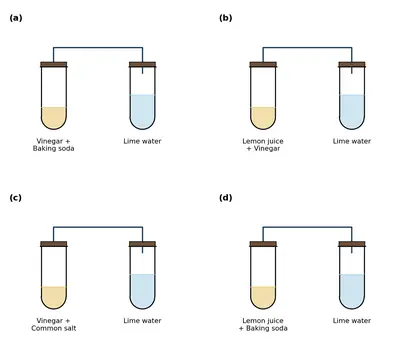
The experiments shown in Fig. 5.11a, b, c, and d were performed. Find out in which case(s) did lime water turn milky and why?
(a) Vinegar and baking soda; Lime water
(b) Lemon juice and vinegar; Lime water
(c) Vinegar and common salt; Lime water
(d) Lemon juice and baking soda; Lime water
Solution
Key fact recalled
Lime-water is a dilute solution of calcium hydroxide, $$\mathrm{Ca(OH)_2}$$. Whenever carbon dioxide gas is bubbled through it, the following reaction occurs:
$$\mathrm{Ca(OH)_2 + CO_2 \;\longrightarrow\; CaCO_3 \downarrow + H_2O}$$
The insoluble calcium carbonate, $$\mathrm{CaCO_3}$$, makes the clear lime-water turn milky. Therefore lime water will turn milky only if the experiment produces the gas $$\mathrm{CO_2}$$.
Step-by-step check of every set-up
| Case | What is mixed? | Expected reaction | Is $$\mathrm{CO_2}$$ produced? | Effect on lime water |
|---|---|---|---|---|
| (a) | Vinegar (acetic acid) + Baking soda (sodium hydrogen-carbonate) | $$\mathrm{CH_3COOH + NaHCO_3 \;\rightarrow\; CH_3COONa + CO_2 \uparrow + H_2O}$$ | Yes | Turns milky |
| (b) | Lemon juice (citric acid) + Vinegar (acetic acid) | Both are acids; simply mix—no gas-evolving reaction | No | No change |
| (c) | Vinegar (acetic acid) + Common salt (sodium chloride) | Only dissolving; no carbonate present, so no $$\mathrm{CO_2}$$ | No | No change |
| (d) | Lemon juice (citric acid) + Baking soda (sodium hydrogen-carbonate) | $$\mathrm{C_6H_8O_7 + 3\,NaHCO_3 \;\rightarrow\; Na_3C_6H_5O_7 + 3\,CO_2 \uparrow + 3\,H_2O}$$ | Yes | Turns milky |
Conclusion
Lime water turns milky only in experiments (a) and (d) because these are the ones that release carbon dioxide gas. The gas reacts with lime water forming insoluble calcium carbonate, which gives the milky appearance.
Answer
Lime water turns milky in cases (a) and (d). Both mixtures generate $$\mathrm{CO_2}$$, and the gas converts lime water (calcium hydroxide solution) into insoluble $$\mathrm{CaCO_3}$$, producing the milky appearance.
Exploratory Projects
1 Write a message on a piece of paper using lemon juice as ink and let it dry. The message will become invisible. Now use a warm iron over the paper (or hold the paper over the flame of a candle, taking care that it does not catch fire). The invisible letters turn dark brown as the paper gets warm. Can any of these changes be reversed?
Solution
Step 1 — Understanding what happens when the ink dries
Lemon juice is mostly water with some acids (citric acid) and other organic substances dissolved in it. When you write and then leave the sheet in air, the water in the juice evaporates:
$$\text{Lemon-juice solution}\;\xrightarrow[\text{air}]{\text{evaporation}}\;\text{dry lemon solids on paper}$$
Only a physical change (loss of water) has occurred. If you again moisten the same spot with a few drops of water, the dry solids dissolve back and the written area looks wet. Thus the drying of the juice can be reversed; it is a physical change.
Step 2 — What happens when the paper is warmed
On heating, the acids and sugars left in the lemon juice react with oxygen from the air and also begin to char (partial burning of the paper surface):
$$\text{Organic matter}\;\xrightarrow[\text{heat}]{\text{oxidation}}\;\text{brown/black compounds}$$
New chemical substances are produced, giving the letters a dark-brown colour. Because entirely new substances form, this stage is a chemical change.
Step 3 — Can we reverse the second change?
A chemical change is generally permanent. After charring, no simple cooling or addition of water will convert the brown substances back into the original colourless acids and sugars of lemon juice. Hence the dark-brown letters cannot be changed back to the invisible form.
Conclusion
- The drying of lemon juice before heating is a physical change and can be reversed by re-adding water.
- The browning of the letters on heating is a chemical change and cannot be reversed.
Answer
The first stage (evaporation of water from the lemon juice) is reversible, but once the heated letters turn dark-brown a chemical change has occurred and that change cannot be reversed.
2 We hear a lot of news about landslides and breaking of rocks in hilly regions these days, causing a lot of damage to life and property. Discuss what steps we can take to reduce landslides and rock erosion.
Solution
Understanding the problem first
- Rocks on a hill–side are constantly broken down by two kinds of changes you have learnt in this chapter:
- Physical change — Weathering:
- Heating by Sun and cooling at night,
- Water entering the cracks and freezing,
- Roots of plants exerting a push.
- Chemical change — Chemical weathering:
- Rainwater (which is weak $$\mathrm{H_2CO_3}$$) reacts with minerals,
- Oxygen in moist air rusts iron-rich rocks.
Steps that can be taken to reduce landslides and rock erosion
- Afforestation and protection of existing vegetation
Roots form a natural network that ties soil and small rock pieces, so planting trees and grasses on slopes gives mechanical support and also reduces direct impact of rain drops. - Terracing and contour bunding
Cutting long slopes into a series of almost horizontal steps (terraces) decreases the effective slope angle $$\theta$$ (smaller $$\theta$$ → smaller downward component of weight $$W \sin\theta$$), thus reducing the tendency of the mass to slide. - Proper drainage systems
Laying perforated pipes, side drains and catch-water drains quickly removes rain water before it can soak the ground. Less water means less additional mass and smaller pore-water pressure, both of which otherwise act to push the material outward. - Retaining structures
- Stone masonry or RCC retaining walls,
- Gabion walls (wire-mesh boxes filled with stones),
- Soil-nailed walls or rock-bolts that literally ‘pin’ loose rocks to the stable bed-rock. These act against the downslope sliding force.
- Rock fall nets and shot-creting (sprayed concrete)
Nets catch individual falling blocks; a thin concrete skin binds together the outer few centimetres of a weathered rock face and stops small cracks from widening further (a purely physical change). - Controlled construction and mining
- No cutting at the foot of an already steep slope,
- No dumping of excavated soil on the crest,
- Regulating blasting vibration and quarry depth. Such regulations keep the natural slope in its angle of repose.
- Providing vegetation cover quickly after a fire or deforestation event
Fast-growing grasses or hydro-seeding prevent direct exposure of bare soil to wind and rain. - Channel diversion and check dams
Small concrete/stone barriers slow down flowing water, force it to deposit its sediment load and therefore lessen the erosive power downstream. - Monitoring and early-warning systems
Instruments such as tilt-meters, rain gauges and ground-movement sensors send alerts when preset thresholds are crossed, giving enough time to evacuate people. - Community awareness
Signs of an imminent slide—cracks on walls, tilted trees, jamming of doors—must be reported early so that point-6 regulations can be enforced.
Summary
- Landslides happen because of a combination of physical and chemical changes that weaken rocks.
- Practical preventive steps centre around (a) binding the soil and rocks (vegetation, bolts, concrete), (b) lowering the slope angle and removing water (terracing and drainage), and (c) controlling man-made disturbances and setting up early-warning arrangements.
Answer
We can reduce landslides and rock erosion by (i) keeping or planting vegetation on slopes, (ii) making terraces or contour bunds, (iii) building good surface & sub-surface drains, (iv) supporting the slope with retaining walls, gabions, rock-bolts or shot-crete, (v) avoiding unplanned cutting, quarrying and dumping, (vi) slowing water with check-dams and channel diversion, and (vii) installing monitoring/early-warning systems and spreading public awareness.
3 Observe the activities going on in the kitchen and note any changes that can be reversed. Are these physical or chemical changes?
Solution
Step 1 – Look carefully at routine kitchen work
Typical activities you can spot are
- Ice is taken out of the freezer and kept on the table → it melts to liquid water.
- Water is heated for tea → it starts boiling and gives off steam.
- Steam from the kettle strikes a cold plate held above it → tiny drops of liquid water collect (condensation).
- Butter / ghee is warmed slightly → it changes from solid to liquid.
- Salt or sugar is stirred into a glass of water → it dissolves and the solid seems to disappear.
Step 2 – Test whether each change can be reversed easily
| Kitchen change | How to reverse it | Possible/Not possible |
|---|---|---|
| Ice → liquid water | Keep in freezer again: water → ice. | Possible |
| Liquid water → steam | Cool the steam on a lid: steam → water. | Possible |
| Condensed water drops | Re-heat: drops → steam. | Possible |
| Solid butter → liquid butter | Allow to cool: liquid → solid. | Possible |
| Salt/sugar + water → solution | Evaporate water; crystals of salt/sugar remain. | Possible |
Step 3 – Classify the reversible changes
In every example above, the substance itself remains $$\mathrm{H_2O}$$ or butter or salt; no new material having a different composition is produced. Therefore each of these is a physical change.
Step 4 – Write the final observation
The kitchen changes that can be reversed are melting / freezing of water or butter, boiling / condensing of water, and dissolving / crystallising of salt or sugar. All of them are reversible physical changes, not chemical changes.
Answer
The reversible kitchen changes are melting ↔ freezing of water or butter, boiling ↔ condensation of water and dissolving ↔ crystallising of salt or sugar. All are physical changes.
4
Yeast is added while baking bread to make it fluffy and soft. How does yeast work? Try and find out!
- Take a small bottle, some sugar, fresh yeast, water, and a balloon. Make a sugar solution in the bottle by mixing two teaspoons of sugar and a small amount of water. Now add a spoonful of yeast and cover the mouth of the bottle with a balloon. Leave it undisturbed for about an hour.
- What do you observe?
- Carefully take off the balloon, holding its mouth tightly closed and attach it to another small bottle containing freshly prepared lime water. Shake the bottle so that the contents of the balloon get mixed with lime water.
- What do you observe?
- What can you conclude from this experiment?
- Identify all the changes occurring in the experiment and state which of them are physical and chemical changes.
Solution
Material used : A small bottle, fresh baker’s yeast, about 2 teaspoons of sugar, water, a balloon and another small bottle containing freshly prepared lime-water (clear solution of $$\mathrm{Ca(OH)_2}$$).
Step 1 : Preparing the sugar solution (set-up A)
Two teaspoons of sugar are stirred in a little water taken in the first bottle till the crystals disappear.
- Dissolving sugar does not create any new substance; it is only a change of physical state (solid $$\rightarrow$$ aqueous).
Step 2 : Adding yeast and fitting the balloon
A spoonful of fresh yeast is dropped into the sugary liquid and the mouth of the bottle is closed tightly with a limp balloon.
- At the start the balloon hangs flat because there is almost no gas above the liquid.
Observation after about one hour
- The balloon is found swollen or partially inflated.
- Bubbling is seen in the liquid and it smells slightly alcoholic (like fermented batter).
Explanation
Yeast contains the enzyme complex zymase. In the absence of air it brings about fermentation of the dissolved sugar (glucose/sucrose):
\[ \mathrm{C_6H_{12}O_6\,(aq) \xrightarrow[\;\text{zymase}\;]{\text{yeast}} 2\,C_2H_5OH\,(aq)+2\,CO_2\,(g)} \]
- The $$\mathrm{CO_2}$$ produced collects above the liquid and stretches the balloon. Inflating the balloon is only a physical effect; the real change is chemical (fermentation).
Step 3 : Passing the gas into lime-water (set-up B)
The balloon is pinched at its neck, removed carefully and fitted over a second bottle that contains clear lime-water. On gentle shaking the gas from the balloon mixes with the solution.
Second observation
- Lime-water turns milky (a white suspension forms).
Chemical test for carbon dioxide
\[ \mathrm{Ca(OH)_2\,(aq)+CO_2\,(g)\;\rightarrow\;CaCO_3\,(s)\downarrow+H_2O\,(l)} \]
The white solid $$\mathrm{CaCO_3}$$ makes the liquid look milky, proving that the gas inside the balloon is carbon dioxide.
What does the experiment tell us?
- Yeast breaks down sugar into alcohol and carbon dioxide — a chemical change called fermentation.
- The carbon dioxide produced is responsible for the balloon inflating in the model experiment and, in real bread-making, for the soft, spongy texture (gas bubbles get trapped in the dough and expand on baking).
Classification of every change that occurred
| Change observed | Nature of change | Reason |
|---|---|---|
| Sugar crystals dissolving in water | Physical | No new substance; can recover sugar by evaporation. |
| Fermentation of sugar by yeast | Chemical | New substances (ethanol and $$\mathrm{CO_2}$$) are formed; irreversible by simple means. |
| Balloon getting inflated | Physical (effect) | Only volume/shape of balloon changes; no new substance. |
| Lime-water turning milky | Chemical | Formation of a new solid $$\mathrm{CaCO_3}$$ from $$\mathrm{Ca(OH)_2}$$ and $$\mathrm{CO_2}$$. |
Final summary
Yeast makes bread fluffy because, during fermentation, it converts the sugar present in the dough into carbon dioxide gas. The gas forms tiny bubbles that get trapped in the dough, causing it to rise and giving the baked bread a soft, airy texture.
Answer
The balloon swells because yeast ferments the sugar solution and releases carbon dioxide. When this gas is led into lime-water the liquid turns milky, confirming that the gas is $$\mathrm{CO_2}$$.
Dissolving sugar – physical; balloon inflation – physical (only expansion); fermentation and lime-water test – chemical.
Thus yeast makes bread light by producing $$\mathrm{CO_2}$$ which gets trapped as bubbles inside the dough.
5
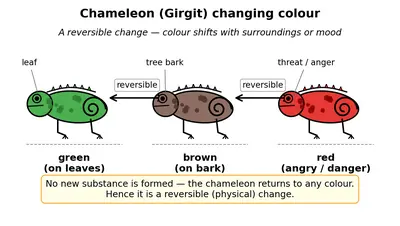
Solution
Step 1 – Recall the definitions
- Reversible change: A change that can be undone by reversing the conditions. The original substance or state can be obtained again. Examples learned in class are stretching a rubber band and melting/freezing water.
- Irreversible change: A change that cannot be undone easily. The substance formed or the condition achieved is permanent for everyday purposes. Examples are burning paper or curdling milk.
Step 2 – Observe what actually happens in a chameleon
- The skin of a chameleon contains special cells called chromatophores. Inside every chromatophore there are tiny grains of different coloured pigments (mainly black/brown, red/yellow and a reflective layer that looks blue/white).
- By expanding or contracting these grains a chameleon can let some colours show more and others less. This rearrangement changes the colour that we finally see.
- No new substance is produced in the skin. The pigments were already there; only their position and thickness change.
Step 3 – Classify the change using science concepts
- The change is similar to shaking a box of coloured beads and then letting them settle again—the beads are the same, only their places differ.
- Because the same pigments come back to their previous arrangement when the surroundings or mood change again, the skin returns to its former colour.
- Thus the chameleon’s colour shift satisfies the description of a reversible, physical change: no chemical reaction, no new molecule, and the process can be repeated any number of times.
Step 4 – Answer in textbook language
Yes, the colour change shown by a chameleon is a reversible change. It is brought about only by redistribution of pigments in its skin and the process can return to the original state whenever the animal is calm or moves to a different background.
Answer
Yes. A chameleon’s colour change is a reversible, physical change because the same skin pigments merely rearrange and can return to their original pattern.


