 91- 6303239042


Intext Questions
Intext 1 I am curious to know — what are these red and blue litmus paper strips made of? Why do they change colour when drops of some samples are put on them?
Solution
Step 1 ‒ What exactly is a litmus strip?
- A litmus strip is nothing more than a narrow piece of very porous filter paper.
- The paper has been soaked in, and then dried after, a special coloured liquid called litmus solution.
Step 2 ‒ Where does the coloured liquid come from?
- Litmus solution is prepared from dyes obtained naturally from certain lichens (for example Roccella tinctoria or Lecanora species).
- The lichen is boiled in water and then treated with a little ammonia and potassium carbonate; the deep purple solution that forms is concentrated and mixed with some starch to help it stick to paper.
Step 3 ‒ Making red and blue papers
- The neutral purple litmus solution is first painted or soaked on clean filter paper and dried.
When the dry sheets are later rinsed in a weak base such as $$\mathrm{Na_2CO_3}$$, they turn blue — these are cut into blue litmus strips. - Other sheets are dipped for a moment in a dilute acid such as $$\mathrm{HCl}$$. They become red and are cut into red litmus strips.
Step 4 ‒ Why does the colour change on adding a test liquid?
The dye present in litmus is an acid–base indicator.
- In its acidic form the indicator molecule is written as $$\mathrm{HLit}$$ and looks red.
- In its basic form it loses one $$\mathrm{H^+}$$ ion and becomes $$\mathrm{Lit^-}$$, which looks blue.
Two reversible changes control the colour:
\[\mathrm{Lit^- + H^+ \longrightarrow HLit}\]
(Blue → Red in an acid)
\[\mathrm{HLit + OH^- \longrightarrow Lit^- + H_2O}\]
(Red → Blue in a base)
Thus, when you touch a drop of a sample on a litmus strip:
- If the sample supplies plenty of $$\mathrm{H^+}$$ ions (acidic), blue litmus turns red.
- If the sample supplies plenty of $$\mathrm{OH^-}$$ ions (basic), red litmus turns blue.
- If it supplies neither in excess (neutral), no visible colour change occurs.
Conclusion
Red and blue litmus papers are simply filter papers impregnated with the natural litmus dye. The dye molecules can exist in two differently coloured forms. Contact with an acid or a base shifts them from one form to the other, so the strip instantly signals whether the test liquid is acidic, basic, or neutral.
Answer
Litmus paper is ordinary filter paper soaked in a purple dye extracted from lichens. That dye exists in two coloured forms: its acidic form $$\mathrm{HLit}$$ is red, while its basic form $$\mathrm{Lit^-}$$ is blue. Dropping an acid on the paper supplies $$\mathrm{H^+}$$ ions and converts the dye to red; dropping a base supplies $$\mathrm{OH^-}$$ ions and converts it to blue. Hence blue litmus turns red in acids, red litmus turns blue in bases, and no change occurs with neutral solutions.
Intext 2 The substances in Group C, such as tap water, sugar solution, and salt solution, did not change the colour of either litmus paper. Can you predict their nature?
Solution
Step 1 : Recall what litmus tells us
- Blue litmus turns red in an acidic solution.
- Red litmus turns blue in a basic (alkaline) solution.
- If neither blue nor red litmus changes its colour, the solution is neutral.
Step 2 : Apply the rule to Group C substances
You observed that tap water, sugar solution and salt solution did not bring about any colour change in either type of litmus paper. In symbols we can write
$$\text{colour change} = 0$$
(where 0 stands for “no change” for both red and blue litmus).
Step 3 : Deduce their nature
Because the litmus test shows no change, each of the Group C liquids must be
\[ \text{neither acidic nor basic}\;\Longrightarrow\;\textbf{neutral in nature} \]Conclusion
Tap water, sugar solution and common-salt solution are predicted to be neutral.
Answer
The liquids are neutral; they are neither acidic nor basic.
Intext 3 Find out and write the names of the most common acids present in the following substances — Lemon______, Curd______, Tamarind______, Vinegar______.
Solution
Step 1 – Recall: what makes food taste sour?
All substances that taste sour contain one or more acids. These are called natural (organic) acids because they come from plants or animals and are safe to eat in small amounts.
Step 2 – Look up the common natural acids found in the four given foods.
| Food / substance | Main natural acid present | Usual chemical formula (for interest) |
|---|---|---|
| Lemon (and other citrus fruits) | Citric acid | $$\mathrm{C_6H_8O_7}$$ |
| Curd (yoghurt, buttermilk) | Lactic acid | $$\mathrm{C_3H_6O_3}$$ |
| Tamarind (imli) | Tartaric acid | $$\mathrm{C_4H_6O_6}$$ |
| Vinegar | Acetic acid | $$\mathrm{CH_3COOH}$$ |
Step 3 – Why these answers are correct
- Lemon: Laboratory tests show that more than 90 % of the sourness in lemon juice comes from citric acid. That is why lemon juice is often used to prepare a standard solution of citric acid in science activities.
- Curd: During fermentation, milk sugar (lactose) is converted by bacteria into lactic acid. This lowers the pH and makes milk set into curd.
- Tamarind: The dried pulp of tamarind pods contains a high percentage of tartaric acid, which gives the fruit its strong tangy taste.
- Vinegar: Vinegar is a 4–8 % water solution of acetic acid. The sharp smell of vinegar is the characteristic smell of acetic acid vapour.
Key result
Thus, the most common naturally occurring acids in the four substances are citric, lactic, tartaric and acetic respectively.
Answer
Lemon – Citric acid
Curd – Lactic acid
Tamarind – Tartaric acid
Vinegar – Acetic acid
Intext 4 Now, let us take one of the substances — baking soda solution — from Group B. Rub the baking soda solution between your fingers. What do you observe?
Solution
Step 1: Prepare the sample
Baking soda (whose chemical name is sodium hydrogencarbonate, written as $$\mathrm{NaHCO_3}$$) is first dissolved in a small beaker of clean water to make the baking-soda solution.
Step 2: Perform the touch test
Dip two fingers (for example, the thumb and index finger) into the solution, lift them out and gently rub the wet fingertips against each other.
Step 3: Record your sensation
While rubbing, the fingertips feel soapy / slippery.
Step 4: Explain the observation
(i) Baking soda solution is a base.
(ii) A common physical property of bases is that their aqueous solutions feel slippery or soapy to the touch.
Therefore, the slippery feeling confirms that the baking-soda solution is basic in nature.
Answer
The solution feels soapy or slippery when rubbed between the fingers.
Intext 5 If litmus is not available, are there some other natural substances that can serve as acid-base indicators?
Solution
Understanding the need
An acid–base indicator is a coloured substance that shows one colour in acidic medium and a different colour in basic medium. Litmus is the most common indicator, but the NCERT text also tells us that many plants contain pigments that behave in exactly the same way.
Step 1 ‒ Recall what an indicator does
- In an acid (for example, dilute $$\mathrm{HCl}$$), the indicator shows colour A.
- In a base (for example, dilute $$\mathrm{NaOH}$$), the indicator shows colour B.
Therefore, to act as an indicator a natural substance must satisfy just one condition: its pigment must change colour when the $$\text{pH}$$ (acidity/basicity) changes.
Step 2 ‒ Natural substances that work
Turmeric (Haldi)
• Contains the yellow pigment curcumin.
• Colour change: Stays yellow in acids and neutral solutions, but turns dark reddish-brown in bases.
• Quick test: Put a drop of soap solution on a turmeric-stained cloth; the spot turns brown. A drop of lemon juice changes it back to yellow.China-rose (Hibiscus) petals
• Petals give a pink extract.
• Colour change: Bright pink (magenta) in acids, green in bases.Red-cabbage leaves
• Contain a family of pigments called anthocyanins.
• Colour change: Red in strong acids, purple in weak acids/neutral, bluish-green in bases.Grape or Jamun juice, and Beetroot
• Also rich in anthocyanins.
• Show a similar red-to-green colour shift with change in $$\text{pH}$$.
Step 3 ‒ How to prepare and use them
- Turmeric paper: Mix turmeric powder with a little water, paint the slurry on blotting paper, dry, and cut strips. Dip a strip in the test solution and observe the colour.
- China-rose indicator: Crush fresh petals in a mortar, add a spoonful of warm water, filter. Add a few drops of this filtrate to different test solutions.
- Red-cabbage juice: Chop the leaves, boil in minimal water for 5–10 min, cool and filter. The violet solution acts as a universal indicator showing a whole range of colours depending on $$\text{pH}$$.
Step 4 ‒ Conclusion
Yes, there are several easily available natural materials—turmeric, china-rose petals, red-cabbage juice, grape or jamun juice, and beetroot—that can serve as reliable acid-base indicators when litmus is not at hand.
Answer
Yes. Common household examples are turmeric, china-rose (hibiscus) petal extract, red-cabbage juice, grape/jamun juice and beetroot juice, all of which show one colour in acidic solutions and a different colour in basic solutions, so they can replace litmus as natural acid-base indicators.
Intext 6 Are the samples that change the colour of the flower extract to a shade of red the same as those that changed the colour of blue litmus paper to red? (Group A, Table 2.2)
Solution
Step 1 ‒ Recall what the two indicators tell us
- Blue litmus paper turns red only when it is dipped into an acidic sample.
- The natural flower (China-rose/hibiscus) extract also gives a reddish or magenta colour only in an acidic solution (it becomes greenish in a basic solution and remains almost unchanged in a neutral one).
Step 2 ‒ Connect the two observations
If a liquid is able to turn blue litmus red, we can state in words (and, for later classes, write symbolically)
$$\text{nature of sample} = \text{acidic}$$The same acidic nature will make the flower extract show a reddish shade:
$$\text{acidic sample}\;\longrightarrow\;\text{flower extract becomes red}$$Step 3 ‒ Answer the question
Because both indicators detect exactly the same property (acidity) and respond in the same direction (by turning red), the very same set of samples must be responsible for the colour change reported in the two different columns of Group A in Table 2.2.
Therefore, every sample that changed the blue litmus to red also changed the colour of the flower extract to a shade of red, and vice-versa.
Answer
Yes. The samples that turn blue litmus paper red are acidic, and the same acidic samples also change the flower extract to a shade of red.
Intext 7 Are the samples that change the colour of the flower extract to a shade of green the same as those that changed the colour of red litmus paper to blue? (Group B, Table 2.2)
Solution
Step 1 – Recall the two indicators used in Table 2.2
- Red litmus paper ➔ turns blue in the presence of a base; it stays red with an acid or a neutral sample.
- Flower (China-rose) extract ➔ gives three possible colours:
• Magenta/Deep pink in an acid
• Green in a base
• Remains unchanged/faintly pink if the solution is neutral.
Step 2 – Link the two colour changes to the same property
If a given sample is a base, it will —
- make red litmus turn blue, and
- change the China-rose extract from pink to green.
Conversely, an acid (or a neutral solution) fails to do either of these two specific changes. Therefore, the two separate observations are testing the very same chemical property: basic character.
Step 3 – Compare the results in Group B
Look down the “red litmus” column of Group B in Table 2.2. Wherever you recorded “turns blue,” move horizontally across the row and you will find that the corresponding cell in the “flower-extract” column says “green.”
Likewise, samples that did not turn red litmus blue also failed to give a green colour with the flower indicator.
Step 4 – Draw the conclusion
Because every basic sample shows both effects and no acidic/neutral sample shows either, the two sets of samples are identical.
Hence, the samples that changed the colour of the flower extract to a shade of green are indeed the same samples that changed red litmus paper to blue.
Answer
Yes—both colour changes signal a basic substance, so the two sets of samples are identical.
Intext 8 Are the samples that do not change the colour of the flower extract the same as those that did not change the colour of red and blue litmus papers? (Group C, Table 2.2)
Solution
Step 1 – Recall what “no colour change” means for each indicator
- Red and blue litmus papers:
- If an aqueous sample is acidic, it turns blue litmus red.
- If it is basic, it turns red litmus blue.
- If neither paper changes colour, the sample is neutral.
- Flower (China-rose) extract used in Activity 2.2:
- It behaves like a natural indicator—acids give one shade and bases give another.
- If the extract shows no visible colour change, the solution is again neutral.
Step 2 – Interpret the observations recorded in Table 2.2 (Group C)
According to the table, the Group C samples produced no colour change when:
- droplets were placed on both red and blue litmus papers, and
- a few drops of the flower extract were added.
Because “no colour change” with any indicator means the solution is neutral, every sample that left the flower extract unchanged must also have left the litmus papers unchanged ⇒ the same set of samples is being referred to.
Step 3 – State the conclusion clearly
Yes, the samples that did not change the colour of the flower extract are exactly the same samples that did not change the colour of red and blue litmus papers. All such samples are neutral solutions.
Answer
Yes. The very samples that left the flower-extract indicator unchanged are the ones that left both red and blue litmus papers unchanged; all of them are neutral.
Intext 9 Can you now fill in the nature of the substances in Table 2.3?
Solution
Step 1 — Re-write the observations that are already in Table 2.3
The activity asked you to dip a strip each of red and blue litmus paper into the given liquids. The teacher had already helped you note the colour-changes. They are reproduced here so that we do not change any experimental fact while completing the last column (the one headed “Nature of the substance”).
| S. No. | Substance tested | Effect on red litmus paper | Effect on blue litmus paper | Nature (to be filled in) |
|---|---|---|---|---|
| 1 | Dil. hydrochloric acid (HCl) | No change | Turns red | |
| 2 | Dil. sodium hydroxide (NaOH) | Turns blue | No change | |
| 3 | Sugar solution | No change | No change | |
| 4 | Baking-soda solution | Turns blue | No change | |
| 5 | Lemon juice | No change | Turns red | |
| 6 | Common-salt (NaCl) solution | No change | No change |
Step 2 — Recall what the two litmus papers tell us
- If a substance turns blue litmus red, it is acidic.
- If a substance turns red litmus blue, it is basic.
- If neither red nor blue litmus is affected, the substance is neutral.
We can summarise these facts with the following logical statements:
• Acidic $$\Longleftrightarrow$$ blue litmus $$\rightarrow$$ red
• Basic $$\Longleftrightarrow$$ red litmus $$\rightarrow$$ blue
• Neutral $$\Longleftrightarrow$$ no change in either strip.
Step 3 — Decide the nature of each substance
- Dil. HCl: blue litmus turns red → acidic.
- Dil. NaOH: red litmus turns blue → basic.
- Sugar solution: no change to either strip → neutral.
- Baking-soda solution: red litmus turns blue → basic (mild base).
- Lemon juice: blue litmus turns red → acidic.
- Common-salt solution: no change to either strip → neutral.
Step 4 — Fill in the last column of Table 2.3
| S. No. | Substance tested | Effect on red litmus | Effect on blue litmus | Nature of the substance |
|---|---|---|---|---|
| 1 | Dil. hydrochloric acid | No change | Turns red | Acidic |
| 2 | Dil. sodium hydroxide | Turns blue | No change | Basic |
| 3 | Sugar solution | No change | No change | Neutral |
| 4 | Baking-soda solution | Turns blue | No change | Basic |
| 5 | Lemon juice | No change | Turns red | Acidic |
| 6 | Common-salt solution | No change | No change | Neutral |
Hence, the “nature” column has been completely and correctly filled.
Answer
Acidic → 1 and 5 | Basic → 2 and 4 | Neutral → 3 and 6
Intext 10 Can gardeners alter the colour of hydrangea flowers by adjusting the acidic or basic nature of the soil?
Solution
Step 1 – Recall what controls flower colour
Hydrangea petals contain a natural pigment (an anthocyanin). Whether this pigment looks pink-red or blue-violet depends on two things in the soil:
- the availability of aluminium ions (Al3+)
- the pH (acidic or basic nature) of the soil
Step 2 – Effect of acidic soil
If the soil is acidic, that means its pH is below about $$\text{pH}=6$$. Under these conditions aluminium compounds present in the ground dissolve more easily and supply free Al3+ to the roots. The anthocyanin pigment combines with these Al3+ ions and turns blue to violet. Thus an acid soil produces blue or purplish hydrangea flowers.
Step 3 – Effect of basic (alkaline) soil
If the soil is basic, $$\text{pH}>7$$, the aluminium is locked up as insoluble compounds. The petals receive almost no Al3+, so the same pigment appears pink to red. Therefore alkaline soil gives pink-red blossoms.
Step 4 – How a gardener can change the soil pH
- To make the soil more acidic: mix in materials such as powdered sulphur, iron(II) sulphate, or garden alum (hydrated aluminium sulphate). These release acid when they react with moisture, lowering the pH.
- To make the soil more basic: add substances like ground limestone (calcium carbonate) or wood ash; both raise the pH by neutralising acids.
Because these additives gradually alter $$\text{pH}$$, the flower colour also shifts over the growing season.
Step 5 – Special notes
- White hydrangea varieties usually stay white whatever the soil pH.
- The colour change takes time; plants grown from the same bush may show mixed hues while the soil adjusts.
Conclusion
Yes. By deliberately making the soil acidic or basic, gardeners can control the uptake of aluminium ions and therefore change hydrangea flowers from pink-red to blue-violet or vice-versa.
Answer
Yes. Making the soil acidic (pH < 6) turns hydrangeas blue-violet, while making it basic (pH > 7) turns them pink-red; gardeners adjust pH with acid-forming or lime-rich additives to obtain the desired colour.
Intext 11 Do you find lichens on trees in your neighbourhood?
Solution
Step 1 – Recall what lichens are
Lichens are light–coloured, flat, flaky growths made up of an alga and a fungus living together. They usually appear as pale green, whitish, or orange patches on the bark of trees, old walls, or rocks.
Step 2 – Know where to look for them
- Trunk and branches of old mango, neem, peepal or gulmohar trees.
- Damp, shaded sides of the bark—often on the north-facing surface.
- Rough, unpainted stone walls or rocks in gardens.
Step 3 – Observe trees in your neighbourhood
- Walk around the locality and carefully examine the bark of several trees.
- Look for thin, crusty patches that are different in colour from the bark itself (light green, whitish, grey, yellow, or orange).
- Touch gently—lichens feel dry and slightly powdery or flaky.
Step 4 – Interpret your observations
- If you saw such patches: they are most probably lichens. Their presence suggests the area is not heavily polluted, because lichens are very sensitive to sulphur-dioxide and other air pollutants.
- If you did not see any patches: it may be because the trunks are regularly white-washed/painted, the trees are too young, or the air pollution level is high enough to prevent lichens from growing.
Step 5 – Conclude
You answer “yes” if you found the light-coloured crusts, or “no” (with a reason) if you did not. Either reply is acceptable as long as it is based on real observation.
Answer
Yes. Pale green, crusty patches of lichens are present on the bark of several old trees in my neighbourhood.
Intext 12 Do all samples change the colour of the turmeric paper?
Solution
Step 1 ― Recall what an indicator does
An indicator is a coloured substance that tells us, by a change in its own colour, whether a sample is acidic, basic or neutral.
Step 2 ― Understand turmeric as a natural indicator
Turmeric contains the dye curcumin. In the presence of a base (an alkaline substance) curcumin forms an ion that has a reddish-brown colour. In an acidic medium or in pure water the molecule remains in its yellow form. Thus:
• If the sample is basic (for example a soap solution), turmeric paper changes from yellow to reddish-brown.
• If the sample is acidic (for example lemon juice) or neutral (for example distilled water or sugar solution), the turmeric paper stays yellow.
We can summarise the behaviour by writing, in chemical words,
$$ \text{Curcumin (yellow)} + \text{OH}^- \longrightarrow \text{Curcumin ion (reddish-brown)} $$
Step 3 ― Apply this idea to the question
When we test different samples—say lemon juice, soda-water, baking-soda solution, soap solution, sugar solution, tap water—only the ones that actually contain excess hydroxide ions $$\bigl(\text{OH}^-\bigr)$$ will be able to react with the dye and change its colour. Acidic or neutral samples lack those hydroxide ions, so no reaction (and therefore no colour change) takes place.
Step 4 ― State the conclusion clearly
Because only basic substances turn turmeric paper reddish-brown, not every sample you test will change the colour of turmeric paper.
Answer
No. Only samples that are basic turn turmeric paper reddish-brown; acidic and neutral samples leave it yellow.
Intext 13 Group the samples which do not change the colour of the turmeric paper. Compare them with the samples in Group A, Group B, and Group C in Table 2.2. Can turmeric paper be used as an indicator for acidic substances? Discuss your observations with your classmates.
Solution
Step 1 – Re-collect the earlier observations with turmeric paper
- Dry turmeric paper is bright yellow.
- When a basic solution touches it, the paper turns reddish-brown.
- If the same reddish-brown paper is later dipped in an acidic solution, it goes back to yellow.
- Acidic solutions by themselves do not change the colour of fresh yellow turmeric paper.
- Neutral solutions also leave the paper yellow.
Step 2 – Find which samples did not change the colour
Look again at Table 2.2 in your textbook.
| Group in Table 2.2 | Nature of samples (already known from litmus) | Effect on turmeric paper |
|---|---|---|
| Group A | Acidic (e.g. $$\mathrm{HCl}$$, lemon juice) | No colour change (paper remains yellow) |
| Group B | Basic (e.g. soap solution, washing-soda) | Turns reddish-brown |
| Group C | Neutral (e.g. distilled water, sugar solution) | No colour change (paper remains yellow) |
Therefore the samples that do not change the colour belong to
- Group A (acidic) and
- Group C (neutral).
Step 3 – Comparison among the three groups
- Group B stands out clearly because it turns the paper reddish-brown → definite test for bases.
- Groups A and C both keep the paper yellow, so turmeric paper cannot tell acids and neutrals apart.
Step 4 – Can turmeric paper serve as an indicator for acids?
No. A reliable indicator must give a unique and distinct colour for the category it is testing. Turmeric paper
- shows the same yellow colour with both acidic and neutral solutions, and
- changes colour only in the presence of bases.
Hence it is useful to confirm that a substance is basic, but it is not suitable for detecting acids.
Class discussion tip: Ask your classmates to predict the result if a piece of reddish-brown turmeric paper (already dipped in base) is now dipped in lemon juice. They will see it change back to yellow, reinforcing the point that acids alone do not create a new colour on fresh paper.
Answer
The samples that keep turmeric paper yellow are those placed earlier in Group A (acidic) and Group C (neutral). Only the Group B (basic) samples give the reddish-brown colour. Because acids and neutral substances show the same (no) change, turmeric paper cannot be used as a separate indicator for acidic solutions; it is useful only for recognising bases.
Intext 14 Ashwin created a greeting card to pay gratitude to his teacher on the day of Guru Purnima. He applied turmeric paste on white paper and dried it. He wrote his wishes in the teacher's mother tongue (Odia language) on the dried paper using one of the solutions tested in Table 2.4. Which solution can be used to write the message?
Solution
Step 1 : Recall what turmeric paste indicates
Turmeric is a natural indicator. When it comes in contact with a basic solution, the yellow colour changes to a reddish-brown shade. With acidic or neutral solutions the colour remains yellow.
Step 2 : Examine the solutions listed in Table 2.4
| Sl. No. | Solution given in Table 2.4 | Nature of the solution |
|---|---|---|
| 1 | Lemon juice | Acidic |
| 2 | Vinegar | Acidic |
| 3 | Sugar solution | Neutral |
| 4 | Baking-soda (sodium hydrogencarbonate) solution | Basic |
| 5 | Tamarind (imli) juice | Acidic |
Step 3 : Choose the correct solution
Only a basic solution will turn the turmeric-coated paper reddish-brown, making the writing visible. From the table, the basic solution is baking-soda solution.
Step 4 : Conclusion
Therefore Ashwin should dip his brush (or cotton bud) in the baking-soda solution to write his wishes. The letters will immediately appear brownish-red on the yellow turmeric background.
Answer
Baking-soda solution
Intext 15 Are there any substances whose odours change on adding acidic or basic substances?
Solution
Step 1 ‒ Recall what an indicator is
An acid–base indicator is any substance that shows a detectable change when it is brought in contact with an acid or a base. In most cases the change is in colour (for example, litmus paper turning red or blue).
Step 2 ‒ A second kind of indicator: olfactory (smell-) indicators
Besides colour indicators, there are substances whose odour (smell) changes when they are treated with an acidic or a basic solution. Such substances are called olfactory indicators (from “olfaction” = sense of smell).
Step 3 ‒ Examples of substances whose odour changes
- Onion extract
• Smell disappears in a basic medium (e.g. if a few drops of $$\mathrm{NaOH}$$ are added).
• Smell remains in an acidic medium (e.g. with dilute $$\mathrm{HCl}$$). - Vanilla essence
• Characteristic vanilla smell disappears in a basic solution.
• Smell persists in an acidic solution. - Clove oil
• Pleasant clove odour is lost in the presence of a base.
• Odour remains unchanged in an acid.
Step 4 ‒ Answering the question
Yes, there are substances whose odours change on adding acidic or basic solutions. Onion, vanilla essence and clove oil are common examples used in school laboratory work to test for acids and bases by the change (or disappearance) of their smell.
Answer
Yes. Onion extract, vanilla essence and clove oil are examples whose odour changes when an acidic or a basic solution is added; hence they serve as olfactory indicators.
Intext 16 Do you notice any change in the odour of the onion strips before and after putting tamarind water and baking soda solution on them?
Solution
Concept used : Onion juice is an olfactory indicator. Its characteristic pungent smell is due to sulphur-containing volatile molecules.
• In an acidic medium (for example, tamarind water, which contains abundant $$\mathrm{H^{+}}$$ ions) these molecules remain chemically unchanged, so the original onion odour persists.
• In a basic medium (for example, baking-soda solution containing $$\mathrm{OH^{-}}$$ ions) the volatile sulphur compounds react to form non-volatile or less-volatile products; therefore the characteristic smell is lost or at least becomes very faint.
Step-wise activity and observation
- Smell the plain onion strips — a strong, typical onion odour is noticed.
- Add a few drops of tamarind water (acid). Smell again.
Observation : The onion smell remains unchanged. - Wash the same strip lightly and now add a few drops of baking-soda solution (base). Smell again.
Observation : The onion smell disappears or becomes almost unnoticeable.
Inference : An acidic solution does not affect the odour of onion, whereas a basic solution destroys it. Thus onion can serve as an indicator to distinguish acids from bases.
Answer
Onion smell stays the same after adding tamarind water (acidic) but disappears after adding baking-soda solution (basic).
Intext 17
Take one drop of lemon juice in a test tube and add around twenty drops of water to it. Add a drop of blue litmus solution to it. Slowly add drops of lime water to this test tube with the help of a dropper and swirl it well. A stage comes when the colour of the solution changes from red to blue. Again, add one drop of lemon juice to the above solution.
Can you predict why there is a change in colour?
Solution
Step 1 – Identify the nature of each substance
Lemon juice contains citric acid, so it is an acidic solution.
Lime water is a dilute solution of calcium hydroxide $$\mathrm{Ca(OH)_2}$$, so it is basic.
Step 2 – Why blue litmus turns red at first
We first added one drop of lemon juice and then 20 drops of water. When we now add one drop of blue litmus solution, the litmus is in an acidic medium.
- In an acidic solution, blue litmus turns red.
Step 3 – Addition of lime water
We next add lime-water drops while swirling. Calcium hydroxide is a base; as we add it, it reacts with the acid present in the lemon juice.
Neutralisation taking place
$$\text{Acid (citric acid)} + \text{Base (lime water)} \rightarrow \text{Salt} + \text{Water}$$
(For citric acid the salt formed is calcium citrate; the exact salt name is not essential for class 7.)
As more lime water is added, the acidic solution gradually becomes less acidic, then neutral, and finally slightly basic. Litmus behaves like this:
- acidic medium – red
- neutral medium – purple (intermediate, often not seen clearly)
- basic medium – blue
Step 4 – Adding one more drop of lemon juice
At this stage the solution is slightly basic. As soon as we add one fresh drop of lemon juice, we re-introduce acid. The basic medium is overcome locally by the acid, so the litmus indicator senses an acidic environment and immediately goes back to red.
Step 5 – The reason for the colour changes
The observed colour changes are therefore due to neutralisation:
- Lime water (base) neutralises the citric acid until the medium becomes basic → litmus turns blue.
- A fresh addition of lemon juice makes the medium acidic again → litmus turns red.
Key idea – Litmus is an indicator whose colour tells us whether a solution is acidic (red) or basic (blue). Changing the nature of the solution by adding an acid or a base leads directly to a change in the litmus colour.
Answer
The colour changes because lime water (a base) slowly neutralises the citric acid of lemon juice; when the medium becomes basic, litmus turns blue. Adding one more drop of lemon juice makes the solution acidic again, so the litmus reverts to red. Thus the colour change simply follows the shift of the solution from acidic → basic → acidic.
Intext 18 (Situation 1)
Keerthi was observing a butterfly in the garden with her hand resting on a tree trunk. Suddenly, a red ant bit her, leaving her skin red with stinging pain. Her brother helped her by applying moist baking soda to the affected area, which relieved the pain. What do you think might be the reason for this?
What remedies do people use to treat ant bites in your region?
Solution
Step 1 – What happens during an ant bite?
When a red ant bites it injects a small amount of formic acid, written chemically as $$\mathrm{HCOOH}$$, into the skin. Formic acid is an acidic substance, so the place where it enters becomes acidic. This excess acid irritates the skin and causes the familiar burning pain and redness.
Step 2 – Why does moist baking soda give relief?
Moist baking soda is nothing but sodium hydrogen carbonate, $$\mathrm{NaHCO_3}$$. It is a mild base. When a base comes in contact with an acid the two react and neutralise each other. The relevant reaction is
$$\mathrm{HCOOH + NaHCO_3 \;\longrightarrow\; HCOONa + H_2O + CO_2\uparrow}$$
The products—sodium formate ($$\mathrm{HCOONa}$$), water and carbon-dioxide—are not harmful to the skin. As soon as the excess acid is neutralised the burning sensation stops and Keerthi feels relief.
Step 3 – Answer to the first part of the question
Keerthi’s brother applied moist baking soda because a base neutralises the formic acid injected by the ant, thereby removing the cause of pain.
Step 4 – Common remedies used in our locality
- Paste of baking soda or washing soda (both are basic).
- Calamine lotion (contains the mild basic compound zinc carbonate).
- Tooth-paste (many brands are slightly basic due to the presence of calcium carbonate).
- Some people rub a little wet ash or limewater, which are also weakly basic.
- Placing an ice cube for a short while to reduce swelling, although this works by cooling rather than neutralisation.
All effective chemical treatments have one idea in common: they supply a mild base that neutralises the acid from the ant bite.
Answer
The ant injects formic acid, so the skin becomes acidic and stings. Baking soda (sodium hydrogen carbonate) is a mild base; it neutralises the acid and the pain stops.
In our area people usually apply baking-soda paste, calamine lotion, toothpaste, or even a little wet ash/limewater—all of which are weak bases that serve the same neutralising purpose.
Intext 19 (Situation 2) On the Farmer's Portal (an online platform from the Department of Agriculture, Cooperation and Farmers Welfare), a query from a farmer states, "My plants are not growing well lately". After a detailed discussion, it was found that the excessive use of chemical fertilisers (substances added to soil to help plants grow better) made the soil acidic. What remedy might be provided to him?
Solution
Step 1 – Identify the problem
The farmer’s soil has become acidic because too many chemical fertilisers were used. Plants usually grow best when the soil is close to neutral (pH around 7).
Step 2 – Recall the concept of neutralisation
An acid can be neutralised by adding a suitable base (or alkali).
Neutralisation in words: acid + base → salt + water.
Step 3 – Choose a base safe for soil
For farmland we normally use inexpensive, harmless bases such as –
- Quick lime: $$\mathrm{CaO}$$ (calcium oxide)
- Slaked lime: $$\mathrm{Ca(OH)_2}$$ (calcium hydroxide)
- Sometimes even chalk: $$\mathrm{CaCO_3}$$ (calcium carbonate)
Step 4 – Explain how it works
Example with slaked lime:
\[ \mathrm{Ca(OH)_2 + 2H^+ \;\longrightarrow\; Ca^{2+} + 2H_2O} \]
The hydroxide ions $$\mathrm{OH^-}$$ from the lime combine with the extra hydrogen ions $$\mathrm{H^+}$$ (which make the soil acidic) and form neutral water. The soil pH therefore rises toward 7, giving plants better conditions to grow.
Step 5 – State the remedy for the farmer
The farmer should evenly sprinkle and mix a small, recommended amount of powdered slaked lime (or quick lime/chalk) into the field soil. This will neutralise the excess acid and restore the soil to nearly neutral, helping the plants to grow well again.
Answer
Add a mild base such as finely powdered slaked lime $$\mathrm{Ca(OH)_2}$$ (or quick-lime/chalk) to the soil to neutralise the excess acid.
Intext 20 (Situation 3) Ashwin's friend Gurbir stays near an industrial area. He shared with him that the fish population in his neighbourhood lake was declining day by day! What do you think might be the causes for this? It may be due to factory waste being released into the lake. If the factory waste is acidic in nature, what could be done to save the fish in the lake?
Solution
Step 1 – Understand the problem
The number of fish in the lake near Gurbir’s house is falling. Ashwin has already guessed one possible reason: factories around the lake may be releasing their liquid waste directly into the water.
Step 2 – Recall what you know about factory waste
- Many industrial processes (for example, making fertilisers, dyes, plastics, batteries, pickles, metal cleaning, etc.) produce acidic effluents.
- When these acids mix with lake water they lower the pH of the water.
- A large fall in pH (too much acidity) is harmful to most aquatic life: the delicate skin of fish and the gills they use to breathe get damaged, and many eggs do not hatch.
Step 3 – Connect with the concept learnt in the chapter
In Chapter 2 we studied neutralisation: an acid and a base react to give a salt and water, and in the process the solution’s pH moves towards $$7$$ (neutral).
The general word equation is
$$\text{Acid} + \text{Base} \;\longrightarrow\; \text{Salt} + \text{Water}$$
Step 4 – Apply neutralisation to the lake water
Since tests show that the lake water has become acidic, we must add a basic (alkaline) substance in a carefully measured amount. The base will neutralise the excess acid and raise the pH back to a safe, nearly-neutral value (about 6.5 to 8.5 for most freshwater fish).
Step 5 – Suitable bases that are commonly used
| Basic material | Chemical name / formula | Why it is suitable |
|---|---|---|
| Limestone powder | $$\mathrm{CaCO_3}$$ | Cheap, naturally occurring, only slightly soluble — raises pH slowly, preventing sudden shock to fish. |
| Slaked lime | $$\mathrm{Ca(OH)_2}$$ | More alkaline than limestone; a small, controlled quantity neutralises acid quickly. |
| Baking soda | $$\mathrm{NaHCO_3}$$ | Mild base, safe to handle, useful for small ponds or aquaria. |
Step 6 – A sample neutralisation reaction
Suppose the factory is releasing dilute sulphuric acid $$\mathrm{H_2SO_4}$$. If we add slaked lime $$\mathrm{Ca(OH)_2}$$, the reaction is
\[\mathrm{H_2SO_4 + Ca(OH)_2 \;\longrightarrow\; CaSO_4 + 2\,H_2O}\]
The harmful acid is converted to calcium sulphate (a neutral salt) and water, thus raising the pH.
Step 7 – Precautions while treating the lake
- Measure the initial pH of the lake water.
- Add the basic substance slowly while stirring or spraying to distribute it evenly.
- Keep testing the water at intervals so that the pH does not rise above 8.5, because highly alkaline water is also dangerous for fish.
- Long-term solution: the factory should install proper treatment plants so that only neutral effluent (pH close to 7) is released.
Final conclusion
The fall in fish population is most likely due to acidification of the lake by untreated industrial waste. To save the fish, we should neutralise the acidity by adding a suitable base — such as powdered limestone or slaked lime — in controlled amounts, thereby restoring the lake water to a near-neutral pH that supports aquatic life.
Answer
Add a mild base (for example powdered limestone $$\mathrm{CaCO_3}$$ or slaked lime $$\mathrm{Ca(OH)_2}$$) to the lake; the base neutralises the acidic factory waste and brings the water’s pH back to nearly $$7$$, saving the fish.
Intext 21 Now, can you explain why the words 'Welcome to the Wonderful World of Science' appeared on Ashwin and Keerthi's paper sheets when the liquid was sprayed on them? Do you think that one possibility could be using a turmeric solution for the spraying liquid and a soap solution for writing on the paper?
Solution
Step 1 – Recalling the activity described in the story
- Ashwin and Keerthi had two apparently blank paper sheets.
- As soon as a yellow liquid was sprayed, the sentence ‘Welcome to the Wonderful World of Science’ appeared in brown-red colour.
Step 2 – What kind of liquid can bring about such a colour change?
- Many natural substances behave as indicators: they remain one colour in an acidic or neutral medium but show a different colour in a basic medium.
- Turmeric is one of the best known natural indicators studied in Class 7.
- Colour in acid/neutral medium : bright yellow.
- Colour in basic medium : reddish brown.
Hence, a turmeric solution (obtained by boiling turmeric powder in water/ethanol and filtering) is a logical candidate for the spray liquid.
Step 3 – What invisible ‘ink’ can give a basic coating on paper?
- Soap solution is mildly alkaline because it contains sodium or potassium salts of fatty acids that liberate hydroxide ions $$\mathrm{OH^-}$$ in water.
- Its pH is usually between 8 and 10 > 7, so it is basic.
- When a thin film of soap solution dries on white paper it leaves almost no visible mark (only a faint glaze that easily escapes notice).
Step 4 – Combining Steps 2 and 3 to explain the ‘magic’
- Keerthi (or Ashwin) first wrote the sentence on the paper using a cotton earbud/paint-brush dipped in soap solution. The soap layer is basic but colourless, so the message remains invisible after drying.
- Later, when turmeric indicator is sprayed, the following happens:
- On plain parts of the sheet: turmeric stays yellow because the surface is neutral.
- On letters coated with dried soap: the basic $$\mathrm{OH^-}$$ ions react with the active colouring molecule of turmeric (curcumin), shifting its structure so that it now reflects reddish-brown light.
The colour change can be summarised in one line:
[Display-worthy key idea]
\[ \text{Turmeric (yellow)} + \text{base (e.g. soap)} \;\longrightarrow\; \text{reddish-brown complex} \]Step 5 – Answering the question precisely
- Why did the words appear?
Because the regions with dried soap were basic; the sprayed turmeric acted as an indicator and instantly turned those regions brown-red, revealing the writing. - Is ‘turmeric spray + soap ink’ a possible explanation?
Yes. A turmeric indicator solution for spraying and a soap solution for writing fully account for the observed colour change in a simple, safe, classroom-level demonstration.
Extra note (for curiosity)
You can erase the brown letters by lightly brushing the sheet with dilute lemon-juice or vinegar (both acidic). The area turns yellow again, showing that the colour change is reversible — a typical property of acid-base indicators.
Answer
Yes. Soap solution (basic) used as invisible ink dries colourless on paper. When a turmeric indicator solution (yellow; turns reddish-brown in base) is sprayed, only the soap-coated letters become brown-red, so the sentence suddenly appears.
Let Us Enhance Our Learning
1
A solution turns the red litmus paper to blue. Excess addition of which of the following solution would reverse the change?
- Lime water
- Baking soda
- Vinegar
- Common salt solution
Solution
Step 1 · Identify the nature of the unknown solution
The solution turns red litmus paper blue. This colour change is a sure test for a basic (alkaline) solution.
Step 2 · What is needed to reverse the change?
To make the blue litmus become red again, we must neutralise the base or even make the medium acidic. Therefore we must add an acidic substance in excess.
Step 3 · Check the nature of each option
| Option | Substance | Chemical nature | Will it reverse the change? |
|---|---|---|---|
| 1 | Lime water ($$\mathrm{Ca(OH)_2}$$) | Strong base | No — it would strengthen the basicity. |
| 2 | Baking soda ($$\mathrm{NaHCO_3}$$) | Mild base | No — still basic. |
| 3 | Vinegar ($$\mathrm{CH_3COOH}$$) | Weak acid | Yes — it can neutralise the base and make the paper red again. |
| 4 | Common salt solution ($$\mathrm{NaCl}$$) | Neutral | No — very little effect on pH. |
Step 4 · Conclusion
Only vinegar is acidic enough to counteract the basic solution and restore the original red colour of litmus.
Answer
Vinegar — option 3.
2
You are provided with three unknown solutions labelled A, B, and C, but you do not know which of these are acidic, basic, or neutral. Upon adding a few drops of red litmus solution to solution A, it turns blue. When a few drops of turmeric solution are added to solution B, it turns red. Finally, after adding a few drops of red rose extract to solution C, it turns green.
Based on the observations, which of the following is the correct sequence for the nature of solutions A, B, and C?
- Acidic, acidic, and acidic
- Neutral, basic, and basic
- Basic, basic, and acidic
- Basic, basic, and basic
Solution
Indicator facts required
- Red litmus turns blue only in a basic solution.
- Turmeric paper/solution stays yellow in acidic or neutral media but turns reddish-brown in a basic solution.
- Anthocyanins present in red-rose petals are red/pink in acidic medium and change to green in a basic medium.
Step 1 | Identification of Solution A
Red litmus ➔ blue ⇒ Solution A is basic.
Step 2 | Identification of Solution B
Turmeric ➔ red ⇒ Solution B is basic.
Step 3 | Identification of Solution C
Red-rose extract ➔ green ⇒ Solution C is basic.
Step 4 | Matching with the options
Nature of A, B, C = Basic, Basic, Basic → Option (4).
Answer
Option (4): Basic, basic, and basic.
3
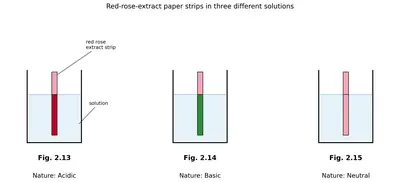
Solution
Concept used : Rose-petal (china-rose) extract behaves as a natural indicator.
- In an acidic medium the rose strip turns dark pink / magenta.
- In a basic medium the rose strip turns green.
- In a neutral medium the rose strip shows no colour change (remains light pink).
Step-by-step identification
| Figure | Colour observed on the strip | Inference about the solution |
|---|---|---|
| Fig. 2.13 | Dark pink / red | Acidic |
| Fig. 2.14 | Green | Basic |
| Fig. 2.15 | No change | Neutral |
Hence, comparing the colour change with the indicator key, we label the three containers as containing acidic, basic, and neutral solutions respectively.
Answer
- Fig. 2.13 : acidic solution
- Fig. 2.14 : basic solution
- Fig. 2.15 : neutral solution
4
A liquid sample from the laboratory was tested using various indicators:
| Indicator | Red litmus | Blue litmus | Turmeric |
|---|---|---|---|
| Change | No change | Turned red | No change in colour |
Based on the tests, identify the acidic or basic nature of the liquid and justify your answer.
Solution
Step 1 : Recall of indicator behaviour
- If a substance is acidic, it
• turns blue litmus red,
• gives no change to red litmus (it is already red),
• gives no change to turmeric paper. - If a substance is basic, it
• turns red litmus blue,
• gives no change to blue litmus,
• turns turmeric paper a brown-red colour. - A neutral substance brings no change to any of the three indicators.
Step 2 : Analyse each observation
| Indicator used | Observation given | What this tells us |
|---|---|---|
| Red litmus | No change | Could be acidic or neutral (a base would turn it blue). |
| Blue litmus | Turns red | Only an acid turns blue litmus red. |
| Turmeric paper | No change | Bases alone give a reddish-brown colour; so “no change” again rules out a base. |
Step 3 : Arrive at a single conclusion
The decisive test is with blue litmus: it changed from blue to red, which happens only in an acidic medium. All other observations (no change with red litmus and turmeric) are fully consistent with an acid.
Therefore, the liquid sample is acidic in nature.
Answer
The liquid is acidic, because only an acid turns blue litmus red while leaving red litmus and turmeric unchanged.
5 Manya is blindfolded. She is given two unknown solutions to test and determine whether they are acidic or basic. Which indicator should Manya use to test the solutions and why?
Solution
Step 1 | Recall what an indicator does
An acid–base indicator is a substance that gives a detectable change when it is mixed with an acid or a base. The most familiar change is a colour change, e.g. blue litmus $$\rightarrow$$ red in an acid.
Step 2 | Why the usual colour indicators will not help Manya
Because Manya is blind-folded, she cannot rely on any change that must be seen. Indicators such as litmus solution, phenolphthalein or methyl-orange would change colour, but she would not be able to notice it.
Step 3 | Look for an indicator that gives a change she can sense while blind-folded
Besides colour indicators, there is another group called olfactory (smell) indicators. These indicators do not change colour; instead, their odour becomes stronger, weaker or disappears when they are added to an acidic or a basic solution.
- Onion extract: its characteristic smell remains in an acid but vanishes in a base.
- Vanilla essence: sweet vanilla smell stays in acid but is lost in base.
- Clove oil: the clove smell persists in acid but disappears in base.
Step 4 | Selecting the most convenient olfactory indicator
All the above olfactory indicators work, yet onion extract is the one most often suggested at school level because it is inexpensive, safe, and already mentioned in the NCERT activity on natural indicators.
Step 5 | How Manya can now test the two unknown solutions
- Put a few drops of freshly prepared onion juice on separate strips of plain filter paper and allow them to dry. The paper now has a strong onion smell.
- Dip one treated strip into each unknown solution for a few seconds and take it out.
- Smell the strip immediately:
- If the onion smell is still present, the solution in which the strip was dipped is acidic.
- If the onion smell has disappeared, the solution is basic.
Conclusion
Since she cannot see, Manya should use an olfactory indicator such as onion juice. The presence or disappearance of its smell will allow her to identify whether each unknown solution is acidic or basic without needing to look at any colour change.
Answer
Use an olfactory (smell) indicator—for example, onion juice. Because its odour remains in an acid but disappears in a base, Manya can distinguish the two solutions by smelling the treated strips even while blind-folded.
6 Could you suggest various materials which can be used for writing the message on the white sheet of paper (given at the beginning of the chapter) and what could be in the spray bottle? Make a table of various possible combinations and the colour of the writing obtained.
Solution
Step 1 – Recall what makes the hidden message appear
The paper looks blank at first because the material used for writing is either
- colourless itself or
- coloured only in the presence of an acid / a base / a special indicator.
When we spray another liquid on the sheet, the writing comes in contact with an acid or a base (opposite in nature to the writing material) or with an indicator. The resulting chemical interaction produces a visible colour.
Step 2 – Choose indicators that a Class–7 student can find at home or in the school laboratory
- Turmeric solution (natural indicator)
- China-rose (hibiscus) petal extract (natural indicator)
- Litmus solution (prepared from lichens)
- Phenolphthalein solution (laboratory indicator, colourless in acids but pink in bases)
- Methyl-orange solution (laboratory indicator, yellow in base, red in acid)
Step 3 – Select everyday acids and bases
- Acids : lemon-juice (citric acid), orange-juice, vinegar (acetic acid), soda-water (carbonic acid)
- Bases : baking-soda solution ( $$\mathrm{NaHCO_3}$$ ), washing-soda solution ( $$\mathrm{Na_2CO_3}$$ ), soap or detergent solution (mild base), household ammonia (window cleaner)
Step 4 – Work out colour changes
Each indicator shows a characteristic colour change, for example
- Turmeric → yellow normally, reddish-brown in a base.
- China-rose extract → pink in acid, green in base.
- Phenolphthalein → colourless in acid / neutral, deep pink in base.
- Litmus → blue litmus turns red in acid; red litmus turns blue in base.
- Methyl-orange → yellow in base, orange-red in acid.
Step 5 – Prepare the table of possible combinations
| S. No. | Material used for writing on paper (colourless when dry) | Liquid filled in the spray bottle | Reason for colour change | Colour that finally appears |
|---|---|---|---|---|
| 1. | Colourless phenolphthalein solution | Soap / dilute $$\mathrm{Na_2CO_3}$$ solution (basic) | Base converts colourless phenolphthalein ( $$\mathrm{PhH}$$ ) to pink $$\mathrm{Ph^-}$$ ion. | Bright pink letters |
| 2. | Baking-soda solution (mild base) $$\mathrm{NaHCO_3}$$ | Turmeric water (indicator) | Turmeric turns reddish-brown in a basic medium. | Reddish-brown letters |
| 3. | Lemon-juice / vinegar (acid) | Blue litmus solution | Acid changes blue litmus to red. | Red letters on blue-tinged sheet |
| 4. | Soap solution (base) | China-rose (hibiscus) petal extract | Hibiscus indicator becomes green in basic medium. | Green letters |
| 5. | Soda-water ( $$\mathrm{H_2CO_3}$$ , weak acid) | Methyl-orange solution | Methyl-orange turns orange-red in acid. | Orange-red letters |
| 6. | Dilute ammonia (base) (school lab) | Red litmus solution | Base converts red litmus to blue. | Blue letters |
Step 6 – How to perform any one combination safely
- Dip a cotton-bud (earbud) in the writing solution, write your message on white chart-paper and let it dry. It will look invisible or very faint.
- Fill the spray bottle with the chosen revealing liquid.
- Hold the sheet vertically and spray a fine mist from about 20 cm away so that the paper becomes just moist, not wet.
- Within seconds the letters develop the colour mentioned in the table.
Note : Use only dilute household solutions, protect eyes, and wash hands after the activity.
Answer
| Writing material | Liquid in spray bottle | Colour obtained |
|---|---|---|
| Phenolphthalein solution (colourless) | Soap / $$\mathrm{Na_2CO_3}$$ solution (base) | Bright pink |
| Baking-soda solution (base) | Turmeric water | Reddish-brown |
| Lemon-juice or vinegar (acid) | Blue litmus solution | Red |
| Soap solution (base) | China-rose petal extract | Green |
| Soda-water / citric acid (weak acid) | Methyl-orange solution | Orange-red |
| Ammonia solution (base) | Red litmus solution | Blue |
7 Grape juice was mixed with red rose extract; the mixture got a tint of red colour. What will happen if baking soda is added to this mixture? Justify your answer.
Solution
Step 1 – Recognising the substances
Grape juice is known to be mildly acidic because it contains organic acids such as tartaric and malic acid. Baking soda is the common name for sodium hydrogen-carbonate, $$\mathrm{NaHCO_3}$$, which is a weak base.
Step 2 – Understanding the behaviour of the indicator (red-rose / china-rose extract)
The red-rose (actually china-rose) extract works as a natural acid–base indicator:
- In an acidic medium it shows a reddish / magenta colour.
- In a basic medium it turns green (sometimes greenish-yellow).
Step 3 – Explaining the first observation
When red-rose extract was mixed with grape juice the liquid obtained a red tint. This confirms that the original mixture is acidic.
Step 4 – Adding baking soda
When we add baking soda, the base $$\mathrm{NaHCO_3}$$ reacts with the acids present in the grape juice:
\[\mathrm{NaHCO_3\;+(acid)\;\longrightarrow\;Na^+\;+\;CO_2\uparrow\;+\;H_2O}\]
The hydrogen ions $$\mathrm{H^+}$$ that made the solution acidic are neutralised, so the mixture shifts from the acidic region towards the basic region of the pH scale.
Step 5 – Predicting the colour change
Because the medium becomes basic, the china-rose indicator must switch to its basic colour. Hence the red colour will gradually disappear and the mixture will acquire a greenish hue (the exact shade depends on the amount of baking soda added).
Conclusion
On adding baking soda the red-tinted mixture will turn green. This happens because baking soda neutralises the acids in grape juice, changing the indicator from its acidic (red) colour to its basic (green) colour.
Answer
The red colour will change to green because baking soda (a base) neutralises the acids in the grape juice, so the china-rose indicator shifts from its acidic red shade to its basic green shade.
8 Keerthi wrote a secret message to her grandmother on her birthday using orange juice. Can you assist her grandmother in revealing the message? Which indicator would you use to make it visible?
Solution
Step 1 – Identify the nature of the invisible ink
Keerthi used orange juice. The sour taste of oranges is due to the presence of citric acid, $$\mathrm{C_6H_8O_7}$$, so the dry traces on the paper are acidic.
Step 2 – Recall how common indicators behave
- Blue litmus → turns red in an acid.
- Red litmus → no colour change in an acid.
- Phenolphthalein → colourless in an acid.
- Turmeric paper → shows a change only with a base, not with an acid.
Step 3 – Choose the indicator that will give a visible contrast
Because the writing is acidic, we must use an indicator that gives a different, easily seen colour in the presence of an acid. Blue litmus fits this requirement because it will change from blue to red exactly along the strokes of citric acid.
Step 4 – Procedure for Grandmother
- Prepare a dilute blue-litmus solution (or simply wet a piece of blue-litmus paper and squeeze it gently to get a few drops).
- With a soft brush, lightly paint the litmus solution over the sheet that contains the dried message.
- Where the orange-juice traces are present, the blue colour will quickly turn red; the rest of the sheet remains blue. The contrast reveals the secret message.
Why it works
The reaction is purely visual: the hydrogen ions in the citric acid lower the pH of the moist layer on the paper. Blue litmus shows this by changing colour to red, so the message stands out against the unaffected blue background.
Answer
Brush the paper with blue litmus (solution or paper). The acidic orange-juice strokes turn the blue litmus red, making the hidden message visible.
9 How can natural indicators be prepared? Explain by giving an example.
Solution
What is an indicator?
Substances that show one colour in an acidic medium and another colour in a basic medium are called acid–base indicators.
How to prepare a natural indicator
- Choose a plant part that contains a colour-changing dye
• red/China-rose (hibiscus) petals
• turmeric rhizome
• red-cabbage leaves, etc. - Crush or cut the material finely to expose more surface area.
- Extract the pigment
• Put the pieces in a beaker.
• Add just enough warm distilled water (or ethanol).
• Stir for a few minutes until the liquid becomes coloured. - Filter to remove the solid pieces. The clear coloured filtrate is the liquid natural indicator.
- (Optional) Prepare indicator paper
• Dip clean strips of filter paper into the filtrate.
• Dry the strips. They now work exactly like litmus paper.
Example : China-rose (hibiscus) indicator
- Preparation : Crush 5–6 fresh hibiscus petals, soak them in 50 mL warm water, stir, then filter.
- Colour change
| Medium tested | Colour of the hibiscus extract |
|---|---|
| Acidic (e.g. lemon juice) | Bright pink / magenta |
| Basic (e.g. baking-soda solution) | Green |
| Neutral (distilled water) | No change (remains light pink) |
Because the pigment anthocyanin inside the petals reversibly changes colour with pH, the extract clearly distinguishes between acids, bases and neutral solutions. In the same way, many other plant materials can be used to prepare natural indicators.
Answer
Crush a coloured plant material, dissolve the pigment in a little warm water, filter off the solids and use the clear filtrate as the indicator. For instance, an extract of China-rose (hibiscus) petals is light pink; it turns bright pink in acids and green in bases, so it can be used to test whether a substance is acidic, basic or neutral.
10 Three liquids are given to you. One is vinegar, another is a baking soda solution, and the third is a sugar solution. Can you identify them only using turmeric paper? Explain.
Solution
Facts you need
- Turmeric is a natural indicator. In an alkaline medium its yellow colour changes to reddish-brown, while in acidic or neutral media it stays yellow.
- Among the three unknown liquids
• Vinegar is acidic (main acid: $$\mathrm{CH_3COOH}$$).
• Baking-soda solution is basic (contains $$\mathrm{NaHCO_3}$$, a mild base).
• Sugar solution is neutral.
Step 1 – Find the basic liquid
- Take three fresh strips of turmeric paper.
- Dip one strip into each liquid and note the colour.
Observation
- Only one strip turns reddish-brown. That liquid is baking-soda solution (basic).
- The other two strips remain yellow, so those liquids are either acidic or neutral.
Step 2 – Distinguish acid from neutral using the colour-reversal test
- Keep the reddish-brown strip obtained in Step 1. Cut it into two small pieces so that both pieces are already brown (alkaline).
- Rinse one brown piece in each of the remaining two liquids.
Observation
- The piece dipped in one liquid turns back to bright yellow. That liquid is vinegar because its acid neutralises the base on the paper, bringing the medium back to acidic.
- The piece dipped in the other liquid stays reddish-brown. That liquid is the sugar solution because it is neutral and cannot alter the alkaline colour.
Conclusion
| Behaviour with turmeric paper | Identity of the liquid |
|---|---|
| Turns paper reddish-brown | Baking-soda solution |
| Turns that brown paper back to yellow | Vinegar |
| No change in either test | Sugar solution |
Thus, by only using turmeric indicator, all three liquids can be correctly identified.
Answer
Baking-soda solution → makes turmeric paper reddish-brown.
Vinegar → changes that brown paper back to yellow (acidic).
Sugar solution → causes no colour change at any stage (neutral).
11 The extract of red rose turns the liquid X to green. What will the nature of liquid X be? What will happen when excess of amla juice is added to liquid X?
Solution
Step 1 · Recall how the red-rose indicator behaves
Many coloured flower extracts (china-rose, red-rose, etc.) behave like natural acid–base indicators:
- in an acidic medium they show shades of red / magenta,
- in a basic (alkaline) medium they turn green.
Step 2 · Decide the nature of liquid X
Because only a base makes the red-rose indicator go green, liquid X must be basic in nature (an alkali).
Step 3 · What is present in amla juice?
Amla (Indian gooseberry) is rich in vitamin C (ascorbic acid) and several other organic acids, so amla juice is a strongly acidic liquid.
Step 4 · Predict the effect of adding amla juice to a base
When an acid is added to a base, a neutralisation reaction takes place:
$$\text{Acid} + \text{Base} \; \longrightarrow \; \text{Salt} + \text{Water}.$$
If we go on adding the acid, the basic solution will first be neutralised; after the equivalence point any further acid will make the mixture acidic.
Step 5 · Resulting colour change
• Initially the indicator in liquid X is green (basic).
• On adding amla juice, the base is neutralised; the green colour fades.
• With excess amla juice the solution becomes acidic, so the indicator finally shows a red / magenta colour.
Conclusion
Liquid X is basic. Excess amla juice (acid) will neutralise it and, beyond the neutral point, turn the mixture reddish-pink; in other words the green colour will disappear and change to red.
Answer
Liquid X is basic. Adding a little amla juice will start neutralising it; when amla juice is added in excess, the mixture becomes acidic and the red-rose indicator changes from green back to reddish-pink.
12
Observe and analyse the information given in the following flowchart. Complete the missing information.
- Imagine a garden with plants showing signs of poor health.
- The soil can be _____ in nature. / The soil can be _____ in nature.
- Which indicator can be used to test the nature of the soil? _____________
- The acidic soil can be treated with _____________.
- The basic soil can be treated with _____________.
Solution
Step 1 – Recall the possible nature of soil
Just like any other substance, soil can show acidic, basic or neutral behaviour.
Because the plants in the garden are unhealthy, the gardener first assumes that either too much acid or too much base is present. Hence the two possibilities are:
- Soil is $$\text{acidic}$$ in nature or
- Soil is $$\text{basic}$$ in nature.
Step 2 – Choosing an indicator to find the nature of the soil
To know whether the soil sample is acidic or basic, we dissolve a little soil in water and test the solution with an indicator. The simplest and most easily available indicator for such a test, as mentioned in the Class 7 text, is litmus paper (red and blue litmus).
Step 3 – Correcting an acidic soil
If the indicator shows that the soil is acidic, a base has to be added to neutralise the excess acid. Farmers usually add:
- quick lime $$\bigl(\mathrm{CaO}\bigr)$$, or
- slaked lime $$\bigl(\mathrm{Ca(OH)_2}\bigr).$$
Step 4 – Correcting a basic soil
When the soil turns out to be basic, an acid-forming substance is needed. The safest way is to add organic matter such as compost or well-rotted manure. While decomposing, it produces mild natural acids that lower the pH and bring the soil back towards neutral.
Filled-in flow-chart
| Situation | Action / Remedy |
|---|---|
| The soil can be acidic in nature | Add quick lime or slaked lime |
| The soil can be basic in nature | Add organic matter (compost / manure) |
Indicator used : Litmus paper (red & blue)
Answer
acidic; basic | litmus paper | quick lime / slaked lime | organic matter (compost / manure)
Dive Deeper Aman accidentally spilt vinegar on some pieces of an eggshell or marble and noticed bubbling. He then poured a soap solution on another piece of eggshell or marble, but no bubbles appeared. Why did bubbles occur with vinegar but not with soap solution?
Solution
Step 1 – Recall the main components
- Egg-shells and marble are made chiefly of calcium carbonate; write it as $$\mathrm{CaCO_3}$$.
- Vinegar is a dilute solution of the weak acid acetic acid; write it as $$\mathrm{CH_3COOH}$$.
- “Soap solution” is slightly basic because soaps are sodium or potassium salts of long-chain fatty acids; the solution therefore shows the behaviour of a base.
Step 2 – State what happens when an acid meets a carbonate
A general fact you have already met in this chapter is:
“All acids react with metal carbonates to give a salt, water and carbon-dioxide gas.”
The appearance of the escaping $$\mathrm{CO_2}$$ gas is observed as bubbling / effervescence.
Step 3 – Write the specific chemical reaction for vinegar and eggshell / marble
Here the acid is acetic acid and the carbonate is calcium carbonate, so in symbols:
\[\mathrm{CaCO_3 + 2\,CH_3COOH \;\longrightarrow\; (CH_3COO)_2Ca + H_2O + CO_2\uparrow}\]The upward arrow ( ↑ ) reminds us that carbon-dioxide leaves as a gas, forming bubbles.
Step 4 – Explain why nothing similar happens with soap solution
- A basic (alkaline) solution does not attack calcium carbonate under ordinary conditions.
- Therefore no new products, and especially no gas, are produced when soap solution is poured on the shell or marble.
- With no gas, there can be no bubbles or effervescence.
Step 5 – Conclude
Bubbles appeared in the first case because vinegar is an acid and acids liberate carbon-dioxide from carbonates; they did not appear in the second case because soap solution is basic and bases do not react with carbonates in that fashion.
Answer
Vinegar is acidic, so it reacts with the calcium carbonate in the eggshell / marble to form a salt, water and carbon-dioxide gas; the escaping CO2 shows up as bubbles. Soap solution is basic and does not react with calcium carbonate, hence no gas and no bubbles are produced.


