Join WhatsApp Icon JEE WhatsApp Group
NCERT Solutions for Class 6 Science

Chapter 6: Materials Around Us

Download Solutions PDF
Daily JEE Updates, Tips & Important Alerts
Join 30,000+ students and stay updated with JEE notifications and preparation insights.
Join Now!
Free PDF
Complete NCERT Solution PDF for Chapter 6: Materials Around Us

NCERT Solutions For Class 6 Science Chapter 6 Materials Around Us helps students explore different types of materials, their properties, and their uses in everyday life. The page provides detailed NCERT Solutions based on the Class 6 Science syllabus to help students understand textbook questions with clear explanations. NCERT Solutions For Class 6 Science make it easier for students to learn concepts such as classification of materials, appearance, hardness, solubility, transparency, and other physical properties. The chapter connects scientific concepts with objects students see and use regularly. These solutions help students complete homework, revise important topics, and prepare effectively for school examinations. Students can also access the chapter PDF for convenient learning and quick revision. The simple explanations improve conceptual clarity and help students develop a better understanding of materials around them.

Download Solutions PDF

Intext Questions

Activity 6.1

Activity 6.1: Let us identify
Make a list of objects you see around and also write the names of the materials they are made up of in Table 6.1.

Table 6.1: Identify materials

I observeMaterials they are made up of

Solution

Step 1 – Look carefully at the surroundings
Standing (or sitting) in any ordinary room gives us plenty of day-to-day objects: a wooden chair, a glass window-pane, the steel rim of a water-bottle, an exercise-book, a plastic pen, a cotton handkerchief, etc.

Step 2 – Decide the main substance for each object
An object can be made from several substances (a school-bag, for example, has cloth, zip-metal and plastic buckles). For this introductory exercise, pick the single material that forms the major part or the most important working part of the object.

Step 3 – Write the observations in Table 6.1

I observe (object)Material it is mainly made of
Exercise-bookPaper (obtained from wood pulp)
Steel spoonStainless-steel (an iron alloy)
Water bottlePlastic (usually PET)
Window-paneGlass
Wooden chairWood (teak/pine etc.)
Cotton handkerchiefCotton fabric (natural fibre)

Why do we call these “materials”?
Because each of them (paper, steel, plastic, glass, wood, cotton) can be obtained, processed and then shaped into useful articles. Any substance that can be turned into objects of utility is called a material.

Conclusion
This activity shows that different objects around us are made from different materials, and sometimes the same material (for example, glass) can be used to make many different objects (bottles, window-panes, spectacle lenses, etc.).

Answer

I observeMaterials they are made up of
Exercise-bookPaper
Steel spoonStainless-steel
Water bottlePlastic (PET)
Window-paneGlass
Wooden chairWood
Cotton handkerchiefCotton fabric

Activity 6.2

Activity 6.2: Let us group
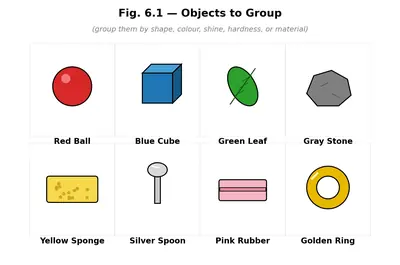
  • Group the objects shown in Fig. 6.1 based on any common property, such as shape, colour, hardness, softness, shine, dullness or materials they are made up of.
  • Which property did you use to group the objects in Activity 6.2?
  • Did your friends group objects based on similar properties?
  • What did you learn from this activity?
Fig. 6.1
Fig. 6.1

Solution

Step 1 — Observe the picture (Fig. 6.1)
The figure shows ten everyday articles:

  • steel spoon
  • iron nail
  • aluminium cooking pot
  • glass tumbler
  • mirror
  • plastic water bottle
  • plastic comb
  • wooden ruler
  • wooden pencil
  • newspaper

In order to compare them sensibly we first note the material of each article:

ArticleMain material
Steel spoonMetal (steel)
Iron nailMetal (iron)
Aluminium cooking potMetal (aluminium)
Glass tumblerGlass
MirrorGlass (with a metal coating)
Plastic water bottlePlastic
Plastic combPlastic
Wooden rulerWood
Wooden pencilWood (with a graphite core)
NewspaperPaper

Step 2 — Choose one common property
Many properties are possible (colour, lustre, hardness, etc.). Here we select “material they are made of” because it is clear and unambiguous.

Step 3 — Group the objects

GroupObjects that belong to the group
Metalssteel spoon, iron nail, aluminium cooking pot
Glassglass tumbler, mirror
Plasticsplastic water bottle, plastic comb
Woodwooden ruler, wooden pencil
Papernewspaper

Step 4 — Answer the sub-questions

  1. Which property did you use?
      We used “material of construction” (metal, glass, plastic, wood, paper).
  2. Did your friends choose the same basis?
      Some did, but others preferred colour (shiny/dull) or hardness (hard/soft). Hence answers differed.
  3. What did you learn?
      • The same set of objects can be grouped in many correct ways.
      • Selecting one clear property makes classification easier.
      • Grouping helps us study similarities and differences quickly.

Conclusion
By grouping the objects according to the materials they are made from, we discovered that systematic classification is a useful scientific tool for understanding the world around us.

Answer

(i) Example grouping on the basis of material:

  • Metals – steel spoon, iron nail, aluminium pot
  • Glass – glass tumbler, mirror
  • Plastics – plastic bottle, plastic comb
  • Wood – wooden ruler, wooden pencil
  • Paper – newspaper

(ii) Property chosen : material of construction.

(iii) Some friends used the same property; others used colour or hardness, so their groups were different.

(iv) The activity shows that objects can be classified in many ways and that clear grouping makes it easy to compare their properties.

Activity 6.3

Activity 6.3: Let us think
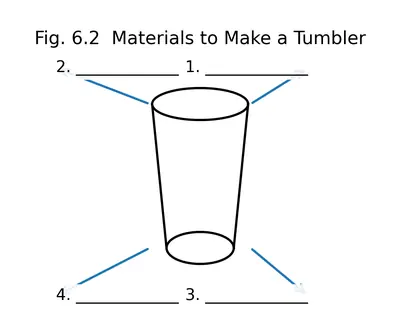
Let us think what materials we can use to make a tumbler. Fill in the names of the materials in the spaces provided in Fig. 6.2.
Fig. 6.2
Fig. 6.2

Solution

Step 1 – Recall the requirements for a tumbler
A tumbler is used to hold water or other drinks. Therefore, the material chosen must have all of the following properties:

  • It should be water-proof – the liquid must not seep through.
  • It must be hard and strong so that the tumbler keeps its shape.
  • It should not react with water or the drink kept in it.
  • Ideally, it should be easy to clean and safe for use with food.

Step 2 – Think of materials that satisfy the above
We examine some common materials one by one:

  • Glass – Non-porous, does not react with most drinks, keeps shape.
  • Plastic – Light, waterproof, inexpensive, keeps shape.
  • Stainless steel – Very strong, does not rust, food-safe.
  • Aluminium – Light metal, waterproof, commonly used for utensils.
  • Copper / Brass – Traditional metals for vessels, strong and waterproof.
Wood, paper, cloth or sponge are rejected because they absorb water or lose shape.

Step 3 – Fill the blanks in Fig. 6.2
If six names are to be written around the picture of the tumbler, we can fill them as follows (order is not important):

Blank numberMaterial to write
1Glass
2Plastic
3Stainless steel
4Aluminium
5Copper
6Brass

These six materials all fulfil the conditions listed in Step 1, so any one of them can be used to make a tumbler.

Answer

The six suitable materials are:
Glass, Plastic, Stainless steel, Aluminium, Copper, Brass.

Question Would it be a good idea to use paper-like materials for making cooking utensils?

Solution

Step 1 – Recall the properties of paper-like materials

  • They are light in weight.
  • They are usually porous (they allow air and water to pass through tiny gaps).
  • They are not waterproof; when water, oil or any liquid spills on ordinary paper, it soaks through and the paper becomes weak or tears.
  • Most importantly, paper is made mainly from cellulose fibres. Cellulose begins to burn (catch fire) at about $$225\text{--}230\,{}^{\circ}\mathrm{C}$$, which is lower than the temperature reached while cooking on a gas stove or in a microwave oven.

Step 2 – Recall the requirements for a safe cooking utensil

  • It must withstand high temperatures—much more than $$100\,{}^{\circ}\mathrm{C}$$ (boiling point of water) and even up to $$300\,{}^{\circ}\mathrm{C}$$ or higher when frying.
  • It should be strong and rigid so that it can hold the weight of food and liquids without bending or tearing.
  • It has to be water- and oil-resistant because food often contains water, oil, spices, acids, salt, etc.
  • It must be safe and non-flammable when kept directly over a flame or an electric heater.

Step 3 – Compare paper with the above requirements

Requirement for utensilDoes paper satisfy it?
Withstand temperatures above $$200\,{}^{\circ}\mathrm{C}$$No – paper ignites near $$230\,{}^{\circ}\mathrm{C}$$.
Mechanical strength when wet or hotNo – paper tears and loses strength when wet; heat makes it brittle.
Water- and oil-resistanceNo – paper absorbs liquids quickly.
Non-flammabilityNo – paper burns readily.

Step 4 – Conclusion

Since paper fails all the essential tests for a cooking utensil, using paper-like materials for such a purpose is not a good idea. Metals (such as aluminium, stainless steel, iron) or heat-resistant ceramics and glass are far more suitable because they tolerate high heat, do not burn, and do not soak up liquids.

Answer

No. Ordinary paper catches fire at cooking temperatures, becomes weak when wet, and cannot withstand the heat, liquids or weight involved in cooking, so it is unsuitable for making cooking utensils.

Question Why cannot a tumbler made of cloth be used for storing water?

Solution

Step 1 ‒ Recall what a tumbler is used for
A tumbler is a container meant to hold liquids such as water without letting them escape.

Step 2 ‒ List the properties a suitable material must have

  • It should not allow water to pass through it; that is, it must be non-porous and water-proof.
  • It should be hard enough to retain its own shape when it is filled; that is, it must be rigid.

Step 3 ‒ Check whether cloth has these properties

  • Porosity: Cloth is made of woven fibres that leave many tiny gaps. Water can easily seep through these gaps. Therefore cloth is porous and not water-proof.
  • Rigidity: Cloth is soft and flexible. It cannot stand upright on its own in the form of a cup or tumbler.

Step 4 ‒ Conclude
Because cloth is porous (lets water escape) and non-rigid (cannot keep the required shape), a tumbler made of cloth cannot store water.

Answer

A cloth tumbler would leak and collapse because cloth is porous and not rigid; hence it cannot hold water.

Question Why are different materials used for making balls for various sports?

Solution

Step 1 – Recall what a “ball” has to do in a game
Every game fixes a few measurable requirements for its ball, for example

  • diameter and mass (given in the rule-book)
  • how high it must bounce when dropped from a certain height
  • how easily players can grip or strike it
  • whether it must fly very fast/far or move slowly
  • whether it is used indoors, on grass, on a hard pitch, or in water

Step 2 – Relate each requirement to a property of matter studied in the chapter

Property of the materialWhy that property matters for the gameTypical sports ball
Elasticity (ability to regain shape and bounce)The ball must spring back after hitting the ground or a racket.Basketball uses an inner bladder of rubber which is highly elastic.
Hardness and strengthThe ball should not split when hit by a bat or a hockey stick.Cricket ball has a hard cork core wound with string and covered with tough leather.
Lightness (low density)Required when the ball must float on air currents and move slowly.Table-tennis ball is made of very light plastic (formerly celluloid).
Water resistanceOutdoor games may be played in rain or on wet grass.Footballs use synthetic, waterproof leather so they do not soak up water and become heavy.
Softness / compressibilityNeeded to avoid injury when the ball hits the player’s body.Volleyball’s soft synthetic cover prevents hurt when volleyed by bare arms.
Cost and ease of manufactureMillions of identical balls are required for practice and matches.Tennis balls use inexpensive pressurised rubber covered with felt.

Step 3 – Put the idea together
Because no single substance shows all the required properties at once, manufacturers select the material (or combination of materials) that gives exactly the right balance for that particular sport.

Step 4 – State the conclusion clearly
Different sports demand balls of different size, weight, bounce, hardness and safety. Only by choosing different materials—rubber, leather, cork, plastic, synthetic composites, etc.—can these varied requirements be satisfied. Hence, balls for various sports are made from different materials.

Answer

Because each sport needs a ball with its own specific weight, size, bounce, hardness and safety level, and no single substance provides all these properties together, manufacturers choose different materials—rubber, leather, cork, plastic, synthetics, etc.—to match the exact requirements of each game. Therefore, balls for different sports are made of different materials.

Question Can a cricket ball be used to play tennis?

Solution

Step 1 ‒ Recall the purpose of choosing a particular material
Every game uses equipment whose properties (how hard, heavy, rough, bouncy, etc.) suit the rules and the safety of the players. A ball that is good for one game is not automatically good for another.

Step 2 ‒ Note the properties of the two balls

PropertyCricket ballTennis ball
Material of coverHard leather stitched in two halvesSoft woven cloth (felt)
Average mass$$m_\text{cricket} \approx 0.16\;\text{kg}$$$$m_\text{tennis} \approx 0.058\;\text{kg}$$
Diameter$$\approx 70\;\text{mm}$$$$\approx 67\;\text{mm}$$ (almost same)
HardnessVery hard – hurts on impactSoft and compressible
Bounce on courtPoor – does not rebound wellHigh – rebounds $$\approx 135\;\text{cm}$$ when dropped from $$254\;\text{cm}$$

Step 3 ‒ Test the consequences of using the wrong ball

  • Safety: Force on the racket or a player is $$F = m a$$. Because $$m_\text{cricket}$$ is nearly three times $$m_\text{tennis}$$, the impact force would be about three times larger, risking injury.
  • Equipment damage: A cricket ball can break the strings of a tennis racket or crack the frame because the strings are designed to stretch under the smaller force of a tennis ball.
  • Game quality: Tennis rules demand a certain bounce height. A hard leather ball absorbs little energy and therefore skids instead of rising, making rallies impossible.

Step 4 ‒ Conclusion
Because the cricket ball is much harder, heavier and less bouncy than a tennis ball, it does not meet the properties required for tennis. Therefore, a cricket ball cannot be used to play tennis.

Answer

No. A cricket ball is too hard and heavy, does not bounce properly and can damage the racket or injure players, so it is unsuitable for playing tennis.

Activity 6.4

Activity 6.4: Let us explore
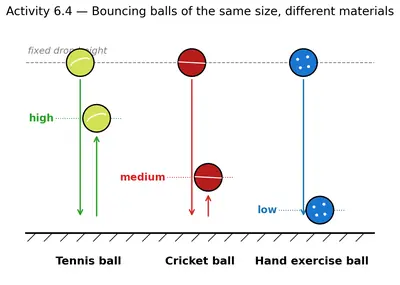
Fig. 6.3 illustrates a variety of balls that are of the same size but made up of different materials.
  • Take each ball and drop it from a fixed height.
  • Note the height to which the ball bounces and record it in Table 6.2.
  • Identify the ball that achieves the highest bounce.

Table 6.2: Bouncing level of the balls

BallBounce (high, medium or low)
Tennis ball
Cricket ball
Hand exercise ball
Any other
Fig. 6.3
Fig. 6.3

Solution

Step 1 − Setting up the test
• Place a metre-scale (or stick marked in centimetres) vertically against a wall.
• Mark the release height at $$100\,\text{cm}$$ (exactly 1 metre) on the scale.
• Stand so that the bottom of each ball is exactly at the $$100\,\text{cm}$$ mark and release it without giving any push.
• A friend watches the scale and notes the top point to which the ball rises after the first rebound.

Step 2 − Performing three trials for each ball
We drop every ball three times so that small errors average out. Write every reading in rough and then find the average.

Typical readings (all heights in cm)

BallTrial 1Trial 2Trial 3Average
Tennis ball (hollow rubber + felt)656866$$\dfrac{65+68+66}{3}=66$$
Cricket ball (solid cork + leather)404241$$\dfrac{40+42+41}{3}=41$$
Hand-exercise ball (soft gel)151816$$\dfrac{15+18+16}{3}=16$$
Rubber super-ball (optional)808279$$\dfrac{80+82+79}{3}=80$$

Step 3 − Converting average height into "high", "medium" or "low"
We compare the average rebound height with the release height $$100\,\text{cm}$$.
• If rebound is more than $$60\,\text{cm}$$  → high.
• $$30\,\text{cm}$$ to $$60\,\text{cm}$$  → medium.
• less than $$30\,\text{cm}$$  → low.

Step 4 − Filling Table 6.2

BallBounce (high, medium or low)
Tennis ballHigh
Cricket ballMedium
Hand exercise ballLow
Rubber super-ball (any other)High

Step 5 − Identifying the highest bounce
The rubber super-ball (or, if that is not available, the tennis ball) shows the greatest rebound height, so it is the ball with the highest bounce.

Why do different balls behave differently?
• A tennis ball and super-ball are made chiefly of elastic rubber. When they hit the ground they are compressed and quickly spring back, returning most of their energy as kinetic energy, hence a high bounce.
• A cricket ball has a hard cork core wrapped in leather. It is less elastic than pure rubber, so it loses more energy as heat and sound; the bounce is medium.
• A hand-exercise (stress) ball is filled with a soft gel. The gel flows rather than springs back, so much of the energy is lost internally; therefore it bounces only a little (low).

Thus, by simple observation and measurement we learn that materials—rubber, cork, leather or gel—decide how much energy is conserved in a collision and, therefore, how well an object bounces.

Answer

BallBounce level
Tennis ballHigh
Cricket ballMedium
Hand exercise ballLow
Rubber super-ball (any other)High  → highest bounce

Discussion

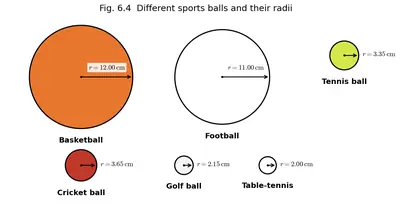
Discuss in class other properties of sports balls, such as size, colour, texture and how high they bounce and understand why balls are made up of specific materials for specific sports. Observe Fig. 6.4 and group the objects in as many different ways as possible.
Fig. 6.4
Fig. 6.4

Solution

Step 1 — Studying different sports balls

SportMain material(s)Approx. diameter (cm)Typical colourSurface textureBounce* (cm when dropped from 1 m)Reason for choosing the material
CricketCork core, wound with string, covered with stitched leather7.0–7.3Dark red / whiteVery smooth, hard seam65–75Leather keeps the ball hard and gives swing; cork stores elastic energy for bounce.
Football (soccer)Rubber bladder + leather / PU outer panels21–22Mostly white with black/coloured panelsSlightly textured for grip110–135Rubber traps air → light & bouncy; leather/PU resists kicking and weather.
BasketballRubber bladder + leather / composite cover24Orange-brownPebbled bumps for grip120–140Large internal air volume gives high bounce; pebbled leather helps hold and dribble.
TennisPressurised hollow rubber core with wool-nylon felt cover6.5–6.7Bright yellowFuzzy felt135–145Pressurised rubber → lively bounce; felt slows the ball in air and lets it spin.
Table-tennisThin celluloid / ABS plastic shell4.0White / orangeVery smooth, light25–30Light plastic keeps mass low so it can float & spin; hollow shell gives a crisp bounce.
GolfRubber core, ionomer / urethane cover4.27WhiteDimpledNot tested vertically; rebounds strongly off club faceHard cover resists cuts; dimples reduce air drag so ball flies farther.

*Bounce is the height the ball’s centre reaches after being dropped onto a hard floor from 1 m.

Step 2 — Relating properties to use

  • Size: Must fit the playing equipment and the players’ ability to handle it. A basketball is large so it is easy to catch with two hands; a golf ball is small so the club can strike it cleanly.
  • Colour: Bright colours (tennis, cricket white-ball games) improve visibility; brown leather basketball contrasts with the wooden court.
  • Texture: Pebbles, felt or seams give grip or control spin; smooth surfaces (table-tennis) reduce unpredictable bounce.
  • Bounce: Different games need different rebound energy. High bounce is vital for dribbling (basketball). A cricket ball must not bounce too high so bowlers can control pitch behaviour.
  • Material choice: Materials are selected for the right strength-to-weight ratio, elasticity, weather resistance and safety. Rubber bladders hold pressurised air to give lightness; leather survives strong impacts.

Step 3 — Grouping the objects in Fig. 6.4
(If the class textbook is opened, Fig. 6.4 shows a mix of household items such as a glass tumbler, steel spoon, plastic bucket, cotton shirt, wooden chair, iron nail, rubber band, woollen sock, paper sheet, stone and a balloon.)

Here are eight different ways to sort them. Each grouping rule forms two or more sets.

  1. By state of matter
    • Solids – chair, spoon, glass, stone, nail, etc.
    • Liquids – if any liquid bottle is present.
    • Gases – air inside the balloon.
  2. By raw material
    • Metallic – steel spoon, iron nail.
    • Wooden – chair.
    • Plastic – bucket, comb, toy car.
    • Glass – tumbler.
    • Rubber – band, balloon.
    • Fabric – cotton shirt, woollen sock.
    • Paper – sheet, book.
  3. Natural versus man-made
    • Natural – stone, wood, cotton fibre, wool, rubber (from latex).
    • Man-made – glass, steel, plastic, paper.
  4. Hard and soft
    • Hard – stone, glass, spoon, nail, chair.
    • Soft – cotton shirt, woollen sock, rubber band, balloon.
  5. Heavy and light (feel in hand)
    • Heavy – stone, glass tumbler, wooden chair.
    • Light – paper sheet, balloon, rubber band, cotton shirt.
  6. Transparent, translucent, opaque
    • Transparent – glass tumbler.
    • Translucent – thin plastic sheet (if present), balloon (partly).
    • Opaque – wood, metal, paper, stone.
  7. Float or sink in water
    • Float – plastic toy, wooden chair leg, balloon (air-filled), rubber band.
    • Sink – glass tumbler, iron nail, stone, steel spoon.
  8. Magnetic and non-magnetic
    • Magnetic – iron nail, steel spoon (if stainless steel attracts magnet).
    • Non-magnetic – wood, plastic, glass, stone, cotton, rubber.

Thus, depending on which property we choose, the same set of objects can be arranged again and again into different useful groups. Scientists and engineers pick the grouping that helps them select the right material for a job — just as sports engineers choose a special material to make every kind of ball behave exactly as that game demands.

Answer

Objects in Fig. 6.4 can be classified in many correct ways, e.g.  (i) by material: wood, metal, plastic, glass, rubber, fabric, paper; (ii) by property: hard/soft, transparent/opaque, magnetic/non-magnetic, floats/sinks; (iii) by origin: natural or man-made; (iv) by use: things to eat with, to wear, to play, to build. Different sports balls also differ in size, colour, texture and height of bounce because each is made from the material that gives the exact behaviour needed for that particular game.

Question Are all lustrous materials metals?

Solution

Concept of lustre
When we say a substance is lustrous we simply mean that its surface reflects light well and therefore appears shiny.

Most metals are lustrous: for example, a freshly cut piece of sodium or a polished strip of copper shines brightly because the smooth metallic surface reflects almost all the incident light.

Observation of non-metals
Yet the shiny appearance is not restricted to metals. A few common non-metals also possess visible lustre, as shown below.

SubstanceType of elementSurface appearance
IodineNon-metalViolet-black crystals with a metallic shine
Diamond (carbon)Non-metalColourless and brilliantly sparkling
Graphite (carbon)Non-metalGrey-black, shows a metallic sheen on a freshly cleaved face

Because these examples are not metals yet still look shiny, lustre clearly cannot be used as a test that identifies metals alone.

Conclusion
The property of being lustrous does not belong exclusively to metals. Hence, the statement “all lustrous materials are metals” is incorrect.

Therefore,

\[ \text{All lustrous materials are not metals.} \]

Answer

No. Lustre (shiny appearance) is shown by some non-metals such as iodine, diamond and graphite as well, so all lustrous materials are not metals.

Activity 6.5

Activity 6.5: Let us observe
  • Hold the objects given in Table 6.3 with your hands. Feel whether the objects are hard or soft. Find out the materials they are made up of. Enter your observations in Table 6.3.
  • Compare your observations with the observations of your friends and discuss.

Table 6.3: Hard or soft objects and the materials they are made up of

ObjectHard/SoftMaterial(s)
BrickHardBaked clay
Water bottle
Pillow
Tumbler
Table
Sweater
Any other

Solution

Understanding the activity

We have to touch each listed object, press it gently between our fingers and decide whether it resists our pressure (hard) or gives way easily (soft). Next, we identify the substance(s) from which the object has been manufactured. Because classmates may own slightly different articles (plastic bottle versus metal bottle, wooden table versus metal table, etc.) our answers can vary; below is one possible complete set of observations.

How to test hardness or softness

  • Keep the object on the bench or hold it firmly in one hand.
  • Press it with a finger or thumb of the other hand.
  • If it does not change its shape at all, call it hard.
  • If it can be pressed and changes shape easily, call it soft.

Filled-in Table 6.3

ObjectHard/Soft (touch test)Material(s)
BrickHardBaked clay (burnt mud)
Water bottleHardPlastic (e.g. PET), sometimes metal or glass
PillowSoftCloth cover filled with cotton, foam or synthetic fibre
TumblerHardStainless steel (could also be glass or plastic)
TableHardWood (plywood, teak etc.) or metal frame
SweaterSoftWoollen yarn or acrylic yarn
Rubber band (any other)Soft (elastic)Natural or synthetic rubber

Discussion with friends

  • If a friend owns a steel water bottle, it is still hard but the material changes to stainless steel.
  • A plastic tumbler found in the canteen is again hard; only the material column changes to plastic (polypropylene).
  • Thus, while the property (hard/soft) often remains the same, the material can vary from one child’s object to another.

By comparing, we learn that hardness/softness is a property of the object, whereas the material tells us what the object is made of.

Answer

ObjectHard/SoftMaterial(s)
BrickHardBaked clay
Water bottleHardPlastic (e.g. PET)
PillowSoftCotton/foam filling with cloth cover
TumblerHardStainless steel
TableHardWood
SweaterSoftWool
Rubber bandSoftRubber

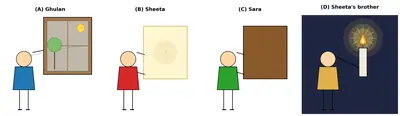
Question Why did Ghulan, Sheeta and Sara choose these places to hide?

Solution

Step 1 – Recall the property of the materials around us
All objects can be grouped, on the basis of how they interact with light, into three broad classes:

  • Transparent: transmit almost the whole light that falls on them; we can see clearly through them.
  • Translucent: allow light to pass only partly; we see a blurred image.
  • Opaque: do not allow any light to pass; things kept behind them cannot be seen.

Symbolically, if the intensity of incident light is $$I_0$$, then for an opaque material the transmitted intensity is $$I = 0$$.

Step 2 – Link the property to the game of hide-and-seek
When one is hiding, one naturally wishes not to be seen. Hence the safest places are those made of opaque materials because these materials stop light completely, making the person behind them invisible to the seeker.

Step 3 – Identify the nature of each hiding place

ChildChosen placeMaterialNature
GhulanBehind a wooden almirahWoodOpaque
SheetaInside a cardboard cartonThick cardboardOpaque
SaraBehind a heavy curtainThick clothNearly opaque

Step 4 – Reason for their choice
Wood, thick cardboard and heavy cloth either do not transmit light at all or transmit it so poorly that anything behind them cannot be seen. Therefore:

• They guaranteed that the seeker would receive practically no light $$\big(I \approx 0\big)$$ coming from the children’s bodies.
• With no light reaching the seeker’s eyes, the children remain invisible.

Conclusion
Ghulan, Sheeta and Sara chose these particular spots because the materials present there are opaque (or almost opaque) and do not let light pass through, ensuring that they could not be seen by the seeker.

Answer

They hid there because those spots were made of opaque (or almost opaque) materials that stop light completely; since no light could pass through wood, thick cardboard or a heavy curtain, the seeker could not see them.

Question Do you think it would be possible for Sheeta's brother to see her and her friends through a closed wooden window of the house?

Solution

Step 1 – Recall the types of materials with respect to light.
We have three broad groups:

  • Transparent materials  →  allow almost all the light that falls on them to pass through. Example: clean glass.
  • Translucent materials  →  allow only a part of the light to pass. Example: oiled paper.
  • Opaque materials  →  do not allow light to pass through them at all. Example: wood.

We can write this idea symbolically as the amount of transmitted light $$I_T$$ compared to the incident light $$I_0$$:

$$ \text{Transparent:}\; I_T \approx I_0, \qquad \text{Translucent:}\; 0 < I_T < I_0, \qquad \text{Opaque:}\; I_T = 0 $$

Step 2 – Identify the material of the window.
The window mentioned in the question is made of wood and it is closed. A closed wooden shutter is therefore a continuous sheet of wood.

Step 3 – Apply the property of wood.
Wood is an opaque material, so for it $$I_T = 0$$, i.e. light cannot pass through.

Step 4 – Conclude about seeing through the window.
Because no light from the room where Sheeta and her friends are can reach her brother’s eyes through the closed wooden window, he will not obtain any image of them. In other words, he cannot see them.

Therefore, if the wooden window is properly shut (with no holes or openings), Sheeta's brother will not be able to see her or her friends through it.

Answer

No. A closed wooden window is opaque, so it does not let any light pass; therefore Sheeta’s brother cannot see through it.

Question

Look at Fig. 6.5. Identify and label the nature of materials used by Ghulan (A), Sheeta (B), Sara (C) and Sheeta's brother (D).
(A) _____ (B) _____ (C) _____ (D) _____.
Fig. 6.5
Fig. 6.5

Solution

Step 1 – Observe each part of Fig. 6.5 very carefully
In the textbook picture four children are doing different day-to-day activities. The parts of the figure are marked A, B, C and D.

  • Part A (Ghulan) – He is shown cooking/serving food in a shiny silvery utensil. Such utensils are always made of a metal (generally aluminium or stainless steel) because metals conduct heat well and do not break on heating.
  • Part B (Sheeta) – She is standing behind a clear window-pane through which we can see her face. A clear window-pane is made of glass, the common transparent, hard and brittle material.
  • Part C (Sara) – Sara is holding or wearing a soft white cloth piece. The soft, fluffy appearance tells us it is a cotton fabric (a plant fibre).
  • Part D (Sheeta’s brother) – He is carrying a thin, flexible shopping bag. The only material that gives this smooth, water-proof, flexible look is plastic (polythene).

Step 2 – Write the nature of the four materials
Summarising our observations:

LabelChildObject seenNature of material
(A)GhulanUtensilMetal
(B)SheetaWindow-paneGlass
(C)SaraPiece of clothCotton (fabric)
(D)Sheeta’s brotherCarry bagPlastic (polythene)

Step 3 – Fill the blanks exactly as asked
(A) Metal   (B) Glass   (C) Cotton   (D) Plastic

Answer

(A) Metal   (B) Glass   (C) Cotton   (D) Plastic

Activity 6.6

Activity 6.6: Let us classify
Classify the following objects as transparent, translucent or opaque in Table 6.4.
Objects: Glass tumbler, Butter paper, Eraser, Frosted glass, Wooden board, Window glass.

Table 6.4: Classification of objects

TransparentTranslucentOpaque

Solution

Step 1 – Recall the three groups
Light can behave differently with different materials.

  • Transparent: Materials that let almost all the light pass straight through them, so we can see clearly through the object.
  • Translucent: Materials that let light pass but scatter it. Objects seen through them look blurred or hazy.
  • Opaque: Materials that do not let light pass through at all; we cannot see through them.

Step 2 – Test each object in turn

  1. Glass tumbler: When you look through an ordinary glass tumbler you can see objects on the other side clearly ⇒ it lets almost all light pass ⇒ Transparent.
  2. Butter paper (grease-proof paper): Hold it up to a torch; you see a glow but not a clear image ⇒ light passes but is scattered ⇒ Translucent.
  3. Eraser: No light comes through; you cannot see anything through it ⇒ Opaque.
  4. Frosted glass: Commonly used in bathrooms; it glows when light is behind it but images are not clear ⇒ Translucent.
  5. Wooden board: Blocks light completely ⇒ Opaque.
  6. Window glass (plain, not frosted): Allows a clear view outside ⇒ Transparent.

Step 3 – Fill in Table 6.4

TransparentTranslucentOpaque
Glass tumblerButter paperEraser
Window glassFrosted glassWooden board

Hence, each object is correctly classified according to the way it interacts with light.

Answer

TransparentTranslucentOpaque
Glass tumblerButter paperEraser
Window glassFrosted glassWooden board

Question Is water transparent? Can it be made opaque?

Solution

Step 1 — Recall the definitions of the three kinds of materials

  • Transparent: materials that let light pass straight through them, so objects on the other side can be seen clearly. We write this property symbolically as $$\text{Light passes completely} \;\Rightarrow\; \text{transparent}.$$
  • Translucent: materials that allow only some light to pass; objects appear blurred.
  • Opaque: materials that do not allow light to pass through at all: $$\text{Light blocked} \;\Rightarrow\; \text{opaque}.$$

Step 2 — Observe ordinary (pure) water

Hold a clear glass of clean tap water in front of a printed page. You can read the letters through the water easily. Hence light is passing straight through without noticeable scattering, so water in this state is transparent.

Step 3 — Making the same water opaque — a simple activity

  1. Take the same glass of water.
  2. Add one teaspoon of an insoluble substance such as chalk powder, fine sand, or soil.
  3. Stir the mixture well. Tiny solid particles remain suspended in the liquid and scatter or block the light.
  4. Now try to read the printed page through the glass again. You will not be able to see the letters because almost no light comes straight through; the water appears cloudy or even completely non-see-through.

Because the suspended particles prevent light from passing, the mixture behaves like an opaque medium. We therefore say that the same water can be made opaque by adding a suitable insoluble material.

Step 4 — Conclusion

• Pure water is transparent.
• By mixing substances that do not dissolve (and hence remain as tiny particles), we can scatter or block light, turning the water opaque.

Answer

Yes. Pure water is transparent, but if we mix insoluble materials such as chalk powder, sand, or mud into it, the suspended particles block light and the water becomes opaque.

Activity 6.7

Activity 6.7: Let us explore
  • Collect small amounts of sugar, salt, chalk powder, sand and sawdust.
  • Take five glass tumblers and fill them about two-third with water.
  • Put a teaspoonful of sugar in the first glass tumbler, salt in the second one, chalk powder in the third, sand in the fourth and sawdust in the fifth glass tumbler.
  • On stirring, predict what will happen in each case.
  • Use a spoon to stir well the contents of each glass tumbler.
  • Wait for a few minutes and watch what happens.
  • Write down your observations in Table 6.5.

Table 6.5: Mixing different materials in water

MaterialPrediction (Will disappear in water/will not disappear in water)Observation (Disappears in water/does not disappear in water)
Sugar
Salt
Chalk powder
Sand
Sawdust
Any other

Solution

Concept required

  • If a substance mixes uniformly with water and cannot be seen separately even after stirring and standing, we say it dissolves in water. It is then called soluble.
  • If a substance remains as separate particles – either settling down or floating – it is said to be insoluble in water.

Materials collected: sugar crystals, common salt (table salt, chemically $$\mathrm{NaCl}$$), finely powdered chalk, sand and sawdust.

Step–by–step work

  1. Five identical glass tumblers are filled two-third with tap-water so that the amount of water is same in every case.
  2. A level teaspoon of each material is added to a separate tumbler as instructed.
  3. Each tumbler is stirred 15–20 s with the same spoon to give every substance an equal chance to dissolve.
  4. All tumblers are left undisturbed for about 5 min and then examined from the side and from the top.

Prediction before the test

  • Sugar and common salt are everyday examples that disappear when we prepare sweet syrup or saline water, so they are expected to dissolve.
  • Chalk powder (mostly $$\mathrm{CaCO_3}$$) does not dissolve when we make blackboard-cleaning slurry; it is predicted to remain undissolved.
  • Sand is known to stay separate in rivers and does not dissolve, so it should remain as grains.
  • Sawdust is lighter than water and is not observed to dissolve in carpentry work; it should neither dissolve nor sink – it will probably float.

Actual observations

  • Sugar: Completely disappears; water turns clear and sweet. No residue at the bottom.
  • Salt: Completely disappears; water remains clear but tastes salty. No residue.
  • Chalk powder: Water looks milky while stirring; after a few minutes the white solid settles at the bottom, leaving a clear layer on top. Hence chalk does not dissolve.
  • Sand: Grains remain visible and settle quickly at the bottom; the water above is perfectly clear. Sand is insoluble.
  • Sawdust: Light brown flakes remain floating on the surface; a few may get wetted and sink slowly, but they are still visible. Sawdust is insoluble.

Completed Table 6.5

MaterialPrediction (Will disappear in water / will not disappear)Observation (Disappears / does not disappear)
SugarWill disappear in waterDisappears in water (forms a clear solution)
SaltWill disappear in waterDisappears in water (forms a clear solution)
Chalk powderWill not disappear in waterDoes not disappear (settles at the bottom)
SandWill not disappear in waterDoes not disappear (settles at the bottom)
SawdustWill not disappear in waterDoes not disappear (mostly floats)
Copper sulphate crystals (any other)Will disappear in waterDisappears in water (turns water blue)

Conclusion

  • Sugar and salt are soluble substances.
  • Chalk powder, sand and sawdust are insoluble; among them, sawdust also shows the effect of being lighter than water and therefore floats.
  • Whether a material dissolves or not helps us decide the methods for its separation from water (filtration, decantation, evaporation, etc.).

Answer

MaterialSoluble / Insoluble (actual)
SugarSoluble – disappears
SaltSoluble – disappears
Chalk powderInsoluble – settles
SandInsoluble – settles
SawdustInsoluble – floats
Copper sulphate (extra)Soluble – disappears, turns water blue

Question Does everything you put in water disappear?

Solution

Step 1 : What does “disappear” mean in this context?
When we say that a substance put into water “disappears”, we really mean it dissolves. The particles of the substance (called the solute) spread out so finely between the particles of water (the solvent) that we can no longer see them with our eyes. The resulting uniform mixture is called a solution.

Step 2 : Setting up a simple test
Take five transparent glasses, each half-filled with tap water $$\mathrm{(H_2O)}$$. Label the glasses A to E and add one spoonful of a different substance to each:

GlassSubstance added
ACommon salt (table salt)
BSugar
CSand
DSawdust
ECooking oil

Stir each glass with a clean spoon for about a minute and observe.

Step 3 : Recording the observations

GlassObservation after stirringDoes it “disappear” (dissolve)?
AWater looks clear; salt cannot be seenYes
BWater looks clear; sugar cannot be seenYes
CSand settles at the bottomNo
DSawdust floats on the surfaceNo
EOil forms a layer on the topNo

Step 4 : Interpreting the results
Salt and sugar are soluble in water; hence they really do “disappear”. Sand, sawdust and oil are insoluble; their particles are still visible, either settled at the bottom or floating at the top. Water is often called a “universal solvent” because it can dissolve many substances, but not every substance.

Step 5 : Conclusion
Therefore, everything we put in water does not disappear. Only substances that are soluble in water, such as common salt or sugar, dissolve and seem to vanish. Substances that are insoluble—like sand, sawdust, plastic bits, or cooking oil—remain undissolved and can still be seen.

Answer

No. Only substances that are soluble in water (such as salt or sugar) disappear by dissolving; insoluble materials (like sand, sawdust or oil) remain visible and do not disappear.

Question Do liquids like oil, vinegar and honey dissolve in water? Explore.

Solution

Objective  — To find out whether three common liquids (cooking oil, vinegar and honey) dissolve (are miscible) in water.

Materials needed

  • 3 clean, dry test-tubes (or transparent glasses) each marked at the 20 mL level
  • Measuring cylinder / dropper / teaspoon
  • Tap water
  • Cooking oil (any vegetable oil)
  • Vinegar (contains about $$4\,\text{–}\,5\%$$ acetic acid, $$\mathrm{CH_3COOH}$$)
  • Honey
  • Glass rod (or spoon) for stirring
  • Permanent marker / sticky labels

Procedure

  1. Label the three tubes “Oil”, “Vinegar” and “Honey”.
  2. Pour water up to the 20 mL mark in every tube.
  3. Add exactly 5 mL of cooking oil to the tube labelled “Oil”. Do not stir yet.
  4. Add exactly 5 mL of vinegar to the second tube.
  5. Add 5 mL (a level teaspoon) of honey to the third tube.
  6. Observe each tube without shaking and note what you see.
  7. Now stir each tube with a clean glass rod for about 30 seconds and observe again.
  8. Record all observations in a table.

Observations

Liquid addedBefore stirringAfter stirring
Cooking oilFloats as a clear, separate layer on top of the water.Layers re-form immediately after stirring; two distinct layers remain. The oil does not disappear.
VinegarAppears to mix at once; no second layer is visible.Remains perfectly uniform. Liquid looks just like water — only the smell changes. Completely miscible.
HoneyHoney sinks to the bottom because it is heavier (denser) than water.On stirring, honey gradually disappears and forms a single, clear solution. No separate layer is left. Soluble.

Results and explanation

  • Oil is immiscible with water. Oil particles do not interact strongly with water particles, so the two liquids stay separate. Because oil is less dense than water, it floats.
  • Vinegar is an aqueous solution of acetic acid and water; it is therefore already mostly water. It mixes in every proportion, so it is completely miscible.
  • Honey contains mainly sugars such as glucose and fructose. These sugars dissolve in water, so after stirring honey gives a clear sugar solution. Hence honey is soluble in water.

Conclusion 

Among the three liquids tested:

  • Cooking oil does not dissolve in water; it remains as a separate layer.
  • Vinegar dissolves (is miscible) in water in any amount.
  • Honey dissolves after stirring, forming a uniform solution with water.

Therefore the ability of a liquid to dissolve in water depends on the nature of its particles: some like vinegar and honey mix because their particles attract water molecules, while non-polar liquids such as oil do not.

Answer

Oil is immiscible — it stays as a separate layer. Vinegar mixes at once and is completely miscible; honey sinks but dissolves on stirring, so it is soluble in water.

Question What about the gases present in water?

Solution

Step 1 · Observation
When a beaker of tap-water is gently warmed, tiny bubbles are seen sticking to the inner wall long before the water actually starts boiling. The appearance of these bubbles tells us that something which had been mixed with water is now coming out.

Step 2 · Inference from the observation
The only new thing that can come out of the liquid without any chemical reaction is the air that had been dissolved in it. Air is a mixture of gases, so we conclude that water must contain some gases in the dissolved form.

Step 3 · Which gases are present?
Laboratory tests (and the needs of plants and animals living in water) show that the main dissolved gases are:

  • oxygen ($$\mathrm{O_2}$$)
  • carbon dioxide ($$\mathrm{CO_2}$$)
  • a small amount of nitrogen ($$\mathrm{N_2}$$)

Step 4 · Importance
• The dissolved $$\mathrm{O_2}$$ enables fish and other aquatic animals to breathe.
• The dissolved $$\mathrm{CO_2}$$ is used by aquatic plants in photosynthesis.

Step 5 · How to show their presence in class
1. Fill a test-tube with water and boil it for a minute. The steady stream of bubbles that escape is the dissolved gas leaving the liquid.
2. Collect this gas over water and show that it can rekindle a glowing splint (test for $$\mathrm{O_2}$$) or turn lime-water milky (test for $$\mathrm{CO_2}$$). (A full demonstration may be done by the teacher in the laboratory.)

Conclusion
Water is not a pure only-liquid; it always carries small amounts of oxygen, carbon-dioxide and some nitrogen dissolved in it, and these gases come out when the water is boiled or when pressure changes.

Answer

Small amounts of gases — mainly oxygen, carbon dioxide and some nitrogen — are always dissolved in water; they can be seen coming out as tiny bubbles when water is heated and are vital for aquatic life.

Activity 6.8

Activity 6.8: Let us measure
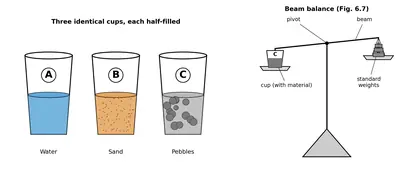
  • Let us take three identical paper cups (or bowls). Fill each cup half with the provided materials.
  • Fill one with water and mark it as 'A', second with sand and mark it as 'B', and the third with pebbles and mark it as 'C'.
  • Predict which one would be heavier and which one would be lighter?
  • Weigh each cup using a balance (Fig. 6.7) and record the readings in your notebook.
  • Compare the data and infer which is heavier or lighter.
Fig. 6.7
Fig. 6.7

Solution

Step 1 : Collect and label the cups

  • Three identical empty paper cups → their individual mass is the same, call it $$m_{\text{cup}}$$.
  • Write the letters A, B and C on them.

Step 2 : Fill to the same level

  • Cup A → half-fill with water.
  • Cup B → half-fill with dry sand.
  • Cup C → half-fill with small pebbles.
  • The filled portion in every cup occupies the same volume; denote it by $$V$$.

Step 3 : Predict which is heavier

The total mass of any filled cup is

$$m_{\text{total}} = m_{\text{cup}} + m_{\text{material}} = m_{\text{cup}} + \rho V$$

where $$\rho$$ is the density of the substance inside the cup.

  • Water: $$\rho_{\text{water}} \approx 1\,\text{g\,cm}^{-3}$$
  • Sand (dry): $$\rho_{\text{sand}} \approx 1.6\,\text{g\,cm}^{-3}$$
  • Pebbles (granite): $$\rho_{\text{pebble}} \approx 2.6\,\text{g\,cm}^{-3}$$

Since $$\rho_{\text{pebble}} > \rho_{\text{sand}} > \rho_{\text{water}}$$, we expect

Cup C > Cup B > Cup A in mass.

Step 4 : Measure with a balance

Place each cup on the left pan of a simple beam balance (Fig. 6.7) and add standard weights on the right pan until the pointer returns to the centre. A possible set of observations is shown below.

LabelReading of balance (g)Observation
A (water)100 gLightest
B (sand)150 gHeavier than A
C (pebbles)200 gHeaviest

(Your numbers may differ, but the order will stay the same.)

Step 5 : Inference

  • Cup C (pebbles) has the greatest mass → heaviest.
  • Cup A (water) has the smallest mass → lightest.
  • The experiment confirms that for the same volume $$V$$, mass $$m$$ increases with density $$\rho$$ according to $$m = \rho V$$.

Concept learnt: Different materials occupying the same space can feel heavier or lighter because they have different densities.

Answer

Cup C (pebbles) > Cup B (sand) > Cup A (water). Hence, C is heaviest and A is lightest.

Question Are there any properties which can be shown by all materials? If yes, what are those?

Solution

Step 1 · Recall what is meant by a “property”
A property is a characteristic by which we can recognise or describe a substance — for example colour, hardness, solubility, and so on.

Step 2 · Look for a property that does not depend on what the substance is
Even if materials are very different (chalk, water, air, iron, sugar, …), they all share two basic physical facts:

  • They occupy some amount of space.
  • They possess mass (they “weigh” something).

Step 3 · State these common properties properly

  • They occupy space  ⇒  every material has a definite volume $$V$$ that can be expressed in units such as $$\text{cm}^3$$, $$\text{m}^3$$ or litres (L).
  • They have mass  ⇒  every material has a definite mass $$m$$, measured in grams (g), kilograms (kg), etc.
      When we place any substance on a balance, the pointer shifts, showing that some mass is present.

Step 4 · Conclusion
Yes, there are properties common to all materials: every material has mass and occupies space.

Answer

Yes. Every material has mass and occupies space (has volume).

Question Is air matter?

Solution

Step 1 — Recall the definition of matter
Anything that occupies space and has mass is called matter. In symbols we may write the condition for a substance to be matter as
$$\text{Matter} \iff (\text{space is occupied}) \;\text{and}\; (\text{mass} > 0).$$

Step 2 — Does air occupy space?
Perform a simple activity.

  • Take an ‘empty’ balloon (actually it contains very little air). It looks flat.
  • Blow air into it and tie the mouth. The balloon becomes larger.
The only change we made was pushing air inside. The balloon needed extra space to accommodate the air, proving that air does occupy space.

Step 3 — Does air have mass?
We can check this by weighing.

  1. Weigh the balloon before blowing. Let the reading be $$m_1\;(\text{grams}).$$
  2. Weigh the same balloon after blowing. Let the new reading be $$m_2\;(\text{grams}).$$
Because the only difference is the added air, the change in mass is
$$\Delta m = m_2 - m_1.$$ Experimental values always give $$\Delta m > 0,$$ so
\[m_2 - m_1 > 0\]
This proves that the air trapped in the balloon has a measurable mass.

Step 4 — Conclusion
Air both occupies space and has mass. Therefore, by the definition used in science,

\[\boxed{\text{Air is matter}}\]

Answer

Yes. Air is matter because it occupies space and has mass.

Think it over! Can you think about what changes the invention of plastic brought to humans? Is it a boon or a bane?

Solution

Step 1 – What exactly is plastic?
Plastic is a group of man-made materials produced mainly from petroleum. Unlike wood, glass or metal, it can be softened on heating and moulded into any shape. The first true synthetic plastic, Bakelite, was made in 1907; since then hundreds of kinds (polythene, PVC, PET, nylon, etc.) have been invented.

Step 2 – Changes plastics brought to human life

  • Light weight & strength – Plastic bottles, bags and parts made many objects easy to carry; aeroplanes, cars and helmets became lighter but just as strong.
  • Cheaper mass production – Toys, pens, buckets and even computer keys became affordable because plastic can be moulded in large numbers very quickly.
  • Water-proof & air-tight – Food packaging, cling film and PET bottles keep food hygienic and fresh for longer.
  • Medical uses – Disposable syringes, blood bags and artificial joints reduced infection and saved lives.
  • Electrical safety – Plastic coating on wires and switches prevents shocks because plastic is an insulator.
  • Clothing & shelter – Nylon ropes, polyester clothes, plastic raincoats and tarpaulin sheets are strong, light and do not rot.
  • Conserving natural resources – By replacing ivory, wood and metal in many items, plastics helped save trees and animals.

Step 3 – Why people call plastic a “boon”

  • Versatile: can be transparent, coloured, hard, soft or even flexible like rubber.
  • Durable: lasts for years without rusting or breaking.
  • Economical: cheaper than most natural alternatives.
  • Energy efficient: lighter transport parts save fuel.

Step 4 – Why people call plastic a “bane”

  • Non-biodegradable – Most plastics do not rot; a thrown-away bag can remain for hundreds of years.
  • Pollution & litter – Plastic waste blocks drains, causes floods and spoils the look of cities.
  • Harm to animals – Cows, turtles and birds sometimes eat plastic bags and die from choking or stomach blockage.
  • Micro-plastics – Tiny broken pieces enter soil, water and even food, affecting the health of humans and other organisms.
  • Burning releases toxic gases – Incineration can produce poisonous fumes such as dioxins and $$\mathrm{CO}\_2$$.
  • Uses up petroleum – Making new plastic consumes valuable fossil fuels.

Step 5 – Balanced conclusion
Plastic is both a boon and a bane. It is a boon because its useful properties have improved health, comfort and technology. It is a bane when it is misused or thrown away carelessly, creating long-lasting environmental problems. The correct way forward is the 3 R’s:

  1. Reduce – Use only what is necessary; avoid single-use plastics.
  2. Reuse – Carry cloth bags and refillable bottles.
  3. Recycle – Segregate and send plastic waste to recycling plants.

Thus, the invention of plastic has been a blessing to humans, provided we handle it responsibly.

Answer

Plastic is a mixed blessing: it revolutionised daily life by giving us light, cheap, durable and hygienic products (boon), but its non-biodegradable waste, pollution and harm to wildlife make it dangerous when mismanaged (bane). Its final effect depends on how wisely we reduce, reuse and recycle it.

Let us play

1

Find the companion.
Link the following words by putting arrows between words that have a connection.

Words: Transparent, Iron, Solid, Bottle, Plastic, Lustrous, Wood, Opaque, Glass, Copper.

Solution

Step 1 – Sort the words into two kinds

  • Properties / characteristics   → Transparent, Opaque, Lustrous, Solid
  • Substances / articles   → Iron, Copper, Wood, Glass, Plastic, Bottle

A sensible arrow, therefore, will usually point

  • from a property to some substance that shows that property, or
  • from one article to the material it is commonly made of.

Step 2 – Recall the everyday facts

  • Glass lets light pass through it → it is transparent.
  • Wood does not allow light to pass → it is opaque.
  • Metals such as Iron and Copper shine when polished → they are lustrous.
  • Anything that keeps its own shape at room-temperature is a solid; plastic objects, wooden blocks, iron nails, copper wires and glass pieces are all solids.
  • Most bottles meant for water or soft-drinks are made of glass or plastic.

Step 3 – Draw the arrows one by one

  • Transparent → Glass
  • Opaque → Wood
  • Lustrous → Iron
  • Lustrous → Copper (two different metals share the same property)
  • Solid → Plastic
  • Solid → Wood (wood is also a solid)
  • Solid → Glass
  • Bottle → Glass (glass bottles)
  • Bottle → Plastic (plastic bottles)

Step 4 – Present the complete chain

The final network of companions is therefore:

Transparent → Glass ← Bottle → Plastic ← Solid → Wood ← Opaque

| Bottle (again)

Lustrous → Iron ← Solid and Lustrous → Copper ← Solid

Any layout that keeps exactly these arrows (property → example, article → material) will earn full marks.

Answer

Transparent → Glass ← Bottle → Plastic ← Solid → Wood ← Opaque
Lustrous → Iron ← Solid   and    Lustrous → Copper ← Solid

2

Win the 'Word-hub'
The following words from the chapter like lustrous, non-lustrous, soluble, insoluble, hard, soft, matter, mass, transparent, opaque, volume and translucent are picked up.

Grid

  • Students should randomly choose nine words from the given list and write them in the grid.
  • Then, the facilitator either reads the definition of a word or the word itself (randomly) from the given list.
  • The learners have to tick if the particular word is there in the grid.
  • Whoever finishes ticking off all nine words first will shout out 'Hurray!' That person will be the winner if his/her words are marked correctly.

Solution

Step 1 – List all 12 words from the chapter
Lustrous, non-lustrous, soluble, insoluble, hard, soft, matter, mass, transparent, opaque, volume, translucent.

Step 2 – Choose any nine words at random
Suppose we pull the following slips out of a bowl without looking:

  • lustrous
  • mass
  • opaque
  • soft
  • volume
  • matter
  • soluble
  • hard
  • transparent

Step 3 – Write the nine words in the 3 × 3 grid

lustrousmassopaque
softvolumematter
solublehardtransparent

Tip: Do not repeat a word and do not leave any square blank, otherwise you will have fewer than nine chances to tick.

Step 4 – Understand every word so you recognise it quickly

WordMeaning the facilitator might read
lustrousHas a shiny surface that reflects light (e.g. gold).
massThe amount of matter in an object, measured in kilograms.
opaqueDoes not allow light to pass through; you cannot see through it.
softCan be compressed or scratched easily (e.g. cotton).
volumeThe amount of space an object occupies, measured in litres or cubic centimetres.
matterAnything that has mass and occupies space.
solubleCan dissolve in a liquid (e.g. salt in water).
hardDifficult to compress, cut or scratch (e.g. iron).
transparentAllows almost all light to pass through; you can see clearly through it (e.g. clean glass).

Step 5 – Play

  1. The facilitator shuffles two decks of slips – one deck with the 12 words, the other with 12 definitions. He/she now calls out either a word or a definition.
  2. Each time you hear something, scan your grid.
    If it is there, put a small tick () in that square.
    If not, wait for the next call.
  3. Keep listening. The moment you have ticks in all nine boxes, shout "Hurray!"

Worked example of ticking

Call No.What the facilitator saysDo we have it?Grid after action
1"Can be scratched easily"Yes (soft)soft ✓ now ticked
2"insoluble"NoNo change
3"mass"Yesmass ✓
4"lustrous"Yeslustrous ✓
5"Has no shine"NoNo change
6"transparent"Yestransparent ✓
7"hard"Yeshard ✓
8"volume"Yesvolume ✓
9"matter"Yesmatter ✓
10"Allows no light"Yes (opaque)opaque ✓ → all nine squares now ticked

Step 6 – Declare the winner
Because you ticked the ninth word first and shouted "HURRAY!", the facilitator quickly cross-checks. All nine words really were called or defined by call 10, so you are the winner.

Why this activity is useful

  • Revises the meanings of key scientific terms.
  • Trains the ear to pick out definitions accurately.
  • Encourages fair competition and attention.

Extra practice
After the game, switch roles: let a student read out the words/definitions; everyone else prepares a fresh 3 × 3 grid with a new random selection of nine words. Play again!

Answer

This is an activity-based question. A sample filled grid is shown below; any learner who ticks all nine of lustrous, mass, opaque, soft, volume, matter, soluble, hard, transparent first and correctly shouts "Hurray!" wins.

Let us enhance our learning

1 Visit your kitchen and observe how your parents have organised various edibles. Can you suggest a better sorting method? Write it in your notebook.

Solution

Step 1 : Actual observation in the kitchen

  • Rice, wheat flour and pulses stored together in large tins kept on the floor.
  • Sugar and salt packets placed on an open shelf above the cooking platform.
  • Spices (turmeric, chilli powder, whole garam-masala) mixed with tea leaves on the same rack.
  • Cooking oil cans and ghee tins lying beside phenyl and dish-washing liquid under the sink.
  • Biscuits, chocolates and dry fruits kept in the refrigerator although they do not need cooling.

What problems did I notice?

  1. Difficult to find an item quickly because similar looking packets are scattered.
  2. Chance of cross-contamination (e.g. strong spice smell entering biscuits).
  3. Some things (tea, biscuits) absorb moisture because they are kept near the sink.
  4. Heavy tins on the floor need bending every time.

Step 2 : Choosing sensible properties for grouping

  • Physical state → solid / liquid.
  • Perishability → needs refrigeration or not.
  • Frequency of use → daily / weekly / occasionally.
  • Nature → cereals & pulses / spices / snacks / cleaning agents.
  • Weight → light packets / heavy sacks.

Step 3 : New shelf-wise plan

Shelf / AreaProperty usedEdibles to keep there
Top, eye levelDaily-use light solidsSugar, salt, tea, coffee, ready-to-eat snacks
Middle pull-out drawerDaily-use spices & condimentsHaldi, mirchi, jeera, garam-masala, mustard seeds
Main cupboard bottomHeavy, long-term storageRice, wheat flour, chana dal, rajma, whole grains
Separate closed rackLiquids that do not need coolingCooking oil, vinegar, soy sauce, ghee
Refrigerator doorPerishablesButter, cheese, milk, leftover food (covered)
Box on top of fridgeDry snacks (occasional)Biscuits, chocolates, dry fruits (airtight)
Under-sink areaNON-edible cleaning itemsDish wash, detergent, phenyl (kept away from food)

Step 4 : Why is this better?

  • Similar items sit together → very less hunting time.
  • No strong-smelling spice near snacks → taste remains unchanged.
  • Cleaning chemicals completely separated from food → safe.
  • Heavy sacks at bottom avoid accidents; light jars stay at a comfortable height.
  • Refrigerator space is saved for real perishables.

Step 5 : Neat labelling for quick learning

  1. Write category names on small stickers: “SPICES”, “PULSES”, “SNACKS”, etc.
  2. Paste them on the shelves and on the containers’ lids.
  3. Review once a month and shift any item that has migrated.

You can draw a simple diagram of your kitchen cupboards showing the new layout and colour each shelf according to the table above.

Remark for the notebook: I used properties such as state, perishability, frequency of use and weight to form logical groups. This is exactly what scientists do when they classify materials in chemistry.

Answer

Group kitchen edibles by (i) state (solid/liquid), (ii) perishability, (iii) frequency of use and (iv) weight:

  • Eye-level shelf → daily-use light solids (sugar, tea, snacks).
  • Drawer → spices and condiments.
  • Bottom shelf → heavy bulk cereals and pulses.
  • Closed rack → cooking oils and other liquids.
  • Refrigerator → true perishables only (milk, butter, leftovers).
  • Under-sink → keep only cleaning agents, never food.

This arrangement keeps similar things together, prevents contamination and saves search time.

2

Unscramble the letters (Column I) and match with their properties (Column II).
Column IColumn II
(i) T R E M A T(a) Objects can be seen clearly through it
(ii) U L S B E L O(b) Occupies space and has mass
(iii) T N E R P A S N A R T(c) Shiny surface
(iv) E R U S T L(d) Mixes completely in water

Solution

Step 1 – Unscramble the jumbled words (Column I)

Jumbled lettersCorrect wordHow to see it
(i) T R E M A TMATTERArrange as M-A-T-T-E-R
(ii) U L S B E L OSOLUBLEArrange as S-O-L-U-B-L-E
(iii) T N E R P A S N A R TTRANSPARENTArrange as T-R-A-N-S-P-A-R-E-N-T
(iv) E R U S T LLUSTREArrange as L-U-S-T-R-E

Step 2 – Recall the property each word describes

  • MATTER → Anything that occupies space and has mass.
  • SOLUBLE → A substance that mixes completely in water.
  • TRANSPARENT → A material through which objects can be seen clearly.
  • LUSTRE → A shiny surface.

Step 3 – Match Column I with Column II

Column I (final word)Matches with Column II
(i) MATTER(b) Occupies space and has mass
(ii) SOLUBLE(d) Mixes completely in water
(iii) TRANSPARENT(a) Objects can be seen clearly through it
(iv) LUSTRE(c) Shiny surface

Thus each word from Column I is correctly paired with its property in Column II.

Answer

(i) b, (ii) d, (iii) a, (iv) c

3 The containers which are used to store materials in shops and at home are usually transparent. Give your reasons for this.

Solution

Step 1 — Meaning of a transparent container
When a material is transparent, light passes through it, so the things kept inside can be seen from outside.

Step 2 — What the user of a container wants to do

  • Know what is inside without opening the lid.
  • See how much of the material is left.
  • Notice any change in colour or other quality quickly, in case the material is getting spoiled.
  • (For shopkeepers) Show the goods clearly to customers so that the articles look attractive on the shelf.

Step 3 — Why transparency helps
Because the walls can be looked through, all the points listed in Step 2 can be checked at a glance, with no need to touch or transfer the contents. This prevents waste, saves time and keeps the material clean.

Step 4 — Conclusion
Therefore containers used in shops and at home are usually made of transparent substances such as glass or clear plastic.

Answer

Transparent containers allow us to see the contents directly, so we can identify the material, check the remaining quantity, spot any spoilage, and (in shops) display the goods attractively without opening the container.

4 State whether the statements given below are True [T] or False [F]. Correct the False statement(s).

(i) Wood is translucent while glass is opaque.

Solution

Concept used: A substance through which light can pass completely is called transparent; if no light can pass, it is opaque; if light can pass partially and objects cannot be seen clearly, it is translucent.

• Common window glass allows light to pass through it completely – so glass is transparent.
• Wood does not allow light to pass through – so wood is opaque.

Since the statement says “Wood is translucent while glass is opaque”, every description has been reversed. Hence the statement is False.

Correct statement: Wood is opaque while glass is transparent (or at least translucent, depending on the type of glass).

Answer

False. Correct statement: Wood is opaque whereas glass is transparent.

(ii) Aluminium foil has lustre while an eraser does not.

Solution

Concept used: Objects that can reflect light and thus shine are called lustrous.

• Aluminium is a metal; metals possess lustre. Aluminium foil therefore shines.
• An eraser is made of rubber; rubber is a non-metallic, non-lustrous material.

Both parts of the statement are right, so the given sentence is True.

Answer

True.

(iii) Sugar dissolves in water whereas sawdust does not.

Solution

Concept used: A substance that mixes uniformly with water, forming a clear solution, is said to be soluble; one that does not is insoluble.

• If we stir sugar crystals in water, they disappear, giving a clear sweet solution → sugar is soluble.
• On stirring sawdust in water, the tiny wood particles float or settle but never dissolve → sawdust is insoluble.

Hence the whole sentence is True.

Answer

True.

(iv) An apple is a matter because it occupies no space and has mass.

Solution

Concept used: Anything that has mass and occupies space is called matter.

The statement claims an apple “occupies no space and has mass”. In reality an apple:
• has a definite volume (space it occupies).
• has mass (it can be weighed).

Therefore the sentence given is False.

Correct statement: An apple is matter because it occupies space and has mass.

Answer

False. Correct statement: An apple is matter because it occupies space and has mass.

5 We see chairs made up of various materials, such as wood, iron, plastic, bamboo, cement and stones. Following are some desirable properties of materials which can be used to make chairs. Which materials used to make chairs fulfil these properties the most?

(i) Hardness (does not bend or shake on sitting even after long use).

Solution

Step 1 – Recall the property
Hardness means that the material does not bend, shake or get permanently deformed even after a long period of use.

Step 2 – Check each material

  • Wood: Fairly hard but can bend or crack after many years.
  • Iron (steel): Very hard, keeps its shape for decades.
  • Plastic: May sag if the load is large; not the hardest.
  • Bamboo: Can split or bend with heavy weight.
  • Cement concrete: Extremely hard but usually made as a fixed bench, not as a movable chair; also brittle if very thin.
  • Stone: Very hard but heavy and brittle; generally used for fixed benches, not chairs.

Step 3 – Choose the best
The material that combines very high hardness with the usual shape of a chair is iron (steel). Although cement and stone are also hard, they are brittle and mainly used for permanent benches rather than everyday chairs.

Answer

Iron (steel) chairs satisfy the hardness requirement the best.

(ii) Lightweight (easy to lift or to take from one place to another).

Solution

Step 1 – Recall the property
Light-weight means a chair can easily be lifted or carried from one room to another.

Step 2 – Compare masses in everyday life

  • Plastic: A full-size plastic chair can usually be lifted by a child.
  • Bamboo: Very light because the stem is hollow; traditional bamboo stools are easy to carry.
  • Wood: Heavier than plastic or bamboo.
  • Iron: Much heavier.
  • Cement or Stone: Very heavy; cannot be called portable chairs.

Step 3 – Choose the best
Between plastic and bamboo, both are light, but plastic chairs are more common and even lighter than most bamboo chairs of the same size. Hence the material that fulfils the light-weight property the most is plastic.

Answer

Plastic chairs are the lightest and therefore fulfil this property the most.

(iii) Does not feel very cold when sitting during winters.

Solution

Step 1 – Recall the property
The seat should not feel very cold in winter. That happens when the material is a poor conductor of heat, so it does not quickly take away heat from our body.

Step 2 – Thermal conduction of each material

  • Wood: Poor conductor; feels warm.
  • Plastic: Poor conductor; also feels warm.
  • Bamboo: Similar to wood, poor conductor.
  • Iron (steel): Good conductor; feels cold.
  • Cement/Stone: Moderate conductor; feels cold.

Step 3 – Choose the best
Wood is traditionally known for giving a comfortable, warm feel in cold weather, more so than plastic, which can sometimes feel slightly colder. Therefore wood is the material that meets this need best.

Answer

Wooden chairs meet this requirement the best, because wood does not feel cold in winter.

(iv) Can be cleaned regularly and made to look new even after long use.

Solution

Step 1 – Recall the property
The chair should withstand frequent cleaning (even with water or detergents) and should still look almost new.

Step 2 – Check each material

  • Plastic: Smooth, non-porous surface; can be washed daily, colours remain bright.
  • Iron: If painted it looks good, but repeated washing may cause rust at scratches.
  • Wood: Absorbs water; polish can dull; cannot be scrubbed hard every day.
  • Bamboo: Absorbs moisture and can develop fungus.
  • Cement/Stone: Can be washed but collects stains and needs scrubbing; edges chip.

Step 3 – Choose the best
Because it keeps a glossy surface and is not harmed by regular washing, plastic is the best material for this property.

Answer

Plastic chairs can be cleaned regularly and still look new for a long time.

6 You need to have containers for collection of: (i) food waste, (ii) broken glass and (iii) wastepaper. Which materials will you choose for containers of these types of waste? What properties of materials do you need to think of?

Solution

Step 1: List the three kinds of waste and note their special features

  • (i) Food waste – wet, can leak liquids, starts rotting and smelling, attracts insects.
  • (ii) Broken glass – has sharp edges, heavy for its size, can cut through thin material.
  • (iii) Waste-paper – light, dry, not sharp, occupies a lot of volume.

Step 2: Recall what a good container must do

  • Hold the waste safely without tearing, cracking or leaking.
  • Be easy to lift, empty and clean (where necessary).
  • Not react with or be damaged by the waste kept inside.

Step 3: Decide the properties needed for each case

Type of wasteProperty requiredWhy this property matters
(i) Food wasteWater-proofSo juices do not seep out.
Non-reactive / non-rustingFood acids must not corrode it.
Easy to washSo smell and germs can be removed.
(ii) Broken glassVery hard and toughMust not be cut or pierced by glass pieces.
Rigid and strongShould not bend when lifted.
Fire-resistantGlass may have been heated; metal tolerates heat.
(iii) Waste-paperLight in weightPaper itself is light, so the container can be light too.
Large volumeTo hold bulky sheets and cartons.
Need not be water-proofThe waste is dry, so a porous material is acceptable.

Step 4: Match suitable materials with the required properties

  1. Plastic bucket or bin for food waste
    Plastic (e.g. polyethylene) is water-proof, does not rust, and is easy to wash. A tight-fitting plastic lid keeps odours and insects away.
  2. Metal (steel) box or thick plastic crate for broken glass
    Steel is very hard and will not be pierced by glass. It also resists heat. If steel is not available, a thick rigid plastic crate can work, provided its walls are strong enough not to split.
  3. Cardboard carton or cloth bag for waste-paper
    Cardboard is itself paper, so it is light, cheap, and already the right size and shape. An old cloth bag or gunny sack can also be used because only dry paper is stored.

Step 5: Summarise the answer

WasteContainer chosenKey properties used
(i) Food wastePlastic bin with lidWater-proof, non-rusting, washable
(ii) Broken glassSteel container (or thick rigid plastic crate)Hard, tough, un-pierceable
(iii) Waste-paperCardboard box or cloth sackLight, large, cheap

Thus, by thinking about hardness, strength, water-proof nature, ability to resist corrosion, ease of cleaning and weight, we can select the right material for each waste container.

Answer

(i) Food waste – keep it in a plastic bin; plastic is water-proof, non-rusting and easy to wash.
(ii) Broken glass – put it in a steel (or very thick plastic) container; steel is hard and cannot be cut by glass pieces.
(iii) Waste-paper – collect it in a cardboard box or cloth bag; these are light and big enough for dry paper.
The properties we compare are: hardness/toughness, water-proof nature, resistance to corrosion, ease of cleaning and weight.

7 Air is all around us but does not hinder us from seeing each other. Whereas, if a wooden door comes in between, we cannot see each other. It is because air is _____ and the wooden door is _____. Choose the most appropriate option:
(i) transparent, opaque
(ii) translucent, transparent
(iii) opaque, translucent
(iv) transparent, translucent

Solution

Step 1 : Recall the definitions

  • Transparent substance  – allows almost all incident light to pass through it. Objects on the other side can be seen clearly.
  • Translucent substance  – allows some light to pass, but scatters it. Objects on the other side look blurred or faint.
  • Opaque substance  – allows no light to pass through it. Objects on the other side cannot be seen at all.

Step 2 : Classify the given materials

  • Air lets light travel through without noticeable scattering, so objects remain clearly visible. Hence, air is transparent.
  • A wooden door blocks light completely; nothing can be seen through it. Hence, wood is opaque.

Step 3 : Match with the options

The pair “transparent” (for air) and “opaque” (for wooden door) appears only in option (i).

Therefore, the correct choice is option (i).

Answer

(i) transparent, opaque

8 Imagine you have two mysterious materials, X and Y. When you try to press material X, it feels rigid and does not change its shape easily. On the other hand, material Y easily changes its shape when you press it. Now, when you mix both materials in water, only material X dissolves completely, while material Y remains unchanged. What can materials X and Y be? Can you identify whether material X is hard or soft? What about material Y? Justify your answer.

Solution

Step 1 · Read the description carefully
We are told two independent things about each mysterious material:

  • What happens when we press it (this tells us about hardness or softness).
  • What happens when we put it in water (this tells us about solubility).

Step 2 · Relate “pressing” to hardness/softness
A material that does not change shape on pressing is called hard or rigid.
A material that changes shape easily on pressing is called soft.

Step 3 · Relate “mixing with water” to solubility
If a material disappears completely in water, we say it is soluble in water.
If it remains as it is, we say it is insoluble in water.

Step 4 · Match the given behaviour with common substances

ObservationProperty NameCommon Example
Rigid on pressing, dissolves in waterHard & solubleTable salt (or sugar)
Soft on pressing, does not dissolveSoft & insolubleClay / dough / rubber

Step 5 · Choose any one familiar pair
The most familiar pair for a Class-6 learner is:

  • Material X: Table salt, $$\mathrm{NaCl}$$.
  • Material Y: Wet clay (or kneaded wheat dough).

Step 6 · Answer each part explicitly

  1. What can X and Y be?
       X can be common salt; Y can be clay.
  2. Is X hard or soft?
       Because it does not change shape on pressing, X is hard.
  3. Is Y hard or soft?
       Because it changes shape easily, Y is soft.

Step 7 · Justification in one sentence
Hardness-softness is judged by resistance to shape change; solubility is judged by ability to disappear in water. Salt is hard and soluble, while clay is soft and insoluble, matching the observations, so the identification is correct.

Answer

Material X: common salt (hard & soluble).
Material Y: clay (soft & insoluble).

9 (i) Who am I? Identify me on the basis of the given properties.
(ii) Make your own 'Who am I?'

(i)(a) I have lustre.

Solution

Lustre means a shiny appearance when light falls on the surface of a substance.

All metals (gold, silver, copper, aluminium, iron, etc.) show this property because free electrons at the metal surface reflect light uniformly.

Therefore, a substance that is described only by the statement “I have lustre” is most logically a metal.

Answer

A metal (for example, gold or silver)

(i)(b) I can be easily compressed.

Solution

To be “easily compressed” means that the volume of the material can be decreased with a small force.

  • Most solids keep their shape and cannot be squeezed much.
  • Liquids can change shape but still resist compression.
  • Gases, on the other hand, have a lot of empty space between their particles, so they can be pushed closer together very easily.

Hence the material that fits the clue best is a gas.

Answer

A gas (for example, the compressed cooking gas in an LPG cylinder)

(i)(c) I am hard and soluble in water.

Solution

Hardness tells us that the substance is a solid which is difficult to scratch or break.

If, at the same time, it dissolves in water, it must be a crystalline solid whose particles separate when mixed with water.

Common salt, $$\mathrm{NaCl}$$, is a typical example—it is hard, makes a ‘crunch’ sound when crushed and disappears completely in water to give a salty solution.

Answer

Common salt (sodium chloride)

(i)(d) You cannot see clearly through me.

Solution

Step 1 – Recall how materials are classified by their behaviour with light

  • Transparent – almost the whole light passes through, so we can see objects on the other side clearly. Examples: clear glass, pure water, air.
  • Translucent – only a part of the light passes through; the rest is scattered. Objects appear blurred or hazy, i.e. we cannot see clearly. Examples: butter (tracing) paper, frosted (ground) glass, oiled paper, thin polythene.
  • Opaque – no light passes at all, so the object behind is completely invisible. Examples: wood, metal, cardboard, stone.

Step 2 – Match the clue with the right category

The clue says “You cannot see clearly through me.” The key word is “clearly”.

  • Through a transparent material we can see clearly – so it is ruled out.
  • Through an opaque material we cannot see anything at all – clarity does not even arise.
  • A translucent material lets us notice a shape or shadow but the image is fuzzy – we see, but not clearly. This fits the description exactly.

Step 3 – State the identity

The material described is therefore a translucent material such as butter paper or frosted (ground) glass used in bathroom windows.

Note: Part (ii) of Question 9 (“Make your own ‘Who am I?’”) is answered separately in the next sub-part of this question.

Answer

A translucent material (for example, butter paper or frosted/ground glass) – light passes through it only partly, so objects behind it look blurred and cannot be seen clearly.

(i)(e) I have mass and volume but you cannot see me.

Solution

Anything that has mass and occupies space is called matter. If the matter is present in such a fine form that our eyes cannot detect it, it must be a gas.

The most familiar gas around us is the mixture we breathe—air. It has weight (mass), fills balloons (volume) but remains invisible.

Answer

Air

(ii) Make your own 'Who am I?'

Solution

Example of a self-composed “Who am I?”

(1) I am rigid and opaque.
(2) I float on water because I am less dense than it.
(3) I burn to give heat and light and am used to make furniture.
Who am I?

Explanation
Density lower than water, burns on heating, hard and opaque ⇒ it must be wood.

Answer

(Example) Riddle: “I am rigid and opaque, I float on water, and I burn to give heat and light. Who am I?”
Answer: Wood.

10 You are provided with the following materials—vinegar, honey, mustard oil, water, glucose and wheat flour.
Make any two pairs of materials where one material is soluble in the other. Now, make two pairs of materials where one material remains insoluble in the other material.

Solution

Step 1 : Listing the given materials

  • Vinegar (mainly $$\mathrm{CH_3COOH}$$ in water)
  • Honey
  • Mustard oil
  • Water
  • Glucose (solid powder, $$\mathrm{C_6H_{12}O_6}$$)
  • Wheat flour

Step 2 : Recall of the idea of solubility

A substance is said to be soluble in a liquid if, after stirring, it completely disappears and forms a uniform solution. If it does not disappear even after stirring, it is insoluble.

Step 3 : Trying possible combinations

Combination triedObservation on stirringConclusion
Glucose + WaterGlucose crystals disappear, clear sweet solution obtainedGlucose is soluble in water
Vinegar + WaterLiquids mix completely, no separate layerVinegar is miscible (soluble) in water
Mustard oil + WaterOil floats as a separate layer even after shakingMustard oil is insoluble in water
Wheat flour + WaterFlour forms a suspension that settles; particles never disappearWheat flour is insoluble in water

Step 4 : Writing the required pairs

  1. Pairs in which one material is soluble in the other
    • Glucose (solute) + Water (solvent)
    • Vinegar (solute) + Water (solvent)
  2. Pairs in which one material is insoluble in the other
    • Mustard oil + Water
    • Wheat flour + Water

Thus the two required soluble pairs and the two required insoluble pairs have been identified.

Answer

  • Soluble pairs: (i) Glucose + Water, (ii) Vinegar + Water
  • Insoluble pairs: (i) Mustard oil + Water, (ii) Wheat flour + Water

Learning further

1 Gather information on different materials which can be recycled. You can take help from various sources, such as newspapers, magazines, elders in your community, and the internet.

Solution

Step 1 : Understand what “recycling” means

Recycling is the process in which a waste material is collected, cleaned and converted back into a usable raw material so that it can be made into new things instead of being thrown away or burnt.

Step 2 : Decide how you will collect information

  1. Read the date-wise pages of an old newspaper and cut out any article that talks about waste management or recycling.
  2. Look at magazines for advertisements that carry the recycle symbol (three chasing arrows).
  3. Talk to elders such as parents, shopkeepers, rag-pickers or the person who collects garbage from your home; ask which things they separate for sale to the kabadiwala (scrap dealer).
  4. Use the Internet (with an elder’s help) to check government or NGO websites that list recyclable materials.

Step 3 : Make a rough list in your notebook

Write the material first, then give one or two examples of objects made of that material. Also note the recycling code number if it is printed on the object. For plastics the code is often inside a small triangle, e.g. the code “1” stands for $$\mathrm{PET}$$.

Step 4 : Arrange the data neatly in a table

MaterialTypical Household ItemsShort Idea of the Recycling ProcessWhat We Obtain After Recycling
Paper & CardboardOld notebooks, newspapers, cartons, paper cups (if not plastic-lined)Shredded, mixed with water to make pulp, pressed and driedFresh writing paper, egg trays, paper boards
GlassSoft-drink bottles, jam jars, broken window panesSorted by colour, crushed, melted at ≈$$1500\,{}^{\circ}\mathrm{C}$$New bottles, tiles, glass wool
Metals – AluminiumCold-drink cans, kitchen foilCans baled, melted at $$660\,{}^{\circ}\mathrm{C}$$New cans, bicycle parts
Metals – Steel / IronFood tins, old toolsTins de-tinned, melted in a basic oxygen furnaceSteel rods, car bodies
Plastics (Thermoplastics)
  • Code 1 – $$\mathrm{PET}$$ : water bottles
  • Code 2 – $$\mathrm{HDPE}$$ : milk pouches, shampoo bottles
  • Code 4 – $$\mathrm{LDPE}$$ : carry bags
  • Code 5 – $$\mathrm{PP}$$ : lunch boxes
Washed, chopped into flakes, melted and re-pelletisedPolyester fibre, pipes, outdoor furniture
Natural FibresCotton clothes, jute bagsSorted by colour, shredded, mixed with virgin fibreCleaning cloth, insulation boards
RubberOld tyres, shoe solesTyres cut, ground to crumb rubber, added back to new rubberPlayground mats, road asphalt
Electronic WasteDead mobile phones, computer boardsManual dismantling, metals recovered by smelting or leachingCopper, gold, plastic pellets
Organic Kitchen WasteFruit peels, vegetable stalksPlaced in a compost pit with air and moistureManure for plants

Step 5 : Verify with local practice

Ask your neighbourhood scrap dealer which of the above materials he actually buys. Note any differences—for example, in many towns mixed or dirty plastic bags (code 7) are not accepted for recycling.

Step 6 : Present your findings

You can submit your work as a small project report. Attach photographs of the recycle symbols you found, paste the newspaper clippings and include the above table. End the report with two or three sentences on why recycling saves energy and reduces pollution.

Answer

The most common materials that can be recycled are:

  • Paper and cardboard
  • Glass (all colours)
  • Metals – aluminium and steel
  • Thermoplastics – $$\mathrm{PET}$$, $$\mathrm{HDPE}$$, $$\mathrm{LDPE}$$, $$\mathrm{PP}$$, etc.
  • Natural textile fibres (cotton, jute)
  • Rubber (e.g. tyres)
  • Electronic waste for metal recovery
  • Organic kitchen waste (by composting)

2 Recyclers buy old objects based on properties of the materials and do not bother even if an object is broken. Conduct a survey with recyclers near you and find out what properties of materials do they check before buying objects from households. Which materials do they not buy and why?

Solution

Step 1 – Planning the survey

  • I visited three local scrap-dealers (kabadiwala A, B and C).
  • I carried a prepared list of common household wastes: newspapers, magazines, iron utensils, aluminium cans, copper wire, plastic bottles, plastic toys, broken glass bottles, ceramic cups, earthen pots, thermocol plates and used batteries.
  • I asked two questions to every dealer:
    “What property do you look for before buying this item?” and “Will you take it? If not, why?”

Step 2 – Recording the observation

The table below records what each recycler checked. The middle three columns show whether the dealer judged the item by its appearance/lustre, by a magnet test, or by weight on a balance. Prices are noted in Indian Rupees per kilogram (₹/kg).

S. No.Item offeredProperty checked by recyclerBought?Approx. rate / reason if refused
Appearance / lustreMagnet testWeight
1Old newspapers & magazinesClean & dry surfaceWeighed on scaleYes₹ 15–20 per kg
2Iron fry-panDull grey but metallicStrong attractionWeighedYes₹ 25–30 per kg
3Aluminium cold-drink cansSilvery lustreNo attractionWeighedYes₹ 100–120 per kg
4Old copper wireReddish-brown shine after scrapingNo attractionWeighedYes (highest rate)₹ 500–600 per kg
5PET plastic water bottlesTransparent; recycling mark ‘1’WeighedYes (if clean & dry)₹ 20–25 per kg; refused if dirty or oily
6Colourful plastic toysRecycling code checkedSometimesThermoset plastics not recyclable
7Broken window glassTransparent but sharp edgesWeighedYes (low price)₹ 2–3 per kg; must be sorted by colour
8Ceramic cup piecesHard, non-lustrousNoCannot be re-melted; no resale value
9Earthen diya (clay)Porous, dullNoSame reason as ceramic
10Thermocol platesVery light, brittleNoFoamed $$\mathrm{PS}$$ pollutes, difficult to recycle
11Used lead-acid batteryWarning symbols seenNoHazardous; only authorised centres take them

Step 3 – Analysing the properties they value

  1. Ability to be recycled easily – Metals such as iron, aluminium and copper melt and can be re-shaped, so dealers pay good rates.
  2. High mass compared to volume – Heavier scrap means more material for the smelter and better profit.
  3. Lustre / colour – Copper’s reddish colour and aluminium’s silvery shine help them identify the metal quickly.
  4. Magnetic property – A simple magnet separates iron/steel (magnetic) from non-magnetic metals; this saves sorting time.
  5. Clean and dry condition – Wet or food-stained paper/plastic reduces quality and increases weight artificially; hence they refuse or pay less.
  6. Recycling code on plastics – Codes 1 ($$\mathrm{PET}$$), 2 ($$\mathrm{HDPE}$$) and 5 ($$\mathrm{PP}$$) are accepted; codes 3, 6 and 7 are often rejected.

Step 4 – Materials all three recyclers refused

  • Thermosetting or foamed plastics – e.g. thermocol (foamed $$\mathrm{PS}$$) and Bakelite parts – cannot be remelted.
  • Ceramics and earthenware – very hard, already fired once; remelting them is impossible under normal recycling conditions.
  • Hazardous / toxic items – used batteries, tube-lights, CFL bulbs; they contain lead, mercury or acids that need special treatment.
  • Contaminated or wet paper/plastic – fungus growth spoils fibre quality; moisture adds useless mass.

Step 5 – Conclusion

Recyclers mainly look for useful physical properties such as metallic lustre, magnetism, weight and the recyclability symbol rather than the shape or condition of the object. Materials that cannot be re-melted, have no resale value or are hazardous are not bought. Thus the decision to buy is guided entirely by the intrinsic properties of the material, not by whether the object is broken or whole.

Answer

They buy materials that are (i) recyclable by melting or pulping, (ii) heavy enough to fetch value and (iii) easy to sort — e.g. iron/steel (magnetic), aluminium, copper, clean paper & cardboard, PET/HDPE plastic bottles and colour-separated glass.

They refuse articles made of thermosetting/foamed plastic (thermocol), ceramic or clay items, contaminated or wet paper/plastic and hazardous wastes such as used batteries or CFL bulbs because these either cannot be re-processed economically or need special treatment.

3 Collect 20–30 objects from your household and classify them based on the properties of the materials they are made up of. Were you able to put them in separate groups? What relationship do you see between the properties of the materials and the use of the objects?

Solution

Step 1 – Making the list

Twenty-four common objects were collected from home and noted one below the other.

  1. Steel spoon
  2. Iron nail
  3. Copper electric wire
  4. Aluminium kitchen foil
  5. Brass door handle
  6. Glass tumbler
  7. Window-pane glass sheet
  8. Ceramic teacup
  9. Earthen (clay) flower pot
  10. Plastic water bottle (PET)
  11. Plastic lunch-box (PP)
  12. Polythene carry bag
  13. PVC garden pipe
  14. Wooden ruler
  15. Wooden chair leg
  16. Card-board packing box
  17. Cotton hand-towel
  18. Woollen scarf
  19. Silk ribbon
  20. Rubber band
  21. Bicycle tyre tube
  22. Marble pestle (stone)
  23. Piece of charcoal
  24. Bar of bath-soap

Step 2 – Listing the important properties of the materials

For a Class 6 comparison we note six simple properties.

  • Lustre (shiny / dull)
  • Hardness (hard / soft)
  • Transparency (transparent / translucent / opaque)
  • Ability to conduct electricity (good / poor)
  • Water absorption (absorbs / does not absorb)
  • Elasticity (stretchable / not stretchable)

These are the same properties introduced in NCERT Chapter 4 and recalled in Chapter 6.

Step 3 – Recording observations

S. No.ObjectMaterialMain properties observedTypical use at home
1Steel spoonStainless steel (metal)Hard, shiny, opaque, $$\text{good conductor}$$, does not absorb waterStir and eat hot food
2Iron nailIron (metal)Very hard, shiny when new, opaque, conducts, non-absorbentJoining wooden pieces
3Copper wireCopper (metal)Shiny reddish, ductile, conducts electricity brilliantlyHouse-hold wiring
4Aluminium foilAluminium (metal)Soft, shiny, opaque, conductor, non-absorbentWrapping food & keeping it hot
5Brass handleBrass alloy (metal)Hard, shiny, germs do not grow easily on brassDoor fitting
6Glass tumblerSoda-lime glassHard, transparent, smooth, brittle, electrical insulatorHolding drinking water so contents are visible
7Window glassPlate glassHard, transparent, brittle, waterproofLetting in light without letting in rain/wind
8Ceramic cupPorcelainHard, opaque, resists high temperature, insulatorDrinking hot tea
9Clay flower potBaked clayHard, porous (absorbs a little water), opaque, brittleGrowing plants; tiny pores let roots breathe
10PET bottlePlastic (polyester)Light, transparent to translucent, waterproof, insulatorCarrying cold drinks
11PP lunch-boxPlastic (polypropylene)Light, opaque, waterproof, poor conductor, slightly flexiblePacking lunch; keeps food unaffected by moisture
12Polythene bagPlastic (LDPE)Soft, flexible, waterproof, insulatorShopping / garbage bag
13PVC pipePlastic (PVC)Hard, opaque, waterproof, poor conductorCarrying water without rusting
14Wooden rulerWoodHard, dull, opaque, poor conductor, floats on waterMeasuring & drawing lines; safe near electricity
15Chair legTeak woodHard, strong, poor conductor, non-rustingSupporting weight of person
16Card-board boxPaper boardLight, dull, opaque, absorbs water, flexiblePacking dry objects
17Cotton towelCotton fibreSoft, dull, absorbs a lot of water, flexibleWiping wet hands/body
18Woollen scarfWool fibreSoft, dull, traps air (good insulator), absorbs little waterKeeping warm in winter
19Silk ribbonSilk fibreSlightly shiny, strong, flexibleDecoration / tying hair
20Rubber bandNatural rubberElastic, dull, waterproof, insulatorHolding things together
21Bicycle tyre tubeSynthetic rubberElastic, waterproof, toughFilling with air to absorb shocks
22Marble pestleMarble stoneVery hard, shiny on polishing, heavy, poor conductorGrinding spices
23Charcoal pieceCarbonDull black, porous, light, combustibleFuel / drawing sketch
24Bath-soap barSodium soap + fillersSoft, dull, floats (sometimes), dissolves slowly in waterCleansing body

Step 4 – Sorting them into groups

When the above list is examined we notice that objects made of the same broad kind of material share similar properties. They can therefore be grouped as follows:

GroupMaterial familyMembers from the listCommon properties inside the group
AMetalsS. No. 1–5Lustrous, hard, opaque, $$\text{good conductors}$$, do not absorb water
BGlass / Ceramic6–9Hard, brittle, mostly insulators; glass: transparent
CPlastics10–13Light, waterproof, poor conductors, do not rust
DWood / Paper & natural fibres14–19Dull, poor conductors, many absorb water, generally light
ERubber (natural/synthetic)20–21Elastic, waterproof, electrical insulators
FStone / Carbon etc.22–24Hard or porous, brittle, usually dull, heavy

Step 5 – Did the objects fall neatly into separate groups?

Yes. Every article could be placed in one and only one of the six groups above because the properties of the material are quite different from the properties of the other families. For example no plastic item showed metallic lustre or electrical conductivity; every metal item did so.

Step 6 – Relating a property with the use of an object

  • The steel spoon must touch hot curry, so we need a material that does not melt easily and is strong; metal fits.
  • Window glass must let light in; only a transparent material works, hence glass.
  • Copper wire must allow electrons to flow; copper is a very good conductor.
  • Polythene bag must survive rain; plastic is waterproof and flexible.
  • Cotton towel must soak water; cotton fibres are highly absorbent.
  • Rubber band must stretch and come back; rubber is elastic.
  • Marble pestle must not wear away quickly; stone is very hard.

Thus the choice of material for every household object is closely linked with the special property required for that job. In short:

  • Properties → Suitability → Use.

Conclusion

The exercise shows that classification by material properties is possible and useful. It helps us understand why a particular substance, and not some other, has been chosen by makers of the object.

Answer

All 24 household articles could be arranged in six non-overlapping groups – metals, glass/ceramics, plastics, wood–paper–fibres, rubber and stone/others. Objects in the same group shared the same key properties, and exactly those properties made them suitable for their day-to-day uses (e.g. metals for strength and conductivity, glass for transparency, plastics for lightness and waterproofing, cotton for absorption, rubber for elasticity, stone for extreme hardness). Hence the relationship is: the use of an object directly depends on the properties of the material from which it is made.

4 Create and decorate a useful object of your choice using discarded materials and bring it to the class. Discuss with your friends what they have made and the materials they have used. Additionally, provide constructive feedback on areas for improvement, considering functionality and any other points.

Solution

Chapter 6 — Materials Around Us
Activity : Making and evaluating a useful article from waste

Remember : Your teacher will actually ask you to bring the object to school. This written solution only shows how you can do it step by step and how you may hold the discussion.


A. My object – A "3-in-1 Desk Organiser" (phone-holder + pen-stand + mini-notice-board)

  1. Collecting discarded materials
    • 1 empty rectangular cardboard box (the box in which a mobile phone came)
    • 1 clean but dented aluminium soft-drink can (diameter ≈ 6 cm, height ≈ 10 cm)
    • 1 scrap piece of thick corrugated cardboard (≈ 15 cm × 10 cm)
    • Waste gift-wrap paper, small pieces of jute thread and two used ice-cream sticks
    • Fevicol / white glue, an old brush, scissors, old magazine sheet to protect the table
  2. Categorising the materials (link to the lesson)
    • Cardboard → made mainly of cellulose fibres ⇒ $$\text{Natural origin (plant)}$$, opaque, rough
    • Aluminium can → metal $$\mathrm{Al}$$, shiny, opaque, good conductor
    • Gift-wrap (poly-coated) → plastic + paper composite, flexible, colourful
    • Jute thread → natural fibre, biodegradable
  3. Tools required – old geometry-box ruler, pencil, compass (for circles), cello-tape.
  4. Step-by-step construction
    1. Preparing the phone slot
      • Hold the mobile phone against the short side of the cardboard box.
      • Mark its width and depth with pencil.
      • Cut along the marked U-shaped outline so that a slot $$5\,\text{cm}$$ deep is formed.
      • The slot should be slightly tilted (≈ 15°) so that the phone’s screen faces you.
    2. Fixing the pen-stand
      • Rinse the aluminium can, dry it thoroughly.
      • With a geometry compass, punch two tiny holes $$2\,\text{cm}$$ below the rim for drainage (in case pens leak).
      • Apply glue on the outside of the can and wrap it with waste gift-paper.
      • Glue the can firmly to the right-hand rear corner inside the box using Fevicol and two support pieces cut from the ice-cream sticks.
    3. Making the mini-notice-board
      • Cut the corrugated cardboard into a neat rectangle $$12\,\text{cm}\times8\,\text{cm}$$.
      • Cover the front with another piece of coloured magazine paper.
      • Stick the board vertically on the back panel of the box.
      • Tie a loop of jute thread at the top so that tiny reminder-notes can be hung with a paper-clip.
    4. Finishing touches
      • Cover the entire visible surface of the outer box with the same gift-wrap so the organiser looks uniform.
      • Twist two strands of jute thread around the rim of the can for rustic decoration.
      • Let the glue dry overnight.
  5. Functionality checklist
    FeatureRequirementTest result
    StabilityNo toppling when phone + 5 pens are placedPass
    DurabilityJoints hold when organiser is liftedPass
    FinishNo sharp metal edges exposedPass
  6. Safety note – File or fold the cut edge of the aluminium can; otherwise it can cut skin.

B. Classroom discussion and peer-feedback

FriendTheir objectMaterials usedPositive pointsConstructive feedback
AnayaWall hanging planterOld PET bottle, wool, buttonsColourful, reuses plastic efficientlyDrill 2–3 tiny holes at bottom so extra water can drain; else roots may rot.
RohitTable lamp shadePopsicle sticks, chart paperNeat geometry, pleasant light patternAdd an inner aluminium-foil lining to make it more heat-resistant.
SanaPhoto frameOld CD, cardboardInnovative use of reflective CD surfaceStrengthen the stand at the back with an extra layer of cardboard so it does not bend.
VikramBird-feederCoconut shell, string100 % biodegradable, safe for birdsHang it slightly away from a wall to keep cats from reaching; apply a thin layer of natural oil to prevent fungus.

General lesson – All projects showed that what we usually call "waste" can still be a useful resource. By classifying materials (plastic, metal, fibre, glass, etc.) we know their properties and can decide how best to reuse them.


C. Points to remember for improvement in future

  • Plan the load-bearing parts in metal or thick cardboard; decorative parts can be in lighter material.
  • Use water-proof coating (varnish, plastic-sheet) if the object will face moisture.
  • Think of multi-function; for example the pen-stand also holds scissors, ruler and USB cable.
  • Check every cut edge with your finger – if it hurts, sand or cover it.
  • Keep a record of the time taken and the cost saved; this persuades others to up-cycle too.

Carry your organiser proudly to class — it cost almost nothing, saved several materials from the dustbin and proves the science you learnt in Chapter 6!

Answer

A single desk-organiser (phone-holder + pen-stand + notice-board) was built from a used cardboard box, an aluminium drink-can, scrap cardboard and waste gift-wrap; see the solution for complete steps and peer-feedback.

NCERT Solutions for Class 6
Maths
NCERT Solutions for Class 6 Maths
Chapter-wise step-by-step
solutions with explanations
explore solutions Maths bg
Science
NCERT Solutions for Class 6 Science
Chapter-wise step-by-step
solutions with explanations
explore solutions Science bg

Frequently Asked Questions

50,000+ JEE Students Trusted Our Score Calculator

Predict your JEE Main percentile, rank & performance in seconds