Join WhatsApp Icon JEE WhatsApp Group
NCERT Solutions for Class 12 Maths

Chapter 3: Matrices

Download Solutions PDF
Daily JEE Updates, Tips & Important Alerts
Join 30,000+ students and stay updated with JEE notifications and preparation insights.
Join Now!
Free PDF
Complete NCERT Solution PDF for Chapter 3: Matrices

NCERT Solutions For Class 12 Maths Chapter 3 Matrices helps students understand the arrangement of numbers in rows and columns and their applications in mathematical operations. The page provides detailed NCERT Solutions that explain types of matrices, matrix operations, transpose, symmetric matrices, and related concepts. NCERT Solutions For Class 12 Maths simplify matrix-based problems through clear explanations and solved examples. The chapter develops analytical thinking and introduces important tools used in algebra and real-world applications. These solutions guide students in solving textbook questions accurately and improving their calculation skills. Students can access the chapter PDF for revision, practice, and board exam preparation. The detailed explanations make matrix concepts easier to understand and apply.

Download Solutions PDF

Examples 3.1 - 3.22

Example 1

Consider the following information regarding the number of men and women workers in three factories I, II and III
Men workersWomen workers
I3025
II2531
III2726
Represent the above information in the form of a $$3 \times 2$$ matrix. What does the entry in the third row and second column represent?

Solution

The information has three factories (I, II, III) and two categories of workers (men, women). We take the rows to represent the factories and the columns to represent the type of worker. Since there are 3 factories and 2 types of workers, the matrix will be of order $$3 \times 2$$.

Placing the men workers in the first column and the women workers in the second column, the required matrix is

$$A = \begin{bmatrix} 30 & 25 \\ 25 & 31 \\ 27 & 26 \end{bmatrix}$$

Here the rows correspond to factories I, II, III (top to bottom) and the columns correspond to men workers and women workers respectively.

The entry in the third row and second column is $$a_{32} = 26$$. Since the third row stands for factory III and the second column stands for women workers, this entry represents the number of women workers in factory III.

Answer

$$A = \begin{bmatrix} 30 & 25 \\ 25 & 31 \\ 27 & 26 \end{bmatrix}$$; the entry $$a_{32} = 26$$ is the number of women workers in factory III.

Example 2 If a matrix has 8 elements, what are the possible orders it can have?

Solution

A matrix of order $$m \times n$$ has exactly $$mn$$ elements. So to find the possible orders of a matrix with 8 elements, we need all ordered pairs $$(m, n)$$ of positive integers for which

$$m \times n = 8$$

We therefore list all the ways of writing 8 as a product of two natural numbers (order matters, since $$m \times n$$ and $$n \times m$$ are different orders):

$$8 = 1 \times 8 = 2 \times 4 = 4 \times 2 = 8 \times 1$$

Hence the possible orders are

$$1 \times 8,\quad 8 \times 1,\quad 2 \times 4,\quad 4 \times 2$$

So there are 4 possible orders.

Answer

The possible orders are $$1 \times 8$$, $$8 \times 1$$, $$2 \times 4$$ and $$4 \times 2$$.

Example 3

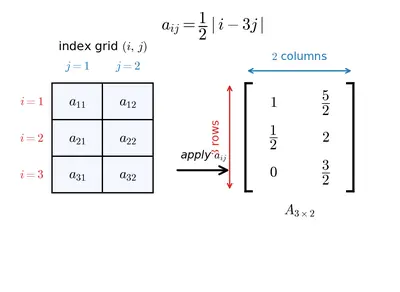
Construct a $$3 \times 2$$ matrix whose elements are given by $$a_{ij} = \frac{1}{2}|i - 3j|$$.
Figure
Figure

Solution

A $$3 \times 2$$ matrix has the form $$A = \begin{bmatrix} a_{11} & a_{12} \\ a_{21} & a_{22} \\ a_{31} & a_{32} \end{bmatrix}$$, where the row index $$i$$ takes values $$1, 2, 3$$ and the column index $$j$$ takes values $$1, 2$$.

We compute each element using $$a_{ij} = \frac{1}{2}|i - 3j|$$.

$$a_{11} = \frac{1}{2}|1 - 3(1)| = \frac{1}{2}|-2| = 1$$

$$a_{12} = \frac{1}{2}|1 - 3(2)| = \frac{1}{2}|-5| = \frac{5}{2}$$

$$a_{21} = \frac{1}{2}|2 - 3(1)| = \frac{1}{2}|-1| = \frac{1}{2}$$

$$a_{22} = \frac{1}{2}|2 - 3(2)| = \frac{1}{2}|-4| = 2$$

$$a_{31} = \frac{1}{2}|3 - 3(1)| = \frac{1}{2}|0| = 0$$

$$a_{32} = \frac{1}{2}|3 - 3(2)| = \frac{1}{2}|-3| = \frac{3}{2}$$

Therefore the required matrix is

$$A = \begin{bmatrix} 1 & \frac{5}{2} \\ \frac{1}{2} & 2 \\ 0 & \frac{3}{2} \end{bmatrix}$$

Answer

$$A = \begin{bmatrix} 1 & \frac{5}{2} \\ \frac{1}{2} & 2 \\ 0 & \frac{3}{2} \end{bmatrix}$$

Example 4 If $$\begin{bmatrix} x+3 & z+4 & 2y-7 \\ -6 & a-1 & 0 \\ b-3 & -21 & 0 \end{bmatrix} = \begin{bmatrix} 0 & 6 & 3y-2 \\ -6 & -3 & 2c+2 \\ 2b+4 & -21 & 0 \end{bmatrix}$$ Find the values of $$a, b, c, x, y$$ and $$z$$.

Solution

Two matrices are equal if and only if they have the same order and their corresponding elements are equal. Both matrices here are of order $$3 \times 3$$, so we equate the entries in matching positions.

Comparing position $$(1,1)$$: $$x + 3 = 0 \Rightarrow x = -3$$

Comparing position $$(1,2)$$: $$z + 4 = 6 \Rightarrow z = 2$$

Comparing position $$(1,3)$$: $$2y - 7 = 3y - 2$$

$$\Rightarrow -7 + 2 = 3y - 2y \Rightarrow -5 = y \Rightarrow y = -5$$

Comparing position $$(2,2)$$: $$a - 1 = -3 \Rightarrow a = -2$$

Comparing position $$(2,3)$$: $$0 = 2c + 2 \Rightarrow 2c = -2 \Rightarrow c = -1$$

Comparing position $$(3,1)$$: $$b - 3 = 2b + 4$$

$$\Rightarrow -3 - 4 = 2b - b \Rightarrow b = -7$$

(The remaining positions $$(2,1), (3,2), (3,3)$$ already match, since $$-6 = -6$$, $$-21 = -21$$ and $$0 = 0$$.)

Hence $$a = -2,\ b = -7,\ c = -1,\ x = -3,\ y = -5,\ z = 2$$.

Answer

$$a = -2,\ b = -7,\ c = -1,\ x = -3,\ y = -5,\ z = 2$$

Example 5 Find the values of $$a, b, c,$$ and $$d$$ from the following equation: $$\begin{bmatrix} 2a+b & a-2b \\ 5c-d & 4c+3d \end{bmatrix} = \begin{bmatrix} 4 & -3 \\ 11 & 24 \end{bmatrix}$$

Solution

Since the two matrices are equal, their corresponding elements must be equal. Equating entries in matching positions gives four equations:

$$2a + b = 4 \quad \text{...(1)}$$

$$a - 2b = -3 \quad \text{...(2)}$$

$$5c - d = 11 \quad \text{...(3)}$$

$$4c + 3d = 24 \quad \text{...(4)}$$

Solving for $$a$$ and $$b$$: Multiply equation (1) by 2: $$4a + 2b = 8 \quad \text{...(5)}$$

Adding (5) and (2): $$(4a + 2b) + (a - 2b) = 8 + (-3)$$

$$5a = 5 \Rightarrow a = 1$$

Substituting $$a = 1$$ in (1): $$2(1) + b = 4 \Rightarrow b = 2$$

Solving for $$c$$ and $$d$$: Multiply equation (3) by 3: $$15c - 3d = 33 \quad \text{...(6)}$$

Adding (6) and (4): $$(15c - 3d) + (4c + 3d) = 33 + 24$$

$$19c = 57 \Rightarrow c = 3$$

Substituting $$c = 3$$ in (3): $$5(3) - d = 11 \Rightarrow 15 - d = 11 \Rightarrow d = 4$$

Hence $$a = 1,\ b = 2,\ c = 3,\ d = 4$$.

Answer

$$a = 1,\ b = 2,\ c = 3,\ d = 4$$

Example 6 Given $$A = \begin{bmatrix} \sqrt{3} & 1 & -1 \\ 2 & 3 & 0 \end{bmatrix}$$ and $$B = \begin{bmatrix} 2 & \sqrt{5} & 1 \\ -2 & 3 & \frac{1}{2} \end{bmatrix}$$, find $$A + B$$.

Solution

Both $$A$$ and $$B$$ are matrices of order $$2 \times 3$$, so their sum is defined. The sum $$A + B$$ is obtained by adding the corresponding (matching) elements.

$$A + B = \begin{bmatrix} \sqrt{3} & 1 & -1 \\ 2 & 3 & 0 \end{bmatrix} + \begin{bmatrix} 2 & \sqrt{5} & 1 \\ -2 & 3 & \frac{1}{2} \end{bmatrix}$$

$$= \begin{bmatrix} \sqrt{3}+2 & 1+\sqrt{5} & -1+1 \\ 2+(-2) & 3+3 & 0+\frac{1}{2} \end{bmatrix}$$

$$= \begin{bmatrix} \sqrt{3}+2 & 1+\sqrt{5} & 0 \\ 0 & 6 & \frac{1}{2} \end{bmatrix}$$

Answer

$$A + B = \begin{bmatrix} \sqrt{3}+2 & 1+\sqrt{5} & 0 \\ 0 & 6 & \frac{1}{2} \end{bmatrix}$$

Example 7 If $$A = \begin{bmatrix} 1 & 2 & 3 \\ 2 & 3 & 1 \end{bmatrix}$$ and $$B = \begin{bmatrix} 3 & -1 & 3 \\ -1 & 0 & 2 \end{bmatrix}$$, then find $$2A - B$$.

Solution

First multiply matrix $$A$$ by the scalar 2, which means multiplying every element of $$A$$ by 2:

$$2A = 2\begin{bmatrix} 1 & 2 & 3 \\ 2 & 3 & 1 \end{bmatrix} = \begin{bmatrix} 2 & 4 & 6 \\ 4 & 6 & 2 \end{bmatrix}$$

Now subtract $$B$$ from $$2A$$ by subtracting corresponding elements (both are of order $$2 \times 3$$):

$$2A - B = \begin{bmatrix} 2 & 4 & 6 \\ 4 & 6 & 2 \end{bmatrix} - \begin{bmatrix} 3 & -1 & 3 \\ -1 & 0 & 2 \end{bmatrix}$$

$$= \begin{bmatrix} 2-3 & 4-(-1) & 6-3 \\ 4-(-1) & 6-0 & 2-2 \end{bmatrix} = \begin{bmatrix} -1 & 5 & 3 \\ 5 & 6 & 0 \end{bmatrix}$$

Answer

$$2A - B = \begin{bmatrix} -1 & 5 & 3 \\ 5 & 6 & 0 \end{bmatrix}$$

Example 8 If $$A = \begin{bmatrix} 8 & 0 \\ 4 & -2 \\ 3 & 6 \end{bmatrix}$$ and $$B = \begin{bmatrix} 2 & -2 \\ 4 & 2 \\ -5 & 1 \end{bmatrix}$$, then find the matrix $$X$$, such that $$2A + 3X = 5B$$.

Solution

We treat the matrix equation like an ordinary algebraic equation. Starting from

$$2A + 3X = 5B$$

Subtract $$2A$$ from both sides: $$3X = 5B - 2A$$

Multiply both sides by the scalar $$\frac{1}{3}$$: $$X = \frac{1}{3}(5B - 2A)$$

Now compute $$5B$$ and $$2A$$:

$$5B = 5\begin{bmatrix} 2 & -2 \\ 4 & 2 \\ -5 & 1 \end{bmatrix} = \begin{bmatrix} 10 & -10 \\ 20 & 10 \\ -25 & 5 \end{bmatrix}$$

$$2A = 2\begin{bmatrix} 8 & 0 \\ 4 & -2 \\ 3 & 6 \end{bmatrix} = \begin{bmatrix} 16 & 0 \\ 8 & -4 \\ 6 & 12 \end{bmatrix}$$

So

$$5B - 2A = \begin{bmatrix} 10-16 & -10-0 \\ 20-8 & 10-(-4) \\ -25-6 & 5-12 \end{bmatrix} = \begin{bmatrix} -6 & -10 \\ 12 & 14 \\ -31 & -7 \end{bmatrix}$$

Therefore

$$X = \frac{1}{3}\begin{bmatrix} -6 & -10 \\ 12 & 14 \\ -31 & -7 \end{bmatrix} = \begin{bmatrix} -2 & -\frac{10}{3} \\ 4 & \frac{14}{3} \\ -\frac{31}{3} & -\frac{7}{3} \end{bmatrix}$$

Answer

$$X = \begin{bmatrix} -2 & -\frac{10}{3} \\ 4 & \frac{14}{3} \\ -\frac{31}{3} & -\frac{7}{3} \end{bmatrix}$$

Example 9 Find $$X$$ and $$Y$$, if $$X + Y = \begin{bmatrix} 5 & 2 \\ 0 & 9 \end{bmatrix}$$ and $$X - Y = \begin{bmatrix} 3 & 6 \\ 0 & -1 \end{bmatrix}$$.

Solution

We are given the two matrix equations

$$X + Y = \begin{bmatrix} 5 & 2 \\ 0 & 9 \end{bmatrix} \quad \text{...(1)}$$

$$X - Y = \begin{bmatrix} 3 & 6 \\ 0 & -1 \end{bmatrix} \quad \text{...(2)}$$

Adding (1) and (2): the $$Y$$ terms cancel, giving $$2X$$:

$$2X = \begin{bmatrix} 5 & 2 \\ 0 & 9 \end{bmatrix} + \begin{bmatrix} 3 & 6 \\ 0 & -1 \end{bmatrix} = \begin{bmatrix} 8 & 8 \\ 0 & 8 \end{bmatrix}$$

$$\Rightarrow X = \frac{1}{2}\begin{bmatrix} 8 & 8 \\ 0 & 8 \end{bmatrix} = \begin{bmatrix} 4 & 4 \\ 0 & 4 \end{bmatrix}$$

Subtracting (2) from (1): the $$X$$ terms cancel, giving $$2Y$$:

$$2Y = \begin{bmatrix} 5 & 2 \\ 0 & 9 \end{bmatrix} - \begin{bmatrix} 3 & 6 \\ 0 & -1 \end{bmatrix} = \begin{bmatrix} 2 & -4 \\ 0 & 10 \end{bmatrix}$$

$$\Rightarrow Y = \frac{1}{2}\begin{bmatrix} 2 & -4 \\ 0 & 10 \end{bmatrix} = \begin{bmatrix} 1 & -2 \\ 0 & 5 \end{bmatrix}$$

Answer

$$X = \begin{bmatrix} 4 & 4 \\ 0 & 4 \end{bmatrix},\quad Y = \begin{bmatrix} 1 & -2 \\ 0 & 5 \end{bmatrix}$$

Example 10 Find the values of $$x$$ and $$y$$ from the following equation: $$2\begin{bmatrix} x & 5 \\ 7 & y-3 \end{bmatrix} + \begin{bmatrix} 3 & -4 \\ 1 & 2 \end{bmatrix} = \begin{bmatrix} 7 & 6 \\ 15 & 14 \end{bmatrix}$$

Solution

First carry out the scalar multiplication on the left side:

$$2\begin{bmatrix} x & 5 \\ 7 & y-3 \end{bmatrix} = \begin{bmatrix} 2x & 10 \\ 14 & 2y-6 \end{bmatrix}$$

Now add the second matrix:

$$\begin{bmatrix} 2x & 10 \\ 14 & 2y-6 \end{bmatrix} + \begin{bmatrix} 3 & -4 \\ 1 & 2 \end{bmatrix} = \begin{bmatrix} 2x+3 & 6 \\ 15 & 2y-4 \end{bmatrix}$$

So the equation becomes

$$\begin{bmatrix} 2x+3 & 6 \\ 15 & 2y-4 \end{bmatrix} = \begin{bmatrix} 7 & 6 \\ 15 & 14 \end{bmatrix}$$

Equating corresponding elements:

$$2x + 3 = 7 \Rightarrow 2x = 4 \Rightarrow x = 2$$

$$2y - 4 = 14 \Rightarrow 2y = 18 \Rightarrow y = 9$$

Hence $$x = 2$$ and $$y = 9$$.

Answer

$$x = 2,\ y = 9$$

Example 11

Two farmers Ramkishan and Gurcharan Singh cultivates only three varieties of rice namely Basmati, Permal and Naura. The sale (in Rupees) of these varieties of rice by both the farmers in the month of September and October are given by the following matrices A and B.

September Sales (in Rupees): $$A = \begin{bmatrix} 10{,}000 & 20{,}000 & 30{,}000 \\ 50{,}000 & 30{,}000 & 10{,}000 \end{bmatrix}\begin{matrix} \text{Ramkishan} \\ \text{Gurcharan Singh} \end{matrix}$$ (columns: Basmati, Permal, Naura)

October Sales (in Rupees): $$B = \begin{bmatrix} 5000 & 10{,}000 & 6000 \\ 20{,}000 & 10{,}000 & 10{,}000 \end{bmatrix}\begin{matrix} \text{Ramkishan} \\ \text{Gurcharan Singh} \end{matrix}$$ (columns: Basmati, Permal, Naura)

(i) Find the combined sales in September and October for each farmer in each variety.

Solution

The combined sales over the two months is obtained by adding the September sales matrix $$A$$ and the October sales matrix $$B$$ element by element. Both matrices have order $$2 \times 3$$ (rows: Ramkishan, Gurcharan Singh; columns: Basmati, Permal, Naura), so the sum is defined.

$$A + B = \begin{bmatrix} 10{,}000 & 20{,}000 & 30{,}000 \\ 50{,}000 & 30{,}000 & 10{,}000 \end{bmatrix} + \begin{bmatrix} 5000 & 10{,}000 & 6000 \\ 20{,}000 & 10{,}000 & 10{,}000 \end{bmatrix}$$

$$= \begin{bmatrix} 10{,}000+5000 & 20{,}000+10{,}000 & 30{,}000+6000 \\ 50{,}000+20{,}000 & 30{,}000+10{,}000 & 10{,}000+10{,}000 \end{bmatrix}$$

$$= \begin{bmatrix} 15{,}000 & 30{,}000 & 36{,}000 \\ 70{,}000 & 40{,}000 & 20{,}000 \end{bmatrix}$$

So the combined sales (in Rupees) are: Ramkishan — Basmati 15,000, Permal 30,000, Naura 36,000; Gurcharan Singh — Basmati 70,000, Permal 40,000, Naura 20,000.

Answer

Combined sales $$= A + B = \begin{bmatrix} 15{,}000 & 30{,}000 & 36{,}000 \\ 70{,}000 & 40{,}000 & 20{,}000 \end{bmatrix}$$ (Rupees).

(ii) Find the decrease in sales from September to October.

Solution

The decrease in sales from September to October is found by subtracting the October matrix $$B$$ from the September matrix $$A$$ (a positive entry means sales went down).

$$A - B = \begin{bmatrix} 10{,}000 & 20{,}000 & 30{,}000 \\ 50{,}000 & 30{,}000 & 10{,}000 \end{bmatrix} - \begin{bmatrix} 5000 & 10{,}000 & 6000 \\ 20{,}000 & 10{,}000 & 10{,}000 \end{bmatrix}$$

$$= \begin{bmatrix} 10{,}000-5000 & 20{,}000-10{,}000 & 30{,}000-6000 \\ 50{,}000-20{,}000 & 30{,}000-10{,}000 & 10{,}000-10{,}000 \end{bmatrix}$$

$$= \begin{bmatrix} 5000 & 10{,}000 & 24{,}000 \\ 30{,}000 & 20{,}000 & 0 \end{bmatrix}$$

So in October, sales decreased by these amounts (in Rupees) compared with September. In particular Gurcharan Singh's Naura sales showed no change (entry 0).

Answer

Decrease in sales $$= A - B = \begin{bmatrix} 5000 & 10{,}000 & 24{,}000 \\ 30{,}000 & 20{,}000 & 0 \end{bmatrix}$$ (Rupees).

(iii) If both farmers receive 2% profit on gross sales, compute the profit for each farmer and for each variety sold in October.

Solution

A 2% profit on the October gross sales means the profit matrix is $$2\%$$ of matrix $$B$$, i.e. the scalar $$\frac{2}{100} = 0.02$$ times $$B$$.

$$\text{Profit} = \frac{2}{100}\,B = 0.02\begin{bmatrix} 5000 & 10{,}000 & 6000 \\ 20{,}000 & 10{,}000 & 10{,}000 \end{bmatrix}$$

Multiplying every element by $$0.02$$:

$$= \begin{bmatrix} 0.02 \times 5000 & 0.02 \times 10{,}000 & 0.02 \times 6000 \\ 0.02 \times 20{,}000 & 0.02 \times 10{,}000 & 0.02 \times 10{,}000 \end{bmatrix}$$

$$= \begin{bmatrix} 100 & 200 & 120 \\ 400 & 200 & 200 \end{bmatrix}$$

So in October the profit (in Rupees) is: Ramkishan — Basmati 100, Permal 200, Naura 120; Gurcharan Singh — Basmati 400, Permal 200, Naura 200.

Answer

Profit $$= 2\% \text{ of } B = \begin{bmatrix} 100 & 200 & 120 \\ 400 & 200 & 200 \end{bmatrix}$$ (Rupees).

Example 12 Find $$AB$$, if $$A = \begin{bmatrix} 6 & 9 \\ 2 & 3 \end{bmatrix}$$ and $$B = \begin{bmatrix} 2 & 6 & 0 \\ 7 & 9 & 8 \end{bmatrix}$$.

Solution

Matrix $$A$$ has order $$2 \times 2$$ and matrix $$B$$ has order $$2 \times 3$$. Since the number of columns of $$A$$ (which is 2) equals the number of rows of $$B$$ (which is 2), the product $$AB$$ is defined and its order is $$2 \times 3$$.

Each entry of $$AB$$ is found by multiplying a row of $$A$$ with a column of $$B$$ (the sum of products of corresponding terms).

$$AB = \begin{bmatrix} 6 & 9 \\ 2 & 3 \end{bmatrix}\begin{bmatrix} 2 & 6 & 0 \\ 7 & 9 & 8 \end{bmatrix}$$

$$= \begin{bmatrix} 6(2)+9(7) & 6(6)+9(9) & 6(0)+9(8) \\ 2(2)+3(7) & 2(6)+3(9) & 2(0)+3(8) \end{bmatrix}$$

$$= \begin{bmatrix} 12+63 & 36+81 & 0+72 \\ 4+21 & 12+27 & 0+24 \end{bmatrix} = \begin{bmatrix} 75 & 117 & 72 \\ 25 & 39 & 24 \end{bmatrix}$$

Answer

$$AB = \begin{bmatrix} 75 & 117 & 72 \\ 25 & 39 & 24 \end{bmatrix}$$

Example 13 If $$A = \begin{bmatrix} 1 & -2 & 3 \\ -4 & 2 & 5 \end{bmatrix}$$ and $$B = \begin{bmatrix} 2 & 3 \\ 4 & 5 \\ 2 & 1 \end{bmatrix}$$, then find $$AB, BA$$. Show that $$AB \neq BA$$.

Solution

Here $$A$$ is of order $$2 \times 3$$ and $$B$$ is of order $$3 \times 2$$.

Computing $$AB$$: columns of $$A$$ (3) = rows of $$B$$ (3), so $$AB$$ is defined and has order $$2 \times 2$$.

$$AB = \begin{bmatrix} 1 & -2 & 3 \\ -4 & 2 & 5 \end{bmatrix}\begin{bmatrix} 2 & 3 \\ 4 & 5 \\ 2 & 1 \end{bmatrix}$$

$$= \begin{bmatrix} 1(2)+(-2)(4)+3(2) & 1(3)+(-2)(5)+3(1) \\ -4(2)+2(4)+5(2) & -4(3)+2(5)+5(1) \end{bmatrix}$$

$$= \begin{bmatrix} 2-8+6 & 3-10+3 \\ -8+8+10 & -12+10+5 \end{bmatrix} = \begin{bmatrix} 0 & -4 \\ 10 & 3 \end{bmatrix}$$

Computing $$BA$$: columns of $$B$$ (2) = rows of $$A$$ (2), so $$BA$$ is defined and has order $$3 \times 3$$.

$$BA = \begin{bmatrix} 2 & 3 \\ 4 & 5 \\ 2 & 1 \end{bmatrix}\begin{bmatrix} 1 & -2 & 3 \\ -4 & 2 & 5 \end{bmatrix}$$

$$= \begin{bmatrix} 2(1)+3(-4) & 2(-2)+3(2) & 2(3)+3(5) \\ 4(1)+5(-4) & 4(-2)+5(2) & 4(3)+5(5) \\ 2(1)+1(-4) & 2(-2)+1(2) & 2(3)+1(5) \end{bmatrix}$$

$$= \begin{bmatrix} 2-12 & -4+6 & 6+15 \\ 4-20 & -8+10 & 12+25 \\ 2-4 & -4+2 & 6+5 \end{bmatrix} = \begin{bmatrix} -10 & 2 & 21 \\ -16 & 2 & 37 \\ -2 & -2 & 11 \end{bmatrix}$$

Since $$AB$$ is a $$2 \times 2$$ matrix while $$BA$$ is a $$3 \times 3$$ matrix, they are not even of the same order. Hence $$AB \neq BA$$.

Answer

$$AB = \begin{bmatrix} 0 & -4 \\ 10 & 3 \end{bmatrix}$$, $$BA = \begin{bmatrix} -10 & 2 & 21 \\ -16 & 2 & 37 \\ -2 & -2 & 11 \end{bmatrix}$$; $$AB$$ and $$BA$$ have different orders, so $$AB \neq BA$$.

Example 14 If $$A = \begin{bmatrix} 1 & 0 \\ 0 & -1 \end{bmatrix}$$ and $$B = \begin{bmatrix} 0 & 1 \\ 1 & 0 \end{bmatrix}$$, then find $$AB$$ and $$BA$$ and show that $$AB \neq BA$$.

Solution

Both $$A$$ and $$B$$ are $$2 \times 2$$ matrices, so both products $$AB$$ and $$BA$$ are defined and are $$2 \times 2$$.

Computing $$AB$$:

$$AB = \begin{bmatrix} 1 & 0 \\ 0 & -1 \end{bmatrix}\begin{bmatrix} 0 & 1 \\ 1 & 0 \end{bmatrix} = \begin{bmatrix} 1(0)+0(1) & 1(1)+0(0) \\ 0(0)+(-1)(1) & 0(1)+(-1)(0) \end{bmatrix}$$

$$= \begin{bmatrix} 0 & 1 \\ -1 & 0 \end{bmatrix}$$

Computing $$BA$$:

$$BA = \begin{bmatrix} 0 & 1 \\ 1 & 0 \end{bmatrix}\begin{bmatrix} 1 & 0 \\ 0 & -1 \end{bmatrix} = \begin{bmatrix} 0(1)+1(0) & 0(0)+1(-1) \\ 1(1)+0(0) & 1(0)+0(-1) \end{bmatrix}$$

$$= \begin{bmatrix} 0 & -1 \\ 1 & 0 \end{bmatrix}$$

Comparing the two results, the $$(1,2)$$ entry is $$1$$ in $$AB$$ but $$-1$$ in $$BA$$ (and similarly for the $$(2,1)$$ entry). Since corresponding elements are not all equal,

$$AB \neq BA$$

Answer

$$AB = \begin{bmatrix} 0 & 1 \\ -1 & 0 \end{bmatrix}$$, $$BA = \begin{bmatrix} 0 & -1 \\ 1 & 0 \end{bmatrix}$$; hence $$AB \neq BA$$.

Example 15 Find $$AB$$, if $$A = \begin{bmatrix} 0 & -1 \\ 0 & 2 \end{bmatrix}$$ and $$B = \begin{bmatrix} 3 & 5 \\ 0 & 0 \end{bmatrix}$$.

Solution

Both matrices are of order $$2 \times 2$$, so $$AB$$ is defined and is a $$2 \times 2$$ matrix.

$$AB = \begin{bmatrix} 0 & -1 \\ 0 & 2 \end{bmatrix}\begin{bmatrix} 3 & 5 \\ 0 & 0 \end{bmatrix}$$

$$= \begin{bmatrix} 0(3)+(-1)(0) & 0(5)+(-1)(0) \\ 0(3)+2(0) & 0(5)+2(0) \end{bmatrix}$$

$$= \begin{bmatrix} 0+0 & 0+0 \\ 0+0 & 0+0 \end{bmatrix} = \begin{bmatrix} 0 & 0 \\ 0 & 0 \end{bmatrix}$$

So $$AB = O$$, the zero matrix. This is an important observation: the product of two matrices can be the zero matrix even though neither $$A$$ nor $$B$$ is the zero matrix.

Answer

$$AB = \begin{bmatrix} 0 & 0 \\ 0 & 0 \end{bmatrix} = O$$

Example 16 If $$A = \begin{bmatrix} 1 & 1 & -1 \\ 2 & 0 & 3 \\ 3 & -1 & 2 \end{bmatrix}$$, $$B = \begin{bmatrix} 1 & 3 \\ 0 & 2 \\ -1 & 4 \end{bmatrix}$$ and $$C = \begin{bmatrix} 1 & 2 & 3 & -4 \\ 2 & 0 & -2 & 1 \end{bmatrix}$$, find $$A(BC), (AB)C$$ and show that $$(AB)C = A(BC)$$.

Solution

The orders are: $$A$$ is $$3 \times 3$$, $$B$$ is $$3 \times 2$$, $$C$$ is $$2 \times 4$$. All the products below are therefore defined.

Step 1: Compute $$BC$$ — order $$(3 \times 2)(2 \times 4) = 3 \times 4$$.

$$BC = \begin{bmatrix} 1 & 3 \\ 0 & 2 \\ -1 & 4 \end{bmatrix}\begin{bmatrix} 1 & 2 & 3 & -4 \\ 2 & 0 & -2 & 1 \end{bmatrix} = \begin{bmatrix} 1+6 & 2+0 & 3-6 & -4+3 \\ 0+4 & 0+0 & 0-4 & 0+2 \\ -1+8 & -2+0 & -3-8 & 4+4 \end{bmatrix}$$

$$= \begin{bmatrix} 7 & 2 & -3 & -1 \\ 4 & 0 & -4 & 2 \\ 7 & -2 & -11 & 8 \end{bmatrix}$$

Step 2: Compute $$A(BC)$$ — order $$(3 \times 3)(3 \times 4) = 3 \times 4$$.

$$A(BC) = \begin{bmatrix} 1 & 1 & -1 \\ 2 & 0 & 3 \\ 3 & -1 & 2 \end{bmatrix}\begin{bmatrix} 7 & 2 & -3 & -1 \\ 4 & 0 & -4 & 2 \\ 7 & -2 & -11 & 8 \end{bmatrix}$$

Row 1: $$[\,7+4-7,\ 2+0+2,\ -3-4+11,\ -1+2-8\,] = [4, 4, 4, -7]$$

Row 2: $$[\,14+0+21,\ 4+0-6,\ -6+0-33,\ -2+0+24\,] = [35, -2, -39, 22]$$

Row 3: $$[\,21-4+14,\ 6-0-4,\ -9+4-22,\ -3-2+16\,] = [31, 2, -27, 11]$$

$$A(BC) = \begin{bmatrix} 4 & 4 & 4 & -7 \\ 35 & -2 & -39 & 22 \\ 31 & 2 & -27 & 11 \end{bmatrix}$$

Step 3: Compute $$AB$$ — order $$(3 \times 3)(3 \times 2) = 3 \times 2$$.

$$AB = \begin{bmatrix} 1 & 1 & -1 \\ 2 & 0 & 3 \\ 3 & -1 & 2 \end{bmatrix}\begin{bmatrix} 1 & 3 \\ 0 & 2 \\ -1 & 4 \end{bmatrix} = \begin{bmatrix} 1+0+1 & 3+2-4 \\ 2+0-3 & 6+0+12 \\ 3+0-2 & 9-2+8 \end{bmatrix} = \begin{bmatrix} 2 & 1 \\ -1 & 18 \\ 1 & 15 \end{bmatrix}$$

Step 4: Compute $$(AB)C$$ — order $$(3 \times 2)(2 \times 4) = 3 \times 4$$.

$$(AB)C = \begin{bmatrix} 2 & 1 \\ -1 & 18 \\ 1 & 15 \end{bmatrix}\begin{bmatrix} 1 & 2 & 3 & -4 \\ 2 & 0 & -2 & 1 \end{bmatrix}$$

Row 1: $$[\,2+2,\ 4+0,\ 6-2,\ -8+1\,] = [4, 4, 4, -7]$$

Row 2: $$[\,-1+36,\ -2+0,\ -3-36,\ 4+18\,] = [35, -2, -39, 22]$$

Row 3: $$[\,1+30,\ 2+0,\ 3-30,\ -4+15\,] = [31, 2, -27, 11]$$

$$(AB)C = \begin{bmatrix} 4 & 4 & 4 & -7 \\ 35 & -2 & -39 & 22 \\ 31 & 2 & -27 & 11 \end{bmatrix}$$

Comparing Step 2 and Step 4, the two matrices are identical. Hence $$(AB)C = A(BC)$$, which illustrates the associative property of matrix multiplication.

Answer

$$A(BC) = (AB)C = \begin{bmatrix} 4 & 4 & 4 & -7 \\ 35 & -2 & -39 & 22 \\ 31 & 2 & -27 & 11 \end{bmatrix}$$

Example 17 If $$A = \begin{bmatrix} 0 & 6 & 7 \\ -6 & 0 & 8 \\ 7 & -8 & 0 \end{bmatrix}$$, $$B = \begin{bmatrix} 0 & 1 & 1 \\ 1 & 0 & 2 \\ 1 & 2 & 0 \end{bmatrix}$$, $$C = \begin{bmatrix} 2 \\ -2 \\ 3 \end{bmatrix}$$. Calculate $$AC, BC$$ and $$(A + B)C$$. Also, verify that $$(A + B)C = AC + BC$$.

Solution

$$A$$ and $$B$$ are $$3 \times 3$$ matrices and $$C$$ is a $$3 \times 1$$ matrix, so every product below is defined and gives a $$3 \times 1$$ matrix.

Computing $$AC$$:

$$AC = \begin{bmatrix} 0 & 6 & 7 \\ -6 & 0 & 8 \\ 7 & -8 & 0 \end{bmatrix}\begin{bmatrix} 2 \\ -2 \\ 3 \end{bmatrix} = \begin{bmatrix} 0(2)+6(-2)+7(3) \\ -6(2)+0(-2)+8(3) \\ 7(2)+(-8)(-2)+0(3) \end{bmatrix}$$

$$= \begin{bmatrix} 0-12+21 \\ -12+0+24 \\ 14+16+0 \end{bmatrix} = \begin{bmatrix} 9 \\ 12 \\ 30 \end{bmatrix}$$

Computing $$BC$$:

$$BC = \begin{bmatrix} 0 & 1 & 1 \\ 1 & 0 & 2 \\ 1 & 2 & 0 \end{bmatrix}\begin{bmatrix} 2 \\ -2 \\ 3 \end{bmatrix} = \begin{bmatrix} 0(2)+1(-2)+1(3) \\ 1(2)+0(-2)+2(3) \\ 1(2)+2(-2)+0(3) \end{bmatrix}$$

$$= \begin{bmatrix} 0-2+3 \\ 2+0+6 \\ 2-4+0 \end{bmatrix} = \begin{bmatrix} 1 \\ 8 \\ -2 \end{bmatrix}$$

Computing $$(A + B)C$$: first add $$A$$ and $$B$$:

$$A + B = \begin{bmatrix} 0 & 7 & 8 \\ -5 & 0 & 10 \\ 8 & -6 & 0 \end{bmatrix}$$

$$(A+B)C = \begin{bmatrix} 0 & 7 & 8 \\ -5 & 0 & 10 \\ 8 & -6 & 0 \end{bmatrix}\begin{bmatrix} 2 \\ -2 \\ 3 \end{bmatrix} = \begin{bmatrix} 0-14+24 \\ -10+0+30 \\ 16+12+0 \end{bmatrix} = \begin{bmatrix} 10 \\ 20 \\ 28 \end{bmatrix}$$

Verification:

$$AC + BC = \begin{bmatrix} 9 \\ 12 \\ 30 \end{bmatrix} + \begin{bmatrix} 1 \\ 8 \\ -2 \end{bmatrix} = \begin{bmatrix} 10 \\ 20 \\ 28 \end{bmatrix}$$

This equals $$(A+B)C$$. Hence $$(A + B)C = AC + BC$$, illustrating the distributive property.

Answer

$$AC = \begin{bmatrix} 9 \\ 12 \\ 30 \end{bmatrix}$$, $$BC = \begin{bmatrix} 1 \\ 8 \\ -2 \end{bmatrix}$$, $$(A+B)C = \begin{bmatrix} 10 \\ 20 \\ 28 \end{bmatrix} = AC + BC$$. Verified.

Example 18 If $$A = \begin{bmatrix} 1 & 2 & 3 \\ 3 & -2 & 1 \\ 4 & 2 & 1 \end{bmatrix}$$, then show that $$A^3 - 23A - 40I = O$$.

Solution

Step 1: Compute $$A^2 = A \cdot A$$.

$$A^2 = \begin{bmatrix} 1 & 2 & 3 \\ 3 & -2 & 1 \\ 4 & 2 & 1 \end{bmatrix}\begin{bmatrix} 1 & 2 & 3 \\ 3 & -2 & 1 \\ 4 & 2 & 1 \end{bmatrix}$$

Row 1: $$[\,1+6+12,\ 2-4+6,\ 3+2+3\,] = [19, 4, 8]$$

Row 2: $$[\,3-6+4,\ 6+4+2,\ 9-2+1\,] = [1, 12, 8]$$

Row 3: $$[\,4+6+4,\ 8-4+2,\ 12+2+1\,] = [14, 6, 15]$$

$$A^2 = \begin{bmatrix} 19 & 4 & 8 \\ 1 & 12 & 8 \\ 14 & 6 & 15 \end{bmatrix}$$

Step 2: Compute $$A^3 = A^2 \cdot A$$.

$$A^3 = \begin{bmatrix} 19 & 4 & 8 \\ 1 & 12 & 8 \\ 14 & 6 & 15 \end{bmatrix}\begin{bmatrix} 1 & 2 & 3 \\ 3 & -2 & 1 \\ 4 & 2 & 1 \end{bmatrix}$$

Row 1: $$[\,19+12+32,\ 38-8+16,\ 57+4+8\,] = [63, 46, 69]$$

Row 2: $$[\,1+36+32,\ 2-24+16,\ 3+12+8\,] = [69, -6, 23]$$

Row 3: $$[\,14+18+60,\ 28-12+30,\ 42+6+15\,] = [92, 46, 63]$$

$$A^3 = \begin{bmatrix} 63 & 46 & 69 \\ 69 & -6 & 23 \\ 92 & 46 & 63 \end{bmatrix}$$

Step 3: Compute $$23A$$ and $$40I$$.

$$23A = \begin{bmatrix} 23 & 46 & 69 \\ 69 & -46 & 23 \\ 92 & 46 & 23 \end{bmatrix}, \qquad 40I = \begin{bmatrix} 40 & 0 & 0 \\ 0 & 40 & 0 \\ 0 & 0 & 40 \end{bmatrix}$$

Step 4: Compute $$A^3 - 23A - 40I$$.

$$A^3 - 23A - 40I = \begin{bmatrix} 63-23-40 & 46-46-0 & 69-69-0 \\ 69-69-0 & -6+46-40 & 23-23-0 \\ 92-92-0 & 46-46-0 & 63-23-40 \end{bmatrix}$$

$$= \begin{bmatrix} 0 & 0 & 0 \\ 0 & 0 & 0 \\ 0 & 0 & 0 \end{bmatrix} = O$$

Hence $$A^3 - 23A - 40I = O$$.

Answer

Proved that $$A^3 - 23A - 40I = O$$.

Example 19

In a legislative assembly election, a political group hired a public relations firm to promote its candidate in three ways: telephone, house calls, and letters. The cost per contact (in paise) is given in matrix A as $$A = \begin{bmatrix} 40 \\ 100 \\ 50 \end{bmatrix}\begin{matrix} \text{Telephone} \\ \text{Housecall} \\ \text{Letter} \end{matrix}$$

The number of contacts of each type made in two cities X and Y is given by $$B = \begin{bmatrix} 1000 & 500 & 5000 \\ 3000 & 1000 & 10{,}000 \end{bmatrix}\begin{matrix} \to \text{X} \\ \to \text{Y} \end{matrix}$$ (columns: Telephone, Housecall, Letter). Find the total amount spent by the group in the two cities X and Y.

Solution

The amount spent in a city is (number of contacts of each type) $$\times$$ (cost per contact), summed over the three types. This is exactly a row of $$B$$ multiplied by the column matrix $$A$$. So the total amounts are given by the product $$BA$$.

Here $$B$$ has order $$2 \times 3$$ and $$A$$ has order $$3 \times 1$$, so $$BA$$ is defined and has order $$2 \times 1$$.

$$BA = \begin{bmatrix} 1000 & 500 & 5000 \\ 3000 & 1000 & 10{,}000 \end{bmatrix}\begin{bmatrix} 40 \\ 100 \\ 50 \end{bmatrix}$$

$$= \begin{bmatrix} 1000(40)+500(100)+5000(50) \\ 3000(40)+1000(100)+10{,}000(50) \end{bmatrix}$$

$$= \begin{bmatrix} 40{,}000+50{,}000+2{,}50{,}000 \\ 1{,}20{,}000+1{,}00{,}000+5{,}00{,}000 \end{bmatrix} = \begin{bmatrix} 3{,}40{,}000 \\ 7{,}20{,}000 \end{bmatrix}$$

So the group spent $$3{,}40{,}000$$ paise in city X and $$7{,}20{,}000$$ paise in city Y. Since $$100$$ paise $$= \text{₹}\, 1$$:

Amount in X $$= \text{₹}\, 3400$$ and amount in Y $$= \text{₹}\, 7200$$.

Total amount spent $$= \text{₹}\, 3400 + \text{₹}\, 7200 = \text{₹}\, 10{,}600$$.

Answer

City X: $$\text{₹}\, 3400$$; City Y: $$\text{₹}\, 7200$$; total amount spent $$= \text{₹}\, 10{,}600$$.

Example 20 If $$A = \begin{bmatrix} 3 & \sqrt{3} & 2 \\ 4 & 2 & 0 \end{bmatrix}$$ and $$B = \begin{bmatrix} 2 & -1 & 2 \\ 1 & 2 & 4 \end{bmatrix}$$, verify that

(i) $$(A')' = A$$

Solution

We have $$A = \begin{bmatrix} 3 & \sqrt{3} & 2 \\ 4 & 2 & 0 \end{bmatrix}$$, a $$2 \times 3$$ matrix.

The transpose $$A'$$ is obtained by interchanging rows and columns — row 1 of $$A$$ becomes column 1, row 2 becomes column 2:

$$A' = \begin{bmatrix} 3 & 4 \\ \sqrt{3} & 2 \\ 2 & 0 \end{bmatrix}$$

Now take the transpose again. $$(A')'$$ is obtained by turning the rows of $$A'$$ into columns:

$$(A')' = \begin{bmatrix} 3 & \sqrt{3} & 2 \\ 4 & 2 & 0 \end{bmatrix} = A$$

Hence $$(A')' = A$$ is verified.

Answer

$$(A')' = \begin{bmatrix} 3 & \sqrt{3} & 2 \\ 4 & 2 & 0 \end{bmatrix} = A$$. Verified.

(ii) $$(A + B)' = A' + B'$$

Solution

Here $$A = \begin{bmatrix} 3 & \sqrt{3} & 2 \\ 4 & 2 & 0 \end{bmatrix}$$ and $$B = \begin{bmatrix} 2 & -1 & 2 \\ 1 & 2 & 4 \end{bmatrix}$$.

Left side $$(A + B)'$$: first add $$A$$ and $$B$$.

$$A + B = \begin{bmatrix} 3+2 & \sqrt{3}-1 & 2+2 \\ 4+1 & 2+2 & 0+4 \end{bmatrix} = \begin{bmatrix} 5 & \sqrt{3}-1 & 4 \\ 5 & 4 & 4 \end{bmatrix}$$

Taking the transpose:

$$(A + B)' = \begin{bmatrix} 5 & 5 \\ \sqrt{3}-1 & 4 \\ 4 & 4 \end{bmatrix}$$

Right side $$A' + B'$$:

$$A' = \begin{bmatrix} 3 & 4 \\ \sqrt{3} & 2 \\ 2 & 0 \end{bmatrix}, \qquad B' = \begin{bmatrix} 2 & 1 \\ -1 & 2 \\ 2 & 4 \end{bmatrix}$$

$$A' + B' = \begin{bmatrix} 3+2 & 4+1 \\ \sqrt{3}-1 & 2+2 \\ 2+2 & 0+4 \end{bmatrix} = \begin{bmatrix} 5 & 5 \\ \sqrt{3}-1 & 4 \\ 4 & 4 \end{bmatrix}$$

The left side equals the right side, so $$(A + B)' = A' + B'$$ is verified.

Answer

Both sides equal $$\begin{bmatrix} 5 & 5 \\ \sqrt{3}-1 & 4 \\ 4 & 4 \end{bmatrix}$$, so $$(A + B)' = A' + B'$$. Verified.

(iii) $$(kB)' = kB'$$, where $$k$$ is any constant.

Solution

Here $$B = \begin{bmatrix} 2 & -1 & 2 \\ 1 & 2 & 4 \end{bmatrix}$$ and $$k$$ is any constant.

Left side $$(kB)'$$: first multiply $$B$$ by the scalar $$k$$.

$$kB = \begin{bmatrix} 2k & -k & 2k \\ k & 2k & 4k \end{bmatrix}$$

Taking the transpose:

$$(kB)' = \begin{bmatrix} 2k & k \\ -k & 2k \\ 2k & 4k \end{bmatrix}$$

Right side $$kB'$$:

$$B' = \begin{bmatrix} 2 & 1 \\ -1 & 2 \\ 2 & 4 \end{bmatrix} \quad\Rightarrow\quad kB' = \begin{bmatrix} 2k & k \\ -k & 2k \\ 2k & 4k \end{bmatrix}$$

The left side equals the right side, so $$(kB)' = kB'$$ is verified.

Answer

Both sides equal $$\begin{bmatrix} 2k & k \\ -k & 2k \\ 2k & 4k \end{bmatrix}$$, so $$(kB)' = kB'$$. Verified.

Example 21 If $$A = \begin{bmatrix} -2 \\ 4 \\ 5 \end{bmatrix}$$, $$B = \begin{bmatrix} 1 & 3 & -6 \end{bmatrix}$$, verify that $$(AB)' = B'A'$$.

Solution

$$A$$ is of order $$3 \times 1$$ and $$B$$ is of order $$1 \times 3$$, so $$AB$$ is defined and has order $$3 \times 3$$.

Step 1: Compute $$AB$$.

$$AB = \begin{bmatrix} -2 \\ 4 \\ 5 \end{bmatrix}\begin{bmatrix} 1 & 3 & -6 \end{bmatrix} = \begin{bmatrix} -2(1) & -2(3) & -2(-6) \\ 4(1) & 4(3) & 4(-6) \\ 5(1) & 5(3) & 5(-6) \end{bmatrix}$$

$$= \begin{bmatrix} -2 & -6 & 12 \\ 4 & 12 & -24 \\ 5 & 15 & -30 \end{bmatrix}$$

Step 2: Take the transpose, $$(AB)'$$.

$$(AB)' = \begin{bmatrix} -2 & 4 & 5 \\ -6 & 12 & 15 \\ 12 & -24 & -30 \end{bmatrix}$$

Step 3: Compute $$B'A'$$. We have $$B' = \begin{bmatrix} 1 \\ 3 \\ -6 \end{bmatrix}$$ (order $$3 \times 1$$) and $$A' = \begin{bmatrix} -2 & 4 & 5 \end{bmatrix}$$ (order $$1 \times 3$$). So $$B'A'$$ has order $$3 \times 3$$.

$$B'A' = \begin{bmatrix} 1 \\ 3 \\ -6 \end{bmatrix}\begin{bmatrix} -2 & 4 & 5 \end{bmatrix} = \begin{bmatrix} 1(-2) & 1(4) & 1(5) \\ 3(-2) & 3(4) & 3(5) \\ -6(-2) & -6(4) & -6(5) \end{bmatrix}$$

$$= \begin{bmatrix} -2 & 4 & 5 \\ -6 & 12 & 15 \\ 12 & -24 & -30 \end{bmatrix}$$

Step 2 and Step 3 give the same matrix, so $$(AB)' = B'A'$$ is verified.

Answer

Both $$(AB)'$$ and $$B'A'$$ equal $$\begin{bmatrix} -2 & 4 & 5 \\ -6 & 12 & 15 \\ 12 & -24 & -30 \end{bmatrix}$$. Verified.

Example 22 Express the matrix $$B = \begin{bmatrix} 2 & -2 & -4 \\ -1 & 3 & 4 \\ 1 & -2 & -3 \end{bmatrix}$$ as the sum of a symmetric and a skew symmetric matrix.

Solution

Any square matrix $$B$$ can be written as $$B = \dfrac{1}{2}(B + B') + \dfrac{1}{2}(B - B')$$, where $$\dfrac{1}{2}(B + B')$$ is symmetric and $$\dfrac{1}{2}(B - B')$$ is skew symmetric.

Step 1: Write down $$B'$$.

$$B' = \begin{bmatrix} 2 & -1 & 1 \\ -2 & 3 & -2 \\ -4 & 4 & -3 \end{bmatrix}$$

Step 2: Form the symmetric part $$P = \dfrac{1}{2}(B + B')$$.

$$B + B' = \begin{bmatrix} 4 & -3 & -3 \\ -3 & 6 & 2 \\ -3 & 2 & -6 \end{bmatrix}$$

$$P = \frac{1}{2}(B + B') = \begin{bmatrix} 2 & -\frac{3}{2} & -\frac{3}{2} \\ -\frac{3}{2} & 3 & 1 \\ -\frac{3}{2} & 1 & -3 \end{bmatrix}$$

Since $$P' = P$$, the matrix $$P$$ is symmetric.

Step 3: Form the skew symmetric part $$Q = \dfrac{1}{2}(B - B')$$.

$$B - B' = \begin{bmatrix} 0 & -1 & -5 \\ 1 & 0 & 6 \\ 5 & -6 & 0 \end{bmatrix}$$

$$Q = \frac{1}{2}(B - B') = \begin{bmatrix} 0 & -\frac{1}{2} & -\frac{5}{2} \\ \frac{1}{2} & 0 & 3 \\ \frac{5}{2} & -3 & 0 \end{bmatrix}$$

Since $$Q' = -Q$$, the matrix $$Q$$ is skew symmetric.

Step 4: Verify $$P + Q = B$$.

$$P + Q = \begin{bmatrix} 2 & -2 & -4 \\ -1 & 3 & 4 \\ 1 & -2 & -3 \end{bmatrix} = B$$

Hence $$B$$ is expressed as the sum of the symmetric matrix $$P$$ and the skew symmetric matrix $$Q$$.

Answer

$$B = \begin{bmatrix} 2 & -\frac{3}{2} & -\frac{3}{2} \\ -\frac{3}{2} & 3 & 1 \\ -\frac{3}{2} & 1 & -3 \end{bmatrix} + \begin{bmatrix} 0 & -\frac{1}{2} & -\frac{5}{2} \\ \frac{1}{2} & 0 & 3 \\ \frac{5}{2} & -3 & 0 \end{bmatrix}$$ (symmetric + skew symmetric).

Exercise 3.1

1 In the matrix $$A = \begin{bmatrix} 2 & 5 & 19 & -7 \\ 35 & -2 & \frac{5}{2} & 12 \\ \sqrt{3} & 1 & -5 & 17 \end{bmatrix}$$, write:

(i) The order of the matrix,

Solution

The order of a matrix is written as (number of rows) $$\times$$ (number of columns).

Counting the given matrix $$A$$: it has 3 horizontal rows and 4 vertical columns.

Therefore the order of the matrix is $$3 \times 4$$.

Answer

The order of the matrix is $$3 \times 4$$.

(ii) The number of elements,

Solution

A matrix of order $$m \times n$$ has $$mn$$ elements in total.

Here the order is $$3 \times 4$$, so the number of elements is

$$3 \times 4 = 12$$

Answer

The matrix has 12 elements.

(iii) Write the elements $$a_{13}, a_{21}, a_{33}, a_{24}, a_{23}$$.

Solution

In the notation $$a_{ij}$$, the first index $$i$$ is the row number and the second index $$j$$ is the column number. We read off each entry from the matrix $$A = \begin{bmatrix} 2 & 5 & 19 & -7 \\ 35 & -2 & \frac{5}{2} & 12 \\ \sqrt{3} & 1 & -5 & 17 \end{bmatrix}$$.

$$a_{13}$$ = element in row 1, column 3 $$= 19$$

$$a_{21}$$ = element in row 2, column 1 $$= 35$$

$$a_{33}$$ = element in row 3, column 3 $$= -5$$

$$a_{24}$$ = element in row 2, column 4 $$= 12$$

$$a_{23}$$ = element in row 2, column 3 $$= \frac{5}{2}$$

Answer

$$a_{13} = 19,\ a_{21} = 35,\ a_{33} = -5,\ a_{24} = 12,\ a_{23} = \frac{5}{2}$$

2 If a matrix has 24 elements, what are the possible orders it can have? What, if it has 13 elements?

Solution

A matrix of order $$m \times n$$ has $$mn$$ elements. To find all possible orders we list every way of writing the number of elements as an ordered product $$m \times n$$ of natural numbers.

Case 1: 24 elements. We need $$m \times n = 24$$. The factor pairs of 24 are:

$$1 \times 24,\ 2 \times 12,\ 3 \times 8,\ 4 \times 6,\ 6 \times 4,\ 8 \times 3,\ 12 \times 2,\ 24 \times 1$$

So there are 8 possible orders: $$1 \times 24,\ 24 \times 1,\ 2 \times 12,\ 12 \times 2,\ 3 \times 8,\ 8 \times 3,\ 4 \times 6,\ 6 \times 4$$.

Case 2: 13 elements. We need $$m \times n = 13$$. Since 13 is a prime number, its only factorisations are $$1 \times 13$$ and $$13 \times 1$$.

So there are 2 possible orders: $$1 \times 13$$ and $$13 \times 1$$.

Answer

For 24 elements: 8 orders — $$1 \times 24, 24 \times 1, 2 \times 12, 12 \times 2, 3 \times 8, 8 \times 3, 4 \times 6, 6 \times 4$$. For 13 elements: 2 orders — $$1 \times 13$$ and $$13 \times 1$$.

3 If a matrix has 18 elements, what are the possible orders it can have? What, if it has 5 elements?

Solution

A matrix of order $$m \times n$$ has $$mn$$ elements. The possible orders correspond to all ordered factorisations of the number of elements.

Case 1: 18 elements. We need $$m \times n = 18$$. The factor pairs of 18 are:

$$1 \times 18,\ 2 \times 9,\ 3 \times 6,\ 6 \times 3,\ 9 \times 2,\ 18 \times 1$$

So there are 6 possible orders: $$1 \times 18,\ 18 \times 1,\ 2 \times 9,\ 9 \times 2,\ 3 \times 6,\ 6 \times 3$$.

Case 2: 5 elements. We need $$m \times n = 5$$. Since 5 is a prime number, its only factorisations are $$1 \times 5$$ and $$5 \times 1$$.

So there are 2 possible orders: $$1 \times 5$$ and $$5 \times 1$$.

Answer

For 18 elements: 6 orders — $$1 \times 18, 18 \times 1, 2 \times 9, 9 \times 2, 3 \times 6, 6 \times 3$$. For 5 elements: 2 orders — $$1 \times 5$$ and $$5 \times 1$$.

4 Construct a $$2 \times 2$$ matrix, $$A = [a_{ij}]$$, whose elements are given by:

(i) $$a_{ij} = \frac{(i+j)^2}{2}$$

Solution

A $$2 \times 2$$ matrix is $$A = \begin{bmatrix} a_{11} & a_{12} \\ a_{21} & a_{22} \end{bmatrix}$$, where $$i, j \in \{1, 2\}$$. We compute each element using $$a_{ij} = \dfrac{(i+j)^2}{2}$$.

$$a_{11} = \frac{(1+1)^2}{2} = \frac{4}{2} = 2$$

$$a_{12} = \frac{(1+2)^2}{2} = \frac{9}{2}$$

$$a_{21} = \frac{(2+1)^2}{2} = \frac{9}{2}$$

$$a_{22} = \frac{(2+2)^2}{2} = \frac{16}{2} = 8$$

Therefore $$A = \begin{bmatrix} 2 & \frac{9}{2} \\ \frac{9}{2} & 8 \end{bmatrix}$$.

Answer

$$A = \begin{bmatrix} 2 & \frac{9}{2} \\ \frac{9}{2} & 8 \end{bmatrix}$$

(ii) $$a_{ij} = \frac{i}{j}$$

Solution

For a $$2 \times 2$$ matrix $$A = [a_{ij}]$$ with $$i, j \in \{1, 2\}$$, compute each element using $$a_{ij} = \dfrac{i}{j}$$.

$$a_{11} = \frac{1}{1} = 1$$

$$a_{12} = \frac{1}{2}$$

$$a_{21} = \frac{2}{1} = 2$$

$$a_{22} = \frac{2}{2} = 1$$

Therefore $$A = \begin{bmatrix} 1 & \frac{1}{2} \\ 2 & 1 \end{bmatrix}$$.

Answer

$$A = \begin{bmatrix} 1 & \frac{1}{2} \\ 2 & 1 \end{bmatrix}$$

(iii) $$a_{ij} = \frac{(i+2j)^2}{2}$$

Solution

For a $$2 \times 2$$ matrix $$A = [a_{ij}]$$ with $$i, j \in \{1, 2\}$$, compute each element using $$a_{ij} = \dfrac{(i+2j)^2}{2}$$.

$$a_{11} = \frac{(1+2 \cdot 1)^2}{2} = \frac{3^2}{2} = \frac{9}{2}$$

$$a_{12} = \frac{(1+2 \cdot 2)^2}{2} = \frac{5^2}{2} = \frac{25}{2}$$

$$a_{21} = \frac{(2+2 \cdot 1)^2}{2} = \frac{4^2}{2} = \frac{16}{2} = 8$$

$$a_{22} = \frac{(2+2 \cdot 2)^2}{2} = \frac{6^2}{2} = \frac{36}{2} = 18$$

Therefore $$A = \begin{bmatrix} \frac{9}{2} & \frac{25}{2} \\ 8 & 18 \end{bmatrix}$$.

Answer

$$A = \begin{bmatrix} \frac{9}{2} & \frac{25}{2} \\ 8 & 18 \end{bmatrix}$$

5 Construct a $$3 \times 4$$ matrix, whose elements are given by:

(i) $$a_{ij} = \frac{1}{2}|-3i + j|$$

Solution

A $$3 \times 4$$ matrix has row index $$i \in \{1, 2, 3\}$$ and column index $$j \in \{1, 2, 3, 4\}$$. We compute each element using $$a_{ij} = \dfrac{1}{2}|-3i + j|$$.

Row 1 ($$i = 1$$):

$$a_{11} = \tfrac{1}{2}|-3+1| = \tfrac{1}{2}(2) = 1,\quad a_{12} = \tfrac{1}{2}|-3+2| = \tfrac{1}{2},\quad a_{13} = \tfrac{1}{2}|-3+3| = 0,\quad a_{14} = \tfrac{1}{2}|-3+4| = \tfrac{1}{2}$$

Row 2 ($$i = 2$$):

$$a_{21} = \tfrac{1}{2}|-6+1| = \tfrac{5}{2},\quad a_{22} = \tfrac{1}{2}|-6+2| = 2,\quad a_{23} = \tfrac{1}{2}|-6+3| = \tfrac{3}{2},\quad a_{24} = \tfrac{1}{2}|-6+4| = 1$$

Row 3 ($$i = 3$$):

$$a_{31} = \tfrac{1}{2}|-9+1| = 4,\quad a_{32} = \tfrac{1}{2}|-9+2| = \tfrac{7}{2},\quad a_{33} = \tfrac{1}{2}|-9+3| = 3,\quad a_{34} = \tfrac{1}{2}|-9+4| = \tfrac{5}{2}$$

Therefore $$A = \begin{bmatrix} 1 & \frac{1}{2} & 0 & \frac{1}{2} \\ \frac{5}{2} & 2 & \frac{3}{2} & 1 \\ 4 & \frac{7}{2} & 3 & \frac{5}{2} \end{bmatrix}$$.

Answer

$$A = \begin{bmatrix} 1 & \frac{1}{2} & 0 & \frac{1}{2} \\ \frac{5}{2} & 2 & \frac{3}{2} & 1 \\ 4 & \frac{7}{2} & 3 & \frac{5}{2} \end{bmatrix}$$

(ii) $$a_{ij} = 2i - j$$

Solution

A $$3 \times 4$$ matrix has row index $$i \in \{1, 2, 3\}$$ and column index $$j \in \{1, 2, 3, 4\}$$. We compute each element using $$a_{ij} = 2i - j$$.

Row 1 ($$i = 1$$): $$a_{11} = 2-1 = 1,\ a_{12} = 2-2 = 0,\ a_{13} = 2-3 = -1,\ a_{14} = 2-4 = -2$$

Row 2 ($$i = 2$$): $$a_{21} = 4-1 = 3,\ a_{22} = 4-2 = 2,\ a_{23} = 4-3 = 1,\ a_{24} = 4-4 = 0$$

Row 3 ($$i = 3$$): $$a_{31} = 6-1 = 5,\ a_{32} = 6-2 = 4,\ a_{33} = 6-3 = 3,\ a_{34} = 6-4 = 2$$

Therefore $$A = \begin{bmatrix} 1 & 0 & -1 & -2 \\ 3 & 2 & 1 & 0 \\ 5 & 4 & 3 & 2 \end{bmatrix}$$.

Answer

$$A = \begin{bmatrix} 1 & 0 & -1 & -2 \\ 3 & 2 & 1 & 0 \\ 5 & 4 & 3 & 2 \end{bmatrix}$$

6 Find the values of $$x, y$$ and $$z$$ from the following equations:

(i) $$\begin{bmatrix} 4 & 3 \\ x & 5 \end{bmatrix} = \begin{bmatrix} y & z \\ 1 & 5 \end{bmatrix}$$

Solution

Two matrices of the same order are equal only if their corresponding elements are equal. Equating entries in matching positions:

Position $$(1,1)$$: $$4 = y \Rightarrow y = 4$$

Position $$(1,2)$$: $$3 = z \Rightarrow z = 3$$

Position $$(2,1)$$: $$x = 1$$

(Position $$(2,2)$$ already matches: $$5 = 5$$.)

Hence $$x = 1,\ y = 4,\ z = 3$$.

Answer

$$x = 1,\ y = 4,\ z = 3$$

(ii) $$\begin{bmatrix} x+y & 2 \\ 5+z & xy \end{bmatrix} = \begin{bmatrix} 6 & 2 \\ 5 & 8 \end{bmatrix}$$

Solution

Equating corresponding elements of the two equal matrices:

Position $$(1,1)$$: $$x + y = 6 \quad \text{...(1)}$$

Position $$(2,1)$$: $$5 + z = 5 \Rightarrow z = 0$$

Position $$(2,2)$$: $$xy = 8 \quad \text{...(2)}$$

From (1), $$y = 6 - x$$. Substitute into (2):

$$x(6 - x) = 8 \Rightarrow 6x - x^2 = 8 \Rightarrow x^2 - 6x + 8 = 0$$

Factorising: $$(x - 2)(x - 4) = 0 \Rightarrow x = 2 \text{ or } x = 4$$.

If $$x = 2$$, then $$y = 6 - 2 = 4$$. If $$x = 4$$, then $$y = 6 - 4 = 2$$.

Hence $$z = 0$$, and either $$x = 2,\ y = 4$$ or $$x = 4,\ y = 2$$.

Answer

$$z = 0$$; and $$x = 2,\ y = 4$$ or $$x = 4,\ y = 2$$.

(iii) $$\begin{bmatrix} x+y+z \\ x+z \\ y+z \end{bmatrix} = \begin{bmatrix} 9 \\ 5 \\ 7 \end{bmatrix}$$

Solution

Equating corresponding elements of the two equal column matrices:

$$x + y + z = 9 \quad \text{...(1)}$$

$$x + z = 5 \quad \text{...(2)}$$

$$y + z = 7 \quad \text{...(3)}$$

Substitute (2) into (1): $$(x + z) + y = 9 \Rightarrow 5 + y = 9 \Rightarrow y = 4$$

Substitute (3) into (1): $$x + (y + z) = 9 \Rightarrow x + 7 = 9 \Rightarrow x = 2$$

From (2): $$z = 5 - x = 5 - 2 = 3$$

Check with (3): $$y + z = 4 + 3 = 7$$ ✓

Hence $$x = 2,\ y = 4,\ z = 3$$.

Answer

$$x = 2,\ y = 4,\ z = 3$$

7 Find the value of $$a, b, c$$ and $$d$$ from the equation: $$\begin{bmatrix} a-b & 2a+c \\ 2a-b & 3c+d \end{bmatrix} = \begin{bmatrix} -1 & 5 \\ 0 & 13 \end{bmatrix}$$

Solution

Since the two matrices are equal, their corresponding elements are equal. This gives four equations:

$$a - b = -1 \quad \text{...(1)}$$

$$2a + c = 5 \quad \text{...(2)}$$

$$2a - b = 0 \quad \text{...(3)}$$

$$3c + d = 13 \quad \text{...(4)}$$

Solving for $$a$$ and $$b$$: Subtract equation (1) from equation (3):

$$(2a - b) - (a - b) = 0 - (-1) \Rightarrow a = 1$$

Substitute $$a = 1$$ in (1): $$1 - b = -1 \Rightarrow b = 2$$

Solving for $$c$$: Substitute $$a = 1$$ in (2): $$2(1) + c = 5 \Rightarrow c = 3$$

Solving for $$d$$: Substitute $$c = 3$$ in (4): $$3(3) + d = 13 \Rightarrow 9 + d = 13 \Rightarrow d = 4$$

Hence $$a = 1,\ b = 2,\ c = 3,\ d = 4$$.

Answer

$$a = 1,\ b = 2,\ c = 3,\ d = 4$$

8 $$A = [a_{ij}]_{m \times n}$$ is a square matrix, if
(A) $$m < n$$
(B) $$m > n$$
(C) $$m = n$$
(D) None of these

Solution

A matrix is called a square matrix when its number of rows is equal to its number of columns.

For the matrix $$A = [a_{ij}]_{m \times n}$$, the number of rows is $$m$$ and the number of columns is $$n$$.

So $$A$$ is a square matrix precisely when $$m = n$$.

Hence the correct option is (C).

Answer

(C) $$m = n$$

9 Which of the given values of $$x$$ and $$y$$ make the following pair of matrices equal $$\begin{bmatrix} 3x+7 & 5 \\ y+1 & 2-3x \end{bmatrix}, \begin{bmatrix} 0 & y-2 \\ 8 & 4 \end{bmatrix}$$
(A) $$x = \frac{-1}{3}, y = 7$$
(B) Not possible to find
(C) $$y = 7, x = \frac{-2}{3}$$
(D) $$x = \frac{-1}{3}, y = \frac{-2}{3}$$

Solution

If the two matrices are equal, then all corresponding elements must be equal. Equating the entries:

Position $$(1,1)$$: $$3x + 7 = 0 \Rightarrow x = -\dfrac{7}{3}$$

Position $$(2,2)$$: $$2 - 3x = 4 \Rightarrow -3x = 2 \Rightarrow x = -\dfrac{2}{3}$$

From the first condition $$x = -\dfrac{7}{3}$$, but from the second condition $$x = -\dfrac{2}{3}$$. A single value of $$x$$ cannot equal both $$-\dfrac{7}{3}$$ and $$-\dfrac{2}{3}$$ at the same time.

Since the conditions on $$x$$ contradict each other, no values of $$x$$ and $$y$$ can make the matrices equal.

Hence the correct option is (B).

Answer

(B) Not possible to find

10 The number of all possible matrices of order $$3 \times 3$$ with each entry 0 or 1 is:
(A) 27
(B) 18
(C) 81
(D) 512

Solution

A matrix of order $$3 \times 3$$ has $$3 \times 3 = 9$$ entries.

Each of these 9 entries can be filled independently in 2 ways — it can be either $$0$$ or $$1$$.

By the multiplication principle of counting, the total number of such matrices is

$$\underbrace{2 \times 2 \times \cdots \times 2}_{9 \text{ times}} = 2^9 = 512$$

Hence the correct option is (D).

Answer

(D) 512

Exercise 3.2

1 Let $$A = \begin{bmatrix} 2 & 4 \\ 3 & 2 \end{bmatrix}, B = \begin{bmatrix} 1 & 3 \\ -2 & 5 \end{bmatrix}, C = \begin{bmatrix} -2 & 5 \\ 3 & 4 \end{bmatrix}$$. Find each of the following:

(i) $$A + B$$

Solution

Both $$A$$ and $$B$$ are $$2 \times 2$$ matrices, so $$A + B$$ is found by adding corresponding elements.

$$A + B = \begin{bmatrix} 2 & 4 \\ 3 & 2 \end{bmatrix} + \begin{bmatrix} 1 & 3 \\ -2 & 5 \end{bmatrix} = \begin{bmatrix} 2+1 & 4+3 \\ 3+(-2) & 2+5 \end{bmatrix}$$

$$= \begin{bmatrix} 3 & 7 \\ 1 & 7 \end{bmatrix}$$

Answer

$$A + B = \begin{bmatrix} 3 & 7 \\ 1 & 7 \end{bmatrix}$$

(ii) $$A - B$$

Solution

Subtract corresponding elements of the $$2 \times 2$$ matrices.

$$A - B = \begin{bmatrix} 2 & 4 \\ 3 & 2 \end{bmatrix} - \begin{bmatrix} 1 & 3 \\ -2 & 5 \end{bmatrix} = \begin{bmatrix} 2-1 & 4-3 \\ 3-(-2) & 2-5 \end{bmatrix}$$

$$= \begin{bmatrix} 1 & 1 \\ 5 & -3 \end{bmatrix}$$

Answer

$$A - B = \begin{bmatrix} 1 & 1 \\ 5 & -3 \end{bmatrix}$$

(iii) $$3A - C$$

Solution

First multiply $$A$$ by the scalar 3:

$$3A = 3\begin{bmatrix} 2 & 4 \\ 3 & 2 \end{bmatrix} = \begin{bmatrix} 6 & 12 \\ 9 & 6 \end{bmatrix}$$

Now subtract $$C$$ element by element:

$$3A - C = \begin{bmatrix} 6 & 12 \\ 9 & 6 \end{bmatrix} - \begin{bmatrix} -2 & 5 \\ 3 & 4 \end{bmatrix} = \begin{bmatrix} 6-(-2) & 12-5 \\ 9-3 & 6-4 \end{bmatrix}$$

$$= \begin{bmatrix} 8 & 7 \\ 6 & 2 \end{bmatrix}$$

Answer

$$3A - C = \begin{bmatrix} 8 & 7 \\ 6 & 2 \end{bmatrix}$$

(iv) $$AB$$

Solution

Both $$A$$ and $$B$$ are $$2 \times 2$$, so $$AB$$ is defined and is $$2 \times 2$$. Each entry is a row of $$A$$ times a column of $$B$$.

$$AB = \begin{bmatrix} 2 & 4 \\ 3 & 2 \end{bmatrix}\begin{bmatrix} 1 & 3 \\ -2 & 5 \end{bmatrix}$$

$$= \begin{bmatrix} 2(1)+4(-2) & 2(3)+4(5) \\ 3(1)+2(-2) & 3(3)+2(5) \end{bmatrix}$$

$$= \begin{bmatrix} 2-8 & 6+20 \\ 3-4 & 9+10 \end{bmatrix} = \begin{bmatrix} -6 & 26 \\ -1 & 19 \end{bmatrix}$$

Answer

$$AB = \begin{bmatrix} -6 & 26 \\ -1 & 19 \end{bmatrix}$$

(v) $$BA$$

Solution

Here we multiply in the order $$B$$ then $$A$$. Both are $$2 \times 2$$, so $$BA$$ is defined and is $$2 \times 2$$.

$$BA = \begin{bmatrix} 1 & 3 \\ -2 & 5 \end{bmatrix}\begin{bmatrix} 2 & 4 \\ 3 & 2 \end{bmatrix}$$

$$= \begin{bmatrix} 1(2)+3(3) & 1(4)+3(2) \\ -2(2)+5(3) & -2(4)+5(2) \end{bmatrix}$$

$$= \begin{bmatrix} 2+9 & 4+6 \\ -4+15 & -8+10 \end{bmatrix} = \begin{bmatrix} 11 & 10 \\ 11 & 2 \end{bmatrix}$$

(Note that $$BA \neq AB$$, confirming that matrix multiplication is not commutative.)

Answer

$$BA = \begin{bmatrix} 11 & 10 \\ 11 & 2 \end{bmatrix}$$

2 Compute the following:

(i) $$\begin{bmatrix} a & b \\ -b & a \end{bmatrix} + \begin{bmatrix} a & b \\ b & a \end{bmatrix}$$

Solution

Add the two $$2 \times 2$$ matrices by adding corresponding elements.

$$\begin{bmatrix} a & b \\ -b & a \end{bmatrix} + \begin{bmatrix} a & b \\ b & a \end{bmatrix} = \begin{bmatrix} a+a & b+b \\ -b+b & a+a \end{bmatrix}$$

$$= \begin{bmatrix} 2a & 2b \\ 0 & 2a \end{bmatrix}$$

Answer

$$\begin{bmatrix} 2a & 2b \\ 0 & 2a \end{bmatrix}$$

(ii) $$\begin{bmatrix} a^2+b^2 & b^2+c^2 \\ a^2+c^2 & a^2+b^2 \end{bmatrix} + \begin{bmatrix} 2ab & 2bc \\ -2ac & -2ab \end{bmatrix}$$

Solution

Add corresponding elements of the two $$2 \times 2$$ matrices.

$$\begin{bmatrix} a^2+b^2 & b^2+c^2 \\ a^2+c^2 & a^2+b^2 \end{bmatrix} + \begin{bmatrix} 2ab & 2bc \\ -2ac & -2ab \end{bmatrix} = \begin{bmatrix} a^2+b^2+2ab & b^2+c^2+2bc \\ a^2+c^2-2ac & a^2+b^2-2ab \end{bmatrix}$$

Now use the identities $$x^2 + y^2 + 2xy = (x+y)^2$$ and $$x^2 + y^2 - 2xy = (x-y)^2$$ on each entry:

$$= \begin{bmatrix} (a+b)^2 & (b+c)^2 \\ (a-c)^2 & (a-b)^2 \end{bmatrix}$$

Answer

$$\begin{bmatrix} (a+b)^2 & (b+c)^2 \\ (a-c)^2 & (a-b)^2 \end{bmatrix}$$

(iii) $$\begin{bmatrix} -1 & 4 & -6 \\ 8 & 5 & 16 \\ 2 & 8 & 5 \end{bmatrix} + \begin{bmatrix} 12 & 7 & 6 \\ 8 & 0 & 5 \\ 3 & 2 & 4 \end{bmatrix}$$

Solution

Add the two $$3 \times 3$$ matrices by adding corresponding elements.

$$\begin{bmatrix} -1 & 4 & -6 \\ 8 & 5 & 16 \\ 2 & 8 & 5 \end{bmatrix} + \begin{bmatrix} 12 & 7 & 6 \\ 8 & 0 & 5 \\ 3 & 2 & 4 \end{bmatrix}$$

$$= \begin{bmatrix} -1+12 & 4+7 & -6+6 \\ 8+8 & 5+0 & 16+5 \\ 2+3 & 8+2 & 5+4 \end{bmatrix}$$

$$= \begin{bmatrix} 11 & 11 & 0 \\ 16 & 5 & 21 \\ 5 & 10 & 9 \end{bmatrix}$$

Answer

$$\begin{bmatrix} 11 & 11 & 0 \\ 16 & 5 & 21 \\ 5 & 10 & 9 \end{bmatrix}$$

(iv) $$\begin{bmatrix} \cos^2 x & \sin^2 x \\ \sin^2 x & \cos^2 x \end{bmatrix} + \begin{bmatrix} \sin^2 x & \cos^2 x \\ \cos^2 x & \sin^2 x \end{bmatrix}$$

Solution

Add corresponding elements of the two $$2 \times 2$$ matrices.

$$\begin{bmatrix} \cos^2 x & \sin^2 x \\ \sin^2 x & \cos^2 x \end{bmatrix} + \begin{bmatrix} \sin^2 x & \cos^2 x \\ \cos^2 x & \sin^2 x \end{bmatrix} = \begin{bmatrix} \cos^2 x + \sin^2 x & \sin^2 x + \cos^2 x \\ \sin^2 x + \cos^2 x & \cos^2 x + \sin^2 x \end{bmatrix}$$

Using the identity $$\sin^2 x + \cos^2 x = 1$$, every entry equals 1:

$$= \begin{bmatrix} 1 & 1 \\ 1 & 1 \end{bmatrix}$$

Answer

$$\begin{bmatrix} 1 & 1 \\ 1 & 1 \end{bmatrix}$$

3 Compute the indicated products.

(i) $$\begin{bmatrix} a & b \\ -b & a \end{bmatrix}\begin{bmatrix} a & -b \\ b & a \end{bmatrix}$$

Solution

Both factors are $$2 \times 2$$, so the product is $$2 \times 2$$. Each entry is a row of the first matrix times a column of the second.

$$\begin{bmatrix} a & b \\ -b & a \end{bmatrix}\begin{bmatrix} a & -b \\ b & a \end{bmatrix} = \begin{bmatrix} a(a)+b(b) & a(-b)+b(a) \\ -b(a)+a(b) & -b(-b)+a(a) \end{bmatrix}$$

$$= \begin{bmatrix} a^2+b^2 & -ab+ab \\ -ab+ab & b^2+a^2 \end{bmatrix} = \begin{bmatrix} a^2+b^2 & 0 \\ 0 & a^2+b^2 \end{bmatrix}$$

Answer

$$\begin{bmatrix} a^2+b^2 & 0 \\ 0 & a^2+b^2 \end{bmatrix}$$

(ii) $$\begin{bmatrix} 1 \\ 2 \\ 3 \end{bmatrix}\begin{bmatrix} 2 & 3 & 4 \end{bmatrix}$$

Solution

The first matrix is of order $$3 \times 1$$ and the second is of order $$1 \times 3$$. Since columns of the first (1) = rows of the second (1), the product is defined and has order $$3 \times 3$$.

$$\begin{bmatrix} 1 \\ 2 \\ 3 \end{bmatrix}\begin{bmatrix} 2 & 3 & 4 \end{bmatrix} = \begin{bmatrix} 1(2) & 1(3) & 1(4) \\ 2(2) & 2(3) & 2(4) \\ 3(2) & 3(3) & 3(4) \end{bmatrix}$$

$$= \begin{bmatrix} 2 & 3 & 4 \\ 4 & 6 & 8 \\ 6 & 9 & 12 \end{bmatrix}$$

Answer

$$\begin{bmatrix} 2 & 3 & 4 \\ 4 & 6 & 8 \\ 6 & 9 & 12 \end{bmatrix}$$

(iii) $$\begin{bmatrix} 1 & -2 \\ 2 & 3 \end{bmatrix}\begin{bmatrix} 1 & 2 & 3 \\ 2 & 3 & 1 \end{bmatrix}$$

Solution

The first matrix is $$2 \times 2$$ and the second is $$2 \times 3$$. Since columns of the first (2) = rows of the second (2), the product is defined and has order $$2 \times 3$$.

$$\begin{bmatrix} 1 & -2 \\ 2 & 3 \end{bmatrix}\begin{bmatrix} 1 & 2 & 3 \\ 2 & 3 & 1 \end{bmatrix}$$

$$= \begin{bmatrix} 1(1)+(-2)(2) & 1(2)+(-2)(3) & 1(3)+(-2)(1) \\ 2(1)+3(2) & 2(2)+3(3) & 2(3)+3(1) \end{bmatrix}$$

$$= \begin{bmatrix} 1-4 & 2-6 & 3-2 \\ 2+6 & 4+9 & 6+3 \end{bmatrix} = \begin{bmatrix} -3 & -4 & 1 \\ 8 & 13 & 9 \end{bmatrix}$$

Answer

$$\begin{bmatrix} -3 & -4 & 1 \\ 8 & 13 & 9 \end{bmatrix}$$

(iv) $$\begin{bmatrix} 2 & 3 & 4 \\ 3 & 4 & 5 \\ 4 & 5 & 6 \end{bmatrix}\begin{bmatrix} 1 & -3 & 5 \\ 0 & 2 & 4 \\ 3 & 0 & 5 \end{bmatrix}$$

Solution

Both matrices are $$3 \times 3$$, so the product is $$3 \times 3$$. We compute each entry as a row of the first matrix times a column of the second.

Row 1 $$[2, 3, 4]$$:

$$[\,2(1)+3(0)+4(3),\ 2(-3)+3(2)+4(0),\ 2(5)+3(4)+4(5)\,] = [14, 0, 42]$$

Row 2 $$[3, 4, 5]$$:

$$[\,3(1)+4(0)+5(3),\ 3(-3)+4(2)+5(0),\ 3(5)+4(4)+5(5)\,] = [18, -1, 56]$$

Row 3 $$[4, 5, 6]$$:

$$[\,4(1)+5(0)+6(3),\ 4(-3)+5(2)+6(0),\ 4(5)+5(4)+6(5)\,] = [22, -2, 70]$$

Therefore the product is

$$\begin{bmatrix} 14 & 0 & 42 \\ 18 & -1 & 56 \\ 22 & -2 & 70 \end{bmatrix}$$

Answer

$$\begin{bmatrix} 14 & 0 & 42 \\ 18 & -1 & 56 \\ 22 & -2 & 70 \end{bmatrix}$$

(v) $$\begin{bmatrix} 2 & 1 \\ 3 & 2 \\ -1 & 1 \end{bmatrix}\begin{bmatrix} 1 & 0 & 1 \\ -1 & 2 & 1 \end{bmatrix}$$

Solution

The first matrix is $$3 \times 2$$ and the second is $$2 \times 3$$. Columns of the first (2) = rows of the second (2), so the product is defined and has order $$3 \times 3$$.

Row 1 $$[2, 1]$$: $$[\,2(1)+1(-1),\ 2(0)+1(2),\ 2(1)+1(1)\,] = [1, 2, 3]$$

Row 2 $$[3, 2]$$: $$[\,3(1)+2(-1),\ 3(0)+2(2),\ 3(1)+2(1)\,] = [1, 4, 5]$$

Row 3 $$[-1, 1]$$: $$[\,-1(1)+1(-1),\ -1(0)+1(2),\ -1(1)+1(1)\,] = [-2, 2, 0]$$

Therefore the product is

$$\begin{bmatrix} 1 & 2 & 3 \\ 1 & 4 & 5 \\ -2 & 2 & 0 \end{bmatrix}$$

Answer

$$\begin{bmatrix} 1 & 2 & 3 \\ 1 & 4 & 5 \\ -2 & 2 & 0 \end{bmatrix}$$

(vi) $$\begin{bmatrix} 3 & -1 & 3 \\ -1 & 0 & 2 \end{bmatrix}\begin{bmatrix} 2 & -3 \\ 1 & 0 \\ 3 & 1 \end{bmatrix}$$

Solution

The first matrix is $$2 \times 3$$ and the second is $$3 \times 2$$. Columns of the first (3) = rows of the second (3), so the product is defined and has order $$2 \times 2$$.

Row 1 $$[3, -1, 3]$$:

$$[\,3(2)+(-1)(1)+3(3),\ 3(-3)+(-1)(0)+3(1)\,] = [6-1+9,\ -9+0+3] = [14, -6]$$

Row 2 $$[-1, 0, 2]$$:

$$[\,-1(2)+0(1)+2(3),\ -1(-3)+0(0)+2(1)\,] = [-2+0+6,\ 3+0+2] = [4, 5]$$

Therefore the product is

$$\begin{bmatrix} 14 & -6 \\ 4 & 5 \end{bmatrix}$$

Answer

$$\begin{bmatrix} 14 & -6 \\ 4 & 5 \end{bmatrix}$$

4 If $$A = \begin{bmatrix} 1 & 2 & -3 \\ 5 & 0 & 2 \\ 1 & -1 & 1 \end{bmatrix}, B = \begin{bmatrix} 3 & -1 & 2 \\ 4 & 2 & 5 \\ 2 & 0 & 3 \end{bmatrix}$$ and $$C = \begin{bmatrix} 4 & 1 & 2 \\ 0 & 3 & 2 \\ 1 & -2 & 3 \end{bmatrix}$$, then compute $$(A+B)$$ and $$(B - C)$$. Also, verify that $$A + (B - C) = (A + B) - C$$.

Solution

All three matrices are of order $$3 \times 3$$, so every sum and difference below is defined.

Computing $$A + B$$:

$$A + B = \begin{bmatrix} 1+3 & 2-1 & -3+2 \\ 5+4 & 0+2 & 2+5 \\ 1+2 & -1+0 & 1+3 \end{bmatrix} = \begin{bmatrix} 4 & 1 & -1 \\ 9 & 2 & 7 \\ 3 & -1 & 4 \end{bmatrix}$$

Computing $$B - C$$:

$$B - C = \begin{bmatrix} 3-4 & -1-1 & 2-2 \\ 4-0 & 2-3 & 5-2 \\ 2-1 & 0+2 & 3-3 \end{bmatrix} = \begin{bmatrix} -1 & -2 & 0 \\ 4 & -1 & 3 \\ 1 & 2 & 0 \end{bmatrix}$$

Verification:

$$A + (B - C) = \begin{bmatrix} 1 & 2 & -3 \\ 5 & 0 & 2 \\ 1 & -1 & 1 \end{bmatrix} + \begin{bmatrix} -1 & -2 & 0 \\ 4 & -1 & 3 \\ 1 & 2 & 0 \end{bmatrix} = \begin{bmatrix} 0 & 0 & -3 \\ 9 & -1 & 5 \\ 2 & 1 & 1 \end{bmatrix}$$

$$(A + B) - C = \begin{bmatrix} 4 & 1 & -1 \\ 9 & 2 & 7 \\ 3 & -1 & 4 \end{bmatrix} - \begin{bmatrix} 4 & 1 & 2 \\ 0 & 3 & 2 \\ 1 & -2 & 3 \end{bmatrix} = \begin{bmatrix} 0 & 0 & -3 \\ 9 & -1 & 5 \\ 2 & 1 & 1 \end{bmatrix}$$

Both sides are equal, so $$A + (B - C) = (A + B) - C$$ is verified.

Answer

$$A + B = \begin{bmatrix} 4 & 1 & -1 \\ 9 & 2 & 7 \\ 3 & -1 & 4 \end{bmatrix}$$, $$B - C = \begin{bmatrix} -1 & -2 & 0 \\ 4 & -1 & 3 \\ 1 & 2 & 0 \end{bmatrix}$$; and both $$A+(B-C)$$ and $$(A+B)-C$$ equal $$\begin{bmatrix} 0 & 0 & -3 \\ 9 & -1 & 5 \\ 2 & 1 & 1 \end{bmatrix}$$. Verified.

5 If $$A = \begin{bmatrix} \frac{2}{3} & 1 & \frac{5}{3} \\ \frac{1}{3} & \frac{2}{3} & \frac{4}{3} \\ \frac{7}{3} & 2 & \frac{2}{3} \end{bmatrix}$$ and $$B = \begin{bmatrix} \frac{2}{5} & \frac{3}{5} & 1 \\ \frac{1}{5} & \frac{2}{5} & \frac{4}{5} \\ \frac{7}{5} & \frac{6}{5} & \frac{2}{5} \end{bmatrix}$$, then compute $$3A - 5B$$.

Solution

First multiply $$A$$ by the scalar 3. Each fraction with denominator 3 gets multiplied by 3, which cancels the denominator:

$$3A = \begin{bmatrix} 3 \cdot \frac{2}{3} & 3 \cdot 1 & 3 \cdot \frac{5}{3} \\ 3 \cdot \frac{1}{3} & 3 \cdot \frac{2}{3} & 3 \cdot \frac{4}{3} \\ 3 \cdot \frac{7}{3} & 3 \cdot 2 & 3 \cdot \frac{2}{3} \end{bmatrix} = \begin{bmatrix} 2 & 3 & 5 \\ 1 & 2 & 4 \\ 7 & 6 & 2 \end{bmatrix}$$

Next multiply $$B$$ by the scalar 5. Each fraction with denominator 5 gets multiplied by 5:

$$5B = \begin{bmatrix} 5 \cdot \frac{2}{5} & 5 \cdot \frac{3}{5} & 5 \cdot 1 \\ 5 \cdot \frac{1}{5} & 5 \cdot \frac{2}{5} & 5 \cdot \frac{4}{5} \\ 5 \cdot \frac{7}{5} & 5 \cdot \frac{6}{5} & 5 \cdot \frac{2}{5} \end{bmatrix} = \begin{bmatrix} 2 & 3 & 5 \\ 1 & 2 & 4 \\ 7 & 6 & 2 \end{bmatrix}$$

Now subtract:

$$3A - 5B = \begin{bmatrix} 2 & 3 & 5 \\ 1 & 2 & 4 \\ 7 & 6 & 2 \end{bmatrix} - \begin{bmatrix} 2 & 3 & 5 \\ 1 & 2 & 4 \\ 7 & 6 & 2 \end{bmatrix} = \begin{bmatrix} 0 & 0 & 0 \\ 0 & 0 & 0 \\ 0 & 0 & 0 \end{bmatrix}$$

So $$3A - 5B = O$$, the zero matrix.

Answer

$$3A - 5B = \begin{bmatrix} 0 & 0 & 0 \\ 0 & 0 & 0 \\ 0 & 0 & 0 \end{bmatrix} = O$$

6 Simplify $$\cos\theta \begin{bmatrix} \cos\theta & \sin\theta \\ -\sin\theta & \cos\theta \end{bmatrix} + \sin\theta \begin{bmatrix} \sin\theta & -\cos\theta \\ \cos\theta & \sin\theta \end{bmatrix}$$

Solution

Carry out the two scalar multiplications first.

$$\cos\theta \begin{bmatrix} \cos\theta & \sin\theta \\ -\sin\theta & \cos\theta \end{bmatrix} = \begin{bmatrix} \cos^2\theta & \sin\theta\cos\theta \\ -\sin\theta\cos\theta & \cos^2\theta \end{bmatrix}$$

$$\sin\theta \begin{bmatrix} \sin\theta & -\cos\theta \\ \cos\theta & \sin\theta \end{bmatrix} = \begin{bmatrix} \sin^2\theta & -\sin\theta\cos\theta \\ \sin\theta\cos\theta & \sin^2\theta \end{bmatrix}$$

Now add the two matrices element by element:

$$= \begin{bmatrix} \cos^2\theta+\sin^2\theta & \sin\theta\cos\theta-\sin\theta\cos\theta \\ -\sin\theta\cos\theta+\sin\theta\cos\theta & \cos^2\theta+\sin^2\theta \end{bmatrix}$$

Using the identity $$\sin^2\theta + \cos^2\theta = 1$$:

$$= \begin{bmatrix} 1 & 0 \\ 0 & 1 \end{bmatrix}$$

So the expression simplifies to the identity matrix $$I$$.

Answer

$$\begin{bmatrix} 1 & 0 \\ 0 & 1 \end{bmatrix}$$ (the identity matrix)

7 Find $$X$$ and $$Y$$, if

(i) $$X + Y = \begin{bmatrix} 7 & 0 \\ 2 & 5 \end{bmatrix}$$ and $$X - Y = \begin{bmatrix} 3 & 0 \\ 0 & 3 \end{bmatrix}$$

Solution

We have $$X + Y = \begin{bmatrix} 7 & 0 \\ 2 & 5 \end{bmatrix}$$ ...(1) and $$X - Y = \begin{bmatrix} 3 & 0 \\ 0 & 3 \end{bmatrix}$$ ...(2).

Adding (1) and (2) eliminates $$Y$$:

$$2X = \begin{bmatrix} 7 & 0 \\ 2 & 5 \end{bmatrix} + \begin{bmatrix} 3 & 0 \\ 0 & 3 \end{bmatrix} = \begin{bmatrix} 10 & 0 \\ 2 & 8 \end{bmatrix}$$

$$\Rightarrow X = \frac{1}{2}\begin{bmatrix} 10 & 0 \\ 2 & 8 \end{bmatrix} = \begin{bmatrix} 5 & 0 \\ 1 & 4 \end{bmatrix}$$

Subtracting (2) from (1) eliminates $$X$$:

$$2Y = \begin{bmatrix} 7 & 0 \\ 2 & 5 \end{bmatrix} - \begin{bmatrix} 3 & 0 \\ 0 & 3 \end{bmatrix} = \begin{bmatrix} 4 & 0 \\ 2 & 2 \end{bmatrix}$$

$$\Rightarrow Y = \frac{1}{2}\begin{bmatrix} 4 & 0 \\ 2 & 2 \end{bmatrix} = \begin{bmatrix} 2 & 0 \\ 1 & 1 \end{bmatrix}$$

Answer

$$X = \begin{bmatrix} 5 & 0 \\ 1 & 4 \end{bmatrix},\quad Y = \begin{bmatrix} 2 & 0 \\ 1 & 1 \end{bmatrix}$$

(ii) $$2X + 3Y = \begin{bmatrix} 2 & 3 \\ 4 & 0 \end{bmatrix}$$ and $$3X + 2Y = \begin{bmatrix} 2 & -2 \\ -1 & 5 \end{bmatrix}$$

Solution

We have $$2X + 3Y = \begin{bmatrix} 2 & 3 \\ 4 & 0 \end{bmatrix}$$ ...(1) and $$3X + 2Y = \begin{bmatrix} 2 & -2 \\ -1 & 5 \end{bmatrix}$$ ...(2). We eliminate one unknown using the elimination method.

Finding $$X$$: multiply (1) by 2 and (2) by 3:

$$4X + 6Y = \begin{bmatrix} 4 & 6 \\ 8 & 0 \end{bmatrix} \quad \text{...(3)}$$

$$9X + 6Y = \begin{bmatrix} 6 & -6 \\ -3 & 15 \end{bmatrix} \quad \text{...(4)}$$

Subtract (3) from (4): $$5X = \begin{bmatrix} 6-4 & -6-6 \\ -3-8 & 15-0 \end{bmatrix} = \begin{bmatrix} 2 & -12 \\ -11 & 15 \end{bmatrix}$$

$$\Rightarrow X = \frac{1}{5}\begin{bmatrix} 2 & -12 \\ -11 & 15 \end{bmatrix} = \begin{bmatrix} \frac{2}{5} & -\frac{12}{5} \\ -\frac{11}{5} & 3 \end{bmatrix}$$

Finding $$Y$$: multiply (1) by 3 and (2) by 2:

$$6X + 9Y = \begin{bmatrix} 6 & 9 \\ 12 & 0 \end{bmatrix} \quad \text{...(5)}$$

$$6X + 4Y = \begin{bmatrix} 4 & -4 \\ -2 & 10 \end{bmatrix} \quad \text{...(6)}$$

Subtract (6) from (5): $$5Y = \begin{bmatrix} 6-4 & 9+4 \\ 12+2 & 0-10 \end{bmatrix} = \begin{bmatrix} 2 & 13 \\ 14 & -10 \end{bmatrix}$$

$$\Rightarrow Y = \frac{1}{5}\begin{bmatrix} 2 & 13 \\ 14 & -10 \end{bmatrix} = \begin{bmatrix} \frac{2}{5} & \frac{13}{5} \\ \frac{14}{5} & -2 \end{bmatrix}$$

Answer

$$X = \begin{bmatrix} \frac{2}{5} & -\frac{12}{5} \\ -\frac{11}{5} & 3 \end{bmatrix},\quad Y = \begin{bmatrix} \frac{2}{5} & \frac{13}{5} \\ \frac{14}{5} & -2 \end{bmatrix}$$

8 Find $$X$$, if $$Y = \begin{bmatrix} 3 & 2 \\ 1 & 4 \end{bmatrix}$$ and $$2X + Y = \begin{bmatrix} 1 & 0 \\ -3 & 2 \end{bmatrix}$$

Solution

From $$2X + Y = \begin{bmatrix} 1 & 0 \\ -3 & 2 \end{bmatrix}$$, subtract $$Y$$ from both sides:

$$2X = \begin{bmatrix} 1 & 0 \\ -3 & 2 \end{bmatrix} - Y = \begin{bmatrix} 1 & 0 \\ -3 & 2 \end{bmatrix} - \begin{bmatrix} 3 & 2 \\ 1 & 4 \end{bmatrix}$$

$$2X = \begin{bmatrix} 1-3 & 0-2 \\ -3-1 & 2-4 \end{bmatrix} = \begin{bmatrix} -2 & -2 \\ -4 & -2 \end{bmatrix}$$

Multiply both sides by the scalar $$\frac{1}{2}$$:

$$X = \frac{1}{2}\begin{bmatrix} -2 & -2 \\ -4 & -2 \end{bmatrix} = \begin{bmatrix} -1 & -1 \\ -2 & -1 \end{bmatrix}$$

Answer

$$X = \begin{bmatrix} -1 & -1 \\ -2 & -1 \end{bmatrix}$$

9 Find $$x$$ and $$y$$, if $$2\begin{bmatrix} 1 & 3 \\ 0 & x \end{bmatrix} + \begin{bmatrix} y & 0 \\ 1 & 2 \end{bmatrix} = \begin{bmatrix} 5 & 6 \\ 1 & 8 \end{bmatrix}$$

Solution

Carry out the scalar multiplication, then add:

$$2\begin{bmatrix} 1 & 3 \\ 0 & x \end{bmatrix} = \begin{bmatrix} 2 & 6 \\ 0 & 2x \end{bmatrix}$$

$$\begin{bmatrix} 2 & 6 \\ 0 & 2x \end{bmatrix} + \begin{bmatrix} y & 0 \\ 1 & 2 \end{bmatrix} = \begin{bmatrix} 2+y & 6 \\ 1 & 2x+2 \end{bmatrix}$$

So the equation becomes

$$\begin{bmatrix} 2+y & 6 \\ 1 & 2x+2 \end{bmatrix} = \begin{bmatrix} 5 & 6 \\ 1 & 8 \end{bmatrix}$$

Equating corresponding elements:

$$2 + y = 5 \Rightarrow y = 3$$

$$2x + 2 = 8 \Rightarrow 2x = 6 \Rightarrow x = 3$$

Hence $$x = 3$$ and $$y = 3$$.

Answer

$$x = 3,\ y = 3$$

10 Solve the equation for $$x, y, z$$ and $$t$$, if $$2\begin{bmatrix} x & z \\ y & t \end{bmatrix} + 3\begin{bmatrix} 1 & -1 \\ 0 & 2 \end{bmatrix} = 3\begin{bmatrix} 3 & 5 \\ 4 & 6 \end{bmatrix}$$

Solution

Perform the scalar multiplications on each side.

$$2\begin{bmatrix} x & z \\ y & t \end{bmatrix} = \begin{bmatrix} 2x & 2z \\ 2y & 2t \end{bmatrix}, \qquad 3\begin{bmatrix} 1 & -1 \\ 0 & 2 \end{bmatrix} = \begin{bmatrix} 3 & -3 \\ 0 & 6 \end{bmatrix}, \qquad 3\begin{bmatrix} 3 & 5 \\ 4 & 6 \end{bmatrix} = \begin{bmatrix} 9 & 15 \\ 12 & 18 \end{bmatrix}$$

The equation becomes

$$\begin{bmatrix} 2x & 2z \\ 2y & 2t \end{bmatrix} + \begin{bmatrix} 3 & -3 \\ 0 & 6 \end{bmatrix} = \begin{bmatrix} 9 & 15 \\ 12 & 18 \end{bmatrix}$$

$$\begin{bmatrix} 2x+3 & 2z-3 \\ 2y & 2t+6 \end{bmatrix} = \begin{bmatrix} 9 & 15 \\ 12 & 18 \end{bmatrix}$$

Equating corresponding elements:

$$2x + 3 = 9 \Rightarrow x = 3$$

$$2z - 3 = 15 \Rightarrow 2z = 18 \Rightarrow z = 9$$

$$2y = 12 \Rightarrow y = 6$$

$$2t + 6 = 18 \Rightarrow 2t = 12 \Rightarrow t = 6$$

Hence $$x = 3,\ y = 6,\ z = 9,\ t = 6$$.

Answer

$$x = 3,\ y = 6,\ z = 9,\ t = 6$$

11 If $$x\begin{bmatrix} 2 \\ 3 \end{bmatrix} + y\begin{bmatrix} -1 \\ 1 \end{bmatrix} = \begin{bmatrix} 10 \\ 5 \end{bmatrix}$$, find the values of $$x$$ and $$y$$.

Solution

Carry out the scalar multiplications and then add the two column matrices:

$$x\begin{bmatrix} 2 \\ 3 \end{bmatrix} + y\begin{bmatrix} -1 \\ 1 \end{bmatrix} = \begin{bmatrix} 2x \\ 3x \end{bmatrix} + \begin{bmatrix} -y \\ y \end{bmatrix} = \begin{bmatrix} 2x-y \\ 3x+y \end{bmatrix}$$

So $$\begin{bmatrix} 2x-y \\ 3x+y \end{bmatrix} = \begin{bmatrix} 10 \\ 5 \end{bmatrix}$$. Equating corresponding elements:

$$2x - y = 10 \quad \text{...(1)}$$

$$3x + y = 5 \quad \text{...(2)}$$

Adding (1) and (2) eliminates $$y$$:

$$5x = 15 \Rightarrow x = 3$$

Substitute $$x = 3$$ in (1): $$2(3) - y = 10 \Rightarrow 6 - y = 10 \Rightarrow y = -4$$

Hence $$x = 3$$ and $$y = -4$$.

Answer

$$x = 3,\ y = -4$$

12 Given $$3\begin{bmatrix} x & y \\ z & w \end{bmatrix} = \begin{bmatrix} x & 6 \\ -1 & 2w \end{bmatrix} + \begin{bmatrix} 4 & x+y \\ z+w & 3 \end{bmatrix}$$, find the values of $$x, y, z$$ and $$w$$.

Solution

The left side, after scalar multiplication, is $$\begin{bmatrix} 3x & 3y \\ 3z & 3w \end{bmatrix}$$.

The right side, after adding the two matrices, is $$\begin{bmatrix} x+4 & 6+x+y \\ -1+z+w & 2w+3 \end{bmatrix}$$.

So $$\begin{bmatrix} 3x & 3y \\ 3z & 3w \end{bmatrix} = \begin{bmatrix} x+4 & x+y+6 \\ z+w-1 & 2w+3 \end{bmatrix}$$.

Equating corresponding elements:

Position $$(1,1)$$: $$3x = x + 4 \Rightarrow 2x = 4 \Rightarrow x = 2$$

Position $$(2,2)$$: $$3w = 2w + 3 \Rightarrow w = 3$$

Position $$(1,2)$$: $$3y = x + y + 6 \Rightarrow 2y = x + 6 = 2 + 6 = 8 \Rightarrow y = 4$$

Position $$(2,1)$$: $$3z = z + w - 1 \Rightarrow 2z = w - 1 = 3 - 1 = 2 \Rightarrow z = 1$$

Hence $$x = 2,\ y = 4,\ z = 1,\ w = 3$$.

Answer

$$x = 2,\ y = 4,\ z = 1,\ w = 3$$

13 If $$F(x) = \begin{bmatrix} \cos x & -\sin x & 0 \\ \sin x & \cos x & 0 \\ 0 & 0 & 1 \end{bmatrix}$$, show that $$F(x)F(y) = F(x + y)$$.

Solution

We have $$F(x) = \begin{bmatrix} \cos x & -\sin x & 0 \\ \sin x & \cos x & 0 \\ 0 & 0 & 1 \end{bmatrix}$$ and $$F(y) = \begin{bmatrix} \cos y & -\sin y & 0 \\ \sin y & \cos y & 0 \\ 0 & 0 & 1 \end{bmatrix}$$.

Both are $$3 \times 3$$, so we multiply them:

$$F(x)F(y) = \begin{bmatrix} \cos x & -\sin x & 0 \\ \sin x & \cos x & 0 \\ 0 & 0 & 1 \end{bmatrix}\begin{bmatrix} \cos y & -\sin y & 0 \\ \sin y & \cos y & 0 \\ 0 & 0 & 1 \end{bmatrix}$$

Entry $$(1,1)$$: $$\cos x\cos y + (-\sin x)\sin y + 0 = \cos x\cos y - \sin x\sin y = \cos(x+y)$$

Entry $$(1,2)$$: $$\cos x(-\sin y) + (-\sin x)\cos y + 0 = -(\sin x\cos y + \cos x\sin y) = -\sin(x+y)$$

Entry $$(1,3)$$: $$\cos x(0) + (-\sin x)(0) + 0(1) = 0$$

Entry $$(2,1)$$: $$\sin x\cos y + \cos x\sin y + 0 = \sin(x+y)$$

Entry $$(2,2)$$: $$\sin x(-\sin y) + \cos x\cos y + 0 = \cos x\cos y - \sin x\sin y = \cos(x+y)$$

Entry $$(2,3)$$: $$0$$. Entries $$(3,1), (3,2)$$: $$0$$. Entry $$(3,3)$$: $$0+0+1 = 1$$.

Therefore

$$F(x)F(y) = \begin{bmatrix} \cos(x+y) & -\sin(x+y) & 0 \\ \sin(x+y) & \cos(x+y) & 0 \\ 0 & 0 & 1 \end{bmatrix} = F(x+y)$$

Hence $$F(x)F(y) = F(x+y)$$ is proved.

Answer

Proved that $$F(x)F(y) = F(x+y)$$.

14 Show that

(i) $$\begin{bmatrix} 5 & -1 \\ 6 & 7 \end{bmatrix}\begin{bmatrix} 2 & 1 \\ 3 & 4 \end{bmatrix} \neq \begin{bmatrix} 2 & 1 \\ 3 & 4 \end{bmatrix}\begin{bmatrix} 5 & -1 \\ 6 & 7 \end{bmatrix}$$

Solution

We compute the product on each side and compare.

Left side:

$$\begin{bmatrix} 5 & -1 \\ 6 & 7 \end{bmatrix}\begin{bmatrix} 2 & 1 \\ 3 & 4 \end{bmatrix} = \begin{bmatrix} 5(2)+(-1)(3) & 5(1)+(-1)(4) \\ 6(2)+7(3) & 6(1)+7(4) \end{bmatrix}$$

$$= \begin{bmatrix} 10-3 & 5-4 \\ 12+21 & 6+28 \end{bmatrix} = \begin{bmatrix} 7 & 1 \\ 33 & 34 \end{bmatrix}$$

Right side:

$$\begin{bmatrix} 2 & 1 \\ 3 & 4 \end{bmatrix}\begin{bmatrix} 5 & -1 \\ 6 & 7 \end{bmatrix} = \begin{bmatrix} 2(5)+1(6) & 2(-1)+1(7) \\ 3(5)+4(6) & 3(-1)+4(7) \end{bmatrix}$$

$$= \begin{bmatrix} 10+6 & -2+7 \\ 15+24 & -3+28 \end{bmatrix} = \begin{bmatrix} 16 & 5 \\ 39 & 25 \end{bmatrix}$$

Since $$\begin{bmatrix} 7 & 1 \\ 33 & 34 \end{bmatrix} \neq \begin{bmatrix} 16 & 5 \\ 39 & 25 \end{bmatrix}$$, the two products are unequal. This shows matrix multiplication is not commutative.

Answer

Left side $$= \begin{bmatrix} 7 & 1 \\ 33 & 34 \end{bmatrix}$$, right side $$= \begin{bmatrix} 16 & 5 \\ 39 & 25 \end{bmatrix}$$; they are unequal. Shown.

(ii) $$\begin{bmatrix} 1 & 2 & 3 \\ 0 & 1 & 0 \\ 1 & 1 & 0 \end{bmatrix}\begin{bmatrix} -1 & 1 & 0 \\ 0 & -1 & 1 \\ 2 & 3 & 4 \end{bmatrix} \neq \begin{bmatrix} -1 & 1 & 0 \\ 0 & -1 & 1 \\ 2 & 3 & 4 \end{bmatrix}\begin{bmatrix} 1 & 2 & 3 \\ 0 & 1 & 0 \\ 1 & 1 & 0 \end{bmatrix}$$

Solution

Let $$M = \begin{bmatrix} 1 & 2 & 3 \\ 0 & 1 & 0 \\ 1 & 1 & 0 \end{bmatrix}$$ and $$N = \begin{bmatrix} -1 & 1 & 0 \\ 0 & -1 & 1 \\ 2 & 3 & 4 \end{bmatrix}$$. We compute $$MN$$ and $$NM$$.

$$MN$$:

Row 1 $$[1,2,3]$$: $$[\,-1+0+6,\ 1-2+9,\ 0+2+12\,] = [5, 8, 14]$$

Row 2 $$[0,1,0]$$: $$[\,0+0+0,\ 0-1+0,\ 0+1+0\,] = [0, -1, 1]$$

Row 3 $$[1,1,0]$$: $$[\,-1+0+0,\ 1-1+0,\ 0+1+0\,] = [-1, 0, 1]$$

$$MN = \begin{bmatrix} 5 & 8 & 14 \\ 0 & -1 & 1 \\ -1 & 0 & 1 \end{bmatrix}$$

$$NM$$:

Row 1 $$[-1,1,0]$$: $$[\,-1+0+0,\ -2+1+0,\ -3+0+0\,] = [-1, -1, -3]$$

Row 2 $$[0,-1,1]$$: $$[\,0+0+1,\ 0-1+1,\ 0+0+0\,] = [1, 0, 0]$$

Row 3 $$[2,3,4]$$: $$[\,2+0+4,\ 4+3+4,\ 6+0+0\,] = [6, 11, 6]$$

$$NM = \begin{bmatrix} -1 & -1 & -3 \\ 1 & 0 & 0 \\ 6 & 11 & 6 \end{bmatrix}$$

Since $$MN \neq NM$$, the two products are unequal.

Answer

$$MN = \begin{bmatrix} 5 & 8 & 14 \\ 0 & -1 & 1 \\ -1 & 0 & 1 \end{bmatrix} \neq NM = \begin{bmatrix} -1 & -1 & -3 \\ 1 & 0 & 0 \\ 6 & 11 & 6 \end{bmatrix}$$. Shown.

15 Find $$A^2 - 5A + 6I$$, if $$A = \begin{bmatrix} 2 & 0 & 1 \\ 2 & 1 & 3 \\ 1 & -1 & 0 \end{bmatrix}$$

Solution

Step 1: Compute $$A^2 = A \cdot A$$.

$$A^2 = \begin{bmatrix} 2 & 0 & 1 \\ 2 & 1 & 3 \\ 1 & -1 & 0 \end{bmatrix}\begin{bmatrix} 2 & 0 & 1 \\ 2 & 1 & 3 \\ 1 & -1 & 0 \end{bmatrix}$$

Row 1 $$[2,0,1]$$: $$[\,4+0+1,\ 0+0-1,\ 2+0+0\,] = [5, -1, 2]$$

Row 2 $$[2,1,3]$$: $$[\,4+2+3,\ 0+1-3,\ 2+3+0\,] = [9, -2, 5]$$

Row 3 $$[1,-1,0]$$: $$[\,2-2+0,\ 0-1+0,\ 1-3+0\,] = [0, -1, -2]$$

$$A^2 = \begin{bmatrix} 5 & -1 & 2 \\ 9 & -2 & 5 \\ 0 & -1 & -2 \end{bmatrix}$$

Step 2: Compute $$5A$$ and $$6I$$.

$$5A = \begin{bmatrix} 10 & 0 & 5 \\ 10 & 5 & 15 \\ 5 & -5 & 0 \end{bmatrix}, \qquad 6I = \begin{bmatrix} 6 & 0 & 0 \\ 0 & 6 & 0 \\ 0 & 0 & 6 \end{bmatrix}$$

Step 3: Compute $$A^2 - 5A + 6I$$.

$$A^2 - 5A + 6I = \begin{bmatrix} 5-10+6 & -1-0+0 & 2-5+0 \\ 9-10+0 & -2-5+6 & 5-15+0 \\ 0-5+0 & -1+5+0 & -2-0+6 \end{bmatrix}$$

$$= \begin{bmatrix} 1 & -1 & -3 \\ -1 & -1 & -10 \\ -5 & 4 & 4 \end{bmatrix}$$

Answer

$$A^2 - 5A + 6I = \begin{bmatrix} 1 & -1 & -3 \\ -1 & -1 & -10 \\ -5 & 4 & 4 \end{bmatrix}$$

16 If $$A = \begin{bmatrix} 1 & 0 & 2 \\ 0 & 2 & 1 \\ 2 & 0 & 3 \end{bmatrix}$$, prove that $$A^3 - 6A^2 + 7A + 2I = 0$$

Solution

Step 1: Compute $$A^2 = A \cdot A$$.

$$A^2 = \begin{bmatrix} 1 & 0 & 2 \\ 0 & 2 & 1 \\ 2 & 0 & 3 \end{bmatrix}\begin{bmatrix} 1 & 0 & 2 \\ 0 & 2 & 1 \\ 2 & 0 & 3 \end{bmatrix}$$

Row 1 $$[1,0,2]$$: $$[\,1+0+4,\ 0+0+0,\ 2+0+6\,] = [5, 0, 8]$$

Row 2 $$[0,2,1]$$: $$[\,0+0+2,\ 0+4+0,\ 0+2+3\,] = [2, 4, 5]$$

Row 3 $$[2,0,3]$$: $$[\,2+0+6,\ 0+0+0,\ 4+0+9\,] = [8, 0, 13]$$

$$A^2 = \begin{bmatrix} 5 & 0 & 8 \\ 2 & 4 & 5 \\ 8 & 0 & 13 \end{bmatrix}$$

Step 2: Compute $$A^3 = A^2 \cdot A$$.

Row 1 $$[5,0,8]$$: $$[\,5+0+16,\ 0+0+0,\ 10+0+24\,] = [21, 0, 34]$$

Row 2 $$[2,4,5]$$: $$[\,2+0+10,\ 0+8+0,\ 4+4+15\,] = [12, 8, 23]$$

Row 3 $$[8,0,13]$$: $$[\,8+0+26,\ 0+0+0,\ 16+0+39\,] = [34, 0, 55]$$

$$A^3 = \begin{bmatrix} 21 & 0 & 34 \\ 12 & 8 & 23 \\ 34 & 0 & 55 \end{bmatrix}$$

Step 3: Compute $$6A^2$$, $$7A$$ and $$2I$$.

$$6A^2 = \begin{bmatrix} 30 & 0 & 48 \\ 12 & 24 & 30 \\ 48 & 0 & 78 \end{bmatrix},\quad 7A = \begin{bmatrix} 7 & 0 & 14 \\ 0 & 14 & 7 \\ 14 & 0 & 21 \end{bmatrix},\quad 2I = \begin{bmatrix} 2 & 0 & 0 \\ 0 & 2 & 0 \\ 0 & 0 & 2 \end{bmatrix}$$

Step 4: Combine.

$$A^3 - 6A^2 + 7A + 2I = \begin{bmatrix} 21-30+7+2 & 0 & 34-48+14+0 \\ 12-12+0+0 & 8-24+14+2 & 23-30+7+0 \\ 34-48+14+0 & 0 & 55-78+21+2 \end{bmatrix}$$

$$= \begin{bmatrix} 0 & 0 & 0 \\ 0 & 0 & 0 \\ 0 & 0 & 0 \end{bmatrix} = O$$

Hence $$A^3 - 6A^2 + 7A + 2I = O$$ is proved.

Answer

Proved that $$A^3 - 6A^2 + 7A + 2I = O$$.

17 If $$A = \begin{bmatrix} 3 & -2 \\ 4 & -2 \end{bmatrix}$$ and $$I = \begin{bmatrix} 1 & 0 \\ 0 & 1 \end{bmatrix}$$, find $$k$$ so that $$A^2 = kA - 2I$$

Solution

Step 1: Compute $$A^2$$.

$$A^2 = \begin{bmatrix} 3 & -2 \\ 4 & -2 \end{bmatrix}\begin{bmatrix} 3 & -2 \\ 4 & -2 \end{bmatrix} = \begin{bmatrix} 3(3)+(-2)(4) & 3(-2)+(-2)(-2) \\ 4(3)+(-2)(4) & 4(-2)+(-2)(-2) \end{bmatrix}$$

$$= \begin{bmatrix} 9-8 & -6+4 \\ 12-8 & -8+4 \end{bmatrix} = \begin{bmatrix} 1 & -2 \\ 4 & -4 \end{bmatrix}$$

Step 2: Express the right side $$kA - 2I$$.

$$kA - 2I = k\begin{bmatrix} 3 & -2 \\ 4 & -2 \end{bmatrix} - \begin{bmatrix} 2 & 0 \\ 0 & 2 \end{bmatrix} = \begin{bmatrix} 3k-2 & -2k \\ 4k & -2k-2 \end{bmatrix}$$

Step 3: Equate $$A^2 = kA - 2I$$.

$$\begin{bmatrix} 1 & -2 \\ 4 & -4 \end{bmatrix} = \begin{bmatrix} 3k-2 & -2k \\ 4k & -2k-2 \end{bmatrix}$$

Comparing the $$(1,1)$$ entries: $$3k - 2 = 1 \Rightarrow 3k = 3 \Rightarrow k = 1$$.

Check with the other entries: $$-2k = -2 \Rightarrow k = 1$$; $$4k = 4 \Rightarrow k = 1$$; $$-2k - 2 = -4 \Rightarrow k = 1$$. All are consistent.

Hence $$k = 1$$.

Answer

$$k = 1$$

18 If $$A = \begin{bmatrix} 0 & -\tan\frac{\alpha}{2} \\ \tan\frac{\alpha}{2} & 0 \end{bmatrix}$$ and $$I$$ is the identity matrix of order 2, show that $$I + A = (I - A)\begin{bmatrix} \cos\alpha & -\sin\alpha \\ \sin\alpha & \cos\alpha \end{bmatrix}$$

Solution

For convenience write $$t = \tan\dfrac{\alpha}{2}$$. Then $$A = \begin{bmatrix} 0 & -t \\ t & 0 \end{bmatrix}$$.

Left side:

$$I + A = \begin{bmatrix} 1 & 0 \\ 0 & 1 \end{bmatrix} + \begin{bmatrix} 0 & -t \\ t & 0 \end{bmatrix} = \begin{bmatrix} 1 & -t \\ t & 1 \end{bmatrix}$$

Right side: first $$I - A = \begin{bmatrix} 1 & t \\ -t & 1 \end{bmatrix}$$.

We use the half-angle formulas $$\cos\alpha = \dfrac{1-t^2}{1+t^2}$$ and $$\sin\alpha = \dfrac{2t}{1+t^2}$$.

$$(I-A)\begin{bmatrix} \cos\alpha & -\sin\alpha \\ \sin\alpha & \cos\alpha \end{bmatrix} = \begin{bmatrix} 1 & t \\ -t & 1 \end{bmatrix}\begin{bmatrix} \cos\alpha & -\sin\alpha \\ \sin\alpha & \cos\alpha \end{bmatrix}$$

$$= \begin{bmatrix} \cos\alpha + t\sin\alpha & -\sin\alpha + t\cos\alpha \\ -t\cos\alpha + \sin\alpha & t\sin\alpha + \cos\alpha \end{bmatrix}$$

Now evaluate each entry. Entry $$(1,1)$$:

$$\cos\alpha + t\sin\alpha = \frac{1-t^2}{1+t^2} + t\cdot\frac{2t}{1+t^2} = \frac{1-t^2+2t^2}{1+t^2} = \frac{1+t^2}{1+t^2} = 1$$

Entry $$(1,2)$$:

$$-\sin\alpha + t\cos\alpha = -\frac{2t}{1+t^2} + t\cdot\frac{1-t^2}{1+t^2} = \frac{-2t + t - t^3}{1+t^2} = \frac{-t-t^3}{1+t^2} = \frac{-t(1+t^2)}{1+t^2} = -t$$

Entry $$(2,1)$$:

$$-t\cos\alpha + \sin\alpha = -t\cdot\frac{1-t^2}{1+t^2} + \frac{2t}{1+t^2} = \frac{-t+t^3+2t}{1+t^2} = \frac{t+t^3}{1+t^2} = \frac{t(1+t^2)}{1+t^2} = t$$

Entry $$(2,2)$$: $$t\sin\alpha + \cos\alpha = 1$$ (same computation as entry $$(1,1)$$).

Therefore

$$(I-A)\begin{bmatrix} \cos\alpha & -\sin\alpha \\ \sin\alpha & \cos\alpha \end{bmatrix} = \begin{bmatrix} 1 & -t \\ t & 1 \end{bmatrix} = I + A$$

Hence $$I + A = (I - A)\begin{bmatrix} \cos\alpha & -\sin\alpha \\ \sin\alpha & \cos\alpha \end{bmatrix}$$ is proved.

Answer

Proved — both sides equal $$\begin{bmatrix} 1 & -\tan\frac{\alpha}{2} \\ \tan\frac{\alpha}{2} & 1 \end{bmatrix}$$.

19 A trust fund has $$\text{₹}\, 30{,}000$$ that must be invested in two different types of bonds. The first bond pays 5% interest per year, and the second bond pays 7% interest per year. Using matrix multiplication, determine how to divide $$\text{₹}\, 30{,}000$$ among the two types of bonds. If the trust fund must obtain an annual total interest of:

(a) $$\text{₹}\, 1800$$

Solution

Let $$\text{₹}\, x$$ be invested in the first bond (5% per year). Then the remaining $$\text{₹}\,(30{,}000 - x)$$ is invested in the second bond (7% per year). We arrange the amounts as a row matrix and the interest rates (per rupee, i.e. as fractions) as a column matrix.

The total annual interest is given by the matrix product

$$\begin{bmatrix} x & 30{,}000-x \end{bmatrix}\begin{bmatrix} \frac{5}{100} \\ \frac{7}{100} \end{bmatrix} = \begin{bmatrix} 1800 \end{bmatrix}$$

Carrying out the multiplication:

$$\frac{5}{100}x + \frac{7}{100}(30{,}000-x) = 1800$$

Multiply throughout by 100:

$$5x + 7(30{,}000 - x) = 1{,}80{,}000$$

$$5x + 2{,}10{,}000 - 7x = 1{,}80{,}000$$

$$-2x = 1{,}80{,}000 - 2{,}10{,}000 = -30{,}000$$

$$x = 15{,}000$$

So the second amount is $$30{,}000 - 15{,}000 = \text{₹}\, 15{,}000$$.

Hence the trust should invest $$\text{₹}\, 15{,}000$$ in each of the two bonds.

Answer

$$\text{₹}\, 15{,}000$$ in the first bond and $$\text{₹}\, 15{,}000$$ in the second bond.

(b) $$\text{₹}\, 2000$$

Solution

As before, let $$\text{₹}\, x$$ be invested in the first bond (5%) and $$\text{₹}\,(30{,}000 - x)$$ in the second bond (7%). The total interest, written as a matrix product, must now equal $$\text{₹}\, 2000$$:

$$\begin{bmatrix} x & 30{,}000-x \end{bmatrix}\begin{bmatrix} \frac{5}{100} \\ \frac{7}{100} \end{bmatrix} = \begin{bmatrix} 2000 \end{bmatrix}$$

$$\frac{5}{100}x + \frac{7}{100}(30{,}000-x) = 2000$$

Multiply throughout by 100:

$$5x + 7(30{,}000 - x) = 2{,}00{,}000$$

$$5x + 2{,}10{,}000 - 7x = 2{,}00{,}000$$

$$-2x = 2{,}00{,}000 - 2{,}10{,}000 = -10{,}000$$

$$x = 5000$$

So the second amount is $$30{,}000 - 5000 = \text{₹}\, 25{,}000$$.

Hence the trust should invest $$\text{₹}\, 5000$$ in the first bond and $$\text{₹}\, 25{,}000$$ in the second bond.

Answer

$$\text{₹}\, 5000$$ in the first bond and $$\text{₹}\, 25{,}000$$ in the second bond.

20 The bookshop of a particular school has 10 dozen chemistry books, 8 dozen physics books, 10 dozen economics books. Their selling prices are $$\text{₹}\, 80, \text{₹}\, 60$$ and $$\text{₹}\, 40$$ each respectively. Find the total amount the bookshop will receive from selling all the books using matrix algebra.

Solution

First convert dozens to numbers of books (1 dozen = 12):

Chemistry: $$10 \times 12 = 120$$ books; Physics: $$8 \times 12 = 96$$ books; Economics: $$10 \times 12 = 120$$ books.

Write the number of books as a row matrix and the selling prices as a column matrix. The total amount received is their product:

$$\text{Total} = \begin{bmatrix} 120 & 96 & 120 \end{bmatrix}\begin{bmatrix} 80 \\ 60 \\ 40 \end{bmatrix}$$

$$= \begin{bmatrix} 120(80) + 96(60) + 120(40) \end{bmatrix}$$

$$= \begin{bmatrix} 9600 + 5760 + 4800 \end{bmatrix} = \begin{bmatrix} 20{,}160 \end{bmatrix}$$

Hence the bookshop will receive a total of $$\text{₹}\, 20{,}160$$.

Answer

The total amount received is $$\text{₹}\, 20{,}160$$.

21

Assume X, Y, Z, W and P are matrices of order $$2 \times n, 3 \times k, 2 \times p, n \times 3$$ and $$p \times k$$, respectively.

The restriction on $$n, k$$ and $$p$$ so that $$PY + WY$$ will be defined are:

(A) $$k = 3, p = n$$
(B) $$k$$ is arbitrary, $$p = 2$$
(C) $$p$$ is arbitrary, $$k = 3$$
(D) $$k = 2, p = 3$$

Solution

The orders are: $$P$$ is $$p \times k$$, $$Y$$ is $$3 \times k$$, $$W$$ is $$n \times 3$$.

Condition for $$PY$$ to be defined: the number of columns of $$P$$ must equal the number of rows of $$Y$$. Columns of $$P$$ $$= k$$, rows of $$Y$$ $$= 3$$. So we need $$k = 3$$. Then $$PY$$ has order $$p \times k = p \times 3$$.

Condition for $$WY$$ to be defined: columns of $$W$$ $$= 3$$ must equal rows of $$Y$$ $$= 3$$. This is automatically satisfied. Then $$WY$$ has order $$n \times k = n \times 3$$ (using $$k = 3$$).

Condition for the sum $$PY + WY$$: two matrices can be added only if they have the same order. Here $$PY$$ is $$p \times 3$$ and $$WY$$ is $$n \times 3$$, so we need $$p = n$$.

Hence the required restrictions are $$k = 3$$ and $$p = n$$, which is option (A).

Answer

(A) $$k = 3,\ p = n$$

22

Assume X, Y, Z, W and P are matrices of order $$2 \times n, 3 \times k, 2 \times p, n \times 3$$ and $$p \times k$$, respectively.

If $$n = p$$, then the order of the matrix $$7X - 5Z$$ is:

(A) $$p \times 2$$
(B) $$2 \times n$$
(C) $$n \times 3$$
(D) $$p \times n$$

Solution

The order of $$X$$ is $$2 \times n$$ and the order of $$Z$$ is $$2 \times p$$.

For the difference $$7X - 5Z$$ to be defined, $$X$$ and $$Z$$ must have the same order. We are given $$n = p$$, so $$Z$$ has order $$2 \times p = 2 \times n$$, the same as $$X$$.

Multiplying a matrix by a scalar does not change its order, so $$7X$$ and $$5Z$$ are both of order $$2 \times n$$.

Therefore $$7X - 5Z$$ is of order $$2 \times n$$, which is option (B).

Answer

(B) $$2 \times n$$

Exercise 3.3

1 Find the transpose of each of the following matrices:

(i) $$\begin{bmatrix} 5 \\ \frac{1}{2} \\ -1 \end{bmatrix}$$

Solution

Let $$A = \begin{bmatrix} 5 \\ \dfrac12 \\ -1 \end{bmatrix}$$. Matrix $$A$$ has 3 rows and 1 column, so it is of order $$3 \times 1$$.

To form the transpose $$A^{\mathrm T}$$ we interchange rows and columns; equivalently, we write the lone column of $$A$$ as a row:

$$A^{\mathrm T} = \begin{bmatrix} 5 & \dfrac12 & -1 \end{bmatrix}.$$

Answer

$$\begin{bmatrix} 5 & \dfrac12 & -1 \end{bmatrix}$$

(ii) $$\begin{bmatrix} 1 & -1 \\ 2 & 3 \end{bmatrix}$$

Solution

Let $$B = \begin{bmatrix} 1 & -1 \\ 2 & 3 \end{bmatrix}$$. Matrix $$B$$ is of order $$2 \times 2$$.

The transpose $$B^{\mathrm T}$$ is obtained by interchanging rows and columns:

  • The first row $$\bigl(1\; -1\bigr)$$ becomes the first column.
  • The second row $$\bigl(2\; 3\bigr)$$ becomes the second column.

Hence

$$B^{\mathrm T} = \begin{bmatrix} 1 & 2 \\ -1 & 3 \end{bmatrix}.$$

Answer

$$\begin{bmatrix} 1 & 2 \\ -1 & 3 \end{bmatrix}$$

(iii) $$\begin{bmatrix} -1 & 5 & 6 \\ \sqrt{3} & 5 & 6 \\ 2 & 3 & -1 \end{bmatrix}$$

Solution

Let $$C = \begin{bmatrix} -1 & 5 & 6 \\ \sqrt3 & 5 & 6 \\ 2 & 3 & -1 \end{bmatrix}$$, a $$3 \times 3$$ matrix.

To transpose, each row of $$C$$ becomes the corresponding column of $$C^{\mathrm T}$$:

  • Row 1: $$(-1\; 5\; 6) \rightarrow$$ Column 1
  • Row 2: $$(\sqrt3\; 5\; 6) \rightarrow$$ Column 2
  • Row 3: $$(2\; 3\; -1) \rightarrow$$ Column 3

Therefore

$$C^{\mathrm T} = \begin{bmatrix} -1 & \sqrt3 & 2 \\ 5 & 5 & 3 \\ 6 & 6 & -1 \end{bmatrix}.$$

Answer

$$\begin{bmatrix} -1 & \sqrt3 & 2 \\ 5 & 5 & 3 \\ 6 & 6 & -1 \end{bmatrix}$$

2 If $$A = \begin{bmatrix} -1 & 2 & 3 \\ 5 & 7 & 9 \\ -2 & 1 & 1 \end{bmatrix}$$ and $$B = \begin{bmatrix} -4 & 1 & -5 \\ 1 & 2 & 0 \\ 1 & 3 & 1 \end{bmatrix}$$, then verify that

(i) $$(A + B)' = A' + B'$$

Solution

We have
$$A = \begin{bmatrix}-1 & 2 & 3 \\ 5 & 7 & 9 \\ -2 & 1 & 1\end{bmatrix},\;B = \begin{bmatrix}-4 & 1 & -5 \\ 1 & 2 & 0 \\ 1 & 3 & 1\end{bmatrix}$$

Step 1 : Compute $$A+B$$
$$A+B = \begin{bmatrix}-1+(-4) & 2+1 & 3+(-5) \\ 5+1 & 7+2 & 9+0 \\ -2+1 & 1+3 & 1+1\end{bmatrix} = \begin{bmatrix}-5 & 3 & -2 \\ 6 & 9 & 9 \\ -1 & 4 & 2\end{bmatrix}$$

Step 2 : Transpose $$A+B$$
$$(A+B)' = \begin{bmatrix}-5 & 6 & -1 \\ 3 & 9 & 4 \\ -2 & 9 & 2\end{bmatrix}$$

Step 3 : Transpose $$A$$ and $$B$$ separately
$$A' = \begin{bmatrix}-1 & 5 & -2 \\ 2 & 7 & 1 \\ 3 & 9 & 1\end{bmatrix},\qquad B' = \begin{bmatrix}-4 & 1 & 1 \\ 1 & 2 & 3 \\ -5 & 0 & 1\end{bmatrix}$$

Step 4 : Add $$A'$$ and $$B'$$
$$A' + B' = \begin{bmatrix}-1+(-4) & 5+1 & -2+1 \\ 2+1 & 7+2 & 1+3 \\ 3+(-5) & 9+0 & 1+1\end{bmatrix} = \begin{bmatrix}-5 & 6 & -1 \\ 3 & 9 & 4 \\ -2 & 9 & 2\end{bmatrix}$$

Step 5 : Comparison
$$(A+B)' = \begin{bmatrix}-5 & 6 & -1 \\ 3 & 9 & 4 \\ -2 & 9 & 2\end{bmatrix} = A' + B'$$ Hence $$ (A+B)' = A' + B' $$ is verified.

Answer

Verified: $$ (A+B)' = A' + B' $$

(ii) $$(A - B)' = A' - B'$$

Solution

Step 1 : Compute $$A-B$$
$$A-B = \begin{bmatrix}-1-(-4) & 2-1 & 3-(-5) \\ 5-1 & 7-2 & 9-0 \\ -2-1 & 1-3 & 1-1\end{bmatrix} = \begin{bmatrix}3 & 1 & 8 \\ 4 & 5 & 9 \\ -3 & -2 & 0\end{bmatrix}$$

Step 2 : Transpose $$A-B$$
$$(A-B)' = \begin{bmatrix}3 & 4 & -3 \\ 1 & 5 & -2 \\ 8 & 9 & 0\end{bmatrix}$$

Step 3 : Use already-found $$A'$$ and $$B'$$
(From part (i))
$$A' = \begin{bmatrix}-1 & 5 & -2 \\ 2 & 7 & 1 \\ 3 & 9 & 1\end{bmatrix},\qquad B' = \begin{bmatrix}-4 & 1 & 1 \\ 1 & 2 & 3 \\ -5 & 0 & 1\end{bmatrix}$$

Step 4 : Subtract $$B'$$ from $$A'$$
$$A' - B' = \begin{bmatrix}-1-(-4) & 5-1 & -2-1 \\ 2-1 & 7-2 & 1-3 \\ 3-(-5) & 9-0 & 1-1\end{bmatrix} = \begin{bmatrix}3 & 4 & -3 \\ 1 & 5 & -2 \\ 8 & 9 & 0\end{bmatrix}$$

Step 5 : Comparison
$$(A-B)' = \begin{bmatrix}3 & 4 & -3 \\ 1 & 5 & -2 \\ 8 & 9 & 0\end{bmatrix} = A' - B'$$ Therefore $$ (A-B)' = A' - B' $$ is verified.

Answer

Verified: $$ (A-B)' = A' - B' $$

3 If $$A' = \begin{bmatrix} 3 & 4 \\ -1 & 2 \\ 0 & 1 \end{bmatrix}$$ and $$B = \begin{bmatrix} -1 & 2 & 1 \\ 1 & 2 & 3 \end{bmatrix}$$, then verify that

(i) $$(A + B)' = A' + B'$$

Solution

We are given

$$A' = \begin{bmatrix} 3 & 4 \\ -1 & 2 \\ 0 & 1 \end{bmatrix},\;\; B = \begin{bmatrix} -1 & 2 & 1 \\ 1 & 2 & 3 \end{bmatrix}$$

Step 1 – Write $$A$$ from $$A'$$
Taking transpose once again:

$$A = (A')' = \begin{bmatrix} 3 & -1 & 0 \\ 4 & 2 & 1 \end{bmatrix}$$

Step 2 – Compute $$A + B$$

$$A + B = \begin{bmatrix}3 & -1 & 0 \\ 4 & 2 & 1\end{bmatrix} + \begin{bmatrix}-1 & 2 & 1 \\ 1 & 2 & 3\end{bmatrix} = \begin{bmatrix} 2 & 1 & 1 \\ 5 & 4 & 4 \end{bmatrix}$$

Step 3 – Find $$(A + B)'$$

$$ (A + B)' = \begin{bmatrix} 2 & 1 & 1 \\ 5 & 4 & 4 \end{bmatrix}' = \begin{bmatrix} 2 & 5 \\ 1 & 4 \\ 1 & 4 \end{bmatrix} $$

Step 4 – Compute $$A' + B'$$

First take the transpose of $$B$$:

$$ B' = \begin{bmatrix} -1 & 1 \\ 2 & 2 \\ 1 & 3 \end{bmatrix} $$

Now add to $$A'$$:

$$ A' + B' = \begin{bmatrix} 3 & 4 \\ -1 & 2 \\ 0 & 1 \end{bmatrix} + \begin{bmatrix} -1 & 1 \\ 2 & 2 \\ 1 & 3 \end{bmatrix} = \begin{bmatrix} 2 & 5 \\ 1 & 4 \\ 1 & 4 \end{bmatrix} $$

Step 5 – Compare
$$(A + B)' = \begin{bmatrix} 2 & 5 \\ 1 & 4 \\ 1 & 4 \end{bmatrix} = A' + B'$$

Hence verified that $$(A + B)' = A' + B'.$$

Answer

Verified: $$(A + B)' = A' + B'.$$

(ii) $$(A - B)' = A' - B'$$

Solution

Step 1 – Compute $$A - B$$

$$A - B = \begin{bmatrix}3 & -1 & 0 \\ 4 & 2 & 1\end{bmatrix} - \begin{bmatrix}-1 & 2 & 1 \\ 1 & 2 & 3\end{bmatrix} = \begin{bmatrix} 4 & -3 & -1 \\ 3 & 0 & -2 \end{bmatrix}$$

Step 2 – Find $$(A - B)'$$

$$ (A - B)' = \begin{bmatrix} 4 & -3 & -1 \\ 3 & 0 & -2 \end{bmatrix}' = \begin{bmatrix} 4 & 3 \\ -3 & 0 \\ -1 & -2 \end{bmatrix} $$

Step 3 – Compute $$A' - B'$$

Using the same $$A'$$ and $$B'$$ obtained earlier:

$$A' - B' = \begin{bmatrix} 3 & 4 \\ -1 & 2 \\ 0 & 1 \end{bmatrix} - \begin{bmatrix} -1 & 1 \\ 2 & 2 \\ 1 & 3 \end{bmatrix} = \begin{bmatrix} 4 & 3 \\ -3 & 0 \\ -1 & -2 \end{bmatrix}$$

Step 4 – Compare
$$(A - B)' = \begin{bmatrix} 4 & 3 \\ -3 & 0 \\ -1 & -2 \end{bmatrix} = A' - B'$$

Hence verified that $$(A - B)' = A' - B'.$$

Answer

Verified: $$(A - B)' = A' - B'.$$

4 If $$A' = \begin{bmatrix} -2 & 3 \\ 1 & 2 \end{bmatrix}$$ and $$B = \begin{bmatrix} -1 & 0 \\ 1 & 2 \end{bmatrix}$$, then find $$(A + 2B)'$$

Solution

We have to evaluate the transpose $$(A + 2B)'$$.
Use the property $$ (P + Q)' = P' + Q' $$ and $$ (kP)' = kP' $$ for any scalar $$k$$.

  1. We are already given the transpose of $$A$$:

    $$A' = \begin{bmatrix}-2 & 3\\ 1 & 2\end{bmatrix}$$

  2. Compute the transpose of $$B$$:

    $$B = \begin{bmatrix}-1 & 0\\ 1 & 2\end{bmatrix} \;\;\Longrightarrow\;\; B' = \begin{bmatrix}-1 & 1\\ 0 & 2\end{bmatrix}$$

  3. Multiply this transpose by 2:

    $$2B' = 2 \times \begin{bmatrix}-1 & 1\\ 0 & 2\end{bmatrix} = \begin{bmatrix}-2 & 2\\ 0 & 4\end{bmatrix}$$

  4. Add $$A'$$ and $$2B'$$:

    \[\begin{aligned} A' + 2B' &= \begin{bmatrix}-2 & 3\\ 1 & 2\end{bmatrix} + \begin{bmatrix}-2 & 2\\ 0 & 4\end{bmatrix} \\[4pt] &= \begin{bmatrix}-2 + (-2) & 3 + 2\\ 1 + 0 & 2 + 4\end{bmatrix} \\[4pt] &= \begin{bmatrix}-4 & 5\\ 1 & 6\end{bmatrix} \end{aligned}\]

  5. Hence

    $$ (A + 2B)' = \begin{bmatrix}-4 & 5\\ 1 & 6\end{bmatrix}. $$

Answer

$$(A + 2B)' = \begin{bmatrix}-4 & 5\\ 1 & 6\end{bmatrix}$$

5 For the matrices A and B, verify that $$(AB)' = B'A'$$, where

(i) $$A = \begin{bmatrix} 1 \\ -4 \\ 3 \end{bmatrix}, B = \begin{bmatrix} -1 & 2 & 1 \end{bmatrix}$$

Solution

Given $$A = \begin{bmatrix} 1 \\ -4 \\ 3 \end{bmatrix},\; B = \begin{bmatrix} -1 & 2 & 1 \end{bmatrix}$$.

Step 1 – Form $$AB$$

$$AB = \begin{bmatrix} 1 \\ -4 \\ 3 \end{bmatrix}\begin{bmatrix} -1 & 2 & 1 \end{bmatrix} = \begin{bmatrix} 1(-1) & 1(2) & 1(1) \\ -4(-1) & -4(2) & -4(1) \\ 3(-1) & 3(2) & 3(1) \end{bmatrix} = \begin{bmatrix} -1 & 2 & 1 \\ 4 & -8 & -4 \\ -3 & 6 & 3 \end{bmatrix}. $$

Step 2 – Transpose $$AB$$

$$ (AB)' = \begin{bmatrix} -1 & 4 & -3 \\ 2 & -8 & 6 \\ 1 & -4 & 3 \end{bmatrix}. $$

Step 3 – Form $$B'$$ and $$A'$$

$$B' = \begin{bmatrix} -1 \\ 2 \\ 1 \end{bmatrix},\qquad A' = \begin{bmatrix} 1 & -4 & 3 \end{bmatrix}. $$

Step 4 – Compute $$B'A'$$

$$ B'A' = \begin{bmatrix} -1 \\ 2 \\ 1 \end{bmatrix}\begin{bmatrix} 1 & -4 & 3 \end{bmatrix} = \begin{bmatrix} -1(1) & -1(-4) & -1(3) \\ 2(1) & 2(-4) & 2(3) \\ 1(1) & 1(-4) & 1(3) \end{bmatrix} = \begin{bmatrix} -1 & 4 & -3 \\ 2 & -8 & 6 \\ 1 & -4 & 3 \end{bmatrix}. $$

Clearly $$(AB)' = B'A'$$, verifying the required property.

Answer

Verified: $$(AB)' = B'A'$$ holds for the given matrices.

(ii) $$A = \begin{bmatrix} 0 \\ 1 \\ 2 \end{bmatrix}, B = \begin{bmatrix} 1 & 5 & 7 \end{bmatrix}$$

Solution

Given $$A = \begin{bmatrix} 0 \\ 1 \\ 2 \end{bmatrix},\; B = \begin{bmatrix} 1 & 5 & 7 \end{bmatrix}$$.

Step 1 – Form $$AB$$

$$AB = \begin{bmatrix} 0 \\ 1 \\ 2 \end{bmatrix}\begin{bmatrix} 1 & 5 & 7 \end{bmatrix} = \begin{bmatrix} 0(1) & 0(5) & 0(7) \\ 1(1) & 1(5) & 1(7) \\ 2(1) & 2(5) & 2(7) \end{bmatrix} = \begin{bmatrix} 0 & 0 & 0 \\ 1 & 5 & 7 \\ 2 & 10 & 14 \end{bmatrix}. $$

Step 2 – Transpose $$AB$$

$$ (AB)' = \begin{bmatrix} 0 & 1 & 2 \\ 0 & 5 & 10 \\ 0 & 7 & 14 \end{bmatrix}. $$

Step 3 – Form $$B'$$ and $$A'$$

$$B' = \begin{bmatrix} 1 \\ 5 \\ 7 \end{bmatrix},\qquad A' = \begin{bmatrix} 0 & 1 & 2 \end{bmatrix}. $$

Step 4 – Compute $$B'A'$$

$$ B'A' = \begin{bmatrix} 1 \\ 5 \\ 7 \end{bmatrix}\begin{bmatrix} 0 & 1 & 2 \end{bmatrix} = \begin{bmatrix} 1(0) & 1(1) & 1(2) \\ 5(0) & 5(1) & 5(2) \\ 7(0) & 7(1) & 7(2) \end{bmatrix} = \begin{bmatrix} 0 & 1 & 2 \\ 0 & 5 & 10 \\ 0 & 7 & 14 \end{bmatrix}. $$

Thus $$(AB)' = B'A'$$, verifying the property for the given matrices.

Answer

Verified: $$(AB)' = B'A'$$ holds for the given matrices.

6 Verify the following:

(i) If $$A = \begin{bmatrix} \cos\alpha & \sin\alpha \\ -\sin\alpha & \cos\alpha \end{bmatrix}$$, then verify that $$A'A = I$$

Solution

Given matrix

$$A = \begin{bmatrix} \cos\alpha & \sin\alpha \\ -\sin\alpha & \cos\alpha \end{bmatrix}$$

Step 1 : Transpose

For a matrix, the transpose is obtained by interchanging rows and columns, hence

$$A' = \begin{bmatrix} \cos\alpha & -\sin\alpha \\ \sin\alpha & \cos\alpha \end{bmatrix}$$

Step 2 : Multiply $$A'$$ and $$A$$

$$A'A = \begin{bmatrix} \cos\alpha & -\sin\alpha \\ \sin\alpha & \cos\alpha \end{bmatrix}\begin{bmatrix} \cos\alpha & \sin\alpha \\ -\sin\alpha & \cos\alpha \end{bmatrix}$$

Compute every element:

  • First row, first column: $$\cos\alpha\cdot\cos\alpha + (-\sin\alpha)(-\sin\alpha)=\cos^{2}\alpha+\sin^{2}\alpha$$
  • First row, second column: $$\cos\alpha\cdot\sin\alpha + (-\sin\alpha)\cdot\cos\alpha=\cos\alpha\sin\alpha-\sin\alpha\cos\alpha=0$$
  • Second row, first column: $$\sin\alpha\cdot\cos\alpha + \cos\alpha(-\sin\alpha)=\sin\alpha\cos\alpha-\cos\alpha\sin\alpha=0$$
  • Second row, second column: $$\sin\alpha\cdot\sin\alpha + \cos\alpha\cdot\cos\alpha =\sin^{2}\alpha+\cos^{2}\alpha$$

Using the fundamental identity $$\sin^{2}\alpha+\cos^{2}\alpha=1$$, the product becomes

$$A'A = \begin{bmatrix}1 & 0 \\ 0 & 1\end{bmatrix}=I$$

Hence, $$A'A=I$$ is verified.

Answer

Verified, $$A'A = I$$.

(ii) If $$A = \begin{bmatrix} \sin\alpha & \cos\alpha \\ -\cos\alpha & \sin\alpha \end{bmatrix}$$, then verify that $$A'A = I$$

Solution

Given matrix

$$A = \begin{bmatrix} \sin\alpha & \cos\alpha \\ -\cos\alpha & \sin\alpha \end{bmatrix}$$

Step 1 : Transpose

$$A' = \begin{bmatrix} \sin\alpha & -\cos\alpha \\ \cos\alpha & \sin\alpha \end{bmatrix}$$

Step 2 : Multiply $$A'$$ and $$A$$

$$A'A = \begin{bmatrix} \sin\alpha & -\cos\alpha \\ \cos\alpha & \sin\alpha \end{bmatrix}\begin{bmatrix} \sin\alpha & \cos\alpha \\ -\cos\alpha & \sin\alpha \end{bmatrix}$$

Compute every element:

  • First row, first column: $$\sin\alpha\cdot\sin\alpha + (-\cos\alpha)(-\cos\alpha)=\sin^{2}\alpha+\cos^{2}\alpha$$
  • First row, second column: $$\sin\alpha\cdot\cos\alpha + (-\cos\alpha)\cdot\sin\alpha=\sin\alpha\cos\alpha-\cos\alpha\sin\alpha=0$$
  • Second row, first column: $$\cos\alpha\cdot\sin\alpha + \sin\alpha(-\cos\alpha)=\cos\alpha\sin\alpha-\sin\alpha\cos\alpha=0$$
  • Second row, second column: $$\cos\alpha\cdot\cos\alpha + \sin\alpha\cdot\sin\alpha=\cos^{2}\alpha+\sin^{2}\alpha$$

Using $$\sin^{2}\alpha+\cos^{2}\alpha=1$$, we get

$$A'A = \begin{bmatrix}1 & 0 \\ 0 & 1\end{bmatrix}=I$$

Thus, $$A'A=I$$ is verified.

Answer

Verified, $$A'A = I$$.

7 Show the following:

(i) Show that the matrix $$A = \begin{bmatrix} 1 & -1 & 5 \\ -1 & 2 & 1 \\ 5 & 1 & 3 \end{bmatrix}$$ is a symmetric matrix.

Solution

First recall the definition.

  • A square matrix $$A$$ is symmetric if $$A^T = A$$, where $$A^T$$ denotes the transpose of $$A$$ (the matrix obtained by interchanging rows and columns).

The given matrix is

$$A = \begin{bmatrix} 1 & -1 & 5 \\ -1 & 2 & 1 \\ 5 & 1 & 3 \end{bmatrix}.$$

Step 1 – Find the transpose $$A^T$$.

Interchange rows and columns:

$$A^T = \begin{bmatrix} 1 & -1 & 5 \\[-2pt] -1 & 2 & 1 \\[-2pt] 5 & 1 & 3 \end{bmatrix}.$$

Step 2 – Compare $$A^T$$ with $$A$$.

Every corresponding element is identical; hence $$A^T = A$$.

Conclusion. Because $$A^T = A$$, the matrix $$A$$ is symmetric.

Answer

The matrix is symmetric because $$A^T = A$$.

(ii) Show that the matrix $$A = \begin{bmatrix} 0 & 1 & -1 \\ -1 & 0 & 1 \\ 1 & -1 & 0 \end{bmatrix}$$ is a skew symmetric matrix.

Solution

A square matrix $$A$$ is skew-symmetric if $$A^T = -A$$. (Equivalently, its diagonal entries are all zero and symmetric off-diagonal entries are negatives of each other.)

The given matrix is

$$A = \begin{bmatrix} 0 & 1 & -1 \\ -1 & 0 & 1 \\ 1 & -1 & 0 \end{bmatrix}.$$

Step 1 – Compute the transpose $$A^T$$.

Interchanging rows and columns,

$$A^T = \begin{bmatrix} 0 & -1 & 1 \\ 1 & 0 & -1 \\ -1 & 1 & 0 \end{bmatrix}.$$

Step 2 – Compute $$-A$$ and compare.

Negating each entry of $$A$$ gives

$$-A = \begin{bmatrix} 0 & -1 & 1 \\ 1 & 0 & -1 \\ -1 & 1 & 0 \end{bmatrix}.$$

Clearly, $$A^T = -A$$.

Conclusion. Since $$A^T = -A$$, the matrix $$A$$ is skew-symmetric.

Answer

The matrix is skew-symmetric because $$A^T = -A$$.

8 For the matrix $$A = \begin{bmatrix} 1 & 5 \\ 6 & 7 \end{bmatrix}$$, verify that

(i) $$(A + A')$$ is a symmetric matrix

Solution

Given
$$A = \begin{bmatrix} 1 & 5 \\ 6 & 7 \end{bmatrix}$$

Step 1 – Transpose of $$A$$
$$A' = A^{T} = \begin{bmatrix} 1 & 6 \\ 5 & 7 \end{bmatrix}$$

Step 2 – Form $$A + A'$$
$$A + A' = \begin{bmatrix} 1 & 5 \\ 6 & 7 \end{bmatrix} + \begin{bmatrix} 1 & 6 \\ 5 & 7 \end{bmatrix} = \begin{bmatrix} 1+1 & 5+6 \\ 6+5 & 7+7 \end{bmatrix} = \begin{bmatrix} 2 & 11 \\ 11 & 14 \end{bmatrix}$$

Step 3 – Transpose of $$A + A'$$
$$(A + A')' = \begin{bmatrix} 2 & 11 \\ 11 & 14 \end{bmatrix}' = \begin{bmatrix} 2 & 11 \\ 11 & 14 \end{bmatrix}$$

The transpose is identical to the original matrix, i.e. $$(A + A')' = A + A'$$. Hence $$A + A'$$ is symmetric.

Answer

$$A + A'$$ is symmetric because $$(A + A')' = A + A'$$.

(ii) $$(A - A')$$ is a skew symmetric matrix

Solution

Using the same matrix $$A$$ and its transpose $$A'$$ from part (i).

Step 1 – Form $$A - A'$$
$$A - A' = \begin{bmatrix} 1 & 5 \\ 6 & 7 \end{bmatrix} - \begin{bmatrix} 1 & 6 \\ 5 & 7 \end{bmatrix} = \begin{bmatrix} 1-1 & 5-6 \\ 6-5 & 7-7 \end{bmatrix} = \begin{bmatrix} 0 & -1 \\ 1 & 0 \end{bmatrix}$$

Step 2 – Transpose of $$A - A'$$
$$(A - A')' = \begin{bmatrix} 0 & -1 \\ 1 & 0 \end{bmatrix}' = \begin{bmatrix} 0 & 1 \\ -1 & 0 \end{bmatrix}$$

Step 3 – Compare with $$-(A - A')$$
$$-(A - A') = -\begin{bmatrix} 0 & -1 \\ 1 & 0 \end{bmatrix} = \begin{bmatrix} 0 & 1 \\ -1 & 0 \end{bmatrix}$$

Since $$(A - A')' = -(A - A')$$, the matrix $$A - A'$$ is skew symmetric.

Answer

$$A - A'$$ is skew symmetric because $$(A - A')' = -(A - A').$$

9 Find $$\frac{1}{2}(A + A')$$ and $$\frac{1}{2}(A - A')$$, when $$A = \begin{bmatrix} 0 & a & b \\ -a & 0 & c \\ -b & -c & 0 \end{bmatrix}$$

Solution

The given matrix is

$$A = \begin{bmatrix} 0 & a & b \\ -a & 0 & c \\ -b & -c & 0 \end{bmatrix}$$

Step 1 : Compute the transpose $$A'$$

Interchanging rows and columns of $$A$$ gives

$$A' = \begin{bmatrix} 0 & -a & -b \\ a & 0 & -c \\ b & c & 0 \end{bmatrix}$$

Step 2 : Evaluate $$A + A'$$

$$A + A'$$=$$\begin{bmatrix} 0 & a & b \\ -a & 0 & c \\ -b & -c & 0 \end{bmatrix} + \begin{bmatrix} 0 & -a & -b \\ a & 0 & -c \\ b & c & 0 \end{bmatrix}$$
=$$\begin{bmatrix} 0 & 0 & 0 \\ 0 & 0 & 0 \\ 0 & 0 & 0 \end{bmatrix}$$

Therefore

$$\tfrac12 (A + A') = \tfrac12 \times 0_{3\times3} = \begin{bmatrix} 0 & 0 & 0 \\ 0 & 0 & 0 \\ 0 & 0 & 0 \end{bmatrix}$$

Step 3 : Evaluate $$A - A'$$

$$A - A'$$=$$\begin{bmatrix} 0 & a & b \\ -a & 0 & c \\ -b & -c & 0 \end{bmatrix} - \begin{bmatrix} 0 & -a & -b \\ a & 0 & -c \\ b & c & 0 \end{bmatrix}$$
=$$\begin{bmatrix} 0 & 2a & 2b \\ -2a & 0 & 2c \\ -2b & -2c & 0 \end{bmatrix}$$

Hence

$$\tfrac12 (A - A') = \begin{bmatrix} 0 & a & b \\ -a & 0 & c \\ -b & -c & 0 \end{bmatrix}$$

The matrix $$A$$ thus splits into its symmetric part (which is the zero matrix) and its skew-symmetric part (which is $$A$$ itself):

$$A = \underbrace{\tfrac12 (A + A')}_{\text{symmetric}} + \underbrace{\tfrac12 (A - A')}_{\text{skew-symmetric}}.$$

Answer

$$\dfrac12\,(A + A') = \begin{bmatrix} 0 & 0 & 0 \\ 0 & 0 & 0 \\ 0 & 0 & 0 \end{bmatrix}, \qquad \dfrac12\,(A - A') = \begin{bmatrix} 0 & a & b \\ -a & 0 & c \\ -b & -c & 0 \end{bmatrix}$$

10 Express the following matrices as the sum of a symmetric and a skew symmetric matrix:

(i) $$\begin{bmatrix} 3 & 5 \\ 1 & -1 \end{bmatrix}$$

Solution

Let $$A = \begin{bmatrix} 3 & 5 \\ 1 & -1 \end{bmatrix}$$. For any square matrix,

$$S = \dfrac{A + A^{T}}{2} \quad\text{(symmetric)},\qquad K = \dfrac{A - A^{T}}{2} \quad\text{(skew-symmetric)}.$$

First find the transpose:

$$A^{T} = \begin{bmatrix} 3 & 1 \\ 5 & -1 \end{bmatrix}.$$

Symmetric part

$$A + A^{T} = \begin{bmatrix} 3+3 & 5+1 \\ 1+5 & -1-1 \end{bmatrix} = \begin{bmatrix} 6 & 6 \\ 6 & -2 \end{bmatrix},$$

$$S = \dfrac{1}{2}\begin{bmatrix} 6 & 6 \\ 6 & -2 \end{bmatrix}=\begin{bmatrix} 3 & 3 \\ 3 & -1 \end{bmatrix}.$$

Skew-symmetric part

$$A - A^{T} = \begin{bmatrix} 3-3 & 5-1 \\ 1-5 & -1-(-1) \end{bmatrix}=\begin{bmatrix} 0 & 4 \\ -4 & 0 \end{bmatrix},$$

$$K = \dfrac{1}{2}\begin{bmatrix} 0 & 4 \\ -4 & 0 \end{bmatrix}=\begin{bmatrix} 0 & 2 \\ -2 & 0 \end{bmatrix}.$$

Check: $$S+K=\begin{bmatrix} 3 & 5 \\ 1 & -1 \end{bmatrix}=A.$$ Hence $$A=S+K$$ with the required properties.

Answer

$$\begin{bmatrix} 3 & 5 \\ 1 & -1 \end{bmatrix} = \underbrace{\begin{bmatrix} 3 & 3 \\ 3 & -1 \end{bmatrix}}_{\text{symmetric}} + \underbrace{\begin{bmatrix} 0 & 2 \\ -2 & 0 \end{bmatrix}}_{\text{skew-symmetric}}.$$

(ii) $$\begin{bmatrix} 6 & -2 & 2 \\ -2 & 3 & -1 \\ 2 & -1 & 3 \end{bmatrix}$$

Solution

Let $$A = \begin{bmatrix} 6 & -2 & 2 \\ -2 & 3 & -1 \\ 2 & -1 & 3 \end{bmatrix}.$$ Observe that the off-diagonal entries satisfy $$a_{ij}=a_{ji},$$ so $$A^{T}=A.$$ Thus,

$$S = \dfrac{A + A^{T}}{2}=\dfrac{A+A}{2}=A,$$

$$K = \dfrac{A - A^{T}}{2}=\dfrac{A-A}{2}=0.$$

Therefore $$A = S + K$$ with $$S=A$$ (already symmetric) and $$K=0$$ (the zero skew-symmetric matrix).

Answer

$$\begin{bmatrix} 6 & -2 & 2 \\ -2 & 3 & -1 \\ 2 & -1 & 3 \end{bmatrix}=\underbrace{\begin{bmatrix} 6 & -2 & 2 \\ -2 & 3 & -1 \\ 2 & -1 & 3 \end{bmatrix}}_{\text{symmetric}} + \underbrace{\begin{bmatrix} 0 & 0 & 0 \\ 0 & 0 & 0 \\ 0 & 0 & 0 \end{bmatrix}}_{\text{skew-symmetric}}.$$

(iii) $$\begin{bmatrix} 3 & 3 & -1 \\ -2 & -2 & 1 \\ -4 & -5 & 2 \end{bmatrix}$$

Solution

Let $$A = \begin{bmatrix} 3 & 3 & -1 \\ -2 & -2 & 1 \\ -4 & -5 & 2 \end{bmatrix},\qquad A^{T}=\begin{bmatrix} 3 & -2 & -4 \\ 3 & -2 & -5 \\ -1 & 1 & 2 \end{bmatrix}.$$

Symmetric part

$$A + A^{T}=\begin{bmatrix} 6 & 1 & -5 \\ 1 & -4 & -4 \\ -5 & -4 & 4 \end{bmatrix},$$

$$S = \dfrac{1}{2}(A+A^{T})=\begin{bmatrix} 3 & \dfrac{1}{2} & -\dfrac{5}{2} \\ \dfrac{1}{2} & -2 & -2 \\ -\dfrac{5}{2} & -2 & 2 \end{bmatrix}.$$

Skew-symmetric part

$$A - A^{T}=\begin{bmatrix} 0 & 5 & 3 \\ -5 & 0 & 6 \\ -3 & -6 & 0 \end{bmatrix},$$

$$K = \dfrac{1}{2}(A-A^{T})=\begin{bmatrix} 0 & \dfrac{5}{2} & \dfrac{3}{2} \\ -\dfrac{5}{2} & 0 & 3 \\ -\dfrac{3}{2} & -3 & 0 \end{bmatrix}.$$

Since $$S^{T}=S$$ and $$K^{T}=-K$$ and $$S+K=A,$$ we have written $$A$$ as the sum of a symmetric and a skew-symmetric matrix.

Answer

$$\begin{bmatrix} 3 & 3 & -1 \\ -2 & -2 & 1 \\ -4 & -5 & 2 \end{bmatrix}=\underbrace{\begin{bmatrix} 3 & \tfrac{1}{2} & -\tfrac{5}{2} \\ \tfrac{1}{2} & -2 & -2 \\ -\tfrac{5}{2} & -2 & 2 \end{bmatrix}}_{\text{symmetric}}+\underbrace{\begin{bmatrix} 0 & \tfrac{5}{2} & \tfrac{3}{2} \\ -\tfrac{5}{2} & 0 & 3 \\ -\tfrac{3}{2} & -3 & 0 \end{bmatrix}}_{\text{skew-symmetric}}.$$

(iv) $$\begin{bmatrix} 1 & 5 \\ -1 & 2 \end{bmatrix}$$

Solution

Let $$A = \begin{bmatrix} 1 & 5 \\ -1 & 2 \end{bmatrix},\qquad A^{T}=\begin{bmatrix} 1 & -1 \\ 5 & 2 \end{bmatrix}.$$

Symmetric part

$$A + A^{T}=\begin{bmatrix} 2 & 4 \\ 4 & 4 \end{bmatrix},\quad S = \dfrac{1}{2}(A+A^{T})=\begin{bmatrix} 1 & 2 \\ 2 & 2 \end{bmatrix}.$$

Skew-symmetric part

$$A - A^{T}=\begin{bmatrix} 0 & 6 \\ -6 & 0 \end{bmatrix},\quad K = \dfrac{1}{2}(A-A^{T})=\begin{bmatrix} 0 & 3 \\ -3 & 0 \end{bmatrix}.$$

Thus $$A = S + K$$ with the required properties.

Answer

$$\begin{bmatrix} 1 & 5 \\ -1 & 2 \end{bmatrix}=\underbrace{\begin{bmatrix} 1 & 2 \\ 2 & 2 \end{bmatrix}}_{\text{symmetric}}+\underbrace{\begin{bmatrix} 0 & 3 \\ -3 & 0 \end{bmatrix}}_{\text{skew-symmetric}}.$$

11 If A, B are symmetric matrices of same order, then $$AB - BA$$ is a
(A) Skew symmetric matrix
(B) Symmetric matrix
(C) Zero matrix
(D) Identity matrix

Solution

Let $$A$$ and $$B$$ be symmetric matrices of the same order, so by definition

$$A^T = A \\[4pt] B^T = B.$$

We need to investigate the nature of the matrix $$AB - BA.$$

Step 1: Compute its transpose.

$$\begin{aligned}(AB - BA)^T &= (AB)^T - (BA)^T \\[4pt] &= B^T A^T - A^T B^T \\[4pt] &= BA - AB.\end{aligned}$$

Step 2: Relate the transpose to the original matrix.

Notice that

$$BA - AB = - (AB - BA).$$

Therefore,

$$(AB - BA)^T = - (AB - BA).$$

This is precisely the condition for a skew symmetric matrix: a matrix $$M$$ is skew symmetric if and only if $$M^T = -M.$$

Conclusion. Since $$AB - BA$$ satisfies this condition, it is a skew symmetric matrix.

Hence, the correct option is (A).

Answer

(A) Skew symmetric matrix

12 If $$A = \begin{bmatrix} \cos\alpha & -\sin\alpha \\ \sin\alpha & \cos\alpha \end{bmatrix}$$, and $$A + A' = I$$, then the value of $$\alpha$$ is
(A) $$\frac{\pi}{6}$$
(B) $$\frac{\pi}{3}$$
(C) $$\pi$$
(D) $$\frac{3\pi}{2}$$

Solution

The given matrix is

$$A = \begin{bmatrix} \cos\alpha & -\sin\alpha \\ \sin\alpha & \cos\alpha \end{bmatrix}$$

Here $$A'$$ denotes the transpose of $$A$$, obtained by interchanging its rows and columns:

$$A' = \begin{bmatrix} \cos\alpha & \sin\alpha \\ -\sin\alpha & \cos\alpha \end{bmatrix}$$

Adding the two matrices element by element:

$$A + A' = \begin{bmatrix} \cos\alpha+\cos\alpha & -\sin\alpha+\sin\alpha \\ \sin\alpha-\sin\alpha & \cos\alpha+\cos\alpha \end{bmatrix} = \begin{bmatrix} 2\cos\alpha & 0 \\ 0 & 2\cos\alpha \end{bmatrix}$$

The condition given is $$A + A' = I$$, where $$I$$ is the $$2 \times 2$$ identity matrix. So

$$\begin{bmatrix} 2\cos\alpha & 0 \\ 0 & 2\cos\alpha \end{bmatrix} = \begin{bmatrix} 1 & 0 \\ 0 & 1 \end{bmatrix}$$

Equating the corresponding elements gives

$$2\cos\alpha = 1 \Rightarrow \cos\alpha = \frac{1}{2}$$

The value of $$\alpha$$ that satisfies $$\cos\alpha = \frac{1}{2}$$ is

$$\alpha = \frac{\pi}{3}$$

Hence the correct option is (B).

Answer

(B) $$\alpha = \frac{\pi}{3}$$

Exercise 3.4

1 Matrices A and B will be inverse of each other only if
(A) $$AB = BA$$
(B) $$AB = BA = 0$$
(C) $$AB = 0, BA = I$$
(D) $$AB = BA = I$$

Solution

Let $$A$$ and $$B$$ be two square matrices of the same order.

Definition of inverse: A matrix $$B$$ is called the inverse of $$A$$ if and only if both of the following products exist and are equal to the identity matrix $$I$$ of the same order:

  • $$AB = I$$
  • $$BA = I$$

The word “inverse” in matrix algebra therefore simultaneously requires left-multiplication and right-multiplication by the same matrix to produce the identity.

Now compare this definition with the alternatives given in the question:

OptionCondition statedMatches the definition?
(A)$$AB = BA$$ (commutativity only)No — says nothing about equalling $$I$$.
(B)$$AB = BA = 0$$No — gives the zero matrix, not $$I$$.
(C)$$AB = 0,\; BA = I$$No — first product is wrong.
(D)$$AB = BA = I$$Yes — exactly the definition.

Hence matrices $$A$$ and $$B$$ are inverses of each other only when option (D) holds.

Answer

(D) $$AB = BA = I$$

Miscellaneous Examples

Example 23 If $$A = \begin{bmatrix} \cos\theta & \sin\theta \\ -\sin\theta & \cos\theta \end{bmatrix}$$, then prove that $$A^n = \begin{bmatrix} \cos n\theta & \sin n\theta \\ -\sin n\theta & \cos n\theta \end{bmatrix}$$, $$n \in \mathbb{N}$$.

Solution

Given: $$A = \begin{bmatrix} \cos\theta & \sin\theta \\ -\sin\theta & \cos\theta \end{bmatrix}$$.

We must prove that for every $$n\in\mathbb{N}$$,

$$A^n = \begin{bmatrix} \cos n\theta & \sin n\theta \\ -\sin n\theta & \cos n\theta \end{bmatrix}$$.

Method – Mathematical Induction

Base Case ($$n = 1$$):
$$A^1 = A = \begin{bmatrix} \cos\theta & \sin\theta \\ -\sin\theta & \cos\theta \end{bmatrix},$$ which matches the required form with $$n=1$$.

Inductive Hypothesis:
Assume that for some arbitrary $$k\in\mathbb{N}$$,

$$A^{k}=\begin{bmatrix} \cos k\theta & \sin k\theta \\ -\sin k\theta & \cos k\theta \end{bmatrix}.$$

Inductive Step:
Show the result for $$n=k+1$$.

Because $$A^{k+1}=A^{k}A$$, we have

$$A^{k+1}=\begin{bmatrix} \cos k\theta & \sin k\theta \\ -\sin k\theta & \cos k\theta \end{bmatrix}\begin{bmatrix} \cos\theta & \sin\theta \\ -\sin\theta & \cos\theta \end{bmatrix}.$$

Multiply the matrices entry-wise:

Row 1, Col 1:$$\cos k\theta\cos\theta-\sin k\theta\sin\theta=\cos(k\theta+\theta)=\cos (k+1)\theta$$
Row 1, Col 2:$$\cos k\theta\sin\theta+\sin k\theta\cos\theta=\sin(k\theta+\theta)=\sin (k+1)\theta$$
Row 2, Col 1:$$-\sin k\theta\cos\theta-\cos k\theta\sin\theta=-\sin(k\theta+\theta)= -\sin (k+1)\theta$$
Row 2, Col 2:$$-\sin k\theta\sin\theta+\cos k\theta\cos\theta=\cos(k\theta+\theta)=\cos (k+1)\theta$$

Therefore

$$A^{k+1}=\begin{bmatrix} \cos (k+1)\theta & \sin (k+1)\theta \\ -\sin (k+1)\theta & \cos (k+1)\theta \end{bmatrix},$$

which is precisely the required expression for $$n=k+1$$.

Since the base case is true and the inductive step holds, by the Principle of Mathematical Induction the statement is true for all $$n\in\mathbb{N}$$.

Hence, $$A^{n}=\begin{bmatrix} \cos n\theta & \sin n\theta \\ -\sin n\theta & \cos n\theta \end{bmatrix}\,.$$

Answer

Proved.

Example 24 If A and B are symmetric matrices of the same order, then show that AB is symmetric if and only if A and B commute, that is $$AB = BA$$.

Solution

Given : $$A$$ and $$B$$ are symmetric matrices of the same order.
To prove : The product $$AB$$ is symmetric  iff  $$AB = BA$$ (that is, the two matrices commute).

Recall that for any matrix $$C$$, the product rule for transposes gives
$$\left(C_1 C_2\right)^T = C_2^T C_1^T$$.
Also, a matrix $$C$$ is said to be symmetric when $$C^T = C$$.


Part I : If $$AB$$ is symmetric, then $$AB = BA$$.

  1. Because $$AB$$ is assumed symmetric, we have $$\left(AB\right)^T = AB.$$
  2. Using the product–transpose rule, $$\left(AB\right)^T = B^T A^T.$$
  3. Since $$A$$ and $$B$$ are individually symmetric, $$A^T = A\,,\; B^T = B$$. Hence $$\left(AB\right)^T = B A.$$
  4. Combine steps 1 – 3: $$BA = \left(AB\right)^T = AB.$$

Thus $$AB = BA$$; the two matrices commute.


Part II : If $$AB = BA$$, then $$AB$$ is symmetric.

  1. Assume $$AB = BA$$.
  2. Find the transpose of the product: $$\left(AB\right)^T = B^T A^T$$ (product–transpose rule).
  3. Again using symmetry of the factors, $$B^T = B\,,\; A^T = A$$, so $$\left(AB\right)^T = BA.$$
  4. But by hypothesis $$BA = AB$$, hence $$\left(AB\right)^T = AB.$$

Therefore $$AB$$ satisfies $$\left(AB\right)^T = AB$$ and is symmetric.


Conclusion : Both implications are verified, so $$AB$$ is symmetric if and only if $$AB = BA$$ when $$A$$ and $$B$$ are symmetric matrices of the same order.

Answer

Proved.

Example 25 Let $$A = \begin{bmatrix} 2 & -1 \\ 3 & 4 \end{bmatrix}, B = \begin{bmatrix} 5 & 2 \\ 7 & 4 \end{bmatrix}, C = \begin{bmatrix} 2 & 5 \\ 3 & 8 \end{bmatrix}$$. Find a matrix D such that $$CD - AB = O$$.

Solution

Let

$$A = \begin{bmatrix} 2 & -1 \\ 3 & 4 \end{bmatrix},\; B = \begin{bmatrix} 5 & 2 \\ 7 & 4 \end{bmatrix},\; C = \begin{bmatrix} 2 & 5 \\ 3 & 8 \end{bmatrix}.$$

We require a matrix $$D$$ satisfying $$CD - AB = O_{2 \times 2}.$$ Since $$O_{2 \times 2}$$ is the null matrix, this is equivalent to

$$CD = AB.$$ If $$C$$ is non–singular we may premultiply both sides by $$C^{-1}$$ to get $$D = C^{-1}AB.$$ Hence we first compute $$AB$$ and $$C^{-1}.$$

1. Product $$AB$$

$$AB = \begin{bmatrix} 2 & -1 \\ 3 & 4 \end{bmatrix}\begin{bmatrix} 5 & 2 \\ 7 & 4 \end{bmatrix} = \begin{bmatrix} 2 \times 5 + (-1) \times 7 & 2 \times 2 + (-1) \times 4 \\ 3 \times 5 + 4 \times 7 & 3 \times 2 + 4 \times 4 \end{bmatrix} = \begin{bmatrix} 3 & 0 \\ 43 & 22 \end{bmatrix}. $$

2. Inverse of $$C$$

The determinant of $$C$$ is

$$|C| = 2 \times 8 - 5 \times 3 = 16 - 15 = 1 \neq 0,$$ so $$C$$ is invertible.

For a $$2 \times 2$$ matrix $$\begin{bmatrix} a & b \\ c & d \end{bmatrix}$$ the inverse is $$\dfrac1{ad-bc}\begin{bmatrix} d & -b \\ -c & a \end{bmatrix}.$$ Hence

$$C^{-1} = \begin{bmatrix} 8 & -5 \\ -3 & 2 \end{bmatrix}.$$ (The factor $$1/|C| = 1$$ need not be written separately.)

3. Required matrix $$D$$

$$D = C^{-1}AB = \begin{bmatrix} 8 & -5 \\ -3 & 2 \end{bmatrix}\begin{bmatrix} 3 & 0 \\ 43 & 22 \end{bmatrix}.$$

Multiply:

$$\begin{aligned} D_{11} &= 8 \times 3 + (-5) \times 43 = 24 - 215 = -191,\\ D_{12} &= 8 \times 0 + (-5) \times 22 = -110,\\ D_{21} &= (-3) \times 3 + 2 \times 43 = -9 + 86 = 77,\\ D_{22} &= (-3) \times 0 + 2 \times 22 = 44. \end{aligned}$$

Thus

$$D = \begin{bmatrix} -191 & -110 \\ 77 & 44 \end{bmatrix}.$$

4. Verification (optional)

Compute $$CD$$:

$$CD = \begin{bmatrix} 2 & 5 \\ 3 & 8 \end{bmatrix}\begin{bmatrix} -191 & -110 \\ 77 & 44 \end{bmatrix} = \begin{bmatrix} 2(-191)+5(77) & 2(-110)+5(44) \\ 3(-191)+8(77) & 3(-110)+8(44) \end{bmatrix} = \begin{bmatrix} 3 & 0 \\ 43 & 22 \end{bmatrix} = AB.$$

Therefore $$CD - AB = O_{2 \times 2},$$ confirming our answer.

Answer

$$D = \begin{bmatrix} -191 & -110 \\ 77 & 44 \end{bmatrix}$$

Miscellaneous Exercise on Chapter 3

1 If A and B are symmetric matrices, prove that $$AB - BA$$ is a skew symmetric matrix.

Solution

Let $$A$$ and $$B$$ be two square matrices of the same order such that each of them is symmetric; that is,

$$A' = A \;\;\text{and}\;\; B' = B.$$

We have to show that the matrix $$AB - BA$$ is skew-symmetric, i.e.

$$ (AB - BA)' = - (AB - BA). $$

Step 1 · Take the transpose of the required expression.

Compute the transpose of $$AB - BA$$:

$$ (AB - BA)' = (AB)' - (BA)'. $$

Step 2 · Use the rule for the transpose of a product.

For any conformable matrices $$X, Y$$ we have $$(XY)' = Y'X'$$. Applying this rule to both terms:

$$ (AB)' = B'A',\qquad (BA)' = A'B'. $$

Therefore

$$ (AB - BA)' = B'A' - A'B'. $$

Step 3 · Replace $$A'$$ and $$B'$$ by $$A$$ and $$B$$ (since they are symmetric).

Because $$A' = A$$ and $$B' = B$$, the above expression becomes

$$ (AB - BA)' = BA - AB. $$

Step 4 · Factor a minus sign.

$$ BA - AB = - (AB - BA). $$

Step 5 · Conclude.

We have shown that

$$ (AB - BA)' = - (AB - BA), $$

which is precisely the defining property of a skew-symmetric matrix. Hence $$AB - BA$$ is skew symmetric.

Hence proved.

Answer

Proved.

2 Show that the matrix $$B'AB$$ is symmetric or skew symmetric according as A is symmetric or skew symmetric.

Solution

Let $$A$$ and $$B$$ be square matrices of the same order n. Throughout the proof the symbol $$'$$ denotes the transpose.

Consider the matrix $$B'AB$$. To examine its symmetry we calculate its transpose.

Using the rule $$(XYZ)' = Z'Y'X'$$ for any conformable matrices $$X ,Y ,Z$$ we obtain

$$ (B'AB)' = B'A'B. $$

(The steps are: $$ (B'AB)' = (B'\,A)B)' = B'(B'A)' = B'\,A'\,(B')' = B'A'B$$.)

Case I : $A$ is symmetric

If $$A' = A$$, substitute this in the above result:

$$ (B'AB)' = B'AB. $$

Hence $$B'AB$$ equals its transpose and is therefore symmetric.

Case II : $A$ is skew–symmetric

If $$A' = -A$$, then

$$ (B'AB)' = B'(-A)B = -B'AB. $$

Thus the transpose of $$B'AB$$ is the negative of the matrix itself, so $$B'AB$$ is skew–symmetric.

Hence $$B'AB$$ is symmetric when $$A$$ is symmetric and skew–symmetric when $$A$$ is skew–symmetric, as required.

Answer

Proved.

3 Find the values of $$x, y, z$$ if the matrix $$A = \begin{bmatrix} 0 & 2y & z \\ x & y & -z \\ x & -y & z \end{bmatrix}$$ satisfy the equation $$A'A = I$$.

Solution

Given matrix

$$A = \begin{bmatrix} 0 & 2y & z \\ x & y & -z \\ x & -y & z \end{bmatrix}$$ and the condition $$A'A = I_3$$, where $$A'$$ is the transpose of $$A$$.

1. Transpose of $$A$$

$$A' = \begin{bmatrix} 0 & x & x \\ 2y & y & -y \\ z & -z & z \end{bmatrix}$$

2. Product $$A'A$$

Compute each entry by the rule “row of $$A'$$ × column of $$A$$”.

EntryCalculationResultIdentity condition
$$(1,1)$$$$(0)(0)+(x)(x)+(x)(x)$$$$2x^2$$$$2x^2=1$$
$$(1,2)$$$$(0)(2y)+(x)(y)+(x)(-y)$$$$0$$$$0$$
$$(1,3)$$$$(0)(z)+(x)(-z)+(x)(z)$$$$0$$$$0$$
$$(2,1)$$$$(2y)(0)+(y)(x)+(-y)(x)$$$$0$$$$0$$
$$(2,2)$$$$(2y)(2y)+(y)(y)+(-y)(-y)$$$$6y^2$$$$6y^2=1$$
$$(2,3)$$$$(2y)(z)+(y)(-z)+(-y)(z)$$$$0$$$$0$$
$$(3,1)$$$$(z)(0)+(-z)(x)+(z)(x)$$$$0$$$$0$$
$$(3,2)$$$$(z)(2y)+(-z)(y)+(z)(-y)$$$$0$$$$0$$
$$(3,3)$$$$(z)(z)+(-z)(-z)+(z)(z)$$$$3z^2$$$$3z^2=1$$

3. Solving the diagonal equations

  • From $$2x^2 = 1\;\Rightarrow\;x^2 = \dfrac12 \;\Rightarrow\; x = \pm \dfrac{1}{\sqrt2}$$
  • From $$6y^2 = 1\;\Rightarrow\;y^2 = \dfrac16 \;\Rightarrow\; y = \pm \dfrac{1}{\sqrt6}$$
  • From $$3z^2 = 1\;\Rightarrow\;z^2 = \dfrac13 \;\Rightarrow\; z = \pm \dfrac{1}{\sqrt3}$$

4. Verification of off-diagonal entries

All off-diagonal elements have already been found to be $$0$$ for every choice of signs, so no further restriction is imposed on the signs of $$x,y,z$$.

Hence, any triple

$$\bigl(x, y, z\bigr)=\left(\pm\dfrac{1}{\sqrt2},\;\pm\dfrac{1}{\sqrt6},\;\pm\dfrac{1}{\sqrt3}\right)$$

satisfies $$A'A = I_3$$. There are $$2^3 = 8$$ such combinations.

Answer

$$x = \pm \dfrac{1}{\sqrt2},\; y = \pm \dfrac{1}{\sqrt6},\; z = \pm \dfrac{1}{\sqrt3}$$

4 For what values of $$x$$: $$\begin{bmatrix} 1 & 2 & 1 \end{bmatrix} \begin{bmatrix} 1 & 2 & 0 \\ 2 & 0 & 1 \\ 1 & 0 & 2 \end{bmatrix} \begin{bmatrix} 0 \\ 2 \\ x \end{bmatrix} = O$$?

Solution

First write the three factors separately:

Row vector  $$A=[1\;2\;1]$$,  matrix  $$B=\begin{bmatrix}1&2&0\\2&0&1\\1&0&2\end{bmatrix}$$,  column vector  $$C=\begin{bmatrix}0\\2\\x\end{bmatrix}$$.

The required product is $$A\,B\,C$$. Because matrix multiplication is associative, compute $$B\,C$$ first (order: $3\times3$ with $3\times1$):

\[\begin{aligned} B\,C&=\begin{bmatrix}1&2&0\\2&0&1\\1&0&2\end{bmatrix}\begin{bmatrix}0\\2\\x\end{bmatrix} =\begin{bmatrix} 1\cdot0+2\cdot2+0\cdot x\\ 2\cdot0+0\cdot2+1\cdot x\\ 1\cdot0+0\cdot2+2\cdot x \end{bmatrix} =\begin{bmatrix}4\\x\\2x\end{bmatrix}.\end{aligned}\]

Now multiply the row vector $$A$$ by this $3\times1$ column vector (dot product):

\[\begin{aligned} A\,(B\,C)&=[1\;2\;1]\begin{bmatrix}4\\x\\2x\end{bmatrix} =1\cdot4+2\cdot x+1\cdot2x =4+2x+2x =4+4x. \end{aligned}\]

The question demands this final result to be zero: $$4+4x=0$$.

Solve for $$x$$:

$$4x=-4\;\Rightarrow\;x=-1.$$

Hence the given product equals the zero element (denoted by $$O$$) only when $$x=-1$$.

Answer

$$x=-1$$

5 If $$A = \begin{bmatrix} 3 & 1 \\ -1 & 2 \end{bmatrix}$$, show that $$A^2 - 5A + 7I = 0$$.

Solution

We are given the matrix

$$A = \begin{bmatrix} 3 & 1 \\ -1 & 2 \end{bmatrix}$$

and we have to verify that $$A^2 - 5A + 7I = O$$, where $$I$$ is the identity matrix and $$O$$ is the null (zero) matrix of the same order (here, order 2).

1. Compute $$A^2$$

$$A^2 = A \times A = \begin{bmatrix} 3 & 1 \\ -1 & 2 \end{bmatrix} \begin{bmatrix} 3 & 1 \\ -1 & 2 \end{bmatrix}$$

Multiply the rows of the first matrix with the columns of the second:

  • First row, first column: $$3\times3 + 1\times(-1) = 9 - 1 = 8$$
  • First row, second column: $$3\times1 + 1\times2 = 3 + 2 = 5$$
  • Second row, first column: $$(-1)\times3 + 2\times(-1) = -3 - 2 = -5$$
  • Second row, second column: $$(-1)\times1 + 2\times2 = -1 + 4 = 3$$

Thus

$$A^2 = \begin{bmatrix} 8 & 5 \\ -5 & 3 \end{bmatrix}$$

2. Compute $$5A$$

$$5A = 5 \times \begin{bmatrix} 3 & 1 \\ -1 & 2 \end{bmatrix} = \begin{bmatrix} 15 & 5 \\ -5 & 10 \end{bmatrix}$$

3. Compute $$7I$$

The identity matrix of order 2 is $$I = \begin{bmatrix} 1 & 0 \\ 0 & 1 \end{bmatrix}$$, so

$$7I = 7 \times \begin{bmatrix} 1 & 0 \\ 0 & 1 \end{bmatrix} = \begin{bmatrix} 7 & 0 \\ 0 & 7 \end{bmatrix}$$

4. Evaluate $$A^2 - 5A + 7I$$

First, subtract $$5A$$ from $$A^2$$:

$$A^2 - 5A = \begin{bmatrix} 8 & 5 \\ -5 & 3 \end{bmatrix} \, - \, \begin{bmatrix} 15 & 5 \\ -5 & 10 \end{bmatrix} = \begin{bmatrix} 8-15 & 5-5 \\ -5-(-5) & 3-10 \end{bmatrix} = \begin{bmatrix} -7 & 0 \\ 0 & -7 \end{bmatrix}$$

Now, add $$7I$$ to the result:

$$\begin{bmatrix} -7 & 0 \\ 0 & -7 \end{bmatrix} + \begin{bmatrix} 7 & 0 \\ 0 & 7 \end{bmatrix} = \begin{bmatrix} -7+7 & 0+0 \\ 0+0 & -7+7 \end{bmatrix} = \begin{bmatrix} 0 & 0 \\ 0 & 0 \end{bmatrix} = O$$

5. Conclusion

We have shown that $$A^2 - 5A + 7I = O$$. Hence the required relation is verified.

Answer

Proved: $$A^2 - 5A + 7I = O$$.

6 Find $$x$$, if $$\begin{bmatrix} x & -5 & -1 \end{bmatrix} \begin{bmatrix} 1 & 0 & 2 \\ 0 & 2 & 1 \\ 2 & 0 & 3 \end{bmatrix} \begin{bmatrix} x \\ 4 \\ 1 \end{bmatrix} = O$$

Solution

Let

$$A = \begin{bmatrix} x & -5 & -1 \end{bmatrix},\; B = \begin{bmatrix} 1 & 0 & 2 \\ 0 & 2 & 1 \\ 2 & 0 & 3 \end{bmatrix},\; C = \begin{bmatrix} x \\ 4 \\ 1 \end{bmatrix}.$$

The given expression is $$A B C = O,$$ i.e. the scalar (a $1\times1$ matrix) obtained from this product must be zero.

Step 1: Multiply $B$ and $C$.

$$B C = \begin{bmatrix} 1 & 0 & 2 \\ 0 & 2 & 1 \\ 2 & 0 & 3 \end{bmatrix} \begin{bmatrix} x \\ 4 \\ 1 \end{bmatrix} = \begin{bmatrix} 1\cdot x + 0\cdot4 + 2\cdot1 \\ 0\cdot x + 2\cdot4 + 1\cdot1 \\ 2\cdot x + 0\cdot4 + 3\cdot1 \end{bmatrix} = \begin{bmatrix} x + 2 \\ 9 \\ 2x + 3 \end{bmatrix}.$$

Step 2: Multiply $A$ with the result.

$$A\,(B C) = \begin{bmatrix} x & -5 & -1 \end{bmatrix} \begin{bmatrix} x + 2 \\ 9 \\ 2x + 3 \end{bmatrix}$$

$$= x(x+2) + (-5)(9) + (-1)(2x+3).$$

Simplify term by term:

$$x(x+2) = x^2 + 2x,$$

$$(-5)(9) = -45,$$

$$(-1)(2x+3) = -2x - 3.$$

Adding these:

$$A\,(B C) = (x^2 + 2x) + (-45) + (-2x - 3) = x^2 - 48.$$

Step 3: Set the result equal to 0.

Because the product equals the zero scalar,

$$x^2 - 48 = 0.$$

Step 4: Solve for $x$.

$$x^2 = 48 \;\;\Rightarrow\;\; x = \pm\sqrt{48} = \pm 4\sqrt{3}.$$

Hence the required values of $x$ are $$x = 4\sqrt{3} \text{ or } x = -4\sqrt{3}.$$

Answer

$$x = \pm 4\sqrt{3}$$

7

A manufacturer produces three products $$x, y, z$$ which he sells in two markets. Annual sales are indicated below:
MarketProducts
I10,0002,00018,000
II6,00020,0008,000

(a) If unit sale prices of $$x, y$$ and $$z$$ are $$\text{₹}\, 2.50, \text{₹}\, 1.50$$ and $$\text{₹}\, 1.00$$, respectively, find the total revenue in each market with the help of matrix algebra.

Solution

Let $$A = \begin{bmatrix}10000 & 2000 & 18000 \\ 6000 & 20000 & 8000\end{bmatrix}$$ represent the annual quantities of products $$x, y, z$$ sold in Markets I and II (rows correspond to markets).

The column vector of unit sale prices is $$P = \begin{bmatrix}2.5 \\ 1.5 \\ 1.0\end{bmatrix}$$ (rupees).

Total revenue is obtained by matrix multiplication $$R = AP$$.

Market I:
$$R_1 = 10000(2.5) + 2000(1.5) + 18000(1.0) = 25000 + 3000 + 18000 = 46000\text{ rupees}.$$

Market II:
$$R_2 = 6000(2.5) + 20000(1.5) + 8000(1.0) = 15000 + 30000 + 8000 = 53000\text{ rupees}.$$

Thus $$R = \begin{bmatrix}46000 \\ 53000\end{bmatrix}$$, i.e. the total revenue is Rs 46 000 in Market I and Rs 53 000 in Market II.

Answer

Revenue: Market I = Rs 46 000; Market II = Rs 53 000.

(b) If the unit costs of the above three commodities are $$\text{₹}\, 2.00, \text{₹}\, 1.00$$ and 50 paise respectively. Find the gross profit.

Solution

The column vector of unit costs is $$C = \begin{bmatrix}2.0 \\ 1.0 \\ 0.5\end{bmatrix}$$ (rupees).

Total cost vector: $$T = AC$$ where $$A$$ is as defined in part (a).

Market I cost:
$$T_1 = 10000(2.0) + 2000(1.0) + 18000(0.5) = 20000 + 2000 + 9000 = 31000\text{ rupees}.$$

Market II cost:
$$T_2 = 6000(2.0) + 20000(1.0) + 8000(0.5) = 12000 + 20000 + 4000 = 36000\text{ rupees}.$$

Gross profit vector $$G = R - T$$, using $$R$$ from part (a).

Market I profit:
$$G_1 = 46000 - 31000 = 15000\text{ rupees}.$$

Market II profit:
$$G_2 = 53000 - 36000 = 17000\text{ rupees}.$$

Therefore $$G = \begin{bmatrix}15000 \\ 17000\end{bmatrix}$$; the gross profit is Rs 15 000 in Market I and Rs 17 000 in Market II.

Answer

Gross profit: Market I = Rs 15 000; Market II = Rs 17 000.

8 Find the matrix X so that $$X \begin{bmatrix} 1 & 2 & 3 \\ 4 & 5 & 6 \end{bmatrix} = \begin{bmatrix} -7 & -8 & -9 \\ 2 & 4 & 6 \end{bmatrix}$$

Solution

Let the required matrix be denoted by $$X$$ and let

$$A = \begin{bmatrix} 1 & 2 & 3 \\ 4 & 5 & 6 \end{bmatrix}, \qquad B = \begin{bmatrix} -7 & -8 & -9 \\ 2 & 4 & 6 \end{bmatrix}.$$

We are asked to find $$X$$ such that $$X A = B.$$

1. Decide the order of $$X$$

The matrix $$A$$ has order $$2 \times 3$$ (2 rows, 3 columns).

  • For the product $$X A$$ to be defined, the number of columns of $$X$$ must equal the number of rows of $$A$$, i.e. 2.
  • The result $$B$$ has order $$2 \times 3$$, so the product must also have 2 rows. Hence $$X$$ must have 2 rows.

Therefore $$X$$ is a $$2 \times 2$$ matrix. Write

$$X = \begin{bmatrix} a & b \\ c & d \end{bmatrix}.$$

2. Multiply $$X$$ and $$A$$ symbolically

Compute $$X A$$:

$$\begin{bmatrix} a & b \\ c & d \end{bmatrix} \begin{bmatrix} 1 & 2 & 3 \\ 4 & 5 & 6 \end{bmatrix} = \begin{bmatrix} a\cdot1 + b\cdot4 & a\cdot2 + b\cdot5 & a\cdot3 + b\cdot6 \\ c\cdot1 + d\cdot4 & c\cdot2 + d\cdot5 & c\cdot3 + d\cdot6 \end{bmatrix}.$$

3. Equate with $$B$$ and set up equations

Since $$X A = B$$, match corresponding entries:

PositionEquation
(1,1)$$a + 4b = -7$$
(1,2)$$2a + 5b = -8$$
(1,3)$$3a + 6b = -9$$
(2,1)$$c + 4d = 2$$
(2,2)$$2c + 5d = 4$$
(2,3)$$3c + 6d = 6$$

4. Solve for $$a$$ and $$b$$

From $$a + 4b = -7 \;\;(i)$$ and $$2a + 5b = -8 \;\;(ii)$$:

Multiply (i) by 2: $$2a + 8b = -14$$.
Subtract from (ii): $$(2a + 5b) - (2a + 8b) = -8 - (-14)$$ gives $$-3b = 6$$, so $$b = -2$$.

Substitute in (i): $$a + 4(-2) = -7 \Rightarrow a - 8 = -7 \Rightarrow a = 1.$$

Check with the third equation: $$3a + 6b = 3(1) + 6(-2) = 3 - 12 = -9,$$ which matches, so $$a = 1,\; b = -2$$ are correct.

5. Solve for $$c$$ and $$d$$

From $$c + 4d = 2 \;\;(iv)$$ and $$2c + 5d = 4 \;\;(v)$$:

Multiply (iv) by 2: $$2c + 8d = 4$$.
Subtract from (v): $$(2c + 5d) - (2c + 8d) = 4 - 4$$ gives $$-3d = 0$$, so $$d = 0$$.

Substitute in (iv): $$c + 4(0) = 2 \Rightarrow c = 2.$$

Check with the sixth equation: $$3c + 6d = 3(2) + 6(0) = 6,$$ matching the required value.

6. Write the matrix $$X$$

$$X = \begin{bmatrix} a & b \\ c & d \end{bmatrix} = \begin{bmatrix} 1 & -2 \\ 2 & 0 \end{bmatrix}.$$

Thus the matrix that satisfies $$X A = B$$ is $$\begin{bmatrix} 1 & -2 \\ 2 & 0 \end{bmatrix}$$.

Answer

$$\begin{bmatrix} 1 & -2 \\ 2 & 0 \end{bmatrix}$$

9 If $$A = \begin{bmatrix} \alpha & \beta \\ \gamma & -\alpha \end{bmatrix}$$ is such that $$A^2 = I$$, then
(A) $$1 + \alpha^2 + \beta\gamma = 0$$
(B) $$1 - \alpha^2 + \beta\gamma = 0$$
(C) $$1 - \alpha^2 - \beta\gamma = 0$$
(D) $$1 + \alpha^2 - \beta\gamma = 0$$

Solution

Given matrix
$$A = \begin{bmatrix}\alpha & \beta\\ \gamma & -\alpha\end{bmatrix}$$
and it is specified that $$A^2 = I_2$$, the 2 × 2 identity matrix.

Step 1: Compute $$A^2$$.

Write the product explicitly:

$$A^2 = A\,A = \begin{bmatrix}\alpha & \beta\\ \gamma & -\alpha\end{bmatrix}\begin{bmatrix}\alpha & \beta\\ \gamma & -\alpha\end{bmatrix}.$$

Carry out entry-wise multiplication.

  • First row, first column:
    $$a_{11} = \alpha\cdot\alpha + \beta\cdot\gamma = \alpha^2 + \beta\gamma.$$
  • First row, second column:
    $$a_{12} = \alpha\cdot\beta + \beta\,(-\alpha) = \alpha\beta - \alpha\beta = 0.$$
  • Second row, first column:
    $$a_{21} = \gamma\cdot\alpha + (-\alpha)\cdot\gamma = \alpha\gamma - \alpha\gamma = 0.$$
  • Second row, second column:
    $$a_{22} = \gamma\cdot\beta + (-\alpha)(-\alpha) = \gamma\beta + \alpha^2 = \alpha^2 + \beta\gamma.$$

Thus

$$A^2 = \begin{bmatrix}\alpha^2 + \beta\gamma & 0\\ 0 & \alpha^2 + \beta\gamma\end{bmatrix}.$$

Step 2: Impose the condition $$A^2 = I_2.$$ That means

$$\begin{bmatrix}\alpha^2 + \beta\gamma & 0\\ 0 & \alpha^2 + \beta\gamma\end{bmatrix} = \begin{bmatrix}1 & 0\\ 0 & 1\end{bmatrix}.$$

Equating corresponding entries gives one equation:

$$\alpha^2 + \beta\gamma = 1.$$

Step 3: Rearrange the relation.

Bring all terms to one side:

$$1 - \alpha^2 - \beta\gamma = 0.$$

This matches option (C).

Hence, the correct statement is $$\boxed{1 - \alpha^2 - \beta\gamma = 0}.$$

Answer

(C) $$1 - \alpha^2 - \beta\gamma = 0$$

10 If the matrix A is both symmetric and skew symmetric, then
(A) A is a diagonal matrix
(B) A is a zero matrix
(C) A is a square matrix
(D) None of these

Solution

Recall the definitions for a matrix $$A$$:

  • $$A$$ is symmetric if $$A' = A$$.
  • $$A$$ is skew symmetric if $$A' = -A$$.

Suppose $$A$$ is both symmetric and skew symmetric. Then both conditions hold at the same time:

$$A' = A \quad \text{and} \quad A' = -A$$

Since both expressions are equal to $$A'$$, they must be equal to each other:

$$A = -A$$

Adding $$A$$ to both sides:

$$A + A = O \Rightarrow 2A = O$$

where $$O$$ is the zero matrix. Dividing both sides by the scalar $$2$$:

$$A = O$$

So every entry of $$A$$ is $$0$$, that is, $$A$$ is the zero matrix. Hence the correct option is (B).

Answer

(B) A is a zero matrix

11 If A is square matrix such that $$A^2 = A$$, then $$(I + A)^3 - 7A$$ is equal to
(A) A
(B) I - A
(C) I
(D) 3A

Solution

Let $$I$$ denote the identity matrix of the same order as $$A$$.

Because $$A^2 = A$$ (that is, $$A$$ is idempotent), expand $$(I + A)^3$$ using the binomial theorem; $$I$$ commutes with every matrix, so ordinary binomial coefficients apply:

$$ (I + A)^3 = I^3 + 3I^2A + 3IA^2 + A^3 $$

Simplify each term:

  • $$I^3 = I$$
  • $$I^2A = IA = A$$
  • $$A^2 = A$$ (given)
  • $$A^3 = A^2\!A = A\!A = A^2 = A$$

Substituting these results,

$$ (I + A)^3 = I + 3A + 3A + A = I + 7A. $$

Now evaluate the required expression:

$$ (I + A)^3 - 7A = (I + 7A) - 7A = I. $$

Thus the value is the identity matrix, corresponding to option (C).

Answer

(C) $$I$$

NCERT Solutions for Class 12
Maths
NCERT Solutions for Class 12 Maths
Chapter-wise step-by-step
solutions with explanations
explore solutions Maths bg
Physics
NCERT Solutions for Class 12 Physics
Chapter-wise step-by-step
solutions with explanations
explore solutions Physics bg
Chemistry
NCERT Solutions for Class 12 Chemistry
Chapter-wise step-by-step
solutions with explanations
explore solutions Chemistry bg

Frequently Asked Questions

50,000+ JEE Students Trusted Our Score Calculator

Predict your JEE Main percentile, rank & performance in seconds