Join WhatsApp Icon JEE WhatsApp Group
NCERT Solutions for Class 11 Physics

Chapter 2: Motion in a Straight Line

Download Solutions PDF
Daily JEE Updates, Tips & Important Alerts
Join 30,000+ students and stay updated with JEE notifications and preparation insights.
Join Now!
Free PDF
Complete NCERT Solution PDF for Chapter 2: Motion in a Straight Line

NCERT Solutions For Class 11 Physics Chapter 2 Motion in a Straight Line helps students explore the basic principles of one-dimensional motion and understand how objects move along a straight path. The page provides comprehensive NCERT Solutions that explain concepts such as position, displacement, velocity, acceleration, and graphical representation of motion. NCERT Solutions For Class 11 Physics simplify these concepts with detailed explanations and solved examples from the NCERT textbook. The chapter develops essential problem-solving skills required for understanding mechanics and advanced Physics topics. These solutions help students analyse motion graphs and solve numerical problems effectively. Students can use the chapter PDF for quick revision and regular practice. The structured explanations make learning motion concepts easier and more effective.
Download Solutions PDF

Examples 2.1-2.7

Example 2.1 The position of an object moving along x-axis is given by $$x = a + bt^2$$ where $$a = 8.5 \, \mathrm{m}$$, $$b = 2.5 \, \mathrm{m\,s^{-2}}$$ and $$t$$ is measured in seconds. What is its velocity at $$t = 0 \, \mathrm{s}$$ and $$t = 2.0 \, \mathrm{s}$$. What is the average velocity between $$t = 2.0 \, \mathrm{s}$$ and $$t = 4.0 \, \mathrm{s}$$?

Solution

Instantaneous velocity. The instantaneous velocity is the time derivative of position:

$$v = \dfrac{dx}{dt} = \dfrac{d}{dt}\left(a + bt^2\right) = 2bt.$$

With $$b = 2.5 \, \mathrm{m\,s^{-2}}$$:

At $$t = 0 \, \mathrm{s}$$: $$v = 2(2.5)(0) = 0 \, \mathrm{m\,s^{-1}}.$$

At $$t = 2.0 \, \mathrm{s}$$: $$v = 2(2.5)(2.0) = 10 \, \mathrm{m\,s^{-1}}.$$

Average velocity between $$t = 2.0 \, \mathrm{s}$$ and $$t = 4.0 \, \mathrm{s}$$. By definition,

$$\bar{v} = \dfrac{x(4.0) - x(2.0)}{4.0 - 2.0}.$$

$$x(4.0) = 8.5 + 2.5(4.0)^2 = 8.5 + 40 = 48.5 \, \mathrm{m},$$
$$x(2.0) = 8.5 + 2.5(2.0)^2 = 8.5 + 10 = 18.5 \, \mathrm{m}.$$

$$\bar{v} = \dfrac{48.5 - 18.5}{2.0} = \dfrac{30}{2.0} = 15 \, \mathrm{m\,s^{-1}}.$$

Answer

$$v(0) = 0 \, \mathrm{m\,s^{-1}}$$; $$v(2.0\,\mathrm{s}) = 10 \, \mathrm{m\,s^{-1}}$$; average velocity between $$t = 2.0 \, \mathrm{s}$$ and $$t = 4.0 \, \mathrm{s}$$ is $$15 \, \mathrm{m\,s^{-1}}$$.

Example 2.2 Obtain equations of motion for constant acceleration using method of calculus.

Solution

Let the object move with a constant acceleration $$a$$ along the $$x$$-axis. Let $$v_0$$ and $$x_0$$ denote the velocity and position at $$t = 0$$, and $$v$$ and $$x$$ their values at a later time $$t$$.

(i) Velocity–time relation. Acceleration is $$a = \dfrac{dv}{dt}$$, so

$$dv = a\,dt.$$

Integrating between the limits $$v_0$$ (at $$t = 0$$) and $$v$$ (at time $$t$$):

$$\int_{v_0}^{v} dv = \int_{0}^{t} a\,dt \quad\Longrightarrow\quad v - v_0 = at.$$

$$v = v_0 + at.$$

(ii) Position–time relation. Since $$v = \dfrac{dx}{dt}$$,

$$dx = v\,dt = (v_0 + at)\,dt.$$

Integrating between $$x_0$$ (at $$t = 0$$) and $$x$$ (at time $$t$$):

$$\int_{x_0}^{x} dx = \int_{0}^{t} (v_0 + at)\,dt \quad\Longrightarrow\quad x - x_0 = v_0 t + \tfrac{1}{2} a t^2.$$

$$x = x_0 + v_0 t + \tfrac{1}{2} a t^2.$$

(iii) Velocity–displacement relation. Using $$a = \dfrac{dv}{dt} = \dfrac{dv}{dx} \cdot \dfrac{dx}{dt} = v\,\dfrac{dv}{dx}$$, we get

$$v\,dv = a\,dx.$$

Integrating from $$v_0$$ to $$v$$ on the left and $$x_0$$ to $$x$$ on the right:

$$\int_{v_0}^{v} v\,dv = \int_{x_0}^{x} a\,dx \quad\Longrightarrow\quad \tfrac{1}{2}\left(v^2 - v_0^2\right) = a(x - x_0).$$

$$v^2 = v_0^2 + 2a(x - x_0).$$

These three relations are the standard kinematic equations for uniformly accelerated motion in one dimension.

Answer

Derived $$v = v_0 + at$$, $$x = x_0 + v_0 t + \tfrac{1}{2} a t^2$$, and $$v^2 = v_0^2 + 2a(x - x_0)$$.

Example 2.3

A ball is thrown vertically upwards with a velocity of $$20 \, \mathrm{m\,s^{-1}}$$ from the top of a multistorey building. The height of the point from where the ball is thrown is $$25.0 \, \mathrm{m}$$ from the ground.

(a) How high will the ball rise? and (b) how long will it be before the ball hits the ground? Take $$g = 10 \, \mathrm{m\,s^{-2}}$$.

Solution

Take the $$y$$-axis vertically upward with origin at the point of throw. Then $$a = -g = -10 \, \mathrm{m\,s^{-2}}$$ throughout the motion (treated by a single equation valid for both upward and downward parts).

(a) Maximum height. At the topmost point the velocity is zero. Using $$v^2 = v_0^2 + 2ay$$ with $$v = 0$$, $$v_0 = 20 \, \mathrm{m\,s^{-1}}$$, $$a = -10 \, \mathrm{m\,s^{-2}}$$:

$$0 = (20)^2 + 2(-10) y \quad\Longrightarrow\quad y = \dfrac{400}{20} = 20 \, \mathrm{m}.$$

The ball rises $$20 \, \mathrm{m}$$ above the point of throw, i.e. to a height of $$25.0 + 20 = 45 \, \mathrm{m}$$ above the ground.

(b) Time to hit the ground. Let $$t$$ be the total time from the throw to the moment the ball reaches the ground. Taking upward positive and the point of throw as origin, the ground is at $$y = -25 \, \mathrm{m}$$.

$$y = v_0 t + \tfrac{1}{2} a t^2 \quad\Longrightarrow\quad -25 = 20 t + \tfrac{1}{2}(-10) t^2.$$

$$-25 = 20 t - 5 t^2 \quad\Longrightarrow\quad t^2 - 4t - 5 = 0.$$

$$t = \dfrac{4 \pm \sqrt{16 + 20}}{2} = \dfrac{4 \pm 6}{2}.$$

The positive root gives $$t = 5 \, \mathrm{s}$$ (the negative root $$t = -1\,\mathrm{s}$$ is unphysical).

Answer

(a) The ball rises $$20 \, \mathrm{m}$$ above the point of throw (i.e. $$45 \, \mathrm{m}$$ above the ground). (b) It hits the ground $$5 \, \mathrm{s}$$ after being thrown.

Example 2.4 Free-fall: Discuss the motion of an object under free fall. Neglect air resistance.

Solution

When air resistance is neglected the only force on a falling object is gravity, which produces a constant downward acceleration $$g \approx 9.8 \, \mathrm{m\,s^{-2}}$$ near the Earth's surface. The motion is therefore uniformly accelerated motion in one dimension.

Choose the $$y$$-axis vertically downward with origin at the point of release, so that $$a = +g$$. Assume the body is released from rest, i.e. $$v_0 = 0$$ at $$t = 0$$.

The kinematic equations become

$$v = g t,$$
$$y = \tfrac{1}{2} g t^2,$$
$$v^2 = 2 g y.$$

Thus the speed grows linearly with time, while the distance fallen grows quadratically with time. With $$g = 9.8 \, \mathrm{m\,s^{-2}}$$, in successive seconds the body falls $$4.9 \, \mathrm{m}$$, $$14.7 \, \mathrm{m}$$, $$24.5 \, \mathrm{m}, \ldots$$ — odd-number multiples of $$4.9 \, \mathrm{m}$$ (Galileo's law).

Graphically:

  • The acceleration–time graph is a horizontal line at $$a = g$$.
  • The velocity–time graph is a straight line through the origin with slope $$g$$.
  • The position–time (distance fallen versus time) graph is the upward-opening parabola $$y = \tfrac{1}{2} g t^2$$.

Because every body, irrespective of mass, falls with the same acceleration $$g$$ in vacuum, a feather and a stone released together strike the ground simultaneously (Galileo's experiment).

Answer

Free-fall is uniformly accelerated motion with constant downward acceleration $$g$$ and (taking downward positive, release from rest) $$v = gt$$, $$y = \tfrac{1}{2} g t^2$$, $$v^2 = 2 g y$$.

Example 2.5 Galileo's law of odd numbers: "The distances traversed, during equal intervals of time, by a body falling from rest, stand to one another in the same ratio as the odd numbers beginning with unity [namely, 1: 3: 5: 7…..]." Prove it.

Solution

Let the body start from rest at $$t = 0$$ and choose the downward direction as positive. The acceleration is $$g$$ and the distance fallen in time $$t$$ is

$$y(t) = \tfrac{1}{2} g t^2.$$

Divide the total time into equal intervals of length $$\tau$$. The distance fallen up to the end of the $$n^{\text{th}}$$ interval is

$$y_n = \tfrac{1}{2} g (n\tau)^2 = \tfrac{1}{2} g \tau^2 \, n^2.$$

The distance traversed during the $$n^{\text{th}}$$ interval alone is

$$D_n = y_n - y_{n-1} = \tfrac{1}{2} g \tau^2 \left[n^2 - (n-1)^2\right] = \tfrac{1}{2} g \tau^2 (2n - 1).$$

Hence, putting $$n = 1, 2, 3, 4, \ldots$$

$$D_1 : D_2 : D_3 : D_4 : \ldots = 1 : 3 : 5 : 7 : \ldots$$

which is Galileo's law of odd numbers. Q.E.D.

Answer

Proved: distances in successive equal intervals are in the ratio $$1 : 3 : 5 : 7 : \ldots$$

Example 2.6 Stopping distance of vehicles: When brakes are applied to a moving vehicle, the distance it travels before stopping is called stopping distance. It is an important factor for road safety and depends on the initial velocity ($$v_0$$) and the braking capacity, or deceleration, $$-a$$ that is caused by the braking. Derive an expression for stopping distance of a vehicle in terms of $$v_0$$ and $$a$$.

Solution

Let $$d_s$$ be the stopping distance. The vehicle has initial velocity $$v_0$$, final velocity $$0$$ (it stops), and constant acceleration $$-a$$ (deceleration $$a$$). Using the kinematic equation $$v^2 = v_0^2 + 2(\text{acc.})\,d_s$$,

$$0 = v_0^2 + 2(-a)\,d_s.$$

Solving for $$d_s$$:

$$d_s = \dfrac{v_0^2}{2a}.$$

The stopping distance is proportional to the square of the initial velocity. So doubling the speed quadruples the stopping distance — a key reason highway speed limits matter. For two vehicles with the same braking ability $$a$$, the heavier vehicle and the lighter vehicle have the same stopping distance (it does not depend on mass in this idealisation).

Answer

$$d_s = \dfrac{v_0^2}{2a}$$.

Example 2.7

Reaction time: When a situation demands our immediate action, it takes some time before we really respond. Reaction time is the time a person takes to observe, think and act. For example, if a person is driving and suddenly a boy appears on the road, then the time elapsed before he slams the brakes of the car is the reaction time. Reaction time depends on complexity of the situation and on an individual.

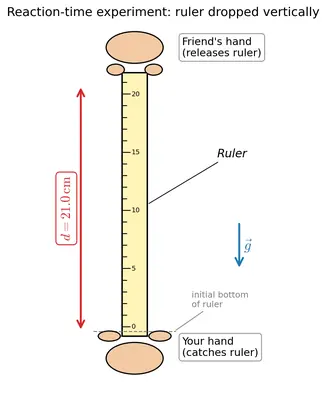
You can measure your reaction time by a simple experiment. Take a ruler and ask your friend to drop it vertically through the gap between your thumb and forefinger (Fig. 2.8). After you catch it, find the distance $$d$$ travelled by the ruler. In a particular case, $$d$$ was found to be $$21.0 \, \mathrm{cm}$$. Estimate reaction time.

Fig. 2.8 — Measuring the reaction time: a photograph of a friend's hand dropping a ruler vertically through the gap between the thumb and forefinger of another person's hand.

Solution

During the reaction time $$t_r$$ the ruler is in free fall (released from rest) under gravity. With downward positive, $$v_0 = 0$$ and $$a = g$$, the distance fallen is

$$d = \tfrac{1}{2} g t_r^2 \quad\Longrightarrow\quad t_r = \sqrt{\dfrac{2 d}{g}}.$$

Substituting $$d = 21.0 \, \mathrm{cm} = 0.210 \, \mathrm{m}$$ and $$g = 9.8 \, \mathrm{m\,s^{-2}}$$,

$$t_r = \sqrt{\dfrac{2 \times 0.210}{9.8}} = \sqrt{0.0429} \approx 0.21 \, \mathrm{s}.$$

So the reaction time is about $$0.2 \, \mathrm{s}$$, which is typical for a healthy human.

Answer

$$t_r = \sqrt{2d/g} \approx 0.21 \, \mathrm{s}$$.

Exercises

2.1 In which of the following examples of motion, can the body be considered approximately a point object:

(a) a railway carriage moving without jerks between two stations.

Solution

A body can be treated as a point object if the distance it travels is much larger than its own size. The distance between two stations is several kilometres, whereas a railway carriage is only a few metres long. Hence the size of the carriage is negligible compared with the distance covered and it can be treated as a point object.

Answer

Yes — can be treated as a point object.

(b) a monkey sitting on top of a man cycling smoothly on a circular track.

Solution

If the circular track is large compared with the size of the monkey + cyclist (a few metres), then the size of the system is negligible compared with the circumference of the track. The monkey moves smoothly on the same trajectory as the cyclist, with no independent jerky motion of its own. Hence the monkey may be treated as a point object.

Answer

Yes — can be treated as a point object.

(c) a spinning cricket ball that turns sharply on hitting the ground.

Solution

The cricket ball is spinning and changes its direction sharply on hitting the ground. The deflection over a small length of pitch is comparable to the size of the ball itself, and the spin is essential to the description of its motion (different parts of the ball move differently). Hence the ball cannot be treated as a point object.

Answer

No — cannot be treated as a point object.

(d) a tumbling beaker that has slipped off the edge of a table.

Solution

The beaker is tumbling, so its different parts are in different states of motion (translation plus rotation) over a fall of only about a metre — a distance comparable to the size of the beaker. Its orientation cannot be ignored. Hence the beaker cannot be treated as a point object.

Answer

No — cannot be treated as a point object.

2.2

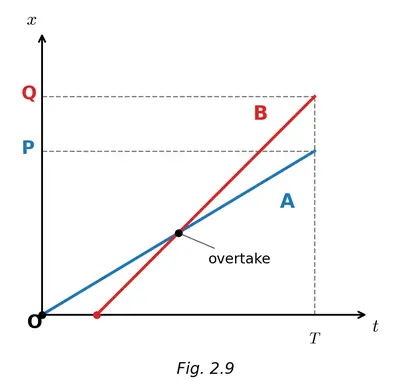
The position-time ($$x$$-$$t$$) graphs for two children A and B returning from their school O to their homes P and Q respectively are shown in Fig. 2.9. Choose the correct entries in the brackets below;
Fig. 2.9 — Position-time (x-t) graphs of two children A and B returning from school O to homes P and Q; two straight lines of different slopes that cross each other once.

(a) (A/B) lives closer to the school than (B/A)

Solution

On the $$x$$-axis (distance from school O), the position of A's home P is at a smaller $$x$$ than the position of B's home Q ($$OP < OQ$$). The line for A reaches a smaller maximum $$x$$ than that of B.

Answer

A lives closer to the school than B.

(b) (A/B) starts from the school earlier than (B/A)

Solution

On the $$t$$-axis, the line for A begins at $$t = 0$$ (the origin), while the line for B begins at a later time. Hence A leaves the school first.

Answer

A starts from the school earlier than B.

(c) (A/B) walks faster than (B/A)

Solution

On an $$x$$-$$t$$ graph the slope $$dx/dt$$ equals the speed. The line for B has a steeper slope than A's line, so B's speed is larger than A's.

Answer

B walks faster than A.

(d) A and B reach home at the (same/different) time

Solution

Looking at Fig. 2.9 the two lines terminate at the same value of $$t$$ (although at different $$x$$-values, since their homes are at different distances). So both reach home simultaneously.

Answer

Same time.

(e) (A/B) overtakes (B/A) on the road (once/twice).

Solution

An overtaking event corresponds to the two $$x$$-$$t$$ lines crossing. The lines for A and B intersect at exactly one point. Since B (the later starter) is faster, B catches up to and passes A. Hence B overtakes A once.

Answer

B overtakes A on the road once.

2.3

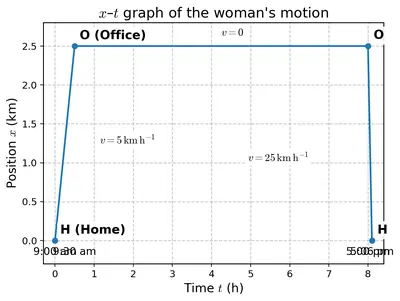
A woman starts from her home at 9.00 am, walks with a speed of $$5 \, \mathrm{km\,h^{-1}}$$ on a straight road up to her office $$2.5 \, \mathrm{km}$$ away, stays at the office up to 5.00 pm, and returns home by an auto with a speed of $$25 \, \mathrm{km\,h^{-1}}$$. Choose suitable scales and plot the $$x$$-$$t$$ graph of her motion.
Figure
Figure

Solution

Choose the home as origin ($$x = 0$$) and take $$t = 0$$ at 9.00 am. The motion has three phases.

Phase 1 — walking to office (9.00 am to 9.30 am).

Time taken $$= \dfrac{2.5}{5} = 0.5 \, \mathrm{h} = 30 \, \mathrm{min}$$.

So during $$t = 0$$ to $$t = 0.5 \, \mathrm{h}$$, position rises linearly from $$x = 0$$ to $$x = 2.5 \, \mathrm{km}$$ (slope $$= 5 \, \mathrm{km\,h^{-1}}$$).

Phase 2 — at office (9.30 am to 5.00 pm).

Position stays constant at $$x = 2.5 \, \mathrm{km}$$ from $$t = 0.5 \, \mathrm{h}$$ to $$t = 8.0 \, \mathrm{h}$$ (a horizontal segment).

Phase 3 — return by auto (5.00 pm onwards).

Time taken $$= \dfrac{2.5}{25} = 0.1 \, \mathrm{h} = 6 \, \mathrm{min}$$.

During $$t = 8.0 \, \mathrm{h}$$ to $$t = 8.1 \, \mathrm{h}$$, position falls linearly from $$x = 2.5 \, \mathrm{km}$$ to $$x = 0$$ (slope $$= -25 \, \mathrm{km\,h^{-1}}$$).

Plot. Take the $$t$$-axis with the scale $$1 \text{ unit} = 1 \, \mathrm{h}$$ and the $$x$$-axis with the scale $$1 \text{ unit} = 0.5 \, \mathrm{km}$$. Plot:

  • A straight line from $$(0, 0)$$ to $$(0.5, 2.5)$$ — going to office.
  • A horizontal line from $$(0.5, 2.5)$$ to $$(8.0, 2.5)$$ — at office.
  • A steeper straight line from $$(8.0, 2.5)$$ to $$(8.1, 0)$$ — returning home.

The first segment has slope $$+5\,\mathrm{km\,h^{-1}}$$, the middle segment slope $$0$$, and the last segment slope $$-25\,\mathrm{km\,h^{-1}}$$.

Answer

The $$x$$-$$t$$ graph consists of three segments: a line of slope $$+5\,\mathrm{km\,h^{-1}}$$ from $$(0,0)$$ to $$(0.5\,\mathrm{h}, 2.5\,\mathrm{km})$$, a horizontal segment from $$(0.5,2.5)$$ to $$(8.0,2.5)$$, and a steep line of slope $$-25\,\mathrm{km\,h^{-1}}$$ from $$(8.0, 2.5)$$ to $$(8.1, 0)$$.

2.4

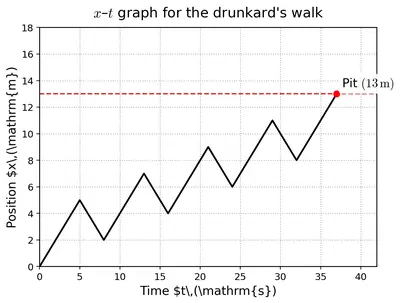
A drunkard walking in a narrow lane takes 5 steps forward and 3 steps backward, followed again by 5 steps forward and 3 steps backward, and so on. Each step is $$1 \, \mathrm{m}$$ long and requires $$1 \, \mathrm{s}$$. Plot the $$x$$-$$t$$ graph of his motion. Determine graphically and otherwise how long the drunkard takes to fall in a pit $$13 \, \mathrm{m}$$ away from the start.
Figure
Figure

Solution

One full cycle consists of $$5$$ forward steps and $$3$$ backward steps, i.e. $$8$$ steps taking $$8 \, \mathrm{s}$$. Net displacement per cycle $$= +5 - 3 = +2 \, \mathrm{m}$$.

After each complete cycle the position advances by $$2 \, \mathrm{m}$$:

At $$t = 8 \, \mathrm{s}$$: $$x = 2 \, \mathrm{m}$$.
At $$t = 16 \, \mathrm{s}$$: $$x = 4 \, \mathrm{m}$$.
At $$t = 24 \, \mathrm{s}$$: $$x = 6 \, \mathrm{m}$$.
At $$t = 32 \, \mathrm{s}$$: $$x = 8 \, \mathrm{m}$$.

However, the maximum position reached within a cycle (i.e. at the end of the $$5$$ forward steps) is $$5 \, \mathrm{m}$$ more than the position at the start of the cycle. So within the cycle the position reaches $$x = 2k + 5$$ at $$t = 8k + 5 \, \mathrm{s}$$, before falling back by $$3 \, \mathrm{m}$$.

The pit is at $$x = 13 \, \mathrm{m}$$. Look at when the drunkard's position first reaches $$13 \, \mathrm{m}$$.

After $$4$$ complete cycles ($$t = 32 \, \mathrm{s}$$) the drunkard is at $$x = 8 \, \mathrm{m}$$. He has just begun his $$5^{\text{th}}$$ cycle. Now he takes $$5$$ forward steps:

  • $$t = 33 \, \mathrm{s}$$: $$x = 9 \, \mathrm{m}$$.
  • $$t = 34 \, \mathrm{s}$$: $$x = 10 \, \mathrm{m}$$.
  • $$t = 35 \, \mathrm{s}$$: $$x = 11 \, \mathrm{m}$$.
  • $$t = 36 \, \mathrm{s}$$: $$x = 12 \, \mathrm{m}$$.
  • $$t = 37 \, \mathrm{s}$$: $$x = 13 \, \mathrm{m}$$ — the drunkard falls into the pit.

Plot. The $$x$$-$$t$$ graph is a zig-zag staircase: from $$(0,0)$$ a straight line of slope $$+1\,\mathrm{m\,s^{-1}}$$ up to $$(5, 5)$$, then a line of slope $$-1\,\mathrm{m\,s^{-1}}$$ down to $$(8, 2)$$, then up to $$(13, 7)$$, down to $$(16, 4)$$, up to $$(21, 9)$$, down to $$(24, 6)$$, up to $$(29, 11)$$, down to $$(32, 8)$$, and finally up to $$(37, 13)$$ where the motion ends.

Answer

Time to fall into the pit $$= 37 \, \mathrm{s}$$.

2.5 A car moving along a straight highway with speed of $$126 \, \mathrm{km\,h^{-1}}$$ is brought to a stop within a distance of $$200 \, \mathrm{m}$$. What is the retardation of the car (assumed uniform), and how long does it take for the car to stop?

Solution

Convert the initial speed to SI units:

$$u = 126 \, \mathrm{km\,h^{-1}} = 126 \times \dfrac{1000}{3600} \, \mathrm{m\,s^{-1}} = 35 \, \mathrm{m\,s^{-1}}.$$

Final speed $$v = 0$$ and distance $$s = 200 \, \mathrm{m}$$. Using $$v^2 = u^2 + 2 a s$$:

$$0 = (35)^2 + 2 a (200) \quad\Longrightarrow\quad a = -\dfrac{1225}{400} = -3.0625 \, \mathrm{m\,s^{-2}}.$$

So the retardation (magnitude of the deceleration) is

$$|a| \approx 3.06 \, \mathrm{m\,s^{-2}}.$$

Time to stop. Using $$v = u + at$$:

$$0 = 35 + (-3.0625) t \quad\Longrightarrow\quad t = \dfrac{35}{3.0625} \approx 11.43 \, \mathrm{s}.$$

Answer

Retardation $$\approx 3.06 \, \mathrm{m\,s^{-2}}$$; time to stop $$\approx 11.43 \, \mathrm{s}$$.

2.6 A player throws a ball upwards with an initial speed of $$29.4 \, \mathrm{m\,s^{-1}}$$.

(a) What is the direction of acceleration during the upward motion of the ball?

Solution

The only force on the ball (air resistance neglected) is gravity, which acts vertically downward. Hence the acceleration is vertically downward throughout the motion — including the upward phase. Its magnitude is $$g = 9.8 \, \mathrm{m\,s^{-2}}$$.

Answer

Vertically downward, with magnitude $$g = 9.8 \, \mathrm{m\,s^{-2}}$$.

(b) What are the velocity and acceleration of the ball at the highest point of its motion?

Solution

At the highest point the ball is momentarily at rest, so $$v = 0$$. The acceleration, however, continues to be that due to gravity: $$a = g = 9.8 \, \mathrm{m\,s^{-2}}$$ directed vertically downward (the gravitational force does not vanish at the topmost point).

Answer

Velocity $$= 0$$; acceleration $$= 9.8 \, \mathrm{m\,s^{-2}}$$ directed vertically downward.

(c) Choose the $$x = 0$$ m and $$t = 0$$ s to be the location and time of the ball at its highest point, vertically downward direction to be the positive direction of $$x$$-axis, and give the signs of position, velocity and acceleration of the ball during its upward, and downward motion.

Solution

With the highest point as origin and downward direction positive:

During the upward motion (before the highest point, $$t < 0$$). The ball is above the origin, so $$x < 0$$ — position is negative. The ball is moving upward (against the chosen positive direction), so $$v < 0$$ — velocity is negative. The acceleration is directed downward (positive direction), so $$a > 0$$ — acceleration is positive.

During the downward motion (after the highest point, $$t > 0$$). The ball is below the origin, so $$x > 0$$ — position is positive. The ball moves downward (along the positive direction), so $$v > 0$$ — velocity is positive. The acceleration is still downward, $$a > 0$$ — acceleration is positive.

PhasePosition $$x$$Velocity $$v$$Acceleration $$a$$
UpwardNegativeNegativePositive
DownwardPositivePositivePositive

Answer

During the upward motion: position $$x < 0$$ (negative), velocity $$v < 0$$ (negative), acceleration $$a > 0$$ (positive). During the downward motion: position $$x > 0$$ (positive), velocity $$v > 0$$ (positive), acceleration $$a > 0$$ (positive).

(d) To what height does the ball rise and after how long does the ball return to the player's hands? (Take $$g = 9.8 \, \mathrm{m\,s^{-2}}$$ and neglect air resistance).

Solution

Take upward positive. Then $$u = 29.4 \, \mathrm{m\,s^{-1}}$$ and $$a = -g = -9.8 \, \mathrm{m\,s^{-2}}$$.

Maximum height. At the topmost point $$v = 0$$. Using $$v^2 = u^2 + 2 a h$$:

$$0 = (29.4)^2 + 2(-9.8) h \quad\Longrightarrow\quad h = \dfrac{(29.4)^2}{2 \times 9.8} = \dfrac{864.36}{19.6} = 44.1 \, \mathrm{m}.$$

Time of flight. The ball returns to the player's hands (same height) when displacement is zero. Using $$s = u t + \tfrac{1}{2} a t^2$$:

$$0 = 29.4 \, t - \tfrac{1}{2}(9.8) t^2 = t (29.4 - 4.9 t).$$

Non-zero root: $$t = \dfrac{29.4}{4.9} = 6.0 \, \mathrm{s}.$$

(Equivalently, $$t_{\text{up}} = u/g = 3.0 \, \mathrm{s}$$ and the total flight time is $$2 t_{\text{up}} = 6.0 \, \mathrm{s}$$.)

Answer

Maximum height $$h = 44.1 \, \mathrm{m}$$; total time of flight $$t = 6.0 \, \mathrm{s}$$.

2.7

Read each statement below carefully and state with reasons and examples, if it is true or false;

A particle in one-dimensional motion

(a) with zero speed at an instant may have non-zero acceleration at that instant

Solution

True. Speed and acceleration are independent quantities — speed concerns the instantaneous velocity, while acceleration concerns the rate of change of velocity. A classic example is a ball thrown vertically upward: at the very highest point its speed is zero but the acceleration is $$g$$ downward.

Answer

True.

(b) with zero speed may have non-zero velocity,

Solution

False. The speed is the magnitude of the velocity: $$|\vec{v}|$$. If the speed is zero then $$|\vec{v}| = 0$$, which forces $$\vec{v} = \vec{0}$$. Thus zero speed always implies zero velocity.

Answer

False.

(c) with constant speed must have zero acceleration,

Solution

True (in one dimension). In one-dimensional motion along a straight line, constant speed means $$|v|$$ is constant. As the particle is constrained to move along a fixed line, the direction does not change either (apart from possible instantaneous reversals which would correspond to discontinuous changes of velocity and infinite acceleration — excluded for normal motion). Therefore the velocity is constant, giving zero acceleration. (In two- or three-dimensional motion, constant speed need not imply zero acceleration — e.g. uniform circular motion has constant speed but a non-zero centripetal acceleration.)

Answer

True (for one-dimensional motion).

(d) with positive value of acceleration must be speeding up.

Solution

False. Whether a particle speeds up or slows down depends on the sign of the product $$\vec{v}\cdot \vec{a}$$, not on the sign of $$a$$ alone. If $$v$$ and $$a$$ have opposite signs the particle is slowing down. For example, a ball thrown vertically upward (taking downward as the positive direction): the acceleration is $$+g > 0$$, but during the upward phase the velocity is negative, so the speed decreases. Hence positive acceleration does not necessarily mean speeding up.

Answer

False — the sign of acceleration alone does not determine whether the particle is speeding up.

2.8

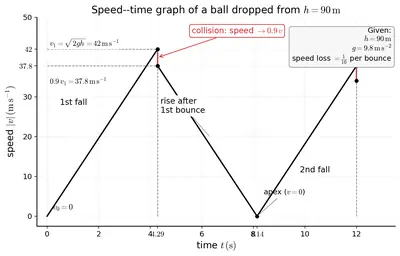
A ball is dropped from a height of $$90 \, \mathrm{m}$$ on a floor. At each collision with the floor, the ball loses one tenth of its speed. Plot the speed-time graph of its motion between $$t = 0$$ to $$12 \, \mathrm{s}$$.
Figure
Figure

Solution

Take $$g = 9.8 \, \mathrm{m\,s^{-2}}$$ and the ball starting from rest at $$h = 90 \, \mathrm{m}$$.

First fall (0 to first collision). Using $$h = \tfrac{1}{2} g t^2$$:

$$t_1 = \sqrt{\dfrac{2 h}{g}} = \sqrt{\dfrac{2 \times 90}{9.8}} = \sqrt{18.37} \approx 4.29 \, \mathrm{s}.$$

Speed just before first impact:

$$v_1 = g t_1 = 9.8 \times 4.29 \approx 42 \, \mathrm{m\,s^{-1}}.$$

After the collision the ball loses one tenth of its speed, retaining $$9/10$$, so

$$v_1' = 0.9 \times 42 = 37.8 \, \mathrm{m\,s^{-1}}.$$

First bounce. The ball moves up at $$37.8 \, \mathrm{m\,s^{-1}}$$, decelerating at $$g$$. Time to reach the top: $$37.8/9.8 \approx 3.86 \, \mathrm{s}$$. By symmetry, total time for the up-and-down bounce is

$$\Delta t = \dfrac{2 \times 37.8}{9.8} \approx 7.71 \, \mathrm{s}.$$

So the next (second) collision occurs at $$t \approx 4.29 + 7.71 = 12.0 \, \mathrm{s}$$, with speed again $$37.8 \, \mathrm{m\,s^{-1}}$$ just before impact.

Speed–time graph for $$0 \le t \le 12 \, \mathrm{s}$$.

  • $$0 \le t \le 4.29 \, \mathrm{s}$$: speed rises linearly from $$0$$ to $$42 \, \mathrm{m\,s^{-1}}$$ with slope $$+g$$.
  • At $$t = 4.29 \, \mathrm{s}$$ there is a sudden vertical drop from $$42$$ to $$37.8 \, \mathrm{m\,s^{-1}}$$ (the collision).
  • $$4.29 \le t \le 8.14 \, \mathrm{s}$$: ball moves upward; speed decreases linearly from $$37.8$$ to $$0$$ (slope $$-g$$).
  • $$8.14 \le t \le 12.0 \, \mathrm{s}$$: ball falls back; speed increases linearly from $$0$$ to $$37.8 \, \mathrm{m\,s^{-1}}$$ (slope $$+g$$).
  • At $$t = 12.0 \, \mathrm{s}$$ there is again a vertical drop, this time from $$37.8$$ to $$34.02 \, \mathrm{m\,s^{-1}}$$.

The graph is a saw-tooth shape whose peaks decay (each peak is $$0.9$$ times the previous one) because of the energy loss at each collision.

Answer

Speed grows linearly (slope $$g$$) from $$0$$ to $$42\,\mathrm{m\,s^{-1}}$$ in $$0$$–$$4.29\,\mathrm{s}$$, drops to $$37.8\,\mathrm{m\,s^{-1}}$$ at impact, decreases to $$0$$ at $$t \approx 8.14\,\mathrm{s}$$ (going up), then rises back to $$37.8\,\mathrm{m\,s^{-1}}$$ at $$t \approx 12.0\,\mathrm{s}$$ where the next collision drops it to $$34.0\,\mathrm{m\,s^{-1}}$$.

2.9 Explain clearly, with examples, the distinction between:

(a) magnitude of displacement (sometimes called distance) over an interval of time, and the total length of path covered by a particle over the same interval;

Solution

The magnitude of displacement is the straight-line distance between the initial and final positions: $$|\Delta x| = |x_f - x_i|.$$ The total path length is the total distance actually travelled by the particle along its path.

Example. A particle moves from $$x = 0$$ to $$x = 5 \, \mathrm{m}$$ and then back to $$x = 2 \, \mathrm{m}$$.

  • Magnitude of displacement $$= |2 - 0| = 2 \, \mathrm{m}$$.
  • Total path length $$= 5 + 3 = 8 \, \mathrm{m}$$.

In general, path length $$\ge$$ magnitude of displacement. Equality holds if and only if the particle moves in a single direction throughout the interval (no reversal of direction).

Answer

Path length $$\ge$$ magnitude of displacement; equality holds when motion is unidirectional (no reversal).

(b) magnitude of average velocity over an interval of time, and the average speed over the same interval. [Average speed of a particle over an interval of time is defined as the total path length divided by the time interval]. Show in both (a) and (b) that the second quantity is either greater than or equal to the first. When is the equality sign true? [For simplicity, consider one-dimensional motion only].

Solution

Magnitude of average velocity $$= \dfrac{|\text{displacement}|}{\text{time interval}}$$. Average speed $$= \dfrac{\text{total path length}}{\text{time interval}}$$.

Dividing the inequality from part (a), path length $$\ge$$ $$|\text{displacement}|$$, by the same positive time interval $$\Delta t$$:

$$\dfrac{\text{path length}}{\Delta t} \ge \dfrac{|\text{displacement}|}{\Delta t},$$

i.e. average speed $$\ge$$ magnitude of average velocity.

Example. Same particle as in (a) — moving from $$0 \to 5 \, \mathrm{m}$$ and back to $$2 \, \mathrm{m}$$ in, say, $$10 \, \mathrm{s}$$:

  • Magnitude of average velocity $$= 2/10 = 0.2 \, \mathrm{m\,s^{-1}}$$.
  • Average speed $$= 8/10 = 0.8 \, \mathrm{m\,s^{-1}}$$.

Equality holds only when the particle does not reverse direction during the interval (so that path length equals magnitude of displacement).

Answer

Average speed $$\ge$$ magnitude of average velocity, with equality when the motion is unidirectional (no reversal of direction).

2.10 A man walks on a straight road from his home to a market $$2.5 \, \mathrm{km}$$ away with a speed of $$5 \, \mathrm{km\,h^{-1}}$$. Finding the market closed, he instantly turns and walks back home with a speed of $$7.5 \, \mathrm{km\,h^{-1}}$$. What is the

(a) magnitude of average velocity, and

Solution

Time to reach the market: $$t_1 = \dfrac{2.5}{5} = 0.5 \, \mathrm{h} = 30 \, \mathrm{min}$$. Time for the return: $$t_2 = \dfrac{2.5}{7.5} = \dfrac{1}{3} \, \mathrm{h} = 20 \, \mathrm{min}$$. The man therefore reaches home again $$50 \, \mathrm{min}$$ after leaving.

(i) 0 to 30 min ($$= 0.5 \, \mathrm{h}$$). Displacement $$= +2.5 \, \mathrm{km}$$.

$$|\bar{v}| = \dfrac{2.5}{0.5} = 5 \, \mathrm{km\,h^{-1}}.$$

(ii) 0 to 50 min ($$= 5/6 \, \mathrm{h}$$). Displacement $$= 0$$ (back home).

$$|\bar{v}| = \dfrac{0}{5/6} = 0.$$

(iii) 0 to 40 min ($$= 2/3 \, \mathrm{h}$$). The first $$30 \, \mathrm{min}$$ take him to the market. The next $$10 \, \mathrm{min} = 1/6 \, \mathrm{h}$$ are spent walking back at $$7.5 \, \mathrm{km\,h^{-1}}$$, covering $$7.5 \times (1/6) = 1.25 \, \mathrm{km}$$. His position from home is $$2.5 - 1.25 = 1.25 \, \mathrm{km}$$.

$$|\bar{v}| = \dfrac{1.25}{2/3} = 1.875 \, \mathrm{km\,h^{-1}}.$$

Answer

(i) $$5 \, \mathrm{km\,h^{-1}}$$; (ii) $$0$$; (iii) $$1.875 \, \mathrm{km\,h^{-1}}$$.

(b) average speed of the man over the interval of time (i) 0 to 30 min, (ii) 0 to 50 min, (iii) 0 to 40 min? [Note: You will appreciate from this exercise why it is better to define average speed as total path length divided by time, and not as magnitude of average velocity. You would not like to tell the tired man on his return home that his average speed was zero!]

Solution

Average speed $$= \dfrac{\text{total path length}}{\text{time interval}}$$.

(i) 0 to 30 min. Path length $$= 2.5 \, \mathrm{km}$$.

$$\bar{s} = \dfrac{2.5}{0.5} = 5 \, \mathrm{km\,h^{-1}}.$$

(ii) 0 to 50 min. Path length $$= 2.5 + 2.5 = 5 \, \mathrm{km}$$.

$$\bar{s} = \dfrac{5}{5/6} = 6 \, \mathrm{km\,h^{-1}}.$$

(iii) 0 to 40 min. Path length $$= 2.5 + 1.25 = 3.75 \, \mathrm{km}$$.

$$\bar{s} = \dfrac{3.75}{2/3} = 5.625 \, \mathrm{km\,h^{-1}}.$$

Observe that in case (ii) the magnitude of average velocity is $$0$$ while the average speed is $$6 \, \mathrm{km\,h^{-1}}$$ — the average speed correctly captures that the man did exert himself, whereas the magnitude of average velocity does not.

Answer

(i) $$5 \, \mathrm{km\,h^{-1}}$$; (ii) $$6 \, \mathrm{km\,h^{-1}}$$; (iii) $$5.625 \, \mathrm{km\,h^{-1}}$$.

2.11 In Exercises 2.9 and 2.10, we have carefully distinguished between average speed and magnitude of average velocity. No such distinction is necessary when we consider instantaneous speed and magnitude of velocity. The instantaneous speed is always equal to the magnitude of instantaneous velocity. Why?

Solution

Instantaneous velocity is

$$\vec{v} = \lim_{\Delta t \to 0} \dfrac{\Delta \vec{r}}{\Delta t},$$

so its magnitude is $$|\vec{v}| = \lim_{\Delta t \to 0} \dfrac{|\Delta \vec{r}|}{\Delta t}$$.

Instantaneous speed is

$$s = \lim_{\Delta t \to 0} \dfrac{\Delta L}{\Delta t},$$

where $$\Delta L$$ is the path length traversed in the time interval $$\Delta t$$. In the infinitesimal limit $$\Delta t \to 0$$, the particle cannot reverse direction during the interval; the path traversed is a single infinitesimal segment, hence $$\Delta L = |\Delta \vec{r}|$$. Therefore

$$s = |\vec{v}|.$$

The discrepancy between average speed and the magnitude of average velocity arose precisely from changes in direction during a finite interval; over an infinitesimal interval there is no scope for such a change, so the two quantities coincide.

Answer

Over an infinitesimal interval the particle cannot reverse direction, so the path length equals the magnitude of the displacement; dividing by $$dt$$ gives speed $$=$$ magnitude of velocity.

2.12

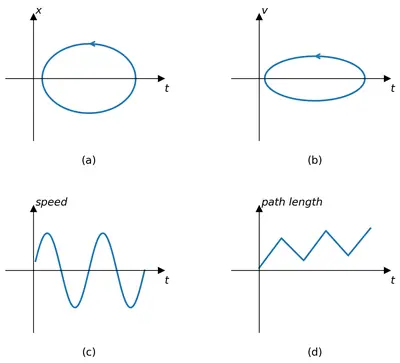
Look at the graphs (a) to (d) (Fig. 2.10) carefully and state, with reasons, which of these cannot possibly represent one-dimensional motion of a particle.
Fig. 2.10 — Four graphs labelled (a) to (d): an x-t plot with a looping curve, a circular v-t plot, an oscillating speed-time plot, and a zig-zag total-path-length plot.

Solution

None of the four graphs in Fig. 2.10 can represent one-dimensional motion of a particle.

(a) The graph is an $$x$$-$$t$$ plot in which a single instant $$t$$ has two different values of $$x$$. A particle cannot be in two positions at the same instant, so this is impossible.

(b) The graph is a $$v$$-$$t$$ plot showing two values of velocity at the same instant $$t$$. A particle cannot have two velocities simultaneously, so this is impossible.

(c) The graph plots speed against time and shows speed taking negative values. Speed is by definition the magnitude of velocity and cannot be negative, so this is impossible.

(d) The graph plots total path length against time and shows path length decreasing. Path length is monotonically non-decreasing in time (the particle keeps adding distance traversed, even if it reverses direction), so this is impossible.

Answer

All four (a), (b), (c), (d) cannot represent one-dimensional motion (multi-valued $$x$$ or $$v$$ at a single $$t$$ in (a), (b); negative speed in (c); decreasing path length in (d)).

2.13

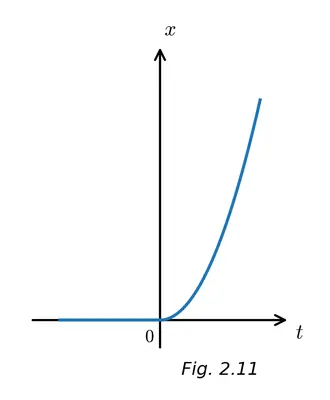
Figure 2.11 shows the $$x$$-$$t$$ plot of one-dimensional motion of a particle. Is it correct to say from the graph that the particle moves in a straight line for $$t < 0$$ and on a parabolic path for $$t > 0$$? If not, suggest a suitable physical context for this graph.
Fig. 2.11 — x-t plot of one-dimensional motion: a single curve lying along the t-axis for t < 0 and rising as a parabola-like branch for t > 0.

Solution

No, it is not correct. Figure 2.11 is an $$x$$-$$t$$ (position–time) graph; it is not the trajectory or path of the particle in space. A particle in one-dimensional motion is constrained to move along the $$x$$-axis, so its actual path is always a straight line — both for $$t < 0$$ and for $$t > 0$$. The shape of the $$x$$-$$t$$ curve tells us only how the position changes with time, not the geometric path traced out.

A suitable physical context. For $$t < 0$$ the graph is a horizontal line, so the position does not change with time — the particle is simply at rest. For $$t > 0$$ the $$x$$-$$t$$ graph is a parabola ($$x \propto t^2$$), which represents uniformly accelerated motion. A suitable situation is therefore a ball held at rest in the hand up to $$t = 0$$, and then released at $$t = 0$$ so that for $$t > 0$$ it falls freely under gravity with constant acceleration, $$x = \tfrac{1}{2} g t^2$$.

Answer

No. The graph shows position versus time, not the spatial path of the particle; in one-dimensional motion the particle always moves along a straight line, both for $$t < 0$$ and for $$t > 0$$. The parabolic shape of the curve for $$t > 0$$ simply indicates uniformly accelerated motion — for example, a ball held at rest until $$t = 0$$ and then released to fall freely under gravity.

2.14 A police van moving on a highway with a speed of $$30 \, \mathrm{km\,h^{-1}}$$ fires a bullet at a thief's car speeding away in the same direction with a speed of $$192 \, \mathrm{km\,h^{-1}}$$. If the muzzle speed of the bullet is $$150 \, \mathrm{m\,s^{-1}}$$, with what speed does the bullet hit the thief's car? (Note: Obtain that speed which is relevant for damaging the thief's car).

Solution

The damage to the thief's car depends on the speed of the bullet relative to the car, not on its ground speed. Convert all speeds to $$\mathrm{m\,s^{-1}}$$:

$$v_{\text{van}} = 30 \, \mathrm{km\,h^{-1}} = 30 \times \dfrac{5}{18} = \dfrac{25}{3} \, \mathrm{m\,s^{-1}}.$$

$$v_{\text{thief}} = 192 \, \mathrm{km\,h^{-1}} = 192 \times \dfrac{5}{18} = \dfrac{160}{3} \, \mathrm{m\,s^{-1}}.$$

The muzzle speed of the bullet ($$150 \, \mathrm{m\,s^{-1}}$$) is relative to the van. So the bullet's speed in the ground frame is

$$v_{\text{bullet}} = 150 + \dfrac{25}{3} = \dfrac{475}{3} \, \mathrm{m\,s^{-1}}.$$

The speed of the bullet relative to the thief's car (both moving in the same direction) is

$$v_{\text{bullet/thief}} = v_{\text{bullet}} - v_{\text{thief}} = \dfrac{475}{3} - \dfrac{160}{3} = \dfrac{315}{3} = 105 \, \mathrm{m\,s^{-1}}.$$

Answer

The bullet hits the thief's car at a relative speed of $$105 \, \mathrm{m\,s^{-1}}$$.

2.15

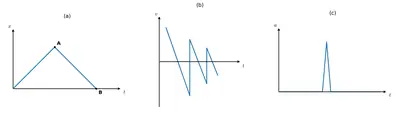
Suggest a suitable physical situation for each of the following graphs (Fig 2.12).
Fig. 2.12 — Three graphs labelled (a) to (c): an x-t triangular peak with points A and B, a v-t plot of repeated descending line segments, and an a-t plot with a single pulse.

Solution

(a) The $$x$$-$$t$$ graph that rises and then suddenly drops back to zero.

A ball is thrown vertically upward by a boy from the ground. It rises (position $$x$$ increases with time), reaches the highest point and falls back; on hitting the ground at the same horizontal location the ball is suddenly stopped (caught by the boy or by the ground). After that the ball is at rest.

(b) The $$v$$-$$t$$ graph showing alternating positive and (smaller-magnitude) negative spikes that gradually die out.

A ball is dropped from a height onto a hard floor. It hits the floor (velocity reverses direction abruptly — vertical jump in the graph), rebounds with a smaller speed, falls back, hits the floor again, and so on. Each successive rebound has a smaller magnitude because energy is lost in each collision.

(c) The $$a$$-$$t$$ graph that is zero except for a short pulse.

A cricket ball is moving with uniform velocity and is struck by a batsman. During the brief contact between the bat and the ball, a large acceleration acts on the ball (the short non-zero pulse); before and after the impact the ball moves uniformly (acceleration zero).

Answer

(a) A ball thrown vertically up returns to the boy's hand and is caught (after which it stays at rest). (b) A ball dropped on a hard floor bouncing repeatedly with diminishing rebounds. (c) A cricket ball travelling uniformly is hit by a bat — a short, large acceleration pulse during the impact.

2.16

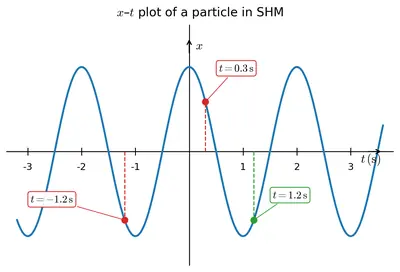
Figure 2.13 gives the $$x$$-$$t$$ plot of a particle executing one-dimensional simple harmonic motion. (You will learn about this motion in more detail in Chapter 13). Give the signs of position, velocity and acceleration variables of the particle at $$t = 0.3 \, \mathrm{s}$$, $$1.2 \, \mathrm{s}$$, $$-1.2 \, \mathrm{s}$$.
Fig. 2.13 — x-t plot of a particle in one-dimensional simple harmonic motion: a sinusoidal curve oscillating about the t-axis over t = -2 to 3 s.

Solution

For simple harmonic motion the displacement can be written as

$$x(t) = -A \sin\!\left(\dfrac{2\pi t}{T}\right)$$

with the period $$T = 2 \, \mathrm{s}$$, consistent with Fig. 2.13. Then

$$v(t) = \dfrac{dx}{dt} = -A \dfrac{2\pi}{T} \cos\!\left(\dfrac{2\pi t}{T}\right), \qquad a(t) = -\left(\dfrac{2\pi}{T}\right)^2 x(t).$$

Crucially, $$a$$ always has the sign opposite to $$x$$.

At $$t = 0.3 \, \mathrm{s}$$. Read the graph: $$x$$ is negative. Since the curve is still moving towards its negative extreme, $$v$$ is negative (slope $$dx/dt$$ is negative). $$a = -\omega^2 x$$ is positive.

At $$t = 1.2 \, \mathrm{s}$$. From the graph: $$x$$ is positive (the curve has swung past zero into positive territory). Its slope is positive ($$v > 0$$). $$a = -\omega^2 x$$ is negative.

At $$t = -1.2 \, \mathrm{s}$$. $$x$$ is negative (graph below the $$t$$-axis). The slope is positive (curve rising towards zero from the negative trough), so $$v > 0$$. $$a = -\omega^2 x$$ is positive.

$$t$$$$x$$$$v$$$$a$$
$$0.3 \, \mathrm{s}$$NegativeNegativePositive
$$1.2 \, \mathrm{s}$$PositivePositiveNegative
$$-1.2 \, \mathrm{s}$$NegativePositivePositive

Answer

$$t = 0.3 \, \mathrm{s}$$: $$x < 0$$, $$v < 0$$, $$a > 0$$. $$t = 1.2 \, \mathrm{s}$$: $$x > 0$$, $$v > 0$$, $$a < 0$$. $$t = -1.2 \, \mathrm{s}$$: $$x < 0$$, $$v > 0$$, $$a > 0$$.

2.17

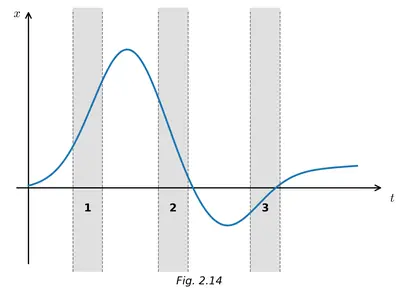
Figure 2.14 gives the $$x$$-$$t$$ plot of a particle in one-dimensional motion. Three different equal intervals of time are shown. In which interval is the average speed greatest, and in which is it the least? Give the sign of average velocity for each interval.
Fig. 2.14 — x-t plot of a particle in one-dimensional motion showing three equal, shaded intervals of time numbered 1, 2 and 3 along a rising-then-falling curve.

Solution

On an $$x$$-$$t$$ graph the slope of the chord drawn between the two endpoints of an interval gives the average velocity; its magnitude is the average speed (the path length equals the magnitude of displacement here, since the $$x$$-$$t$$ curve in Fig. 2.14 is monotonic within each interval).

Average speed. Visually compare the steepness of the chords joining the endpoints of the three equal-width intervals. The chord is steepest in interval 3 and almost flat (horizontal) in interval 2.

Hence the average speed is greatest in interval 3 and least in interval 2.

Sign of average velocity. The slope of the chord is positive in intervals 1 and 2 (the curve is rising) and negative in interval 3 (the curve is falling).

So the average velocity is positive in intervals 1 and 2 and negative in interval 3.

Answer

Average speed is greatest in interval 3 and least in interval 2. Average velocity is positive in intervals 1 and 2, and negative in interval 3.

2.18

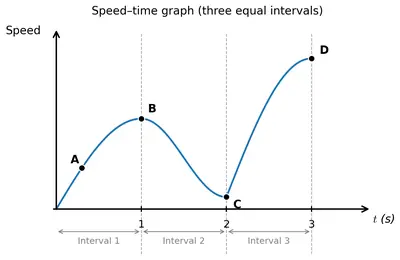
Figure 2.15 gives a speed-time graph of a particle in motion along a constant direction. Three equal intervals of time are shown. In which interval is the average acceleration greatest in magnitude? In which interval is the average speed greatest? Choosing the positive direction as the constant direction of motion, give the signs of v and a in the three intervals. What are the accelerations at the points A, B, C and D?
Fig. 2.15 — Speed-time graph of a particle moving in a constant direction, with three equal shaded intervals and labelled points A, B, C and D on the curve.

Solution

Since the motion is along a constant direction taken as positive, the speed equals the velocity: $$v$$ is positive throughout. The slope of the speed-time curve gives the instantaneous acceleration.

Average acceleration over each interval. Average acceleration $$=$$ (change in speed)/(time interval). The change in speed is largest in interval 2, where the curve falls steeply. So the magnitude of the average acceleration is greatest in interval 2.

Average speed. The area under the speed-time curve (over an interval) divided by the duration gives the average speed. In interval 3 the curve is uniformly high (the highest values of speed are attained there), so the average speed is greatest in interval 3.

Signs of $$v$$ and $$a$$.

Interval$$v$$$$a$$
1PositivePositive (speed is rising)
2PositiveNegative (speed is falling)
3PositivePositive (speed is rising)

Accelerations at A, B, C and D. The points A, B, C and D lie at the local maxima and minima of the speed-time curve. At a local extremum the tangent to the curve is horizontal, so the slope (and hence the acceleration) is zero. Thus

$$a_A = a_B = a_C = a_D = 0.$$

Answer

Average acceleration is greatest in magnitude in interval 2; average speed is greatest in interval 3. $$v$$ is positive in all three intervals; $$a$$ is positive in interval 1, negative in interval 2 and positive in interval 3. Accelerations at A, B, C, D are all zero.
NCERT Solutions for Class 11
Maths
NCERT Solutions for Class 11 Maths
Chapter-wise step-by-step
solutions with explanations
explore solutions Maths bg
Physics
NCERT Solutions for Class 11 Physics
Chapter-wise step-by-step
solutions with explanations
explore solutions Physics bg
Chemistry
NCERT Solutions for Class 11 Chemistry
Chapter-wise step-by-step
solutions with explanations
explore solutions Chemistry bg

Frequently Asked Questions

50,000+ JEE Students Trusted Our Score Calculator

Predict your JEE Main percentile, rank & performance in seconds