Join WhatsApp Icon JEE WhatsApp Group
NCERT Solutions for Class 11 Maths

Chapter 2: Relations and Functions

Download Solutions PDF
Daily JEE Updates, Tips & Important Alerts
Join 30,000+ students and stay updated with JEE notifications and preparation insights.
Join Now!
Free PDF
Complete NCERT Solution PDF for Chapter 2: Relations and Functions

NCERT Solutions For Class 11 Maths Chapter 2 Relations and Functions helps students understand the connection between sets and mathematical relationships. The page provides complete NCERT Solutions that explain concepts such as ordered pairs, relations, functions, domain, codomain, and range. NCERT Solutions For Class 11 Maths simplify these concepts through step-by-step explanations and examples based on the NCERT textbook. The chapter develops logical understanding and prepares students for advanced topics like calculus and algebra. These solutions help learners solve problems accurately and understand the behaviour of different functions. Students can use the chapter PDF for revision, practice, and exam preparation. The detailed approach makes relations and functions easier to understand and apply.
Download Solutions PDF

Examples 1-6

Example 1 If $$(x + 1, y - 2) = (3, 1)$$, find the values of $$x$$ and $$y$$.

Solution

Two ordered pairs are equal if and only if their corresponding components are equal. Therefore, comparing the components of the given equal ordered pairs,

$$x + 1 = 3$$ and $$y - 2 = 1$$.

Solving the first equation,

$$x = 3 - 1 = 2$$.

Solving the second equation,

$$y = 1 + 2 = 3$$.

Hence $$x = 2$$ and $$y = 3$$.

Answer

$$x = 2,\ y = 3$$.

Example 2 If $$P = \{a, b, c\}$$ and $$Q = \{r\}$$, form the sets $$P \times Q$$ and $$Q \times P$$. Are these two products equal?

Solution

By definition, $$P \times Q$$ is the set of all ordered pairs $$(p, q)$$ with $$p \in P$$ and $$q \in Q$$. Forming all such pairs,

$$P \times Q = \{(a, r), (b, r), (c, r)\}$$.

Similarly, $$Q \times P$$ is the set of all ordered pairs $$(q, p)$$ with $$q \in Q$$ and $$p \in P$$,

$$Q \times P = \{(r, a), (r, b), (r, c)\}$$.

Although both sets have the same number of elements (three), the ordered pairs themselves are different. For instance, $$(a, r) \in P \times Q$$ but $$(a, r) \notin Q \times P$$ because the first coordinate must come from $$Q = \{r\}$$.

Hence $$P \times Q \ne Q \times P$$. In general, the Cartesian product is not commutative.

Answer

$$P \times Q = \{(a, r), (b, r), (c, r)\}$$, $$Q \times P = \{(r, a), (r, b), (r, c)\}$$; the two products are not equal.

Example 3 Let $$A = \{1, 2, 3\}$$, $$B = \{3, 4\}$$ and $$C = \{4, 5, 6\}$$. Find

(i) $$A \times (B \cap C)$$

Solution

First find $$B \cap C$$ (the elements common to $$B$$ and $$C$$).

$$B \cap C = \{3, 4\} \cap \{4, 5, 6\} = \{4\}$$.

Now form the Cartesian product of $$A = \{1, 2, 3\}$$ with the singleton $$\{4\}$$:

$$A \times (B \cap C) = \{1, 2, 3\} \times \{4\} = \{(1, 4), (2, 4), (3, 4)\}$$.

Answer

$$A \times (B \cap C) = \{(1, 4), (2, 4), (3, 4)\}$$.

(ii) $$(A \times B) \cap (A \times C)$$

Solution

First write out the two Cartesian products separately.

$$A \times B = \{1, 2, 3\} \times \{3, 4\} = \{(1, 3), (1, 4), (2, 3), (2, 4), (3, 3), (3, 4)\}$$.

$$A \times C = \{1, 2, 3\} \times \{4, 5, 6\} = \{(1, 4), (1, 5), (1, 6), (2, 4), (2, 5), (2, 6), (3, 4), (3, 5), (3, 6)\}$$.

The intersection consists of the ordered pairs that appear in both sets.

$$(A \times B) \cap (A \times C) = \{(1, 4), (2, 4), (3, 4)\}$$.

Note that this matches the result of part (i), illustrating the identity $$A \times (B \cap C) = (A \times B) \cap (A \times C)$$.

Answer

$$(A \times B) \cap (A \times C) = \{(1, 4), (2, 4), (3, 4)\}$$.

(iii) $$A \times (B \cup C)$$

Solution

First compute $$B \cup C$$ (the elements that lie in either $$B$$ or $$C$$).

$$B \cup C = \{3, 4\} \cup \{4, 5, 6\} = \{3, 4, 5, 6\}$$.

Now form $$A \times (B \cup C)$$ with $$A = \{1, 2, 3\}$$:

$$A \times (B \cup C) = \{1, 2, 3\} \times \{3, 4, 5, 6\}$$
$$= \{(1, 3), (1, 4), (1, 5), (1, 6), (2, 3), (2, 4), (2, 5), (2, 6), (3, 3), (3, 4), (3, 5), (3, 6)\}$$.

Answer

$$A \times (B \cup C) = \{(1, 3), (1, 4), (1, 5), (1, 6), (2, 3), (2, 4), (2, 5), (2, 6), (3, 3), (3, 4), (3, 5), (3, 6)\}$$.

(iv) $$(A \times B) \cup (A \times C)$$

Solution

Use the lists of $$A \times B$$ and $$A \times C$$ computed in part (ii).

$$A \times B = \{(1, 3), (1, 4), (2, 3), (2, 4), (3, 3), (3, 4)\}$$.

$$A \times C = \{(1, 4), (1, 5), (1, 6), (2, 4), (2, 5), (2, 6), (3, 4), (3, 5), (3, 6)\}$$.

Taking the union (collecting every ordered pair in either set, without repeating duplicates),

$$(A \times B) \cup (A \times C) = \{(1, 3), (1, 4), (1, 5), (1, 6), (2, 3), (2, 4), (2, 5), (2, 6), (3, 3), (3, 4), (3, 5), (3, 6)\}$$.

This agrees with $$A \times (B \cup C)$$ from part (iii), illustrating the identity $$A \times (B \cup C) = (A \times B) \cup (A \times C)$$.

Answer

$$(A \times B) \cup (A \times C) = \{(1, 3), (1, 4), (1, 5), (1, 6), (2, 3), (2, 4), (2, 5), (2, 6), (3, 3), (3, 4), (3, 5), (3, 6)\}$$.

Example 4 If $$P = \{1, 2\}$$, form the set $$P \times P \times P$$.

Solution

By definition, $$P \times P \times P$$ is the set of all ordered triples $$(a, b, c)$$ with $$a, b, c \in P$$.

Since $$P$$ has $$2$$ elements, the number of such ordered triples is $$2 \times 2 \times 2 = 8$$.

Listing all triples with each coordinate chosen from $$\{1, 2\}$$,

$$P \times P \times P = \{(1, 1, 1), (1, 1, 2), (1, 2, 1), (1, 2, 2), (2, 1, 1), (2, 1, 2), (2, 2, 1), (2, 2, 2)\}$$.

Answer

$$P \times P \times P = \{(1, 1, 1), (1, 1, 2), (1, 2, 1), (1, 2, 2), (2, 1, 1), (2, 1, 2), (2, 2, 1), (2, 2, 2)\}$$.

Example 5 If $$\mathbf{R}$$ is the set of all real numbers, what do the cartesian products $$\mathbf{R} \times \mathbf{R}$$ and $$\mathbf{R} \times \mathbf{R} \times \mathbf{R}$$ represent?

Solution

The Cartesian product $$\mathbf{R} \times \mathbf{R}$$ is the set of all ordered pairs $$(x, y)$$ where $$x, y \in \mathbf{R}$$. Each such ordered pair corresponds to a unique point in the coordinate plane, so

$$\mathbf{R} \times \mathbf{R} = \{(x, y) : x, y \in \mathbf{R}\}$$ represents the set of all points of the coordinate (Cartesian) plane.

The Cartesian product $$\mathbf{R} \times \mathbf{R} \times \mathbf{R}$$ is the set of all ordered triples $$(x, y, z)$$ with $$x, y, z \in \mathbf{R}$$. Each ordered triple corresponds to a unique point in three-dimensional space, so

$$\mathbf{R} \times \mathbf{R} \times \mathbf{R} = \{(x, y, z) : x, y, z \in \mathbf{R}\}$$ represents the set of all points of three-dimensional space.

Answer

$$\mathbf{R} \times \mathbf{R}$$ represents the Cartesian plane; $$\mathbf{R} \times \mathbf{R} \times \mathbf{R}$$ represents three-dimensional space.

Example 6 If $$A \times B = \{(p, q), (p, r), (m, q), (m, r)\}$$, find $$A$$ and $$B$$.

Solution

$$A$$ is the set of all first coordinates appearing in the ordered pairs of $$A \times B$$, and $$B$$ is the set of all second coordinates.

Collecting the first coordinates: $$p, p, m, m$$. Removing duplicates,

$$A = \{p, m\}$$.

Collecting the second coordinates: $$q, r, q, r$$. Removing duplicates,

$$B = \{q, r\}$$.

As a check, $$A \times B = \{p, m\} \times \{q, r\} = \{(p, q), (p, r), (m, q), (m, r)\}$$, which matches the given set.

Answer

$$A = \{p, m\}$$ and $$B = \{q, r\}$$.

Exercise 2.1

1 If $$\left(\dfrac{x}{3} + 1, y - \dfrac{2}{3}\right) = \left(\dfrac{5}{3}, \dfrac{1}{3}\right)$$, find the values of $$x$$ and $$y$$.

Solution

Two ordered pairs are equal precisely when their corresponding components are equal. Equating components,

$$\dfrac{x}{3} + 1 = \dfrac{5}{3}$$ and $$y - \dfrac{2}{3} = \dfrac{1}{3}$$.

Solving the first equation,

$$\dfrac{x}{3} = \dfrac{5}{3} - 1 = \dfrac{5 - 3}{3} = \dfrac{2}{3}$$.

Multiplying both sides by $$3$$,

$$x = 2$$.

Solving the second equation,

$$y = \dfrac{1}{3} + \dfrac{2}{3} = \dfrac{3}{3} = 1$$.

Therefore $$x = 2$$ and $$y = 1$$.

Answer

$$x = 2,\ y = 1$$.

2 If the set $$A$$ has 3 elements and the set $$B = \{3, 4, 5\}$$, then find the number of elements in $$(A \times B)$$.

Solution

If a set $$A$$ has $$p$$ elements and a set $$B$$ has $$q$$ elements, then $$A \times B$$ has $$p \times q$$ elements (each element of $$A$$ pairs with each element of $$B$$).

Here $$n(A) = 3$$ and $$B = \{3, 4, 5\}$$, so $$n(B) = 3$$.

$$n(A \times B) = n(A) \times n(B) = 3 \times 3 = 9$$.

Answer

$$n(A \times B) = 9$$.

3 If $$G = \{7, 8\}$$ and $$H = \{5, 4, 2\}$$, find $$G \times H$$ and $$H \times G$$.

Solution

$$G \times H$$ consists of all ordered pairs $$(g, h)$$ with $$g \in G$$ and $$h \in H$$. Pairing each element of $$G$$ with each element of $$H$$,

$$G \times H = \{(7, 5), (7, 4), (7, 2), (8, 5), (8, 4), (8, 2)\}$$.

Similarly, $$H \times G$$ consists of all ordered pairs $$(h, g)$$ with $$h \in H$$ and $$g \in G$$,

$$H \times G = \{(5, 7), (5, 8), (4, 7), (4, 8), (2, 7), (2, 8)\}$$.

Both products contain $$n(G) \times n(H) = 2 \times 3 = 6$$ ordered pairs.

Answer

$$G \times H = \{(7, 5), (7, 4), (7, 2), (8, 5), (8, 4), (8, 2)\}$$; $$H \times G = \{(5, 7), (5, 8), (4, 7), (4, 8), (2, 7), (2, 8)\}$$.

4 State whether each of the following statements are true or false. If the statement is false, rewrite the given statement correctly.

(i) If $$P = \{m, n\}$$ and $$Q = \{n, m\}$$, then $$P \times Q = \{(m, n), (n, m)\}$$.

Solution

The statement is false.

Since $$n(P) = 2$$ and $$n(Q) = 2$$, $$P \times Q$$ must contain $$2 \times 2 = 4$$ ordered pairs, not $$2$$.

Pairing each element of $$P = \{m, n\}$$ with each element of $$Q = \{n, m\} = \{m, n\}$$,

$$P \times Q = \{(m, m), (m, n), (n, m), (n, n)\}$$.

The correct statement: If $$P = \{m, n\}$$ and $$Q = \{n, m\}$$, then $$P \times Q = \{(m, m), (m, n), (n, m), (n, n)\}$$.

Answer

False. Correct: $$P \times Q = \{(m, m), (m, n), (n, m), (n, n)\}$$.

(ii) If $$A$$ and $$B$$ are non-empty sets, then $$A \times B$$ is a non-empty set of ordered pairs $$(x, y)$$ such that $$x \in A$$ and $$y \in B$$.

Solution

The statement is true.

This is precisely the definition of the Cartesian product of two non-empty sets. Whenever $$A$$ and $$B$$ are both non-empty, picking any $$x \in A$$ and any $$y \in B$$ gives an ordered pair $$(x, y) \in A \times B$$, so $$A \times B$$ is non-empty. Every element of $$A \times B$$ has the form $$(x, y)$$ with $$x \in A$$ and $$y \in B$$.

Answer

True.

(iii) If $$A = \{1, 2\}$$, $$B = \{3, 4\}$$, then $$A \times (B \cap \phi) = \phi$$.

Solution

The statement is true.

The intersection of any set with the empty set is the empty set:

$$B \cap \phi = \phi$$.

The Cartesian product of any set with the empty set is also empty (there are no second coordinates to choose):

$$A \times \phi = \phi$$.

Hence $$A \times (B \cap \phi) = A \times \phi = \phi$$.

Answer

True.

5 If $$A = \{-1, 1\}$$, find $$A \times A \times A$$.

Solution

$$A \times A \times A$$ is the set of all ordered triples $$(x, y, z)$$ with $$x, y, z \in A$$.

Since $$n(A) = 2$$, the number of such ordered triples is $$2 \times 2 \times 2 = 8$$. Each coordinate is chosen from $$\{-1, 1\}$$, giving

$$A \times A \times A = \{(-1, -1, -1), (-1, -1, 1), (-1, 1, -1), (-1, 1, 1),$$ $$(1, -1, -1), (1, -1, 1), (1, 1, -1), (1, 1, 1)\}$$.

Answer

$$A \times A \times A = \{(-1, -1, -1), (-1, -1, 1), (-1, 1, -1), (-1, 1, 1), (1, -1, -1), (1, -1, 1), (1, 1, -1), (1, 1, 1)\}$$.

6 If $$A \times B = \{(a, x), (a, y), (b, x), (b, y)\}$$. Find $$A$$ and $$B$$.

Solution

$$A$$ is the set of all first coordinates that appear in the ordered pairs of $$A \times B$$, and $$B$$ is the set of all second coordinates.

First coordinates: $$a, a, b, b$$. Removing repetitions, $$A = \{a, b\}$$.

Second coordinates: $$x, y, x, y$$. Removing repetitions, $$B = \{x, y\}$$.

Check: $$A \times B = \{a, b\} \times \{x, y\} = \{(a, x), (a, y), (b, x), (b, y)\}$$, which matches.

Answer

$$A = \{a, b\}$$ and $$B = \{x, y\}$$.

7 Let $$A = \{1, 2\}$$, $$B = \{1, 2, 3, 4\}$$, $$C = \{5, 6\}$$ and $$D = \{5, 6, 7, 8\}$$. Verify that

(i) $$A \times (B \cap C) = (A \times B) \cap (A \times C)$$.

Solution

Compute the left-hand side first. We have $$B = \{1, 2, 3, 4\}$$ and $$C = \{5, 6\}$$, so $$B$$ and $$C$$ share no elements:

$$B \cap C = \phi$$.

Hence $$A \times (B \cap C) = A \times \phi = \phi$$.

Now compute the right-hand side.

$$A \times B = \{1, 2\} \times \{1, 2, 3, 4\} = \{(1, 1), (1, 2), (1, 3), (1, 4), (2, 1), (2, 2), (2, 3), (2, 4)\}$$.

$$A \times C = \{1, 2\} \times \{5, 6\} = \{(1, 5), (1, 6), (2, 5), (2, 6)\}$$.

These two sets have no ordered pair in common (the second coordinates differ), so

$$(A \times B) \cap (A \times C) = \phi$$.

Both sides equal $$\phi$$, so $$A \times (B \cap C) = (A \times B) \cap (A \times C)$$ is verified.

Answer

Verified: both sides equal $$\phi$$.

(ii) $$A \times C$$ is a subset of $$B \times D$$.

Solution

We need to show every element of $$A \times C$$ is also in $$B \times D$$.

From the data, $$A = \{1, 2\} \subseteq B = \{1, 2, 3, 4\}$$ and $$C = \{5, 6\} \subseteq D = \{5, 6, 7, 8\}$$.

Listing the products,

$$A \times C = \{(1, 5), (1, 6), (2, 5), (2, 6)\}$$.

$$B \times D = \{(1, 5), (1, 6), (1, 7), (1, 8), (2, 5), (2, 6), (2, 7), (2, 8), (3, 5), (3, 6), (3, 7), (3, 8), (4, 5), (4, 6), (4, 7), (4, 8)\}$$.

Each of the four pairs in $$A \times C$$ also appears in $$B \times D$$, so $$A \times C \subseteq B \times D$$.

(More generally, if $$A \subseteq B$$ and $$C \subseteq D$$ then any $$(x, y) \in A \times C$$ has $$x \in A \subseteq B$$ and $$y \in C \subseteq D$$, so $$(x, y) \in B \times D$$.)

Answer

Verified: $$A \times C \subseteq B \times D$$.

8 Let $$A = \{1, 2\}$$ and $$B = \{3, 4\}$$. Write $$A \times B$$. How many subsets will $$A \times B$$ have? List them.

Solution

Pairing each element of $$A$$ with each element of $$B$$,

$$A \times B = \{(1, 3), (1, 4), (2, 3), (2, 4)\}$$.

This set has $$n(A \times B) = 4$$ elements. A set with $$n$$ elements has exactly $$2^n$$ subsets, so

Number of subsets $$= 2^4 = 16$$.

Listing all $$16$$ subsets (the empty set, four singletons, six pairs, four triples, and the whole set):

$$\phi,$$
$$\{(1, 3)\}, \{(1, 4)\}, \{(2, 3)\}, \{(2, 4)\},$$
$$\{(1, 3), (1, 4)\}, \{(1, 3), (2, 3)\}, \{(1, 3), (2, 4)\}, \{(1, 4), (2, 3)\}, \{(1, 4), (2, 4)\}, \{(2, 3), (2, 4)\},$$
$$\{(1, 3), (1, 4), (2, 3)\}, \{(1, 3), (1, 4), (2, 4)\}, \{(1, 3), (2, 3), (2, 4)\}, \{(1, 4), (2, 3), (2, 4)\},$$
$$\{(1, 3), (1, 4), (2, 3), (2, 4)\}.$$

Answer

$$A \times B = \{(1, 3), (1, 4), (2, 3), (2, 4)\}$$; it has $$2^4 = 16$$ subsets.

9 Let $$A$$ and $$B$$ be two sets such that $$n(A) = 3$$ and $$n(B) = 2$$. If $$(x, 1), (y, 2), (z, 1)$$ are in $$A \times B$$, find $$A$$ and $$B$$, where $$x, y$$ and $$z$$ are distinct elements.

Solution

If $$(x, 1), (y, 2), (z, 1) \in A \times B$$, then the first coordinates $$x, y, z$$ belong to $$A$$ and the second coordinates $$1, 2$$ belong to $$B$$.

Since $$x, y, z$$ are distinct, $$A$$ contains at least the three elements $$x, y, z$$. But $$n(A) = 3$$, so $$A$$ contains exactly these three elements:

$$A = \{x, y, z\}$$.

The second coordinates seen are $$1$$ and $$2$$, so $$B$$ contains $$1$$ and $$2$$. Since $$n(B) = 2$$, $$B$$ contains exactly these two elements:

$$B = \{1, 2\}$$.

Answer

$$A = \{x, y, z\}$$ and $$B = \{1, 2\}$$.

10 The Cartesian product $$A \times A$$ has 9 elements among which are found $$(-1, 0)$$ and $$(0, 1)$$. Find the set $$A$$ and the remaining elements of $$A \times A$$.

Solution

If $$n(A) = p$$, then $$n(A \times A) = p^2$$. Since $$A \times A$$ has $$9$$ elements,

$$p^2 = 9 \implies p = 3$$ (as $$p \ge 0$$).

So $$A$$ has $$3$$ elements. The pairs $$(-1, 0)$$ and $$(0, 1)$$ lie in $$A \times A$$, so the first coordinates $$-1, 0$$ and the second coordinates $$0, 1$$ are all elements of $$A$$. This gives the three distinct elements $$-1, 0, 1$$ in $$A$$.

Since $$n(A) = 3$$,

$$A = \{-1, 0, 1\}$$.

Now $$A \times A = \{-1, 0, 1\} \times \{-1, 0, 1\}$$ has $$9$$ ordered pairs:

$$A \times A = \{(-1, -1), (-1, 0), (-1, 1), (0, -1), (0, 0), (0, 1), (1, -1), (1, 0), (1, 1)\}$$.

Excluding the two already listed, the remaining $$7$$ elements are

$$(-1, -1), (-1, 1), (0, -1), (0, 0), (1, -1), (1, 0), (1, 1)$$.

Answer

$$A = \{-1, 0, 1\}$$; remaining elements: $$(-1, -1), (-1, 1), (0, -1), (0, 0), (1, -1), (1, 0), (1, 1)$$.

Examples 7-9

Example 7 Let $$A = \{1, 2, 3, 4, 5, 6\}$$. Define a relation $$R$$ from $$A$$ to $$A$$ by $$R = \{(x, y) : y = x + 1\}$$.

(i) Depict this relation using an arrow diagram.

Solution

First find the pairs that satisfy $$y = x + 1$$ with $$x, y \in A = \{1, 2, 3, 4, 5, 6\}$$. Substituting $$x = 1, 2, 3, 4, 5, 6$$ in turn,

  • $$x = 1 \Rightarrow y = 2$$, and $$2 \in A$$, so $$(1, 2) \in R$$.
  • $$x = 2 \Rightarrow y = 3 \in A$$, so $$(2, 3) \in R$$.
  • $$x = 3 \Rightarrow y = 4 \in A$$, so $$(3, 4) \in R$$.
  • $$x = 4 \Rightarrow y = 5 \in A$$, so $$(4, 5) \in R$$.
  • $$x = 5 \Rightarrow y = 6 \in A$$, so $$(5, 6) \in R$$.
  • $$x = 6 \Rightarrow y = 7 \notin A$$, so no pair is added.

Hence $$R = \{(1, 2), (2, 3), (3, 4), (4, 5), (5, 6)\}$$.

Arrow diagram: Draw two identical copies of the set $$A$$ (call them the input set on the left and the output set on the right), each listing $$1, 2, 3, 4, 5, 6$$. From each $$x$$ in the left set, draw an arrow to $$x + 1$$ in the right set: $$1 \to 2,\ 2 \to 3,\ 3 \to 4,\ 4 \to 5,\ 5 \to 6$$. The element $$6$$ on the left has no outgoing arrow, and the element $$1$$ on the right has no incoming arrow.

Answer

$$R = \{(1, 2), (2, 3), (3, 4), (4, 5), (5, 6)\}$$; arrow diagram drawn as described.

(ii) Write down the domain, codomain and range of $$R$$.

Solution

From part (i), $$R = \{(1, 2), (2, 3), (3, 4), (4, 5), (5, 6)\}$$.

The domain of $$R$$ is the set of all first coordinates of its ordered pairs:

Domain of $$R = \{1, 2, 3, 4, 5\}$$.

The codomain of $$R$$ is the set to which the relation maps, namely the second set in $$R \subseteq A \times A$$:

Codomain of $$R = A = \{1, 2, 3, 4, 5, 6\}$$.

The range of $$R$$ is the set of all second coordinates of its ordered pairs:

Range of $$R = \{2, 3, 4, 5, 6\}$$.

Answer

Domain $$= \{1, 2, 3, 4, 5\}$$; codomain $$= \{1, 2, 3, 4, 5, 6\}$$; range $$= \{2, 3, 4, 5, 6\}$$.

Example 8

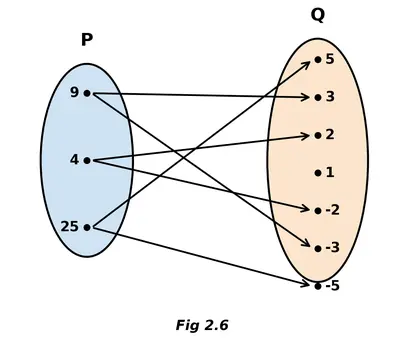
The Fig 2.6 shows a relation between the sets $$P$$ and $$Q$$. Write this relation (i) in set-builder form, (ii) in roster form. What is its domain and range?

The relation shown in Fig 2.6 is between sets $$P = \{9, 4, 25\}$$ and $$Q = \{5, 3, 2, 1, -2, -3, -5\}$$, with arrows from $$9$$ to $$3$$ and $$-3$$, from $$4$$ to $$2$$ and $$-2$$, and from $$25$$ to $$5$$ and $$-5$$.

Fig 2.6 — arrow diagram of a relation from set P = {9, 4, 25} to set Q = {5, 3, 2, 1, -2, -3, -5}, with arrows from 9 to 3 and -3, from 4 to 2 and -2, and from 25 to 5 and -5.

Solution

Examine the arrows. Each $$x \in P$$ is paired with the two square roots of $$x$$ in $$Q$$: $$9$$ pairs with $$\pm 3$$, $$4$$ with $$\pm 2$$, and $$25$$ with $$\pm 5$$. In every case, $$x = y^2$$, i.e. $$y$$ is a square root of $$x$$.

(i) Set-builder form:

$$R = \{(x, y) : x \in P,\ y \in Q,\ y\text{ is a square root of }x\}$$, equivalently $$R = \{(x, y) : x \in P,\ y \in Q,\ x = y^2\}$$.

(ii) Roster form: Listing each ordered pair shown by an arrow,

$$R = \{(9, 3), (9, -3), (4, 2), (4, -2), (25, 5), (25, -5)\}$$.

Domain: set of first coordinates $$= \{9, 4, 25\}$$.

Range: set of second coordinates $$= \{3, -3, 2, -2, 5, -5\}$$.

Answer

$$R = \{(x, y) : x \in P,\ y \in Q,\ x = y^2\} = \{(9, 3), (9, -3), (4, 2), (4, -2), (25, 5), (25, -5)\}$$. Domain $$= \{9, 4, 25\}$$; range $$= \{-5, -3, -2, 2, 3, 5\}$$.

Example 9 Let $$A = \{1, 2\}$$ and $$B = \{3, 4\}$$. Find the number of relations from $$A$$ to $$B$$.

Solution

A relation from $$A$$ to $$B$$ is, by definition, any subset of $$A \times B$$.

First find $$A \times B$$:

$$A \times B = \{1, 2\} \times \{3, 4\} = \{(1, 3), (1, 4), (2, 3), (2, 4)\}$$.

So $$n(A \times B) = 2 \times 2 = 4$$.

A set with $$n$$ elements has $$2^n$$ subsets, so the number of relations from $$A$$ to $$B$$ is

$$2^{n(A \times B)} = 2^4 = 16$$.

Answer

$$16$$ relations.

Exercise 2.2

1 Let $$A = \{1, 2, 3, \ldots, 14\}$$. Define a relation $$R$$ from $$A$$ to $$A$$ by $$R = \{(x, y) : 3x - y = 0, \text{ where } x, y \in A\}$$. Write down its domain, codomain and range.

Solution

The condition $$3x - y = 0$$ gives $$y = 3x$$. We require both $$x$$ and $$y = 3x$$ to lie in $$A = \{1, 2, \ldots, 14\}$$, i.e. $$1 \le 3x \le 14$$, so $$x \in \{1, 2, 3, 4\}$$ (since $$3 \times 5 = 15 > 14$$).

Listing the ordered pairs,

$$x$$$$y = 3x$$
$$1$$$$3$$
$$2$$$$6$$
$$3$$$$9$$
$$4$$$$12$$

So $$R = \{(1, 3), (2, 6), (3, 9), (4, 12)\}$$.

Domain $$= \{1, 2, 3, 4\}$$ (set of first coordinates).

Codomain $$= A = \{1, 2, 3, 4, 5, 6, 7, 8, 9, 10, 11, 12, 13, 14\}$$.

Range $$= \{3, 6, 9, 12\}$$ (set of second coordinates).

Answer

Domain $$= \{1, 2, 3, 4\}$$; codomain $$= \{1, 2, \ldots, 14\}$$; range $$= \{3, 6, 9, 12\}$$.

2 Define a relation $$R$$ on the set $$\mathbf{N}$$ of natural numbers by $$R = \{(x, y) : y = x + 5, x \text{ is a natural number less than } 4; x, y \in \mathbf{N}\}$$. Depict this relationship using roster form. Write down the domain and the range.

Solution

The natural numbers less than $$4$$ are $$x = 1, 2, 3$$. Compute $$y = x + 5$$ for each:

$$x = 1 \Rightarrow y = 6$$; $$x = 2 \Rightarrow y = 7$$; $$x = 3 \Rightarrow y = 8$$.

Roster form: $$R = \{(1, 6), (2, 7), (3, 8)\}$$.

Domain $$= \{1, 2, 3\}$$ (first coordinates).

Range $$= \{6, 7, 8\}$$ (second coordinates).

Answer

$$R = \{(1, 6), (2, 7), (3, 8)\}$$; domain $$= \{1, 2, 3\}$$; range $$= \{6, 7, 8\}$$.

3 $$A = \{1, 2, 3, 5\}$$ and $$B = \{4, 6, 9\}$$. Define a relation $$R$$ from $$A$$ to $$B$$ by $$R = \{(x, y) : \text{the difference between } x \text{ and } y \text{ is odd}; x \in A, y \in B\}$$. Write $$R$$ in roster form.

Solution

The difference $$x - y$$ is odd precisely when one of $$x, y$$ is even and the other is odd. Examine every pair $$(x, y) \in A \times B$$:

$$x$$$$y$$$$x - y$$Odd?
$$1$$$$4$$$$-3$$Yes
$$1$$$$6$$$$-5$$Yes
$$1$$$$9$$$$-8$$No
$$2$$$$4$$$$-2$$No
$$2$$$$6$$$$-4$$No
$$2$$$$9$$$$-7$$Yes
$$3$$$$4$$$$-1$$Yes
$$3$$$$6$$$$-3$$Yes
$$3$$$$9$$$$-6$$No
$$5$$$$4$$$$1$$Yes
$$5$$$$6$$$$-1$$Yes
$$5$$$$9$$$$-4$$No

Collecting the pairs whose difference is odd,

$$R = \{(1, 4), (1, 6), (2, 9), (3, 4), (3, 6), (5, 4), (5, 6)\}$$.

Answer

$$R = \{(1, 4), (1, 6), (2, 9), (3, 4), (3, 6), (5, 4), (5, 6)\}$$.

4

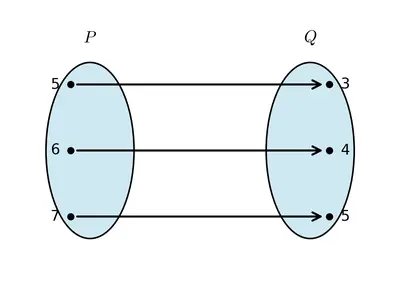
The Fig 2.7 shows a relationship between the sets $$P$$ and $$Q$$. Write this relation (i) in set-builder form (ii) roster form. What is its domain and range?

The relation shown in Fig 2.7 is between sets $$P = \{5, 6, 7\}$$ and $$Q = \{3, 4, 5\}$$, with arrows from $$5$$ to $$3$$, from $$6$$ to $$4$$, and from $$7$$ to $$5$$.

Fig 2.7 — arrow diagram of a relation from set P = {5, 6, 7} to set Q = {3, 4, 5}, with arrows from 5 to 3, from 6 to 4, and from 7 to 5.

Solution

From the arrows, each $$x \in P$$ is connected to $$y = x - 2$$ in $$Q$$:

$$5 \to 3$$ (since $$5 - 2 = 3$$); $$6 \to 4$$ (since $$6 - 2 = 4$$); $$7 \to 5$$ (since $$7 - 2 = 5$$).

(i) Set-builder form:

$$R = \{(x, y) : y = x - 2,\ x \in P,\ y \in Q\}$$.

(ii) Roster form:

$$R = \{(5, 3), (6, 4), (7, 5)\}$$.

Domain $$= \{5, 6, 7\}$$; Range $$= \{3, 4, 5\}$$.

Answer

$$R = \{(x, y) : y = x - 2,\ x \in P,\ y \in Q\} = \{(5, 3), (6, 4), (7, 5)\}$$. Domain $$= \{5, 6, 7\}$$; range $$= \{3, 4, 5\}$$.

5 Let $$A = \{1, 2, 3, 4, 6\}$$. Let $$R$$ be the relation on $$A$$ defined by $$\{(a, b) : a, b \in A, b \text{ is exactly divisible by } a\}$$.

(i) Write $$R$$ in roster form

Solution

$$R = \{(a, b) : a, b \in A,\ b\text{ is exactly divisible by }a\}$$ on $$A = \{1, 2, 3, 4, 6\}$$. For each $$a \in A$$, list the elements $$b \in A$$ that are multiples of $$a$$.

  • $$a = 1$$: every element is a multiple of $$1$$, so $$b \in \{1, 2, 3, 4, 6\}$$.
  • $$a = 2$$: multiples of $$2$$ in $$A$$ are $$2, 4, 6$$.
  • $$a = 3$$: multiples of $$3$$ in $$A$$ are $$3, 6$$.
  • $$a = 4$$: multiples of $$4$$ in $$A$$ are $$4$$.
  • $$a = 6$$: multiples of $$6$$ in $$A$$ are $$6$$.

Hence $$R = \{(1, 1), (1, 2), (1, 3), (1, 4), (1, 6), (2, 2), (2, 4), (2, 6), (3, 3), (3, 6), (4, 4), (6, 6)\}$$.

Answer

$$R = \{(1, 1), (1, 2), (1, 3), (1, 4), (1, 6), (2, 2), (2, 4), (2, 6), (3, 3), (3, 6), (4, 4), (6, 6)\}$$.

(ii) Find the domain of $$R$$

Solution

The domain is the set of all first coordinates of $$R$$. Reading them off the roster in part (i),

First coordinates appearing: $$1, 1, 1, 1, 1, 2, 2, 2, 3, 3, 4, 6$$. Removing duplicates,

Domain of $$R = \{1, 2, 3, 4, 6\}$$.

Answer

Domain $$= \{1, 2, 3, 4, 6\}$$.

(iii) Find the range of $$R$$.

Solution

The range is the set of all second coordinates of $$R$$. From the roster,

Second coordinates appearing: $$1, 2, 3, 4, 6, 2, 4, 6, 3, 6, 4, 6$$. Removing duplicates,

Range of $$R = \{1, 2, 3, 4, 6\}$$.

Answer

Range $$= \{1, 2, 3, 4, 6\}$$.

6 Determine the domain and range of the relation $$R$$ defined by $$R = \{(x, x + 5) : x \in \{0, 1, 2, 3, 4, 5\}\}$$.

Solution

For each $$x \in \{0, 1, 2, 3, 4, 5\}$$ compute $$x + 5$$.

$$x = 0, 1, 2, 3, 4, 5 \Rightarrow x + 5 = 5, 6, 7, 8, 9, 10$$.

So $$R = \{(0, 5), (1, 6), (2, 7), (3, 8), (4, 9), (5, 10)\}$$.

Domain $$= \{0, 1, 2, 3, 4, 5\}$$ (first coordinates).

Range $$= \{5, 6, 7, 8, 9, 10\}$$ (second coordinates).

Answer

Domain $$= \{0, 1, 2, 3, 4, 5\}$$; range $$= \{5, 6, 7, 8, 9, 10\}$$.

7 Write the relation $$R = \{(x, x^3) : x \text{ is a prime number less than } 10\}$$ in roster form.

Solution

The prime numbers less than $$10$$ are $$2, 3, 5, 7$$. Cube each:

$$2^3 = 8,\ 3^3 = 27,\ 5^3 = 125,\ 7^3 = 343$$.

Hence $$R = \{(2, 8), (3, 27), (5, 125), (7, 343)\}$$.

Answer

$$R = \{(2, 8), (3, 27), (5, 125), (7, 343)\}$$.

8 Let $$A = \{x, y, z\}$$ and $$B = \{1, 2\}$$. Find the number of relations from $$A$$ to $$B$$.

Solution

A relation from $$A$$ to $$B$$ is any subset of $$A \times B$$. The number of subsets of a set with $$n$$ elements is $$2^n$$.

$$n(A \times B) = n(A) \times n(B) = 3 \times 2 = 6$$.

So the number of relations from $$A$$ to $$B$$ is

$$2^{6} = 64$$.

Answer

$$64$$ relations.

9 Let $$R$$ be the relation on $$\mathbf{Z}$$ defined by $$R = \{(a, b) : a, b \in \mathbf{Z}, a - b \text{ is an integer}\}$$. Find the domain and range of $$R$$.

Solution

The difference of any two integers is itself an integer. So for every $$a, b \in \mathbf{Z}$$ we have $$a - b \in \mathbf{Z}$$, which means every ordered pair $$(a, b) \in \mathbf{Z} \times \mathbf{Z}$$ belongs to $$R$$.

Therefore $$R = \mathbf{Z} \times \mathbf{Z}$$.

Every integer appears as a first coordinate (take any $$a \in \mathbf{Z}$$ and $$b = 0$$; then $$(a, 0) \in R$$). Similarly every integer appears as a second coordinate.

Domain of $$R = \mathbf{Z}$$.

Range of $$R = \mathbf{Z}$$.

Answer

Domain $$= \mathbf{Z}$$ and range $$= \mathbf{Z}$$.

Examples 10-17

Example 10 Let $$\mathbf{N}$$ be the set of natural numbers and the relation $$R$$ be defined on $$\mathbf{N}$$ such that $$R = \{(x, y) : y = 2x, x, y \in \mathbf{N}\}$$. What is the domain, codomain and range of $$R$$? Is this relation a function?

Solution

For every natural number $$x$$, the value $$y = 2x$$ is also a natural number, so every $$x \in \mathbf{N}$$ contributes the pair $$(x, 2x)$$ to $$R$$.

Domain $$= \mathbf{N}$$ (every $$x \in \mathbf{N}$$ appears as a first coordinate).

Codomain $$= \mathbf{N}$$ ($$R \subseteq \mathbf{N} \times \mathbf{N}$$).

Range $$=$$ set of values of $$2x$$ as $$x$$ ranges over $$\mathbf{N} = \{2, 4, 6, 8, \ldots\}$$, i.e. the set of even natural numbers.

Is $$R$$ a function? A relation is a function from its domain if each domain element has exactly one image. Here each $$x \in \mathbf{N}$$ gives exactly one $$y$$, namely $$y = 2x$$. Hence $$R$$ is a function from $$\mathbf{N}$$ to $$\mathbf{N}$$.

Answer

Domain $$= \mathbf{N}$$; codomain $$= \mathbf{N}$$; range $$= \{2, 4, 6, 8, \ldots\}$$ (set of even natural numbers). Yes, $$R$$ is a function.

Example 11 Examine each of the following relations given below and state in each case, giving reasons whether it is a function or not?

(i) $$R = \{(2, 1), (3, 1), (4, 2)\}$$

Solution

A relation is a function if every element of its domain has exactly one image. The first coordinates of $$R$$ are $$2, 3, 4$$ — all distinct. So each domain element has a unique image.

Hence $$R$$ is a function.

(Domain $$= \{2, 3, 4\}$$, range $$= \{1, 2\}$$.)

Answer

Yes, $$R$$ is a function (each first coordinate is distinct).

(ii) $$R = \{(2, 2), (2, 4), (3, 3), (4, 4)\}$$

Solution

The first coordinate $$2$$ appears twice, in $$(2, 2)$$ and $$(2, 4)$$, with two different images $$2$$ and $$4$$. A function must assign a unique image to each input.

Hence $$R$$ is not a function.

Answer

Not a function: the element $$2$$ has two different images, $$2$$ and $$4$$.

(iii) $$R = \{(1, 2), (2, 3), (3, 4), (4, 5), (5, 6), (6, 7)\}$$

Solution

The first coordinates are $$1, 2, 3, 4, 5, 6$$ — all distinct, so every domain element has a unique image.

Hence $$R$$ is a function.

(Domain $$= \{1, 2, 3, 4, 5, 6\}$$, range $$= \{2, 3, 4, 5, 6, 7\}$$. The rule is $$y = x + 1$$.)

Answer

Yes, $$R$$ is a function (each first coordinate is distinct).

Example 12

Let $$\mathbf{N}$$ be the set of natural numbers. Define a real valued function $$f : \mathbf{N} \to \mathbf{N}$$ by $$f(x) = 2x + 1$$. Using this definition, complete the table given below.

$$x$$1234567
$$y$$$$f(1) = \ldots$$$$f(2) = \ldots$$$$f(3) = \ldots$$$$f(4) = \ldots$$$$f(5) = \ldots$$$$f(6) = \ldots$$$$f(7) = \ldots$$

Solution

Substitute each value of $$x$$ into $$f(x) = 2x + 1$$.

$$f(1) = 2(1) + 1 = 3$$.
$$f(2) = 2(2) + 1 = 5$$.
$$f(3) = 2(3) + 1 = 7$$.
$$f(4) = 2(4) + 1 = 9$$.
$$f(5) = 2(5) + 1 = 11$$.
$$f(6) = 2(6) + 1 = 13$$.
$$f(7) = 2(7) + 1 = 15$$.

Completed table:

$$x$$$$1$$$$2$$$$3$$$$4$$$$5$$$$6$$$$7$$
$$y = f(x)$$$$3$$$$5$$$$7$$$$9$$$$11$$$$13$$$$15$$

Answer

$$f(1) = 3,\ f(2) = 5,\ f(3) = 7,\ f(4) = 9,\ f(5) = 11,\ f(6) = 13,\ f(7) = 15$$.

Example 13

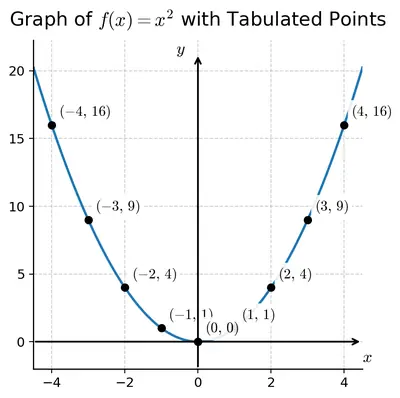
Define the function $$f : \mathbf{R} \to \mathbf{R}$$ by $$y = f(x) = x^2$$, $$x \in \mathbf{R}$$. Complete the Table given below by using this definition. What is the domain and range of this function? Draw the graph of $$f$$.

$$x$$$$-4$$$$-3$$$$-2$$$$-1$$$$0$$$$1$$$$2$$$$3$$$$4$$
$$y = f(x) = x^2$$
Figure
Figure

Solution

Compute $$y = x^2$$ for each tabulated $$x$$.

$$x$$$$-4$$$$-3$$$$-2$$$$-1$$$$0$$$$1$$$$2$$$$3$$$$4$$
$$y = x^2$$$$16$$$$9$$$$4$$$$1$$$$0$$$$1$$$$4$$$$9$$$$16$$

Domain: $$x^2$$ is defined for every real $$x$$, so the domain is $$\mathbf{R}$$.

Range: Since $$x^2 \ge 0$$ for all real $$x$$, and every non-negative real $$y$$ equals $$x^2$$ for $$x = \sqrt{y}$$, the range is $$[0, \infty) = \{y \in \mathbf{R} : y \ge 0\}$$.

Graph: Plot the points $$(-4, 16), (-3, 9), (-2, 4), (-1, 1), (0, 0), (1, 1), (2, 4), (3, 9), (4, 16)$$ and join them with a smooth curve. The resulting curve is a parabola opening upward with its vertex at the origin and symmetric about the $$y$$-axis.

Answer

Table values: $$16, 9, 4, 1, 0, 1, 4, 9, 16$$. Domain $$= \mathbf{R}$$; range $$= [0, \infty)$$. The graph is an upward-opening parabola with vertex at the origin.

Example 14

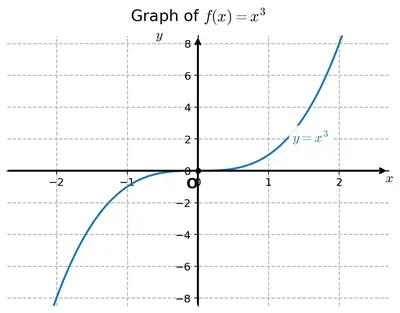
Draw the graph of the function $$f : \mathbf{R} \to \mathbf{R}$$ defined by $$f(x) = x^3$$, $$x \in \mathbf{R}$$.
Figure
Figure

Solution

Tabulate a few values of $$y = x^3$$.

$$x$$$$-3$$$$-2$$$$-1$$$$0$$$$1$$$$2$$$$3$$
$$y = x^3$$$$-27$$$$-8$$$$-1$$$$0$$$$1$$$$8$$$$27$$

Plot these points and join them with a smooth curve.

Description of the graph: The curve passes through the origin. For $$x > 0$$ it rises steeply (more steeply than the line $$y = x$$ for $$|x| > 1$$), and for $$x < 0$$ it descends symmetrically (the graph is symmetric about the origin because $$(-x)^3 = -x^3$$, i.e. $$f$$ is an odd function). The curve has a point of inflection at the origin (it is tangent to the $$x$$-axis there) and extends without bound in both directions.

Domain $$= \mathbf{R}$$; range $$= \mathbf{R}$$.

Answer

The graph is a smooth, monotonically increasing odd cubic curve passing through the origin, symmetric about the origin, with domain $$\mathbf{R}$$ and range $$\mathbf{R}$$.

Example 15

Define the real valued function $$f : \mathbf{R} - \{0\} \to \mathbf{R}$$ defined by $$f(x) = \dfrac{1}{x}$$, $$x \in \mathbf{R} - \{0\}$$. Complete the Table below using this definition. What is the domain and range of this function?

$$x$$$$-2$$$$-1.5$$$$-1$$$$-0.5$$$$0.25$$$$0.5$$$$1$$$$1.5$$$$2$$
$$y = \dfrac{1}{x}$$$$\ldots$$$$\ldots$$$$\ldots$$$$\ldots$$$$\ldots$$$$\ldots$$$$\ldots$$$$\ldots$$$$\ldots$$

Solution

Compute $$y = \dfrac{1}{x}$$ for each tabulated $$x$$.

$$\dfrac{1}{-2} = -0.5$$; $$\dfrac{1}{-1.5} = -\dfrac{2}{3} \approx -0.667$$; $$\dfrac{1}{-1} = -1$$; $$\dfrac{1}{-0.5} = -2$$; $$\dfrac{1}{0.25} = 4$$; $$\dfrac{1}{0.5} = 2$$; $$\dfrac{1}{1} = 1$$; $$\dfrac{1}{1.5} = \dfrac{2}{3} \approx 0.667$$; $$\dfrac{1}{2} = 0.5$$.

$$x$$$$-2$$$$-1.5$$$$-1$$$$-0.5$$$$0.25$$$$0.5$$$$1$$$$1.5$$$$2$$
$$y = \dfrac{1}{x}$$$$-0.5$$$$-\dfrac{2}{3}$$$$-1$$$$-2$$$$4$$$$2$$$$1$$$$\dfrac{2}{3}$$$$0.5$$

Domain: $$\dfrac{1}{x}$$ is defined for every real $$x$$ except $$x = 0$$, so the domain is $$\mathbf{R} - \{0\}$$.

Range: If $$y = \dfrac{1}{x}$$ then $$x = \dfrac{1}{y}$$, which is real and non-zero iff $$y \ne 0$$. Every non-zero real $$y$$ is attained. Hence the range is $$\mathbf{R} - \{0\}$$.

Answer

Table values: $$-0.5, -\dfrac{2}{3}, -1, -2, 4, 2, 1, \dfrac{2}{3}, 0.5$$. Domain $$= \mathbf{R} - \{0\}$$; range $$= \mathbf{R} - \{0\}$$.

Example 16 Let $$f(x) = x^2$$ and $$g(x) = 2x + 1$$ be two real functions. Find $$(f + g)(x)$$, $$(f - g)(x)$$, $$(fg)(x)$$, $$\left(\dfrac{f}{g}\right)(x)$$.

Solution

By the algebra of real functions, $$(f + g)(x) = f(x) + g(x)$$, etc.

Sum:

$$(f + g)(x) = f(x) + g(x) = x^2 + (2x + 1) = x^2 + 2x + 1$$.

Difference:

$$(f - g)(x) = f(x) - g(x) = x^2 - (2x + 1) = x^2 - 2x - 1$$.

Product:

$$(fg)(x) = f(x) \cdot g(x) = x^2(2x + 1) = 2x^3 + x^2$$.

Quotient:

$$\left(\dfrac{f}{g}\right)(x) = \dfrac{f(x)}{g(x)} = \dfrac{x^2}{2x + 1}$$, valid whenever $$2x + 1 \ne 0$$, i.e. $$x \ne -\dfrac{1}{2}$$.

Answer

$$(f + g)(x) = x^2 + 2x + 1$$; $$(f - g)(x) = x^2 - 2x - 1$$; $$(fg)(x) = 2x^3 + x^2$$; $$\left(\dfrac{f}{g}\right)(x) = \dfrac{x^2}{2x + 1},\ x \ne -\dfrac{1}{2}$$.

Example 17 Let $$f(x) = \sqrt{x}$$ and $$g(x) = x$$ be two functions defined over the set of non-negative real numbers. Find $$(f + g)(x)$$, $$(f - g)(x)$$, $$(fg)(x)$$ and $$\left(\dfrac{f}{g}\right)(x)$$.

Solution

Both $$f$$ and $$g$$ are defined on $$[0, \infty)$$.

Sum:

$$(f + g)(x) = \sqrt{x} + x$$, for $$x \ge 0$$.

Difference:

$$(f - g)(x) = \sqrt{x} - x$$, for $$x \ge 0$$.

Product:

$$(fg)(x) = \sqrt{x} \cdot x = x\sqrt{x} = x^{3/2}$$, for $$x \ge 0$$.

Quotient:

$$\left(\dfrac{f}{g}\right)(x) = \dfrac{\sqrt{x}}{x} = \dfrac{1}{\sqrt{x}}$$, valid for $$x > 0$$ (we must exclude $$x = 0$$).

Answer

$$(f + g)(x) = \sqrt{x} + x$$; $$(f - g)(x) = \sqrt{x} - x$$; $$(fg)(x) = x^{3/2}$$; $$\left(\dfrac{f}{g}\right)(x) = \dfrac{1}{\sqrt{x}},\ x > 0$$.

Exercise 2.3

1 Which of the following relations are functions? Give reasons. If it is a function, determine its domain and range.

(i) $$\{(2, 1), (5, 1), (8, 1), (11, 1), (14, 1), (17, 1)\}$$

Solution

The first coordinates are $$2, 5, 8, 11, 14, 17$$ — all distinct — so every element of the domain has a unique image (in fact the constant value $$1$$).

Hence the relation is a function.

Domain $$= \{2, 5, 8, 11, 14, 17\}$$.
Range $$= \{1\}$$.

Answer

Yes, it is a function. Domain $$= \{2, 5, 8, 11, 14, 17\}$$; range $$= \{1\}$$.

(ii) $$\{(2, 1), (4, 2), (6, 3), (8, 4), (10, 5), (12, 6), (14, 7)\}$$

Solution

The first coordinates $$2, 4, 6, 8, 10, 12, 14$$ are all distinct, so each domain element has a unique image. (The rule is $$y = \dfrac{x}{2}$$.)

Hence the relation is a function.

Domain $$= \{2, 4, 6, 8, 10, 12, 14\}$$.
Range $$= \{1, 2, 3, 4, 5, 6, 7\}$$.

Answer

Yes, it is a function. Domain $$= \{2, 4, 6, 8, 10, 12, 14\}$$; range $$= \{1, 2, 3, 4, 5, 6, 7\}$$.

(iii) $$\{(1, 3), (1, 5), (2, 5)\}$$.

Solution

The first coordinate $$1$$ appears in two different ordered pairs: $$(1, 3)$$ and $$(1, 5)$$. The element $$1$$ would have two different images, $$3$$ and $$5$$. A function must assign a unique image to each input.

Hence the relation is not a function.

Answer

Not a function: the element $$1$$ has two images, $$3$$ and $$5$$.

2 Find the domain and range of the following real functions:

(i) $$f(x) = -|x|$$

Solution

Domain: $$|x|$$ is defined for every real $$x$$, so $$-|x|$$ is too. Hence the domain is $$\mathbf{R}$$.

Range: Since $$|x| \ge 0$$ for all real $$x$$, we have $$-|x| \le 0$$. Conversely, every $$y \le 0$$ can be written as $$-|y| = -|x|$$ by taking $$x = -y \ge 0$$ (or $$x = y \le 0$$), so every non-positive real is attained.

Hence the range is $$(-\infty, 0] = \{y \in \mathbf{R} : y \le 0\}$$.

Answer

Domain $$= \mathbf{R}$$; range $$= (-\infty, 0]$$.

(ii) $$f(x) = \sqrt{9 - x^2}$$.

Solution

Domain: The square root is defined for real values only when the radicand is non-negative.

$$9 - x^2 \ge 0 \iff x^2 \le 9 \iff -3 \le x \le 3$$.

So the domain is $$[-3, 3]$$.

Range: Let $$y = \sqrt{9 - x^2}$$. Then $$y \ge 0$$ and $$y^2 = 9 - x^2$$, giving $$x^2 = 9 - y^2$$. For $$x$$ to be real we need $$9 - y^2 \ge 0$$, i.e. $$y^2 \le 9$$, i.e. $$-3 \le y \le 3$$. Combined with $$y \ge 0$$, this gives $$0 \le y \le 3$$.

The endpoints are attained: $$y = 0$$ at $$x = \pm 3$$ and $$y = 3$$ at $$x = 0$$.

Hence the range is $$[0, 3]$$.

Answer

Domain $$= [-3, 3]$$; range $$= [0, 3]$$.

3 A function $$f$$ is defined by $$f(x) = 2x - 5$$. Write down the values of

(i) $$f(0)$$

Solution

Substitute $$x = 0$$ into $$f(x) = 2x - 5$$.

$$f(0) = 2(0) - 5 = -5$$.

Answer

$$f(0) = -5$$.

(ii) $$f(7)$$

Solution

Substitute $$x = 7$$ into $$f(x) = 2x - 5$$.

$$f(7) = 2(7) - 5 = 14 - 5 = 9$$.

Answer

$$f(7) = 9$$.

(iii) $$f(-3)$$.

Solution

Substitute $$x = -3$$ into $$f(x) = 2x - 5$$.

$$f(-3) = 2(-3) - 5 = -6 - 5 = -11$$.

Answer

$$f(-3) = -11$$.

4 The function $$t$$ which maps temperature in degree Celsius into temperature in degree Fahrenheit is defined by $$t(C) = \dfrac{9C}{5} + 32$$. Find

(i) $$t(0)$$

Solution

Substitute $$C = 0$$ into $$t(C) = \dfrac{9C}{5} + 32$$.

$$t(0) = \dfrac{9(0)}{5} + 32 = 0 + 32 = 32$$.

So $$0\,{}^{\circ}\mathrm{C}$$ corresponds to $$32\,{}^{\circ}\mathrm{F}$$.

Answer

$$t(0) = 32$$.

(ii) $$t(28)$$

Solution

Substitute $$C = 28$$ into $$t(C) = \dfrac{9C}{5} + 32$$.

$$t(28) = \dfrac{9(28)}{5} + 32 = \dfrac{252}{5} + 32 = 50.4 + 32 = 82.4$$.

Answer

$$t(28) = 82.4$$.

(iii) $$t(-10)$$

Solution

Substitute $$C = -10$$ into $$t(C) = \dfrac{9C}{5} + 32$$.

$$t(-10) = \dfrac{9(-10)}{5} + 32 = \dfrac{-90}{5} + 32 = -18 + 32 = 14$$.

Answer

$$t(-10) = 14$$.

(iv) The value of $$C$$, when $$t(C) = 212$$.

Solution

Set $$t(C) = 212$$ and solve for $$C$$.

$$\dfrac{9C}{5} + 32 = 212$$.

Subtract $$32$$ from both sides:

$$\dfrac{9C}{5} = 180$$.

Multiply both sides by $$\dfrac{5}{9}$$:

$$C = \dfrac{180 \times 5}{9} = \dfrac{900}{9} = 100$$.

So $$C = 100\,{}^{\circ}\mathrm{C}$$, which is the boiling point of water — consistent with $$212\,{}^{\circ}\mathrm{F}$$.

Answer

$$C = 100$$.

5 Find the range of each of the following functions.

(i) $$f(x) = 2 - 3x$$, $$x \in \mathbf{R}$$, $$x > 0$$.

Solution

The domain is the set $$\{x \in \mathbf{R} : x \gt 0\}$$, that is the interval $$(0, \infty)$$. We need the set of values taken by $$y = 2 - 3x$$ as $$x$$ ranges over this domain.

Since $$x \gt 0$$, multiplying by $$3$$ gives $$3x \gt 0$$, and multiplying by $$-1$$ reverses the inequality:

$$-3x \lt 0$$.

Adding $$2$$ to both sides,

$$2 - 3x \lt 2$$, that is $$y \lt 2$$.

So every output value is strictly less than $$2$$. Conversely, every real number less than $$2$$ is actually attained: given any $$y \lt 2$$, put $$x = \dfrac{2 - y}{3}$$. Then $$x \gt 0$$ (because $$2 - y \gt 0$$), and $$f(x) = 2 - 3 \cdot \dfrac{2 - y}{3} = 2 - (2 - y) = y$$.

As $$x \to 0^+$$ the value $$y \to 2$$ (without ever reaching it), and as $$x \to \infty$$ the value $$y \to -\infty$$.

Hence the range is the set of all real numbers less than $$2$$:

Range $$= (-\infty, 2)$$.

Answer

Range $$= (-\infty, 2)$$.

(ii) $$f(x) = x^2 + 2$$, $$x$$ is a real number.

Solution

For any real $$x$$, $$x^2 \ge 0$$, so

$$f(x) = x^2 + 2 \ge 0 + 2 = 2$$.

The minimum value $$y = 2$$ is attained at $$x = 0$$. Conversely, for any $$y \ge 2$$, take $$x = \sqrt{y - 2}$$ (real because $$y - 2 \ge 0$$); then $$f(x) = (y - 2) + 2 = y$$. So every $$y \ge 2$$ is attained.

Hence the range is $$[2, \infty)$$.

Answer

Range $$= [2, \infty)$$.

(iii) $$f(x) = x$$, $$x$$ is a real number.

Solution

The identity function $$f(x) = x$$ sends every real $$x$$ to itself.

As $$x$$ ranges over $$\mathbf{R}$$, the output $$y = x$$ ranges over $$\mathbf{R}$$ too. Every real $$y$$ is attained (take $$x = y$$).

Hence the range is $$\mathbf{R}$$.

Answer

Range $$= \mathbf{R}$$.

Miscellaneous Examples

Example 18

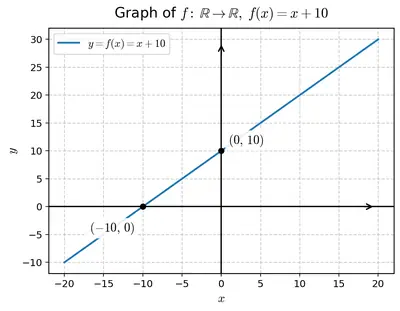
Let $$\mathbf{R}$$ be the set of real numbers. Define the real function $$f : \mathbf{R} \to \mathbf{R}$$ by $$f(x) = x + 10$$ and sketch the graph of this function.
Figure
Figure

Solution

Tabulate a few values of $$y = x + 10$$.

$$x$$$$-4$$$$-3$$$$-2$$$$-1$$$$0$$$$1$$$$2$$$$3$$$$4$$
$$y$$$$6$$$$7$$$$8$$$$9$$$$10$$$$11$$$$12$$$$13$$$$14$$

Graph: Plot the points $$(-4, 6), (-3, 7), \ldots, (4, 14)$$. They lie on a straight line. The graph of $$f(x) = x + 10$$ is a straight line with slope $$1$$ and $$y$$-intercept $$10$$ — it passes through $$(0, 10)$$ and $$(-10, 0)$$, rising at $$45^{\circ}$$ to the $$x$$-axis.

Domain $$= \mathbf{R}$$; range $$= \mathbf{R}$$.

Answer

The graph is the straight line $$y = x + 10$$ with slope $$1$$, $$y$$-intercept $$10$$, and $$x$$-intercept $$-10$$.

Example 19 Let $$R$$ be a relation from $$\mathbf{Q}$$ to $$\mathbf{Q}$$ defined by $$R = \{(a, b) : a, b \in \mathbf{Q} \text{ and } a - b \in \mathbf{Z}\}$$. Show that

(i) $$(a, a) \in R$$ for all $$a \in \mathbf{Q}$$

Solution

Let $$a \in \mathbf{Q}$$. Then $$a - a = 0$$, and $$0 \in \mathbf{Z}$$. So the pair $$(a, a)$$ satisfies the defining condition of $$R$$ (namely $$a - b \in \mathbf{Z}$$ with $$b = a$$).

Therefore $$(a, a) \in R$$ for every $$a \in \mathbf{Q}$$. (This says $$R$$ is reflexive.)

Answer

Proved: $$a - a = 0 \in \mathbf{Z}$$, so $$(a, a) \in R$$ for all $$a \in \mathbf{Q}$$.

(ii) $$(a, b) \in R$$ implies that $$(b, a) \in R$$

Solution

Suppose $$(a, b) \in R$$. By the definition, $$a, b \in \mathbf{Q}$$ and $$a - b \in \mathbf{Z}$$.

Then $$b - a = -(a - b)$$, and the negative of an integer is an integer, so $$b - a \in \mathbf{Z}$$.

Therefore $$(b, a) \in R$$. (This says $$R$$ is symmetric.)

Answer

Proved: if $$a - b \in \mathbf{Z}$$ then $$b - a = -(a - b) \in \mathbf{Z}$$, so $$(b, a) \in R$$.

(iii) $$(a, b) \in R$$ and $$(b, c) \in R$$ implies that $$(a, c) \in R$$

Solution

Suppose $$(a, b) \in R$$ and $$(b, c) \in R$$. Then $$a, b, c \in \mathbf{Q}$$ with

$$a - b \in \mathbf{Z}$$ and $$b - c \in \mathbf{Z}$$.

Adding these two integers gives another integer:

$$(a - b) + (b - c) = a - c \in \mathbf{Z}$$.

Therefore $$(a, c) \in R$$. (This says $$R$$ is transitive.)

Combined with (i) and (ii), $$R$$ is an equivalence relation on $$\mathbf{Q}$$.

Answer

Proved: $$(a - b) + (b - c) = a - c$$ is a sum of integers, hence an integer, so $$(a, c) \in R$$.

Example 20 Let $$f = \{(1, 1), (2, 3), (0, -1), (-1, -3)\}$$ be a linear function from $$\mathbf{Z}$$ into $$\mathbf{Z}$$. Find $$f(x)$$.

Solution

Since $$f$$ is linear, write $$f(x) = ax + b$$ for some constants $$a, b$$.

Use two of the given ordered pairs to set up equations. From $$(1, 1)$$: $$f(1) = a + b = 1$$. From $$(0, -1)$$: $$f(0) = b = -1$$.

Substitute $$b = -1$$ into $$a + b = 1$$:

$$a - 1 = 1 \implies a = 2$$.

Hence $$f(x) = 2x - 1$$.

Verify with the remaining pairs: $$f(2) = 2(2) - 1 = 3$$ ✓; $$f(-1) = 2(-1) - 1 = -3$$ ✓.

Answer

$$f(x) = 2x - 1$$.

Example 21 Find the domain of the function $$f(x) = \dfrac{x^2 + 3x + 5}{x^2 - 5x + 4}$$.

Solution

The function is defined wherever the denominator is non-zero. Factorise the denominator:

$$x^2 - 5x + 4 = (x - 1)(x - 4)$$.

So the denominator vanishes when $$x = 1$$ or $$x = 4$$.

The numerator $$x^2 + 3x + 5$$ is a polynomial defined for every real $$x$$, so it imposes no additional restriction.

Hence the domain of $$f$$ is

$$\mathbf{R} - \{1, 4\}$$, i.e. all real numbers except $$1$$ and $$4$$.

Answer

Domain $$= \mathbf{R} - \{1, 4\}$$.

Example 22

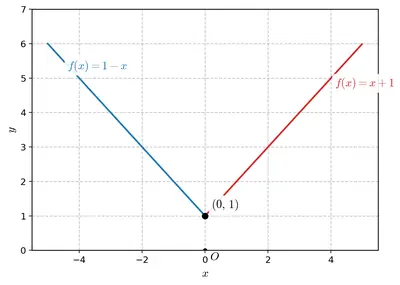
The function $$f$$ is defined by $$f(x) = \begin{cases} 1 - x, & x < 0 \\ 1, & x = 0 \\ x + 1, & x > 0 \end{cases}$$ Draw the graph of $$f(x)$$.
Figure
Figure

Solution

The function is defined piecewise, so examine each piece separately and plot a few sample points.

For $$x \lt 0$$: $$f(x) = 1 - x$$. This is the part of the line $$y = 1 - x$$ (slope $$-1$$, $$y$$-intercept $$1$$) lying strictly to the left of the $$y$$-axis. Since $$x \lt 0$$ on this piece, $$-x \gt 0$$, so $$f(x) = 1 - x \gt 1$$ here. Sample points: $$f(-1) = 2$$ and $$f(-2) = 3$$. As $$x \to 0^-$$, $$f(x) \to 1$$.

For $$x = 0$$: $$f(0) = 1$$. This contributes the single point $$(0, 1)$$.

For $$x \gt 0$$: $$f(x) = x + 1$$. This is the part of the line $$y = x + 1$$ (slope $$1$$, $$y$$-intercept $$1$$) lying strictly to the right of the $$y$$-axis. Since $$x \gt 0$$ on this piece, $$f(x) = x + 1 \gt 1$$ here. Sample points: $$f(1) = 2$$ and $$f(2) = 3$$. As $$x \to 0^+$$, $$f(x) \to 1$$.

The left piece approaches $$(0, 1)$$ as $$x \to 0^-$$, the middle case gives exactly $$f(0) = 1$$, and the right piece approaches $$(0, 1)$$ as $$x \to 0^+$$. All three agree at $$(0, 1)$$, so the graph is a single continuous curve with no break or jump.

Graph: The graph is a V-shape opening upward with its vertex at $$(0, 1)$$. The left ray (drawn for $$x \lt 0$$) has slope $$-1$$ and rises to the left; the right ray (drawn for $$x \gt 0$$) has slope $$1$$ and rises to the right; the vertex point $$(0, 1)$$ is supplied by the value $$f(0) = 1$$. This is exactly the graph of $$y = |x| + 1$$.

Answer

The graph is a V-shape opening upward with vertex at $$(0, 1)$$: the left ray is $$y = 1 - x$$ for $$x \lt 0$$, the right ray is $$y = x + 1$$ for $$x \gt 0$$, and the vertex point $$(0, 1)$$ comes from $$f(0) = 1$$. Equivalently, the graph is $$y = |x| + 1$$.

Miscellaneous Exercise on Chapter 2

1

The relation $$f$$ is defined by $$f(x) = \begin{cases} x^2, & 0 \le x \le 3 \\ 3x, & 3 \le x \le 10 \end{cases}$$

The relation $$g$$ is defined by $$g(x) = \begin{cases} x^2, & 0 \le x \le 2 \\ 3x, & 2 \le x \le 10 \end{cases}$$

Show that $$f$$ is a function and $$g$$ is not a function.

Solution

For a relation to be a function, every input in its domain must have a single, well-defined image. The only point where ambiguity could arise in a piecewise definition is where the two pieces overlap.

For $$f$$: The pieces overlap only at $$x = 3$$. Check the two definitions there:

$$x^2 \big|_{x = 3} = 9$$ and $$3x \big|_{x = 3} = 9$$.

Both pieces give the same value $$9$$, so $$f(3) = 9$$ is unambiguous. Elsewhere, only one piece applies. Hence every $$x$$ in the domain $$[0, 10]$$ has a unique image, and $$f$$ is a function.

For $$g$$: The pieces overlap at $$x = 2$$. Check:

$$x^2 \big|_{x = 2} = 4$$ and $$3x \big|_{x = 2} = 6$$.

The two pieces give different values $$4$$ and $$6$$ at $$x = 2$$, so the element $$2$$ has two different images under $$g$$. This violates the definition of a function.

Hence $$g$$ is not a function.

Answer

$$f$$ is a function (both pieces agree at the overlap $$x = 3$$, giving $$9$$); $$g$$ is not a function (at $$x = 2$$ the pieces give $$4$$ and $$6$$, two images for one input).

2 If $$f(x) = x^2$$, find $$\dfrac{f(1.1) - f(1)}{(1.1 - 1)}$$.

Solution

Compute the numerator and denominator separately.

$$f(1.1) = (1.1)^2 = 1.21$$ and $$f(1) = 1^2 = 1$$.

So $$f(1.1) - f(1) = 1.21 - 1 = 0.21$$.

And $$1.1 - 1 = 0.1$$.

Therefore

$$\dfrac{f(1.1) - f(1)}{1.1 - 1} = \dfrac{0.21}{0.1} = 2.1$$.

Answer

$$2.1$$.

3 Find the domain of the function $$f(x) = \dfrac{x^2 + 2x + 1}{x^2 - 8x + 12}$$.

Solution

The function is defined wherever the denominator is non-zero. Factorise:

$$x^2 - 8x + 12 = (x - 2)(x - 6)$$.

The denominator vanishes at $$x = 2$$ and $$x = 6$$.

The numerator $$x^2 + 2x + 1 = (x + 1)^2$$ is a polynomial defined for every real $$x$$, so no additional restriction comes from it.

Hence the domain is $$\mathbf{R} - \{2, 6\}$$.

Answer

Domain $$= \mathbf{R} - \{2, 6\}$$.

4 Find the domain and the range of the real function $$f$$ defined by $$f(x) = \sqrt{(x - 1)}$$.

Solution

Domain: For $$f(x)$$ to be real, the radicand must be non-negative:

$$x - 1 \ge 0 \iff x \ge 1$$.

So the domain is $$[1, \infty)$$.

Range: By convention, $$\sqrt{\,\cdot\,} \ge 0$$. As $$x$$ ranges over $$[1, \infty)$$, $$x - 1$$ ranges over $$[0, \infty)$$, and so $$\sqrt{x - 1}$$ ranges over $$[0, \infty)$$. Every non-negative real $$y$$ is attained at $$x = y^2 + 1$$.

Hence the range is $$[0, \infty)$$.

Answer

Domain $$= [1, \infty)$$; range $$= [0, \infty)$$.

5 Find the domain and the range of the real function $$f$$ defined by $$f(x) = |x - 1|$$.

Solution

Domain: The absolute value is defined for every real number, so the domain is $$\mathbf{R}$$.

Range: By definition, $$|x - 1| \ge 0$$ for every real $$x$$. The value $$0$$ is attained at $$x = 1$$; every $$y > 0$$ is attained at $$x = 1 + y$$ (or $$x = 1 - y$$). So every non-negative real is achieved.

Hence the range is $$[0, \infty)$$.

Answer

Domain $$= \mathbf{R}$$; range $$= [0, \infty)$$.

6 Let $$f = \left\{\left(x, \dfrac{x^2}{1 + x^2}\right) : x \in \mathbf{R}\right\}$$ be a function from $$\mathbf{R}$$ into $$\mathbf{R}$$. Determine the range of $$f$$.

Solution

Let $$y = \dfrac{x^2}{1 + x^2}$$. We find every value of $$y$$ for which this equation has a real solution $$x$$.

Clear the denominator and collect the $$x^2$$ terms:

$$y(1 + x^2) = x^2 \implies y + y x^2 = x^2 \implies y = x^2 - y x^2 = x^2(1 - y)$$.

If $$y \ne 1$$, then

$$x^2 = \dfrac{y}{1 - y}$$.

A real number $$x$$ exists exactly when $$x^2 \ge 0$$, that is when

$$\dfrac{y}{1 - y} \ge 0$$.

This fraction is non-negative precisely when the numerator $$y$$ and the denominator $$1 - y$$ have the same sign, or when the numerator is $$0$$. Checking each case:

  • If $$y \lt 0$$: the numerator satisfies $$y \lt 0$$ while the denominator satisfies $$1 - y \gt 0$$, so the ratio is negative. Not allowed.
  • If $$y = 0$$: the ratio equals $$0$$, so $$x^2 = 0$$ and $$x = 0$$. Allowed.
  • If $$0 \lt y \lt 1$$: the numerator satisfies $$y \gt 0$$ and the denominator satisfies $$1 - y \gt 0$$, so the ratio is positive. Allowed.
  • If $$y = 1$$: substituting $$y = 1$$ in the original equation gives $$1 + x^2 = x^2$$, i.e. $$1 = 0$$, which is impossible. Not allowed.
  • If $$y \gt 1$$: the numerator satisfies $$y \gt 0$$ while the denominator satisfies $$1 - y \lt 0$$, so the ratio is negative. Not allowed.

So a real $$x$$ exists exactly for the values $$0 \le y \lt 1$$.

Hence the range of $$f$$ is $$[0, 1)$$.

Answer

Range of $$f = [0, 1)$$.

7 Let $$f, g : \mathbf{R} \to \mathbf{R}$$ be defined, respectively by $$f(x) = x + 1$$, $$g(x) = 2x - 3$$. Find $$f + g$$, $$f - g$$ and $$\dfrac{f}{g}$$.

Solution

Apply the definitions of sum, difference, and quotient of real functions.

Sum:

$$(f + g)(x) = f(x) + g(x) = (x + 1) + (2x - 3) = 3x - 2$$.

Difference:

$$(f - g)(x) = f(x) - g(x) = (x + 1) - (2x - 3) = x + 1 - 2x + 3 = -x + 4$$.

Quotient:

$$\left(\dfrac{f}{g}\right)(x) = \dfrac{f(x)}{g(x)} = \dfrac{x + 1}{2x - 3}$$, defined wherever $$g(x) \ne 0$$, i.e. $$2x - 3 \ne 0$$, i.e. $$x \ne \dfrac{3}{2}$$.

Answer

$$(f + g)(x) = 3x - 2$$; $$(f - g)(x) = -x + 4$$; $$\left(\dfrac{f}{g}\right)(x) = \dfrac{x + 1}{2x - 3},\ x \ne \dfrac{3}{2}$$.

8 Let $$f = \{(1, 1), (2, 3), (0, -1), (-1, -3)\}$$ be a function from $$\mathbf{Z}$$ to $$\mathbf{Z}$$ defined by $$f(x) = ax + b$$, for some integers $$a, b$$. Determine $$a, b$$.

Solution

Use the ordered pairs to set up equations in $$a$$ and $$b$$.

From $$(0, -1)$$: $$f(0) = a(0) + b = b = -1$$. So $$b = -1$$.

From $$(1, 1)$$: $$f(1) = a + b = 1$$. With $$b = -1$$,

$$a - 1 = 1 \implies a = 2$$.

So $$a = 2$$ and $$b = -1$$, giving $$f(x) = 2x - 1$$.

Verify using the remaining pairs:

$$f(2) = 2(2) - 1 = 3$$ ✓; $$f(-1) = 2(-1) - 1 = -3$$ ✓.

Answer

$$a = 2,\ b = -1$$ (so $$f(x) = 2x - 1$$).

9 Let $$R$$ be a relation from $$\mathbf{N}$$ to $$\mathbf{N}$$ defined by $$R = \{(a, b) : a, b \in \mathbf{N} \text{ and } a = b^2\}$$. Are the following true?

(i) $$(a, a) \in R$$, for all $$a \in \mathbf{N}$$

Solution

$$(a, a) \in R$$ requires $$a = a^2$$, equivalently $$a(a - 1) = 0$$, so $$a = 0$$ or $$a = 1$$. But $$0 \notin \mathbf{N}$$, so the only natural number satisfying this is $$a = 1$$.

For example, take $$a = 2$$: we would need $$2 = 2^2 = 4$$, which is false. So $$(2, 2) \notin R$$.

The statement is false.

Answer

False. Counter-example: $$(2, 2) \notin R$$ since $$2 \ne 2^2 = 4$$.

(ii) $$(a, b) \in R$$, implies $$(b, a) \in R$$

Solution

$$(a, b) \in R$$ means $$a = b^2$$. We need to test whether this forces $$b = a^2$$.

Take $$b = 2$$ and $$a = b^2 = 4$$. Then $$(4, 2) \in R$$ because $$4 = 2^2$$. But $$(2, 4) \in R$$ would require $$2 = 4^2 = 16$$, which is false. So $$(2, 4) \notin R$$.

The statement is false.

Answer

False. Counter-example: $$(4, 2) \in R$$ but $$(2, 4) \notin R$$.

(iii) $$(a, b) \in R$$, $$(b, c) \in R$$ implies $$(a, c) \in R$$. Justify your answer in each case.

Solution

$$(a, b) \in R$$ means $$a = b^2$$ and $$(b, c) \in R$$ means $$b = c^2$$. Then

$$a = b^2 = (c^2)^2 = c^4$$.

For $$(a, c) \in R$$ we would need $$a = c^2$$, i.e. $$c^4 = c^2$$, i.e. $$c^2(c^2 - 1) = 0$$, i.e. $$c = 0$$ or $$c = 1$$ (taking $$c \in \mathbf{N}$$, only $$c = 1$$). So in general this is false.

Counter-example: take $$c = 2$$, $$b = c^2 = 4$$, $$a = b^2 = 16$$. Then $$(16, 4) \in R$$ (since $$16 = 4^2$$) and $$(4, 2) \in R$$ (since $$4 = 2^2$$). But $$(16, 2) \in R$$ would require $$16 = 2^2 = 4$$, which is false. So $$(16, 2) \notin R$$.

The statement is false.

Answer

False. Counter-example: $$(16, 4), (4, 2) \in R$$ but $$(16, 2) \notin R$$ (since $$16 \ne 4$$).

10 Let $$A = \{1, 2, 3, 4\}$$, $$B = \{1, 5, 9, 11, 15, 16\}$$ and $$f = \{(1, 5), (2, 9), (3, 1), (4, 5), (2, 11)\}$$. Are the following true?

(i) $$f$$ is a relation from $$A$$ to $$B$$

Solution

A relation from $$A$$ to $$B$$ is, by definition, any subset of $$A \times B$$. We need every ordered pair of $$f$$ to have its first coordinate in $$A$$ and its second in $$B$$.

Check each pair: $$(1, 5), (2, 9), (3, 1), (4, 5), (2, 11)$$. The first coordinates are $$1, 2, 3, 4, 2$$ — each lies in $$A = \{1, 2, 3, 4\}$$. The second coordinates are $$5, 9, 1, 5, 11$$ — each lies in $$B = \{1, 5, 9, 11, 15, 16\}$$.

So every element of $$f$$ is in $$A \times B$$, i.e. $$f \subseteq A \times B$$.

The statement is true; $$f$$ is a relation from $$A$$ to $$B$$.

Answer

True. Every ordered pair of $$f$$ has its first coordinate in $$A$$ and second in $$B$$, so $$f \subseteq A \times B$$.

(ii) $$f$$ is a function from $$A$$ to $$B$$. Justify your answer in each case.

Solution

For $$f$$ to be a function from $$A$$ to $$B$$, each element of $$A$$ must have a unique image in $$B$$.

Look at the pairs $$(2, 9)$$ and $$(2, 11)$$ in $$f$$. Both have first coordinate $$2$$, but with different second coordinates $$9$$ and $$11$$. So the element $$2 \in A$$ would have two images, $$9$$ and $$11$$.

This violates the definition of a function. Hence $$f$$ is not a function from $$A$$ to $$B$$.

Answer

False. The element $$2 \in A$$ has two images ($$9$$ and $$11$$), so $$f$$ is not a function.

11 Let $$f$$ be the subset of $$\mathbf{Z} \times \mathbf{Z}$$ defined by $$f = \{(ab, a + b) : a, b \in \mathbf{Z}\}$$. Is $$f$$ a function from $$\mathbf{Z}$$ to $$\mathbf{Z}$$? Justify your answer.

Solution

A subset of $$\mathbf{Z} \times \mathbf{Z}$$ is a function from $$\mathbf{Z}$$ to $$\mathbf{Z}$$ only if each first coordinate is paired with a unique second coordinate. We test whether the same product $$ab$$ can give different sums $$a + b$$.

Take the first coordinate $$6$$:

  • $$a = 2,\ b = 3$$: $$ab = 6$$ and $$a + b = 5$$. So $$(6, 5) \in f$$.
  • $$a = 1,\ b = 6$$: $$ab = 6$$ and $$a + b = 7$$. So $$(6, 7) \in f$$.

The same first coordinate $$6$$ is paired with two different second coordinates $$5$$ and $$7$$. This violates the definition of a function.

Hence $$f$$ is not a function from $$\mathbf{Z}$$ to $$\mathbf{Z}$$.

Answer

Not a function. Counter-example: $$(2 \cdot 3, 2 + 3) = (6, 5)$$ and $$(1 \cdot 6, 1 + 6) = (6, 7)$$ both lie in $$f$$, so the input $$6$$ has two different images.

12 Let $$A = \{9, 10, 11, 12, 13\}$$ and let $$f : A \to \mathbf{N}$$ be defined by $$f(n) = $$ the highest prime factor of $$n$$. Find the range of $$f$$.

Solution

Find the highest prime factor of each $$n \in A$$.

  • $$9 = 3 \times 3$$. Highest prime factor $$= 3$$.
  • $$10 = 2 \times 5$$. Highest prime factor $$= 5$$.
  • $$11$$ is prime. Highest prime factor $$= 11$$.
  • $$12 = 2^2 \times 3$$. Highest prime factor $$= 3$$.
  • $$13$$ is prime. Highest prime factor $$= 13$$.

So $$f(9) = 3,\ f(10) = 5,\ f(11) = 11,\ f(12) = 3,\ f(13) = 13$$.

The range is the set of image values (without repetition):

Range of $$f = \{3, 5, 11, 13\}$$.

Answer

Range of $$f = \{3, 5, 11, 13\}$$.
NCERT Solutions for Class 11
Maths
NCERT Solutions for Class 11 Maths
Chapter-wise step-by-step
solutions with explanations
explore solutions Maths bg
Physics
NCERT Solutions for Class 11 Physics
Chapter-wise step-by-step
solutions with explanations
explore solutions Physics bg
Chemistry
NCERT Solutions for Class 11 Chemistry
Chapter-wise step-by-step
solutions with explanations
explore solutions Chemistry bg

Frequently Asked Questions

50,000+ JEE Students Trusted Our Score Calculator

Predict your JEE Main percentile, rank & performance in seconds