Join WhatsApp Icon JEE WhatsApp Group
NCERT Solutions for Class 11 Maths

Chapter 11: Introduction to Three Dimensional Geometry

Download Solutions PDF
Daily JEE Updates, Tips & Important Alerts
Join 30,000+ students and stay updated with JEE notifications and preparation insights.
Join Now!
Free PDF
Complete NCERT Solution PDF for Chapter 11: Introduction to Three Dimensional Geometry

NCERT Solutions For Class 11 Maths Chapter 11 Introduction to Three Dimensional Geometry helps students understand the representation of points and objects in three-dimensional space. The page provides detailed NCERT Solutions that explain concepts such as coordinate axes, coordinates of points, octants, and distance between points in space. NCERT Solutions For Class 11 Maths help students extend their understanding from two-dimensional geometry to three-dimensional systems. The chapter develops spatial reasoning and provides the foundation for advanced coordinate geometry concepts. These solutions assist students in solving textbook exercises with clear methods and explanations. Students can access the chapter PDF for revision and regular practice. The simple presentation helps learners understand 3D geometry concepts effectively.
Download Solutions PDF

Examples 1-6

Example 1

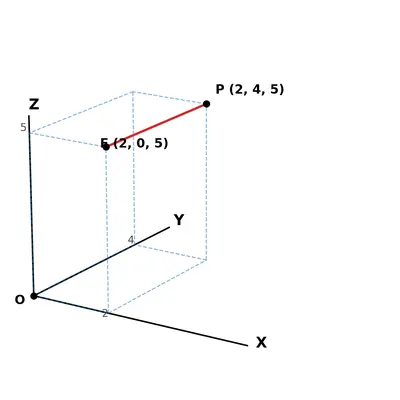
In Fig 11.3, if P is $$(2, 4, 5)$$, find the coordinates of F.
Fig 11.3 — a cuboid drawn in 3D with the Z, X and Y axes and origin O, showing point P located by planes through it parallel to the coordinate planes, with vertices A, B, C, D, E, F marked and edges labelled x, y, z.

Solution

From Fig 11.3, $$F$$ is the foot of the perpendicular dropped from $$P$$ to the $$XZ$$–plane (the plane $$y = 0$$).

Projecting a point onto the $$XZ$$–plane keeps its $$x$$– and $$z$$–coordinates and sets the $$y$$–coordinate to zero, so

$$x_F = x_P = 2, \; y_F = 0, \; z_F = z_P = 5.$$

Therefore, the coordinates of $$F$$ are $$F(2, 0, 5)$$.

Answer

$$F(2,0,5)$$

Example 2 Find the octant in which the points $$(-3, 1, 2)$$ and $$(-3, 1, -2)$$ lie.

Solution

Each octant of three-dimensional space is identified by the signs of the three coordinates $$(x, y, z)$$ of any point lying in it. The eight octants correspond to the sign-combinations below.

OctantSign of $$x$$Sign of $$y$$Sign of $$z$$
I+++
II-++
III--+
IV+-+
V++-
VI-+-
VII---
VIII+--

For the point $$(-3, 1, 2)$$: here $$x = -3 \lt 0$$, $$y = 1 \gt 0$$ and $$z = 2 \gt 0$$, so the sign pattern is $$(-,\, +,\, +)$$. From the table this is octant II.

For the point $$(-3, 1, -2)$$: here $$x = -3 \lt 0$$, $$y = 1 \gt 0$$ and $$z = -2 \lt 0$$, so the sign pattern is $$(-,\, +,\, -)$$. From the table this is octant VI.

Answer

$$(-3, 1, 2)$$ lies in the second octant; $$(-3, 1, -2)$$ lies in the sixth octant.

Example 3 Find the distance between the points $$P(1, -3, 4)$$ and $$Q(-4, 1, 2)$$.

Solution

The distance between two points $$(x_1, y_1, z_1)$$ and $$(x_2, y_2, z_2)$$ in space is given by the distance formula

$$d = \sqrt{(x_2 - x_1)^2 + (y_2 - y_1)^2 + (z_2 - z_1)^2}$$

Here $$P(1, -3, 4)$$ and $$Q(-4, 1, 2)$$, so

$$PQ = \sqrt{(-4 - 1)^2 + (1 - (-3))^2 + (2 - 4)^2}$$

$$PQ = \sqrt{(-5)^2 + (4)^2 + (-2)^2} = \sqrt{25 + 16 + 4}$$

$$PQ = \sqrt{45} = 3\sqrt{5}$$ units.

Answer

$$PQ = \sqrt{45} = 3\sqrt{5}$$ units.

Example 4 Show that the points $$P(-2, 3, 5)$$, $$Q(1, 2, 3)$$ and $$R(7, 0, -1)$$ are collinear.

Solution

Three points are collinear (lie on one straight line) if the sum of the lengths of two of the segments joining them equals the length of the third (the longest) segment.

Using the distance formula for each pair:

$$PQ = \sqrt{(1 - (-2))^2 + (2 - 3)^2 + (3 - 5)^2} = \sqrt{9 + 1 + 4} = \sqrt{14}$$

$$QR = \sqrt{(7 - 1)^2 + (0 - 2)^2 + (-1 - 3)^2} = \sqrt{36 + 4 + 16} = \sqrt{56} = 2\sqrt{14}$$

$$PR = \sqrt{(7 - (-2))^2 + (0 - 3)^2 + (-1 - 5)^2} = \sqrt{81 + 9 + 36} = \sqrt{126} = 3\sqrt{14}$$

Now add the two shorter lengths:

$$PQ + QR = \sqrt{14} + 2\sqrt{14} = 3\sqrt{14} = PR$$

Since $$PQ + QR = PR$$, the points $$P$$, $$Q$$ and $$R$$ are collinear.

Answer

Since $$PQ + QR = PR\ (= 3\sqrt{14})$$, the points are collinear. Proved.

Example 5 Are the points $$A(3, 6, 9)$$, $$B(10, 20, 30)$$ and $$C(25, -41, 5)$$, the vertices of a right angled triangle?

Solution

A triangle is right-angled if (and only if) the square of its longest side equals the sum of the squares of the other two sides (Pythagoras). So compute the squares of the three side lengths.

$$AB^2 = (10 - 3)^2 + (20 - 6)^2 + (30 - 9)^2 = 7^2 + 14^2 + 21^2 = 49 + 196 + 441 = 686$$

$$BC^2 = (25 - 10)^2 + (-41 - 20)^2 + (5 - 30)^2 = 15^2 + (-61)^2 + (-25)^2 = 225 + 3721 + 625 = 4571$$

$$CA^2 = (3 - 25)^2 + (6 - (-41))^2 + (9 - 5)^2 = (-22)^2 + 47^2 + 4^2 = 484 + 2209 + 16 = 2709$$

Test the Pythagoras relation for every possible choice of hypotenuse:

$$AB^2 + CA^2 = 686 + 2709 = 3395 \neq 4571 = BC^2$$

$$AB^2 + BC^2 = 686 + 4571 = 5257 \neq 2709 = CA^2$$

$$BC^2 + CA^2 = 4571 + 2709 = 7280 \neq 686 = AB^2$$

None of the three combinations satisfies the relation, so no angle of the triangle is a right angle.

Answer

No. The points are not the vertices of a right-angled triangle, since for no side does the square of that side equal the sum of the squares of the other two.

Example 6 Find the equation of set of points P such that $$PA^2 + PB^2 = 2k^2$$, where A and B are the points $$(3, 4, 5)$$ and $$(-1, 3, -7)$$, respectively.

Solution

Let $$P(x, y, z)$$ be any point of the required set, with $$A(3, 4, 5)$$ and $$B(-1, 3, -7)$$.

By the distance formula,

$$PA^2 = (x - 3)^2 + (y - 4)^2 + (z - 5)^2$$

$$PB^2 = (x + 1)^2 + (y - 3)^2 + (z + 7)^2$$

Add them, grouping the $$x$$, $$y$$ and $$z$$ terms separately:

$$(x - 3)^2 + (x + 1)^2 = (x^2 - 6x + 9) + (x^2 + 2x + 1) = 2x^2 - 4x + 10$$

$$(y - 4)^2 + (y - 3)^2 = (y^2 - 8y + 16) + (y^2 - 6y + 9) = 2y^2 - 14y + 25$$

$$(z - 5)^2 + (z + 7)^2 = (z^2 - 10z + 25) + (z^2 + 14z + 49) = 2z^2 + 4z + 74$$

Therefore

$$PA^2 + PB^2 = 2x^2 + 2y^2 + 2z^2 - 4x - 14y + 4z + 109$$

The given condition $$PA^2 + PB^2 = 2k^2$$ gives

$$2x^2 + 2y^2 + 2z^2 - 4x - 14y + 4z + 109 = 2k^2$$

$$2x^2 + 2y^2 + 2z^2 - 4x - 14y + 4z = 2k^2 - 109$$

This is the required equation of the set of points; it represents a sphere.

Answer

$$2x^2 + 2y^2 + 2z^2 - 4x - 14y + 4z = 2k^2 - 109$$

Exercise 11.1

1 A point is on the $$x$$-axis. What are its $$y$$-coordinate and $$z$$-coordinates?

Solution

The $$x$$-axis is the line common to the XY-plane and the XZ-plane — every point on the $$x$$-axis lies in both of these planes.

A point lying in the XY-plane has its $$z$$-coordinate equal to $$0$$, and a point lying in the XZ-plane has its $$y$$-coordinate equal to $$0$$.

Since a point on the $$x$$-axis lies in both planes simultaneously, it must satisfy both conditions. Hence its $$y$$-coordinate and $$z$$-coordinate are both zero; such a point is of the form $$(x, 0, 0)$$.

Answer

Both the $$y$$-coordinate and the $$z$$-coordinate are $$0$$.

2 A point is in the XZ-plane. What can you say about its $$y$$-coordinate?

Solution

The XZ-plane is the plane containing the $$x$$-axis and the $$z$$-axis. It consists of exactly those points whose displacement measured along the $$y$$-direction is zero.

Therefore every point lying in the XZ-plane has its $$y$$-coordinate equal to zero, and the point is of the form $$(x, 0, z)$$.

Answer

Its $$y$$-coordinate is $$0$$.

3 Name the octants in which the following points lie:
$$(1, 2, 3)$$, $$(4, -2, 3)$$, $$(4, -2, -5)$$, $$(4, 2, -5)$$, $$(-4, 2, -5)$$, $$(-4, 2, 5)$$, $$(-3, -1, 6)$$, $$(-2, -4, -7)$$.

Solution

The octant in which a point lies is fixed by the signs of its coordinates $$(x, y, z)$$. The standard correspondence is: I $$(+,+,+)$$, II $$(-,+,+)$$, III $$(-,-,+)$$, IV $$(+,-,+)$$, V $$(+,+,-)$$, VI $$(-,+,-)$$, VII $$(-,-,-)$$, VIII $$(+,-,-)$$.

Reading the sign pattern of each given point:

PointSigns $$(x, y, z)$$Octant
$$(1, 2, 3)$$$$(+, +, +)$$I (XOYZ)
$$(4, -2, 3)$$$$(+, -, +)$$IV (XOY'Z)
$$(4, -2, -5)$$$$(+, -, -)$$VIII (XOY'Z')
$$(4, 2, -5)$$$$(+, +, -)$$V (XOYZ')
$$(-4, 2, -5)$$$$(-, +, -)$$VI (X'OYZ')
$$(-4, 2, 5)$$$$(-, +, +)$$II (X'OYZ)
$$(-3, -1, 6)$$$$(-, -, +)$$III (X'OY'Z)
$$(-2, -4, -7)$$$$(-, -, -)$$VII (X'OY'Z')

Answer

$$(1, 2, 3)$$: octant I;   $$(4, -2, 3)$$: octant IV;   $$(4, -2, -5)$$: octant VIII;   $$(4, 2, -5)$$: octant V;   $$(-4, 2, -5)$$: octant VI;   $$(-4, 2, 5)$$: octant II;   $$(-3, -1, 6)$$: octant III;   $$(-2, -4, -7)$$: octant VII.

4 Fill in the blanks:

(i) The $$x$$-axis and $$y$$-axis taken together determine a plane known as _______.

Solution

A coordinate plane is named after the two axes that lie in it. The $$x$$-axis and the $$y$$-axis are two intersecting lines, and two intersecting lines determine a unique plane. This plane contains all points whose $$z$$-coordinate is $$0$$, and it is called the XY-plane.

Answer

the XY-plane

(ii) The coordinates of points in the XY-plane are of the form _______.

Solution

A point lies in the XY-plane exactly when it has no displacement along the $$z$$-direction, i.e. its $$z$$-coordinate is $$0$$. The $$x$$- and $$y$$-coordinates may be any real numbers.

Hence every point of the XY-plane is of the form $$(x, y, 0)$$.

Answer

$$(x, y, 0)$$

(iii) Coordinate planes divide the space into ______ octants.

Solution

The three mutually perpendicular coordinate planes — the XY-plane, the YZ-plane and the ZX-plane — cut space into regions. In each region every coordinate keeps a fixed sign, and each of the three coordinates can independently be positive or negative, giving $$2 \times 2 \times 2 = 8$$ regions.

Hence the coordinate planes divide space into eight octants.

Answer

eight ($$8$$)

Exercise 11.2

1 Find the distance between the following pairs of points:

(i) $$(2, 3, 5)$$ and $$(4, 3, 1)$$

Solution

Using the distance formula $$d = \sqrt{(x_2 - x_1)^2 + (y_2 - y_1)^2 + (z_2 - z_1)^2}$$ with the points $$(2, 3, 5)$$ and $$(4, 3, 1)$$:

$$d = \sqrt{(4 - 2)^2 + (3 - 3)^2 + (1 - 5)^2}$$

$$d = \sqrt{2^2 + 0^2 + (-4)^2} = \sqrt{4 + 0 + 16}$$

$$d = \sqrt{20} = 2\sqrt{5}$$ units.

Answer

$$\sqrt{20} = 2\sqrt{5}$$ units

(ii) $$(-3, 7, 2)$$ and $$(2, 4, -1)$$

Solution

Using the distance formula $$d = \sqrt{(x_2 - x_1)^2 + (y_2 - y_1)^2 + (z_2 - z_1)^2}$$ with the points $$(-3, 7, 2)$$ and $$(2, 4, -1)$$:

$$d = \sqrt{(2 - (-3))^2 + (4 - 7)^2 + (-1 - 2)^2}$$

$$d = \sqrt{5^2 + (-3)^2 + (-3)^2} = \sqrt{25 + 9 + 9}$$

$$d = \sqrt{43}$$ units.

Answer

$$\sqrt{43}$$ units

(iii) $$(-1, 3, -4)$$ and $$(1, -3, 4)$$

Solution

Using the distance formula $$d = \sqrt{(x_2 - x_1)^2 + (y_2 - y_1)^2 + (z_2 - z_1)^2}$$ with the points $$(-1, 3, -4)$$ and $$(1, -3, 4)$$:

$$d = \sqrt{(1 - (-1))^2 + (-3 - 3)^2 + (4 - (-4))^2}$$

$$d = \sqrt{2^2 + (-6)^2 + 8^2} = \sqrt{4 + 36 + 64}$$

$$d = \sqrt{104} = 2\sqrt{26}$$ units.

Answer

$$\sqrt{104} = 2\sqrt{26}$$ units

(iv) $$(2, -1, 3)$$ and $$(-2, 1, 3)$$.

Solution

Using the distance formula $$d = \sqrt{(x_2 - x_1)^2 + (y_2 - y_1)^2 + (z_2 - z_1)^2}$$ with the points $$(2, -1, 3)$$ and $$(-2, 1, 3)$$:

$$d = \sqrt{(-2 - 2)^2 + (1 - (-1))^2 + (3 - 3)^2}$$

$$d = \sqrt{(-4)^2 + 2^2 + 0^2} = \sqrt{16 + 4 + 0}$$

$$d = \sqrt{20} = 2\sqrt{5}$$ units.

Answer

$$\sqrt{20} = 2\sqrt{5}$$ units

2 Show that the points $$(-2, 3, 5)$$, $$(1, 2, 3)$$ and $$(7, 0, -1)$$ are collinear.

Solution

Label the points $$A(-2, 3, 5)$$, $$B(1, 2, 3)$$ and $$C(7, 0, -1)$$. Three points are collinear if the sum of the lengths of two of the segments joining them equals the length of the third (the longest) segment.

Apply the distance formula to each pair:

$$AB = \sqrt{(1 - (-2))^2 + (2 - 3)^2 + (3 - 5)^2} = \sqrt{9 + 1 + 4} = \sqrt{14}$$

$$BC = \sqrt{(7 - 1)^2 + (0 - 2)^2 + (-1 - 3)^2} = \sqrt{36 + 4 + 16} = \sqrt{56} = 2\sqrt{14}$$

$$AC = \sqrt{(7 - (-2))^2 + (0 - 3)^2 + (-1 - 5)^2} = \sqrt{81 + 9 + 36} = \sqrt{126} = 3\sqrt{14}$$

Now

$$AB + BC = \sqrt{14} + 2\sqrt{14} = 3\sqrt{14} = AC$$

Since $$AB + BC = AC$$, the three points $$A$$, $$B$$ and $$C$$ are collinear.

Answer

Since $$AB + BC = AC\ (= 3\sqrt{14})$$, the points are collinear. Proved.

3 Verify the following:

(i) $$(0, 7, -10)$$, $$(1, 6, -6)$$ and $$(4, 9, -6)$$ are the vertices of an isosceles triangle.

Solution

Label the points $$A(0, 7, -10)$$, $$B(1, 6, -6)$$ and $$C(4, 9, -6)$$. A triangle is isosceles if at least two of its sides are equal in length.

$$AB = \sqrt{(1 - 0)^2 + (6 - 7)^2 + (-6 - (-10))^2} = \sqrt{1 + 1 + 16} = \sqrt{18} = 3\sqrt{2}$$

$$BC = \sqrt{(4 - 1)^2 + (9 - 6)^2 + (-6 - (-6))^2} = \sqrt{9 + 9 + 0} = \sqrt{18} = 3\sqrt{2}$$

$$CA = \sqrt{(0 - 4)^2 + (7 - 9)^2 + (-10 - (-6))^2} = \sqrt{16 + 4 + 16} = \sqrt{36} = 6$$

Here $$AB = BC = 3\sqrt{2}$$, so two sides of the triangle are equal. Hence the three points form an isosceles triangle.

Answer

Since $$AB = BC = 3\sqrt{2}$$, the triangle is isosceles. Verified.

(ii) $$(0, 7, 10)$$, $$(-1, 6, 6)$$ and $$(-4, 9, 6)$$ are the vertices of a right angled triangle.

Solution

Label the points $$A(0, 7, 10)$$, $$B(-1, 6, 6)$$ and $$C(-4, 9, 6)$$. Compute the squares of the three side lengths.

$$AB^2 = (-1 - 0)^2 + (6 - 7)^2 + (6 - 10)^2 = 1 + 1 + 16 = 18$$

$$BC^2 = (-4 - (-1))^2 + (9 - 6)^2 + (6 - 6)^2 = 9 + 9 + 0 = 18$$

$$CA^2 = (0 - (-4))^2 + (7 - 9)^2 + (10 - 6)^2 = 16 + 4 + 16 = 36$$

The longest side is $$CA$$. Test the Pythagoras relation:

$$AB^2 + BC^2 = 18 + 18 = 36 = CA^2$$

Since $$AB^2 + BC^2 = CA^2$$, the triangle satisfies the converse of the Pythagoras theorem and is therefore right-angled (the right angle being at $$B$$).

Answer

Since $$AB^2 + BC^2 = CA^2\ (18 + 18 = 36)$$, the triangle is right-angled at $$B$$. Verified.

(iii) $$(-1, 2, 1)$$, $$(1, -2, 5)$$, $$(4, -7, 8)$$ and $$(2, -3, 4)$$ are the vertices of a parallelogram.

Solution

Label the points, taken in order, as $$A(-1, 2, 1)$$, $$B(1, -2, 5)$$, $$C(4, -7, 8)$$ and $$D(2, -3, 4)$$. A quadrilateral $$ABCD$$ is a parallelogram if both pairs of opposite sides are equal in length.

$$AB = \sqrt{(1 - (-1))^2 + (-2 - 2)^2 + (5 - 1)^2} = \sqrt{4 + 16 + 16} = \sqrt{36} = 6$$

$$BC = \sqrt{(4 - 1)^2 + (-7 - (-2))^2 + (8 - 5)^2} = \sqrt{9 + 25 + 9} = \sqrt{43}$$

$$CD = \sqrt{(2 - 4)^2 + (-3 - (-7))^2 + (4 - 8)^2} = \sqrt{4 + 16 + 16} = \sqrt{36} = 6$$

$$DA = \sqrt{(-1 - 2)^2 + (2 - (-3))^2 + (1 - 4)^2} = \sqrt{9 + 25 + 9} = \sqrt{43}$$

Here $$AB = CD = 6$$ and $$BC = DA = \sqrt{43}$$, so both pairs of opposite sides are equal. Hence $$ABCD$$ is a parallelogram.

(For confirmation, the diagonals are $$AC = \sqrt{25 + 81 + 49} = \sqrt{155}$$ and $$BD = \sqrt{1 + 1 + 1} = \sqrt{3}$$. Since $$AC \neq BD$$, the figure is a parallelogram but not a rectangle.)

Answer

Since $$AB = CD$$ and $$BC = DA$$, the points are the vertices of a parallelogram. Verified.

4 Find the equation of the set of points which are equidistant from the points $$(1, 2, 3)$$ and $$(3, 2, -1)$$.

Solution

Let $$P(x, y, z)$$ be a point of the required set, and let $$A(1, 2, 3)$$ and $$B(3, 2, -1)$$. “Equidistant” means $$PA = PB$$, so $$PA^2 = PB^2$$.

$$(x - 1)^2 + (y - 2)^2 + (z - 3)^2 = (x - 3)^2 + (y - 2)^2 + (z + 1)^2$$

Expand both sides:

$$x^2 - 2x + 1 + y^2 - 4y + 4 + z^2 - 6z + 9 = x^2 - 6x + 9 + y^2 - 4y + 4 + z^2 + 2z + 1$$

Cancel the terms common to both sides ($$x^2$$, $$y^2$$, $$z^2$$, $$-4y$$ and $$+4$$):

$$-2x + 1 - 6z + 9 = -6x + 9 + 2z + 1$$

$$-2x - 6z + 10 = -6x + 2z + 10$$

$$-2x - 6z = -6x + 2z$$

Collect like terms:

$$6x - 2x = 2z + 6z \quad\Rightarrow\quad 4x = 8z$$

$$x - 2z = 0$$

This is the required equation of the set of points; it represents a plane.

Answer

$$x - 2z = 0$$

5 Find the equation of the set of points P, the sum of whose distances from $$A(4, 0, 0)$$ and $$B(-4, 0, 0)$$ is equal to $$10$$.

Solution

Let $$P(x, y, z)$$ be a point of the set, with $$A(4, 0, 0)$$ and $$B(-4, 0, 0)$$. The given condition is $$PA + PB = 10$$, i.e.

$$\sqrt{(x - 4)^2 + y^2 + z^2} + \sqrt{(x + 4)^2 + y^2 + z^2} = 10$$

Move one radical to the right side:

$$\sqrt{(x - 4)^2 + y^2 + z^2} = 10 - \sqrt{(x + 4)^2 + y^2 + z^2}$$

Square both sides:

$$(x - 4)^2 + y^2 + z^2 = 100 - 20\sqrt{(x + 4)^2 + y^2 + z^2} + (x + 4)^2 + y^2 + z^2$$

Since $$(x - 4)^2 - (x + 4)^2 = -16x$$, cancelling $$y^2$$ and $$z^2$$ gives

$$-16x = 100 - 20\sqrt{(x + 4)^2 + y^2 + z^2}$$

$$20\sqrt{(x + 4)^2 + y^2 + z^2} = 100 + 16x$$

Divide by $$4$$:

$$5\sqrt{(x + 4)^2 + y^2 + z^2} = 25 + 4x$$

Square both sides again:

$$25\left[(x + 4)^2 + y^2 + z^2\right] = (25 + 4x)^2$$

$$25x^2 + 200x + 400 + 25y^2 + 25z^2 = 625 + 200x + 16x^2$$

Bring all terms to one side and simplify:

$$25x^2 - 16x^2 + 25y^2 + 25z^2 + 400 - 625 = 0$$

$$9x^2 + 25y^2 + 25z^2 - 225 = 0$$

This is the required equation of the set of points.

Answer

$$9x^2 + 25y^2 + 25z^2 - 225 = 0$$

Miscellaneous Examples

Example 7 Show that the points $$A(1, 2, 3)$$, $$B(-1, -2, -1)$$, $$C(2, 3, 2)$$ and $$D(4, 7, 6)$$ are the vertices of a parallelogram ABCD, but it is not a rectangle.

Solution

To prove $$ABCD$$ is a parallelogram, show that both pairs of opposite sides are equal. To prove it is not a rectangle, show that its diagonals are unequal (a rectangle must have equal diagonals).

Side lengths:

$$AB = \sqrt{(-1 - 1)^2 + (-2 - 2)^2 + (-1 - 3)^2} = \sqrt{4 + 16 + 16} = \sqrt{36} = 6$$

$$BC = \sqrt{(2 - (-1))^2 + (3 - (-2))^2 + (2 - (-1))^2} = \sqrt{9 + 25 + 9} = \sqrt{43}$$

$$CD = \sqrt{(4 - 2)^2 + (7 - 3)^2 + (6 - 2)^2} = \sqrt{4 + 16 + 16} = \sqrt{36} = 6$$

$$DA = \sqrt{(1 - 4)^2 + (2 - 7)^2 + (3 - 6)^2} = \sqrt{9 + 25 + 9} = \sqrt{43}$$

Since $$AB = CD = 6$$ and $$BC = DA = \sqrt{43}$$, both pairs of opposite sides are equal, so $$ABCD$$ is a parallelogram.

Diagonals:

$$AC = \sqrt{(2 - 1)^2 + (3 - 2)^2 + (2 - 3)^2} = \sqrt{1 + 1 + 1} = \sqrt{3}$$

$$BD = \sqrt{(4 - (-1))^2 + (7 - (-2))^2 + (6 - (-1))^2} = \sqrt{25 + 81 + 49} = \sqrt{155}$$

Since $$AC = \sqrt{3} \neq \sqrt{155} = BD$$, the diagonals are unequal. Therefore $$ABCD$$ is a parallelogram but not a rectangle.

Answer

$$AB = CD$$ and $$BC = DA$$, so $$ABCD$$ is a parallelogram; but $$AC = \sqrt{3} \neq \sqrt{155} = BD$$, so it is not a rectangle. Proved.

Example 8 Find the equation of the set of the points P such that its distances from the points $$A(3, 4, -5)$$ and $$B(-2, 1, 4)$$ are equal.

Solution

Let $$P(x, y, z)$$ be a point of the required set. Its distances from $$A(3, 4, -5)$$ and $$B(-2, 1, 4)$$ are equal, so $$PA = PB$$, hence $$PA^2 = PB^2$$.

$$(x - 3)^2 + (y - 4)^2 + (z + 5)^2 = (x + 2)^2 + (y - 1)^2 + (z - 4)^2$$

Expand both sides:

$$x^2 - 6x + 9 + y^2 - 8y + 16 + z^2 + 10z + 25 = x^2 + 4x + 4 + y^2 - 2y + 1 + z^2 - 8z + 16$$

Cancel $$x^2$$, $$y^2$$ and $$z^2$$ from both sides, and collect the constants:

$$-6x - 8y + 10z + 50 = 4x - 2y - 8z + 21$$

Bring every term to one side:

$$0 = (4x + 6x) + (-2y + 8y) + (-8z - 10z) + (21 - 50)$$

$$10x + 6y - 18z - 29 = 0$$

This is the required equation of the set of points; it represents a plane (the perpendicular bisector plane of segment $$AB$$).

Answer

$$10x + 6y - 18z - 29 = 0$$

Example 9 The centroid of a triangle ABC is at the point $$(1, 1, 1)$$. If the coordinates of A and B are $$(3, -5, 7)$$ and $$(-1, 7, -6)$$, respectively, find the coordinates of the point C.

Solution

Let the coordinates of $$C$$ be $$(x, y, z)$$. The centroid $$G$$ of a triangle with vertices $$A$$, $$B$$ and $$C$$ is the average of their coordinates:

$$G = \left(\frac{x_A + x_B + x_C}{3},\ \frac{y_A + y_B + y_C}{3},\ \frac{z_A + z_B + z_C}{3}\right)$$

Here $$A(3, -5, 7)$$, $$B(-1, 7, -6)$$ and $$G(1, 1, 1)$$. Equating each coordinate of the centroid to $$1$$:

$$\frac{3 + (-1) + x}{3} = 1 \;\Rightarrow\; 2 + x = 3 \;\Rightarrow\; x = 1$$

$$\frac{-5 + 7 + y}{3} = 1 \;\Rightarrow\; 2 + y = 3 \;\Rightarrow\; y = 1$$

$$\frac{7 + (-6) + z}{3} = 1 \;\Rightarrow\; 1 + z = 3 \;\Rightarrow\; z = 2$$

Hence the coordinates of $$C$$ are $$(1, 1, 2)$$.

Answer

$$C = (1, 1, 2)$$

Miscellaneous Exercise on Chapter 11

1 Three vertices of a parallelogram ABCD are $$A(3, -1, 2)$$, $$B(1, 2, -4)$$ and $$C(-1, 1, 2)$$. Find the coordinates of the fourth vertex.

Solution

Let the fourth vertex be $$D(x, y, z)$$. In a parallelogram the diagonals bisect each other, so the midpoint of diagonal $$AC$$ must coincide with the midpoint of diagonal $$BD$$.

Midpoint of $$AC$$, with $$A(3, -1, 2)$$ and $$C(-1, 1, 2)$$:

$$\left(\frac{3 + (-1)}{2},\ \frac{-1 + 1}{2},\ \frac{2 + 2}{2}\right) = (1,\ 0,\ 2)$$

Midpoint of $$BD$$, with $$B(1, 2, -4)$$ and $$D(x, y, z)$$:

$$\left(\frac{1 + x}{2},\ \frac{2 + y}{2},\ \frac{-4 + z}{2}\right)$$

Equate the two midpoints coordinate by coordinate:

$$\frac{1 + x}{2} = 1 \;\Rightarrow\; 1 + x = 2 \;\Rightarrow\; x = 1$$

$$\frac{2 + y}{2} = 0 \;\Rightarrow\; 2 + y = 0 \;\Rightarrow\; y = -2$$

$$\frac{-4 + z}{2} = 2 \;\Rightarrow\; -4 + z = 4 \;\Rightarrow\; z = 8$$

Hence the fourth vertex is $$D(1, -2, 8)$$.

Answer

$$D = (1, -2, 8)$$

2 Find the lengths of the medians of the triangle with vertices $$A(0, 0, 6)$$, $$B(0, 4, 0)$$ and $$(6, 0, 0)$$.

Solution

Let the vertices be $$A(0, 0, 6)$$, $$B(0, 4, 0)$$ and $$C(6, 0, 0)$$. A median joins a vertex to the midpoint of the opposite side, so first find the midpoints, then use the distance formula.

Median $$AD$$ (from $$A$$ to the midpoint $$D$$ of $$BC$$):

$$D = \left(\frac{0 + 6}{2},\ \frac{4 + 0}{2},\ \frac{0 + 0}{2}\right) = (3, 2, 0)$$

$$AD = \sqrt{(3 - 0)^2 + (2 - 0)^2 + (0 - 6)^2} = \sqrt{9 + 4 + 36} = \sqrt{49} = 7$$

Median $$BE$$ (from $$B$$ to the midpoint $$E$$ of $$AC$$):

$$E = \left(\frac{0 + 6}{2},\ \frac{0 + 0}{2},\ \frac{6 + 0}{2}\right) = (3, 0, 3)$$

$$BE = \sqrt{(3 - 0)^2 + (0 - 4)^2 + (3 - 0)^2} = \sqrt{9 + 16 + 9} = \sqrt{34}$$

Median $$CF$$ (from $$C$$ to the midpoint $$F$$ of $$AB$$):

$$F = \left(\frac{0 + 0}{2},\ \frac{0 + 4}{2},\ \frac{6 + 0}{2}\right) = (0, 2, 3)$$

$$CF = \sqrt{(0 - 6)^2 + (2 - 0)^2 + (3 - 0)^2} = \sqrt{36 + 4 + 9} = \sqrt{49} = 7$$

Hence the lengths of the three medians are $$7$$, $$\sqrt{34}$$ and $$7$$ units.

Answer

The medians have lengths $$7$$, $$\sqrt{34}$$ and $$7$$ units.

3 If the origin is the centroid of the triangle PQR with vertices $$P(2a, 2, 6)$$, $$Q(-4, 3b, -10)$$ and $$R(8, 14, 2c)$$, then find the values of $$a$$, $$b$$ and $$c$$.

Solution

The centroid of triangle $$PQR$$ is the average of the coordinates of its vertices:

$$\left(\frac{x_P + x_Q + x_R}{3},\ \frac{y_P + y_Q + y_R}{3},\ \frac{z_P + z_Q + z_R}{3}\right)$$

It is given that this centroid is the origin $$(0, 0, 0)$$, so each coordinate of the centroid equals $$0$$.

From the $$x$$-coordinate:

$$\frac{2a + (-4) + 8}{3} = 0 \;\Rightarrow\; 2a + 4 = 0 \;\Rightarrow\; a = -2$$

From the $$y$$-coordinate:

$$\frac{2 + 3b + 14}{3} = 0 \;\Rightarrow\; 3b + 16 = 0 \;\Rightarrow\; b = -\frac{16}{3}$$

From the $$z$$-coordinate:

$$\frac{6 + (-10) + 2c}{3} = 0 \;\Rightarrow\; 2c - 4 = 0 \;\Rightarrow\; c = 2$$

Hence $$a = -2$$, $$b = -\dfrac{16}{3}$$ and $$c = 2$$.

Answer

$$a = -2,\quad b = -\dfrac{16}{3},\quad c = 2$$

4 If A and B be the points $$(3, 4, 5)$$ and $$(-1, 3, -7)$$, respectively, find the equation of the set of points P such that $$PA^2 + PB^2 = k^2$$, where $$k$$ is a constant.

Solution

Let $$P(x, y, z)$$ be any point of the required set, with $$A(3, 4, 5)$$ and $$B(-1, 3, -7)$$.

By the distance formula,

$$PA^2 = (x - 3)^2 + (y - 4)^2 + (z - 5)^2$$

$$PB^2 = (x + 1)^2 + (y - 3)^2 + (z + 7)^2$$

Add them, grouping the $$x$$, $$y$$ and $$z$$ terms separately:

$$(x - 3)^2 + (x + 1)^2 = (x^2 - 6x + 9) + (x^2 + 2x + 1) = 2x^2 - 4x + 10$$

$$(y - 4)^2 + (y - 3)^2 = (y^2 - 8y + 16) + (y^2 - 6y + 9) = 2y^2 - 14y + 25$$

$$(z - 5)^2 + (z + 7)^2 = (z^2 - 10z + 25) + (z^2 + 14z + 49) = 2z^2 + 4z + 74$$

So

$$PA^2 + PB^2 = 2x^2 + 2y^2 + 2z^2 - 4x - 14y + 4z + 109$$

The given condition $$PA^2 + PB^2 = k^2$$ yields

$$2x^2 + 2y^2 + 2z^2 - 4x - 14y + 4z + 109 = k^2$$

$$2x^2 + 2y^2 + 2z^2 - 4x - 14y + 4z - k^2 + 109 = 0$$

This is the required equation of the set of points; it represents a sphere.

Answer

$$2x^2 + 2y^2 + 2z^2 - 4x - 14y + 4z - k^2 + 109 = 0$$

NCERT Solutions for Class 11
Maths
NCERT Solutions for Class 11 Maths
Chapter-wise step-by-step
solutions with explanations
explore solutions Maths bg
Physics
NCERT Solutions for Class 11 Physics
Chapter-wise step-by-step
solutions with explanations
explore solutions Physics bg
Chemistry
NCERT Solutions for Class 11 Chemistry
Chapter-wise step-by-step
solutions with explanations
explore solutions Chemistry bg

Frequently Asked Questions

50,000+ JEE Students Trusted Our Score Calculator

Predict your JEE Main percentile, rank & performance in seconds