The length of a rectangle is twice its breadth. If the length of the rectangle is increased by 20% and its breath is decreased by 40% then what will be the percentage change in the area of the rectangle?
- Home
- >
- MAH MBA CET Questions
- >
- Geometry
MAH MBA CET Geometry Questions
Let the breadth of the rectangle be ‘x’. So its length would be 2x.
Thus the area of the rectangle would be $$2x^{2}$$
Now the new length would be 2.4x and new breadth would be .6x
Hence the new area would be $$2.4x*.6x = 1.44x^{2}$$.
Hence we can see that the area has got reduced.
Percentage reduction = $$\frac{56}{200}*100 = 28\%$$
Hence the correct answer is option D.
If the height of a triangle is increased by 10% and base is decreased by 10%, then its area would be 198 sq-cm. What was the original area?
Let the base and height be b and h respectively. Hence, the original area is = 1/2*b*h. After changing the base and height, area= 1/2 * (0.9b) * (1.1h) = 0.99 (1/2*b*h) = 198 sq-cm
Hence, (1/2*b*h) = 198/0.99 = 200 sq-cm
A rectangular plot has a perimeter of 68m. The ratio of the side and the diagonal is 5 : 13. Find the area of the plot (in sq. m).
Given, the diagonal is 13x and the side is 5x.
Let the other side be b.
$$(13x)^2 = (5x)^2 + b^2$$
b = 12x
68 = 2 (12x + 5x)
x = 2m
Hence, the sides are 10m and 24m
Area = 240 sq. m
A metallic sphere of radius 6 cm is melted down and re casted into three metallic spheres of equal radii. Find the radius of the spheres formed.
Volume of the initial sphere = $$\frac{4}{3}*\pi *r^3$$ = $$\frac{4}{3}*\pi *6^3$$
Volume of each of the smaller spheres = $$\frac{4}{3}*\pi *r^3$$
==> 3*$$\frac{4}{3}*\pi *r^3$$ = $$\frac{4}{3}*\pi *6^3$$ ==> $$r^3 = 6^3/3$$ ==> $$r^3 = 72$$ ==> $$r = 2*\sqrt[3]{9}$$
So the correct option to choose is E.
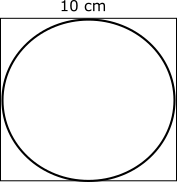
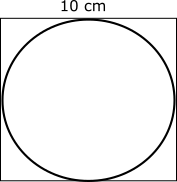
A circular area is carved out of the square sheet of side 10 cm as shown in the figure. What is the area of the sheet that remains after the circle has been carved out?
The area of square = 10*10 = 100$$cm^2$$
Now the side of the square is equal to the diameter of the square.
Hence the diameter of the circle is 10cm
So the radius of the circle will be 5 cm.
Hence the area of the circle = $$\pi*r^2$$ = $$\pi*5^2$$ = 78.5$$cm^2$$
Thus, the remaining area = 100 - 78.5 = 21.5 $$cm^2$$
In a triangle ABC, AD is the bisector of angle A If AC = 4.2 cm , DC = 6 cm, BC =10 cm , then find AB ?
We can use the Angle Bisector Theorem:
In triangle ABC, if AD bisects ∠A, then $$\dfrac{AB}{AC}=\dfrac{BD}{DC}$$
We know: BC=10 and DC=6
So, BD = BC − DC = 10 − 6 = 4
Applying the theorem
$$\dfrac{AB}{AC}=\dfrac{BD}{DC}$$
Given
AC=4.2, so:$$AB=\dfrac{2}{3}\times4.2=2.8\ cm$$
A copper wire having a length of 243 m and a diameter of 4 mm was melted to form a sphere. Find the diameter of the sphere thus formed.
Volume remains conserved during melting.
Volume before melting = Volume after melting
Before melting, the wire was in cylindrical shape and after melting, it became sphere.
So, Vol. before = $$\pi r^2l$$ = Vol. after = $$\ \frac{\ 4}{3}\pi\ R^3$$, where R is the radius of sphere formed.
$$\left(2\times\ 10^{-3}\right)^2\times\ 243\ =\ \frac{\ 4}{3}R^3$$
$$R^3=729\times\ 10^{-6}$$
R=9cm.
So, diameter of the sphere = 18cm.
Option C is the answer.
Let A and B be two solid spheres such that the surface area of B is 300% higher than the surface area of A. The volume of A is found to be k% lower than the volume of B. Determine the value of k.
Let the radius of sphere A be 'r' and sphere B be 'R'
Surface area of A = $$4\pi r^2$$
Surface area of B = $$4\pi R^2$$ = (1+300%) of A = 4 * $$4\pi r^2$$
R=2r
Volume of A = $$\frac{4}{3}\pi r^3$$
Volume of B = $$\frac{4}{3}\pi R^3\ =\ \ \frac{\ 4}{3}\pi\ \left(2r\right)^3\ =\ \ \frac{\ 32}{3}\pi\ r^3$$
Required percent = $$\ \frac{\ \left(\frac{32}{3}\pi\ r^3\ -\ \frac{4}{3}\pi\ r^3\right)}{\ \frac{32}{3}\pi\ r^3}\times\ 100\ =87.5\ \%\ $$
Option C is the answer.
How many isosceles triangles with integer sides are possible such that sum of two of the side is 12 ?
Let the sides of the isosceles triangle be (a, a, b), where a and b are integers.
Case 1: The sum of the two equal sides is 12
a + a = 12 ⇒ a = 6
a + a = 12 ⇒ a = 6
Triangle inequality: 6 + 6 > b ⇒ b < 12
Also b > 0 and integer.
So, b = 1, 2, 3, …, 11
So, Total = 11 triangles
Case 2: One equal side + base = 12
a + b = 12 ⇒ b = 12 − a
Triangle inequality: a + a > b ⇒ 2a > 12 − a ⇒ 3a > 12 ⇒ a > 4
Also: b > 0 ⇒ 12 − a > 0 ⇒ a < 12
So, a = 5,6,7,8,9,10,11
Hence, Total = 7 triangles
But when a=6, the triangle is (6,6,6), which was already counted in Case 1. So subtract 1 duplicate.
So final count: 11 + 7 - 1 = 17
A rectangular swimming pool has a length of 12 m, a width of 6 m, and a depth of 2 m. The pool is to be painted (bottom floor and the four walls). If the cost of painting per square meter is Rs. 25, what would be the total cost incurred in painting the pool?
The bottom part of the pool has a length of 12 m and the width of 6 m . So the area of the bottom ground = 12*6 = 72 m square.
Now, the pool has 2 opposite rectangular walls with the length of 12 m and the depth/width = 2 m so the area = 2*12*2 = 48 m square.
Further, it has another 2 opposite rectangular walls with length of 6 m and depth/width of 2 m so the area = 2*6*2 = 24 m square.
So, the total area to be painted = 72 + 48 + 24 = 144 m square.
Cost of painting = 144*25 = Rs. 3600
Find the internal angle of a polygon with 35 diagonals.
Number of diagonals can be found by using: $$^nC_2-n$$
$$\frac{n\left(n-1\right)}{2}-n=35$$
$$n^2-3n-70=0$$
$$\left(n-10\right)\left(n+7\right)$$
N cannot be negative so n=10
Internal angle can be calculated using,
$$\frac{180\left(n-2\right)}{n}=\frac{180\left(8\right)}{10}=144$$
Hence the answer is 144.
What would be the area of a triangle formed by the medians of an equilateral triangle that has a side length of 12 cm?
The area of a triangle formed by the medians of an equilateral triangle would be (3/4) of the area of the original triangle.
The area of the original equilateral triangle can be calculated using the formula $$\frac{\sqrt{\ 3}}{4}a^2$$, where $$a$$ is the side length, giving the area of the original equilateral triangle to be $$\frac{\sqrt{\ 3}}{4}\times\ 12\times\ 12$$
This would give the area of the triangle formed by the medians to be $$\frac{\sqrt{\ 3}}{4}\times\ 12\times\ 12\times\ \frac{3}{4}=27\sqrt{\ 3}cm^2$$
Therefore, Option C is the correct answer.
If the height of a right circular cone is increased by 200% and the radius of the base is reduced by 50%, then volume of the cone shall :
Volume of cone = $$\ \frac{\ 1}{3}\pi\ r^2h$$
Let initial height be 'h' and radius be 'r' of the cone.
So, Initial volume = $$\ \frac{\ 1}{3}\pi\ r^2h$$
New height H = h(1+200%) = h(1+$$\ \frac{\ 200}{100}$$) = 3h
New radius R = r(1-50%) = r(1-0.5) = $$\ \frac{\ r}{2}$$
New volume = $$\ \ \frac{\ 1}{3}\pi\ \times\ \left(\frac{r}{2}\right)^2\times\ 3h$$ = $$\ \frac{\ \pi\ r^2h}{4}$$
Change in volume = $$\frac{\left(\frac{\ \pi\ r^2h}{4}-\frac{\ \pi\ r^2h}{3}\right)}{\ \frac{\ \pi\ r^2h}{3}}\times\ 100$$ = -25%
So, volume decreased by 25%.
Option B is the answer.
The dimensions length, breadth and height of a wooden plank are in the ratio 4:5:7, and its surface area is 20086 square meters. Find the length of the plank.
Let the common factor be K
∴ Length = 4K ; Breadth = 5K and Height = 7K
Tip:
Total Surface area of cuboid = 2(LB + BH + LH)
L = Length; B = Breadth/width; H = Height
Whole surface area of the rectangular plank = 2(4K x 5K + 5K x 7K + 7K x 4K)
∴ 20086 = 83*2*K^2
∴ K = 11
∴ Length = 4K = 44 sq.m
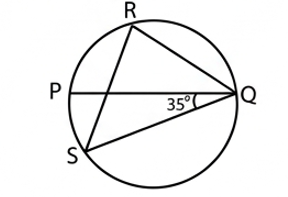
If the Angle PQS is 35$$^{\circ}$$, determine the Angle QRS :