JEE WhatsApp Group



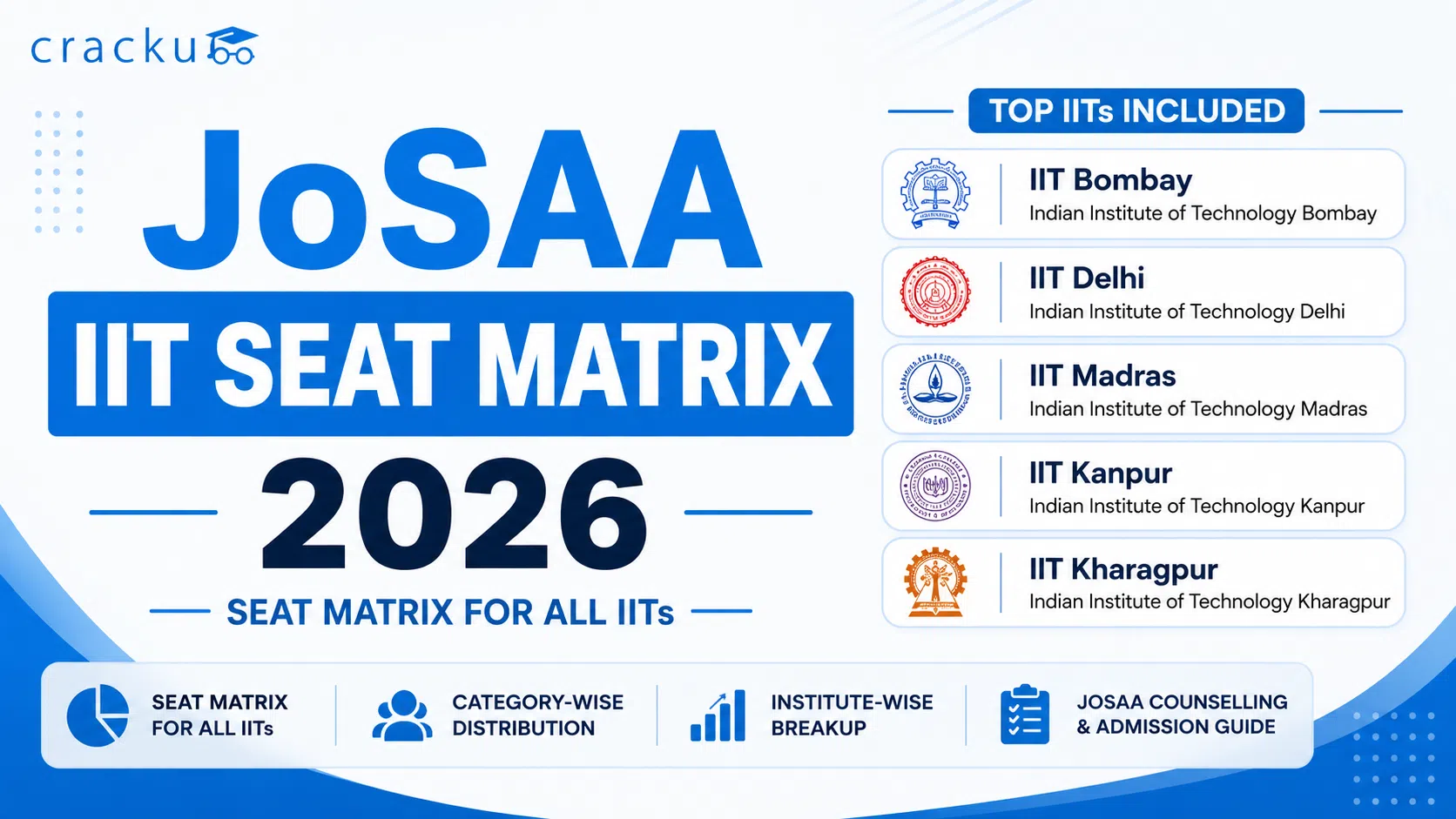
JoSAA Seat Matrix 2026
The Joint Seat Allocation Authority (JoSAA) releases the official seat matrix on its official site after JEE Advanced results are announced each year. The JoSAA IIT Seat Matrix 2026 will list institute-wise, branch-wise, and category-wise seats across all 23 IITs for the 2026-27 academic session. As of May 2026, the matrix has not yet been published and will go live when JoSAA 2026 counselling opens, expected in June 2026. The JoSAA 2025 seat matrix serves as the most reliable reference for planning until then. All 2025 figures in this article are sourced from the official seat matrix. Projections for 2026 are clearly labelled as estimates.
Steps to Access the Seat Matrix
- Visit official site and open the Seat Matrix section from the current session dashboard.
- Select IITs from the institute type filter to isolate IIT data.
- Use the seat matrix information tool at josaa.admissions.nic.in to filter by specific institute, programme, and category.
2026 note: Until JoSAA 2026 counselling opens, the portal continues to show 2025 data. The 2026 data will replace it automatically once the new session is activated.
JoSAA IIT 2026 Seat Matrix
JoSAA manages centralised seat allocation across IITs, NITs, IIITs, and GFTIs. IIT admissions are based on JEE Advanced rank; all other institutes use JEE Main rank. The table below shows the 2025 seat distribution across all JoSAA institute types, which is the current planning baseline for 2026 aspirants.
Institute Type | Institutes | Seats (2025) | Admission Basis |
|---|---|---|---|
Indian Institutes of Technology (IITs) | 23 | 18,160 | JEE Advanced rank |
National Institutes of Technology (NITs) | 32 (including IIEST) | 24,525 | JEE Main rank (All India + Home State Quota) |
IIITs | 26 | 9,940 | JEE Main rank |
Other GFTIs | 47 | 10,228 | JEE Main rank |
Total (JoSAA 2025) | 121 | 62,853 | JEE Main and JEE Advanced combined |
JoSAA typically runs 6 rounds of seat allotment. After each round, candidates can accept, freeze, float, or slide their seat. IIT seats carry no home state quota and are open to all candidates nationally, based purely on JEE Advanced rank.
Also Read: JoSAA Counselling 2026
IIT Branch Wise Seat Matrix 2026
Branch-wise seat distribution directly determines a branch's closing rank: fewer seats typically means stronger competition and a lower closing rank. The table below reflects JoSAA 2025 data and 2026 values can be similar. Actual 2026 figures will be confirmed in the official seat matrix.
Branch / Programme | Demand | Total Seats (across IITs) |
|---|---|---|
Computer Science and Engineering | Very High | 2,129 |
Mathematics and Computing | Very High | 601 |
Electrical Engineering | High | 1,879 |
Electronics and Communication Engineering | High | 530 |
Mechanical Engineering | Moderate | 2,271 |
Chemical Engineering | Moderate | 1,332 |
Civil Engineering | Lower | 1,672 |
CSE remains the most competitive branch at every IIT. Mathematics and Computing is the second most competitive at IITs that offer it. Electrical and Electronics branches are more accessible to a broader rank range. For targeted branch-wise preparation, the Cracku JEE Question Bank covers Physics, Chemistry, and Mathematics at the depth needed for JEE Advanced.
Category Wise IIT Seats 2026
IIT seats follow Government of India reservation norms. The same structure has applied consistently for several years and is expected for 2026. Category-wise seat counts below are based on 18,160 total IIT seats from 2025.
Category | Reservation % | Approx. Seats (2025) | Key Note |
|---|---|---|---|
Open / General | 40.5% | ~7,355 | Gender-Neutral + female-only split |
OBC-NCL | 27% | ~4,903 | Non-Creamy Layer candidates only |
SC | 15% | ~2,724 | - |
ST | 7.5% | ~1,362 | - |
Gen-EWS | 10% | ~1,816 | Introduced from 2019-20 cycle |
PwD (Persons with Disabilities) | 5% horizontal | Within each category above | Not additional seats; sub-quota within each category |
Female Supernumerary | Additional | Above base intake | Target: at least 20% female representation per IIT |
Female supernumerary seats are created above the sanctioned intake to reach approximately 20% female representation. They do not reduce seats available to other candidates. PwD reservation is horizontal: a 5% sub-quota within each main category, not an addition on top of them. Gen-EWS seats were introduced from 2019-20 and require meeting the annual income and asset criteria set by the Government of India.
Reservation and closing ranks: Always compare your category-specific closing rank, not the general Open rank. For the same programme, SC and ST categories have higher closing ranks (more accessible), while Open is the most competitive.
Total IIT Seats in India 2026
There are 23 IITs in India, from long-established institutes like IIT Bombay (1,360 seats), IIT Delhi (1,239 seats), IIT Madras (1,121 seats), IIT Kanpur (1,210 seats), and IIT Kharagpur (1,919 seats), to newer IITs such as IIT Bhilai, IIT Goa, IIT Jammu, and IIT Palakkad, each offering 150 to 300 seats and growing. The table below shows how total IIT and JoSAA seats have grown year on year.
Year | IIT Seats | NIT Seats | IIIT Seats |
|---|---|---|---|
2022 | 16,598 | 23,994 | 7,126 |
2023 | 17,385 | 23,954 | 7,746 |
2024 | 17,760 | 24,229 | 8,546 |
2025 (Official) | 18,160 | 24,525 | 9,940 |
Total IIT seats have increased from 16,598 in 2022 to 18,160 in 2025, a growth of roughly 1500 seats. This growth comes from capacity expansion at established IITs, new B.Tech programme introductions, and gradual intake increases at newer IITs as infrastructure develops.
For 2026, a marginal increase from 18,160 is expected, but the official figure will be confirmed only when the JoSAA 2026 seat matrix is published on official site following JEE Advanced 2026 results.
Tips for Using the Seat Matrix in Choice Filling
- Cross-reference the seat matrix with previous year opening and closing ranks to estimate your chances per category before finalising preferences.
- Female candidates should check for female supernumerary seats in each programme, as these expand admission chances beyond gender-neutral seats.
- Always use the current year's official seat matrix once released, not the previous year's PDF, as intakes can change.
- Consistent practice before and during the counselling period matters. The Cracku JEE Daily Target provides structured daily practice in Physics, Chemistry, and Mathematics.
For the official JoSAA 2026 seat matrix, counselling schedule, and allotment results, refer to the official site.
Also Read: JoSAA vs CSAB Counselling 2026
JoSAA Seat Matrix 2026: Conclusion
The JoSAA Seat Matrix 2026 provides the definitive blueprint for IIT admissions, detailing total seats, branch-wise distribution, and category-specific allocations. With 23 IITs offering around 18,160 seats in 2025, the 2026 intake is expected to increase slightly. Understanding branch demand, reservation policies, and female supernumerary allocations is crucial for aspirants aiming for top-ranked IIT branches. Students should analyse previous year opening and closing ranks and map them to their JEE Advanced performance to strategize preference filling effectively.
Using the seat matrix alongside structured daily preparation, like Cracku JEE Daily Target, helps aspirants gauge competition levels, prepare for counselling rounds, and make informed decisions. With no home state quota in IITs, category-wise planning and accurate choice filling become critical to securing a seat in competitive branches such as CSE, Mathematics & Computing, and Electrical Engineering. Staying updated with the official JoSAA portal ensures aspirants do not miss deadlines and understand real-time seat availability.
.webp)