Join WhatsApp Icon JEE WhatsApp Group
JEE Simple Harmonic Motion Questions

Simple Harmonic Motion (SHM) is one of the most important and widely tested chapters in JEE Physics. It describes the rhythmic oscillatory behaviour found in springs, pendulums, and countless physical systems, and it forms the conceptual bridge between mechanics and waves. Because the chapter is rich in both formula-based and reasoning-based questions, JEE Simple Harmonic Motion questions appear reliably in JEE Main and JEE Advanced and reward students who understand the underlying restoring-force principle thoroughly. This chapter covers the definition and conditions for SHM, the equations of displacement, velocity, and acceleration as functions of time, energy in SHM, the simple pendulum and spring-mass system, superposition of SHMs, and damped and forced oscillations. JEE Main typically tests time-period formulas, energy, and the phase relationships between displacement, velocity, and acceleration. JEE Advanced often presents more involved problems combining SHM with energy methods, constraints, or the superposition of two oscillations. Practising topic-wise JEE Questions helps you develop fluency with the sinusoidal equations and apply energy methods to oscillation problems with confidence.

Mastering SHM also prepares you for the Waves chapter, where the same mathematical language of amplitude, phase, and frequency reappears in a different physical context. Students who build a clear picture of the restoring force and phase relationships in SHM find the transition to wave physics far smoother.

Simple Harmonic Motion Topic Overview

Parameter

Details

Topic Name

Simple Harmonic Motion (SHM)

Subject

Physics

JEE Main Weightage

~3-5% (1-2 questions on average)

JEE Advanced Weightage

~4-6% (often in combined problems)

Difficulty Level

Moderate

Important Concepts

SHM Equations, Energy, Simple Pendulum, Spring Systems, Superposition

Recommended Practice Level

High - attempt 70+ mixed problems

Why Practice JEE Simple Harmonic Motion Questions?

  • Reliable weightage: SHM contributes 1-2 questions in JEE Main most years.
  • Foundation for waves: The amplitude, phase, and frequency language carries into Wave Physics.
  • Energy approach payoff: Energy conservation in SHM simplifies many problems.
  • Strong in Advanced: Combined SHM and mechanics problems are JEE Advanced favourites.
  • Clear phase reasoning: Phase-relationship questions test conceptual depth.
  • Connects multiple chapters: SHM links mechanics, gravitation, and elasticity.
  • Predictable question types: Standard problem patterns repeat across years.

Important Concepts and Subtopics

Concept

Importance

Difficulty Level

Frequently Asked In

SHM Definition and Restoring Force

Very High

Easy-Moderate

JEE Main

Displacement, Velocity and Acceleration Equations

Very High

Moderate

JEE Main and Advanced

Phase Relationships

High

Moderate

JEE Main and Advanced

Energy in SHM

Very High

Moderate

JEE Main and Advanced

Simple Pendulum and Time Period

Very High

Moderate

JEE Main

Spring-Mass Systems

Very High

Moderate

JEE Main and Advanced

Superposition of SHMs

High

Moderate-High

JEE Advanced

Damped and Forced Oscillations

Moderate

Moderate

JEE Main

Preparation Strategy for JEE Simple Harmonic Motion

Concept learning: Begin by understanding the restoring force condition as the defining property of SHM, then derive or internalise the sinusoidal equations for displacement, velocity, and acceleration. Understand the phase relationships between these quantities carefully, noting that velocity leads displacement by 90 degrees and acceleration opposes displacement.

Formula revision: Keep the time-period expressions for the pendulum and spring systems, the energy equations for kinetic and potential components, and the superposition result for two SHMs together for quick review. Structured JEE Online Coaching helps you reinforce SHM derivations, clear doubts on spring-combination problems, and build problem-solving confidence efficiently.

Problem-solving techniques: For energy questions, use the total energy as a constant and switch freely between the kinetic and potential forms. For spring combinations, compute the effective spring constant using the series or parallel formula before applying the time-period expression. For pendulum problems, ensure the amplitude is small before applying the standard formula.

Common mistakes: Forgetting that acceleration and displacement point in opposite directions, confusing series and parallel spring combinations, applying the simple-pendulum formula to large-amplitude oscillations, and sign errors in phase calculations.

Exam strategy: Solve direct time-period and energy questions first, then tackle superposition and combined SHM-and-mechanics problems that need more steps. When a problem involves a spring-and-block system, find the equilibrium position first, then set up SHM about it.

JEE Main and Advanced Weightage Analysis

Exam

Average Questions

Expected Marks

JEE Main

1-2

4-8

JEE Advanced

1-2 (often combined)

4-10

SHM is a steady contributor in JEE Main through time-period, energy, and phase questions. In JEE Advanced, it frequently appears within combined mechanics problems that test energy conservation and constraint analysis across an oscillating system.

Tips to Solve Simple Harmonic Motion Questions Faster

  • Identify the restoring force and express it as negative k times displacement to confirm SHM.
  • Use total energy equals kinetic plus potential, each varying as squares of velocity and displacement.
  • For spring combinations, compute the effective spring constant as the first step.
  • Remember that at maximum displacement, kinetic energy is zero and potential energy is maximum.
  • For pendulum problems, check that the amplitude is small enough to use the linearised formula.
  • For superposition of two SHMs of the same frequency, add amplitudes using phasor addition.

Reinforcing these techniques in timed conditions with a JEE Mock Test builds the speed and phase-reasoning ability that SHM questions reward.

JEE Simple Harmonic Motion Questions

Question 1

The kinetic energy of a simple harmonic oscillator is oscillating with angular frequency of 176 rad/ s. The frequency of this simple harmonic oscillator is _____Hz. [take $$\pi = \frac{22}{7}$$]

Question 2

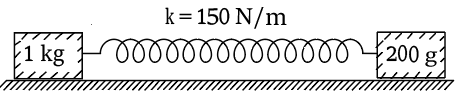
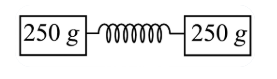
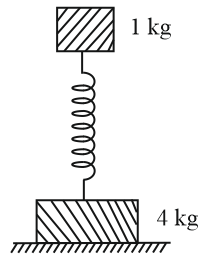
As shown in the figure, a spring is kept in a stretched position with some extension by holding the masses 1 kg and 0.2 kg with a separation more than spring natural length and are released. Assuming the horizontal serface to be frictionless, the angular frequency (in SI unit) of the system is:

image
Video Solution
Question 3

A cylindrical block of mass M and area of cross section A is floating in a liquid of density $$\rho$$ and with its axis vertical. When depressed a little and released the block starts oscillating. The period of oscillation is ___

Video Solution
Question 4

A simple pendulum of string length 30 cm performs 20 oscillations in 10 s. The length of the string required for the pendulum to perfo rm 40 oscillations in the same time duration is _________cm. [Assume that the mass of the pendulum remains same.]

Video Solution
Question 5

A spring of force constant 15 N/m is cut into two pieces. If the ratio of their length is 1:3, then the force constant of smaller piece is __ /m.

Video Solution
Question 6

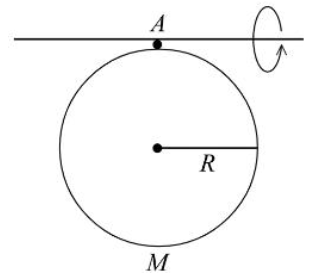
A uniform disc of radius R and mass M is free to oscillate about the axis A as shown in the figure. For small oscillations the time period is ______. ( g is acceleration due to gravity)

image
Question 7

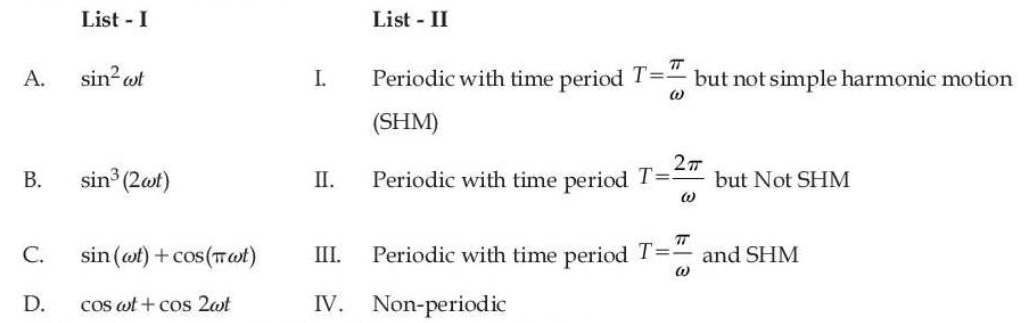
Match the List I with List II:

image

Choose the correct answer from the options given below: 

Question 8

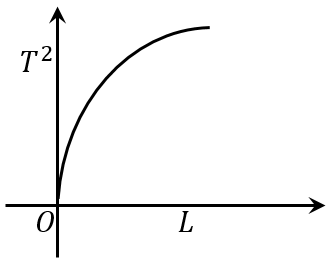
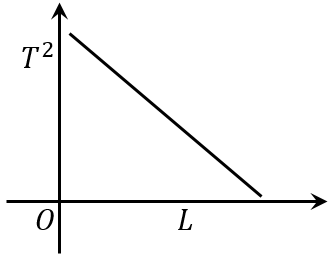
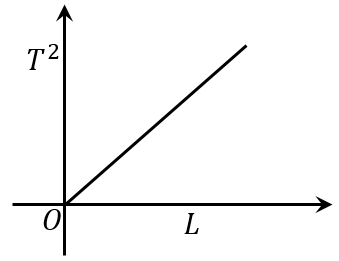
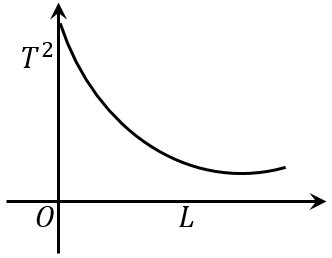
Using a simple pendulum experiment g is determind by measuring its time period T. Which of the following plots represent the correct relation between the pendulum length L and time period T?

Question 9

A spring stretches by 2 mm when it is loaded with a mass of 200 g. From equilibrium position the mass is further pulled down by 2 mm and released. The frequency associated with the system and maximum energy in the spring are __________ Hz and __________ J, respectively. (Take $$g = 10$$ m/s$$^2$$)

Question 10

A particle is executing simple harmonic motion. Its amplitude is $$A$$ and time period is 5 sec. The time required by it to move from $$x = A$$ to $$x = \frac{A}{\sqrt{2}}$$ is _______ sec.

Question 11

The frequency of oscillation of a mass $$m$$ suspended by a spring is $$v_1$$. If the length of the spring is cut to half, the same mass oscillates with frequency $$v_2$$. The value of $$\frac{v_2}{v_1}$$ is __________.

Question 12

The equation of motion of a particle is given by $$x = a\sin\left(50t + \frac{\pi}{3}\right)$$ cm. The particle will come to rest at time $$t_1$$ and it will have zero acceleration at time $$t_2$$. The $$t_1$$ and $$t_2$$ respectively are _____.

Question 13

The displacement of a particle, executing simple harmonic motion with time period T, is expressed as $$x(t) = A\sin \omega t$$, where A is the amplitude. The maximum value of potential energy of this oscillator is found at $$t=T/2\beta$$. The value of $$\beta$$ is_____.

Question 14

The velocity of a particle executing simple harmonic motion along $$x$$-axis is described as $$v^2 = 50 - x^2$$, where $$x$$ represents displacement. If the time period of motion is $$\frac{x}{7}$$ s, the value of $$x$$ is _____.

Frequently Asked Questions