Join WhatsApp Icon JEE WhatsApp Group
JEE Rotational Motion Questions

Rotational Motion is one of the most concept-heavy and high-scoring chapters in the Mechanics unit of JEE Physics. It tests a student's ability to extend the laws of translational motion to rotating bodies, and it consistently appears in both JEE Main and JEE Advanced. Because it blends kinematics, dynamics, and energy conservation, JEE Rotational Motion questions are a reliable measure of how well you understand mechanics as a whole. Questions from this chapter span moment of inertia, torque, angular momentum, rolling motion, and the conservation principles that govern rotating systems. JEE Main usually asks application-based single-concept problems, whereas JEE Advanced frequently combines rotation with energy, collisions, or constraint relations for higher-order reasoning. Practising topic-wise JEE Questions trains you to break these layered problems into manageable steps and build the systematic approach the chapter demands.

Rotational Motion rewards students who build strong fundamentals early. Once you internalise the analogy between linear and angular quantities, a large share of problems become straightforward extensions of ideas you already know from translational mechanics. The chapter also links directly to the torque concepts needed in magnetism and the angular-momentum ideas that appear across advanced problems.

Rotational Motion Topic Overview

Parameter

Details

Topic Name

Rotational Motion

Subject

Physics

JEE Main Weightage

~5-7% (1-2 questions on average)

JEE Advanced Weightage

~6-9% (often in multi-concept problems)

Difficulty Level

Moderate to High

Important Concepts

Moment of Inertia, Torque, Angular Momentum, Rolling Motion, Conservation Laws

Recommended Practice Level

High - attempt 70+ mixed problems

Why Practice JEE Rotational Motion Questions?

  • High weightage: Rotational Motion contributes at least 1-2 questions in JEE Main almost every year.
  • Core of mechanics: Free-body and torque analysis here is reused across circular and rolling problems.
  • Strong in Advanced: Connected systems and angular-momentum problems are JEE Advanced favourites.
  • Builds analytical discipline: Drawing correct free-body and torque diagrams trains systematic thinking.
  • Analogy-based learning: The linear-to-angular analogy makes new formulas intuitive rather than memorised.
  • Differentiates top scorers: Calculation-intensive practice separates accurate solvers from the rest.
  • Rolling motion is pervasive: Rolling problems appear both in Rotational Motion and in energy questions.

Important Concepts and Subtopics

Concept

Importance

Difficulty Level

Frequently Asked In

Moment of Inertia and Theorems

Very High

Moderate

JEE Main and Advanced

Torque and Angular Acceleration

High

Moderate

JEE Main and Advanced

Angular Momentum and Conservation

Very High

Moderate-High

JEE Advanced

Rolling Motion (Pure and Slipping)

Very High

High

JEE Main and Advanced

Rotational Kinetic Energy and Work

High

Moderate

JEE Main

Centre of Mass and Motion

High

Moderate

JEE Main and Advanced

Equilibrium of Rigid Bodies

Moderate

Moderate

JEE Main

Preparation Strategy for JEE Rotational Motion

Concept learning: Start by mapping every linear quantity to its rotational counterpart: mass to moment of inertia, force to torque, momentum to angular momentum. This analogy is the backbone of the chapter and makes new formulas intuitive rather than memorised.

Formula revision: Keep a quick-reference list of moment-of-inertia values for standard bodies, the parallel and perpendicular axis theorems, rolling-condition relations, and angular-momentum conservation conditions. Well-organised JEE Study Material helps you consolidate these results and standard derivations in one place for fast revision before the exam.

Problem-solving techniques: For rolling problems, always write separate equations for translation and rotation, then link them with the rolling constraint. Use conservation of angular momentum whenever no external torque acts about the chosen axis. For equilibrium problems, apply torque balance about the most convenient pivot.

Common mistakes: Choosing the wrong axis for torque, forgetting the rolling constraint, mixing up moment-of-inertia values for different bodies, and neglecting the friction force contribution in rolling without slipping.
Exam strategy: Pick direct moment-of-inertia and torque questions first to bank quick marks, then attempt rolling and angular-momentum problems that require more steps. Reserve heavy multi-body JEE Advanced problems for the end of your Physics section.

JEE Main and Advanced Weightage Analysis

Exam

Average Questions

Expected Marks

JEE Main

1-2

4-8

JEE Advanced

2-3 (often multi-body)

8-14

Rotational Motion is a consistently important chapter in JEE Main and a recurring source of multi-body problems in JEE Advanced. Mastery here directly improves performance across the entire Mechanics unit.

Tips to Solve Rotational Motion Questions Faster

  • Memorise standard moment-of-inertia values so you never lose time re-deriving them.
  • For rolling without slipping, immediately write v equal to r times omega to link translation and rotation.
  • Use conservation of angular momentum whenever external torque about your axis is zero.
  • Apply energy conservation for problems involving height changes or springs to skip force analysis.
  • Choose the axis of rotation wisely because picking the contact point often eliminates unknown friction forces.
  • Track the direction of angular quantities carefully using a consistent sign convention throughout.

Simulating these techniques under timed conditions with a JEE Mock Test is the most effective way to build speed without sacrificing accuracy.

JEE Rotational Motion Questions

Question 1

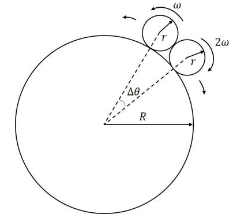
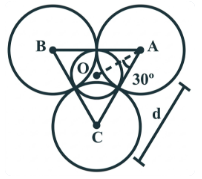
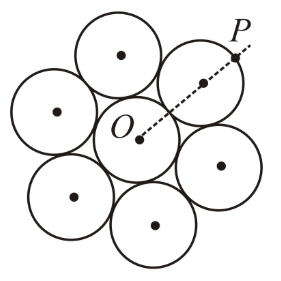
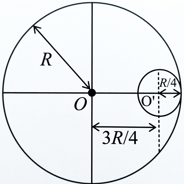
Consider a large disk of radius $$R$$ and two smaller disks, each of radius $$r=R/50$$, lying on its circumference, as shown in the figure. The smaller disks are initially in contact with each other, with an angular separation $$\Delta\theta$$ between their centers. They are made to roll without slipping in opposite directions, with constant angular velocities $$\omega$$ and $$2\omega$$ while the large disk is held stationary. The time $$\tau$$ at which the smaller disks are again in contact is:

[Use $$\sin(\Delta\theta)=\Delta\theta$$ and ignore gravity.]

image
Question 2

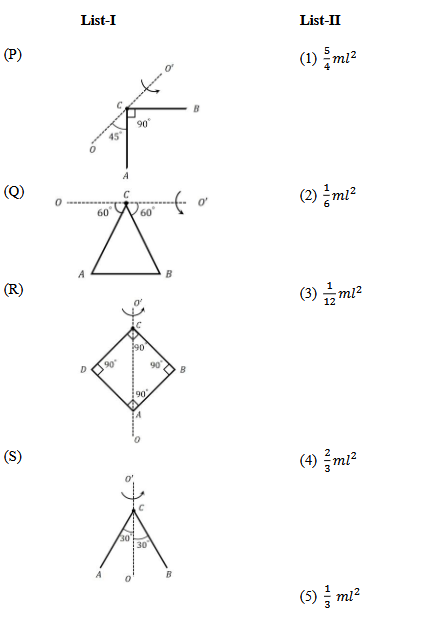
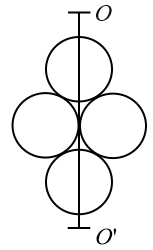
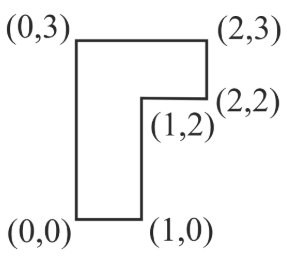
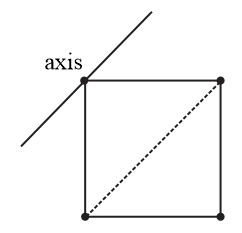
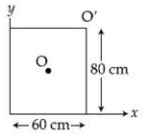
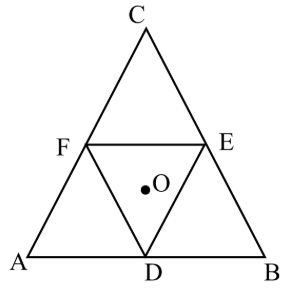
List-I shows four planar structures made of uniform solid rods each of mass $$m$$ and length $$l$$. In the List-II the possible moment of inertia of these structures about an axis $$OCO'$$, which lies in the plane of the structures, are given. Choose the option that describes the correct match between the entries in List-I to those in List-II.

image
Question 3

Question Stem for Question Nos. 17 and 18

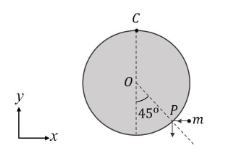
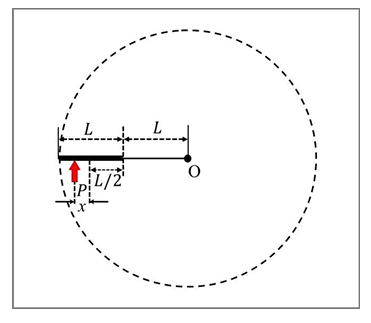
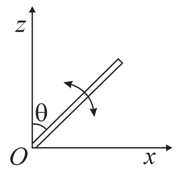
A uniform circular disk of radius $$0.2\,\mathrm{m}$$ and mass $$1\,\mathrm{kg}$$ is pivoted at its top point $$C$$ such that it can rotate freely around $$C$$ in the $$XY$$ plane, as shown in the figure. Initially, when the disk is at rest, a particle of mass $$20\,\mathrm{g}$$, travelling along negative $$x$$ direction in the $$XY$$ plane with speed $$100\,\mathrm{ms^{-1}}$$, hits the circumference of the disk at a point $$P$$. After collision the particle moves along negative $$y$$ direction at a speed of $$90\,\mathrm{ms^{-1}}$$.

[Given: the acceleration due to gravity $$(g)=-10\hat{j}\,\mathrm{ms^{-2}}$$]

image

After the collision the disk starts to rotate around point $$C$$ in the $$XY$$ plane. The maximum change in the height (in m) of its center $$O$$ is:

Question 4

Question Stem for Question Nos. 17 and 18

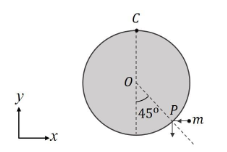
A uniform circular disk of radius $$0.2\,\mathrm{m}$$ and mass $$1\,\mathrm{kg}$$ is pivoted at its top point $$C$$ such that it can rotate freely around $$C$$ in the $$XY$$ plane, as shown in the figure. Initially, when the disk is at rest, a particle of mass $$20\,\mathrm{g}$$, travelling along negative $$x$$ direction in the $$XY$$ plane with speed $$100\,\mathrm{ms^{-1}}$$, hits the circumference of the disk at a point $$P$$. After collision the particle moves along negative $$y$$ direction at a speed of $$90\,\mathrm{ms^{-1}}$$.

[Given: the acceleration due to gravity $$(g)=-10\hat{j}\,\mathrm{ms^{-2}}$$]

image

Amount of energy loss (in J) in the collision is:

Question 5

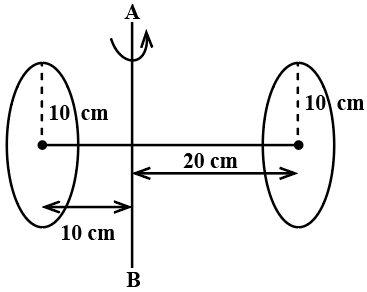
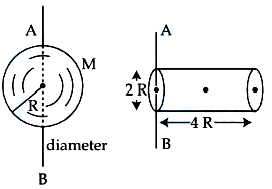
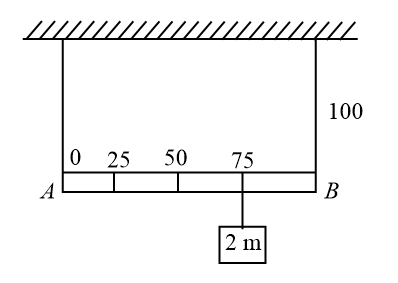
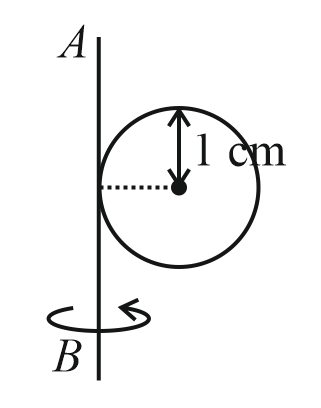
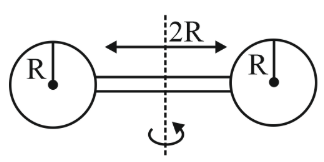
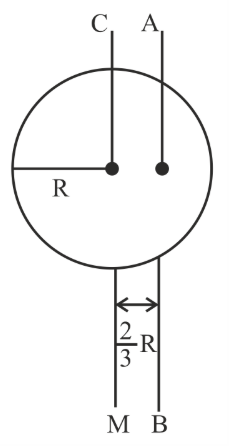
Two circular discs, each of radius 10 cm are joined at their centres by a rod of length 30 cm and mass 600 gm as shown in the figure. If the mass of each disc is 600 gm and applied torque between the two discs is $$43\times 10^{5} dyne.cm$$. The angular acceleration of the discs about the given axis AB is_______$$rad/s^{2}$$.

Screenshot_60
Question 6

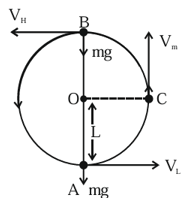
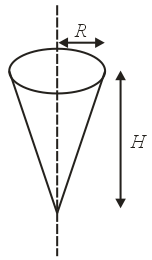
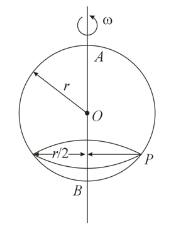
A 0.5 kg mass is in contact against the inner wall of a cylindrical drum of radius 4 m rotating about its vertical axis. The minimum rotational speed of the drum to enable the mass to remain stuck to the wall (without falling) is 5 rad/s. The coefficient of friction between the drum's inner wall surface and mass is : (Take $$g = 10$$ m/s$$^2$$)

Question 7

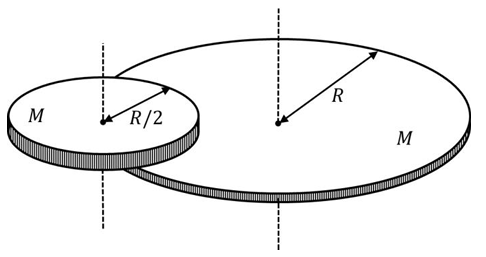
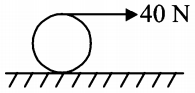
A solid sphere (A) of mass $$5m$$ and a spherical shell (B) of mass $$m$$, both having same radius, are placed on a rough surface. When a force of same magnitude is applied tangentially at the highest points of A and B, they start rolling without slipping with an acceleration of $$a_A$$ and $$a_B$$, respectively. The ratio of $$a_A$$ and $$a_B$$ is __________.

Question 8

Two small balls with masses m and 2m are attached to both ends of a rigid rod of length d and negligible mass. If angular momentum of this system is L about an axis (A) passing through its centre of mass and perpendicular to the rod then angular velocity of the system about A is :

Question 9

The moment of inertia of a square loop made of four uniform solid cylinders, each having radius R and length L (R<L) about an axis passing through the mid points of opposite sides, is (Take the mass of the entire loop as M) :

Question 10

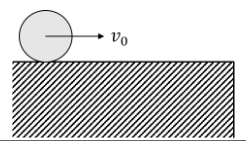
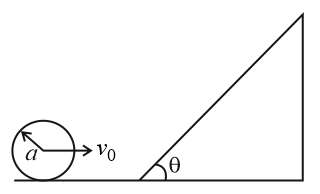
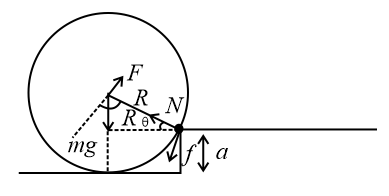
A solid cylinder of radius $$R$$ rolls without slipping with a center of mass speed $$v_0=\sqrt{\dfrac{gR}{3}}$$ on a horizontal surface with a vertical edge, as shown in the figure. Here, $$g$$ is the acceleration due to the gravity. At the moment when the cylinder loses contact with the surface due to rotation around the corner, the speed of its center of mass is:

image
Question 11

A solid sphere of mass $$M$$ and radius $$R$$ is divided into two unequal parts. The smaller part having mass $$\frac{M}{8}$$ is converted to a sphere of radius $$r$$ and the larger part is converted into a circular disc of thickness $$t$$ and radius $$2R$$. If $$I_1$$ is moment of inertia of a sphere having radius $$r$$ about an axis through its centre and $$I_2$$ is the moment of inertia of a disc about its diameter, the ratio of their moment of inertia $$\frac{I_2}{I_1}$$ = :

Question 12

A wheel initially at rest is subjected to a uniform angular acceleration about its axis. In the first 2 s, it rotates through an angle $$\theta_1$$. In the next 2 s, it rotates through an angle $$\theta_2$$. Then the ratio $$\frac{\theta_2}{\theta_1}$$ is :

Question 13

A particle is rotating in a circular path and at any instant its motion can be described as $$\theta = \frac{5t^4}{40} - \frac{t^3}{3}$$. The angular acceleration of the particle after 10 seconds is __________ rad/s$$^2$$.

Question 14

A solid sphere of radius 4 cm and mass 5 kg is rotating (rotation axis is passing through the centre of the sphere) with an angular velocity of 1200 rpm. It is brought to rest in 10 s by applying a constant torque. The torque applied and the number of rotations it made before it comes to rest are _______ and _______ respectively.

Question 15

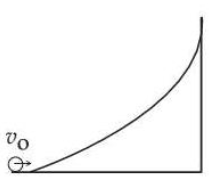
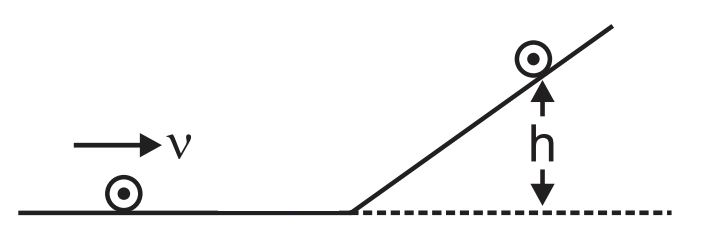
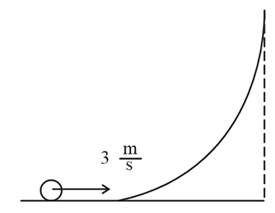
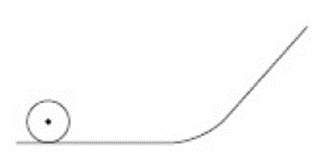
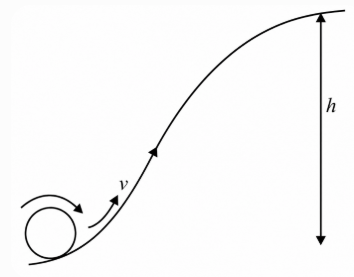
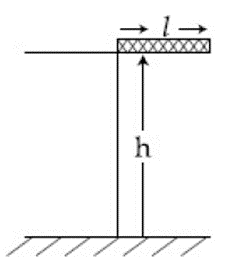
An object of uniform density rolls up a curved path with the initial velocity $$v_{\circ}$$ as shown in the figure. If the maximum height attained by an object is  $$\frac{7v_0^2}{10g}$$. (g = acceleration due to gravity), The object is a :
image
Question 16

A solid cylinder having radius $$R$$ and length $$L$$ is slipping on a rough horizontal plane. At time $$t = 0$$ the cylinder has a translational velocity $$v_0 = 49$$ m/s, perpendicular to its axis and a rotational velocity $$v_0/4R$$ about the centre. The time taken by the cylinder to start rolling is __________ seconds. (coefficient of kinetic friction $$\mu_K = 0.25$$ and $$g = 9.8$$ m/s$$^2$$)

Question 17

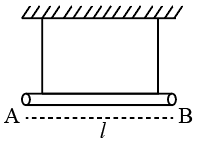
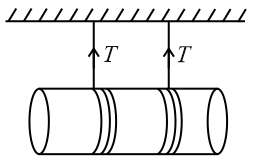
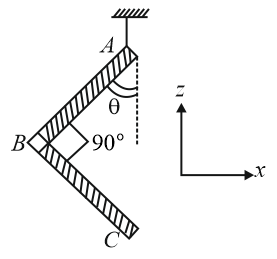
A uniform rod of mass m and length l is suspended by means of two identical inextensible light strings as shown in the figure. Tension in one of the strings, immediately after the other string is cut, is ____ . (g is the acceleration due to gravity)

Screenshot_2
Question 18

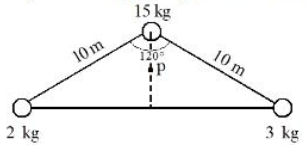
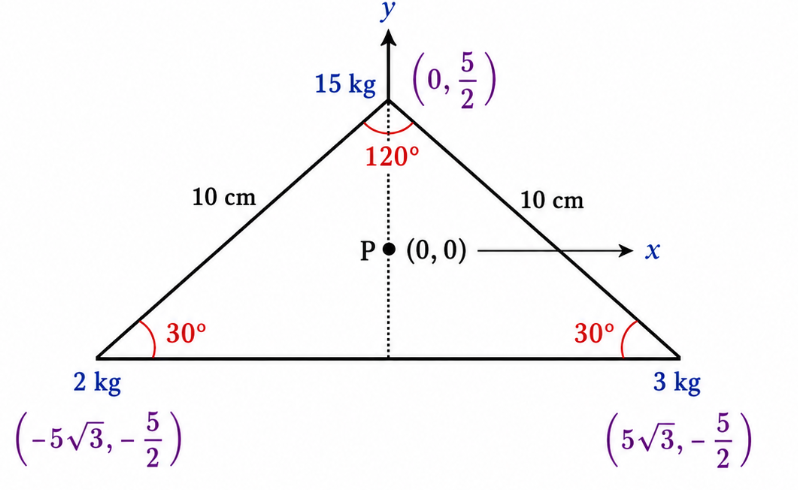
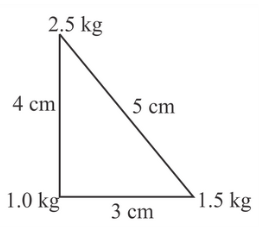
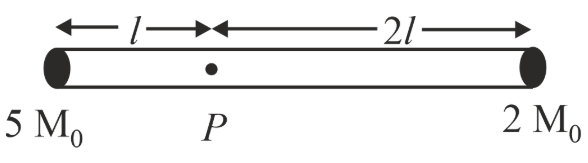
The position of center of mass of three masses 2 kg, 3 kg and 15 kg placed with respect to mid point (p) of normal bisector, as shown in the figure is _______.

image
Question 19

A solid sphere of mass 5 kg and radius 10 cm is kept in contact with another solid sphere of mass 10 kg and radius 20 cm. The moment of inertia of this pair of spheres about the tangent passing through the point of contact is _____ $$kg.m^{2}$$.

Question 20

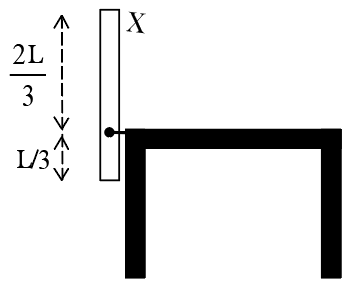
A thin uniform rod X of mass M and length L is pivoted at a height $$(\frac{L}{3})$$ as shown in the figure. The rod is allowed to fall from a vertical position and lie horizontally on the table. The angular velocity of this rod when it hits the table top, is __________.
(g is the acceleration due to gravity)

image
Question 21

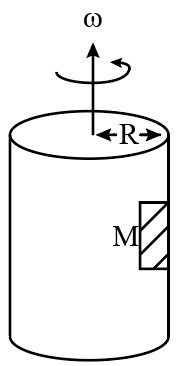
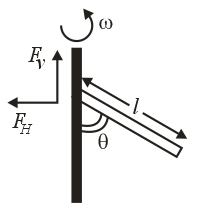
A large drum having radius R is spinning around its axis with angular velocity $$\omega$$, as shown in figure. The minimum value of $$\omega$$ so that a body of mass M remains stuck to the inner wall of the drum, taking the coefficient of friction between the drum surface and mass M as $$\mu$$, is :

38 Slot 2
Question 22

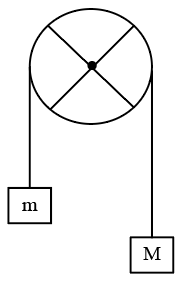
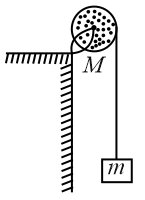
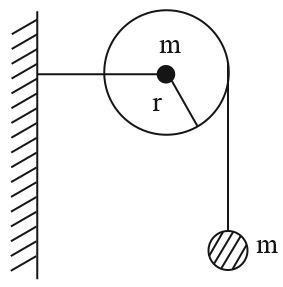
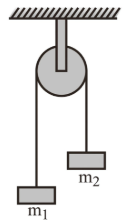
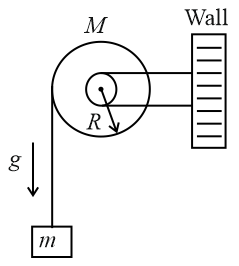
The pulley shown in the figure is made using a thin rim and two rods of length equal to the diameter of the rim. The rim and each rod have a mass of M. Two blocks of mass of M and m are attached to two ends of a light string passing over the pulley, which is hinged to rotate freely in vertical plane about its center. The magnitudes of the acceleration experienced by the blocks is ___________
(assume no slipping of string on pulley).

40 slot 2
Question 23

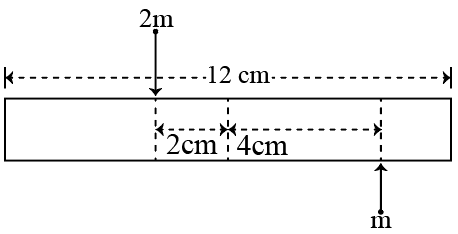
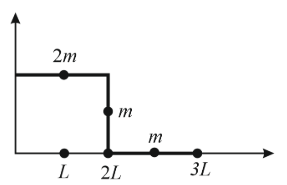
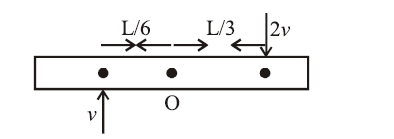
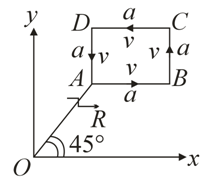
A uniform bar of length 12 cm and mass 20m lies on a smooth horizontal table. Two point masses m and 2m are moving in opposite directions with same speed of $$\nu$$ and in the same plane as the bar, as shown in the figure below. These masses strike the bar simultaneously and get stuck to it. After collision the entire system is rotating with angular frequency $$\omega$$. The ratio of $$\nu$$ and $$\omega$$ is :

41
Question 24

Two cars A and B each of mass $$10^{3}$$ kg are moving on parallel tracks separated by a distance of 10 m, in same direction with speeds 72 km/h and 36 km/h. The magnitude of angular momentum of car A with respect to car B is __________ J.s.

Question 25

Two masses 400 g and 350 g are suspended from the ends of a light string passing over a heavy pulley of radius 2 cm. When released from rest the heavier mass is observed to fall 81 cm in 9 s. The rotational inertia of the pulley is ___ $$kg.m^{2}$$.$$(g=9.8 m/s^{2})$$

Question 26

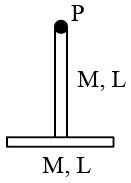
Two identical thin rods of mass M kg and length L m are connected as shown in the figure below. Moment of inertia of the combined rod system about an axis passing through point P and perpendicular to the plane of the rods is $$\frac{x}{12}ML^{2}\text{kg m}^{2}$$. The value of x is ____ .

Screenshot_6
Question 27

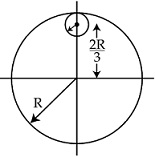
A uniform solid cylinder of length L and radius R has moment of inertia about its axis equal to $$I_{1}$$. A small co-centric cylinder of length L/2 and radius R/3 carved from this cylinder has moment of inertia about its axis equals to $$I_{2}$$. The ratio $$I_{1}/I_{2}$$ is __________.

Question 28

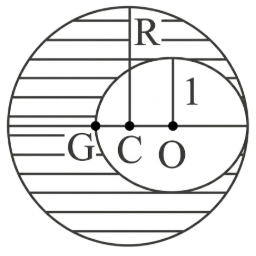
A solid sphere of radius 10 cm is rotating about an axis which is at a distance 15cm from its centre. The radius of gyration about this axis is$$\sqrt{n}cm$$. The value of n is

Question 29

A circular disc has radius $$R_{1}$$ and thickness $$T_{1}$$. Another circular disc made of the same material has radius $$R_{2} and thickness $$T_{2}. If the moment of inertia of both discs are same and $$ \frac{R_{1}}{R_{2}}=2 \text { then }\frac{T_{1}}{T_{2}}=\frac{1}{\alpha} $$. The value of $$\alpha$$ is__________.

Question 30

A fly wheel having mass 3 kg and radius 5 m is free to rotate about a horizontal axis. A string having negligible mass is wound around the wheel and the loose end of the string is connected to 3 kg mass. The mass is kept at rest initially and released. Kinetic energy of the wheel when the mass descends by 3 m is ___ J.$$(g=10 m/s^{2})$$

Question 31

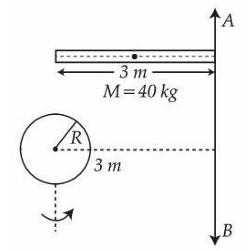
Moment of inertia about an axis $$AB$$ for a rod of mass 40 kg and length 3 m is same as that of a solid sphere of mass 10 kg and radius $$R$$ about an axis parallel to $$AB$$ axis with separation of 3 m as shown in figure. The value of $$R$$ is given as $$\sqrt{\frac{\alpha}{2}}$$. The value of $$\alpha$$ is _________.

image
Question 32

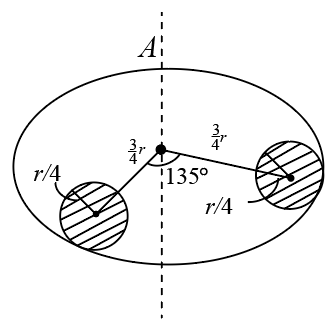
Suppose there is a uniform circular disc of mass $$M$$ kg and radius $$r$$ m shown in figure. The shaded regions are cut out from the disc. The moment of inertia of the remainder about the axis $$A$$ of the disc is given by $$ \frac{x}{256}Mr^{2} $$. The value of $$x$$ is______.

50

Frequently Asked Questions