For a straight, infinitely long wire carrying current $$I$$, the magnetic field at a perpendicular distance $$r$$ from the wire is given by the Biot-Savart result
$$\vec B=\frac{\mu_0 I}{2\pi r}\,\hat{\phi},$$
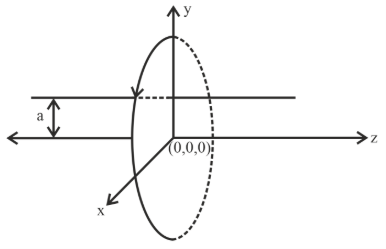
where $$\hat{\phi}$$ is the azimuthal (tangential) unit vector around the wire. In our situation the wire runs along the $$z$$-axis through the point $$(0,b,0)$$, so every field line lies in the $$xy$$-plane centred on that line.
Any current element $$I\,d\vec l$$ placed in a magnetic field experiences a differential force given by
$$d\vec F=I\;d\vec l\times\vec B.$$
The torque of this force about the $$z$$-axis is
$$d\tau_z=(\vec r\times d\vec F)_z=x\,dF_y-y\,dF_x,$$
with $$\vec r=(x,y,z)$$ measured from the origin.
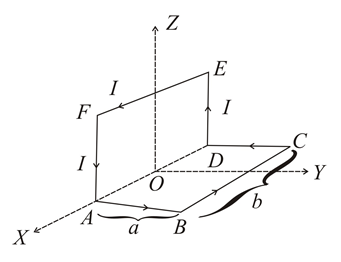
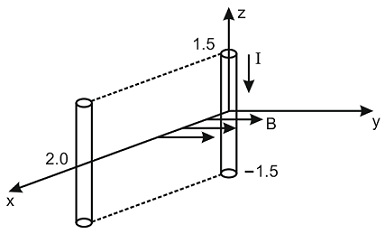
The square loop of side $$2a$$ lies in the $$xz$$-plane ($$y=0$$) and is centred at the origin, so its four straight sides are
1. $$AB: (-a,0,-a)\to(a,0,-a)\ \ (\text{along }+x)\\
2. BC: (a,0,-a)\to(a,0,a)\ \ (\text{along }+z)\\
3. CD: (a,0,a)\to(-a,0,a)\ \ (\text{along }-x)\\
4. DA: (-a,0,a)\to(-a,0,-a)\ (\text{along }-z).$$
Because every point of the loop has coordinate $$y=0$$, the distance of a generic point $$(x,0,z)$$ from the wire is
$$r=\sqrt{x^{2}+b^{2}},$$
and the magnetic field there is obtained by writing the azimuthal unit vector explicitly. The vector from the wire to the field point is $$\vec r=x\,\hat i-b\,\hat j,$$ so
$$\hat{\phi}=\frac{\hat k\times\vec r}{|\vec r|}=\frac{b\,\hat i+x\,\hat j}{r}.$$
Substituting in the Biot-Savart expression gives the field on the loop:
$$\vec B(x)=\frac{\mu_0 I}{2\pi r}\;\hat{\phi}= \frac{\mu_0 I}{2\pi}\;\frac{b\,\hat i+x\,\hat j}{x^{2}+b^{2}}.$$
Now we treat each side in turn.
Sides AB and CD (segments parallel to the $$x$$-axis)
On these sides $$d\vec l=\pm dx\,\hat i$$, so
$$d\vec F=I\,d\vec l\times\vec B
=I\,dx\,\hat i\times\frac{\mu_0 I}{2\pi}\frac{b\,\hat i+x\,\hat j}{x^{2}+b^{2}}
=\frac{\mu_0 I^{2}}{2\pi}\frac{x\,dx}{x^{2}+b^{2}}\;\hat k.$$
Because the force is purely along $$\hat k$$, both $$F_x$$ and $$F_y$$ are zero and therefore $$d\tau_z=0$$ on these two sides. They contribute no torque about the $$z$$-axis.
Side BC (segment parallel to the $$z$$-axis at $$x=+a$$)
Here $$d\vec l=dz\,\hat k$$ and $$x=a$$ is constant, so
$$d\vec F_{BC}=I\,dz\,\hat k\times
\frac{\mu_0 I}{2\pi}\frac{b\,\hat i+a\,\hat j}{a^{2}+b^{2}}
=\frac{\mu_0 I^{2}}{2\pi(a^{2}+b^{2})}\,dz\,
\bigl[b\,(\hat k\times\hat i)+a\,(\hat k\times\hat j)\bigr]
=\frac{\mu_0 I^{2}}{2\pi(a^{2}+b^{2})}\,dz\,(b\,\hat j-a\,\hat i).$$
Its components are $$F_x=-\dfrac{\mu_0 I^{2}a}{2\pi(a^{2}+b^{2})}\,dz$$ and $$F_y=\dfrac{\mu_0 I^{2}b}{2\pi(a^{2}+b^{2})}\,dz$$.
The position vector on this side is $$\vec r=(a,0,z)$$, so
$$d\tau_z^{(BC)}=x\,dF_y-y\,dF_x=a\,dF_y
=\frac{\mu_0 I^{2}a b}{2\pi(a^{2}+b^{2})}\,dz.$$
Integrating $$z$$ from $$-a$$ to $$+a$$ we obtain
$$\tau_z^{(BC)}=\int_{-a}^{a}d\tau_z^{(BC)}
=\frac{\mu_0 I^{2}a b}{2\pi(a^{2}+b^{2})}\,(2a)
=\frac{\mu_0 I^{2}a^{2} b}{\pi(a^{2}+b^{2})}.$$
Side DA (segment parallel to the $$z$$-axis at $$x=-a$$)
On this side the current runs in the negative $$z$$-direction, so we write $$d\vec l=-dz\,\hat k$$ while $$x=-a$$. The magnetic field there is
$$\vec B(-a)=\frac{\mu_0 I}{2\pi}\frac{b\,\hat i- a\,\hat j}{a^{2}+b^{2}}.$$
Hence
$$d\vec F_{DA}=I\,(-dz\,\hat k)\times
\frac{\mu_0 I}{2\pi}\frac{b\,\hat i- a\,\hat j}{a^{2}+b^{2}}
=-\frac{\mu_0 I^{2}}{2\pi(a^{2}+b^{2})}\,dz\,
\bigl[b\,(\hat k\times\hat i)-a\,(\hat k\times\hat j)\bigr]
=-\frac{\mu_0 I^{2}}{2\pi(a^{2}+b^{2})}\,dz\,(b\,\hat j+a\,\hat i).$$
The components are $$F_x=-\dfrac{\mu_0 I^{2}a}{2\pi(a^{2}+b^{2})}\,dz$$, $$F_y=-\dfrac{\mu_0 I^{2}b}{2\pi(a^{2}+b^{2})}\,dz$$.
With $$\vec r=(-a,0,z)$$ we have
$$d\tau_z^{(DA)}=x\,dF_y-y\,dF_x=(-a)(dF_y)
=\frac{\mu_0 I^{2}a b}{2\pi(a^{2}+b^{2})}\,dz,$$
exactly the same integrand as for side BC. Integrating from $$z=+a$$ back to $$z=-a$$ (the physical direction of current) still produces
$$\tau_z^{(DA)}=\frac{\mu_0 I^{2}a^{2} b}{\pi(a^{2}+b^{2})}.$$
Total torque about the $$z$$-axis
The two horizontal sides give zero torque, while each vertical side contributes the same positive amount found above, so
$$\tau_z=\tau_z^{(BC)}+\tau_z^{(DA)}
=\frac{\mu_0 I^{2}a^{2} b}{\pi(a^{2}+b^{2})}
+\frac{\mu_0 I^{2}a^{2} b}{\pi(a^{2}+b^{2})}
=\frac{2\mu_0 I^{2}a^{2} b}{\pi(a^{2}+b^{2})}.$$
Therefore the magnitude of the torque acting on the square loop about the $$z$$-axis is
$$\boxed{\displaystyle \tau=\frac{2\mu_0 I^{2}a^{2} b}{\pi\!\left(a^{2}+b^{2}\right)}}.$$
Hence, the correct answer is Option B.