Join WhatsApp Icon JEE WhatsApp Group

JEE Atoms & Nuclei Questions

Atoms and Nuclei is one of the highest-weightage and most scoring chapters in the Modern Physics section of JEE Physics. It explains the structure of the atom through Bohr's model and the structure and behaviour of the nucleus through binding energy, radioactivity, and nuclear reactions. Because most questions are direct and follow predictable formats, JEE Atoms and Nuclei questions consistently reward focused preparation in both JEE Main and JEE Advanced. This chapter covers the Bohr model of the hydrogen atom, energy levels and the hydrogen spectrum, ionisation and excitation energy, the composition and size of the nucleus, mass defect and binding energy, nuclear stability, radioactivity and the laws of radioactive decay, half-life, and nuclear fission and fusion. JEE Main typically tests Bohr energy levels, spectral transitions, binding energy, and decay laws, while JEE Advanced may probe spectra and decay chains more deeply. Practising topic-wise JEE Questions helps you apply the Bohr relations and decay laws quickly and accurately.

Because the chapter combines clean formulas with high weightage, it is one of the most rewarding areas to master in Modern Physics. It rewards students who use ratio forms for Bohr quantities and who handle half-lives and binding energy with care.

Atoms and Nuclei Topic Overview

Parameter

Details

Topic Name

Atoms and Nuclei

Subject

Physics

JEE Main Weightage

~4–6% (2–3 questions on average)

JEE Advanced Weightage

~4–6% (consistent)

Difficulty Level

Easy to Moderate

Important Concepts

Bohr Model, Hydrogen Spectrum, Binding Energy, Radioactivity, Fission & Fusion

Recommended Practice Level

High – attempt 70+ mixed problems

Why Practice JEE Atoms and Nuclei Questions?

  • Very high weightage: This chapter contributes 2–3 questions in JEE Main most years.
  • High scoring efficiency: Direct formulas make most questions quick to solve.
  • Predictable patterns: Bohr-model and decay questions repeat in familiar formats.
  • Strong in Advanced: Spectra, binding energy, and decay chains appear reliably.
  • Clean numerical answers: Many problems resolve to neat, checkable values.
  • Minimal derivations: Less time on proofs leaves more for practice.
  • Boosts Modern Physics score: It is a cornerstone of the high-weightage Modern Physics unit.

Important Concepts and Subtopics

Concept

Importance

Difficulty Level

Frequently Asked In

Bohr Model & Energy Levels

Very High

Moderate

JEE Main & Advanced

Hydrogen Spectrum & Series

Very High

Moderate

JEE Main & Advanced

Ionisation & Excitation Energy

High

Easy–Moderate

JEE Main

Nuclear Composition & Size

Moderate

Easy

JEE Main

Mass Defect & Binding Energy

Very High

Moderate

JEE Main & Advanced

Radioactivity & Decay Laws

Very High

Easy–Moderate

JEE Main & Advanced

Half-Life & Mean Life

High

Moderate

JEE Main

Nuclear Fission & Fusion

High

Easy–Moderate

JEE Main & Advanced

Preparation Strategy for JEE Atoms and Nuclei

Concept learning: Begin with the Bohr model, mastering the energy-level expression and how transitions produce spectral lines. Move to the nucleus, understanding mass defect, binding energy, and the binding-energy-per-nucleon curve that explains fission and fusion. Then study radioactivity and the exponential decay law with half-life and mean life.

Formula revision: Keep Bohr energy-level and radius relations, the spectral-series formula, binding-energy expressions, and decay laws together for quick review. Well-organised JEE Study Material helps you keep these high-frequency formulas in one place for rapid revision before the exam.

Problem-solving techniques: Use the ratio forms for Bohr quantities to compare states without full computation. For decay problems, count half-lives directly when time is a whole multiple, and use the exponential law otherwise. For binding energy, work from mass defect carefully in consistent units.

Common mistakes: Forgetting the negative sign of Bohr energy levels, mixing up spectral series, miscounting half-lives, and unit errors in mass defect and binding-energy calculations.

Exam strategy: Treat this chapter as a high-yield, quick-marks area — attempt its Bohr and decay questions early, then handle binding-energy and spectra problems that need more steps.

JEE Main & Advanced Weightage Analysis

Exam

Average Questions

Expected Marks

JEE Main

2–3

8–12

JEE Advanced

1–2

4–10

Atoms and Nuclei is one of the heaviest-weighted chapters in JEE Main, frequently contributing two or more questions. JEE Advanced maintains steady representation, usually with clean numerical problems on spectra, binding energy, and decay.

Tips to Solve Atoms and Nuclei Questions Faster

  • Use Bohr ratio forms (energy proportional to 1/n², radius proportional to n²) to compare states quickly.
  • Remember Bohr energy levels are negative for bound electrons — watch the sign.
  • Identify the spectral series by the final energy level to find the wavelength range.
  • Count half-lives directly when the elapsed time is a whole-number multiple.
  • Keep mass and energy in consistent units when computing binding energy.
  • Use the binding-energy-per-nucleon curve to reason about fission and fusion.

Reinforcing these techniques with a timed JEE Mock Test ensures you capture every quick mark this high-weightage chapter offers.

JEE Atoms & Nuclei Questions

Question 1

A nuclear reactor starts producing a radioactive nuclide $$X$$ from $$t=0$$, at a constant rate of $$\alpha$$ per second. Each decay of $$X$$ produces energy $$E_0$$, which is utilized to heat a liquid of mass $$m$$ and specific heat $$s$$. Assuming no heat loss from the liquid and taking $$\lambda$$ as the decay constant of $$X$$, the rate of increase in the temperature of the liquid is:

Question 2

An atom $$^8_{3}X$$ is bombarded by shower of fundamental particles and in 10s this atom absorbed 10 electrons, 10 protons and 9 neutrons. The percentage growth in the smface area of the nucleons is recorded by:

Question 3

The binding energy for the following nuclear reactions are expressed in MeV.
$$ _{2}He^{3}+ _{0}n^{1} \rightarrow {}_{2}He^{4}+20$$ MeV
$$ _{2}He^{4}+ _{0}n^{1} \rightarrow {}_{2}He^{5}-0.9$$ MeV
If $$X_{3}$$, $$X_{4}$$, $$X_{5}$$ denote the stability of $${}_{2}He^{3}, {}_{2}He^{4}$$ and $${}_{2}He^{5},$$ respectively, then the correct order is :

Question 4

Two nuclei of mass number 3 combine with another nucleus of mass number 4 to yield a nucleus of mass number 10. If the binding energy per nucleon for the mass numbers 3, 4 and 10 are 5.6 MeV, 7.4 MeV and 6.1 MeV, respectively, then in the process, $$\Delta Mc^2$$ = _____ MeV.

Question 5

$$7.9 MeV \alpha - \text{particle}$$ scatters from a target material of atomic muuber 79. From the given data the estimated diameter of nuclei of the target material is (approximately) ___m.

$$\left[ \frac{1}{4\pi \epsilon_{o}}=9\times 10^{9} Nm^{2}/c^{2} \text{ and electron change}=1.6\times 10^{-19}C \right ]$$

Question 6

In hydrogen atom spectrum, (R ➔ Rydberg's constant)
A. the maximum wavelength of the radiation of Lyman series is $$\frac{4}{3R}$$
B. the Balmer series lies in the visible region of the spectrum
C. the minimum wavelength of the radiation of Paschen series is $$\frac{9}{R}$$
D. the minimum wavelength of Lyman series is $$\frac{5}{4R}$$
Choose the correct answer from the options given below :

Question 7

The de Broglie wavelength of an oxygen molecule at $$27^{\circ}C\text{ is }x\times10^{-12}m$$. The value of x is (take Planck's constant $$=6.63\times10^{-34}J.s$$, Boltzmann constant $$=1.38\times10^{-23}J/K$$, mass of oxygen molecule $$=5.31\times10^{-26}kg$$)

Question 8

The energy of an electron in an orbit of the Bohr's atom is $$-0.04E_{0} eV$$ where $$E_{0}$$ is the ground state energy. lf L is the angular momentum of the electron in this orbit and h is the Planck's constant, then $$\frac{2\pi L}{h}$$ is __________:

Question 9

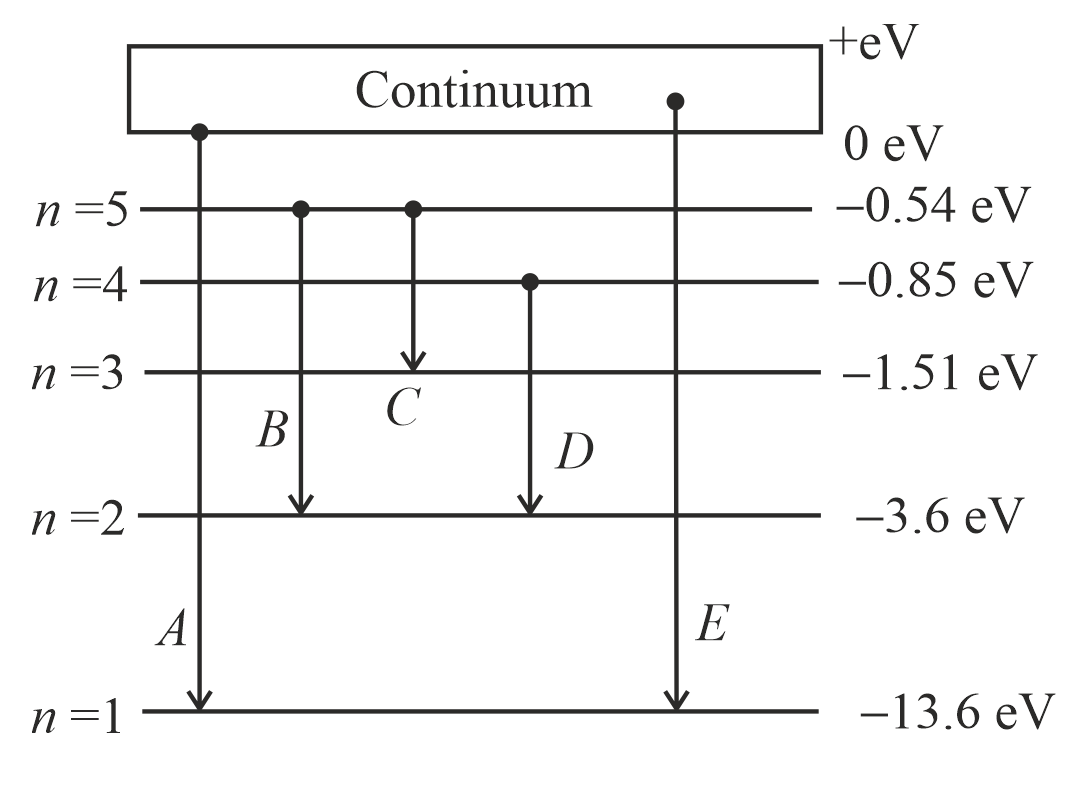
In the hydrogen atom, the electron makes a transition from the higher orbit ($$i$$) to a lower orbit ($$f$$). The ratio of the radius of the orbits is given by $$r_i : r_f = 16 : 4$$. The wavelength of photon emitted due to this transition is _______ nm. (Given Rydberg constant = $$1.0973 \times 10^7$$ /m)

Question 10

Which of the following pair of nuclei are isobars of the element?

Question 11

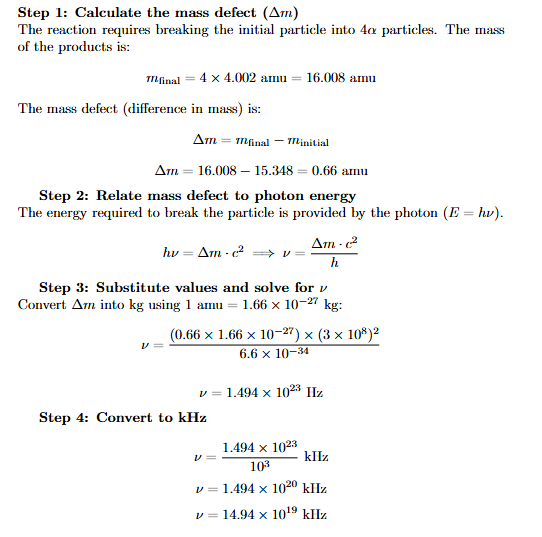
The minimum frequency of photon required to break a particle of mass 15.348 amu into $$4\alpha$$ particles is ____ kHz.
[mass of He nucleus$$=4.002amu, 1 amu=1.66\times10^{-27}kg,h=6.6\times10^{-34}J.s $$ and $$ c=3\times10^{8}m/s$$]

Question 12

Two electrons are moving in orbits of two hydrogen like atoms with speeds $$3\times 10^{5} m/s \text{ and } 2.5\times 10^{5} m/s$$ respectively. If the radii of these orbits are nearly same then the possible order of energy states are ____ respectively.

Question 13

A nucleus has mass number $$\alpha$$ and radius $$R_{\alpha}$$ Another nucleus has mass number $$\beta$$ and radius $$R_{\beta}$$. If $$\beta=8\alpha$$ then $$R_{\alpha}/R_{\beta}$$ is:

Question 14

The energy released if hydrogen atoms are combined to form $$^{4}_{2}$$He is __________ MeV. (Take binding energies per nucleon of $$^{2}_{1}$$H and $$^{4}_{2}$$He as 1.1 MeV and 7.2 MeV, respectively)

Question 15

The smallest wavelength of Lyman series is 91 nm. The difference between the largest wavelengths of Paschen and Balmer series is nearly __ nm.

Question 16

Given below are two statements:
Statement I: For all elements, greater the mass of the nucleus, greater is the binding energy per nucleon.
Statement II: For all elements, nuclei with less binding energy per nucleon transforms to nuclei with greater binding energy per nucleon.
In the light of the above statements, choose the correct answer from the options given below

Question 17

In Rutherford's alpha-particle scattering experiment, only a few alpha particles rebound back because

A. The size of gold nucleus is very small as compared to the size of gold atom.

B. Alpha particle and gold nucleus have equal charge.

C. The impact parameter is minimum for a few alpha particles.

D. A few alpha particles have very high kinetic energy.

E. Only a few alpha particles undergo head-on collision with the nuclei.
Choose the correct answer from the options given below: 

Question 18

Angular momentum of an electron in a hydrogen atom is $$\frac{3h}{\pi}$$, then the energy of the electron is __________ eV.

Question 19

Assuming the experimental mass of $$^{12}_{6}C$$ as 12 u, The mass defect of $${}^{12}\text{C}$$ atom is (in MeV/$$c^2$$) :
(Mass of proton  = 1.00727 u, mass of neutron = 1.00866 u, 1 u = 931.5$$ $$MeV/$$c^2$$ and c is the speed of the light in vacuum).

Question 20

The binding energy per nucleon of $${}^{209}_{83}\text{Bi}$$ is _________ MeV. [Take $$m({}^{209}_{83}\text{Bi}) = 208.980388$$ u, $$m_p = 1.007825$$ u, $$m_n = 1.008665$$ u, $$1$$ u $$= 931$$ MeV/c$$^2$$]

Question 21

The ratio of momentum of the photons of the 1$$^{st}$$ and 2$$^{nd}$$ line of Balmer series of Hydrogen atoms is $$\alpha/\beta$$. The possible values of $$\alpha$$ and $$\beta$$ are:

Question 22

Two radioactive substances A and B of mass numbers 200 and 212 respectively, shows spontaneous $$\alpha$$-decay with same Q value of 1 MeV. The ratio of energies of $$\alpha$$-rays produced by A and B is __________.

Question 23

The ratio of de Broglie wavelength of a deutron with kinetic energy E to that of an alpha particle with kinetic energy 2E, is n : 1. The value of n is __.
(Assume mass of proton= mass of neutron) :

Question 24

Using Bohr's model, calculate the ratio of the magnetic fields generated due to the motion of the electrons in the 2nd and 4th orbits of hydrogen atom _________.

Question 25

The energy released when $$\frac{7}{17.13}$$ kg of $$^7_3$$Li is converted into $$^4_2$$He by proton bombardment is $$\alpha \times 10^{32}$$ eV. The value of $$\alpha$$ is _______. (Nearest integer)
(Mass of $$^7_3$$Li = 7.0183 u, mass of $$^4_2$$He = 4.004 u, mass of proton = 1.008 u and 1 u = 931 MeV/c$$^2$$ and Avogadro number = $$6.0 \times 10^{23}$$)

Question 26

A particle having electric charge $$3\times 10^{-19}$$ C and mass $$6 \times 10^{-27}$$ kg is accelerated by applying an electric Potential of 1.21 V. Wavelength of the matter wave
associated with the particle is $$\alpha \times 10^{-12}m$$. The value of $$\alpha$$ is __________. (Take Planck's constant = $$6.6 \times 10^{-34}$$ J.s. )

Question 27

The average energy released per fission for the nucleus of $$ _{92}^{235}U $$ is 190 MeV.
When all the atoms of 47g pure $$ _{92}^{235}U $$ undergo fission process, the energy released is $$\alpha \times 10^{23}$$MeV. The value of $$\alpha$$ is ______.
(Avogadro Number = 6 $$\times$$ $$10^{23}$$ per mole)

Question 28

Consider a hydrogen atom with $$v_k$$, $$r_k$$, and $$K_k$$ denoting the velocity, orbital radius and kinetic energy of the electron in the $$k^{\text{th}}$$ orbit, respectively. The electron undergoes a transition from the $$n^{\text{th}}$$ orbit, emitting radiation corresponding to the Lyman series. Considering $$h$$ to be the Planck's constant and $$\epsilon_0$$ the permittivity of the free space, the correct statement(s) is(are):

Frequently Asked Questions