Join WhatsApp Icon JEE WhatsApp Group

JEE Alternating Currents Questions

Alternating Currents is a high-yield chapter in the Electrodynamics unit of JEE Physics that builds directly on electromagnetic induction. It studies circuits driven by sinusoidally varying voltages, introducing reactance, impedance, phase relationships, resonance, and power in AC circuits. Because it combines circuit analysis with the behaviour of inductors and capacitors under changing currents, JEE Alternating Currents questions are reliably tested in both JEE Main and JEE Advanced. This chapter covers AC voltage and current, the concept of rms and peak values, behaviour of resistors, inductors, and capacitors in AC circuits, reactance and impedance, the series LCR circuit, resonance, the quality factor, power and the power factor, and transformers. JEE Main typically tests impedance, resonance, and power calculations, while JEE Advanced may probe phasor reasoning and resonance conditions more deeply. Practising topic-wise Cracku JEE Questions helps you handle phasors and impedance with confidence.
A strong grasp of alternating currents ties together induction, capacitance, and circuit analysis into one coherent framework. The chapter rewards students who think in phasors, keep phase relationships straight, and recognise the special simplicity of the resonance condition.

Alternating Currents Topic Overview

Parameter

Details

Topic Name

Alternating Currents

Subject

Physics

JEE Main Weightage

~3–5% (1–2 questions on average)

JEE Advanced Weightage

~4–6% (often combined)

Difficulty Level

Moderate to High

Important Concepts

RMS Values, Reactance, Impedance, LCR Resonance, Power Factor

Recommended Practice Level

High – attempt 70+ mixed problems

Why Practice JEE Alternating Currents Questions?

  • Reliable weightage: AC contributes 1–2 questions in JEE Main most years.
  • Ties concepts together: It unifies induction, capacitance, and circuit analysis.
  • Resonance focus: LCR resonance problems are frequent and rewarding.
  • Strong in Advanced: Phasor and impedance reasoning appear in JEE Advanced.
  • Reliable power questions: Power-factor problems yield consistent, scoring marks.
  • Phasor skill builder: Visualising phasors sharpens circuit intuition.
  • Practical relevance: Transformers and AC circuits connect to real applications.

Important Concepts and Subtopics

Concept

Importance

Difficulty Level

Frequently Asked In

AC Voltage, RMS & Peak Values

Very High

Easy–Moderate

JEE Main

R, L, C in AC Circuits

Very High

Moderate

JEE Main & Advanced

Reactance & Impedance

Very High

Moderate

JEE Main & Advanced

Series LCR Circuit & Phasors

Very High

Moderate–High

JEE Main & Advanced

Resonance & Quality Factor

High

Moderate–High

JEE Advanced

Power & Power Factor

Very High

Moderate

JEE Main & Advanced

Transformers

Moderate

Easy–Moderate

JEE Main

Preparation Strategy for JEE Alternating Currents

Concept learning: Start with rms and peak values, then study how resistors, inductors, and capacitors behave individually in AC circuits, noting their phase relationships. Build to the series LCR circuit using phasor diagrams, then master resonance, the quality factor, and power in AC circuits.

Formula revision: Keep rms relations, reactance and impedance expressions, the resonance condition, and power-factor formulas together for quick review. Structured JEE Online Coaching helps you reinforce phasor reasoning and clear doubts on resonance and power problems efficiently.

Problem-solving techniques: Draw phasor diagrams to combine voltages across circuit elements correctly. Use the impedance triangle to relate resistance, reactance, and phase. At resonance, recall that reactances cancel and impedance is minimum, simplifying calculations dramatically.

Common mistakes: Forgetting phase differences between elements, confusing peak and rms values, mishandling the resonance condition, and ignoring the power factor when computing average power.

Exam strategy: Solve direct rms, impedance, and resonance questions first, then attempt phasor and power-factor problems that require more reasoning. When a circuit is at resonance, use the simplified conditions immediately to save time.

JEE Main & Advanced Weightage Analysis

Exam

Average Questions

Expected Marks

JEE Main

1–2

4–8

JEE Advanced

1–2 (often combined)

4–10

Alternating Currents is a steady contributor in JEE Main, mainly through impedance, resonance, and power questions. In JEE Advanced, it often appears with phasor reasoning and combined circuit analysis that test deeper understanding.

Tips to Solve Alternating Currents Questions Faster

  • Draw phasor diagrams to add voltages across circuit elements correctly.
  • Use the impedance triangle to relate resistance, reactance, and phase angle.
  • At resonance, set reactances equal so impedance is minimum and current is maximum.
  • Keep peak and rms values distinct, converting only when the formula requires it.
  • Compute average power using the power factor, not just current and voltage.
  • For transformers, use the turns ratio to relate primary and secondary quantities.

Reinforcing these techniques with a timed JEE Mock Test builds the phasor fluency that AC problems reward.

JEE Alternating Currents Questions

Question 1

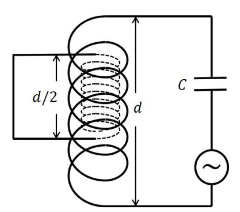
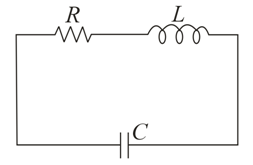
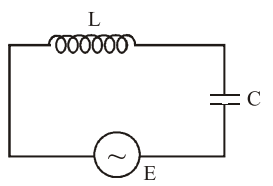
Consider a circuit consisting of a capacitor of capacitance $$C$$ and a coil with $$N$$ turns per unit length, cross sectional area $$S$$ and length $$d$$, where $$d^2\gg S$$. There is another coil of length $$d/2$$, cross sectional area $$S/2$$ and $$2N$$ turns per unit length completely inside the larger coil, as shown in the figure. The ends of this smaller coil are connected with each other by an insulated conducting wire. The self-inductance of the larger coil is $$L$$. Neglecting edge effects and all the Ohmic resistances, the resonant frequency of the circuit is:

image
Question 2

The electric current in the circuit is given as $$i=i_{\circ}(t/T)$$. The r.m.s cm1:ent for the period t = 0 to t = T is______.

Video Solution
Question 3

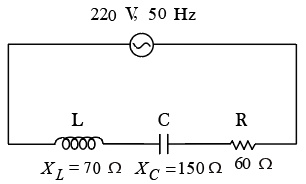
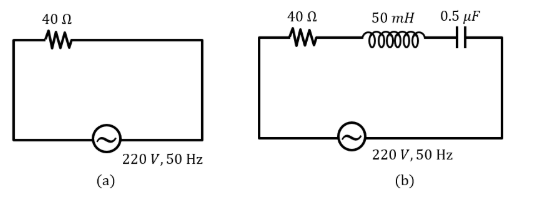
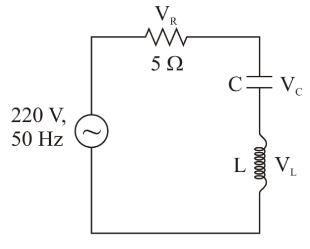
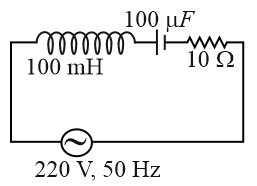
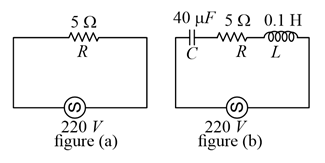
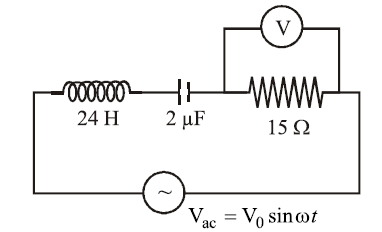
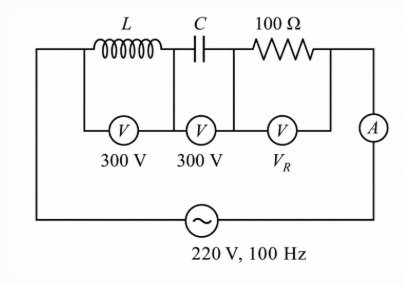
For the series LCR circuit connected with 220 V, 50 Hz a.c source as shown in the figure, the power factor is $$\frac{\alpha}{10}$$. The value of $$\alpha$$ is______.

image
Video Solution
Question 4

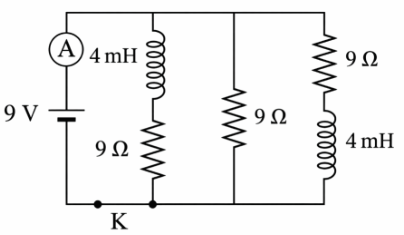
Figure shows the circuit that contains three resistances (9 $$\Omega$$ each) and two inductors (4 mH each). The reading of ammeter at the moment switch K is turned ON, is ____ A.

38
Video Solution
Question 5

A capacitor C is first charged fully with potential difference of $$V_{0}$$ and disconnected from the battery. The charged capacitor is connected across an inductor having inductance L. In t s 25% of the initial energy in the capacitor is transferred to the inductor. The value of t is ____________s.

Question 6

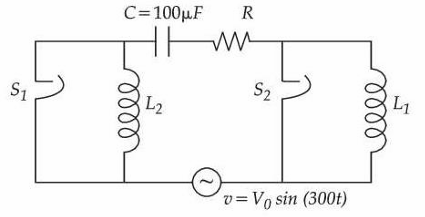
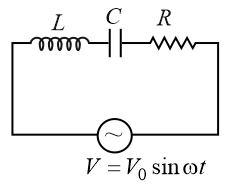
The figure given below shows an LCR series circuit with two switches $$S_1$$ and $$S_2$$. When switch $$S_1$$ is closed keeping $$S_2$$ open, the phase difference $$\phi$$ between the current and source voltage is $$30°$$ and phase difference is $$60°$$ when $$S_2$$ is closed keeping $$S_1$$ open. The value of $$(3L_1 - L_2)$$ is _________ H. 

image
Question 7

An a.c. source of angular frequency $$\omega$$ is connected across a resistor $$R$$ and a capacitor $$C$$ in series. The current is observed as $$I$$. Now the frequency of the source is changed to $$\omega/4$$, (keeping the voltage unchanged) the current is found to be $$I/3$$. The ratio of resistance to reactance at frequency $$\omega$$ is

Question 8

A LCR series circuit driven with $$E_{rms} = 90$$ V at frequency $$f_d = 30$$ Hz has resistance $$R = 80$$ $$\Omega$$, an inductance with inductive reactance $$X_L = 20.0$$ $$\Omega$$ and capacitance with capacitive reactance $$X_C = 80.0$$ $$\Omega$$. The power factor of the circuit is _______.

Question 9

An inductor stores 16 J of magnetic field energy and dissipates 32 W of thermal energy due to its resistance when an a.c. current of 2 A (rms) and frequency 5O Hz nows through it. The ratio of inductive reactance to its resistance is_____.$$(\pi=3.14)$$

Question 10

In a series LCR circuit with , $$R = 20\,\Omega$$, $$L = 1.6$$ H, $$C = 40\,\mu$$F is connected to a variable frequency a.c. source.  The inductive reactance at resonant frequency is ____________ $$\Omega$$.

Question 11

An inductor of 10 mH, capacitor of 0.1 $$\mu$$F and a resistor of 100 $$\Omega$$ are connected in series across an a.c power supply 220 V, 70 Hz. The power factor of the given circuit is 0.5. The difference in the inductive reactance and capacitance reactance is $$\sqrt{3}\,\alpha$$ $$\Omega$$. The value of $$\alpha$$ is _____.

Question 12

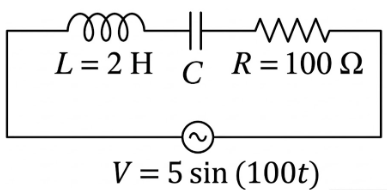
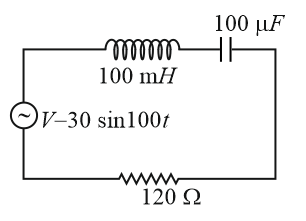
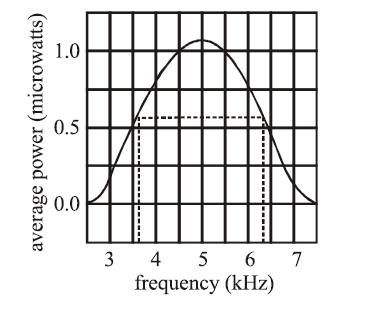
Using a variable frequency a.c. voltage source the maximum current measured in the given LCR circuit is 50 mA for V= 5 sin(100t) The values of L and R are shown in the figure. The capacitance of the capacitor (C) used is ____ µF.

50

Frequently Asked Questions