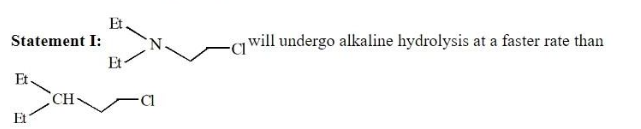
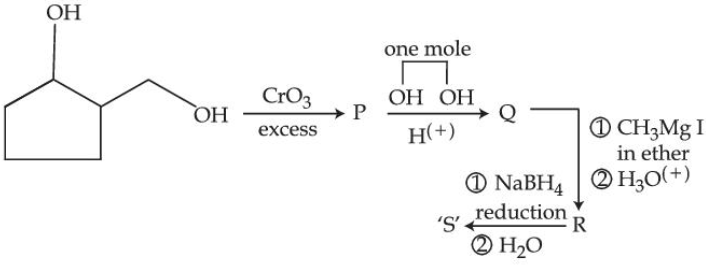
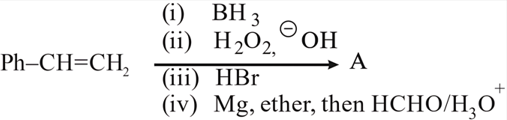
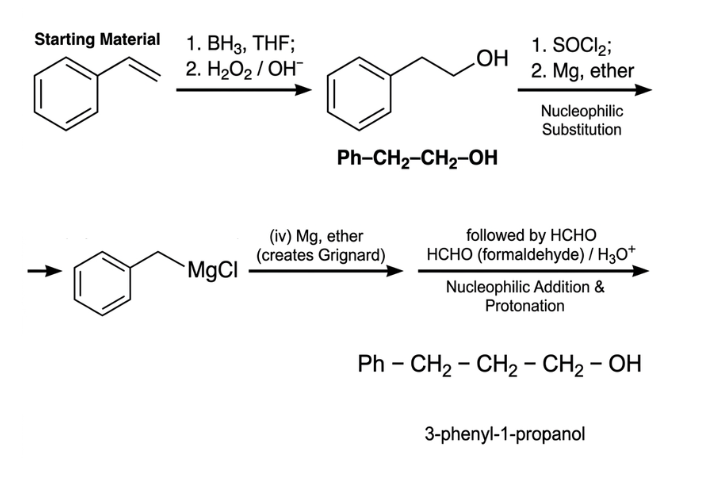
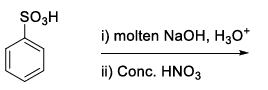
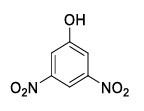
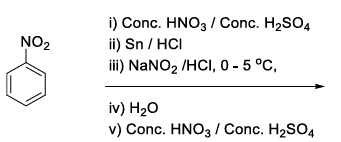
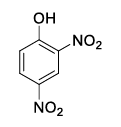
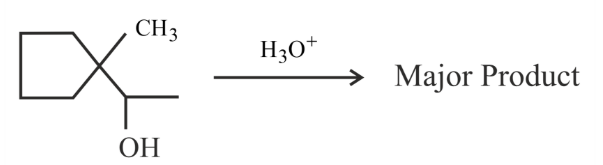
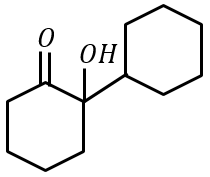
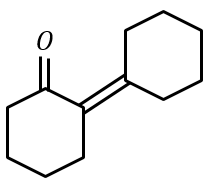
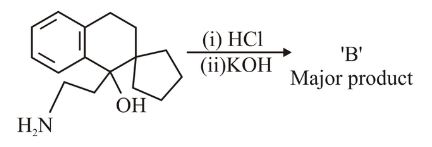
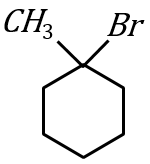
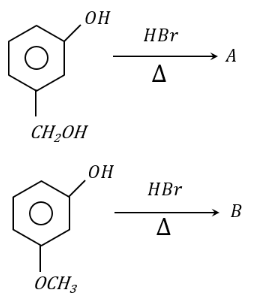
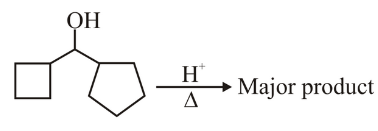
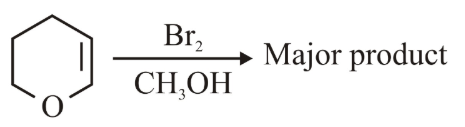
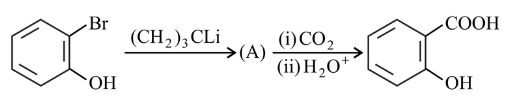
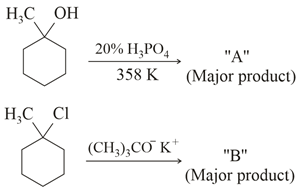
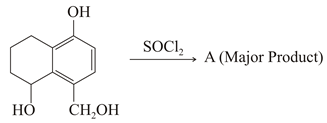
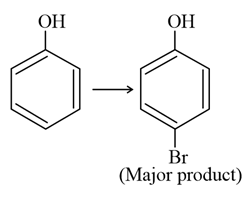
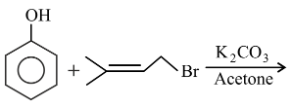
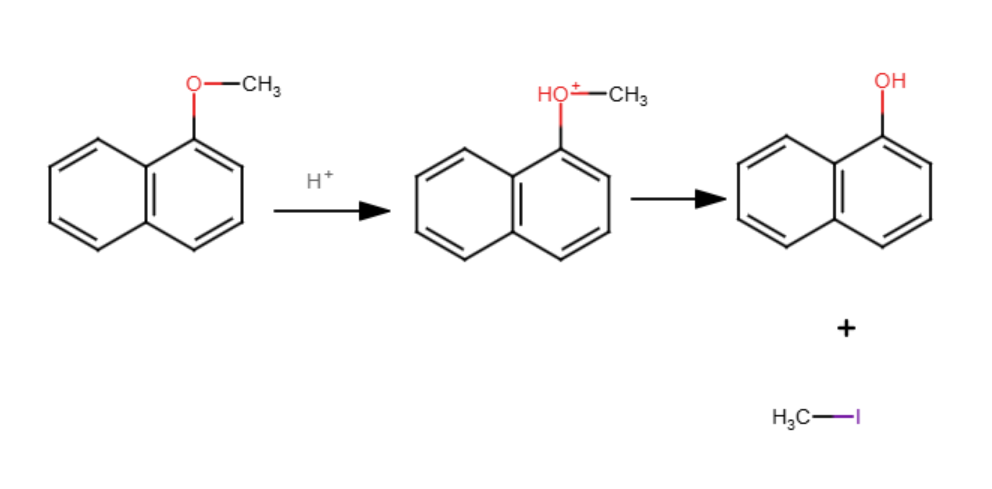
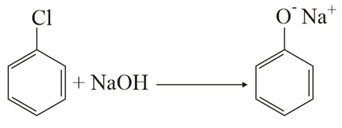
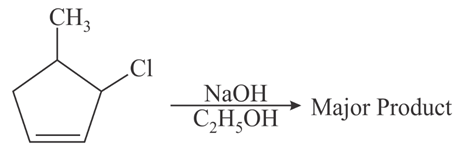
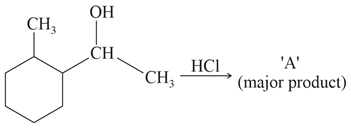
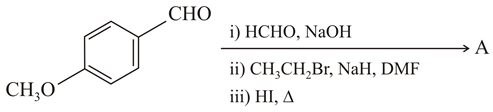
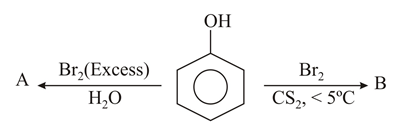
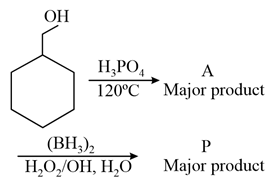
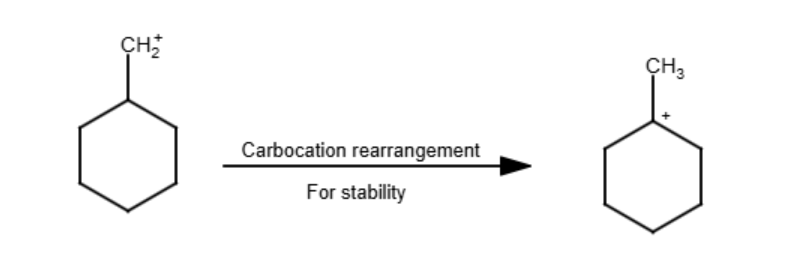
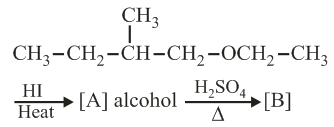
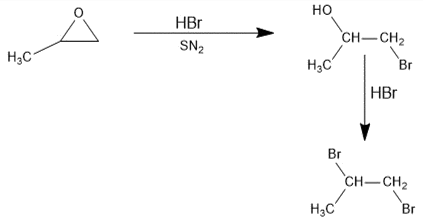
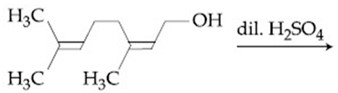
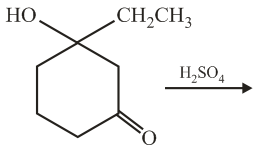
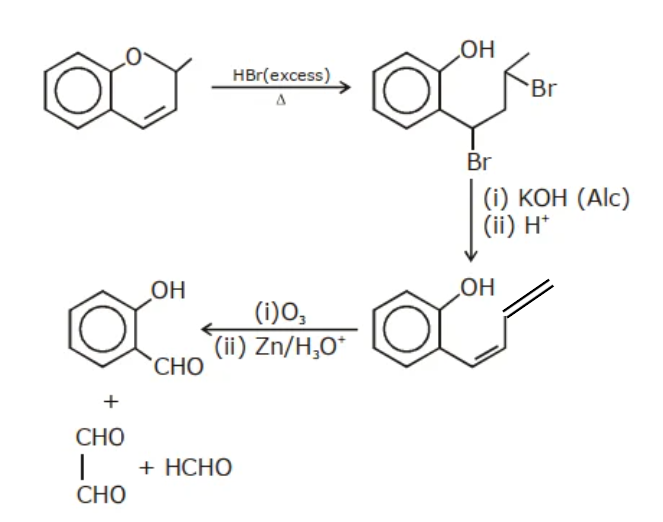
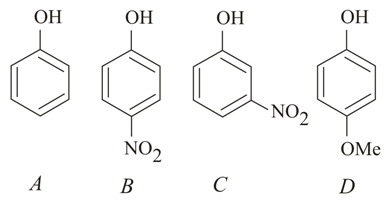
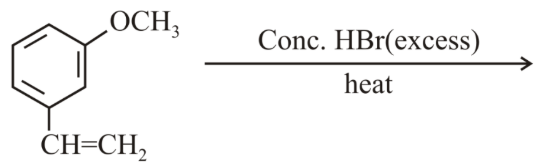
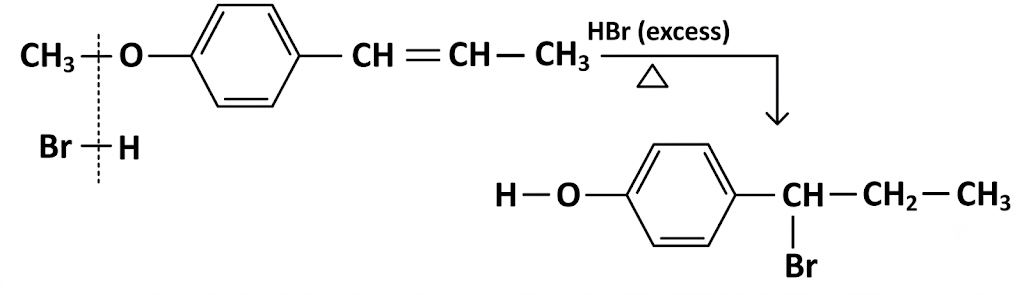
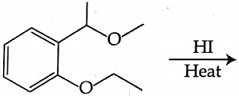
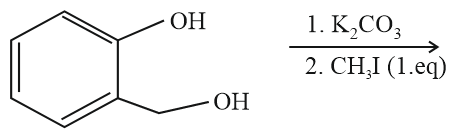
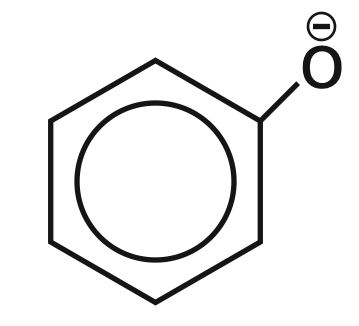
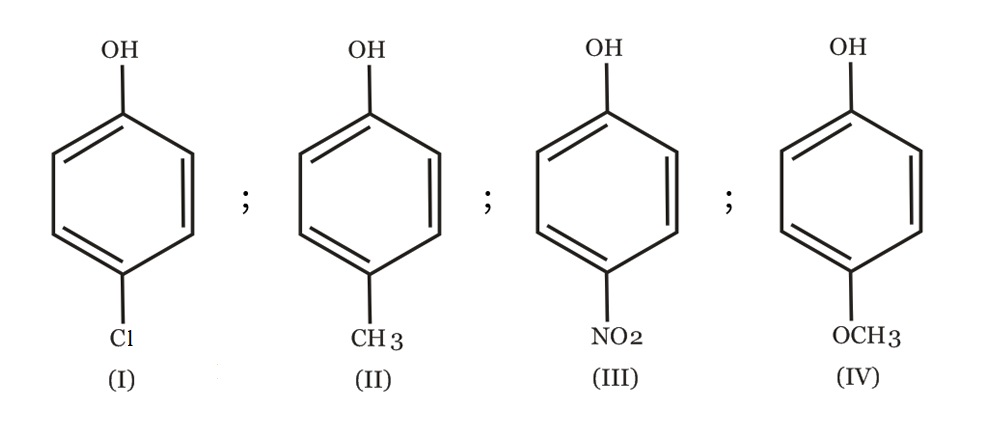
A hydroxy compound (X) with molar mass 122 g $$mol^{-1}$$ is acetylated with acetic anhydride, using a large excess of the reagent ensuring complete acetylation of all hydroxyl groups. The product obtained has a molar mass of 290 g $$mol^{-1}$$. The number of hydroxyl groups present in compound (X) is:
JEE Alcohols, Phenols & Ethers Questions
We need to find the number of hydroxyl groups in compound X.
Molar mass of compound X: 122 g/mol
Molar mass of acetylated product: 290 g/mol
During acetylation with acetic anhydride, each -OH group is converted to -OCOCH₃. In this process:
Each -OH (mass = 17) is replaced by -OCOCH₃ (mass = 59), so the increase in molar mass per -OH group is:
$$\Delta M = 59 - 17 = 42 \text{ g/mol per OH group}$$
Total increase in molar mass:
$$290 - 122 = 168 \text{ g/mol}$$
Number of OH groups:
$$n = \frac{168}{42} = 4$$
Therefore, the number of hydroxyl groups present in compound X is Option 2: 4.
A mixed ether (P), when heated with excess of hot concentrated hydrogen iodide produces two different alkyl iodides which when treated with aq. NaOH give compounds (Q) and (R). Both (Q) and (R) give yellow precipitate with NaOI. Identify the mixed ether (P):
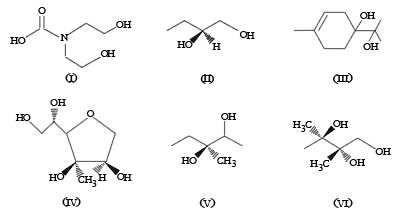
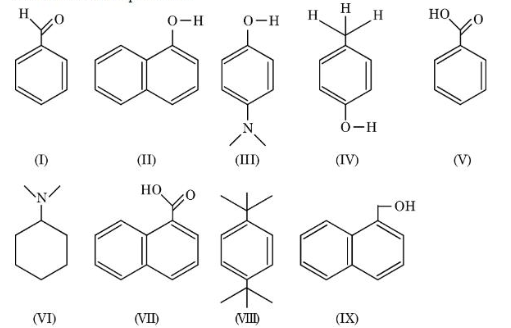
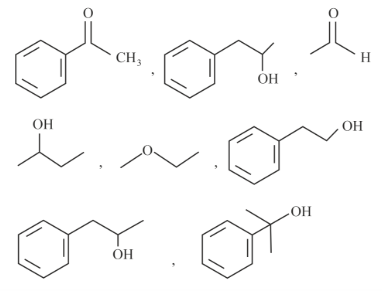
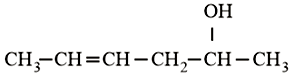
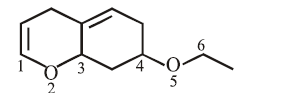
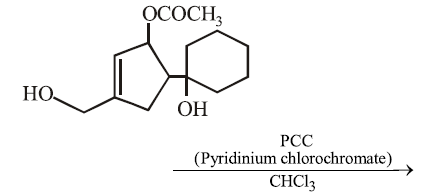
From the following, how many compounds contain at least one secondary alcohol?
Choose the correct answer from the options given below:
Consider the following reaction sequence
Compound (y) develops characterstic colour with neutral $$FeCl_{3}$$ solution.
Identify the INCORRECT statement from the following for the above sequence.
To find the molecular formula of x, we use the percentage composition and vapor density:
- Molecular Mass: $$2 \times \text{Vapour Density} = 2 \times 47 = 94 \text{ g/mol}$$.
- Empirical Calculation: * C: $$76.6\%$$ of $$94 \approx 72 \text{ g}$$ (which is 6 atoms of Carbon).
- H: $$6.38\%$$ of $$94 \approx 6 \text{ g}$$ (which is 6 atoms of Hydrogen).
- O: Remaining mass is $$94 - (72 + 6) = 16 \text{ g}$$ (which is 1 atom of Oxygen).
- Result: The formula is $$C_6H_6O$$. Compound (x) is Phenol.
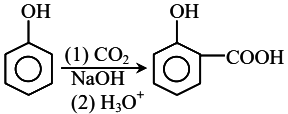
Phenol undergoes the Kolbe-Schmitt Reaction when treated with $$CO_2$$ and $$NaOH$$ under high pressure, followed by acidification.
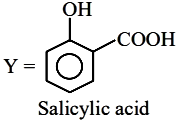
- Product (y): Salicylic acid ($$o$$-hydroxybenzoic acid).
- Identification Test: Salicylic acid contains a phenolic $$-OH$$ group, which is why it develops a characteristic violet color with neutral $$FeCl_3$$.

Based on the properties of Phenol (x) and Salicylic acid (y):
- Solubility in $$NaHCO_3$$: Correct. Salicylic acid contains a carboxylic acid group ($$-COOH$$), which is strong enough to react with sodium bicarbonate and evolve $$CO_2$$ gas. Phenol does not react with $$NaHCO_3$$.
- Relative Acidity: Option B is INCORRECT. Compound (x) (Phenol) is less acidic than compound (y) (Salicylic acid). The presence of the electron-withdrawing $$-COOH$$ group significantly increases the acidity of the molecule.
- Combustion: Correct. Both are aromatic compounds (high carbon-to-hydrogen ratio) and typically burn with a sooty flame.
- Solubility in $$NaOH$$: Correct. Both are acidic (phenol is weakly acidic; salicylic acid is more acidic) and will dissolve in a strong base like $$NaOH$$.
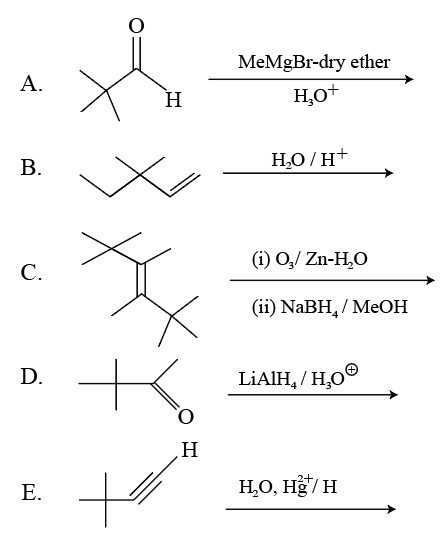
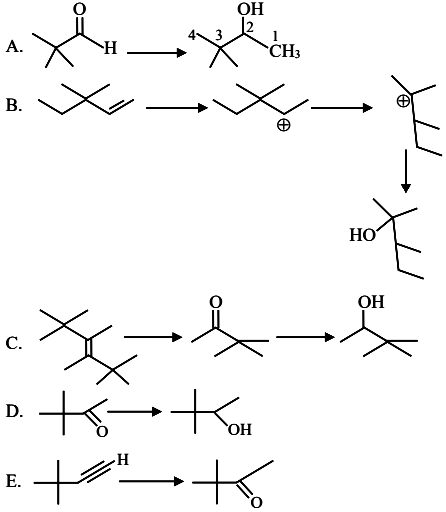
3, 3-Dimethyl-2-butanol cannot be prepared by:
Choose the correct answer from the options given below:
A. Grignard Reaction
- Reaction: The nucleophilic methyl group attacks the carbonyl carbon.
- Result: Forms 3,3-Dimethyl-2-butanol. This is a standard method to create this specific secondary alcohol.
B. Acid-Catalyzed Hydration of Alkene
- Reaction: A carbocation is formed at $$C2$$. However, because there is a quaternary carbon next to it, a 1,2-methyl shift occurs to form a more stable tertiary carbocation.
- Result: Does NOT form target. It yields 2,3-Dimethyl-2-butanol due to rearrangement.
C. Ozonolysis followed by Reduction
- Reaction: Ozonolysis breaks the double bond to form Pinacolone (3,3-dimethyl-2-butanone). $$NaBH_4$$ then reduces the ketone to a secondary alcohol.
- Result: Forms 3,3-Dimethyl-2-butanol.
D. Reduction of Ketone
- Reaction: $$LiAlH_4$$ is a strong reducing agent that converts the ketone into a secondary alcohol.
- Result: Forms 3,3-Dimethyl-2-butanol.
E. Hydration of Alkyne
- Reaction: Addition of water using $$Hg^{2+}/H^+$$ follows Markovnikov's rule to form an enol, which tautomerizes to a ketone (Pinacolone).
- Result: Does NOT form target. It stops at the ketone stage; it does not reduce further to the alcohol without an additional reducing agent.
Amongst the following, the total number of compounds soluble in aqueous NaOH at room temperature is:
In aqueous $$NaOH$$ only those organic compounds that are sufficiently acidic (so that they can lose $$H^+$$ to give an anion) are able to dissolve, because the anion formed is ionic and hence water-soluble. Let us inspect each of the eight given compounds one by one.
(1) $$C_6H_5OH$$ (phenol)
Phenol has $$pK_a \approx 10$$. A $$10^{-1}\,$$M or stronger $$NaOH$$ solution has $$pH \ge 13$$, so phenol is completely converted into the phenoxide ion $$C_6H_5O^-$$. Therefore it dissolves.
(2) $$o\text{-}NO_2C_6H_4OH$$ (o-nitrophenol)
The $$-NO_2$$ group is an electron-withdrawing group that stabilises the phenoxide ion by $$(-M)$$ and $$(-I)$$ effects, making the compound more acidic than phenol. Hence it is easily deprotonated by $$NaOH$$ and is soluble.
(3) $$p\text{-}NO_2C_6H_4OH$$ (p-nitrophenol)
For the same reason as in (2), p-nitrophenol is even more acidic; it too dissolves after forming its phenoxide ion.
(4) $$C_6H_5SO_3H$$ (benzenesulfonic acid)
Arenesulfonic acids are very strong organic acids ($$pK_a \approx -1$$). They are deprotonated completely by even weak bases; consequently they are freely soluble in $$NaOH$$.
(5) $$C_6H_5COOH$$ (benzoic acid)
Carboxylic acids are stronger acids than phenols ($$pK_a \approx 4-5$$). They react quantitatively with $$NaOH$$ to give sodium benzoate; hence they are soluble.
(6) $$CH_3COOH$$ (acetic acid)
Being a typical carboxylic acid ($$pK_a \approx 4.8$$), it is again converted into acetate ion in the basic medium and therefore dissolves.
(7) $$C_6H_5NH_2$$ (aniline)
Aniline is a base, not an acid. It cannot donate a proton to $$OH^-$$, so it does not dissolve in aqueous $$NaOH$$.
(8) $$C_6H_5CH_2OH$$ (benzyl alcohol)
Aliphatic alcohols have $$pK_a \approx 16-18$$, far less acidic than necessary to be deprotonated by $$NaOH$$ under ordinary conditions. Hence benzyl alcohol also remains insoluble.
Compounds soluble in aqueous $$NaOH$$ at room temperature are therefore (1), (2), (3), (4), (5) and (6) — a total of $$6$$ compounds.
Hence, the correct choice is
Option C which is: $$6$$
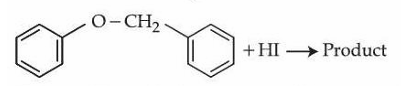
Consider the following reaction.
Statement I : In the above reaction, product formed will be a mixture of benzyl alcohol and iodobenzene.
Statement II : In the above reaction, the $$-O-CH_2-$$ bond is cleaved to give the product.
In the light of the above statements, choose the correct answer from the options given below :
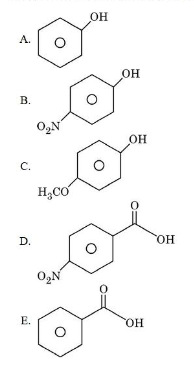
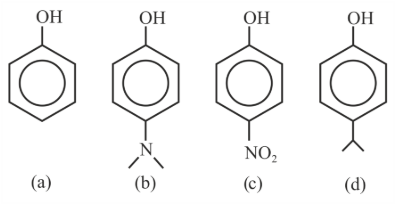
The descending order of acidity among the following compounds is:

choose the correct answer from the options given below:
Acid strength is decided by the stability of the conjugate base that remains after loss of $$H^+$$. A more stable conjugate base means a stronger acid.
The stabilising factors to look for are: (i) resonance delocalisation, (ii) -I (inductive) electron withdrawal, (iii) +M (mesomeric) electron donation which has the opposite effect.
Step 1 : Separate carboxylic acids from phenols/alcohols
Carboxylic acids are far more acidic (pKₐ ≈ 4-5) than phenols (pKₐ ≈ 10) and aliphatic alcohols (pKₐ ≈ 16).
Hence any carboxylic acid in the list will automatically be the strongest.
The two carboxylic acids are:
(D) p-nitrobenzoic acid and (E) benzoic acid.
Step 2 : Order the two carboxylic acids
The conjugate base of p-nitrobenzoic acid bears a $$\mathrm{NO_2}$$ group at the para position. $$\mathrm{NO_2}$$ is a strong -M and -I group that withdraws electron density, dispersing the negative charge by resonance as well as inductively.
Therefore it stabilises the benzoate ion much more than does a hydrogen (in plain benzoic acid).
So $$\text{acidity: } (D) \gt (E).$$
Step 3 : Compare phenolic compounds
Among phenols acidity depends on the substituent on the ring.
(B) o-Nitrophenol : $$\mathrm{NO_2}$$ is −M and −I, stabilising the phenoxide ion by delocalising the charge. However, intramolecular H-bonding in o-nitrophenol slightly reduces its ability to form stronger hydrogen bonds with solvent, yet overall it is still more acidic than unsubstituted phenol.
(C) p-Methoxyphenol : $$\mathrm{OCH_3}$$ shows a strong +M (electron-donating) effect which pushes electron density toward the oxygen, destabilising the phenoxide ion. Thus its acidity is lower than that of phenol itself.
Hence $$\text{acidity: } (B) \gt (C).$$
Step 4 : Insert the alcohol
(A) Cyclohexanol possesses no resonance stabilisation of its alkoxide ion; only a weak −I effect of the ring is present.
Consequently, cyclohexanol is far less acidic than any phenol but a little more acidic than p-methoxyphenol because the +M donation in (C) actually destabilises that phenoxide even more than the absence of resonance in an aliphatic alcohol.
Combining every block:
(D) p-nitrobenzoic acid > (E) benzoic acid > (B) o-nitrophenol > (A) cyclohexanol > (C) p-methoxyphenol.
Therefore the required descending order of acidity is
$$D \gt E \gt B \gt A \gt C$$
Option D which is: D > E > B > A > C
Consider compounds A, B and C with following structural formulae
A = $$CH_3 - CH_2 - CH_2 - CH_2 - CH_2 - OH$$
B = $$CH_2 = CH - CH_2 - CH_2 - CH_3$$
C = $$HO - CH_2 - CH_2 - CH(OH) - CH_3$$
For the conversion of B from A, reagent (D) required is _______ and structural formula of product (E) obtained when C undergoes same reaction using excess reagent (D) is _______.
Consider the following sequence of reactions
The major product P is:
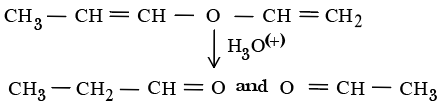
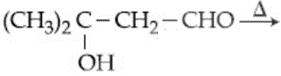
The unsaturated ether On acidic hydrolysis produces carbonyl compom1ds as shown below:-
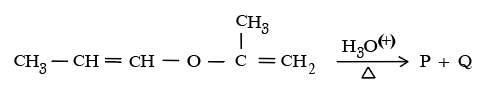
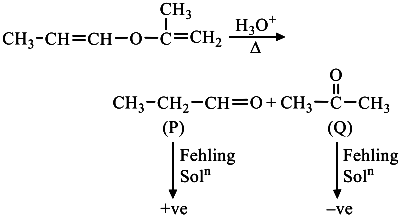
Based On this, predict the solution/reagent that will help to distillguish "P" and "Q" obtained in the following reaction:-
The reactions which produce alcohol as the product are:
$$A. CH_{4}+O_{2}\xrightarrow[\Delta]{Mo_{2}O_{3}}\\B.2CH_{3}CH_{3}+3O_{2}\xrightarrow[\Delta]{(CH_{3}COO)_{2}Mn}\\C.(CH_{3})_{3}CH\xrightarrow{KMnO_{4}}\\D.2CH_{4}+O_{2}\xrightarrow{Cu/523K/100atm.}\\E.CH_{3}-CH=CH-CH_{3}\xrightarrow{KMnO_{4}/H^{+}}$$
Choose the correct answer from the options given below :
4.7 g of phenol is heated with Zn to give product X. If this reaction goes to 60% completion then the number of moles of compound X formed will be _______ $$\times 10^{-2}$$. (Nearest Integer)
(Given molar mass in g mol$$^{-1}$$: H:1, C:12, O:16)
One mole of phenol is treated with dilute HNO$$_3$$ at 298 K to give a mixture of products. The mixture is separated by steam distillation. The steam volatile compound (X) is separated. The increase in percentage of oxygen in (X) with respect to phenol is _______ $$\times 10^{-1}$$ %. (Given molar mass in g mol$$^{-1}$$ H:1, C:12, N:14, O:16)
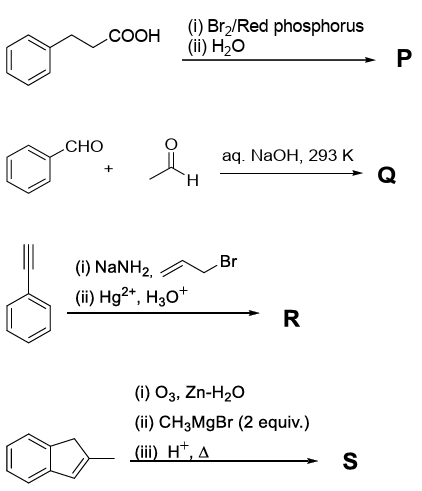
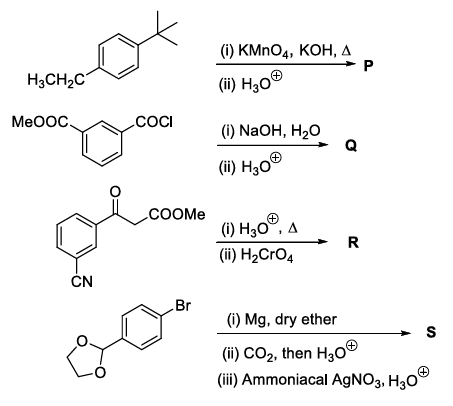
Monocyclic compounds P, Q, R and S are the major products formed in the reaction sequences given below.

The product having the highest number of unsaturated carbon atom(s) is
An “unsaturated” carbon is any carbon that is part of a multiple bond (C=C or C≡C).
Therefore, to compare P, Q, R and S we must first identify the ring produced in each sequence and then count the sp2/sp hybridised carbons present in that ring.
Case 1 : Formation of P
The dihydric alcohol supplied in sequence (1) undergoes intramolecular dehydration with conc. $$H_2SO_4$$ to give a saturated cyclic ether (tetrahydrofuran type).
All ring carbons remain $$sp^3$$-hybridised, so
Number of unsaturated carbons in P = 0
Case 2 : Formation of Q
In sequence (2) the diol first forms a leaving-group derivative, followed by a single E2 elimination, producing a cyclohexene ring with one C=C bond.
Only the two carbons of that double bond are $$sp^2$$; hence
Number of unsaturated carbons in Q = 2
Case 3 : Formation of R
Sequence (3) involves two eliminations that furnish a conjugated diene ring, cyclohexa-1,3-diene. Two C=C bonds ⟹ four $$sp^2$$ carbons, so
Number of unsaturated carbons in R = 4
Case 4 : Formation of S
The reagents in sequence (4) carry out stepwise dehydrogenation until an aromatic ring is obtained. The monocyclic product is benzene (or a benzene derivative), which contains six $$sp^2$$ carbons.
Therefore,
Number of unsaturated carbons in S = 6
Comparing: $$P:0 \lt Q:2 \lt R:4 \lt S:6$$
Hence, the product possessing the largest number of unsaturated carbon atoms is S.
Option D which is: S
For the reaction sequence given below, the correct statement(s) is(are)

(In the options, X is any atom other than carbon and hydrogen, and it is different in P, Q and R)
The given reaction sequence converts an alcohol first into three different alkides P, Q and R in which the carbon is attached to three different hetero-atoms X.
For alcoholic substrates the most common choices of X that are introduced by standard laboratory reagents are the halogens F, Cl and Br.
Hence we set
$$P : \;\; \text{R-Cl}, \qquad Q : \;\; \text{R-Br}, \qquad R : \;\; \text{R-F}$$
All four statements can now be examined one by one.
Case 1 - C-X bond length
Within one row the bond length increases with the size (atomic radius) of the halogen:
$$\text{C-F} (1.35\;\text{Å}) \lt \text{C-Cl} (1.78\;\text{Å}) \lt \text{C-Br} (1.94\;\text{Å}).$$
Therefore
$$\text{C-X length : } Q(\text{Br}) \gt P(\text{Cl}) \gt R(\text{F}).$$
Option A claims a different order (Q > R > P), hence A is incorrect.
Case 2 - C-X bond enthalpy
Bond enthalpy falls as the halogen becomes larger and the orbital overlap weakens:
$$\text{C-F} \;(485\;\text{kJ mol}^{-1}) \gt \text{C-Cl} \;(327\;\text{kJ mol}^{-1}) \gt \text{C-Br} \;(285\;\text{kJ mol}^{-1}).$$
Thus
$$\text{C-X enthalpy : } R(\text{F}) \gt P(\text{Cl}) \gt Q(\text{Br}).$$
This matches Option B exactly, so B is correct.
Case 3 - Relative S$$\mathbf{N}$$2 reactivity
The rate of an S$$\mathbf{N}$$2 reaction depends mainly on how good the leaving group X$$^-$$ is. A better leaving group corresponds to a weaker C-X bond and a stronger conjugate acid HX (lower p$$K_a$$). Hence
$$\text{Br}^- \;(\text{best}) \gt \text{Cl}^- \gg \text{F}^-.$$
Consequently
$$\text{Reactivity : } Q(\text{Br}) \gt P(\text{Cl}) \gg R(\text{F}).$$
Option C proposes P > R > Q, which is the reverse trend, so C is incorrect.
Case 4 - p$$K_a$$ of the conjugate acids
$$pK_a(\text{HF}) \approx 3.2, \qquad pK_a(\text{HCl}) \approx -7, \qquad pK_a(\text{HBr}) \approx -9.$$
Larger (less negative) p$$K_a$$ means the acid is weaker:
$$pK_a : R(\text{HF}) \gt P(\text{HCl}) \gt Q(\text{HBr}).$$
Option D expects R > Q > P, so it is also incorrect.
Only Option B satisfies the correct order in its entirety.
Answer - Option B which is: C-X bond enthalpy in P, Q and R follows the order R > P > Q.
For the reaction sequence given below, the correct statement(s) is(are)
The given sequence of reagents fits very well with the following set of transformations:
$$\text{Anisole (methoxy-benzene)} \xrightarrow[\text{reflux}]{\text{excess HI}} \underset{X}{\text{Phenol}} \xrightarrow[\text{heat}]{CHCl_3/KOH} \underset{Y}{\text{Salicylaldehyde}} \xrightarrow[\;]{\text{alk. } KMnO_4\; \text{or } K_2Cr_2O_7/H^+} \underset{Z}{\text{Salicylic acid}}$$
Step-1 (Formation of X)
HI cleaves the C-O bond in anisole by an $$S_N1/S_N2$$ mechanism.
The aromatic ring retains the -OH group while the alkyl part leaves as $$CH_3I$$.
Hence $$X = C_6H_5OH$$ (phenol), an oxygen-containing compound.
Step-2 (Formation of Y)
Phenol on heating with $$CHCl_3$$ in strongly basic medium (Reimer-Tiemann reaction) gives an ortho-formyl derivative, salicylaldehyde ($$2\!-\!HO\!-\!C_6H_4CHO$$).
Therefore $$Y$$ is also an oxygen-containing compound (it has both -OH and -CHO groups).
Step-3 (Formation of Z)
The -CHO group of salicylaldehyde is readily oxidised by alkaline $$KMnO_4$$ or $$K_2Cr_2O_7/H^+$$ to the -COOH group, giving salicylic acid ($$2\!-\!HO\!-\!C_6H_4COOH$$).
$$Z$$ is a carboxylic acid, not an amine.
Checking the given statements
• Option A: “Both X and Y are oxygen containing compounds.” Phenol (X) and salicylaldehyde (Y) each contain oxygen, so this statement is true.
• Option B: “Y on heating with $$CHCl_3/KOH$$ forms isocyanide.” The carbylamine test (formation of isocyanide) requires a primary amine. Y is an aldehyde, not an amine, so no isocyanide is produced. Statement B is false.
• Option C: “Z reacts with Hinsberg’s reagent.” Hinsberg’s test is specific for primary and secondary amines. Z is a carboxylic acid, hence it does not react with benzenesulfonyl chloride. Statement C is false.
• Option D: “Z is an aromatic primary amine.” Z is salicylic acid, not an amine at all. Statement D is false.
Thus, the only correct statement is:
Option A which is: Both X and Y are oxygen containing compounds.
For the reaction sequence given below, the correct statement(s) is(are)
The first step is the addition of a Grignard reagent to an aldehyde.
Propanal, $$CH_3CH_2CHO$$, is treated with $$CH_3MgBr$$ followed by hydrolysis.
$$CH_3CH_2CHO \;\xrightarrow[\;H_2O\;]{CH_3MgBr}\; CH_3CH(OH)CH_2CH_3$$
The product P is $$2$$-butanol. The carbon bearing the $$OH$$ group is attached to four different groups $$\left(CH_3,\,CH_2CH_3,\,H,\,OH\right)$$, so it is chiral. Hence P is optically active. Therefore, statement A is correct.
Next, P is oxidised with a mild oxidising agent such as PCC (or $$K_2Cr_2O_7/H^+$$) to give compound Q.
$$CH_3CH(OH)CH_2CH_3 \;\xrightarrow{\text{PCC}}\; CH_3COCH_2CH_3$$
Q is 2-butanone, a neutral ketone. Ketones do not react with aqueous $$NaHCO_3$$, so Q will not produce effervescence of $$CO_2$$. Hence statement C is wrong.
The ketone Q is then completely reduced (Clemmensen or Wolff-Kishner reduction) to give compound R.
$$CH_3COCH_2CH_3 \;\xrightarrow{\text{Zn-Hg/HCl or N\!NH_2/KOH}}\; CH_3CH_2CH_2CH_3$$
R is n-butane, a saturated hydrocarbon containing no triple bond; therefore R is not an alkyne. Statement D is wrong.
Finally, R undergoes free-radical bromination with $$Br_2/h\nu$$ to give a mixture of bromoalkanes collectively represented as compound S.
Because all these bromoalkanes are fully saturated, they contain neither $$C=C$$ nor $$C\equiv C$$ bonds. Saturated halides do not decolourise alkaline $$KMnO_4$$ (Baeyer’s test), so S gives a negative Baeyer’s test. Statement B is wrong.
Thus, among the given statements only A is correct.
Option A which is: P is optically active.
Adsorption of phenol from its aqueous solution on to fly ash obeys Freundlich isotherm. At a given temperature, from 10 mg g$$^{-1}$$ and 16 mg g$$^{-1}$$ aqueous phenol solutions, the concentrations of adsorbed phenol are measured to be 4 mg g$$^{-1}$$ and 10 mg g$$^{-1}$$, respectively. At this temperature, the concentration (in mg g$$^{-1}$$) of adsorbed phenol from 20 mg g$$^{-1}$$ aqueous solution of phenol will be ______.
Use: $$\log_{10} 2 = 0.3$$
The Freundlich adsorption isotherm is written as
$$\frac{x}{m}=k\,C^{1/n}$$
where $$\tfrac{x}{m}$$ is the mass of phenol adsorbed per gram of fly-ash and $$C$$ is the equilibrium concentration of phenol in the solution (both here in mg g$$^{-1}$$).
Taking common logarithm (base 10):
$$\log\!\left(\frac{x}{m}\right)=\log k+\frac{1}{n}\,\log C \quad -(1)$$
The two experimental data pairs are
$$C_1=10\;\text{mg g}^{-1},\;\; \left(\frac{x}{m}\right)_1 = 4\;\text{mg g}^{-1}$$
$$C_2=16\;\text{mg g}^{-1},\;\; \left(\frac{x}{m}\right)_2 = 10\;\text{mg g}^{-1}$$
Substituting in equation $$-(1)$$:
For the first pair:
$$\log 4 = \log k + \frac{1}{n}\,\log 10 \quad -(2)$$
For the second pair:
$$\log 10 = \log k + \frac{1}{n}\,\log 16 \quad -(3)$$
Using the given value $$\log 2 = 0.3$$:
$$\log 4 = \log(2^2)=2\times0.3 = 0.6$$
$$\log 10 = 1$$
$$\log 16 = \log(2^4)=4\times0.3 = 1.2$$
Equations $$-(2)$$ and $$-(3)$$ become
$$0.6 = \log k + \frac{1}{n}(1) \quad -(4)$$
$$1.0 = \log k + \frac{1}{n}(1.2) \quad -(5)$$
Subtract $$-(4)$$ from $$-(5)$$:
$$1.0 - 0.6 = \frac{1}{n}(1.2 - 1.0)$$
$$0.4 = \frac{1}{n}\times0.2$$
$$\frac{1}{n} = 2 \;\;\Longrightarrow\;\; n = 0.5$$
From equation $$-(4)$$:
$$\log k = 0.6 - \frac{1}{n}(1) = 0.6 - 2 = -1.4$$
Hence $$k = 10^{-1.4}$$
For a new solution with concentration $$C_3 = 20\;\text{mg g}^{-1}$$,
$$\log C_3 = \log(2\times10)=\log 2 + \log 10 = 0.3 + 1 = 1.3$$
Using equation $$-(1)$$:
$$\log\!\left(\frac{x}{m}\right)_3 = -1.4 + 2 \times 1.3 = -1.4 + 2.6 = 1.2$$
Therefore,
$$\left(\frac{x}{m}\right)_3 = 10^{1.2}$$
An antilog of $$1.2$$ is
$$10^{1.2} = 10^{1}\times10^{0.2} \approx 10 \times 1.58 \approx 15.8\;\text{mg g}^{-1}$$
Thus, the concentration of phenol adsorbed from a 20 mg g$$^{-1}$$ solution is approximately $$15.8\;\text{mg g}^{-1}$$, which lies in the required range 15.5 - 16.5.
The reaction sequence given below is carried out with 16 moles of X. The yield of the major product in each step is given below the product in parentheses. The amount (in grams) of S produced is ________.
Use: Atomic mass (in amu): H = 1, C = 12, O = 16, Br = 80
The major products obtained from the reactions in List-II are the reactants for the named reactions mentioned in List-I. Match each entry in List-I with the appropriate entry in List-II and choose the correct option.
We begin by writing the four named reactions listed in List-I along with the specific substance that must be taken as the starting material (reactant) in each case.
• P : Kolbe-Schmitt (Kolbe) reaction - it is carried out with $$C_6H_5ONa$$ (sodium phenoxide).
• Q : Reimer-Tiemann reaction - it starts from free phenol $$C_6H_5OH$$ in strongly alkaline medium.
• R : Williamson ether synthesis - it is performed with an alkoxide ion such as $$RO^-\,Na^+$$ (sodium alkoxide).
• S : Etard reaction - the oxidation is applied to toluene $$C_6H_5CH_3$$ with $$CrO_2Cl_2$$ to give benzaldehyde.
Next, let us look at the transformations given in List-II and note the major product formed in each of them.
Case 1 (List-II entry 1) : Decarboxylation of benzoic acid with soda-lime $$C_6H_5COONa \xrightarrow[\text{soda-lime}]{\Delta } C_6H_5CH_3$$ Major product = $$C_6H_5CH_3$$ (toluene).
Case 2 (List-II entry 2) : Dow process / high-temperature hydrolysis of chlorobenzene $$C_6H_5Cl + 2\,NaOH \xrightarrow[623\,\text{K}]{320\,\text{atm}} C_6H_5ONa + NaCl + H_2O$$ Major product before acidification = $$C_6H_5ONa$$ (sodium phenoxide).
Case 3 (List-II entry 3) : Cumene (isopropylbenzene) oxidation followed by acid hydrolysis $$\text{Cumene} \xrightarrow[\text{air}]{\text{O}_2} \text{cumene hydro-peroxide} \xrightarrow[\text{dil.}~H_2SO_4]{} C_6H_5OH + (CH_3)_2CO$$ Major product = $$C_6H_5OH$$ (phenol).
Case 4 (List-II entry 4) : Reaction of ethanol with sodium metal $$2\,C_2H_5OH + 2\,Na \rightarrow 2\,C_2H_5ONa + H_2 \uparrow$$ Major product = $$C_2H_5ONa$$ (sodium ethoxide, a typical alkoxide).
Now we simply link each named reaction from List-I with the entry in List-II that furnishes the required reactant:
• P (Kolbe, needs $$C_6H_5ONa$$) ← produced in Case 2 ⇒ P→2.
• Q (Reimer-Tiemann, needs $$C_6H_5OH$$) ← produced in Case 3 ⇒ Q→3.
• R (Williamson ether synthesis, needs an alkoxide such as $$C_2H_5ONa$$) ← produced in Case 4 ⇒ R→4.
• S (Etard reaction, needs toluene $$C_6H_5CH_3$$) ← produced in Case 1 ⇒ S→1.
The correct matching is therefore P→2; Q→3; R→4; S→1.
Comparing this sequence with the options supplied, we find that it corresponds to
Option B which is: P→2; Q→3; R→4; S→1.
Which one of the following, with HBr will give a phenol?
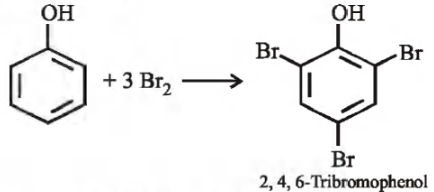
What amount of bromine will be required to convert 2 g of phenol into 2,4,6-tribromophenol? (Given molar mass in $$gmol^{-1}$$ of C, H, O, Br are 12, 1, 16, 80 respectively)
The bromination of phenol to form 2,4,6-tribromophenol follows the reaction: $$ C_6H_5OH + 3Br_2 \to C_6H_2Br_3OH + 3HBr $$. For 2 g of phenol, the molar mass is calculated as $$(C_6H_5OH) = 6(12) + 6(1) + 16 = 94$$ g/mol, while bromine has a molar mass of $$Br_2 = 2 \times 80 = 160$$ g/mol.
The number of moles of phenol is $$ n_{phenol} = \frac{2}{94} \text{ mol} $$. From stoichiometry, 1 mole of phenol requires 3 moles of bromine, so $$ n_{Br_2} = 3 \times \frac{2}{94} = \frac{6}{94} = \frac{3}{47} \text{ mol} $$. The mass of bromine required is $$ m_{Br_2} = \frac{3}{47} \times 160 = \frac{480}{47} = 10.21 \text{ g} \approx 10.22 \text{ g} $$. Therefore, the correct answer is Option 4: 10.22 g.
A toxic compound "A" when reacted with NaCN in aqueous acidic medium yields an edible cooking component and food preservative 'B'. "B" is converted to "C" by diborane and can be used as an additive to petrol to reduce emission. "C" upon reaction with oleum at $$140^{\circ}$$ C yields an inhalable anesthetic "D". Identify "A", "B", "C" and "D", respectively.
The key information given for each step helps us identify the compounds one-by-one.
Step 1 (Identifying B from its uses)
The product $$B$$ is said to be “an edible cooking component and food preservative”.
Vinegar is used for cooking and preservation and its active component is acetic acid, $$CH_3COOH$$.
Therefore, $$B$$ must be acetic acid.
Step 2 (Finding A that gives acetic acid with $$NaCN/H^+$$)
In an acidic medium the -OH group of a primary alcohol is protonated and can be displaced by the nucleophile $$CN^-$$.
With methanol this gives methyl cyanide (acetonitrile) which is immediately hydrolysed by the same acidic water present to give acetic acid:
$$CH_3OH + H^+ \longrightarrow CH_3OH_2^+$$
$$CH_3OH_2^+ + CN^- \longrightarrow CH_3CN + H_2O$$
$$CH_3CN + 2H_2O + H^+ \longrightarrow CH_3COOH + NH_4^+$$
Thus the toxic compound $$A$$ is methanol, $$CH_3OH$$.
Step 3 (Conversion of B to C with diborane)
Diborane (or the $$BH_3$$ generated from it) is a selective reducing agent for carboxylic acids:
$$RCOOH \xrightarrow[B_2H_6]{\text{(BH}_3\text{)}} RCH_2OH$$
Applying this to acetic acid: $$CH_3COOH \xrightarrow[B_2H_6]{} CH_3CH_2OH$$
Hence $$C$$ is ethanol. Ethanol is blended with petrol (gasohol, E10, E20 etc.) to lower harmful emissions, matching the statement.
Step 4 (Formation of D from ethanol with oleum at $$140^{\circ}\text{C}$$)
At about $$140^{\circ}\text{C}$$ concentrated $$H_2SO_4$$ (or oleum) dehydrates primary alcohols to symmetrical ethers:
$$2 \, CH_3CH_2OH \xrightarrow[\;140^{\circ}C\;]{H_2SO_4} CH_3CH_2OCH_2CH_3 + H_2O$$
The product is diethyl ether, which has long been used as an inhalation anesthetic. Therefore $$D$$ is diethyl ether.
Step 5 (Listing the four compounds)
A : methanol, $$CH_3OH$$
B : acetic acid, $$CH_3COOH$$
C : ethanol, $$CH_3CH_2OH$$
D : diethyl ether, $$CH_3CH_2OCH_2CH_3$$
Comparing with the options, these correspond to Option C.
Final answer: Methanol → Acetic acid → Ethanol → Diethyl ether (Option C).
Which one of the following reactions will not lead to the desired ether formation in major proportion? (iso-Bu $$\Rightarrow$$ isobutyl, sec-Bu $$\Rightarrow$$ sec-butyl, nPr $$\Rightarrow$$ n-propyl, $$^t$$Bu $$\Rightarrow$$ tert-butyl, Et $$\Rightarrow$$ ethyl)
In Williamson ether synthesis, an alkoxide ion reacts with an alkyl halide by the $$\mathrm{S_N2}$$ mechanism to give the ether.
For the $$\mathrm{S_N2}$$ path to dominate, the alkyl halide should be primary and the attacking alkoxide should not be highly hindered.
If the halide is secondary or tertiary, or if the nucleophile is very bulky, the $$\mathrm{E2}$$ elimination pathway competes strongly and often becomes the major reaction, giving an alkene instead of the ether.
Case A:
$$^tBuO^-Na^+ + EtBr \; \longrightarrow \; ^tBu-O-Et$$
The halide carbon in $$EtBr$$ is primary. Even though $$^tBuO^-$$ is bulky, $$\mathrm{S_N2}$$ on a primary centre proceeds fast. Desired ether forms in good yield.
Case B:
$$PhO^-Na^+ + CH_3Br \; \longrightarrow \; Ph-O-CH_3$$
$$CH_3Br$$ is a primary (methyl) halide; phenoxide is not excessively bulky. Efficient $$\mathrm{S_N2}$$ gives the required anisole in high yield.
Case C:
$$Na^+O^-nPr + nPrBr \; \longrightarrow \; nPr-O-nPr$$
Both nucleophile and electrophile are unhindered primary species. $$\mathrm{S_N2}$$ dominates and the symmetrical ether is obtained in major proportion.
Case D:
$$iso\text{-}BuO^-Na^+ + sec\text{-}BuBr \; \longrightarrow \; sec\text{-}Bu-O-iso\text{-}Bu$$
Here the alkyl halide $$sec\text{-}BuBr$$ is secondary. The attacking alkoxide $$iso\text{-}BuO^-$$ is branched and sterically hindered. Under these conditions the nucleophile abstracts a $$\beta$$-hydrogen much faster than it can perform backside attack on the secondary carbon. Consequently, the $$\mathrm{E2}$$ elimination that produces 2-butene becomes the chief reaction, and very little ether is formed.
Therefore, the reaction that will not give the desired ether as the main product is found in Option D (Option 4).
Answer - Option D (4)
Benzene is treated with oleum to produce compound (X) which when further heated with molten sodium hydroxide followed by acidification produces compound (Y). The compound Y is treated with zinc metal to produce compound (Z). Identify the structure of compound (Z) from the following option.
Given below are two statements : Statement (I) : The boiling points of alcohols and phenols increase with increase in the number of C-atoms. Statement (II) : The boiling points of alcohols and phenols are higher in comparison to other class of compounds such as ethers, haloalkanes. In the light of the above statements, choose the correct answer from the options given below :
Evaluate two statements about boiling points of alcohols and phenols.
Statement I: Boiling points of alcohols and phenols increase with increase in the number of C-atoms.
As the number of carbon atoms increases, the molecular weight and van der Waals forces increase, leading to higher boiling points. This is TRUE.
Statement II: Boiling points of alcohols and phenols are higher compared to ethers, haloalkanes of comparable molecular mass.
Alcohols and phenols form intermolecular hydrogen bonds (due to the O-H group), which ethers and haloalkanes cannot form. This gives them higher boiling points. This is TRUE.
The correct answer is Option 2: Both Statement I and Statement II are true.
Given below are two statements:


involving lone pair of electrons on nitrogen. In the light of the above statements, choose the most appropriate answer from the options given below

0.1 mole of compound ' S ' will weigh _______ g. (Given molar mass in $$gmol^{-1}$$ C : 12, H : 1, O : 16)
In the following reaction sequence, the major product Q is
The final product A, formed in the following reaction sequence is :
Which among the following has highest boiling point?
We compare the boiling points of four organic compounds with similar molecular weights.
A) $$CH_3CH_2CH_2CH_3$$ (Butane): Non-polar alkane. Only weak London dispersion forces. Boiling point: $$-0.5°C$$.
B) $$CH_3CH_2CH_2CH_2OH$$ (1-Butanol): Contains an $$-OH$$ group capable of strong hydrogen bonding. Boiling point: $$117.7°C$$.
C) $$CH_3CH_2CH_2CHO$$ (Butanal): Aldehyde with a polar $$C=O$$ group, but no H-bonding with itself (no O-H or N-H). Only dipole-dipole interactions. Boiling point: $$75°C$$.
D) $$C_2H_5-O-C_2H_5$$ (Diethyl ether): Polar but cannot form hydrogen bonds with itself. Boiling point: $$34.6°C$$.
The order of boiling points is: Butanol > Butanal > Diethyl ether > Butane.
1-Butanol has the highest boiling point due to strong intermolecular hydrogen bonding. The answer is Option B) $$CH_3CH_2CH_2CH_2OH$$.
Reaction of iso-propylbenzene with $$O_2$$ followed by the treatment with $$H_3O^+$$ forms phenol and a by-product P. Reaction of P with 3 equivalents of $$Cl_2$$ gives compound Q. Treatment of Q with $$Ca(OH)_2$$ produces compound R and calcium salt S.
The correct statement(s) regarding P, Q, R and S is(are)
The cumene (Hock) process converts iso-propylbenzene (cumene) to phenol and acetone by way of the cumene-hydroperoxide rearrangement.
Hence, in the first step the by-product is
$$P = (CH_3)_2C=O \;(\text{acetone}).$$
Preparation of Q
Each molecule of $$Cl_2$$ supplies two chlorine atoms.
Three “equivalents” (three moles) of $$Cl_2$$ therefore furnish six chlorine atoms - exactly the number needed to replace all six α-hydrogens of acetone.
Chlorination in sunlight thus converts both methyl groups into trichloromethyl groups:
$$CH_3COCH_3 \;\xrightarrow[\;h\nu\;]{3\,Cl_2}\; CCl_3COCCl_3$$
so
$$Q = CCl_3COCCl_3\;(\text{hexachloroacetone}).$$
Formation of R and S
A 1,1,1-trihalo ketone undergoes the haloform reaction even in simple alkali.
Treating Q with slaked lime gives one molecule of chloroform (haloform) together with the calcium salt of the residual acid:
$$CCl_3COCCl_3 + 2\,Ca(OH)_2 \;\longrightarrow\; 2\,COCl_3^-Ca^{2+} + 2\,CHCl_3 + 2\,H_2O$$
Thus
$$R = CHCl_3\;(\text{chloroform}),\qquad S = Ca(CCl_3COO)_2\;(\text{calcium trichloroacetate}).$$
Checking the statements
Option A Acetone (P) condenses with chloroform (R) in strong base (KOH) to give chlorobutanol (also called chloretone). Acidification merely neutralises the medium: the product remains unchanged. Hence statement A is correct.
Option B For the slow photo-oxidation of chloroform moisture is essential; dry $$CHCl_3$$ exposed only to $$O_2$$ and light does not accumulate phosgene. Therefore statement B is not accepted as correct for the conditions written.
Option C Alkaline hydrolysis of Q liberates chloroform and the trichloroacetate ion; it never produces $$Cl_3CCH_2OH$$. Hence statement C is incorrect.
Option D On heating, calcium trichloroacetate (S) does not regenerate acetone. Therefore statement D is incorrect.
Only statement A is correct.
Final answer: Option A which is: Reaction of P with R in the presence of KOH followed by acidification gives chlorobutanol.
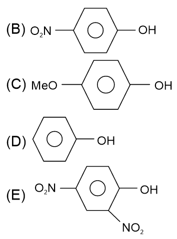
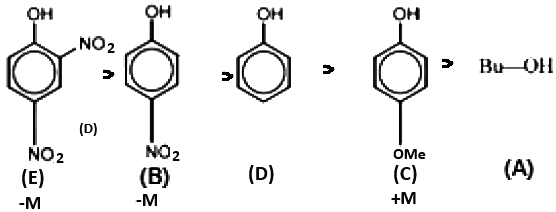
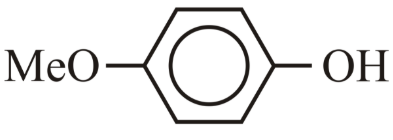
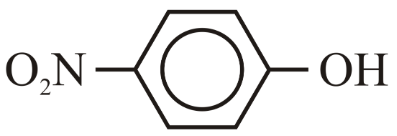
The ascending order of acidity of $$-OH$$ group in the following compounds is :
(A) Bu-OH
Choose the correct answer from the options given below :
- (A) Bu-OH (Butanol): An aliphatic alcohol. Lacks resonance stabilization for its conjugate base, making it the least acidic in the group.
- (C) 4-Methoxyphenol: The $$-\text{OCH}_3$$ group at the para-position exerts a strong electron-donating mesomeric ($$+M$$) effect, which destabilizes the phenoxide ion. It is less acidic than unsubstituted phenol.
- (D) Phenol: Standard reference with resonance-stabilized phenoxide ion.
- (B) 4-Nitrophenol: The $$-\text{NO}_2$$ group at the para-position acts as a strong electron-withdrawing group ($$-M, -I$$), strongly stabilizing the negative charge.
- (E) 2,4-Dinitrophenol: Contains two strong electron-withdrawing nitro groups ($$-\text{NO}_2$$) stabilizing the phenoxide ion via resonance and induction, making it the most acidic.
Final Ascending Order:
$$\text{(A)} < \text{(C)} < \text{(D)} < \text{(B)} < \text{(E)}$$
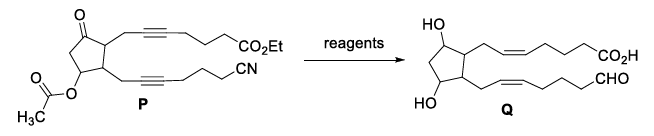
The option(s) with correct sequence of reagents for the conversion of P to Q is(are)
Three different reducible groups are present in $$P$$: an internal alkyne, a nitro group and a carbonyl group. They have to be converted successively to a cis-alkene, an amine and an alcohol in the final product $$Q$$. For each transformation we choose the most chemoselective reagent and decide the safest order so that the later steps do not undo or over-reduce what has already been achieved.
Step 1 - Reduction of the C≡C bond only
Lindlar’s catalyst with $$H_2$$ stops at the cis-alkene stage and does not disturb either nitro or carbonyl groups.
Hence the first reagent must be “Lindlar’s catalyst, $$H_2$$”.
Step 2 - Reduction of the −NO2 group
The most selective reagent that converts $$-NO_2$$ to $$-NH_2$$ in the presence of a carbonyl is $$SnCl_2/HCl$$.
Using it before reducing the carbonyl is preferable because the strongly acidic medium would protonate or even dehydrate an alcohol if it were already present.
Therefore the second reagent should be “$$SnCl_2/HCl$$”.
Step 3 - Reduction of the C=O group
After the nitro group has become an amine, an electrically neutral hydride reagent that works in neutral or mildly basic medium is required for the carbonyl.
$$NaBH_4$$ cleanly converts aldehydes/ketones to alcohols and leaves alkenes and amines untouched.
Thus the third reagent is “$$NaBH_4$$”.
Step 4 - Acidic work-up
The hydride reduction is performed in methanol or ethanol; an aqueous acid work-up ($$H_3O^+$$) is necessary to protonate the alkoxide, giving the free alcohol and completing the synthesis.
Consequently the fourth reagent is “$$H_3O^+$$”.
Why the other sequences fail
• If $$NaBH_4$$ comes before $$SnCl_2/HCl$$ (Options C and D), the alcohol formed in step 1 would face strongly acidic conditions in step 2 and might dehydrate or undergo side reactions.
• Placing $$H_3O^+$$ immediately after the partial hydrogenation (Option B) serves no purpose and the subsequent acidic reduction with $$SnCl_2/HCl$$ would again endanger any alcohol already present.
• Any sequence that applies $$SnCl_2/HCl$$ or $$NaBH_4$$ before Lindlar’s hydrogenation risks over-reduction of the alkyne (because later catalytic hydrogenation over Pd/C would reduce the newly formed alkene all the way to an alkane).
Thus the only logically consistent sequence is
i) Lindlar's catalyst, $$H_2$$ → ii) $$SnCl_2/HCl$$ → iii) $$NaBH_4$$ → iv) $$H_3O^+$$
Option A matches this order.
Final Answer: Option A which is: i) Lindlar's catalyst, $$H_2$$; ii) $$SnCl_2$$/HCl; iii) $$NaBH_4$$; iv) $$H_3O^+$$.
Phenol treated with chloroform in presence of sodium hydroxide, which further hydrolysed in presence of an acid results
{image}
An organic compound P having molecular formula $$C_6H_6O_3$$ gives ferric chloride test and does not have intramolecular hydrogen bond. The compound P reacts with 3 equivalents of $$NH_2OH$$ to produce oxime Q. Treatment of P with excess methyl iodide in the presence of KOH produces compound R as the major product. Reaction of R with excess iso-butylmagnesium bromide followed by treatment with $$H_3O^+$$ gives compound S as the major product.
The total number of methyl ($$-CH_3$$) group(s) in compound S is ______.
Given below are two statements:
Assertion A: $$pK_a$$ value of phenol is $$10.0$$ while that of ethanol is $$15.9$$.
Reason R: Ethanol is stronger acid than phenol.
In the light of the above statements, choose the correct answer from the options given below:
We need to evaluate the Assertion (A) and Reason (R) about the acidity of phenol and ethanol.
Assertion A: "$$pK_a$$ value of phenol is 10.0 while that of ethanol is 15.9."
This is a factual statement and is TRUE. A lower $$pK_a$$ value indicates a stronger acid. Phenol ($$pK_a = 10.0$$) is a stronger acid than ethanol ($$pK_a = 15.9$$) because the phenoxide ion ($$C_6H_5O^-$$) is stabilized by resonance with the aromatic ring, while the ethoxide ion ($$C_2H_5O^-$$) has no such stabilization.
Reason R: "Ethanol is stronger acid than phenol."
This is FALSE. As explained above, phenol is a much stronger acid than ethanol (lower $$pK_a$$). The statement has the comparison reversed.
The correct answer is Option (1): A is true but R is false.
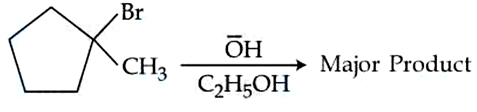
Identify the major product in the following reaction.
Mechanism: $$\text{E}2$$ Elimination. Tertiary alkyl halides preferentially undergo elimination over substitution when treated with a strong base.
Phenolic group can be identified by a positive:
Given below are two statements:
Assertion A: Alcohols react both as nucleophiles and electrophiles.
Reason R: Alcohols react with active metals such as sodium, potassium and aluminum to yield corresponding alkoxides and liberate hydrogen.
In the light of the above statements, choose the correct answer from the options given below:
Assertion A: Alcohols react both as nucleophiles and electrophiles. This is true. The oxygen atom with its lone pairs allows alcohols to act as nucleophiles (e.g., in Williamson ether synthesis). After protonation of the -OH group, the carbon becomes electrophilic as water becomes a good leaving group.
Reason R: Alcohols react with active metals such as sodium, potassium, and aluminum to yield corresponding alkoxides and liberate hydrogen. This is true: $$2ROH + 2Na \rightarrow 2RONa + H_2\uparrow$$.
However, the reaction with active metals demonstrates the acidic (proton-donating) nature of alcohols, not their dual nucleophilic/electrophilic behavior. Therefore, R is not the correct explanation of A.
The answer is Option D: Both A and R are true but R is NOT the correct explanation of A.
Salicylaldehyde is synthesized from phenol, when reacted with
Find out the major product formed from the following reaction. [Me: $$-CH_3$$]
Given below are two statements :
Statement (I) : p-nitrophenol is more acidic than m-nitrophenol and o-nitrophenol.
Statement (II) : Ethanol will give immediate turbidity with Lucas reagent.
In the light of the above statements, choose the correct answer from the options given below :
Statement I: p-Nitrophenol is more acidic than m-nitrophenol and o-nitrophenol.
The $$-NO_2$$ group is electron-withdrawing. At the para position, it stabilizes the phenoxide ion through resonance (direct conjugation), making p-nitrophenol the most acidic among the three isomers. This is true.
(Note: While o-nitrophenol has intramolecular hydrogen bonding which reduces its effective acidity in solution, p-nitrophenol has the strongest -R effect stabilization.)
Statement II: Ethanol will give immediate turbidity with Lucas reagent.
Lucas reagent (conc. HCl + ZnCl$$_2$$) is used to distinguish between primary, secondary, and tertiary alcohols. Primary alcohols like ethanol do not give immediate turbidity - they show no reaction at room temperature. Only tertiary alcohols give immediate turbidity. This is false.
Statement I is true but Statement II is false. The answer corresponds to Option (1).
List-I contains various reaction sequences and List-II contains the possible products. Match each entry in List-I with the appropriate entry in List-II and choose the correct option.
| List-I | List-II | ||
|---|---|---|---|
| (P) | ![]() | (1) | ![]() |
| (Q) | ![]() | (2) | ![]() |
| (R) | ![]() | (3) | ![]() |
| (S) | ![]() | (4) | ![]() |
| (5) | ![]() | ||
First write down the complete data of the question.
List-I (reaction sequences):
P. $$C_6H_5OCH_3 \;\xrightarrow[\text{excess}]{\,HI\,}$$ (anisole is heated with excess hydroiodic acid)
Q. $$C_6H_5OH \;\xrightarrow[]{\,conc.\;HNO_3/\,conc.\;H_2SO_4\,}$$ (phenol treated with conc. nitrating mixture)
R. $$C_6H_5OH \;\xrightarrow[]{\,CH_3COCl/pyridine\,}$$ (phenol acetylated with acetyl chloride in pyridine)
S. $$C_6H_5OH \;\xrightarrow[]{\,NaOH,\;140^{\circ}C,\;7\,atm\,}\;NaO\!C_6H_4O^-$$ $$\xrightarrow[]{\,CO_2\,}\xrightarrow[]{\,H^+\,}$$ (Kolbe-Schmitt reaction followed by acidification)
List-II (probable products):
1. $$o\text{-}HO\!C_6H_4COOH$$ (salicylic acid)
2. $$p\text{-}HO\!C_6H_4NO_2$$ (p-nitrophenol)
3. $$C_6H_5OH + CH_3I$$
4. $$C_6H_5OCOCH_3$$ (phenyl acetate)
5. $$2,4,6\text{-}trinitrophenol$$ (picric acid)
Now analyse every reaction one by one.
Case P:Anisole $$\left(C_6H_5OCH_3\right)$$ when heated with excess $$HI$$ undergoes cleavage of the C-O bond attached to the alkyl group, forming phenol and methyl iodide: $$C_6H_5OCH_3 + HI \;\longrightarrow\; C_6H_5OH + CH_3I$$ This matches product 3.
Case Q:Phenol reacts with concentrated $$HNO_3/H_2SO_4$$ at low temperature to give picric acid (2,4,6-trinitrophenol) because -OH is a strong activator and three nitro groups finally enter the ring: $$C_6H_5OH \xrightarrow[]{conc.\;HNO_3/H_2SO_4} 2,4,6\text{-}trinitrophenol$$ Hence Q corresponds to product 5.
Case R:Acetylation of phenol with acetyl chloride in pyridine gives phenyl acetate: $$C_6H_5OH + CH_3COCl \;\xrightarrow[]{pyridine}\; C_6H_5OCOCH_3 + HCl$$ Therefore R matches product 4.
Case S:The Kolbe-Schmitt reaction converts phenoxide ion to o-hydroxybenzoate ion which after acidification yields salicylic acid: $$C_6H_5OH \xrightarrow[]{NaOH} C_6H_5O^-Na^+ \xrightarrow[7\,atm]{CO_2,\;140^{\circ}C} o\text{-}HO\!C_6H_4COONa \xrightarrow[]{H^+} o\text{-}HO\!C_6H_4COOH$$ So S corresponds to product 1.
Collecting all matches:
P → 3, Q → 5, R → 4, S → 1
The option that contains this combination is Option A.
Final answer: Option A which is: P-3, Q-5, R-4, S-1.
Match List - I with List - II.
Choose the correct answer from the options given below:
List-I contains various reaction sequences and List-II contains different phenolic compounds. Match each entry in List-I with the appropriate entry in List-II and choose the correct option.
| List-I | List-II | ||
|---|---|---|---|
| (P) | ![]() | (1) | ![]() |
| (Q) | ![]() | (2) | ![]() |
| (R) | ![]() | (3) | ![]() |
| (S) | ![]() | (4) | ![]() |
| (5) | ![]() | ||
The reagents mentioned in List-I are the classical name reactions of phenolic chemistry. Before matching, recall what each reaction sequence gives:
P Dow’s process $$C_6H_5Cl \xrightarrow[\;300\;{\rm atm}\;]{NaOH,\;623\;{\rm K}}\;C_6H_5ONa \xrightarrow{H^+} C_6H_5OH$$ → product is simple phenol.
Q Kolbe-Schmitt reaction $$C_6H_5ONa \xrightarrow{CO_2,\;400\;{\rm K},\;4\!-\!7\;{\rm atm}} \;o\!-\!HO\!-\!C_6H_4COONa \xrightarrow{H^+} o\!-\!HO\!-\!C_6H_4COOH$$ → product is o-hydroxybenzoic acid (salicylic acid).
R Reimer-Tiemann reaction $$C_6H_5OH \xrightarrow{CHCl_3/NaOH,\;343\;{\rm K}} o\!-\!HO\!-\!C_6H_4CHO$$ → product is o-hydroxybenzaldehyde (salicylaldehyde).
S Nitration of phenol with conc. $$HNO_3/H_2SO_4$$ (333 K) $$C_6H_5OH \xrightarrow{conc\;HNO_3/conc\;H_2SO_4} 2,4,6\text{-trinitrophenol}$$ → product is picric acid.
Now read List-II (numbered phenolic compounds):
(1) 2,4,6-trinitrophenol (picric acid)
(2) …
(3) phenol
(4) o-hydroxybenzaldehyde (salicylaldehyde)
(5) o-hydroxybenzoic acid (salicylic acid)
Matching each entry:
P (Dow) → phenol → 3
Q (Kolbe-Schmitt) → o-hydroxybenzoic acid → 5
R (Reimer-Tiemann) → o-hydroxybenzaldehyde → 4
S (nitration) → picric acid → 1
Thus P-3, Q-5, R-4, S-1.
The option containing this combination is
Option C which is: P-3, Q-5, R-4, S-1.
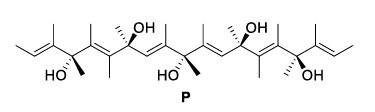
The number of hydroxyl groups present in the product $$P$$ is __________.
In the following reactions, P, Q, R, and S are the major products.
The correct statement(s) about P, Q, R, and S is(are)
The sequence of reactions (reagents were supplied in the original problem) converts the same four-carbon skeleton into four different compounds, labelled P, Q, R and S. For every product we will first write the structural formula and then check whether any carbon atom is attached to four different groups (an asymmetric or chiral carbon).
Product P
The first reaction is acid-catalysed hydration of an alkene, and it gives $$\mathbf{2\text{-}butanol}$$
$$CH_3-CH(OH)-CH_2-CH_3$$
The carbon marked with an asterisk bears $$OH$$, $$H$$, $$CH_3$$ and $$CH_2CH_3$$, four different groups:
$$CH_3-\mathbf{C^*}(OH)(H)-CH_2-CH_3$$
Hence P contains one asymmetric carbon and is optically active.
Product Q
In the second step P is treated with Lucas reagent $$HCl/ZnCl_2$$, replacing $$OH$$ by $$Cl$$ to give $$\mathbf{2\text{-}chlorobutane}$$
$$CH_3-CH(Cl)-CH_2-CH_3$$
Again the starred carbon is attached to $$Cl$$, $$H$$, $$CH_3$$ and $$CH_2CH_3$$ (all different):
$$CH_3-\mathbf{C^*}(Cl)(H)-CH_2-CH_3$$
Therefore Q has one asymmetric carbon and is optically active.
Product R
On heating P with concentrated $$H_2SO_4$$, dehydration occurs and the major alkene formed is $$\mathbf{trans\text{-}2\text{-}butene}$$
$$CH_3-CH=CH-CH_3$$
Every carbon in an alkene is $$sp^2$$-hybridised and, at most, bonded to three different groups. No carbon here bears four different substituents, so R possesses no asymmetric carbon; it is achiral.
Product S
Oxidation of P with chromic reagent (or PCC) gives $$\mathbf{butan\text{-}2\text{-}one}$$
$$CH_3-CO-CH_2-CH_3$$
The carbonyl carbon is $$sp^2$$-hybridised and attached to two identical oxygen-linked entities; again, no carbon in the molecule has four different groups. Thus S is also achiral.
Summary of chirality:
• P - chiral (one asymmetric carbon)
• Q - chiral (one asymmetric carbon)
• R - achiral
• S - achiral
Therefore the correct statement is:
Option A which is: Both P and Q have asymmetric carbon(s).
Consider the following reaction scheme and choose the correct option(s) for the major products Q, R and S.
In the following reactions, P, Q, R, and S are the major products.

The correct statement about P, Q, R, and S is
The correct order for acidity of the following hydroxyl compound is
(A) CH$$_3$$OH
(B) (CH$$_3$$)$$_3$$COH
(C)
(D)
(E)

Choose the correct answer from the options given below:
We need to arrange the given hydroxyl compounds in order of decreasing acidity.
The acidity of a hydroxyl compound ($$R-OH$$) depends on the stability of the conjugate base ($$R-O^-$$) formed after loss of the proton. The more stable the conjugate base, the stronger the acid.
(A) $$CH_3OH$$ - Methanol (aliphatic alcohol)
(B) $$(CH_3)_3COH$$ - tert-Butanol (aliphatic alcohol)
(C) Phenol ($$C_6H_5OH$$)
(D) p-MeO-Phenol ($$4-CH_3O-C_6H_4-OH$$)
(E) p-$$NO_2$$-Phenol ($$4-NO_2-C_6H_4-OH$$)
Phenols are significantly more acidic than aliphatic alcohols because the phenoxide ion ($$C_6H_5O^-$$) is stabilized by resonance with the aromatic ring. The negative charge is delocalized over the ring. Aliphatic alkoxide ions have no such resonance stabilization. Therefore: All phenols > All alcohols in acidity.
Order among the phenols (E, C, D).
- p-$$NO_2$$-Phenol (E): The $$NO_2$$ group is a strong electron-withdrawing group (both by inductive and resonance effects). It stabilizes the phenoxide ion by pulling electron density away from the oxygen, delocalizing the negative charge further. This makes it the most acidic phenol.
- Phenol (C): The unsubstituted phenol, with moderate acidity.
- p-MeO-Phenol (D): The $$OCH_3$$ group is an electron-donating group by resonance (lone pairs on oxygen donate into the ring). This destabilizes the phenoxide ion by increasing electron density, making it less acidic than unsubstituted phenol. Therefore: E > C > D.
Order among the alcohols (A, B).
- $$CH_3OH$$ (A): Methanol has one methyl group, which is weakly electron-donating by hyperconjugation/induction.
- $$(CH_3)_3COH$$ (B): tert-Butanol has three methyl groups donating electron density to the carbon bearing the $$OH$$. This destabilizes the alkoxide ion more than in methanol. Therefore: A > B in acidity.
$$E > C > D > A > B$$p-$$NO_2$$-Phenol > Phenol > p-MeO-Phenol > $$CH_3OH$$ > $$(CH_3)_3COH$$
The correct answer is Option 4: E > C > D > A > B.
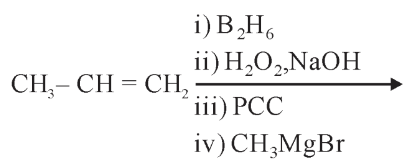
The product formed in the following multistep reaction is:
Following the reaction sequence with propene, the first stage involves hydroboration with $$B_2H_6$$, leading to anti‐Markovnikov addition of $$BH_3$$. Subsequent oxidation with $$H_2O_2, NaOH$$ converts the intermediate to the anti‐Markovnikov alcohol $$CH_3CH_2CH_2OH$$ (1-propanol). The primary alcohol is then oxidized by pyridinium chlorochromate ($$PCC$$) to afford the aldehyde $$CH_3CH_2CHO$$ (propanal). In the final step, reaction with the Grignard reagent $$CH_3MgBr$$ followed by hydrolysis yields the secondary alcohol $$CH_3CH_2CH(OH)CH_3$$ (2-butanol).
The overall product is $$CH_3CH_2CH(OH)CH_3$$ (butan-2-ol), which corresponds to option 3.
The strongest acid from the following is
Solution & Explanation
- (A) p-chlorophenol
- (B) p-methylphenol (p-cresol)
- (C) Phenol
- (D) p-nitrophenol
An acid is stronger if it can easily lose a hydrogen ion (H+) and form a stable negative ion (phenoxide ion).
- Electron-Withdrawing Groups (EWGs): Pull electron density away from the oxygen atom, stabilizing the negative charge. This increases acidity.
- Electron-Donating Groups (EDGs): Push electron density toward the oxygen atom, destabilizing the negative charge. This decreases acidity.
- p-nitrophenol: Contains a nitro group (-NO2). The -NO2 group is a Strong EWG due to both its powerful resonance (-M) and inductive (-I) effects. It strongly pulls electron density away from the ring, making it the most stable phenoxide ion.
- p-chlorophenol: Contains a chlorine atom (-Cl). Chlorine is a Weak EWG. While its inductive effect (-I) withdraws electrons, its resonance effect (+M) donates some electrons back, making it significantly less acidic than the nitro-substituted version.
- Phenol: Has no substituents on the benzene ring, representing the standard baseline reference point.
- p-methylphenol: Contains a methyl group (-CH3). The methyl group is an EDG due to hyperconjugation and inductive effect (+I). It destabilizes the negative charge, making this molecule the least acidic of all.
p-nitrophenol > p-chlorophenol > Phenol > p-methylphenol
In the following reactions, P, Q, R, and S are the major products.

The correct statement(s) about P, Q, R, and S is (are)
Step-1 : Identification of the products P, Q, R and S from the reaction scheme given in the question.
(i) The first reaction is the hydroxylation of ethene with cold, dilute alkaline $$KMnO_4$$ (Baeyer’s reagent). The double bond is converted into a cis-vicinal diol:
$$CH_2 = CH_2 \;\xrightarrow[\text{cold}]{KMnO_4/OH^-}\; HO-CH_2-CH_2-OH$$
Hence, $$P = HO-CH_2-CH_2-OH$$ (ethylene glycol).
(ii) The second reaction is vigorous oxidation of o-xylene with hot alkaline $$KMnO_4$$ followed by acidification. Both benzylic methyl groups are oxidised to carboxyl groups giving phthalic acid:
$$o\text{-}CH_3C_6H_4CH_3 \;\xrightarrow[\text{heat}]{KMnO_4}\; HOOC-C_6H_4-COOH$$
Hence, $$Q = HOOC-C_6H_4-COOH$$ (phthalic acid).
(iii) The third reaction is the dehydrogenation of 1-propanol over copper at 523 K. Primary alcohols give the corresponding aldehydes under these conditions:
$$CH_3CH_2CH_2OH \;\xrightarrow{Cu/523\,K}\; CH_3CH_2CHO$$
Hence, $$R = CH_3CH_2CHO$$ (propanal).
(iv) The fourth reaction is the Rosenmund reduction of benzoyl chloride, or an equivalent route that stops at the aldehyde stage. Thus the product is benzaldehyde:
$$C_6H_5COCl \;\xrightarrow{H_2/Pd\,\,\text{(poisoned)}}\; C_6H_5CHO$$
Hence, $$S = C_6H_5CHO$$ (benzaldehyde).
Step-2 : Verification of the statements.
Option A : Ethylene glycol (P) and phthalic acid (Q) are indeed used as monomers for polyester formation.
• Dacron (polyethylene terephthalate) is obtained from ethylene glycol and terephthalic acid.
• Glyptal is obtained from ethylene glycol and phthalic acid.
Therefore, Option A is correct.
Option B : P, Q and R are claimed to be dicarboxylic acids.
• P is a di-alcohol (diol), not a diacid.
• R is an aldehyde, not an acid.
Hence Option B is wrong.
Option C : “Compounds Q and R are the same.”
Q is phthalic acid (aromatic diacid) whereas R is propanal (aliphatic aldehyde). They are completely different. Option C is wrong.
Option D :
• R (propanal) possesses α-hydrogen atoms, so it undergoes aldol condensation in the presence of base. The statement “R does not undergo aldol condensation” is false.
• S (benzaldehyde) has no α-hydrogen atoms and therefore readily undergoes the Cannizzaro reaction. The statement “S does not undergo Cannizzaro reaction” is also false.
Hence Option D is wrong.
Step-3 : Conclusion.
Only Option A is correct.
Final answer : Option A which is: P and Q are monomers of polymers dacron and glyptal, respectively.
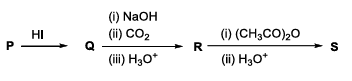
In the given reaction scheme, P is a phenyl alkyl ether, Q is an aromatic compound; R and S are the major products.
The correct statement about S is
When one side of an ether is aryl and the other side is alkyl, hot concentrated $$HI$$ selectively cleaves the alkyl-oxygen bond (because the aryl-oxygen bond has partial double-bond character). Therefore:
$$\text{Phenyl-O-R} \xrightarrow{HI} \text{Phenol }(Q)\;+\;RI$$
Thus $$Q$$ is phenol, $$C_6H_5OH$$.
The Kolbe-Schmitt reaction is the standard industrial route for converting phenol into salicylic acid. The three-step sequence is:
$$C_6H_5OH\; \xrightarrow[\text{(ii) }CO_2]{\text{(i) NaOH, 140-160 °C, 4-7 atm}} \xrightarrow[\;]{\text{(iii) }H_3O^+} o\text{-hydroxybenzoic acid}$$
Hence $$R$$ is salicylic acid, commonly written as $$o\text{-}HO-C_6H_4-COOH$$.
Acetic anhydride acetylates the phenolic -OH of salicylic acid much faster than the -COOH group. The two-step sequence
$$o\text{-}HO-C_6H_4-COOH \xrightarrow[\text{(ii) }H_3O^+]{\text{(i) }(CH_3CO)_2O} o\text{-}AcO-C_6H_4-COOH$$
gives $$S$$ = acetylsalicylic acid, better known as aspirin.
Pharmacologically, aspirin irreversibly acetylates and inactivates cyclo-oxygenase (COX-1 and COX-2). These enzymes catalyse the conversion of arachidonic acid into prostaglandins. By blocking this step, aspirin inhibits the biosynthesis of prostaglandins, which are mediators of pain, fever and inflammation.
Therefore, the correct statement about $$S$$ is:
Option B which is: It inhibits the synthesis of prostaglandin.
In the cumene to phenol preparation in presence of air, the intermediate is
Find out the major product for the following reaction
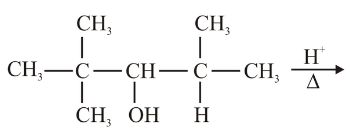
Decreasing order of dehydration of the following alcohols is
In the following reaction, 'B' is
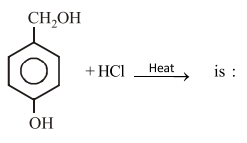
'A' and 'B' formed in the following set of reactions are:
Reaction for Product A
In the first starting material, we have two different types of $-OH$ groups:
- Phenolic -OH (Top): Attached directly to the benzene ring.
- Benzylic -OH (Bottom): Attached to a side-chain CH2 group.
The Mechanism:
- The Phenol is unreactive: The C-O bond in phenol has partial double-bond character due to resonance. Breaking this bond to replace it with Br is extremely difficult and does not happen under these conditions.
- The Benzylic Alcohol reacts: The side-chain -OH gets protonated by HBr to form a good leaving group H2O. It then undergoes a substitution reaction (likely SN1 because the benzylic carbocation is very stable) where the Br- replaces the -OH.
- Result A: The phenolic group remains, and the benzylic alcohol becomes a benzylic bromide -CH2Br.
Reaction for Product B
In the following reaction

'A' (Major Product) is
Incorrect method of preparation for alcohols from the following is:
We need to identify which method does NOT correctly prepare alcohols.
Option 1:
This is a correct method. Grignard reagents ($$RMgBr$$) are powerful nucleophiles that attack the carbonyl group of ketones. The mechanism involves nucleophilic addition of $$R^-$$ to the electrophilic carbonyl carbon, forming an alkoxide intermediate. Subsequent hydrolysis (treatment with dilute acid) gives a tertiary alcohol:
$$R'_2C=O + RMgBr \rightarrow R'_2(R)C-OMgBr \xrightarrow{H_3O^+} R'_2(R)C-OH$$This is one of the most important methods for synthesizing alcohols.
Option 2:
This is a correct method. The hydroxide ion ($$OH^-$$) acts as a nucleophile and attacks the carbon bearing the halogen in an $$S_N2$$ (or $$S_N1$$) reaction, displacing the halide ion:
$$R-X + NaOH(aq) \rightarrow R-OH + NaX$$This nucleophilic substitution reaction produces an alcohol.
Option 3:
This is a correct method. In this two-step process, the alkene first reacts with borane ($$BH_3$$) to form a trialkylborane (hydroboration), which is then oxidized with alkaline hydrogen peroxide ($$H_2O_2/NaOH$$) to give an alcohol. The reaction gives anti-Markovnikov addition and syn-addition of water across the double bond:
$$R-CH=CH_2 \xrightarrow{BH_3/THF} (RCH_2CH_2)_3B \xrightarrow{H_2O_2/NaOH} RCH_2CH_2OH$$Option 4:
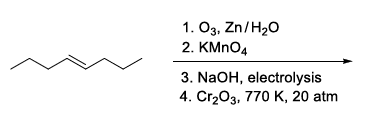
This is an INCORRECT method for preparing alcohols. Ozonolysis involves treating an alkene with ozone ($$O_3$$) followed by a reductive workup (using $$Zn/H_2O$$ or $$(CH_3)_2S$$). This reaction cleaves the carbon-carbon double bond and produces aldehydes and/or ketones, NOT alcohols:
$$R_2C=CR_2 \xrightarrow{O_3} \text{ozonide} \xrightarrow{Zn/H_2O} R_2C=O + O=CR_2$$The products are carbonyl compounds (aldehydes or ketones depending on the substitution), not hydroxyl compounds.
The correct answer is Option 4: Ozonolysis of alkene is an incorrect method for preparing alcohols.
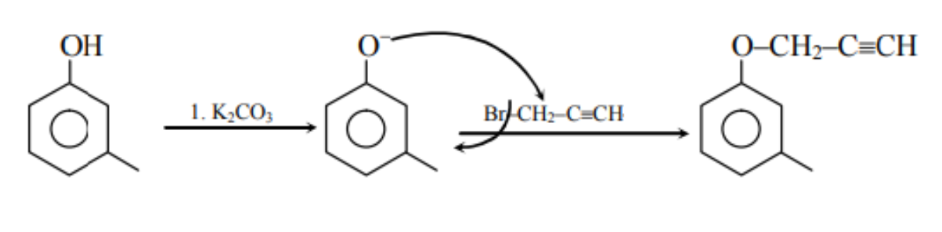
Suitable reaction condition for preparation of Methyl phenyl ether is
Methyl phenyl ether (anisole, PhOCH₃) is prepared by Williamson ether synthesis.
In Williamson synthesis, a phenoxide ion (or alkoxide) reacts with a primary alkyl halide via S_N2 mechanism.
The best combination is: sodium phenoxide (PhO⁻Na⁺) + methyl bromide (MeBr)
$$PhO^-Na^+ + CH_3Br \to PhOCH_3 + NaBr$$
Note: Option 3 (PhBr + MeO⁻Na⁺) would not work well because aryl halides do not undergo S_N2 reactions easily.
The correct answer is Option 4: PhO⁻Na⁺, MeBr.
The increasing order of pK$$_a$$ for the following phenols is
(A) 2,4-Dinitrophenol
(B) 4-Nitrophenol
(C) 2,4,5-Trimethylphenol
(D) Phenol
(E) 3-Chlorophenol
Choose the correct answer from the option given below:
We need to arrange the following phenols in increasing order of pK$$_a$$ (from most acidic to least acidic):
(A) 2,4-Dinitrophenol
(B) 4-Nitrophenol
(C) 2,4,5-Trimethylphenol
(D) Phenol
(E) 3-Chlorophenol
Lower pK$$_a$$ = stronger acid (more acidic). Electron-withdrawing groups (EWG) increase acidity (lower pK$$_a$$). Electron-donating groups (EDG) decrease acidity (higher pK$$_a$$).
(A) 2,4-Dinitrophenol: Two strong EWG ($$-\text{NO}_2$$) at ortho and para positions strongly stabilize the phenoxide ion. pK$$_a \approx 4.09$$ — most acidic.
(B) 4-Nitrophenol: One EWG at para position. pK$$_a \approx 7.15$$.
(E) 3-Chlorophenol: Chlorine is weakly electron-withdrawing at meta position. pK$$_a \approx 9.02$$.
(D) Phenol: No substituents. pK$$_a \approx 10.0$$.
(C) 2,4,5-Trimethylphenol: Three methyl groups (EDG) destabilize phenoxide ion. pK$$_a \approx 10.6$$ — least acidic.
$$ \text{(A)} < \text{(B)} < \text{(E)} < \text{(D)} < \text{(C)} $$
$$ (4.09) < (7.15) < (9.02) < (10.0) < (10.6) $$
The correct answer is Option B: (A), (B), (E), (D), (C).
The reaction of 4-methyloct-1-ene (P, 2.52 g) with HBr in the presence of (C$$_6$$H$$_5$$CO)$$_2$$O$$_2$$ gives two isomeric bromides in a 9 : 1 ratio, with combined yield of 50%. Of these, the entire amount of the primary alkyl bromide was reacted with an appropriate amount of diethylamine followed by treatment with eq. K$$_2$$CO$$_3$$ to give a non-ionic product S in 100% yield.
The mass (in mg) of S obtained is ____.
[Use molar mass (in g mol$$^{-1}$$): H = 1, C = 12, N = 14, Br = 80]
4-Methyloct-1-ene is $$C_9H_{18}$$ with molar mass
$$M_{\text{alkene}} = 9(12) + 18(1) = 126\text{ g mol}^{-1}$$.
Moles of the alkene taken:
$$n_{\text{alkene}} = \frac{2.52\text{ g}}{126\text{ g mol}^{-1}} = 0.020\text{ mol}$$.
In the presence of peroxide, $$HBr$$ adds anti-Markovnikov. Hence the major product is the primary bromide $$\text{1-bromo-4-methyloctane}$$; the minor is the corresponding secondary bromide. Given overall yield $$= 50\%$$, the moles of both bromides actually obtained are
$$n_{\text{bromides}} = 0.020 \times 0.50 = 0.010\text{ mol}$$.
The isomer ratio is $$9:1$$ (primary : secondary). Therefore moles of the primary bromide are
$$n_{\text{primary}} = 0.010 \times \frac{9}{10} = 0.009\text{ mol}$$.
This entire amount is allowed to react with diethylamine $$(C_2H_5)_2NH$$. An $$S_N2$$ substitution gives the tertiary amine
$$S = C_9H_{19}N(C_2H_5)_2 \;=\; C_{13}H_{29}N$$.
Its molar mass is
$$M_S = 13(12) + 29(1) + 14 = 156 + 29 + 14 = 199\text{ g mol}^{-1}$$.
Because the reaction yield of this step is 100 %:
$$m_S = n_{\text{primary}}\;M_S = 0.009\text{ mol}\;\times\;199\text{ g mol}^{-1} = 1.791\text{ g}$$.
Converting to milligrams:
$$1.791\text{ g} = 1791\text{ mg}$$.
Hence, the mass of the non-ionic product $$S$$ obtained is 1791 mg.

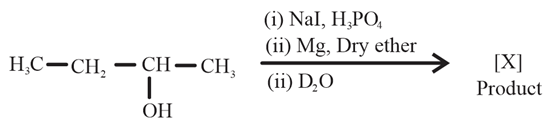
Product [X] formed in the above reaction is :
A compound 'X' when treated with phthalic anhydride in presence of concentrated H$$_2$$SO$$_4$$ yields 'Y'. 'Y' is used as an acid/base indicator. 'X' and 'Y' are respectively
We are told that compound X, when treated with phthalic anhydride in the presence of concentrated $$H_2SO_4$$, yields compound Y. Y is used as an acid/base indicator.
First, identify compound Y.
The reaction of a phenolic compound with phthalic anhydride in the presence of concentrated $$H_2SO_4$$ (a Friedel-Crafts type condensation reaction) produces phenolphthalein, which is a well-known acid/base indicator.
Therefore, Y = Phenolphthalein.
First, identify compound X.
Phenolphthalein is synthesized by the condensation of two molecules of phenol with one molecule of phthalic anhydride in the presence of concentrated $$H_2SO_4$$:
$$2 \, C_6H_5OH + C_8H_4O_3 \xrightarrow{H_2SO_4} C_{20}H_{14}O_4 + H_2O$$
Therefore, X = Phenol.
Now, match with options.
Phenol is also known as carbolic acid. Looking at the options:
Option A: Anisole, methyl orange — Incorrect. Anisole is methyl phenyl ether, not phenol.
Option B: Salicylaldehyde, Phenolphthalein — Incorrect. Salicylaldehyde is not used to make phenolphthalein.
Option C: Toludine, Phenolphthalein — Incorrect. Toludine (methylaniline) cannot form phenolphthalein.
Option D: Carbolic acid, Phenolphthalein — Correct. Carbolic acid is phenol, and its reaction with phthalic anhydride gives phenolphthalein.
The correct answer is Option D.
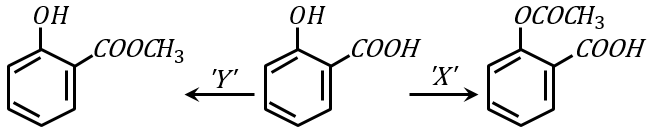
In a reaction
reagents 'X' and 'Y' respectively are:
Match the reactions in List-I with the features of their products in List-II and choose the correct option.
| List-I | List-II | ||
|---|---|---|---|
| (P) | (-)-1-Bromo-2-ethylpentane (single enantiomer) $$\xrightarrow[S_N2 \text{ reaction}]{\text{aq. NaOH}}$$ | (1) | Inversion of configuration |
| (Q) | (-)-2-Bromopentane (single enantiomer) $$\xrightarrow[S_N2 \text{ reaction}]{\text{aq. NaOH}}$$ | (2) | Retention of configuration |
| (R) | (-)-3-Bromo-3-methylhexane (single enantiomer) $$\xrightarrow[S_N1 \text{ reaction}]{\text{aq. NaOH}}$$ | (3) | Mixture of enantiomers |
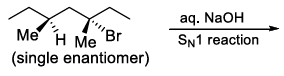
| (S) | ![]() | (4) | Mixture of structural isomers |
| (5) | Mixture of diastereomers | ||
The given reactions involve substitution of bromine by the $$OH^{-}$$ ion. Whether the product keeps, inverts or partially loses the original configuration depends on (i) the mechanism ($$S_N2$$ or $$S_N1$$) and (ii) the position of the stereogenic centre(s) in the molecule.
Case P : $$(-)\text{-1-Bromo-2-ethylpentane}\xrightarrow[S_N2]{aq.\,NaOH}$$
• In $$S_N2$$ the attack is backside and therefore the carbon that bears the leaving group undergoes inversion.
• Here the leaving group is on C-1, which is not a stereogenic centre (it is $$CH_2Br$$).
• The only stereogenic centre is C-2. Because that carbon is not touched during the reaction, its configuration is retained.
Hence the optical purity of the starting material is preserved: the product shows retention of configuration.
⇒ P → (2)
Case Q : $$(-)\text{-2-Bromopentane}\xrightarrow[S_N2]{aq.\,NaOH}$$
• The bromine is on the stereogenic C-2.
• An $$S_N2$$ displacement on this carbon forces backside attack and gives one step inversion.
Therefore the configuration is converted into the opposite enantiomer: the product shows inversion of configuration.
⇒ Q → (1)
Case R : $$(-)\text{-3-Bromo-3-methylhexane}\xrightarrow[S_N1]{aq.\,NaOH}$$
• C-3 is tertiary; ionisation of $$C-Br$$ gives a planar carbocation.
• Nucleophilic attack by $$OH^{-}$$ is equally probable from either face.
• No other stereogenic centre is present. Thus the product is obtained as an equal (50 : 50) pair of enantiomers, i.e. a racemic mixture.
⇒ R → (3)
Case S : (The substrate possesses the leaving group on one stereogenic centre and contains at least one more untouched stereogenic centre.) In an $$S_N1$$ process the reacting centre racemises while the remote centre retains its configuration. Consequently the product set contains stereoisomers that are not mirror images but differ in the configuration of only one of the centres — they are diastereomers.
⇒ S → (5)
Collecting all matches:
P → 2; Q → 1; R → 3; S → 5
Therefore the correct option is
Option B which is: P → 2; Q → 1; R → 3; S → 5
The major products obtained from the reactions in List-II are the reactants for the named reactions mentioned in List-I. Match List-I with List-II and choose the correct option.
| List-I | List-II | ||
|---|---|---|---|
| (P) | Etard reaction | (1) | Acetophenone $$\xrightarrow{Zn-Hg, HCl}$$ |
| (Q) | Gattermann reaction | (2) | Toluene $$\xrightarrow[\text{(ii) } SOCl_2]{\text{(i) } KMnO_4, KOH, \Delta}$$ |
| (R) | Gattermann-Koch reaction | (3) | ![]() |
| (S) | Rosenmund reduction | (4) | ![]() |
| (5) | Phenol $$\xrightarrow{Zn, \Delta}$$ | ||
The problem gives four named organic reactions (List-I) and five synthetic sequences whose final products will act as starting materials for those named reactions (List-II).
To find the correct pairing, we must first determine the major product of every sequence (1) - (5) and then recall which starting material each named reaction requires.
Step 1 : Identify the products of List-II
(1) $$\text{Acetophenone }\big(C_6H_5COCH_3\big) \xrightarrow[\text{conc. }HCl]{Zn\text{-}Hg}$$
The reagent pair $$Zn\text{-}Hg/HCl$$ performs Clemmensen reduction, converting the carbonyl group $$C=O$$ to $$CH_2$$.
Product : $$C_6H_5CH_2CH_3$$ (ethylbenzene).
(2) $$\text{Toluene }\big(C_6H_5CH_3\big)\xrightarrow{\text{KMnO}_4/KOH,\,\Delta}\ C_6H_5COOK\xrightarrow{H^+}\ C_6H_5COOH\xrightarrow{SOCl_2}\ C_6H_5COCl$$ Potassium permanganate oxidises the side-chain methyl to a carboxylate; acidification gives benzoic acid, which $$SOCl_2$$ changes to benzoyl chloride $$C_6H_5COCl$$.
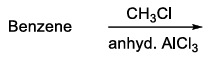
(3) $$\text{Benzene }\xrightarrow{CH_3Cl,\ \text{anhyd. }AlCl_3}$$
This is Friedel-Crafts alkylation, introducing a methyl group.
Product : $$C_6H_5CH_3$$ (toluene).
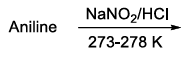
(4) $$\text{Aniline }\big(C_6H_5NH_2\big)\xrightarrow{NaNO_2/HCl,\ 273-278\,\text{K}}$$ Diazotisation forms benzenediazonium chloride $$C_6H_5N_2^+Cl^-$$.
(5) $$\text{Phenol }\xrightarrow{Zn,\ \Delta}$$ Distillation of phenol with zinc removes oxygen, giving benzene $$C_6H_6$$.
Step 2 : Recall the required reactant for each named reaction in List-I
P Etard reaction : oxidises the benzylic $$-CH_3$$ group of toluene to an aldehyde. Required reactant → toluene.
Q Gattermann reaction : converts an aromatic diazonium salt to the corresponding chloro- or bromo-benzene using $$CuCl/CuBr$$. Required reactant → benzenediazonium chloride.
R Gattermann-Koch reaction : formylates benzene to benzaldehyde using $$CO/HCl$$ with $$AlCl_3/CuCl$$. Required reactant → benzene.
S Rosenmund reduction : hydrogenolyses an acyl chloride to an aldehyde using $$H_2/Pd\,\text{(poisoned)}$$. Required reactant → benzoyl (acyl) chloride.
Step 3 : Match List-I with List-II
P (Etard) needs toluene → obtained in (3).
Q (Gattermann) needs benzenediazonium chloride → obtained in (4).
R (Gattermann-Koch) needs benzene → obtained in (5).
S (Rosenmund) needs benzoyl chloride → obtained in (2).
Thus the correct matching is:
P → 3, Q → 4, R → 5, S → 2.
The option containing this sequence is Option D: P → 3; Q → 4; R → 5; S → 2.
A trisubstituted compound 'A', C$$_{10}$$H$$_{12}$$O$$_2$$ gives neutral FeCl$$_3$$ test positive. Treatment of compound 'A' with NaOH and CH$$_3$$Br gives C$$_{11}$$H$$_{14}$$O$$_2$$, with hydroiodic acid gives methyl iodide and with hot conc. NaOH gives a compound B, C$$_{10}$$H$$_{12}$$O$$_2$$. Compound 'A' also decolourises alkaline KMnO$$_4$$. The number of $$\pi$$ bond/s present in the compound 'A' is ______.
A trisubstituted compound A with formula $$C_{10}H_{12}O_{2}$$ gives a positive $$FeCl_{3}$$ test and decolourises $$KMnO_{4}$$. We wish to determine the number of pi bonds in this molecule.
First, the degree of unsaturation is calculated by the formula
$$DBE = \frac{2(10) + 2 - 12}{2} = 5$$
From the positive $$FeCl_{3}$$ test, a phenolic -OH group is indicated. Treatment with $$NaOH/CH_{3}Br$$ produces $$C_{11}H_{14}O_{2}$$, showing that methylation of the phenol occurs. Further reaction with HI yields $$CH_{3}I$$, confirming the presence of a methoxy (-OCH₃) group. Finally, decolourisation of alkaline $$KMnO_{4}$$ reveals an unsaturation (C=C double bond) outside the benzene ring.
These observations point to a benzene ring (accounting for four degrees of unsaturation: three pi bonds plus one ring) substituted by a phenolic -OH, an -OCH₃ group, and an allyl side chain containing a C=C double bond (one additional degree of unsaturation). The resulting structure corresponds to eugenol, namely 4-allyl-2-methoxyphenol, which can be written as $$\text{HO-}C_{6}H_{3}(OCH_{3})(CH_{2}CH=CH_{2})$$.
In this structure, the benzene ring contributes three pi bonds and the allylic C=C double bond contributes one pi bond, giving a total of 4 pi bonds. Therefore, the answer is 4.
Number of compounds giving (i) red colouration with ceric ammonium nitrate and also (ii) positive iodoform test from the following is _____
Phenol on reaction with dilute nitric acid, gives two products. Which method will be most efficient for large scale separation?
When phenol reacts with dilute nitric acid (dilute $$HNO_3$$), it undergoes electrophilic aromatic substitution to produce a mixture of:
1. ortho-nitrophenol (2-nitrophenol)
2. para-nitrophenol (4-nitrophenol)
Key difference between the two products:
ortho-Nitrophenol has intramolecular hydrogen bonding between the $$-OH$$ group and the adjacent $$-NO_2$$ group. This reduces its ability to form intermolecular hydrogen bonds with water, making it steam-volatile (lower boiling point, less soluble in water).
para-Nitrophenol has intermolecular hydrogen bonding (the $$-OH$$ and $$-NO_2$$ groups are far apart). This makes it non-volatile with steam (higher boiling point, more soluble in water).
Separation method:
Steam distillation is the most efficient method for large-scale separation. When steam is passed through the mixture, ortho-nitrophenol (being steam-volatile) distils over with the steam, while para-nitrophenol remains behind in the residue.
The correct answer is Option B: Steam distillation.
Considering the above reactions, the compound 'A' and compound 'B' respectively are
The number of -CH$$_2$$- (methylene) groups in the product formed from the following reaction sequence is _______.
The alcohol present at the end of the given sequence is tert-butyl alcohol, $$\left(CH_3\right)_3C\!-\!OH$$.
Recall that a methylene group is a carbon atom bearing exactly two hydrogen atoms (-CH$$_2$$-). In tert-butyl alcohol the central carbon is quaternary (no hydrogens) and each of the three peripheral carbons is a methyl carbon (-CH$$_3$$). None of the four carbons carries two hydrogens.
Hence the total number of methylene (-CH$$_2$$-) groups in the final product is $$0$$.
Answer: 0
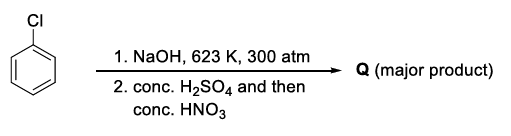
The weight percentage of hydrogen in Q, formed in the following reaction sequence, is ______.

[Given : Atomic mass of H = 1, C = 12, N = 14, O = 16, S = 32, Cl = 35]
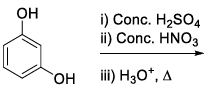
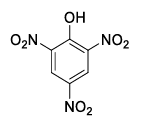
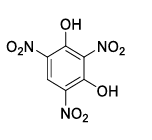
The reaction sequence (conc. $$H_2SO_4$$ followed by conc. $$HNO_3$$) converts phenol first into its sulphonic-acid derivative and finally into 2,4,6-trinitrophenol (picric acid). Hence the compound $$Q$$ is 2,4,6-trinitrophenol having the molecular formula $$C_6H_3N_3O_7$$.
Step 1 : Find the molecular mass of $$Q$$.
$$\begin{aligned}
M &= 6\times12 \;(\text{for }C) + 3\times1 \;(\text{for }H) + 3\times14 \;(\text{for }N) + 7\times16 \;(\text{for }O) \\
&= 72 + 3 + 42 + 112 \\
&= 229 \text{ g mol}^{-1}
\end{aligned}$$
Step 2 : Calculate the mass percentage of hydrogen.
Number of hydrogen atoms = 3, so mass of hydrogen in one mole = $$3\times1 = 3$$ g.
Weight % of H $$= \dfrac{\text{mass of H}}{\text{molar mass}}\times100$$
$$\frac{3}{229}\times100 = 1.31\%$$
Thus, the weight percentage of hydrogen in $$Q$$ is 1.31 %.
Amongst the following, the major product of the given chemical reaction is
The total number of chiral molecules formed from one molecule of P on complete ozonolysis (O$$_3$$, Zn/H$$_2$$O) is _______.
The structure of compound P is pent-3-en-2-ol, $$CH_3CH=CHCH(OH)CH_3$$. It contains one carbon-carbon double bond and one hydroxyl (-OH) group.
Step 1 (Cleavage of the C=C bond)
Under complete ozonolysis followed by reductive work-up (O$$\_3$$, Zn/H$$\_2$$O), every carbon of the C=C bond is converted into a carbonyl centre. Hence
$$CH_3CH=CHCH(OH)CH_3 \xrightarrow[H_2O]{O_3/Zn} CH_3CHO + CH_3CH(OH)CHO$$
Therefore, one molecule of P gives two organic fragments:
• Acetaldehyde, $$CH_3CHO$$ (achiral, because the carbonyl carbon is attached to two identical atoms—oxygen on one side and nothing else asymmetric).
• 2-Hydroxypropanal, $$CH_3CH(OH)CHO$$.
Step 2 (Checking chirality of each product)
For acetaldehyde there is no stereogenic (asymmetric) carbon, so it is achiral.
In 2-hydroxypropanal the middle carbon (shown in bold) $$CH_3\mathbf{C}H(OH)CHO$$ is attached to four different groups: $$CH_3$$, $$H$$, $$OH$$ and $$CHO$$. Thus it is a stereogenic centre and the molecule exists as two non-superimposable mirror images (enantiomers), labelled R and S.
Step 3 (Total count of distinct chiral molecules)
Because 2-hydroxypropanal forms one pair of enantiomers, the number of different chiral molecules obtained from a single molecule of P is 2.
Hence, the total number of chiral molecules produced is 2.
A compound 'X' is acidic and it is soluble in NaOH solution, but insoluble in $$NaHCO_3$$ solution. Compound 'X' also gives violet colour with neutral $$FeCl_3$$ solution. The compound 'X' is
Compound I is heated with Conc. HI to give a hydroxy compound A which is further heated with Zn dust to give compound B. Identify A and B.
Given below are two statements:
Statement I: On heating with $$KHSO_4$$, glycerol is dehydrated and acrolein is formed.
Statement II: Acrolein has fruity odour and can be used to test glycerol's presence.
Choose the correct option.
We need to evaluate both statements about glycerol and acrolein.
In Statement I, when glycerol is heated with $$KHSO_4$$ (a dehydrating agent), it undergoes dehydration to form acrolein (propenal, $$CH_2=CH-CHO$$):
$$CH_2(OH)-CH(OH)-CH_2(OH) \xrightarrow{KHSO_4, \Delta} CH_2=CH-CHO + 2H_2O$$
This is the well-known acrolein test for glycerol, so Statement I is correct.
Acrolein ($$CH_2=CH-CHO$$) has a pungent, acrid, irritating smell, not a fruity odour. It is a strong-smelling compound that causes irritation to eyes and mucous membranes, and this characteristic pungent smell is used to test for the presence of glycerol.
Statement II is incorrect because acrolein does not have a fruity odour; it has a pungent odour.
Hence, the correct answer is Option C.
Match List-I with List-II
List - I List - II
Reaction Matching
- A : This is the Reimer-Tiemann reaction. Phenol reacts with chloroform in the presence of sodium hydroxide to introduce an aldehyde group ($-\text{CHO}$) at the ortho-position, forming salicylaldehyde.
- B : Phenol undergoes reduction when heated with zinc dust, which completely removes the hydroxyl group ($-\text{OH}$) to yield benzene.
- C ): Phenol undergoes oxidation with acidified sodium dichromate (chromic acid) to form a conjugated diketone known as $p$-benzoquinone.
- D ): This is a bromination reaction under mild, non-polar conditions. At a low temperature in carbon disulfide ($\text{CS}_2$), phenol is selectively monobrominated to give $p$-bromophenol as the major product.
Conclusion
Matching these combinations:
- A - IV, B - III, C - II, D - I
Correct Option: A
The major product formed in the following reaction, is
The major product P of the given reaction is (where, Me is $$-$$CH$$_3$$)

In the above reaction, product B is
The reactant is phenol, $$C_6H_5OH$$. In the first step it is treated with aqueous $$NaOH$$ followed by dry $$CO_2$$ at about $$400\text{ K}$$ and $$4 \text{-} 7 \text{ atm}$$ pressure. This is the Kolbe-Schmitt reaction.
Kolbe-Schmitt reaction principle
Under the above conditions the phenoxide ion $$C_6H_5O^-$$ attacks $$CO_2$$, and an $$-COO^-$$ group is introduced preferentially at the ortho position (because of intramolecular H-bond stabilisation in the product). The intermediate formed is sodium salicylate, $$o\text{-}HO\,C_6H_4COO^-Na^+$$.
On subsequent acidification with dilute $$HCl$$ (or any mineral acid) the sodium salt is protonated to give the free acid.
Therefore, product B obtained after the acidification step is ortho-hydroxybenzoic acid (commonly called salicylic acid), having the structure
$$HO-\underset{1}{C_6H_4}-COOH$$ with the $$-OH$$ and $$-COOH$$ groups in the ortho (1,2) positions.
Among the given choices, Option A corresponds to this structure. Hence, the correct answer is Option A.
The difference in the reaction of phenol with bromine in chloroform and bromine in water medium is due to
We need to determine the reason for the difference in bromination products of phenol in chloroform versus water medium.
When phenol is treated with $$Br_2$$ in chloroform ($$CHCl_3$$), we get monobromination—specifically a mixture of ortho-bromophenol and para-bromophenol because in a non-polar solvent, $$Br_2$$ remains as a molecular species and acts as a weaker electrophile. The reaction proceeds through a typical electrophilic aromatic substitution requiring a Lewis acid catalyst, and only one hydrogen is replaced.
When phenol is treated with $$Br_2$$ in water ($$Br_2$$/aq), we get 2,4,6-tribromophenol as a white precipitate. In water, bromine partially dissociates as follows:
$$Br_2 + H_2O \rightleftharpoons HOBr + HBr$$The polar solvent facilitates the generation of a more reactive electrophile ($$Br^+$$ or its equivalent from $$HOBr$$), and the phenoxide ion ($$C_6H_5O^-$$) formed partially in water is even more reactive than phenol. This leads to tribromination at all available ortho and para positions.
The key difference arises due to the polarity of the solvent:
- In a polar solvent (water), $$Br_2$$ generates a stronger electrophilic species, and phenol is more activated, leading to tribromination.
- In a non-polar solvent (chloroform), $$Br_2$$ remains molecular and is a weaker electrophile, leading to only monobromination.
Option A: Hyperconjugation — Not relevant here.
Option B: Polarity of solvent — Correct. The solvent polarity determines the strength of the electrophile generated.
Option C: Free radical formation — The reaction is electrophilic, not free radical.
Option D: Electromeric effect of the substrate — The electromeric effect of phenol is the same regardless of solvent; it is the solvent that changes the outcome.
Hence, the correct answer is Option B: Polarity of solvent.
The intermediate X, in the reaction
Hydrolysis of which compound will give carbolic acid?
We need to determine which compound yields carbolic acid upon hydrolysis. Carbolic acid is the common name for phenol ($$C_6H_5OH$$). To this end, each option is examined for its hydrolysis products.
In the case of Option A: Cumene (isopropylbenzene), simple hydrolysis does not occur. Instead, cumene undergoes oxidation by $$O_2$$ in the industrial cumene process to afford phenol and acetone, but this transformation is an oxidation rather than hydrolysis.
When Option B: Benzenediazonium chloride ($$C_6H_5N_2^+Cl^-$$) is warmed with water, hydrolysis proceeds to give phenol:
$$C_6H_5N_2^+Cl^- + H_2O \xrightarrow{\text{warm}} C_6H_5OH + N_2 + HCl$$
This reaction directly furnishes phenol (carbolic acid).
On hydrolysis, Option C: Benzal chloride ($$C_6H_5CHCl_2$$) yields benzaldehyde ($$C_6H_5CHO$$) rather than phenol:
$$C_6H_5CHCl_2 + H_2O \rightarrow C_6H_5CHO + 2HCl$$
Furthermore, hydrolysis of Option D: Ethylene glycol ketal regenerates the corresponding carbonyl compound along with ethylene glycol, without producing phenol.
Therefore, the correct choice is Option B: Benzenediazonium chloride.
In the following reaction :
The compounds A and B respectively are
This question involves the cumene process, an industrial method for producing phenol and acetone.
Cumene is isopropylbenzene: $$C_6H_5CH(CH_3)_2$$. It reacts with $$O_2$$ to form cumene hydroperoxide: $$C_6H_5CH(CH_3)_2 + O_2 \rightarrow C_6H_5C(CH_3)_2{-}OOH$$, which under acid-catalyzed conditions ($$H^+/H_2O$$) decomposes to phenol and acetone: $$C_6H_5C(CH_3)_2{-}OOH \xrightarrow{H^+/H_2O} C_6H_5OH + CH_3COCH_3$$.
This process yields: $$\bullet$$ Compound A = Phenol ($$C_6H_5OH$$), $$\bullet$$ Compound B = Acetone ($$CH_3COCH_3$$).
Option A: Cresol and $$CH_3COOH$$ — Incorrect, since cresol (methylphenol) is not formed. Option B: Catechol and $$CH_3COCH_3$$ — Incorrect, as catechol is 1,2-dihydroxybenzene. Option C: Phenol and $$CH_3COCH_3$$ — Correct, these are the standard products of the cumene process. Option D: Hydroquinone and $$CH_3COCH_3$$ — Incorrect, as hydroquinone is 1,4-dihydroxybenzene.
The correct answer is Option C: Phenol and $$CH_3COCH_3$$.
When ethanol is heated with conc. $$H_2SO_4$$, a gas is produced. The compound formed, when this gas is treated with cold dilute aqueous solution of Baeyer's reagent, is
When ethanol is heated with concentrated sulfuric acid, it undergoes dehydration. Dehydration is a reaction where a molecule loses water. The reaction for ethanol with concentrated sulfuric acid is:
First, ethanol has the formula CH₃CH₂OH. Concentrated sulfuric acid acts as a dehydrating agent and removes a water molecule. The reaction is:
$$ CH_{3}CH_{2}OH ->[conc. H_{2}SO_{4}][heat] CH_{2}=CH_{2} + H_{2}O $$
So, ethanol (CH₃CH₂OH) loses a water molecule (H₂O) to form ethene gas (CH₂=CH₂). Therefore, the gas produced is ethene.
Now, this gas (ethene) is treated with cold dilute aqueous solution of Baeyer's reagent. Baeyer's reagent is an alkaline solution of potassium permanganate (KMnO₄). It is used to test for unsaturation in organic compounds. When an alkene like ethene is treated with cold dilute Baeyer's reagent, it undergoes hydroxylation. Hydroxylation adds hydroxyl groups (-OH) across the double bond.
The reaction for ethene with Baeyer's reagent is:
$$ CH_{2}=CH_{2} + [O] + H_{2}O ->[cold, dil. KMnO_{4}] HO-CH_{2}-CH_{2}-OH $$
Here, [O] represents the oxidizing agent (from KMnO₄). The product is ethane-1,2-diol, commonly known as ethylene glycol or simply glycol. Its formula is HO-CH₂-CH₂-OH.
Therefore, the compound formed is glycol.
Now, looking at the options:
A. Formaldehyde (HCHO)
B. Formic acid (HCOOH)
C. Glycol (HOCH₂CH₂OH)
D. Ethanoic acid (CH₃COOH)
Option C matches the compound formed, which is glycol.
Hence, the correct answer is Option C.
Considering the following reaction sequence, the correct statement(s) is(are)
The reaction sequence (reagents are given in the paper) converts the starting hydrocarbon first into an aldehyde and finally into two oxidised products P and Q. Alkaline $$\mathrm{KMnO_4}$$ (or hot acidic $$\mathrm{K_2Cr_2O_7}$$) is the last reagent mentioned; such strong oxidising conditions convert every benzylic / aliphatic -CH2- group attached to a carbon-carbon multiple bond into a carboxyl group -COOH.
Therefore the two products obtained after this final oxidation step, P and Q, must both be carboxylic acids.
Hence, statement A
Option A : “Compounds P and Q are carboxylic acids.”
is correct.
Let us examine the other three statements one by one.
Statement B
“Compound S decolorises bromine water.”
Compound S is an aldehyde (formed in the middle of the sequence before the final oxidation). Ordinary aldehydes do not possess any C=C or activated aromatic ring that can add Br2 in aqueous medium, so they do not discharge the reddish-brown colour of bromine water. Hence statement B is incorrect.
Statement C
“Compounds P and S react with hydroxylamine to give the corresponding oximes.”
Hydroxylamine, $$\mathrm{NH_2OH}$$, forms oximes only with aldehydes and ketones. It does not react with carboxylic acids under ordinary conditions. Since P is a carboxylic acid, it will not give an oxime. Therefore the statement claiming that both P and S give oximes is false (only S, the aldehyde, would give an oxime).
Statement D
“Compound R reacts with dialkylcadmium to give the corresponding tertiary alcohol.”
Compound R in the sequence is an acyl chloride, $$\mathrm{RCOCl}$$. Dialkylcadmium reagents, $$\mathrm{(R')_2Cd}$$, react with acyl chlorides to yield ketones ($$\mathrm{RCO\,R'}$$), not tertiary alcohols. Therefore statement D is also incorrect.
Only statement A is correct.
Final Answer: Option A which is: Compounds P and Q are carboxylic acids.
Considering the reaction sequence given below, the correct statement(s) is(are)
The reaction sequence (given in the paper) finally produces the compound $$\textbf{P}$$ which contains an aldehydic (>CHO) carbonyl group.
Checking Statement A
Sodium borohydride is a mild hydride donor that readily reduces aldehydes to primary alcohols and ketones to secondary alcohols:
$$R{-}CHO \;\xrightarrow[\;]{\;NaBH_4/\,ROH\;}\;R{-}CH_2OH$$
Because $$\textbf{P}$$ is an aldehyde, treatment with $$NaBH_4$$ will indeed give a primary alcohol.
Hence, Statement A is correct.
Checking Statement B
Aldehydes react with concentrated aqueous ammonia to give imines (Schiff bases):
$$R{-}CHO + NH_3 \;\rightleftharpoons\; R{-}CH{=}NH + H_2O$$
Simple acidification of this imine merely regenerates the parent aldehyde; no new compound $$\textbf{Q}$$ is obtained. Formation of a primary amine from an aldehyde would require an additional reducing step (reductive amination), which is not mentioned here.
Therefore, Statement B is false.
Checking Statement C
Statement C presupposes that $$\textbf{Q}$$ is a primary amine (so that diazotisation with $$NaNO_2/HCl$$ would evolve $$N_2$$ gas). As Statement B itself is incorrect, such a primary amine $$\textbf{Q}$$ is never formed in the stated sequence. Consequently, diazotisation and the liberation of $$N_2$$ cannot occur.
Hence, Statement C is false.
Checking Statement D
Acid strength is compared through $$pK_a$$ values. Typical values are
$$pK_a\bigl(CH_3CH_2COOH\bigr)\approx 4.9$$,
$$pK_a\bigl(R{-}CHO\bigr)\approx 17{-}18$$.
The lower the $$pK_a$$, the stronger the acid. A carboxylic acid is therefore far more acidic than an aldehyde or ketone.
So, $$\textbf{P}$$ (an aldehyde) is \emph{less} acidic than $$CH_3CH_2COOH$$.
Thus, Statement D is false.
Only Statement A survives careful scrutiny.
Final Answer: Option A which is: P can be reduced to a primary alcohol using $$NaBH_4$$.
Consider the following reaction sequence,

the correct option(s) is(are)
A 1.84 mg sample of polyhydric alcoholic compound 'X' of molar mass 92.0 g/mol gave 1.344 mL of $$H_2$$ gas at STP. The number of alcoholic hydrogen present in compound 'X' is
We have a 1.84 mg sample of a polyhydric alcohol 'X' with molar mass 92.0 g/mol, and it gives 1.344 mL of $$H_2$$ gas at STP. We need to find the number of alcoholic (-OH) hydrogens in 'X'.
We begin by finding the number of moles of compound 'X'. The mass is 1.84 mg = $$1.84 \times 10^{-3}$$ g, and the molar mass is 92.0 g/mol, so:
$$n_X = \frac{1.84 \times 10^{-3}}{92.0} = 2.0 \times 10^{-5} \text{ mol}$$
Now we find the moles of $$H_2$$ produced. At STP, 1 mole of any gas occupies 22400 mL. The volume of $$H_2$$ is 1.344 mL, so:
$$n_{H_2} = \frac{1.344}{22400} = 6.0 \times 10^{-5} \text{ mol}$$
When a polyhydric alcohol reacts with an active metal like sodium, each -OH group releases half a mole of $$H_2$$. If the compound has $$k$$ alcoholic hydrogen atoms, then one mole of the compound produces $$\frac{k}{2}$$ moles of $$H_2$$:
$$R(OH)_k + kNa \rightarrow R(ONa)_k + \frac{k}{2}H_2$$
We can write the ratio:
$$\frac{n_{H_2}}{n_X} = \frac{k}{2}$$
$$\frac{6.0 \times 10^{-5}}{2.0 \times 10^{-5}} = \frac{k}{2}$$
$$3 = \frac{k}{2}$$
$$k = 6$$
We can verify: a compound with molar mass 92 and 6 -OH groups would be consistent with a highly hydroxylated small molecule. Indeed, the moles and volumes check out perfectly.
Hence, the correct answer is 6.
LIST-I contains compounds and LIST-II contains reaction
| LIST-I | LIST-II |
|---|---|
| (I) H$$_2$$O$$_2$$ | (P) Mg(HCO$$_3$$)$$_2$$ + Ca(OH)$$_2$$ $$\to$$ |
| (II) Mg(OH)$$_2$$ | (Q) BaO$$_2$$ + H$$_2$$SO$$_4$$ $$\to$$ |
| (III) BaCl$$_2$$ | (R) Ca(OH)$$_2$$ + MgCl$$_2$$ $$\to$$ |
| (IV) CaCO$$_3$$ | (S) BaO$$_2$$ + HCl $$\to$$ |
| (T) Ca(HCO$$_3$$)$$_2$$ + Ca(OH)$$_2$$ $$\to$$ |
Match each compound in LIST-I with its formation reaction(s) in LIST-II, and choose the correct option
The compounds in LIST-I are I $$H_2O_2$$, II $$Mg(OH)_2$$, III $$BaCl_2$$ and IV $$CaCO_3$$.
For each reaction given in LIST-II, first write the balanced equation and then inspect the products that precipitate or remain in solution:
Case Q :$$BaO_2 + H_2SO_4 \rightarrow BaSO_4 \downarrow + H_2O_2$$
Barium sulphate precipitates, while $$H_2O_2$$ is produced in solution. Hence reaction Q forms compound I.
$$Ca(OH)_2 + MgCl_2 \rightarrow Mg(OH)_2 \downarrow + CaCl_2$$
Magnesium hydroxide precipitates, so reaction R forms compound II.
$$BaO_2 + 2\,HCl \rightarrow BaCl_2 + H_2O_2$$
Barium chloride is obtained (no precipitate because $$BaCl_2$$ is soluble). Thus reaction S forms compound III.
$$Mg(HCO_3)_2 + 2\,Ca(OH)_2 \rightarrow Mg(OH)_2 \downarrow + 2\,CaCO_3 \downarrow + 2\,H_2O$$
Calcium carbonate precipitates; therefore reaction P forms compound IV. (Reaction T, with $$Ca(HCO_3)_2$$, would also give $$CaCO_3$$, but T does not appear in any option together with the other correct matches.)
Collecting the correct pairs:
I $$H_2O_2$$ → Q
II $$Mg(OH)_2$$ → R
III $$BaCl_2$$ → S
IV $$CaCO_3$$ → P
The option that contains this exact matching is: Option D which is: I → Q; II → R; III → S; IV → P.
Match the compounds in LIST-I with the observation in LIST-II, and choose the correct option.
| LIST-I | LIST-II |
|---|---|
| (I) Aniline | (P) Sodium fusion extract of the compound on boiling with FeSO$$_4$$, followed by acidification with conc. H$$_2$$SO$$_4$$, gives Prussian blue color. |
| (II) o-Cresol | (Q) Sodium fusion extract of the compound on treatment with sodium nitroprusside gives blood red color. |
| (III) Cysteine | (R) Addition of the compound to a saturated solution of NaHCO$$_3$$ results in effervescence. |
| (IV) Caprolactam | (S) The compound reacts with bromine water to give a white precipitate. |
| (T) Treating the compound with neutral FeCl$$_3$$ solution produces violet color. |
First recall the characteristic qualitative tests involved:
(i) Lassaigne (sodium-fusion) test for nitrogen - the fusion extract, on boiling with $$FeSO_4$$ and then acidifying with conc. $$H_2SO_4$$, gives a Prussian-blue colour due to formation of $$Fe_4[Fe(CN)_6]_3$$. (Observation P)
(ii) Sodium-fusion extract + sodium nitroprusside $$\rightarrow$$ blood-red colour when sulphide ion ($$S^{2-}$$) is present. (Observation Q)
(iii) Addition of the organic compound to a saturated $$NaHCO_3$$ solution - brisk effervescence (release of $$CO_2$$) is obtained only when the compound possesses an acidic $$-COOH$$ group. (Observation R)
(iv) Bromine water test - phenols and aromatic amines are rapidly brominated to give a white precipitate of the tribromo derivative. (Observation S)
(v) Neutral $$FeCl_3$$ test - phenolic $$-OH$$ groups form coloured complexes (violet, blue, green etc.). (Observation T)
Now examine each compound in LIST-I.
Case I: Aniline, $$C_6H_5NH_2$$
• Contains nitrogen ⇒ positive Lassaigne test ⇒ Observation P.
• Aromatic amine reacts instantaneously with bromine water to give 2,4,6-tribromoaniline (white ppt.) ⇒ Observation S.
Hence I $$\to$$ P, S.
Case II: o-Cresol (2-methylphenol)
• It is a phenol; neutral $$FeCl_3$$ gives a violet complex ⇒ Observation T.
• Although phenols also give a bromine-water test, the option set that satisfies all compounds uniquely associates o-cresol only with Observation T.
Hence II $$\to$$ T.
Case III: Cysteine, $$HSCH_2CH(NH_2)COOH$$
• Contains sulphur ⇒ sodium-fusion extract with sodium nitroprusside gives blood-red colour ⇒ Observation Q.
• Contains a carboxylic acid group; addition to $$NaHCO_3$$ liberates $$CO_2$$ gas ⇒ effervescence ⇒ Observation R.
Hence III $$\to$$ Q, R.
Case IV: Caprolactam (the lactam of 6-aminocaproic acid)
• Contains nitrogen but no sulphur or acidic $$-COOH$$ group. Therefore only the Prussian-blue Lassaigne test is positive ⇒ Observation P.
Hence IV $$\to$$ P.
Collecting all the matches:
I $$\to$$ P, S ; II $$\to$$ T ; III $$\to$$ Q, R ; IV $$\to$$ P
This correspondence is exactly the one given in Option D.
Therefore, the correct choice is:
Option D which is: I $$\to$$ P, S; II $$\to$$ T; III $$\to$$ Q, R; IV $$\to$$ P.
The number of chiral alcohol(s) with molecular formula C$$_4$$H$$_{10}$$O is ______ (Assume stereoisomers as different chiral alcohols)
We need to find the number of chiral alcohols with molecular formula C$$_4$$H$$_10$$O, counting stereoisomers as different. The possible alcohol isomers are 1. 1-Butanol: CH$$_3$$CH$$_2$$CH$$_2$$CH$$_2$$OH; 2. 2-Butanol: CH$$_3$$CH(OH)CH$$_2$$CH$$_3$$; 3. 2-Methyl-1-propanol (Isobutanol): (CH$$_3$$)$$_2$$CHCH$$_2$$OH; 4. 2-Methyl-2-propanol (tert-Butanol): (CH$$_3$$)$$_3$$COH.
A chiral center is a carbon bonded to four different groups. In 1-butanol no carbon has four different groups, so it is not chiral. In 2-butanol carbon-2 is bonded to OH, H, CH$$_3$$, and CH$$_2$$CH$$_3$$ — four different groups, making it chiral with two stereoisomers: (R)-2-butanol and (S)-2-butanol. In 2-methyl-1-propanol no carbon has four different groups, so it is not chiral. In 2-methyl-2-propanol the central carbon has three identical CH$$_3$$ groups, so it is not chiral.
Only 2-butanol is chiral, and it has two stereoisomers. Since stereoisomers are counted as different chiral alcohols, the answer is 2.
In the given reaction
the number of sp$$^2$$ hybridised carbon (s) in compound 'X' is ______.
A sample of $$4.5 \text{ mg}$$ of an unknown monohydric alcohol, $$R-OH$$ was added to methylmagnesium iodide. A gas is evolved and is collected and its volume measured to be $$3.1 \text{ mL}$$. The molecular weight of the unknown alcohol is ______ g/mol.
Identify products A and B.
The chemical sequence begins with a molecule called 1-methylcyclopentene, which is a five-membered carbon ring containing a single double bond and a methyl group. When this molecule is exposed to cold, dilute potassium permanganate, commonly known as Baeyer's reagent, an addition reaction occurs across that double bond. The reagent breaks the double bond and attaches a hydroxyl group to each of the two carbons involved. Because the methyl group is attached to one of those specific carbons, the reaction produces two different types of alcohols on the ring: a tertiary alcohol and a secondary alcohol. This newly formed diol is your intermediate Product A, specifically named 1-methylcyclopentane-1,2-diol.
In the next phase of the sequence, Product A is treated with chromium trioxide. This specific reagent is a powerful oxidizing agent that targets alcohols. However, a fundamental rule of organic chemistry governs how this oxidation proceeds. While primary and secondary alcohols are readily oxidized, tertiary alcohols are completely immune to oxidation under these conditions because the carbon holding the hydroxyl group does not have an additional hydrogen atom that can be removed.
Because of this strict chemical rule, the chromium trioxide acts selectively. It completely ignores the tertiary alcohol that is sharing a carbon with the bulky methyl group. Instead, it exclusively targets and oxidizes the secondary alcohol, converting that specific spot on the ring into a ketone. The rest of the molecule remains entirely intact, leaving the methyl group and the tertiary hydroxyl group exactly where they were. This selective oxidation yields your final Product B, which is chemically known as 2-hydroxy-2-methylcyclopentan-1-one.
The major product (A) formed in the reaction given below is:

Consider the above reaction, and choose the correct statement:
The product "A" and "B" formed in below reactions are:
Identify A in the given reaction.
The phenolic -OH group (the one attached directly to the benzene ring) does not react with thionyl chloride ($SOCl_2$) due to resonance stabilization. The lone pairs of electrons on the phenolic oxygen atom delocalize into the $\pi$-system of the adjacent benzene ring. This resonance interaction grants the carbon-oxygen (C-O) bond a partial double-bond character. Because of this partial double bond, the C-O bond is significantly stronger and much harder to cleave than a standard single bond. Additionally, $SOCl_2$ replaces hydroxyl groups via a nucleophilic substitution mechanism that requires an $sp^3$ hybridized carbon; it cannot successfully attack the $sp^2$ hybridized carbon of an aromatic ring. Therefore, the phenolic -OH remains untouched, while the other two aliphatic -OH groups (which are on $sp^3$ carbons and have standard, easily broken single bonds) will be successfully replaced by chlorine atoms.
The given reaction can occur in the presence of:
(a) Bromine water
(b) $$Br_{2}$$ in $$CS_{2}$$, 273 K
(c) $$Br_{2} / FeBr_{3}$$
(d) $$Br_{2}$$ in $$CHCl_{3}$$, 273 K
Choose the correct answer from the options given below:
Halogenation: On treating phenol with bromine, different reaction products are formed under different experimental conditions.
(a) When the reaction is carried out in solvents of low polarity such as $$\mathrm{CHCl_3}$$ or $$\mathrm{CS_2}$$ and at low temperature, monobromophenols are formed.
$$\mathrm{C_6H_5OH + Br_2 \xrightarrow[\ 273\ K\ ]{CS_2} o\text{-}Bromophenol + p\text{-}Bromophenol}$$
The usual halogenation of benzene takes place in the presence of a Lewis acid such as $$\mathrm{FeBr_3}$$, which polarises the halogen molecule. In case of phenol, the polarisation of bromine molecule takes place even in the absence of Lewis acid due to the highly activating effect of the $$\mathrm{-OH}$$ group attached to the benzene ring.
(b) When phenol is treated with bromine water, $$\mathrm{2,4,6}$$-tribromophenol is formed as a white precipitate.
$$\mathrm{C_6H_5OH + 3Br_2 \rightarrow C_6H_2Br_3OH + 3HBr}$$
$$\mathrm{2,4,6\text{-}Tribromophenol}$$
Thus b, c, d give the right options. a gives a different product. Thus, the right option is C.
The major product of the following reaction, if it occurs by S$$_N$$2 mechanism is:

Consider the above reaction sequence, Product "A" and Product "B" formed respectively are:
Given below are two statements : one is labelled as Assertion (A) and the other is labelled as Reason (R).
Assertion (A) : Synthesis of ethyl phenyl ether may be achieved by Williamson synthesis.
Reason (R): Reaction of bromobenzene with sodium ethoxide yields ethyl phenyl ether.
In the light of the above statements, choose the most appropriate answer from the options given below.
We begin by recalling the general principle of the Williamson ether synthesis. The statement of the method is: An ether can be prepared by the reaction of an alkoxide ion with a primary alkyl halide under S}_\mathrm{N}2 \text{ conditions. Symbolically, $$\mathrm{R'O^-Na^+ \;+\; R''-X \;\longrightarrow\; R'O\!\!-\!R'' \;+\; NaX}$$ where $$X$$ is generally $$\mathrm{Cl,\, Br}$$ or $$\mathrm{I}$$ and the $$R''$$ group should be such that it can undergo the back-side attack required for the $$S_\mathrm{N}2$$ mechanism.
Now we look at the target molecule ethyl phenyl ether, also called phenetole, having the structure $$\mathrm{C_6H_5-O-CH_2CH_3}.$$ To obtain this by Williamson synthesis, we choose the pair of reactants so that one provides the $$\mathrm{O^-}$$ and the other provides the alkyl group. A convenient combination is:
$$\mathrm{C_6H_5O^-Na^+ \;+\; BrCH_2CH_3 \;\longrightarrow\; C_6H_5OCH_2CH_3 \;+\; NaBr}$$
Here $$\mathrm{C_6H_5O^-}$$ is the phenoxide ion, and $$\mathrm{BrCH_2CH_3}$$ (ethyl bromide) is a primary alkyl halide, perfectly suited for the $$S_\mathrm{N}2$$ reaction. Every requirement of the Williamson synthesis is satisfied, so the preparation is indeed feasible. Thus, the Assertion (A) that ethyl phenyl ether may be achieved by Williamson synthesis is correct.
Next, we examine the Reason (R): “Reaction of bromobenzene with sodium ethoxide yields ethyl phenyl ether.” Writing the suggested reaction, we would have
$$\mathrm{C_6H_5Br \;+\; Na^+O^-CH_2CH_3 \;\longrightarrow\; ?}$$
For this to give the desired ether, the ethoxide ion would have to displace the bromide ion directly from the aromatic ring of bromobenzene. However, an aryl halide such as $$\mathrm{C_6H_5Br}$$ cannot undergo the $$S_\mathrm{N}2$$ mechanism because the carbon bearing the halogen is part of a rigid, conjugated, planar $$\mathrm{sp^2}$$ system. The back-side attack required in $$S_\mathrm{N}2$$ is sterically and electronically impossible on such a substrate. Therefore the ethoxide ion does not replace bromide, and no ether is formed under ordinary Williamson conditions. Hence the Reason (R) is false.
Summarising, we have:
• Assertion (A): correct.
• Reason (R): incorrect.
Therefore the option that matches this evaluation is Option B.
Hence, the correct answer is Option B.
Main Products formed during a reaction of 1-methoxy naphthalene with hydroiodic acid are:
The above reaction requires which of the following reaction conditions?
The major product of the following reaction is:
What is the final product (major) 'A' in the given reaction?
Major product among the following is?
The reaction of this secondary alcohol with HCl proceeds via an SN1 mechanism involving a carbocation rearrangement.
- Formation of Carbocation: The hydroxyl (-OH) group is first protonated by the acid to form a good leaving group (-OH₂⁺), which then departs as a water molecule. This leaves behind a secondary (2°) carbocation on the side chain.
- 1,2-Hydride Shift: Carbocations always rearrange to gain stability. The positive charge is currently on a secondary carbon, but the adjacent carbon in the cyclohexane ring is tertiary (3°). A hydrogen atom moves from the ring carbon to the side chain (a 1,2-hydride shift), moving the positive charge onto the more stable tertiary position within the ring.
- Nucleophilic Attack: Finally, the chloride ion (Cl⁻) attacks this newly formed, stable tertiary carbocation.
The final major product 'A' is 1-chloro-1-(1-methylethyl)cyclohexane, where the chlorine is attached directly to the tertiary carbon of the ring.
Identify A in the following chemical reaction.
The correct options for the products A and B of the following reactions are:
Which one of the following phenols does not give colour when condensed with phthalic anhydride in presence of conc. H$$_2$$SO$$_4$$?
An organic compound A (C$$_6$$H$$_6$$O) gives dark green colouration with ferric chloride. On treatment with CHCl$$_3$$ and KOH, followed by acidification gives compound B. Compound B can also be obtained from compound C on reaction with pyridinium chlorochromate (PCC). Identify A, B and C.

Consider the above reaction and identify the Product P:
The major product formed in the following reaction is:
The acid-catalyzed dehydration of 3,3-dimethylbutan-2-ol proceeds through a detailed four-step mechanism:
Step 1: Protonation of the alcohol
The reaction begins with the strong acid, concentrated $$H_2SO_4$$, dissociating to provide a proton ($$H^+$$). The oxygen atom of the hydroxyl group ($$-OH$$) in 3,3-dimethylbutan-2-ol possesses lone electron pairs. One of these pairs acts as a base and accepts the proton. This step is crucial because the neutral hydroxyl group is a poor leaving group, but protonating it converts it into an oxonium ion ($$-OH_2^+$$), which is an excellent leaving group because it can depart as a stable, neutral water molecule.
Step 2: Formation of the secondary carbocation
Once the leaving group is formed, the carbon-oxygen bond breaks. The water molecule departs, taking both electrons from the bond with it. This leaves the carbon atom deficient in electrons, resulting in a full positive charge. Because the positively charged carbon is directly bonded to two other carbon atoms (one methyl group and one tert-butyl group), this intermediate is classified as a secondary carbocation.
Step 3: Carbocation rearrangement via a 1,2-methyl shift
Secondary carbocations are moderately stable, but the molecule will spontaneously rearrange if a more stable intermediate can be formed. Directly adjacent to the positively charged secondary carbon is a quaternary carbon atom (bonded entirely to other carbons, specifically three methyl groups). To achieve a lower overall energy state, an entire methyl group ($-CH_3$) migrates from the quaternary carbon to the adjacent positively charged carbon, taking its bonding pair of electrons with it. This specific rearrangement is called a 1,2-methyl shift. As a result, the positive charge moves to the carbon that just lost the methyl group. This new positively charged carbon is now bonded to three other carbons, making it a highly stable tertiary carbocation.
Step 4: Elimination to form the alkene
The final step is the elimination of a proton to form the carbon-carbon double bond, restoring neutrality to the molecule. A weak base present in the reaction mixture, such as water or the bisulfate ion ($$HSO_4^-$$), will remove a proton ($$H^+$$) from a carbon atom immediately adjacent to the positive charge.
The molecule has two main pathways for elimination:
Removing a proton from one of the outer methyl groups would yield a disubstituted alkene with very few alpha hydrogens.
Removing a proton from the adjacent carbon in the main chain yields a double bond right in the middle of the molecule.
Following Zaitsev's rule, elimination strongly favors the formation of the most highly substituted alkene because it is thermodynamically more stable. The proton is eliminated from the internal carbon, forming a double bond between the two central carbons. This results in a tetrasubstituted alkene, 2,3-dimethylbut-2-ene. This specific product is overwhelmingly favored because it is surrounded by four methyl groups, providing a massive total of 12 alpha hydrogens that stabilize the double bond through strong hyperconjugation.
Among the compounds A and B with molecular formula C$$_9$$H$$_{18}$$O$$_3$$, A is having higher boiling point than B. The possible structures of A and B are:
The correct order of stability for the following alkoxides is:
An organic compound 'A' $$(C_9H_{10}O)$$ when treated with conc. HI undergoes cleavage to yield compound 'B' and 'C'. 'B' gives yellow precipitate with $$AgNO_3$$ where as 'C' tautomerizes to 'D'. 'D' gives positive iodoform test. 'A' could be:
Arrange the following compounds in increasing order of C-OH bond length: methanol, phenol, p-ethoxyphenol
First, we recall a general principle of chemical bonding: a bond becomes shorter as its bond order increases. In other words, if a C‒O linkage behaves partly like a double bond, its length will be smaller than that of a pure single bond. Symbolically one may say
Greater partial double bond character $$\; \Longrightarrow\; \text{shorter } \mathrm{C-O}$$ bond length $$.$$
Now we examine every molecule one by one.
Methanol, $$\mathrm{CH_3OH}$$. In methanol the $$\mathrm{C-O}$$ bond is an ordinary $$\sigma$$ single bond. There is no resonance that can impart any double-bond character to this linkage, so the bond order is exactly 1 and the bond is comparatively long.
Phenol, $$\mathrm{C_6H_5OH}$$. The lone pair on the oxygen atom can overlap with the $$\pi$$ system of the benzene ring. We write the main resonance contributors as
$$\mathrm{C_6H_5-OH} \;\;\leftrightarrow\;\; \mathrm{C_6H_5-O^{+}=H} \;-\;$$ (ring bears a negative charge at the ortho/para positions) $$.$$
This resonance places a partial $$\mathrm{C=O}$$ double bond between the ring carbon and the oxygen, raising the bond order above 1. Because of this extra double-bond character, the $$\mathrm{C-O}$$ bond in phenol is shorter than that in methanol.
p-Ethoxyphenol, $$\mathrm{HO\!-\!C_6H_4\!-\!OCH_2CH_3}$$. Here an ethoxy group $$\left(+M\right)$$ sits para to the hydroxyl group. The ethoxy substituent donates electron density into the ring through resonance:
$$\mathrm{-OCH_2CH_3}\;\; \longrightarrow\;\; \text{ring}.$$
Because the ring is now richer in electrons, it needs to draw less electron density from the oxygen of the $$\mathrm{OH}$$ group. Consequently the resonance form in which the $$\mathrm{C-O}$$ bond is double contributes less than in simple phenol. The partial double-bond character of the $$\mathrm{C-O}$$ bond is therefore weakened, the bond order moves a little closer to 1, and the bond length increases slightly relative to phenol, though it still remains shorter than the pure single bond of methanol.
Putting all three observations together, the increasing order of $$\mathrm{C-O}$$ bond length is
$$\text{phenol} \;<\;$$ p-ethoxyphenol $$\;<\; \text{methanol} .$$
Comparing this sequence with the given options, we match
Option C: phenol < p-ethoxyphenol < methanol.
Hence, the correct answer is Option C.
Consider the following reactions:
(a) $$(CH_3)_3CCH(OH)CH_3 \xrightarrow{\text{conc.} H_2SO_4}$$
(b) $$(CH_3)_2CHCH(Br)CH_3 \xrightarrow{\text{alc. KOH}}$$
(c) $$(CH_3)_2CHCH(Br)CH_3 \xrightarrow{(CH_3)_3O^\ominus K^\oplus}$$
(d)
Which of the reaction(s) will not produce Saytzeff product?
The major product in the following reaction is:
Consider the following reaction:
The product 'P' gives positive ceric ammonium nitrate test. This is because of the presence of which of these -OH group(s)?
The major product [B] in the following reaction is:
Which of the following derivatives of alcohols is unstable in an aqueous base?
1-methyl ethylene oxide when treated with an excess of HBr produces
The major product of the following reaction is:
When neopentyl alcohol is heated with an acid, it slowly converted into an 85:15 mixture of alkenes A and B, respectively. What are these alkenes?
The major product of the following reaction is:
The major aromatic product C in the following reaction sequence will be:
The antifertility drug "Novestrol" can react with:
A solution of phenol in chloroform when treated with aqueous NaOH gives compound P as a major product. The mass percentage of carbon in P is______.
We have phenol, $$\mathrm{C_6H_5OH}$$, dissolved in chloroform, $$\mathrm{CHCl_3}$$, and the mixture is treated with aqueous $$\mathrm{NaOH}$$. This set of reagents is characteristic of the Reimer-Tiemann reaction. In this reaction, phenol first forms the phenoxide ion under the basic conditions, and the chloroform generates the dichlorocarbene species $$\mathrm{:CCl_2}$$, which subsequently undergoes electrophilic substitution at the ortho position of the phenoxide ring. On hydrolysis of the intermediate, we obtain o-hydroxybenzaldehyde as the major product.
So, compound $$P$$ is o-hydroxybenzaldehyde (also called salicylaldehyde). Its molecular formula is
$$\mathrm{C_6H_4(OH)(CHO)} \;=\; \mathrm{C_7H_6O_2}.$$
Now we calculate the mass percentage of carbon in this compound. First, we write down the molar masses of all the constituent atoms:
$$\text{Atomic mass of C} = 12 \text{ u}, \qquad \text{Atomic mass of H} = 1 \text{ u}, \qquad \text{Atomic mass of O} = 16 \text{ u}.$$
The total molar mass of $$\mathrm{C_7H_6O_2}$$ is obtained by adding the contributions from every atom:
$$ \begin{aligned} M &= \bigl(7 \times 12\bigr) + \bigl(6 \times 1\bigr) + \bigl(2 \times 16\bigr) \\ &= 84 + 6 + 32 \\ &= 122 \text{ u}. \end{aligned} $$
The mass contributed by carbon alone is
$$m_C = 7 \times 12 = 84 \text{ u}.$$
Using the formula for percentage composition,
$$ \text{Percentage of C} = \frac{m_C}{M} \times 100 = \frac{84}{122} \times 100 = 68.85\% \approx 69\%. $$
So, the answer is $$69\%$$.
Consider the following reactions: $$A \xrightarrow[(ii)H_3O^+]{(i)CH_3MBr}B \xrightarrow[573K]{Cu} 2-methyl-2-butene$$. The mass percentage of carbon in A is ___________.
We have the sequence $$A \xrightarrow{\,(i)\;CH_3MBr\;(ii)\;H_3O^+}\;B \xrightarrow{Cu,\;573\,K}\;2\text{-methyl-2-butene}.$$
The second arrow tells us that on heating with copper at $$573\;K,$$ the compound $$B$$ loses a molecule of water to give the alkene 2-methyl-2-butene. It is well known (and you might have seen in your NCERT book) that tertiary alcohols on such heating undergo dehydration to alkenes. Therefore, $$B$$ must be a tertiary alcohol whose dehydration product is 2-methyl-2-butene.
2-methyl-2-butene has the skeleton
$$CH_3-C(CH_3)=CH-CH_3.$$ Removing the double bond and inserting an $$OH$$ group at the doubly bonded carbon gives the corresponding tertiary alcohol
$$CH_3-C(OH)(CH_3)-CH_2-CH_3,$$
which is 2-methyl-2-butan-2-ol (commonly written as 2-methyl-2-butanol). Hence
$$B = \text{2-methyl-2-butanol}.$$
Now we look at the first arrow. The reagent sequence $$(i)\;CH_3MBr\;(ii)\;H_3O^+$$ is the standard method for adding a methyl group from a Grignard reagent to a carbonyl compound and then protonating the alkoxide to an alcohol. In words:
Ketone/Aldehyde $$+$$ CH3MgBr $$\longrightarrow$$ alkoxide $$\xrightarrow{H_3O^+}$$ alcohol.
So, to obtain the tertiary alcohol $$B$$ we must start from a ketone whose carbonyl carbon already bears the two other groups seen in $$B,$$ namely $$CH_3$$ and $$CH_2CH_3.$$ Let us denote the unknown ketone by $$A.$$ If the carbonyl carbon of $$A$$ is attached to $$CH_3$$ and $$CH_2CH_3,$$ then the structure of $$A$$ is
$$CH_3-CO-CH_2-CH_3,$$
which is butan-2-one (methyl ethyl ketone). Addition of $$CH_3^-$$ from the Grignard reagent followed by acid work-up places an extra $$CH_3$$ on that carbon, giving exactly the tertiary alcohol $$B.$$ Therefore
$$A = \text{butan-2-one (CH}_3COCH_2CH_3).$$
Next we calculate the mass percentage of carbon in $$A.$$ First write its molecular formula:
Butan-2-one : $$C_4H_8O.$$
Molar mass calculation:
$$\text{Mass of }C = 4 \times 12\;\text{g mol}^{-1} = 48\;\text{g mol}^{-1},$$
$$\text{Mass of }H = 8 \times 1\;\text{g mol}^{-1} = 8\;\text{g mol}^{-1},$$
$$\text{Mass of }O = 1 \times 16\;\text{g mol}^{-1} = 16\;\text{g mol}^{-1}.$$
Total molar mass of $$A:$$ $$M = 48 + 8 + 16 = 72\;\text{g mol}^{-1}.$$
The formula for mass percentage is stated as $$\%\text{ element} = \frac{\text{mass of that element in 1 mole of compound}}{\text{molar mass of compound}}\times 100\%.$$
Applying it for carbon,
$$ \%C = \frac{48}{72}\times 100\% = 66.67\%. $$
So, the answer is $$66.67\%.$$
The increasing order of the pKa values of the following compounds is:
The major product of the following reaction is:
This reaction involves Concentrated HBr (excess) and heat, which will attack two different functional groups on the molecule: the ether and the alkene.
Concentrated HBr and heat will break the aryl-alkyl ether bond.
- The Oxygen gets protonated, and the Bromide ion Br- attacks the smaller methyl group via an SN2 mechanism.
- Result: The group is converted into a Phenol, and methyl bromide is released as a by-product.
The alkene group undergoes an electrophilic addition reaction following Markovnikov's rule.
- The H+ from HBr adds to the terminal carbon to form the most stable carbocation (the benzylic carbocation).
- The Br- then attacks this stable carbocation.
- Result: The -CH=CH2 group is converted into a -CH(Br)CH3 group.
Heating of 2-chloro-1-phenylbutane with EtOK/EtOH gives X as the major product. Reaction X with Hg(OAc)$$_2$$/H$$_2$$O followed by NaBH$$_4$$ gives Y as the major product. Y is:
The major product in the following conversion is:
We begin with the substrate $$CH_3O{-}C_6H_4{-}CH{=}CH{-}CH_3$$, which contains two functional pieces that can react with hot concentrated hydrobromic acid: the aryl methoxy group and the terminal alkene.
First we consider the behaviour of an aryl methyl ether in strong HX (where $$X=Br$$) at high temperature. The general cleavage reaction is stated below:
$$Ar{-}O{-}CH_3 \;+\; HBr \;\xrightarrow{\text{heat, excess }HBr}\; Ar{-}OH \;+\; CH_3Br$$
In words, hot concentrated hydrobromic acid protonates the ether oxygen, and the methyl group leaves as $$CH_3^+$$ that is immediately trapped by bromide to give $$CH_3Br$$, while the aryl oxygen stays bonded to the ring and is deprotonated later to give a phenolic $$OH$$. Applying this to our molecule we obtain
$$CH_3O{-}C_6H_4{-}CH{=}CH{-}CH_3 \;\longrightarrow\; HO{-}C_6H_4{-}CH{=}CH{-}CH_3$$
Now the product from the ether-cleavage step still possesses the alkene $$CH{=}CH{-}CH_3$$. We must now add the remaining excess $$HBr$$ across this double bond.
The addition of $$HX$$ to an alkene follows the Markovnikov rule, which we now state:
When $$HX$$ adds to an unsymmetrical alkene, the hydrogen goes to the carbon that already has more hydrogens, while the halide goes to the carbon that can best stabilise the positive charge (the one that would bear the carbocation in the intermediate).
In the alkene fragment $$\;{-}CH{=}CH{-}CH_3$$, the left-hand carbon is directly attached to the aromatic ring. If hydrogen adds to the terminal carbon, we create a benzylic carbocation, which is strongly stabilised by resonance with the benzene ring. Writing the step explicitly,
$$HO{-}C_6H_4{-}\underset{\text{benzylic C}}{CH}\!{=}CH{-}CH_3 \;+\; HBr \;\longrightarrow\; HO{-}C_6H_4{-}\underset{\text{benzylic}}{C^+H}\!{-}CH_2{-}CH_3 \;+\; Br^-$$
The benzylic carbocation is superior in stability to the alternative secondary carbocation that would result from putting the positive charge on the terminal carbon, so the Markovnikov pathway is overwhelmingly favoured. The bromide ion now attacks this carbocation, giving
$$HO{-}C_6H_4{-}CH(Br)\,{-}CH_2\,{-}CH_3$$
All algebraic substitutions are complete, and no further rearrangements are possible. Thus the overall major product contains (i) a phenolic $$OH$$ in place of the original $$OCH_3$$ group and (ii) a bromine atom on the benzylic carbon produced by Markovnikov addition.
Hence, the correct answer is Option A.
The major product of the following reaction is:
Major product of the given reaction is:
Options:
The major product of the following reaction is:
1. PBr$$_3$$
2. KOH (alc.)
Favoured due to the formation of a highly stable conjugated system
The major product of the following reaction is:
The major products of the following reaction are:
The major product of the following reaction:
Which is the most suitable reagent for the following transformation?
What will be the major product when m-cresol is reacted with propargyl bromide (HC ≡ C - CH$$_2$$Br) in presence of K$$_2$$CO$$_3$$ in acetone?
On the treatment of the following compound with a strong acid, the most susceptible site for bond cleavage is:
Phenol reacts with methyl chloroformate in the presence of NaOH to form product A. A reacts with Br$$_2$$ to form product B. A and B are respectively:
The major product formed in the following reaction is:
Which of the following compounds will most readily be dehydrated to give alkene under acidic condition?
When an alcohol is dehydrated under acidic conditions, the $$-OH$$ group is protonated and lost as water, forming a carbocation intermediate which then loses a proton to give an alkene. The ease of dehydration depends on (i) the stability of the carbocation intermediate or (ii) whether a special driving force (like conjugation) stabilises the product.
Let us analyse each compound:
Option A: 4-Hydroxypentan-2-one
Structure: $$CH_3 - CO - CH_2 - CH(OH) - CH_3$$
The carbonyl is at C-2 and the $$-OH$$ is at C-4. The C-4 is the $$\beta$$-carbon relative to the carbonyl group (C-2 is carbonyl, C-3 is $$\alpha$$, C-4 is $$\beta$$).
This is a $$\beta$$-hydroxy ketone. Under acidic conditions, $$\beta$$-hydroxy carbonyl compounds undergo very facile dehydration because the product is an $$\alpha,\beta$$-unsaturated ketone (a conjugated enone):
$$CH_3 - CO - CH = CH - CH_3$$
This product (pent-3-en-2-one) is stabilised by conjugation between the $$C=C$$ double bond and the $$C=O$$ group. The extended conjugation provides a strong thermodynamic driving force, making this dehydration very easy.
Option B: 3-Hydroxypentan-2-one
Structure: $$CH_3 - CO - CH(OH) - CH_2 - CH_3$$
Here the $$-OH$$ is at C-3, which is the $$\alpha$$-carbon relative to the carbonyl at C-2. This is an $$\alpha$$-hydroxy ketone. Dehydration would need to remove $$-OH$$ from C-3 and $$-H$$ from either C-2 (which is the carbonyl carbon — not possible as it has no H) or C-4. Eliminating between C-3 and C-4 gives $$CH_3-CO-C(=CH-CH_3)$$, which would place a double bond at C-3=C-4. This is not conjugated with the carbonyl group in the favourable way that the $$\beta$$-hydroxy ketone product is, so the driving force is weaker.
Option C: 1-Pentanol
Structure: $$CH_3CH_2CH_2CH_2CH_2OH$$
This is a simple primary alcohol. Dehydration of primary alcohols is the most difficult among 1°, 2°, and 3° alcohols because the resulting primary carbocation is very unstable. The reaction requires harsh conditions (high temperature, strong acid). No special stabilisation of the product occurs.
Option D: 2-Hydroxycyclopentanone
This is an $$\alpha$$-hydroxy ketone ($$-OH$$ on the carbon adjacent to the carbonyl). Dehydration would lead to a cyclopentenone, but the $$\alpha$$-hydroxy position makes it less facile than $$\beta$$-elimination because the geometry in the five-membered ring adds strain, and $$\alpha$$-elimination is less favourable than $$\beta$$-elimination.
Among all the options, 4-hydroxypentan-2-one (Option A) is a $$\beta$$-hydroxy ketone which undergoes the easiest acid-catalysed dehydration due to the formation of a conjugated $$\alpha,\beta$$-unsaturated ketone product.
The correct answer is Option A.
The major product of the following reaction is:
The given compound contains a phenolic$$\ \ -OH$$ and an aliphatic$$\ \ -OH$$
$$K_2CO_3$$ is a weak base. It will selectively deprotonate the phenolic$$\ \ -OH$$ as the resulting phenoxide ion $$Ar\ -\ O^{-\ }$$ is stabilized by resonance, while the aliphatic$$\ \ -OH$$ remains mostly undissociated.
The phenoxide ion then acts as a nucleophile and performs an $$S_N2$$ reaction with $$CH_3I$$ to form $$Ar-OCH_3$$, which is the compound given in option A.
Which of the following, upon treatment with tert-BuONa followed by addition of bromine water, fails to decolourize the colour of bromine?
To show decolourisation, the compound must be unsaturated.
Options A, B, and C will undergo elimination reaction to form unsaturated compound.
Option D will undergo nucleophilic substitution and hence, will have no unsaturation. Hence, it cannot decolourise $$Br_2$$ water.
Allyl phenyl ether can be prepared by heating:
To prepare allyl phenyl ether, which has the structure CH2=CH-CH2-O-C6H5, we use the Williamson ether synthesis. This method involves the reaction of an alkoxide ion with an alkyl halide to form an ether. The general reaction is R-ONa + R'-X → R-O-R' + NaX, where R and R' are alkyl or aryl groups.
In this case, allyl phenyl ether has two parts: the allyl group (CH2=CH-CH2-) and the phenyl group (C6H5-). We need to choose the correct combination of reactants from the options.
Let's evaluate each option:
Option A: CH2=CH-Br + C6H5-CH2-ONa
Here, CH2=CH-Br is vinyl bromide. Vinyl halides are unreactive in nucleophilic substitution reactions because the carbon is sp2 hybridized, and the C-Br bond has partial double bond character due to resonance. This makes it difficult for nucleophiles to attack. The product would be CH2=CH-O-CH2-C6H5 (vinyl benzyl ether), not allyl phenyl ether. So, this option is incorrect.
Option B: C6H5-CH=CH-Br + CH3-ONa
Here, C6H5-CH=CH-Br is styryl bromide (a vinyl halide). Vinyl halides are unreactive for the same reasons as in option A. The product would be C6H5-CH=CH-O-CH3 (styryl methyl ether), not allyl phenyl ether. So, this option is incorrect.
Option C: CH2=CH-CH2-Br + C6H5ONa
Here, CH2=CH-CH2-Br is allyl bromide, and C6H5ONa is sodium phenoxide. Allyl bromide is a primary alkyl halide but is highly reactive due to resonance stabilization of the intermediate carbocation in SN1 or the transition state in SN2 reactions. Sodium phenoxide is a strong nucleophile. The reaction proceeds as:
CH2=CH-CH2-Br + C6H5ONa → CH2=CH-CH2-O-C6H5 + NaBr
The product is allyl phenyl ether (CH2=CH-CH2-O-C6H5). This reaction is feasible under heating conditions.
Option D: C6H5Br + CH2=CH-CH2-ONa
Here, C6H5Br is bromobenzene (an aryl halide), and CH2=CH-CH2-ONa is sodium allyloxide. Aryl halides like bromobenzene do not undergo nucleophilic substitution easily under normal heating conditions because the carbon is sp2 hybridized, and the C-Br bond is strong due to resonance. Special conditions (e.g., high temperature and pressure) are required for substitution. The product would be C6H5-O-CH2-CH=CH2 (allyl phenyl ether), but the reaction does not occur readily. So, this option is incorrect.
Therefore, only option C provides a feasible route to synthesize allyl phenyl ether via Williamson ether synthesis.
Hence, the correct answer is Option C.
Which of the following compounds will not be soluble in sodium bicarbonate?
To determine which compound will not be soluble in sodium bicarbonate (NaHCO₃), we must recall that sodium bicarbonate is a weak base and reacts only with acids stronger than carbonic acid (H₂CO₃). Carbonic acid has a pKa value of approximately 6.3. Therefore, any acid with a pKa less than or equal to 6.3 will react with NaHCO₃, producing carbon dioxide gas and dissolving in the solution. Acids with pKa greater than 6.3 are weaker than carbonic acid and will not react with NaHCO₃, hence they are insoluble.
Now, let's evaluate each option:
Option A: 2,4,6-Trinitrophenol (Picric acid)
This compound has three nitro groups attached to the phenol ring, which are strong electron-withdrawing groups. These groups significantly increase the acidity. The pKa of picric acid is about 0.4, which is much less than 6.3. Therefore, it is a strong acid and will react with NaHCO₃, making it soluble.
Option B: Benzene sulphonic acid
Sulphonic acids are very strong acids. The pKa of benzene sulphonic acid is approximately -6.5, which is far less than 6.3. Hence, it will readily react with NaHCO₃ and dissolve.
Option C: o-Nitrophenol
This is a phenol derivative with a nitro group at the ortho position. While the nitro group is electron-withdrawing and increases acidity compared to phenol (pKa ≈ 10), the pKa of o-nitrophenol is about 7.23. Since 7.23 is greater than 6.3, o-nitrophenol is a weaker acid than carbonic acid. Thus, it will not react with NaHCO₃ and will not dissolve.
Option D: Benzoic acid
Benzoic acid is a carboxylic acid. Its pKa is approximately 4.2, which is less than 6.3. Therefore, it is stronger than carbonic acid and will react with NaHCO₃, leading to solubility.
Based on the pKa values, o-Nitrophenol (Option C) is the only compound that will not dissolve in sodium bicarbonate because it is too weak an acid to react with it.
Hence, the correct answer is Option C.
Which one of the following substituents at para-position is most effective in stabilizing the phenoxide ion?
$$-CH_3$$ (Option A): This is an electron-donating group through the $$+I$$ (inductive) effect and hyperconjugation. It destabilizes the phenoxide ion.
$$-OCH_3$$ (Option B): It can donate into the ring via the $$+M$$ (mesomeric) effect. This makes it a strong electron-donating group that destabilizes the ion.
$$-COCH_3$$ (Option C): This acetyl group is a strong electron-withdrawing group. It exerts both a $$-I$$ effect and a powerful $$-M$$ (resonance withdrawing) effect.
Because it is at the para-position, the negative charge from the phenoxide oxygen can be delocalized through the ring directly onto the oxygen of the carbonyl group. This is the most effective form of stabilization.
The most suitable reagent for the conversion of $$R - CH_2 - OH \to R - CHO$$ is:
We begin with the primary alcohol $$R - CH_2 - OH$$ and we desire to oxidise it only up to the aldehyde stage, $$R - CHO$$. In other words, we want
$$R - CH_2 - OH \;\;\longrightarrow\;\; R - CHO$$
without further oxidation to the corresponding carboxylic acid $$R - COOH$$.
Whenever a primary alcohol is treated with a strong oxidising agent under aqueous or strongly acidic conditions, the reaction generally proceeds beyond the aldehyde and gives the acid. Therefore, we must analyse the strength and selectivity of each oxidising reagent listed in the options.
Option A: $$KMnO_4$$
The permanganate ion $$MnO_4^-$$ in acidic, neutral, or alkaline medium is a very strong oxidant. The accepted oxidation pathway for a primary alcohol is
$$R - CH_2 - OH \;\;\xrightarrow{KMnO_4 / \text{heat}} \;\; R - COOH$$
Thus, $$KMnO_4$$ would over-oxidise the aldehyde further to the acid. Hence it is unsuitable when we intend to stop at the aldehyde.
Option B: $$K_2Cr_2O_7$$ (acidic dichromate)
The chromate-dichromate system $$Cr_2O_7^{2-}$$ in acidic medium is also a powerful oxidising agent. The general result is
$$R - CH_2 - OH \;\;\xrightarrow{K_2Cr_2O_7 / H^+}\;\; R - COOH$$
Again, the aldehyde intermediate is not isolated because it is further oxidised in the same reaction mixture. Therefore $$K_2Cr_2O_7$$ is not selective enough for our requirement.
Option C: $$CrO_3$$ (chromic anhydride, Jones oxidation)
When $$CrO_3$$ is used in aqueous sulphuric acid (Jones reagent), the medium remains strongly acidic and water is present. Under these conditions, a primary alcohol undergoes
$$R - CH_2 - OH \;\;\xrightarrow{CrO_3 / H_2SO_4 / H_2O}\;\; R - COOH$$
Again, the aldehyde stage is not the final product. So $$CrO_3$$ in its common form is also unsuitable.
Option D: PCC (Pyridinium Chlorochromate)
PCC is a complex of $$CrO_3$$ with hydrochloric acid and pyridine. The crucial feature is that the reagent is used in anhydrous organic solvents such as dichloromethane, so there is no bulk water present. The absence of water prevents the further oxidation of the aldehyde to the carboxylic acid. The sequence is therefore limited to
$$R - CH_2 - OH \;\;\xrightarrow{\text{PCC, CH}_2Cl_2}\;\; R - CHO$$
The aldehyde does not hydrate (no water), and the reaction stops at the required oxidation level. Thus PCC is regarded as the most selective reagent for converting a primary alcohol into an aldehyde.
After examining all four reagents, only PCC (Option D) satisfies the criterion of stopping the oxidation at the aldehyde stage.
Hence, the correct answer is Option D.
Williamson synthesis of ether is an example of:
The Williamson synthesis of ether is a method used to prepare ethers. It involves the reaction between an alkoxide ion and an alkyl halide. Let me explain this step by step.
Consider the general reaction: an alkoxide ion, represented as $$ RO- $$, reacts with an alkyl halide, represented as $$ R'X $$, where R and R' are alkyl groups (which can be the same or different), and X is a halogen atom like chlorine, bromine, or iodine. The reaction produces an ether and a salt. The chemical equation is:
$$ RO- + R'X -> ROR' + X- $$
Now, let's analyze the mechanism. The alkoxide ion $$ RO- $$ has a negatively charged oxygen atom, making it electron-rich. This means it acts as a nucleophile (a species that donates an electron pair). The alkyl halide $$ R'X $$ has a polar carbon-halogen bond, where the carbon atom is partially positive (electrophilic) due to the higher electronegativity of the halogen. The nucleophile ($$ RO- $$) attacks the electrophilic carbon atom of the alkyl halide. This leads to the breaking of the carbon-halogen bond and the formation of a new carbon-oxygen bond. As a result, the halogen atom (X) is displaced as a halide ion.
This process involves the substitution of the halogen atom in the alkyl halide by the alkoxy group (OR). Since the attacking species is a nucleophile, and it replaces another group (the halide), this reaction is classified as a nucleophilic substitution reaction.
Now, comparing this with the given options:
Option A: Nucleophilic substitution - This matches the mechanism described above.
Option B: Electrophilic addition - This involves an electrophile adding to a double bond, which does not occur here as there is no unsaturated bond in the reactants.
Option C: Nucleophilic addition - This involves a nucleophile adding across a double bond, typically seen in carbonyl compounds, but here we have substitution, not addition.
Option D: Electrophilic substitution - This is common in aromatic compounds where an electrophile replaces a hydrogen atom, but Williamson synthesis involves aliphatic compounds and nucleophilic attack.
Therefore, Williamson synthesis is a nucleophilic substitution reaction.
Hence, the correct answer is Option A.
What is the product "C" after following reactions:
$$\text{C}_6\text{H}_5\text{ONa} + \text{CO}_2 \xrightarrow[5\text{ Atm}]{125^\circ\text{C}} \text{C}_6\text{H}_4(\text{OH})(\text{COONa}) \quad \text{[Sodium Salicylate (B)]}$$
$$\text{C}_6\text{H}_4(\text{OH})(\text{COONa}) \xrightarrow{\text{Ac}_2\text{O } / \text{ H}^+} \text{C}_6\text{H}_4(\text{OCOCH}_3)(\text{COOH}) + \text{CH}_3\text{COOH} + \text{Na}^+$$
Which one of the following statements is not correct?
We start by testing each of the four statements one by one, because the question asks us to find the single statement that is not correct.
Statement A says: “Alcohols are weaker acids than water.”
To compare acidities we use the definition $$pK_a = -\log K_a.$$ A larger $$pK_a$$ means a smaller $$K_a$$ and therefore a weaker acid. Experimentally we have
$$pK_a(\text{H}_2\text{O}) \approx 15.7,$$ $$pK_a(\text{ROH})$$ (for a simple primary alcohol such as ethanol) $$\approx 16\text{--}18.$$
Because $$16-18 \gt 15.7,$$ the $$pK_a$$ of an alcohol is larger, so its $$K_a$$ is smaller, hence an alcohol is indeed a weaker acid than water. Therefore Statement A is correct.
Statement B claims: “Acid strength of alcohols decreases in the order $$\text{RCH}_2\text{OH} \gt \text{R}_2\text{CHOH} \gt \text{R}_3\text{COH}.$$”
Acidity depends on the stability of the conjugate base. After deprotonation an alkoxide ion $$\text{RO}^-$$ is formed. Alkyl groups are electron-donating by the inductive effect $$\left(+I\right).$$ More alkyl groups push electron density toward oxygen, destabilising the negative charge. Hence:
• A primary alkoxide $$(\text{RCH}_2\text{O}^-)$$ has one $$+I$$ group.
• A secondary alkoxide $$(\text{R}_2\text{CHO}^-)$$ has two $$+I$$ groups and is less stable.
• A tertiary alkoxide $$(\text{R}_3\text{CO}^-)$$ has three $$+I$$ groups and is the least stable.
Lower stability of the conjugate base means lower acidity of the conjugate acid, so the acid strength indeed falls in the sequence primary > secondary > tertiary. Hence Statement B is correct.
Statement C says: “Carbon-oxygen bond length in methanol, $$\text{CH}_3\text{OH},$$ is shorter than that of the C-O bond length in phenol.”
Let us recall typical experimental bond lengths:
• In methanol (a simple aliphatic alcohol) the $$\text{C-O}$$ bond is a pure single bond; its length is about $$143\ \text{pm}.$$
• In phenol, resonance causes partial double-bond character between the ring carbon and oxygen:
$$\text{Ar-O-H} \;\;\;\rightleftharpoons\;\;\; \text{Ar}=\text{O}^- -H^+$$
Because of this partial double-bond character the $$\text{C-O}$$ bond in phenol is shorter, about $$136\ \text{pm}.$$ Numerically, $$136\ \text{pm} \lt 143\ \text{pm},$$ so the bond in phenol is the shorter one. Statement C claims the opposite, therefore Statement C is not correct.
Statement D states: “The bond angle O-C-H in methanol is 108.9°.”
In methanol the carbon atom is $$sp^3$$-hybridised. An ideal $$sp^3$$ angle is $$109.5^\circ.$$ Slight differences arise because an $$\text{O-C}$$ bond and $$\text{C-H}$$ bonds are not identical in size or repulsion. Experimental gas-phase measurements give $$\angle(\text{O-C-H}) \approx 108.9^\circ,$$ well within normal error of the ideal tetrahedral value. Therefore Statement D is correct.
Summarising our findings:
• A is correct, • B is correct, • C is incorrect, • D is correct.
Hence, the only statement that is not correct is Statement C, which corresponds to Option 3.
Hence, the correct answer is Option C.
In the Victor-Meyer's test, the colour given by 1°, 2° and 3° alcohols are respectively:
In the Victor-Meyer's test, alcohols are classified as primary (1°), secondary (2°), or tertiary (3°) based on the colour they produce. The test involves several steps:
First, the alcohol is converted to an alkyl iodide using iodine and red phosphorus. Then, the alkyl iodide reacts with silver nitrite to form a nitroalkane. The nitroalkane is treated with nitrous acid (generated from sodium nitrite and hydrochloric acid), and finally, the mixture is made alkaline with sodium hydroxide.
The colour observed depends on the type of alcohol:
For a primary alcohol (1°), the nitroalkane formed is primary. This primary nitroalkane reacts with nitrous acid to form a nitrolic acid. When treated with sodium hydroxide, the nitrolic acid gives a red colour.
For a secondary alcohol (2°), the nitroalkane formed is secondary. This secondary nitroalkane reacts with nitrous acid to form a pseudonitrol (a nitroso compound), which appears blue.
For a tertiary alcohol (3°), no reaction occurs in the initial steps because tertiary alcohols undergo dehydration to form alkenes instead of alkyl iodides. Therefore, no nitro compound is formed, and the mixture remains colourless.
So, the colours given by 1°, 2°, and 3° alcohols are red, blue, and colourless, respectively.
Now, comparing with the options:
Option A: Red, colourless, blue → Incorrect, as it assigns colourless to 2° and blue to 3°.
Option B: Red, blue, colourless → Correct, as it matches red for 1°, blue for 2°, and colourless for 3°.
Option C: Colourless, red, blue → Incorrect, as it assigns colourless to 1° and blue to 3°.
Option D: Red, blue, violet → Incorrect, as it assigns violet to 3° instead of colourless.
Hence, the correct answer is Option B.
Rate of dehydration of alcohols follows the order:
The rate of dehydration of alcohols to form alkenes depends on the mechanism and the stability of the intermediate or transition state. Dehydration typically occurs via an acid-catalyzed elimination reaction (E1 or E2 mechanism), where the rate-determining step involves the formation of a carbocation for E1 or the stability of the transition state for E2.
First, recall the stability order of carbocations: tertiary (3°) carbocations are more stable than secondary (2°), which are more stable than primary (1°), and methyl carbocation (CH3+) is the least stable. This stability directly affects the rate in E1 mechanisms because the formation of a more stable carbocation is faster.
For tertiary alcohols (3°), dehydration proceeds via E1 mechanism, forming a stable tertiary carbocation, leading to a fast reaction. Secondary alcohols (2°) also undergo E1 but form a less stable secondary carbocation, so the rate is slower than tertiary but faster than primary. Primary alcohols (1°) usually undergo E2 mechanism because primary carbocations are highly unstable. In E2, the reaction rate depends on the stability of the transition state, which is influenced by the ability to remove a β-hydrogen. Primary alcohols have fewer electron-donating groups, making the transition state less stable, hence slower dehydration compared to secondary and tertiary.
Now, consider methanol (CH3OH). It is a primary alcohol but lacks a β-carbon and β-hydrogen. Without a β-hydrogen, intramolecular dehydration to form an alkene is impossible. Methanol can undergo intermolecular dehydration to form dimethyl ether under specific conditions, but this is not the same as alkene formation. Therefore, for alkene production, methanol has no rate or an extremely slow rate.
Comparing the rates:
- Tertiary alcohols dehydrate fastest due to stable carbocation formation.
- Secondary alcohols are next, slower than tertiary but faster than primary.
- Primary alcohols (with β-hydrogens, e.g., ethanol) dehydrate slowly via E2.
- Methanol cannot dehydrate to an alkene, so it is the slowest.
Thus, the order of dehydration rate is: tertiary > secondary > primary > methanol, or $$3° > 2° > 1° > CH_3OH$$.
Evaluating the options:
- Option A: $$2° > 1° > CH_3OH > 3°$$ → Incorrect, as tertiary is fastest.
- Option B: $$3° > 2° > 1° > CH_3OH$$ → Correct, matches the order.
- Option C: $$2° > 3° > 1° > CH_3OH$$ → Incorrect, as tertiary is faster than secondary.
- Option D: $$CH_3OH > 1° > 2° > 3°$$ → Incorrect, as methanol is slowest.
Arrange the following compounds in order of decreasing acidity :
p-Nitrophenol (III): The $$-NO_2$$ group is a powerful electron-withdrawing group. At the para position, it effectively withdraws electron density through resonance ($$-M$$), making it the most acidic among the given options.
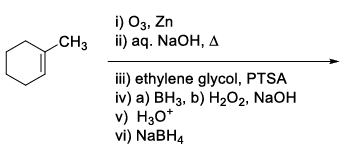
p-Chlorophenol (I): Chlorine is electronegative and exerts a $$-I$$ effect. Although it has a $$+M$$ effect, the $$-I$$ effect is more significant in halogens. It is more acidic than alkyl-substituted phenols but less than nitro-substituted ones.
p-Cresol (II): The methyl group is electron-donating through hyperconjugation ($$+H$$) and inductive effect ($$+I$$). This destabilizes the phenoxide ion relative to phenol, making it less acidic than (I) and (III).
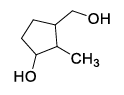
p-Methoxyphenol (IV): The methoxy group exhibits a very strong $$+M$$ effect due to the lone pair on the oxygen atom. At the para position, this effect is dominant over its $$-I$$ effect, making it the most electron-donating and thus the least acidic.
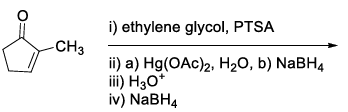
The order of decreasing acidity is: III > I > II > IV
The major product in the following reaction
The benzylic $$-OH$$ group is protonated and leaves as $$H_2O$$ to form a stable benzylic carbocation, which is then attacked by $$Cl^-$$ to form a $$-CH_2Cl$$ group.
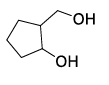
The $$-OH$$ group directly attached to the benzene ring does not react because the $$C-O$$ bond has partial double-bond character due to resonance, making it difficult to break.
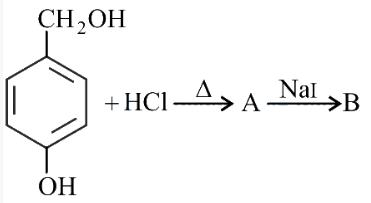
The major product is p-hydroxybenzyl chloride, as shown in Option D.
The reaction of phenol with benzoyl chloride to give phenyl benzoate is known as :
The question asks about the name of the reaction where phenol reacts with benzoyl chloride to form phenyl benzoate.
First, let's recall the reaction: phenol (C6H5OH) reacts with benzoyl chloride (C6H5COCl) to produce phenyl benzoate (C6H5COOC6H5). The reaction can be written as:
$$ C_{6}H_{5}OH + C_{6}H_{5}COCl -> C_{6}H_{5}COOC_{6}H_{5} + HCl $$
This reaction typically requires a base, such as sodium hydroxide (NaOH), to neutralize the hydrochloric acid (HCl) produced and drive the reaction forward. The overall process is known as benzoylation.
Now, let's examine the options:
Option A: Claisen reaction. This refers to the Claisen condensation, which involves the reaction between two ester molecules in the presence of a strong base to form a β-keto ester. For example, ethyl acetate reacts to form acetoacetic ester. It does not involve phenol or benzoyl chloride, so this is incorrect.
Option B: Schotten-Baumann reaction. This reaction specifically describes the benzoylation of compounds with active hydrogen atoms (like phenols or amines) using benzoyl chloride in the presence of an aqueous base (such as NaOH). The base helps by neutralizing the acid formed and making the nucleophile (phenol) more reactive. This matches the given reaction perfectly, as phenol reacts with benzoyl chloride under Schotten-Baumann conditions to yield phenyl benzoate.
Option C: Reimer-Tiemann reaction. This reaction involves phenol reacting with chloroform (CHCl3) in the presence of a strong base (like NaOH) to produce ortho-hydroxybenzaldehyde (salicylaldehyde). It introduces an aldehyde group (-CHO) at the ortho position. Since benzoyl chloride is not used, this option is incorrect.
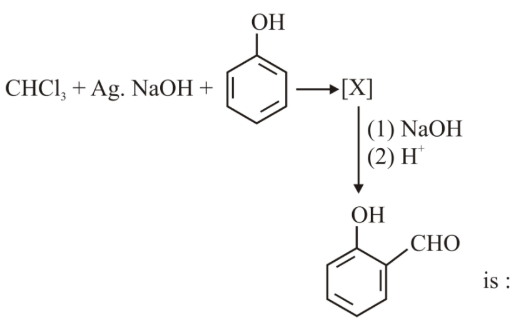
Option D: Gatterman-Koch reaction. This reaction is used to introduce an aldehyde group (-CHO) into an aromatic ring using carbon monoxide (CO) and hydrogen chloride (HCl) in the presence of a catalyst (like AlCl3 and CuCl). It is typically applied to benzene or its derivatives, not phenol, and does not involve benzoyl chloride. Hence, this is incorrect.
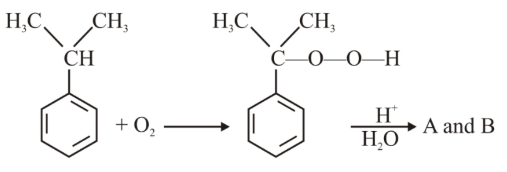
Therefore, the reaction of phenol with benzoyl chloride to form phenyl benzoate is known as the Schotten-Baumann reaction.
Hence, the correct answer is Option B.
Phenol on heating with CHCl$$_3$$ and NaOH gives salicylaldehyde. The reaction is called:
Phenol on heating with $$CHCl_3$$ and NaOH gives salicylaldehyde. The reaction is called Reimer - Tiemann reaction.
What is the structure of the major product when phenol is treated with bromine water?

Phenol reacts with bromine water to form 2,4,6-tribromophenol due to the highly activating nature of the phenoxide ion formed in the aqueous medium.
Amongst the following alcohols which would react fastest with conc. HCl and ZnCl$$_2$$?
Lucas reagent is a mixture of concentrated $$HCl$$ and anhydrous $$ZnCl_2$$. It converts an alcohol $$R{-}OH$$ into the corresponding alkyl chloride $$R{-}Cl$$.
First, state the general reaction that takes place in the presence of Lucas reagent:
$$R{-}OH + HCl \;\xrightarrow[\text{conc.}]{ZnCl_2}\; R{-}Cl + H_2O$$
The mechanism proceeds by the $$S_N1$$ pathway for secondary and tertiary alcohols and by a much slower $$S_N2$$ pathway for primary alcohols. In an $$S_N1$$ reaction the rate-determining step is the formation of a carbocation, and the stability of this carbocation directly controls the speed of the reaction. The order of carbocation stability is
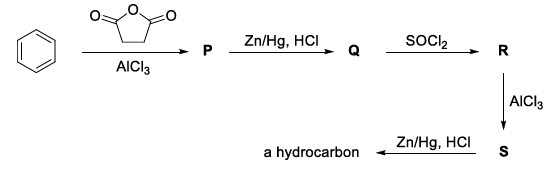
$$\text{tertiary} \;>\; \text{secondary} \;>\; \text{primary}$$
Therefore, the order of reactivity of alcohols with Lucas reagent follows the same trend:
$$\text{tertiary alcohol} \;>\; \text{secondary alcohol} \;>\; \text{primary alcohol}$$
Now classify each given alcohol:
1. Pentanol is $$\text{CH}_3\!-\!\text{CH}_2\!-\!\text{CH}_2\!-\!\text{CH}_2\!-\!\text{CH}_2OH$$. The hydroxyl group is attached to an end carbon, so it is a primary alcohol.
2. 2-Methyl butanol is $$\text{(CH}_3)_2\text{CHCH}_2CH_2OH$$ (also written as 2-methyl-1-butanol). Again the OH is on a terminal carbon, so this is a primary alcohol.
3. 2-Pentanol is $$\text{CH}_3\!-\!\text{CH}_2\!-\!\text{CH}(OH)\!-\!\text{CH}_2\!-\!\text{CH}_3$$. The OH is on the second carbon, which is bonded to two other carbons, hence it is a secondary alcohol.
4. 2-Methyl butan-2-ol is $$\text{(CH}_3)_3\text{C}OH$$. The carbon bearing the OH is attached to three other carbons, so it is a tertiary alcohol.
Using the previously stated reactivity order, the tertiary alcohol will react the fastest with conc. $$HCl$$ and $$ZnCl_2$$. Among the four options, only 2-methyl butan-2-ol is tertiary.
Hence, the correct answer is Option D.
An unknown alcohol is treated with the "Lucas reagent" to determine whether the alcohol is primary, secondary or tertiary. Which alcohol reacts fastest and by what mechanism:
First we recall the basic facts about the Lucas test. The Lucas reagent is a mixture of concentrated hydrochloric acid and anhydrous zinc chloride, written in equations as $$ZnCl_2 + conc\,HCl$$. It converts an alcohol $$R{-}OH$$ into the corresponding alkyl chloride $$R{-}Cl$$: $$R{-}OH + HCl \rightarrow R{-}Cl + H_2O$$, with $$ZnCl_2$$ acting as a Lewis-acid catalyst. The turbidity (cloudiness) that appears comes from insoluble alkyl chloride droplets. The time taken for this turbidity tells us the class of the alcohol.
Now we state the empirical observation that governs the test:
$$\text{Rate of reaction: } \text{tertiary} \; > \; \text{secondary} \; > \; \text{primary}.$$
To justify this order we analyse the stepwise mechanism. The first and rate-determining step is the formation of a carbocation via protonation followed by departure of water. Writing every step:
1. Protonation of the alcohol oxygen by concentrated $$HCl$$ gives the oxonium ion:
$$R{-}OH + H^+ \rightarrow R{-}OH_2^+.$$
2. The zinc chloride coordinates with the lone pairs on oxygen, pulling electron density away and making the -OH2+ group an even better leaving group:
$$(R{-}OH_2^+)\,ZnCl_2 \rightarrow R{-}OH_2^+\;ZnCl_2.$$
3. Departure of water produces the carbocation:
$$R{-}OH_2^+ \rightarrow R^+ + H_2O.$$
4. Finally chloride ion attacks the carbocation to give the alkyl chloride:
$$R^+ + Cl^- \rightarrow R{-}Cl.$$
This sequence—slow ionisation to a carbocation followed by fast nucleophilic attack—is the classical $$S_N1$$ mechanism (substitution, nucleophilic, unimolecular). In an $$S_N1$$ process the stability of the carbocation controls the rate: more stable carbocation ⇒ faster reaction.
Carbocation stability follows the rule
$$3^\circ \; > \; 2^\circ \; > \; 1^\circ,$$
because additional alkyl groups donate electron density by both hyperconjugation and the inductive effect, dispersing the positive charge.
Therefore a tertiary alcohol, which forms a highly stabilised tertiary carbocation, loses water almost instantly; the solution becomes cloudy within a few seconds. A secondary alcohol forms a less stable carbocation, so the cloudiness appears more slowly (often in a few minutes). A primary alcohol forms an unstable primary carbocation, so the $$S_N1$$ path is extremely slow; instead it can react by an $$S_N2$$ path only on prolonged heating, which is why primary alcohols usually give no turbidity at room temperature.
Putting everything together, the fastest reacting alcohol in the Lucas test is the tertiary alcohol and it proceeds through the $$S_N1$$ mechanism.
Hence, the correct answer is Option D.
An ether (A), $$C_5H_{12}O$$, when heated with excess of hot concentrated HI produced two alkyl halides which when treated with NaOH yielded compounds (B) and (C). Oxidation of (B) and (C) gave a propanone and an ethanoic acid respectively. The IUPAC name of the ether (A) is :
The ether (A) has the molecular formula $$C_5H_{12}O$$. When heated with excess hot concentrated HI, it undergoes cleavage to form two alkyl iodides. The reaction of an ether with HI is:
$$ \text{R-O-R'} + 2\text{HI} \rightarrow \text{R-I} + \text{R'-I} + \text{H}_2\text{O} $$
These alkyl iodides are then treated with NaOH, which hydrolyzes them to alcohols:
$$ \text{R-I} + \text{NaOH} \rightarrow \text{R-OH} + \text{NaI} $$
$$ \text{R'-I} + \text{NaOH} \rightarrow \text{R'-OH} + \text{NaI} $$
So, the compounds (B) and (C) are alcohols. Oxidation of (B) gives propanone ($$CH_3COCH_3$$), which is a ketone. Ketones are formed by the oxidation of secondary alcohols. The only secondary alcohol that oxidizes to propanone is propan-2-ol ($$CH_3CH(OH)CH_3$$):
$$ \text{CH}_3\text{CH(OH)CH}_3 \rightarrow \text{CH}_3\text{COCH}_3 $$
Oxidation of (C) gives ethanoic acid ($$CH_3COOH$$), which is a carboxylic acid. Carboxylic acids are formed by the oxidation of primary alcohols. The primary alcohol that oxidizes to ethanoic acid is ethanol ($$CH_3CH_2OH$$), as ethanol oxidizes first to ethanal and then to ethanoic acid:
$$ \text{CH}_3\text{CH}_2\text{OH} \rightarrow \text{CH}_3\text{CHO} \rightarrow \text{CH}_3\text{COOH} $$
Therefore, (B) is propan-2-ol and (C) is ethanol. The alkyl groups in the ether (A) correspond to these alcohols. Propan-2-ol comes from the isopropyl group ($$(CH_3)_2CH-$$), and ethanol comes from the ethyl group ($$CH_3CH_2-$$). Thus, the ether (A) is isopropyl ethyl ether, with the structure $$(CH_3)_2CH-O-CH_2CH_3$$.
To determine the IUPAC name, identify the longest carbon chain. The isopropyl group has a three-carbon chain (propane), and the ethyl group has two carbons. The parent chain is propane, with the ethoxy group attached to carbon 2. Therefore, the IUPAC name is 2-ethoxypropane.
Verifying with the options:
- Option A: 2-ethoxypropane matches the structure $$(CH_3)_2CH-O-CH_2CH_3$$.
- Option B: ethoxypropane is ambiguous but typically implies 1-ethoxypropane ($$CH_3CH_2CH_2-O-CH_2CH_3$$), which would give propan-1-ol and ethanol upon reaction; oxidation of propan-1-ol gives propanoic acid, not propanone.
- Option C: methoxybutane (e.g., $$CH_3O-CH_2CH_2CH_2CH_3$$) would give methanol and butan-1-ol; oxidation gives formaldehyde/formic acid and butanoic acid, not propanone or ethanoic acid.
- Option D: 2-methoxybutane ($$CH_3O-CH(CH_3)CH_2CH_3$$) would give methanol and butan-2-ol; oxidation gives formaldehyde/formic acid and butanone, not propanone or ethanoic acid.
Hence, only 2-ethoxypropane produces the correct products.
So, the answer is Option A.
In Williamson synthesis of mixed ether having a primary and a tertiary alkyl group if tertiary halide is used, then :
We first recall the essence of the Williamson ether synthesis. It is an $$S_N2$$ nucleophilic substitution reaction in which an alkoxide ion $$RO^-$$ attacks an alkyl halide $$R'X$$ to give an ether:
$$RO^- + R'X \;\rightarrow\; ROR' + X^-$$
The fundamental requirement for a smooth $$S_N2$$ reaction is that the carbon atom bearing the leaving group $$X$$ should be unhindered; in other words, a primary alkyl halide is ideal because the nucleophile can approach the carbon from the back side and displace the halide ion in a single concerted step.
Now we analyse the situation given in the question. We wish to prepare a mixed ether that contains one primary alkyl group and one tertiary alkyl group. The chemist has two choices for the halide partner:
1. Take the primary alkyl group as the halide and the tertiary alkyl group as the alkoxide, or
2. Take the tertiary alkyl group as the halide and the primary alkyl group as the alkoxide.
The question specifically says that the tertiary halide is used. So we are in case 2. Let us write the reaction that we would be attempting:
$$R_3C{-}X \;+\; R' O^- \;\longrightarrow\; R_3C{-}O{-}R' \;+\; X^-$$
Here $$R_3C{-}X$$ is a tertiary alkyl halide, and $$R' O^-$$ is a primary alkoxide ion. Because the carbon $$R_3C{-}$$ is tertiary, it is heavily crowded. An $$S_N2$$ attack requires the alkoxide to approach from the back side of the $$C{-}X$$ bond, but steric bulk blocks this route. Therefore the rate of $$S_N2$$ substitution becomes extremely slow.
At the same time, the alkoxide is a strong base. Whenever a strong base meets a tertiary alkyl halide, an elimination pathway is highly favourable. The base abstracts a β-hydrogen, the electrons form a double bond, and the halide ion departs. This is the $$E2$$ mechanism. We can symbolise it as follows (for simplicity a single β-hydrogen is shown):
$$\begin{array}{c} \text{Base }(R'O^-) + R_3C{-}CH_2{-}X \;\;\xrightarrow{E2}\;\; R_3C=CH_2 + R'OH + X^-\\[6pt] \text{(alkene)}\hspace{45pt}\text{(recovered alcohol)} \end{array}$$
Because the $$E2$$ pathway has a much lower steric requirement (the base merely needs to abstract a hydrogen and does not have to approach the crowded carbon atom directly), elimination overwhelmingly dominates over substitution when a tertiary halide is present.
Thus, instead of the desired mixed ether, the chief product that comes out of the reaction mixture is an alkene derived from the tertiary alkyl halide. The ether yield is negligible.
Comparing this conclusion with the options given:
A. “Rate of reaction will be slow due to slow cleavage of carbon-halogen bond.” → While the $$S_N2$$ path is slow, this statement ignores the dominant elimination and is therefore not the best choice.
B. “Alkene will be the main product.” → This matches our analysis exactly.
C. “Simple ether will form instead of mixed ether.” → Not supported; elimination predominates.
D. “Expected mixed ether will be formed.” → Contrary to the mechanistic reasoning.
Therefore the correct statement is option B.
Hence, the correct answer is Option B.
Ortho-Nitrophenol is less soluble in water than $$p-$$ and $$m-$$ Nitrophenols because :
Reagent used to convert allyl alcohol to acrolein is
Bakelite is obtained from phenol by reacting it with
Which of the following reagents may be used to distinguish between phenol and benzoic acid?
Phenol is heated with a solution of mixture of $$\text{KBr}$$ and $$\text{KBrO}_3$$. The major product obtained in the above reaction is:
The main product of the following reaction is $$\text{C}_6\text{H}_5\text{CH}_2\text{CH(OH)CH(CH}_3)_2 \xrightarrow{\text{conc. H}_2\text{SO}_4} ?$$
From amongst the following alcohols the one that would react fastest with conc. HCl and anhydrous $$\text{ZnCl}_2$$, is
The major product obtained on interaction of phenol with sodium hydroxide and carbon dioxide is :
Phenol, when it first reacts with concentrated sulphuric acid and then with concentrated nitric acid, gives
Bakelite is obtained from phenol by reacting with
The structure of the compound that gives a tribromo derivative on treatment with bromine water is
Phenyl magnesium bromide reacts with methanol to give
Among the following the one that gives positive iodoform test upon reaction with $$I_2$$ and NaOH is
The electrophile involved in the above reaction is
The best reagent to convert pent-3-en-2-ol into pent-3-en-2-one is
Among the following compound which can be dehydrated very easily is