
Join Our JEE Preparation Group
Prep with like-minded aspirants; Get access to free daily tests and study material.
Sign in
Please select an account to continue using cracku.in
↓ →
Join Our JEE Preparation Group
Prep with like-minded aspirants; Get access to free daily tests and study material.
Match List - I with List - II.
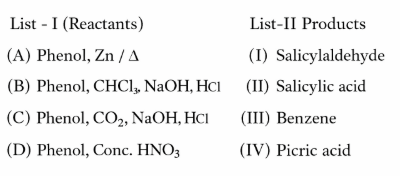
Choose the correct answer from the options given below:
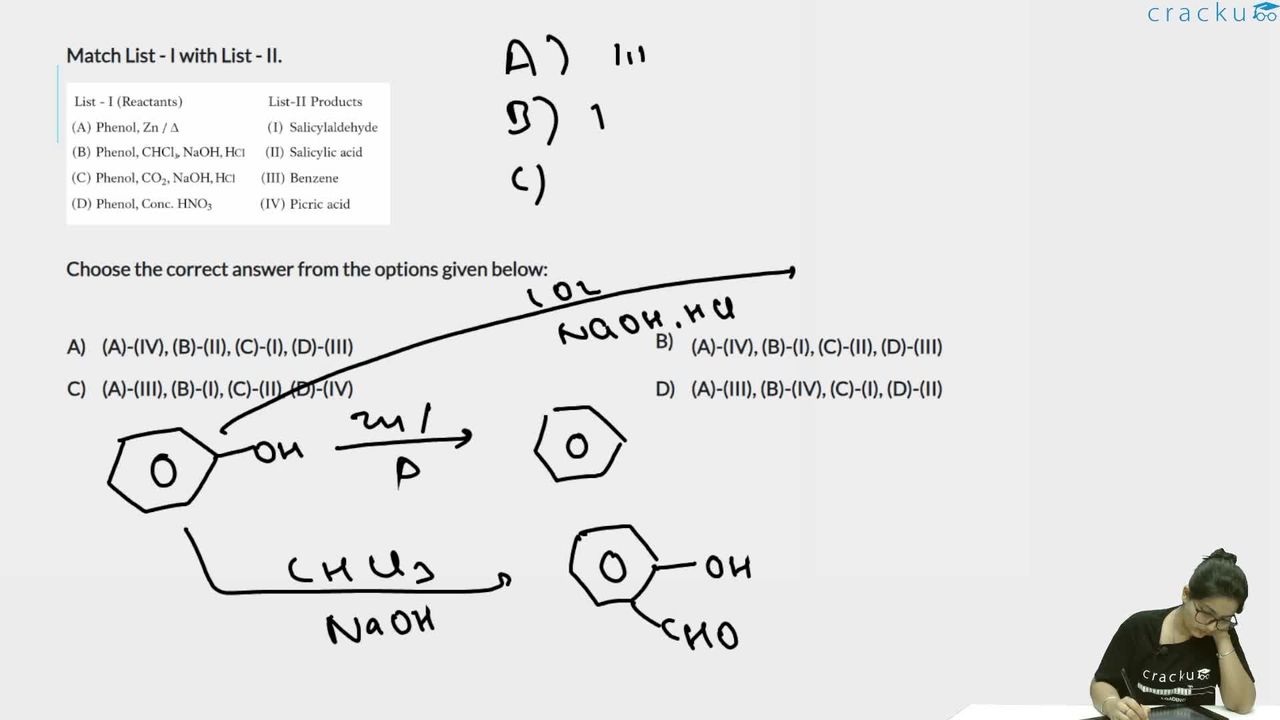
In reaction A, phenol on heating with $$Zn$$ dust undergoes reduction. Zinc removes the oxygen atom as $$ZnO$$, converting phenol into benzene. Therefore, A matches with Benzene, i.e., $$A \rightarrow (III)$$.
In reaction B, phenol reacts with $$CHCl_3/NaOH$$ followed by acidification. This is the Reimer-Tiemann reaction, which introduces a formyl group $$(-CHO)$$ at the ortho position of phenol to form salicylaldehyde. Therefore, $$B \rightarrow (I)$$.
In reaction C, phenol reacts with $$CO_2/NaOH$$ followed by acidification. This is the Kolbe-Schmitt reaction, in which a carboxyl group $$(-COOH)$$ is introduced at the ortho position to form salicylic acid. Therefore, $$C \rightarrow (II)$$.
In reaction D, phenol reacts with concentrated $$HNO_3$$. Due to the strongly activating nature of the $$-OH$$ group, nitration occurs at all available ortho and para positions, producing 2,4,6-trinitrophenol (picric acid). Therefore, $$D \rightarrow (IV)$$.
Thus, the correct matching is:
$$A \rightarrow (III)$$
$$B \rightarrow (I)$$
$$C \rightarrow (II)$$
$$D \rightarrow (IV)$$
Hence, the correct answer is:
$$A-(III),\ B-(I),\ C-(II),\ D-(IV)$$
Was this solution helpful?
Click on the Email ☝️ to Watch the Video Solution
Create a FREE account and get:
_1.webp)

Educational materials for JEE preparation

Ask our AI anything

AI can make mistakes. Please verify important information.
AI can make mistakes. Please verify important information.
