Join Our JEE Preparation Group
Prep with like-minded aspirants; Get access to free daily tests and study material.
Sign in
Please select an account to continue using cracku.in
↓ →
Join Our JEE Preparation Group
Prep with like-minded aspirants; Get access to free daily tests and study material.
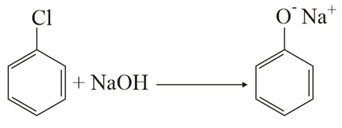
Chlorobenzene reacts with sodium hydroxide only under very harsh conditions because the $$\mathrm{C-Cl}$$ bond in aryl halides has partial double bond character due to resonance, making nucleophilic substitution difficult.
When chlorobenzene is fused with aqueous $$\mathrm{NaOH}$$ at high temperature and high pressure, it forms sodium phenoxide.
$$\mathrm{C_6H_5Cl + NaOH \xrightarrow[300\ atm]{623\ K} C_6H_5ONa + NaCl}$$
On subsequent acidification, sodium phenoxide is converted into phenol.
$$\mathrm{C_6H_5ONa + HCl \rightarrow C_6H_5OH + NaCl}$$
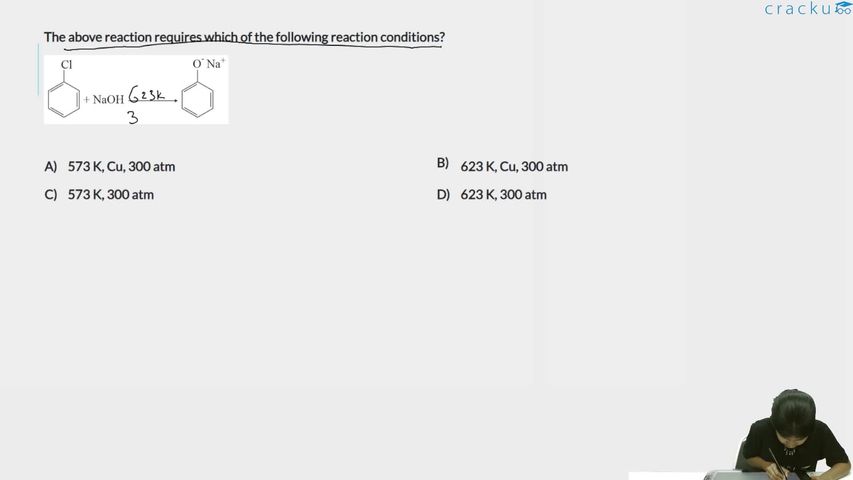
Therefore, the required reaction conditions for the conversion of chlorobenzene to sodium phenoxide are:
Hence, the correct answer is Option (D): $$623\ \mathrm{K},\ 300\ \mathrm{atm}$$.
Was this solution helpful?
Click on the Email ☝️ to Watch the Video Solution
Create a FREE account and get:
_1.webp)

Educational materials for JEE preparation

Ask our AI anything

AI can make mistakes. Please verify important information.
AI can make mistakes. Please verify important information.