Join Our JEE Preparation Group
Prep with like-minded aspirants; Get access to free daily tests and study material.
Sign in
Please select an account to continue using cracku.in
↓ →
Join Our JEE Preparation Group
Prep with like-minded aspirants; Get access to free daily tests and study material.
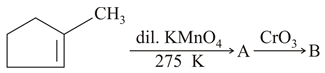
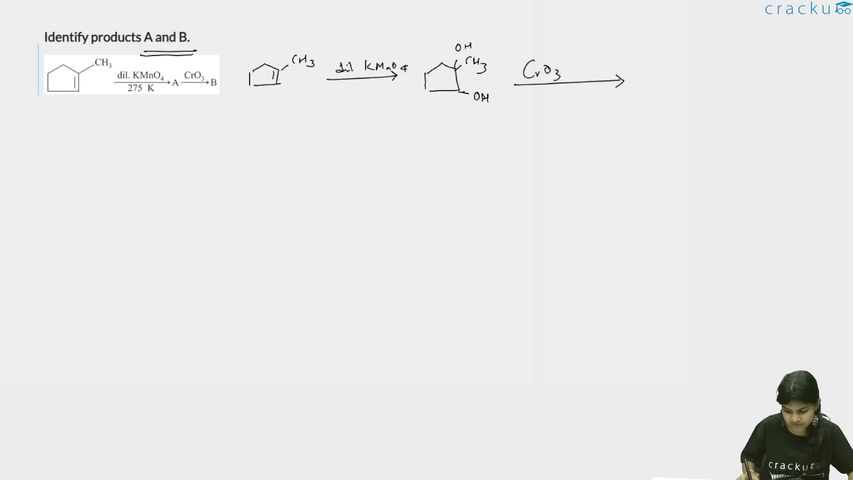
The chemical sequence begins with a molecule called 1-methylcyclopentene, which is a five-membered carbon ring containing a single double bond and a methyl group. When this molecule is exposed to cold, dilute potassium permanganate, commonly known as Baeyer's reagent, an addition reaction occurs across that double bond. The reagent breaks the double bond and attaches a hydroxyl group to each of the two carbons involved. Because the methyl group is attached to one of those specific carbons, the reaction produces two different types of alcohols on the ring: a tertiary alcohol and a secondary alcohol. This newly formed diol is your intermediate Product A, specifically named 1-methylcyclopentane-1,2-diol.
In the next phase of the sequence, Product A is treated with chromium trioxide. This specific reagent is a powerful oxidizing agent that targets alcohols. However, a fundamental rule of organic chemistry governs how this oxidation proceeds. While primary and secondary alcohols are readily oxidized, tertiary alcohols are completely immune to oxidation under these conditions because the carbon holding the hydroxyl group does not have an additional hydrogen atom that can be removed.
Because of this strict chemical rule, the chromium trioxide acts selectively. It completely ignores the tertiary alcohol that is sharing a carbon with the bulky methyl group. Instead, it exclusively targets and oxidizes the secondary alcohol, converting that specific spot on the ring into a ketone. The rest of the molecule remains entirely intact, leaving the methyl group and the tertiary hydroxyl group exactly where they were. This selective oxidation yields your final Product B, which is chemically known as 2-hydroxy-2-methylcyclopentan-1-one.
Was this solution helpful?
Click on the Email ☝️ to Watch the Video Solution
Create a FREE account and get:
_1.webp)

Educational materials for JEE preparation

Ask our AI anything

AI can make mistakes. Please verify important information.
AI can make mistakes. Please verify important information.