
 Group
Group
 Group
Group


 Preferred Source

 Google Discover
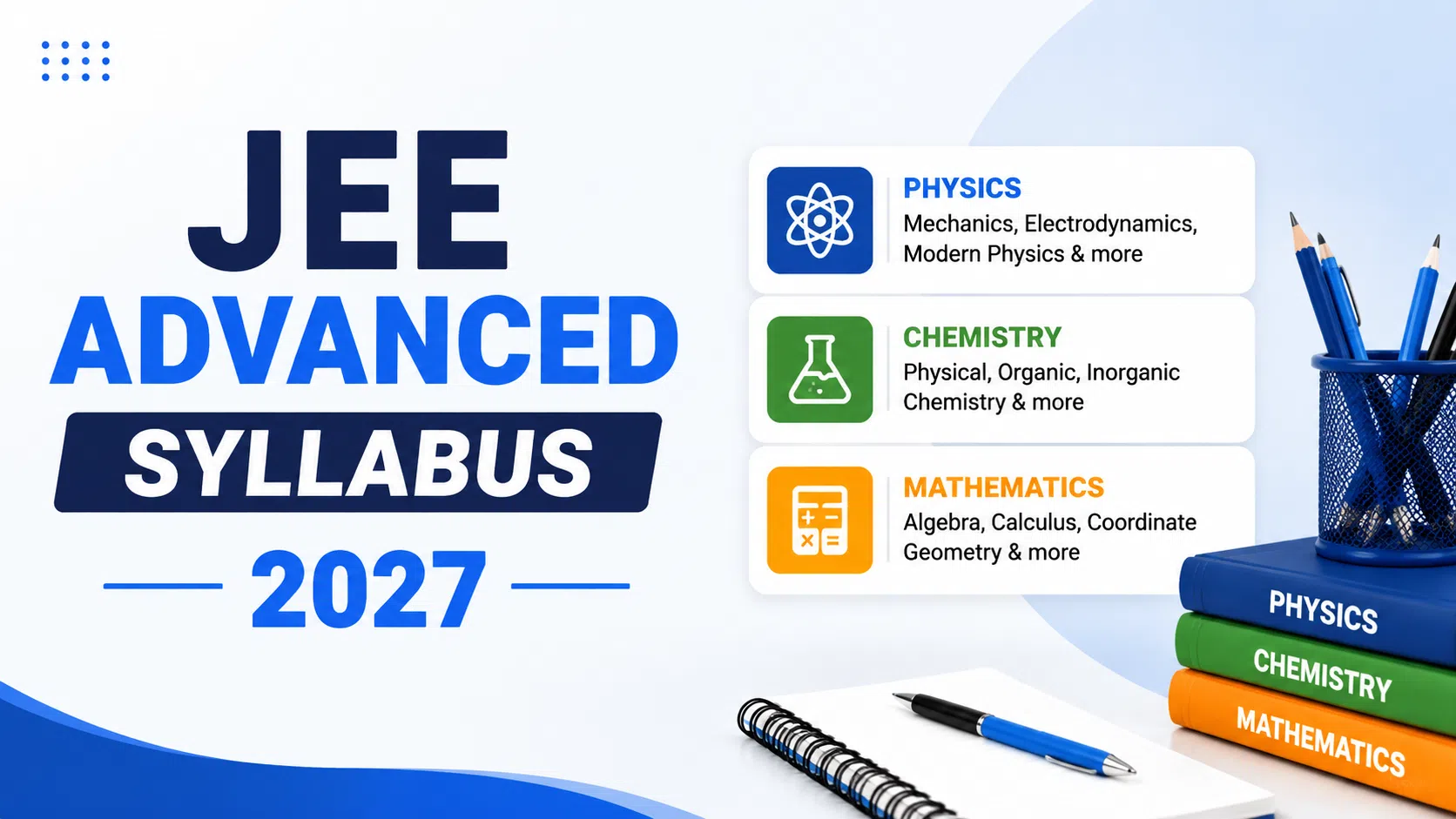
JEE Advanced is conducted for admission to undergraduate programmes offered by the Indian Institutes of Technology (IITs). A clear understanding of the JEE Advanced Syllabus 2027 is essential for planning subject-wise preparation and covering all the required topics. The syllabus includes advanced concepts from Physics, Chemistry and Mathematics based mainly on the Class 11 and Class 12 curriculum.
The official JEE Advanced 2027 information brochure and syllabus PDF have not yet been released. However, no major syllabus change is currently expected. Until the official 2027 syllabus is published, candidates can prepare using the syllabus followed for JEE Advanced 2025 and 2026, which was introduced after the syllabus revision in 2023.
JEE Advanced Syllabus 2027
The JEE Advanced Syllabus 2027 is expected to cover Physics, Chemistry and Mathematics. Both Paper 1 and Paper 2 include questions from all three subjects. The questions are designed to test conceptual understanding, analytical thinking and the ability to apply multiple concepts to complex problems.
Particulars |
Details |
|---|---|
Exam Name |
JEE Advanced 2027 |
Subjects |
Physics, Chemistry and Mathematics |
Syllabus Level |
Class 11 and Class 12 concepts |
Number of Papers |
Two compulsory papers |
Exam Mode |
Computer-Based Test |
Syllabus Status |
Official 2027 syllabus awaited |
Expected Change |
No major change expected from the 2025–2026 syllabus |
Official Website |
jeeadv.ac.in |
The final subject-wise syllabus must be verified from the official JEE Advanced 2027 information brochure once it is released by the organising IIT.
Also Read: JEE Advanced Cutoff 2026, Expected & Previous Year Trends
JEE Advanced Syllabus PDF 2027
The official JEE Advanced Syllabus PDF 2027 will be released on jeeadv.ac.in along with the information brochure. Until then, candidates can refer to the latest available official syllabus because the core topics are expected to remain unchanged.
The JEE Advanced syllabus PDF contains:
- Complete subject-wise syllabus for Physics, Chemistry and Mathematics.
- Unit-wise and topic-wise details for each subject.
- Important experimental concepts included in Physics.
- Detailed division of Physical, Organic and Inorganic Chemistry.
- Mathematics topics from Algebra, Calculus, Coordinate Geometry, Vectors and Trigonometry.
Steps to Download the JEE Advanced Syllabus PDF
- Visit the official JEE Advanced website at jeeadv.ac.in.
- Open the syllabus, information brochure or downloads section.
- Click on the JEE Advanced Syllabus 2027 PDF link.
- Download the PDF and save it for preparation and revision.
- Compare the PDF with the topics already completed in the study plan.
Candidates should use the official PDF as the final reference instead of depending only on syllabus lists published by third-party websites.
Candidates can strengthen their preparation after reviewing the syllabus by practising Cracku’s JEE questions covering important concepts from Physics, Chemistry and Mathematics.
Also Read: Best Engineering Colleges In India 2026, IIT, NIT & IIIT Details
JEE Advanced Physics Syllabus 2027
The JEE Advanced Physics Syllabus 2027 covers General Physics, Mechanics, Thermal Physics, Electricity and Magnetism, Optics and Modern Physics. Questions generally require candidates to connect concepts, interpret physical situations and apply formulas correctly instead of relying only on direct substitution.
Unit |
Topics Covered |
|---|---|
General Physics |
Units and dimensions, dimensional analysis, least count, significant figures, methods of measurement, error analysis and experimental skills |
Mechanics |
Kinematics, Newton’s laws of motion, friction, work, energy and power, centre of mass, collisions, circular motion, rotational dynamics, gravitation and fluid mechanics |
Oscillations and Waves |
Simple harmonic motion, wave motion, sound waves, Doppler effect, standing waves, superposition and resonance |
Thermal Physics |
Thermal expansion, calorimetry, heat transfer, kinetic theory of gases, laws of thermodynamics, heat engines and Carnot cycle |
Electricity and Magnetism |
Electrostatics, capacitance, current electricity, magnetic effects of current, electromagnetic induction, alternating current and electromagnetic waves |
Optics |
Reflection, refraction, lenses, mirrors, optical instruments, interference, diffraction and polarisation |
Modern Physics |
Photoelectric effect, atomic models, nuclear physics, radioactivity, semiconductors and logic gates |
JEE Advanced Experimental Skills Syllabus
Experimental skills form an important part of the Physics syllabus. Questions may test understanding of measuring instruments, observations, errors, graphs and standard laboratory experiments.
Experiment or Instrument |
Concepts Tested |
|---|---|
Vernier Callipers |
Least count, measurement of internal and external dimensions and error calculation |
Screw Gauge |
Pitch, least count, zero error and measurement of small dimensions |
Simple Pendulum |
Time period, effective length and acceleration due to gravity |
Metre Bridge |
Wheatstone bridge principle and resistance measurement |
Potentiometer |
Comparison of electromotive force and determination of internal resistance |
Young’s Modulus Experiment |
Stress, strain, elasticity and graphical analysis |
Experimental Physics should not be ignored because questions may combine practical observations with theoretical concepts.
Also Read: Top 10 Engineering Colleges in India 2026, Placements & ROI
JEE Advanced Chemistry Syllabus 2027
The JEE Advanced Chemistry Syllabus 2027 is divided into Physical Chemistry, Organic Chemistry and Inorganic Chemistry. Physical Chemistry requires numerical problem-solving, Organic Chemistry focuses on reaction mechanisms and transformations, while Inorganic Chemistry requires conceptual understanding and careful revision of standard facts.
JEE Advanced Physical Chemistry Syllabus
Unit |
Topics Covered |
|---|---|
General Topics |
Mole concept, stoichiometry, concentration terms and chemical calculations |
Atomic Structure |
Atomic models, quantum numbers, electronic configuration and orbitals |
States of Matter |
Gas laws, ideal and real gases, liquid state and intermolecular forces |
Chemical Thermodynamics |
Enthalpy, entropy, Gibbs energy, Hess’s law and spontaneity |
Chemical Equilibrium |
Ionic equilibrium, acids and bases, buffer solutions, solubility product and hydrolysis |
Electrochemistry |
Conductance, electrochemical cells, Nernst equation and electrolysis |
Chemical Kinetics |
Rate laws, order of reaction, activation energy and Arrhenius equation |
Solutions |
Colligative properties, Raoult’s law and concentration calculations |
Surface Chemistry |
Adsorption, catalysis, colloids and emulsions |
JEE Advanced Organic Chemistry Syllabus
Unit |
Topics Covered |
|---|---|
Basic Principles |
Nomenclature, structural isomerism, stereochemistry, electronic effects and reaction intermediates |
Hydrocarbons |
Alkanes, alkenes, alkynes and aromatic hydrocarbons |
Halo Compounds |
Haloalkanes, haloarenes, substitution and elimination reactions |
Alcohols, Phenols and Ethers |
Preparation, properties and important chemical reactions |
Aldehydes and Ketones |
Nucleophilic addition, oxidation, reduction and named reactions |
Carboxylic Acids |
Preparation, acidity, derivatives and chemical reactions |
Amines |
Basicity, preparation, diazonium salts and important transformations |
Biomolecules and Polymers |
Carbohydrates, amino acids, proteins, nucleic acids and polymerisation |
Practical Organic Chemistry |
Detection of elements and identification of functional groups |
JEE Advanced Inorganic Chemistry Syllabus
Unit |
Topics Covered |
|---|---|
Periodic Properties |
Periodic classification, atomic radius, ionisation energy, electron affinity and electronegativity |
Chemical Bonding |
Ionic bonding, covalent bonding, hybridisation, molecular orbital theory and molecular shapes |
Hydrogen |
Hydrides, water, hydrogen peroxide and hydrogen economy |
s-Block Elements |
Properties and compounds of alkali and alkaline earth metals |
p-Block Elements |
Properties and important compounds of Groups 13 to 18 |
d- and f-Block Elements |
Transition elements, lanthanoids, actinoids and their compounds |
Coordination Chemistry |
Nomenclature, bonding, isomerism, crystal field theory and applications |
Metallurgy |
Principles of extraction, concentration, reduction and refining of metals |
Qualitative Analysis |
Identification of anions, cations and common inorganic salts |
JEE Advanced Mathematics Syllabus 2027
The JEE Advanced Mathematics Syllabus 2027 covers Sets and Functions, Algebra, Matrices, Probability, Trigonometry, Analytical Geometry, Differential Calculus, Integral Calculus and Vectors. The subject requires continuous problem-solving practice because many questions combine concepts from multiple chapters.
Unit |
Topics Covered |
|---|---|
Sets, Relations and Functions |
Sets, union and intersection, Cartesian products, relations, functions, composition, inverse functions and graphs |
Algebra |
Complex numbers, quadratic equations, sequences and series, logarithms, permutations and combinations and binomial theorem |
Matrices and Determinants |
Matrix operations, determinants, inverse of a matrix and solutions of linear equations |
Probability and Statistics |
Conditional probability, Bayes’ theorem, random variables, mean, variance and standard deviation |
Trigonometry |
Trigonometric functions, identities, equations, inverse trigonometric functions and properties of triangles |
Coordinate Geometry |
Straight lines, circles, parabola, ellipse and hyperbola |
Differential Calculus |
Limits, continuity, differentiability, derivatives and applications of derivatives |
Integral Calculus |
Indefinite integration, definite integration, area under curves and differential equations |
Vectors |
Vector addition, scalar product, vector product and geometrical applications |
Three-Dimensional Geometry |
Direction ratios, direction cosines, straight lines, planes and shortest distance between lines |
Sets, Relations and Functions and Statistics were included during the syllabus revision introduced in 2023 and should not be omitted from preparation.
Is the JEE Advanced 2027 Syllabus the Same as 2026?
The official JEE Advanced 2027 syllabus has not yet been released. However, it is expected to remain similar to the syllabus followed for JEE Advanced 2025 and 2026. The syllabus underwent a major revision in 2023, after which the same broad structure continued across Physics, Chemistry and Mathematics.
Candidates can therefore begin preparation using the latest official syllabus instead of waiting for the 2027 brochure. If IIT Delhi or the Joint Admission Board introduces any revisions, the changes will be mentioned in the official information brochure published on jeeadv.ac.in.
Subject |
Expected Status for 2027 |
|---|---|
Physics |
No major change expected |
Chemistry |
No major change expected |
Mathematics |
No major change expected |
Experimental Skills |
Expected to remain part of Physics |
The latest official syllabus should be used for preparation, but the 2027 brochure must be checked after its release for additions, deletions or modifications.
Common JEE Advanced Syllabus Preparation Mistakes
Completing the syllabus does not automatically guarantee a strong JEE Advanced score. Candidates must avoid preparation mistakes that reduce accuracy, revision quality and performance under examination conditions.
1. Depending on an Unofficial Syllabus
Candidates should compare their study plan with the official syllabus PDF. Unverified topic lists may include deleted chapters or omit important subtopics.
2. Studying Only Theory
JEE Advanced tests the application of concepts. Every chapter should be followed by numerical problems, multi-concept questions and previous-year questions.
3. Ignoring Experimental Physics
Practical concepts such as least count, errors, graphs and measuring instruments are part of the syllabus and require separate preparation.
4. Neglecting a Weak Subject
Physics, Chemistry and Mathematics contribute to the aggregate score. Ignoring one subject can also make it difficult to clear the subject-wise qualifying marks.
5. Memorising Without Understanding
Formulas and reactions should be studied along with their applications, assumptions and limitations because JEE Advanced frequently presents unfamiliar situations.
6. Delaying Revision
Regular revision is necessary for retaining formulas, reactions, exceptions and problem-solving methods.
7. Skipping Previous-Year Papers
Previous JEE Advanced papers help candidates understand the actual difficulty level, question structure and depth of concepts tested.
8. Avoiding Full-Length Mock Tests
Attempting a timed JEE mock test helps improve speed, accuracy, concentration and time management.
Best Books for JEE Advanced Syllabus 2027
Study material should be selected according to the candidate’s preparation level. NCERT books can be used to build the foundation, while advanced reference books and previous-year papers can be used for higher-level problem practice.
Subject |
Recommended Books |
|---|---|
Physics |
Concepts of Physics Volume 1 and 2 by H.C. Verma, Problems in General Physics by I.E. Irodov and the D.C. Pandey Physics series |
Physical Chemistry |
NCERT Chemistry, Physical Chemistry by P. Bahadur and Problems in Physical Chemistry by N. Avasthi |
Organic Chemistry |
NCERT Chemistry, Organic Chemistry by Morrison and Boyd and advanced problem books by M.S. Chouhan |
Inorganic Chemistry |
NCERT Chemistry and Concise Inorganic Chemistry by J.D. Lee |
Mathematics |
Cengage Mathematics series, Arihant Skills in Mathematics and advanced problem books by A. Das Gupta |
Previous-Year Papers |
JEE Advanced previous 10 to 15 years’ question papers with detailed solutions |
Candidates should avoid collecting too many books. Completing a limited set of reliable resources with proper revision is more effective than solving only selected portions from multiple books.
Preparation Tips for JEE Advanced Syllabus 2027
A structured study plan should combine syllabus coverage, question practice, revision and mock-test analysis. The following preparation tips can help candidates complete the JEE Advanced syllabus efficiently:
- Download the latest official syllabus and create a chapter-wise checklist.
- Divide the syllabus into weekly and monthly preparation targets.
- Study Physics, Chemistry and Mathematics regularly instead of completing one subject at a time.
- Build conceptual clarity before attempting advanced-level questions.
- Solve JEE Advanced previous-year papers chapter-wise after completing each unit.
- Prepare separate revision notes for formulas, reactions, exceptions and important results.
- Revise completed chapters regularly to prevent loss of retention.
- Attempt both Paper 1 and Paper 2 under timed conditions.
- Analyse every mock test and classify errors as conceptual, calculation-based or time-management errors.
- Complete the main syllabus at least two to three months before the expected examination date.
Candidates who need structured support for strengthening fundamental concepts can begin with JEE Mains online coaching before moving towards advanced-level questions and full-length JEE Advanced papers.
JEE Advanced Syllabus 2027: Conclusion
The JEE Advanced Syllabus 2027 is expected to include detailed Class 11 and Class 12 topics from Physics, Chemistry and Mathematics. Although the official JEE Advanced Syllabus PDF 2027 has not been released, no major change is currently expected from the syllabus followed in 2025 and 2026. Students can begin their preparation with the latest official syllabus while regularly checking the official website for updates, additions or deleted topics.
Effective preparation for the JEE Advanced 2027 syllabus requires conceptual clarity, regular revision and consistent advanced-level problem practice. Students should complete all three subjects, practise Experimental Physics, solve previous-year JEE Advanced papers and attempt full-length mock tests for both papers. Once the official 2027 information brochure is released, the study plan should be compared with the final syllabus to ensure that every required topic has been covered.