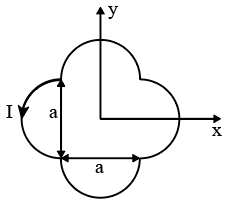
A loop carrying current I lies in the x-y plane as shown in the figure. the unit vector $$\hat{k}$$ is coming out of the plane of the paper. the magnetic moment of the current loop is :
Sign in
Please select an account to continue using cracku.in
↓ →

Join Our JEE Preparation Group
Prep with like-minded aspirants; Get access to free daily tests and study material.
A loop carrying current I lies in the x-y plane as shown in the figure. the unit vector $$\hat{k}$$ is coming out of the plane of the paper. the magnetic moment of the current loop is :
A thin uniform cylindrical shell, closed at both ends, is partially filled with water. It is floating vertically in water in half-submerged state. If $$\rho_c$$ is the relative density of the material of the shell with respect to water, then the correct statement is that the shell is
Loading solution...
An infinitely long hollow conducting cylinder with inner radius R/2 and outer radius R carries a uniform current density along is length. Themagnitude of themagnetic field, $$\mid \overrightarrow{B} \mid$$ as a function of the radial distance r from the axis is best represented by :
Loading solution...

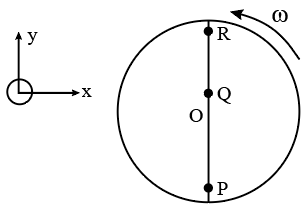
Consider a disc rotating in the horizontal plane with a constant angular speed $$\omega$$ about its centre O. The disc has a shaded region on one side of the diameter and an unshaded region on the other side as shown in the figure. When the disc is in the orientation as shown, two pebbles P and Q are simultaneously projected at an angle towards R. The velocity of projection is in the y-z plane and is same for both pebbles with respect to the disc. Assume that (i) they land back on the disc before the disc completed $$\frac{1}{8}$$ rotation. (ii) their range is less than half disc radius, and (iii) $$\omega$$ remains constant throughout . Then
Loading solution...
A student is performing the experiment of Resonance Column. The diameter of the column tube is 4cm . The distance frequency of the tuning for k is 512 Hz. The air temperature is $$38^\circ C$$ in which the speed of sound is 336 m/s. The zero of the meter scale coincides with the top and of the Resonance column. When first resonance occurs, the reading of the water level in the column is
Loading solution...
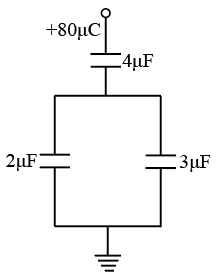
In the given circuit, a charge of +80 $$\mu C$$ is given to the upper plate of the $$4 \mu F$$ capacitor. Then in the steady state, the charge on the upper plate of the $$3 \mu F$$ capacitor is :
Loading solution...
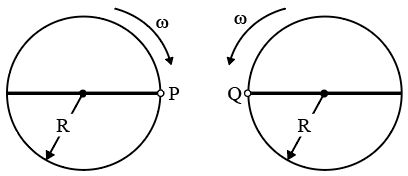
Two identical discs of same radius R are rotating about their axes in opposite directions with the same constant angular speed $$\omega$$. The disc are in the same horizontal plane. At time t = 0 , the points P and Q are facing each other as shown in the figure. The relative speed between the two points P and Q is $$v_r$$. as function of times best represented by
Loading solution...
Two moles of ideal helium gas are in a rubber balloon at $$30^\circ C$$ .The balloon is fully expandable and can be assumed to require no energy in its expansion. The temperature of the gas in the balloon is slowly changed to $$35^\circ C$$.The amount of heat required in raising the temperature is nearly (take R = 8.31 J/mol.K)
Loading solution...
The $$\beta$$- decay process, discovered around 1900, is basically the decay of a neutron (n), In the laboratory, a proton (p) and an electron $$(e^{-})$$ are observed as the decay products of the neutron. therefore, considering the decay of a neutron as a tro-body dcay process, it was predicted theoretically that thekinetic energy of the electron should be a constant. But experimentally, it was observed that the electron kinetic energy has a continuous spectrum. Considering a three-body decay process, i.e. $$n \rightarrow p + e^{-} + \overline{v_e}$$, around 1930, pauli explained the observed electron energy spectrum. Assuming the anti-neutrino $$(\overline{v_e})$$ to be massless and possessing negligible energy, and neutron to be at rest, momentum and energy conservation principles are applied. From this calculation, themaximum kinetic energy of the lectron is $$0.8 \times 10^6$$ eV. The kinetic energy carried by the proton is only the recoil energy.
What is the maximum energy of the anti-neutrino ?
Loading solution...
If the anti-neutrino had amass of 3 eV/c$$^2$$ (where c is the speed of light) instead of zeromass, what should be the range of the kinetic energy, K, of the electron ?
Loading solution...
Most materials have therefractive index, n > 1. So, when a light ray from air enters a naturally occurring material, then by Snells' law, $$\frac{\sin \theta_1}{\sin \theta_2} = \frac{n_2}{n_1}$$, it is understood that the refracted ray bends towards the normal. But it never emerges on the same side of the normal as the incident ray.According to electromagnetism, the
refractive index of themedium is given by the relation, $$n = \left(\frac{c}{v}\right) = \pm \sqrt{ε_r\mu_r}$$ where c is the speed of electromagnetic waves in vacuum, v its speed in the medium, $$ε_r$$ and $$\mu_r$$ are negative, one one must choose the negative root of n. Such negative refractive index materials can now be artificially prepared and are calledmeta-materials.
They exhibit significantly different optical behavior, without violating any physical laws. Since n is negative, it results in a change in the direction of propagation of the refracted light. However, similar to normalmaterials, the frequency of light remains unchanged upon refraction even inmeta-materials.
Choose the correct statement.
Loading solution...
For light incident from air on a meta-material, the appropriate ray diagram is :
Loading solution...
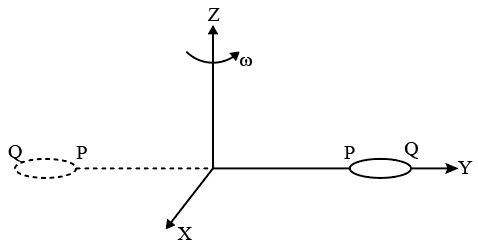
The general motion of a rigid body can be considered to be a combination of (i) a motion --- centre of mass about an axis, and (ii) its motion about an instantanneous axis passing through center of mass. These axes need not be stationary. Consider, for example, a thin uniform welded (rigidly fixed) horizontally at its rim to a massless stick, as shown in the figure. Where disc-stick system is rotated about the origin ona horizontal frictionless plane with angular sp--- $$\omega$$, the motion at any instant can be taken as a combination of (i) a rotation of the centre of mass the disc about the z-axis, and (ii) a rotation of the disc through an instantaneous vertical axis pass through its centre of mass (as is seen from the changed orientation of points P and Q). Both the motions have the same angular speed $$\omega$$ in the case.
Now consider two similar systems as shown in the figure: case (a) the disc with its face ver--- and parallel to x-z plane; Case (b) the disc with its face making an angle of $$45^\circ$$ with x-y plane its horizontal diameter parallel to x-axis. In both the cases, the disc is weleded at point P, and systems are rotated with constant angular speed $$\omega$$ about the z-axis.
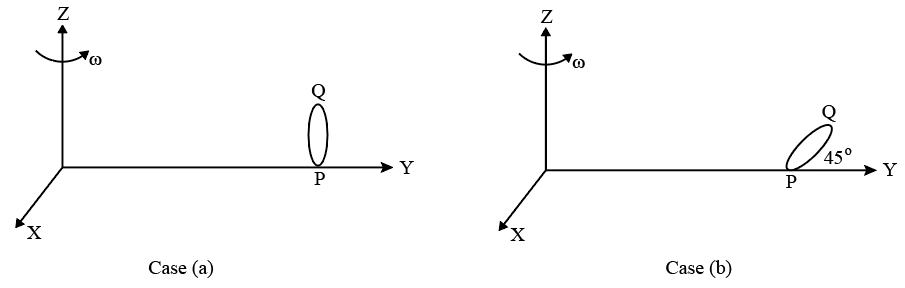
Which of the following statement regarding the angular speed about the istantaneous axis (passing through the centre of mass) is correct?
Loading solution...
Which of the following statements about the instantaneous axis (passing through the centre of mass) is correct?
Loading solution...
Two solid cylinders P andQ of same mass and same radius start rolling down a fixed inclined plane form the same height at the same time. Cylinder P has most of its mass concentrated near its surface, while Q has most of its mass concentrated near the axis. Which statement (s) is (are) correct?
Loading solution...
A current carrying infinitely long wire is kept along the diameter of a circular wire loop,without touching it. The correct statement (s) is (are) :
Loading solution...
In the given circuit, the AC source has $$ \omega = 100$$ rad/s. considering the inductor and capacitor to be ideal, the correct choice (s) is(are)

Loading solution...
Six point charges are kept at the vertices of a regular hexagon of side L and centre O, as shown in the figure. Given that $$K = \frac{1}{4 \pi ε_0}\frac{q}{L^2}$$, which of the following statement (s) is (are) correct?

Loading solution...
Two spherical planets P andQ have the same unfirom density $$\rho$$, masses $$M_P$$ and $$M_Q$$, an surface areas A and 4A, respectively. A spherical planet R also has unfirom density $$\rho$$ and its mass is $$(M_P + M_Q)$$. The escape velocities from the planets P, Q and R, are $$V_P, V_Q$$ and $$V$$ respectively. Then
Loading solution...
The figure shows a system consisting of (i) a ring of outer radius 3R rolling clockwise without slipping on a horizontal surface with angular speed $$\omega$$ and (ii) an inner disc of radius 2R rotating anti-clockwisewith angular speed $$\frac{\omega}{2}$$. The ring and disc are separated b frictionaless ball bearings. The system is in the x-z plane. The
point P on the inner disc is at distance R from the origin, where OP makes an angle of $$30^\circ$$ with the horizontal. Then with respect to the horizontal surface,

Loading solution...
$$NiCl_2\left\{P (C_2H_5)_2(C_6H_5)\right\}_2$$ exhibits temperature dependentmagnetic behaviour (paramagnetic/ diamagnetic). the coordination geometries of $$Ni^{2+}$$ in the paramagnetic and diamagnetic states are respectively
Loading solution...
The reaction of white phosphorous with aqueous NaOH gives phosphine along with another phosphorus containing compound. The reaction type; the oxidation states of phosphorous in phosphine and the other product are respectively
Loading solution...
In the cyanide extraction process of silver from argentite ore, the oxidizing and reducing agents used are
Loading solution...
The compound that undergoes decarboxlylationmost readily under mild condition is
Loading solution...
Using the data provided, calculate the multiple bond energy $$(kJ mol^{-1})$$ of a $$C \equiv C$$ bond $$C_2H_2$$. That energy is (take the bond energy of a C-H bond as 350 kJ $$mol^{-1}$$)
$$2C(s) + H_2(g) \rightarrow C_2H_2(g)$$ $$\triangle H = 225 kJ mol^{-1}$$
$$2C(s) \rightarrow 2C(g)$$ $$\triangle H = 1410 kJ mol^{-1}$$
$$H_2(g) \rightarrow 2H(g)$$ $$\triangle H = 330 kJ mol^{-1}$$
Loading solution...
The shape of $$XeO_2F_2$$ molecule is
Loading solution...
The major product H in the given reaction sequence is

Loading solution...
For a dilute solution containing 2.5 g of a non- volatile non- electrolyte solute in 100 g of water, the elevation in boiling point at 1 atm pressure is $$2^\circ C$$. Assuming concentration of solute is much lower than the concentration of solvent, the vapour pressure (mm of Hg) of the solution is (take $$K_b = 0.76$$ K kg $$mol^{-1}$$)
Loading solution...
The electrochemical cell shown below is a concentration cell.
$$M \mid M^{2+}$$ (saturated solution of a sparingly soluble salt, $$MX_2$$) $$\parallel M^{2+}$$ (0.001 mol $$dm^{-3}$$) $$\mid M$$
The emf of the cell depends on the difference in concetration of $$M^{2+}$$ ions at the two electrodes. The emf of the cell at 298 is 0.059 V
The solubility product ($$K_{sp};mol^3 dm^{-9}$$) of $$MX_2$$ at 298 based on the information available the given concentration cell is (take $$2.303 \times R \times \frac{298}{F} = 0.059 V$$)
Loading solution...
The value of $$\triangle G (kJ mol^{-1})$$ for the given cell is (take 1F = 96500 C $$mol^{-1}$$)
Loading solution...
Bleaching powder and bleach solution are produced on a large scale and used in several house hold products. The effectiveness of bleach solution is often measured by iodometry.
25mL of household bleach solution was mixed with 30mL of 0.50MKI and 10mL of 4N acetic acid. In the titration of the liberated iodine, 48mL of 0.25 N $$Na_2S_2O_3$$ was used to reach the end point. Themolarity of the household bleach solution is
Loading solution...
Bleaching powder contains a salt of an oxoacid as one of its components. The anhydride of that oxoacid is
Loading solution...
In the following reactions sequence, the compound J is an intermediate.

$$J(C_9H_8O_2)$$ gives effervescence on treatment with $$NaHCO_3$$ and positive baeyer's test
The compound K is
Loading solution...
The compound I is
Loading solution...
With respect to graphite and diamond, which of the statement(s) given below is (are) correct ?
Loading solution...
The given graph / data I, II, III and IV represent general trends observed for different physisorption and chemisorption processes under mild conditions of temperature and pressure. Which of the following choice (s) about I, II, III and IV is (are) correct

Loading solution...
The reversible expansion of an ideal gas under adiabatic and isothermal conditions is shown in the figure. Which of the following statement(s) is (are) correct ?

Loading solution...
For the given aqueous reaction which of the statement(s) is (are) true ?

Loading solution...
With reference to the scheme given, which of the given statements(s) about T, U, V and W is (are) correct?

Loading solution...
Which of the given statement(s) about N, O, P and Q with respect to M is (are) correct ?

Loading solution...
The equation of a plane passing through the line of intersection of the planes $$x + 2y + 3z = 2$$ and $$x - y + z = 3$$ and at a distance $$\frac{2}{\sqrt{3}}$$ from the point (3, 1, -1) is
Loading solution...
If $$\overrightarrow{a}$$ and $$\overrightarrow{b}$$ are vectors such that $$\mid \overrightarrow{a} + \overrightarrow{b} \mid = \sqrt{29}$$ and $$\overrightarrow{a} \times (2 \hat{i} + 3 \hat{j} + 4 \hat{k}) = (2 \hat{i} + 3\hat{j} + 4 \hat{k}) \times \overrightarrow{b}$$, then a possible value of $$(\overrightarrow{a} + \overrightarrow{b}).(-7 \hat{i} + 2 \hat{j} + 3 \hat{k})$$ is
Loading solution...
Let PQR be a triangle of area $$\triangle$$ with $$a = 2, b = \frac{7}{2}$$ and $$c = \frac{5}{2}$$, where a, b and c are the lengths of the sides of the triangle opposite to the angles at P, Q and R respectively. Then $$\frac{2 \sin P - \sin 2P}{2 \sin P + \sin 2P}$$ equals
Loading solution...
Four fair dice $$D_1, D_2, D_3$$ and $$D_4$$ each having six faces numbered 1, 2, 3, 4, 5 and 6 are rolled simultaneously. The probability that $$D_4$$ shows a number appearing on one of $$D_1, D_2$$ and $$D_3$$ is
Loading solution...
The value of the integral $$\int_{-\frac{\pi}{2}}^{\frac{\pi}{2}}\left(x^2 + \ln \frac{\pi + x}{\pi - x}\right)\cos x dx$$ is
Loading solution...
If P is a $$3 \times 3$$ matrix such that $$P^T = 2P + I$$, where $$P^T$$ is the transpose of P and I is the $$3 \times 3$$ identity matrix, then there exists a column matrix $$X = \begin{bmatrix}x \\y \\z\end{bmatrix} \neq \begin{bmatrix}0 \\0 \\0\end{bmatrix}$$ such that
Loading solution...
Let $$a_1, a_2, a_3,....$$ be in harmonic progression with $$a_1 = 5$$ and $$a_{20} = 25$$. The least positive integer n for which $$a_n < 0$$ is
Loading solution...
Let $$\alpha(a)$$ and $$\beta(a)$$ be the roots of the equation $$\left(\sqrt[3]{1 + a} - 1\right)x^2 + \left(\sqrt{1 + a} - 1\right)x + \left(\sqrt[6]{1 + a} - 1\right) = 0$$ where a > -1. Then $$\lim_{a \rightarrow 0^+}\alpha(a)$$ and $$\lim_{a \rightarrow 0^+}\beta(a)$$ are
Loading solution...
Let $$f(x) = (1 - x)^2 \sin^2 x + x^2$$ for all $$x \in IR$$ and let $$g(x) = \int_{1}^{x}\left(\frac{2(t - 1)}{t + 1} - \ln t\right)f(t) dt$$ for all $$x \in (1, \infty)$$.
Which of the following is true ?
Loading solution...
Consider the statements :
P : There exists some $$x \in IR$$ such that $$f(x) + 2x = 2(1 + x^2)$$
Q : There exists some $$x \in IR$$ such that $$2f(x) + 1 = 2x(1 + x)$$ Then
Loading solution...
Let $$a_n$$ denote the number of all n-digit positive integers formed by the digits 0,1 or both such that no consecutive digits in them are 0. Let $$b_n =$$ the number of such n-digit integers ending with digit 1 and $$c_n =$$ the number of such n-digit integers ending with digit 0.
Which of the following is correct ?
Loading solution...
The value of $$b_6$$ is
Loading solution...
A tangent PT is drawn to the circle $$x^2 + y^2 = 4$$ at the point $$P(\sqrt{3}, 1)$$. A Straight line L, perpendicular to PT is a tangent to the circle $$(x - 3)^2 + y^2 = 1$$
A common tangent of the two circles is
Loading solution...
A possible equation of L is
Loading solution...
Let X and Y be two events such that $$P(X \mid Y) = \frac{1}{2}, P(Y \mid X) = \frac{1}{3}$$ and $$P(X \cap Y) = \frac{1}{6}$$. Which of the following is (are) correct?
Loading solution...
If $$f(x) = \int_{0}^{x} e^{t^2}(t - 2)(t - 3) dt$$ for all $$x \in (0, \infty)$$, then
Loading solution...
For every integer n, let $$a_n$$ and $$b_n$$ be real numbers. Let function $$f : IR \rightarrow IR$$ be given by
$$ f(x) = \begin{cases}a_n + \sin \pi x & for x \in [2n , 2n + 1]\\b_n + \cos \pi x & for x \in [2n - 1 , 2n]\end{cases}$$, for all integers n.
If f is continuous, then which of the following hold(s) for all n?
Loading solution...
If the straight lines $$\frac{x - 1}{2} = \frac{y + 1}{k} = \frac{z}{2}$$ and $$\frac{x + 1}{5} = \frac{y + 1}{2} = \frac{z}{k}$$ are coplanar, then the plane(s) containing these two lines is(are)
Loading solution...
If the adjoint of a $$3 \times 3$$ matrix P is $$\begin{bmatrix}1 & 4 & 4 \\2 & 1 & 7\\1 & 1 & 3 \end{bmatrix}$$, then the possible value(s) of the determinant of P is (are)
Loading solution...
Let $$f : (-1, 1) \rightarrow IR$$ be such that $$f(\cos 4 \theta) = \frac{2}{2 - \sec^2 \theta}$$ for $$\theta \in \left(0, \frac{\pi}{4}\right)\cup \left(\frac{\pi}{4}, \frac{\pi}{2}\right)$$ Then the value(s) of $$f\left(\frac{1}{3}\right)$$ is (are)
Loading solution...
Educational materials for JEE preparation