The complex showing a spin-only magnetic moment of 2.82 B.M. is

Join Our JEE Preparation Group
Prep with like-minded aspirants; Get access to free daily tests and study material.
Sign in
Please select an account to continue using cracku.in
↓ →
Join Our JEE Preparation Group
Prep with like-minded aspirants; Get access to free daily tests and study material.
The complex showing a spin-only magnetic moment of 2.82 B.M. is
The species having pyramidal shape is
Loading solution...
In the reaction

Loading solution...

The compounds P, Q and S
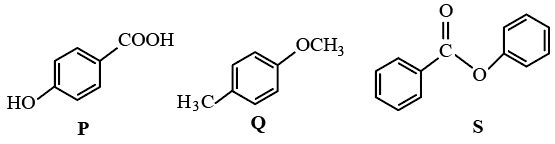
were separately subjected to nitration using $$HNO_3/H_2SO_4$$ mixture. The major product formed in each case respectively, is
Loading solution...
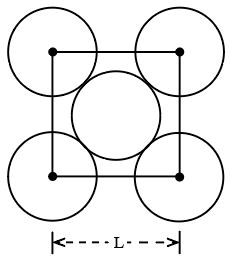
The packing efficiency of the two-dimensional square unit cell shown below is
Loading solution...
Assuming that Hund's rule is violated, the bond order and magnetic nature of the diatomic molecule $$B_2$$ is
Loading solution...
The total number of diprotic acids among the following is

Loading solution...
Total number of geometrical isomers for the complex $$[RhCl(CO)(PPh_3)(NH_3)]$$ is
Loading solution...
Among the following, the number of elements showing only one non-zero oxidation state is
O, Cl, F, N, P, Sn. Tl, Na, Ti
Loading solution...
Silver (atomic weight = $$108 g mol^{-1}$$) has a density of 10.5 g $$cm^{-3}$$. The number of silver atoms on a surface of area $$10^{-12} m^2$$ can be expressed in scientific notation as $$y \times 10^x$$. The value of x is
Loading solution...
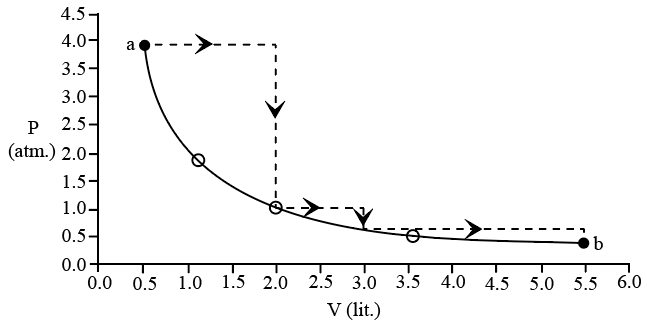
One mole of an ideal gas is taken from a to b along two paths denoted bythe solid and the dashed lines as shownin the graph below. If the work done along the solid line path is $$W_s$$ and that along the dotted line path is $$W_d$$, then the integer closest to the ratio $$\frac{W_d}{W_s}$$ is
Loading solution...
Two aliphatic aldehydes P and Q react in the presence of aqueous $$K_2CO_3$$ to give compound R, which upon treatment with HCN provides compound S. On acidification and heating, S gives the product shown below:
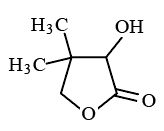
The compounds P and Q respectively are
Loading solution...
The compound R is
Loading solution...
The compound S is
Loading solution...
The hydrogen-like species $$Li^{2+}$$ is in a spherically symmetric state $$S_1$$, with one radial node. Upon absorbing light the ion undergoes transition to a state $$S_2$$. The state $$S_2$$, has one radial node and its energy is equal to the groundstate energy of the hydrogen atom.
The state $$S_1$$ is
Loading solution...
Energy of the state $$S_1$$ in units of the hydrogen atom ground state energy is
Loading solution...
The orbital angular momentum quantum number of the state $$S_2$$ is
Loading solution...
Match the reactions in Column I with appropriate options in Column II.

Loading solution...
All the compounds listed in Column I react with water. Match the result of the respective reactions with the appropriate options listed in Column II.

Loading solution...
For $$r = 0, 1, ...., 10$$, let $$A_r, B_r$$ and $$C_r$$ denote, respectively, the coefficient of $$x^r$$ in the expansions of $$(1 + x)^{10}, (1 + x)^{20}$$ and $$(1 + x)^{30}$$. Then
$$\sum_{r=1}^{10}A_r(B_{10}B_r = C_{10}A_r)$$ is equal to
Loading solution...
Let S = {1, 2, 3, 4}. The total number of unordered pairs of disjoint subsets of S is equal to
Loading solution...
Let f be a real-valued function defined on the interval (-1, 1) such that $$e^{-x}f(x) = 2 + \int_{0}^{x}\sqrt{t^4 + 1} dt$$, for all $$x \in (-1, 1)$$, and let $$f^{-1}$$ be the inverse function of f. Then $$(f^{-1})'(2)$$ is equal to
Loading solution...
If the distance of the point P(1, -2, 1) from the plane $$x + 2y - 2z = \alpha$$, where $$\alpha > 0$$, is 5, then the foot of the perpendicular from P to the plane is
Loading solution...
Two adjacent sides of a parallelogram ABCD are given by
$$\overrightarrow{AB} = 2\hat{i} + 10\hat{j} + 11\hat{k}$$ and $$\overrightarrow{AD} = -\hat{i} + 2\hat{j} + 2\hat{k}$$
The side AD is rotated by an acute angle $$\alpha$$ in the plane of the parallelogram so that AD becomes AD'. If AD' makes a right angle with the side AB, then the cosine of the angle $$\alpha$$ is given by
Loading solution...
A signal which can be green or red with probability $$\frac{4}{5}$$ and $$\frac{1}{5}$$ respectively, is received by station A and then transmitted to station B. The probability of each station receiving the signal correctly is $$\frac{3}{4}$$. If the signal received at station B is green, then the probability that the original signal was green is
Loading solution...
Two parallel chords of a circle of radius 2 are at a distance $$\sqrt{3} + 1$$ apart. If the chords subtend at the center, angles of $$\frac{\pi}{k}$$ and $$\frac{2 \pi}{k}$$, where k > 0, then the value of [k] is
[Note : [k] denotes the largest integer less then or equal to k]
Loading solution...
Consider a triangle ABC and let a, b and c denote the lengths of the sides opposite to vertices A, B and C respectively. Suppose a = 6, b = 10 and the area of the triangle is $$15\sqrt{3}$$. If $$\angle ACB$$ is obtuse andif r denotes the radius of the incircle of the triangle, then $$r^2$$ is equal to
Loading solution...
Let f be a function defined on R (the set of all real numbers) such that
$$f'(x) = 2010(x-2009)(x-2010)^2(x-2011)^3(x-2012)^4$$, for all $$x \in R$$.
If g is a function defined on R with values in the interval $$(0, \infty)$$ such that $$f(x) = \ln (g(x))$$, for all $$x \in R$$,
then the number of points in R at which g has a local maximum is
Loading solution...
Let $$a_1, a_2, a_3, ...., a_{11}$$ be real numbers satisfying
$$a_1 = 15, 27 - 2a_2 > 0$$ and $$a_k = 2a_{k-1} - a_{k-2}$$, for k = 3, 4, ...., 11.
If $$\frac{a_{1}^{2} + a_{2}^{2} + ..... + a_{11}^{2}}{11} = 90$$, then the value of $$\frac{a_1 + a_2 + .... + a_{11}}{11}$$ is equal to
Loading solution...
Let k be a positive real number and let
$$A = \begin{bmatrix}2k-1 & 2\sqrt{k} & 2\sqrt{k} \\2\sqrt{k} & 1 & -2k \\-2\sqrt{k} & 2k & -1 \end{bmatrix}$$ and $$B = \begin{bmatrix}0 & 2k-1 & \sqrt{k} \\1-2k & 0 & 2\sqrt{k} \\-\sqrt{k} & -2\sqrt{k} & 0 \end{bmatrix}$$.If $$det(adj A) + det(adj B) = 10^6$$, then [k] is equal to
[Note : adj M denotes the adjoint of a square matrix M and [k] denotes the largest integer less than or equal to k].
Loading solution...
Consider the polynomial
$$f(x) = 1 + 2x + 3x^2 + 4x^3$$.
Let s be the sum of all distinct real roots of f(x) and let $$t = \mid s \mid$$.
The real numbers lies in the interval
Loading solution...
The area bounded bythe curve y= f(x) and the lines x = 0, y = O and x = t, lies in the interval
Loading solution...
The function $$f'(x)$$ is
Loading solution...
Tangents are drawn from the point P(3, 4) to the ellipse $$\frac{x^2}{9} + \frac{y^2}{4} = 1$$ touching the ellipse at point A and B.
The coordinates of A and B are
Loading solution...
The orthocenter of the triangle PAB is
Loading solution...
The equation of the locus of the point whose distances from the point P and the line AB are equal, is
Loading solution...
Match the statements in Column-I with those in Column-II.
(Note: Here z takes values in the complex plane and Im z and Re z denote, respectively, the imaginary part and the real part of z.]

Loading solution...
Match the statements in Column-I with the values in Column-II.

Loading solution...
A Vernier calipers has 1 mm marks on the main scale. It has 20 equal divisions on the Vernier scale which match with 16 main scale divisions. For this Vernier calipers, the least count is
Loading solution...
A hollowpipe of length 0.8 mis closed at one end. At its open end a 0.5 mlong uniform string is vibrating in its second harmonic and it resonates with the fundamental frequencyof the pipe. If the tension in the wire is 50 N and the speed of sound is 320 ms$$^{-1}$$, the massof thestring is
Loading solution...
A biconvex lens of focal length 15 cmis in front of a plane mirror. The distance between the lens and the mirror is 10 cm. A small object is kept at a distance of 30 cm from the lens. The final image is
Loading solution...
A block of mass 2 kg is free to move along the x-axis. It is at rest and from t = 0 onwards it is subjected to a time-dependent force Fit) in the x direction. The force F(t) varies with t as shown in the figure. The kinetic energy of the block after 4.5 seconds is

Loading solution...
A tiny spherical oil drop carrying a net charge q is balanced instill air with a vertical uniform electric field of strength $$\frac{81 \pi}{7} \times 10^5 Vm^{-1}$$. When the field switched off, the drop is observed to fall with terminal velocity $$2 \times 10^{-3} m s^{-1}$$. Given $$g = 9.8 m s^{-2}$$, viscosity of the air = $$1.8 \times 10^{-5} Ns m^{-2}$$ and the density of oil = $$900 kg m^{-3}$$, the magnitude of q is
Loading solution...
A uniformly charged thin spherical shell of radius R carries uniform surface charge density of $$\sigma$$ per unit area. It is made of two hemispherical shells, held together by pressing them with force F (see figure). F is proportional to

Loading solution...
A diatomic ideal gas is compressed adiabatically to $$\frac{1}{32}$$ of its initial volume. In the initial temperature of the gas is $$T_i$$(in Kelvin) and the final temperature is $$aT_i$$, the value of a is
Loading solution...
At time t = O, a battery of 10 V is connected across points A and B in the given circuit. If the capacitors have no charge initially, at what time (in seconds) does the voltage across them become 4 V ?
[Take : $$\ln 5 = 1.6, \ln 3 = 1.1$$]

Loading solution...
Image of an object approaching a convex mirror of radius of curvature 20 m along its optical axis is observed to move from $$\frac{25}{3} m$$ to $$\frac{50}{7} m$$ in 30 seconds. What is the speed of the object in km per hour ?
Loading solution...
A large glass slab $$(\mu = \frac{5}{3})$$ of thickness 8 cm is placed over a point source of light on a plane surface. It is seen that light emerges out of the top surface of the slab from a circular area of radius R cm. What is the value of R?
Loading solution...
To determine the half life of a radioactive element, a student plots a graph of $$\ln \mid \frac{dN(t)}{dt} \mid$$ versus t. Here $$\frac{dN(t)}{dt}$$ is the rate of radioactive decay at time t If the number of radioactive nuclei of this element decreases by a factor of p after 4.16 years, the value of p is
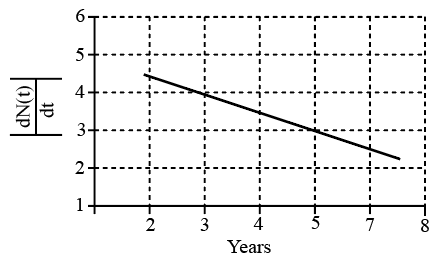
Loading solution...
When liquid medicine of density $$\rho$$ is to be put in theeye, it is done with the help of a dropper. As the bulb onthe topof the dropperis pressed, a drop forms at the opening of the dropper. We wishto estimate the size of the drop. Wefirst assume that the drop formed at the opening is spherical because that requires a minimum increase in its surface energy. To determine the size, we calculate the net vertical force due to the surface tension T when the radius of the drop is R. When this force becomes smaller than the weight of the drop, the drop gets detached from the dropper.
If the radius of the opening of the dropperis r, the vertical force due to the surface tension on the drop of radius R (assuming $$r \ll R$$) is
Loading solution...
If $$r = 5 \times 10^{-4} m, p = 10^3 kgm^{-3}, g = 10 ms^{-2}, T = 0.11 Nm^{-1}$$, the radius of the drop when it detaches from the dropper is approximately
Loading solution...
After the drop detaches, its surface energy is
Loading solution...
The key feature of Bohr's theory of spectrumof hydrogen atomis the quantization of angular momentum whenanelectron is revolving around a proton. We will extend this to a general rotational motion to find quantized rotational energy of a diatomic molecule assuming it to be rigid. The rule to be applied is Bohr's quantization condition.
A diatomic molecule has momentof inertia I By Bohr's quantization condition its rotational energy in the $$n^{th}$$ level (n = O is not allowed) is
Loading solution...
It is found that the excitation frequency from ground to thefirst excited state of rotation for the CO molecule is close to $$\frac{4}{\pi} \times 10^{11}$$ Hz. Then the moment of inertia of
CO molecule about its center of massis close to (Take $$h = 2 \pi \times 10^{-34}$$ J s)
Loading solution...
In a CO molecule, the distance between C (mass = 12 a.m.u.) and O (mass = 16 a.m.u.), where 1 a.m.u. $$= \frac{5}{3} \times 10^{-27}$$ kg, is close to
Loading solution...
Two transparent media of refractive indices $$\mu_1$$ and $$\mu_2$$ have a solid lens shaped transper material of refractive index $$\mu_2$$ between them as shown in figures in Column II A: traversing these media is also shown in the figures. In Column different relations between $$\mu_1, \mu_2$$ and $$\mu_3$$ are given. Match them to the ray diagrams shown in Column

Loading solution...
You are given many resistances, capacitors and inductors. These are connected to variable DC voltage source(the first two circuits) or an AC voltage source of 50 Hz frequency(the next three circuits) in different ways as shown in Column II. When a current (steady state for DC or rms for AC) flows through the circuit, the corresponding voltage $$V_1$$ and $$V_2$$. (indicated in circuits) are related as shown in column I. Match the two

Loading solution...
Educational materials for JEE preparation