IIFT 2017 Question Paper

Read the paragraphs carefully and identify the factual mistakes.

News Item Dated 22 Jan 2017: Saina Nehwal's Triumph at Malaysia Masters Final

Days after recovering from knee injury during Rio Olympics, Saina Nehwal is back with a bang as this Indian badminton ace thrashes Pompawee Chochuwong of Thailand by 22-20 and 22-20, thereby claiming the Malaysia Masters Grand title.

Quashing the air about her ability to win titles, the world No 10 Nehwal clinched her first Masters within five months since knee injury. Nehwal had to undergo surgery after an early exit from the Rio Olympics where her fellow citizen PV Sindhu created history by claiming the first silver medal for Indian badminton.

Silencing the critiques, Saina returned to action within a quarter of her surgery setback. Once the absolute queen of Indian badminton, she faced early exits and missed the qualification mark for Sharjah World Super Series Finals. Also, she lost to Sindhu in the Premier Badminton League. However, Malaysia Masters Grand title has been her winning start to 2017.

News Item dated, April 2017: West Bengal Won the Santosh Trophy

West Bengal won the Santosh Trophy forthe 32nd time aftera 1-0 winoverGoa, extending their domination in the premier domestic football tournament. Playing in front of a vociferous home crowd, five-time winners Goa tried their best and controlled the match, but ran out of steam in the extratime.The hosts had their chances to score but the rival keeper pulled off some great saves. West Bengal, thus, ended a six-year wait having last won the title in 2011. Goa last won it in 2010. Goa. who had‘hostedthe tournament thrice, lost to West Bengal in the semi-final in 1972 and the final in 1996, while winning against Kemla in 1990.

For the following questions answer them individually

‘Soulmate" is a famous Indian music band: Identify the genre of music for which they are famous. Also, name the place from where the music band comes from.

XYZ is an Indian English-language broadsheet daily Newspaper founded in 1875 and published simultaneously in various cities of India. It is a direct descendant of two newspapers, The Englishman (1821) and The Friend of India (1818) which later merged with XYZ. It was managed by a British corporate group until it transferred ownership to the Tata Group, with JRd: Tata as Chairman in the mid-1960s. It is currently owned by Nachikcta Publications, Kolkata. Identify XYZ out of the following:

Which London-based Group founded in mid-1910, started out as a moneylender before expanding the business to include imports of dried fruit, jute, textiles and tea. The business grew steadily under the Iate Shah of Iran as they were having large presence in Iran and continued to flourish even after Islamic Revolution forced it to move to Europe. It is now a multi billion-dollar energy, transport, media and agriculture conglomerate. The company had been in a bidding war to acquire the Express News papers group,and was one of several bidders for Go Fly, British Airways’ low-cost airline. This famous conglomerate has a large presence in India also. Identify the Group.

Match the companies with their CEOs of Indian origin (either in the past or present).


Choose the odd match from the following Fortune 500 Companies with their respective sector/ industry and headquarters:

Match the name of the famous conglomerate I company with its particular tagline:

Method to safeguard against losses due to currency fluctuations is popularly known as:

Which of the following is not correct about Regional Comprehensive Economic Partnership (RCEP)?

Which of the following is not correct for Government of India’s initiative “Make in India”?

The ‘Ease of Doing Business Index’ is an index created by the World Bank Group. Which of the following is not correct about ‘Ease of Doing Business Index"?

Given as under, are part logo of different Organizations. Match the part logo of each with their type of Organization:

Who among the following cricketers has highest individual score in Women‘s One Day International Cricket?

India is building which of the following port in Iran in order to improve the trade connectivity with Iran, Afghanistan and Central Asian countries.

Which of the following stock market index is not correctly matched with the country’?

Which of the following pair of country - present currency is not correctly matched?

Megastar Amitabh Bachchan is one of the most popular actors of Bollywood: lt is said that the advertisers line up to rope him in as their brand ambmador. Which of the foflowing brands has not been endorsed by Amitabh Bachchan till date ?

Read the sentences below carefully and identify the nature of phrase/clause used in the underlined section of the sentences.

He failed in spite of his best efforts

How to find way to the ruins is the question.

Since you have already decided, why do you ask my opinion?

The Poor debtor intended to pay back every penny of the money.

The Plan has the virtue of committing us to nothing.

Insert commas wherever necessary in the following sentences and identify the words sequentially alter which commas will be inserted

ln the old Persian stories Turan the land of darkness is opposed to lran in the land of light.

A letter from a young lady written in most passionate terms wherein she laments the misfortune of a gentleman her lover who was lately wounded in a duel has turned my thoughts to that subject and inclined me to examine into the causes which precipitate men into so fatal a folly.

When he was a boy Franklin who afterward became a distinguished statesman and philosopher learned his trade in the printing office of his brother who published a paper in Boston.

For the following questions answer them individually

Match the prefix and suffix with its meaning

Follow the analogy between the given pair of words in the question (in Capital) and identify the most suitable pair which can represent almost similar relationship

FRET: DlSQUIETUDE

COFFER: VALUABLES

APOCRYPHAL: CORROBORATION

Create a word using all the given letters from the jumbled letters and identify its appropriate meaning.


Passage below is accompanied by a number of questions.

 For some questions, consider how the passage might be revised to improve the expression of ideas. For other questions, consider how the passage might be edited to correct errors in sentence structure, usage or punctuation.
Alter reading the passage, choose the answer to each question that most effectively improves the quality of writing in the passage or that makes the passage confirm to the conventions of standard written English.
The underlined areas in the passage along with the [number] direct you to the question concerned

If you've ever been to an art museum, you know the basic layout: long hallways and large rooms with paintings hung a few feet apart You know how the paintings are [34] by certain means are marked and you know that the paintings have been arranged chronologically or thematically.

There’s one thing, however, which you’ve definitely noticed even if you can’t quite articulate it- Particularly when looking at old paintings. [35] paintings all have that vividly new look, Whether they were painted in 1950 or 1450. Even where the subject matter is older, the colors are vibrant, and you're never forced to wonder exactly what the painting must have looked like in its original state.
[36] The history of painting is nearly as long as the history of mankind. The incredible feat is the work of a highly specialized group: art restorers. Despite this specialization, the profession has exploded in recent years. Art restoration has been growing steadily since 1930. While the job of an art restorer may seem fairly straight forward [37] When looking, the job is in fact quite complicated: Sometimes, as in the case of Michelangelo's famous sculpture David, the cleaning and restoration of art works is a simple matter: applying chemicals, washing away grime and scrubbing of the dirt.
[38] With most paintings however, the process is a good deal more involved because it is not necessarily, just a matter of 'cleaning' the older paintings. One cannot merely take a scrub brush to centuries - old great work, Because of the wide range of restoration techniques, art restoration itself can be controversial business.

[34] Identify the best possible change in the underlined area

[35]Identify the best possible change in the underlined area

[36]The writer is considering deleting the underlined sentence. Should the sentence be kept or deleted?

[37] Identify the best possible change in the underlined area

[38] Identify the best possible change in the underlined area

Read the following passages carefully and identify most appropriate answer to the questions given at the end of each passage.

Groupon is one of the fastest-growing companies of all time. Its name comes from "group coupons," an ingenious idea that has spawned an entire industry of social commerce imitators. However, it didn't start out successful. When customers took Groupon up on its first deal, a whopping twenty people bought two-for-one pizza in a restaurant on the first floor of the company's Chicago offices-hardly a world-changing event. ln fact, Groupon wasn't originally meant to be about commerce at all. The founder, Andrew Mason, intended his company to become a "collective activism platform" called The Point. Its goal was to bring people together to solve problems they couldn't solve on their own, such as fund-raising for a cause or boycotting a certain retailer. The Point's early results were disappointing, however, and at the end of 2008 the founders decided to try something new. Although they still had grand ambitions, they were determined to keep the new product simple. They built a minimum viable product. Does this sound like a billion-dollar company to you? Mason tells the story: “We took a Word Press Blog and we skinned it to say Groupon and then every day we would do a new post. It was totally ghetto. We would sell T-shirts on the first version of Groupon. We'd say in the write-up, ”This T-shirt will come in the colour red, size large. If you want a different colour or size, e-mail that to us.” We didn't have a form to add that stuff. lt was just so cobbled together. It was enough to prove the concept and show that it was something that people really liked: The actual coupon generation that we were doing was all File Maker. We would run a script that would e-mail the coupon PDF to people. It got to the point where we'd sell 500 sushi coupons in a day, and we'd send 500 PDFs to people with Apple Mail at the same time. Really until July of the first year it was just a scrambling to grab the tiger by the tail. It was trying to catch up and reasonably piece together a product. "Handmade PDFs, a pizza coupon, and simple blog were enough to launch Groupon into-breaking success; it is on pace to become the fastest company in history to achieve $1 billion in sales. It is revolutionizing the way local businesses find new custmors, offering special deals to consumers in more than 375 cities worldwide. A minimum viable product (MVP) helps enterpremuers start the process of learning as quickly as possible. "It is not necessarily the smallest product imaginable, though; it is simply the fastest way to get through the Build-Measure-Learn feedback loop with the minimum amount of effort. Contrary to traditional product development, which usually involves a long, thoughtful incubation period and strives for product perfection, the goal of the MVP is to begin the process of learning, not end it, Unlike a prototype or concept test, an MVP is designed not just to answer product design or technical questions. Its goal is to test fundamental business hypotheses.

Early adopters use their imagination to fill in what a product is missing. They prefer that state of affairs, because what they care about above all is being the first one to use or adopt a new product or technology. In consumer products, it's often the thrill of being the first one on the block to show off a new basketball shoe, music player, or cool phone. In enterprise products, it's often about gaining a competitive advantage by taking a risk with something new that competitors don't have yet. Early adopters are suspicious of something that is too polished if it's ready for everyone to adopt, how much advantage cart one get by being early? As a result, additional features or polish beyond what early adopters demand is a form of wasted resources and time. This is a hard truth for many entrepreneurs to accept. After all, the vision entrepreneurs keep in their beads is of a high-quality mainstream product that will change the world, not one used by a small niche of people who are willing to give it a shot before it's ready. That world-changing product is polished, slick, and ready for prime time. It wins awards at trade shows and, most of all, is something you can proudly show Mom and Dad: An early, buggy, incomplete product feels like an unacceptable compromise. How many of us were raised with the expectation that we would put our best work forward? As one manager put it to me recently, "I know for me, the MVP feels a little dangerous in a good way-since I have always been such a perfectionist." Minimum viable products range in complexity from extremely simple smoke tests (little more than an advertisement) to actual early prototypes complete with problems and missing features. Deciding exactly how complex an MVP needs to be cannot be done using formulas. It requires judgment. Luckily, this judgment is not difficult to develop: most entrepreneurs and product development people dramatically over estimate how many features are needed in an MVP. When in doubt simplify. For example, consider a service sold with a one-month free trial. Before a customer can use the service, he or she has to sign up for the trial. One obvious assumption, then, of the business model is that customers will sign up for a free trial once they have a certain amount of information about the service. A critical question to consider is whether customers will in fact signup for the free trial given a certain number of promised features (the value hypothesis). Somewhere in the business model, probably buried in a single cell in a spreadsheet, it specifies the "percentage of customers whose the free trial offer who then sign up." Maybe in our projections we say that this number should be 10 percent. lf you think about it, this is a leap-of-faith question. It really should be represented in giant letters in a bold red font: WE ASSUME 10 PERCENT OF CUSTOMERS WILL SIGN UP.

Most entrepreneurs approach a question like this by building the product and then checking to see how customers react to it. I consider this to be exactly backward because it can lead to a lot of waste. First,if it turns out that we're building something nobody wants, the whole exercise will be an avoidable expense of time and money. If customers won't sign up for the free trial, they'll never get to experience the amazing features that await them. Even if they do sign up, there are many other opportunities for waste. For example, how many features do we really need to include to appeal to early adopters? Every extra feature is a form of waste, and if we delay the test for these extra features, it comes with a tremendous potential cost in terms of learning and cycle time. The lesson of the MVP is that any additional work beyond what was required to start learning is waste, no matter how important it might have seemed at the time.

What is the central idea of the passage?

According to the Author, what do early adopters want?

What does the author seek to imply by quoting "I know for me, the MVP feels a little dangerous-in a good way-since I have always been such a perfectionist"?

What is the function of MVP?

Read the following passages carefully and identify most appropriate answer to the questions given at the end of each passage:

I wear a variety of professional hats- university professor, literacy consultant to districts, author of several books related to comprehension.To keep myself honest (and humble); l spend a lot of time in classrooms watching kids and teachers at work. During the past decade, I've observed a transformation in the teaching of reading from an approved:h that measured readers' successful understanding of the text through lengthy packets of comprehension questions to one that requires students to think about their thinking, activating their "good reader" strategies. Close reading is a deep analysis of how a literary text works; it is both a· reading process and something you include in a literary analysis paper, though in a refined form. Fiction writers and poets build texts out of many central components, including subject, form, and specific word choices. Essentially, close reading means reading to uncover layers of meaning that lead to deep comprehension. "Close, analytic reading stresses engaging with a text of sufficient complexity directly and examining meaning thoroughly and methodically, encouraging students to read and reread deliberately. Directing student attention on the text itself empowers students to understand the central ideas and key supporting details. It also enables students to reflect on the meanings of individual words and sentences; the order in which sentences unfold; and the development of ideas over the course of the text, which ultimately leads students to arrive at an understanding of the text as a whole." Reread the definition of close reading closely-to extract .key concepts. You might identify these ideas: examining meaning thoroughly and analytically; directing attention to the text, central ideas, and supporting details; reflecting on meanings of individual words and sentences; and developing ideas over the course of the text. Notice that reader reflection is still integral to the process. But close reading goes beyond that: The best thinkers do monitor and assess their thinking, but in the context of processing the thinking of others (Paul & Elder, 2008).

When you close read, you observe facts and details about the text. You may focus on a particular passage, or on the text as a whole. Your aim may be notice all striking features of the text, including rhetorical features, structural elements and cultural references; or, your aim may be to notice only selected features of the text- for instance, oppositions and correspondences, or particular historical references. Either way, making these observations constitutes the first step in the process of close reading. The second step is interpreting your observations. What we're basically talking about here is inductive reasoning: moving from the observation of particular facts and details to a conclusion, or interpretation, based on those observations. And, as with inductive reasoning, close reading requires the careful gathering of data (your observations) and careful thinking about what these data add up to. The literary analysis involves examining these components, which still allows us to find in small parts of the text clues to help us understand the whole. For example, if an author writes a novel in the form of a personal journal about a character's daily life, but that journal reads like a series of lab reports, what do we learn about that character? What is the effect of picking a word like "tome" instead of ''book"? In effect, you are putting the author's choices under a microscope. The process of close reading should produce a lot of questions. It is when you begin to answer these questions that you are ready to participate thoughtfully in class discussion or write a literary analysis paper that makes the most of your close reading work. Close reading sometimes feels like over-analysing, but don worry. Close reading is a process of finding as much information as you can in order to form as many questions as you can. When it is time to write your paper and formalize your close reading, you'll sort through your work to figure out what is most convincing and helpful to the argument you hope to make and, conversely, what seems like a stretch. It's our responsibility as educators to build students' capacity for independently comprehending a text through close reading. Teaching is about the transfer. The goal is for students is to take what they learn from the study of one text and apply it to the next text they read: How can we ensure that students both reap the requisite knowledge from each text they read and acquire skills to pursue the meaning of other texts independently? I suggest we coach students to ask themselves four basic questions as they reflect on a specific portion of any text, even the shortest: What is the author telling me here? Are there any hard or important words? What does the author want me to understand? How does the author play with language to add to meaning? If students take time to ask themselves these questions while reading and become skilful at answering them, there'll be less need for the teacher to doll the asking. For this to happen, we must develop students' capacity to observe and analyse. First things first: See whether students have noticed the details of a passage and can recount those details in their own words. Note that the challenge here isn't to be brief (as in a summary); it's to be accurate, precise, and clear.

The recent focus on finding evidence in a text has sent students (even in primary grades) scurrying back to their books to retrieve a quote that validates their opinion. But to paraphrase what that quote means in a student's own language, rather than the author's, is more difficult than you might think. Try it with any paragraph. Expressing the same meaning with different words often requires going back to that text a few times to get the details just right. Paraphrasing is pretty low on Bloom's continuum of lower- to higher-order thinking, yet many students stumble even b: here. This is the first stop along the journey to close reading. If students can't paraphrase the basic content of a passage, how can they dig for its deeper meaning? The second basic question about hard or important words encourages students to zoom in on precise meaning. When students are satisfied that they have a basic grasp of what the author is telling them, they're ready to move on to analysing the fine points of content. If students begin their analysis by asking themselves the third question- What does the author want me to understand in this passage?-they'II be on their way to malcing appropriate inferences determining what the author is trying to show without stating it directly.

We can also teach students to read carefully with the eye of a writer, which means helping them analyse craft. How a text is written is as important as the content itself in getting the author's· message across. Just as a movie director focuses the camera on a particular detail to get you to view the scene the way he or she wants you to, authors play with words to get you to see a text their way. Introducing students to some of the tricks authors use opens students' minds to an entirely new realm in close reading.

In the above passage the author has used the term 'Rhetoric features'. What does it mean?

According to the author what is inductive reasoning with regard to Close Reading?

According to the passage, what is the importance of ' paraphrasing' for students?

With reference to the above passage, what responsibility, according to the author, do educators have?

Read the following passages carefully and identify most appropriate answer to the questions given at the end of each passage.

As someone' said, this crisis was too valuable to waste. I, for one, learnt many lessons on crisis management and leadership. By far the most important lesson I learnt is that the primary focus of a central bank during a crisis has to be on restoring confidence in the markets, and what this requires is swift, bold and decisive action. This is not as obvious'as it sounds because central banks are typically given to agonizing over every move they make out of anxiety that failure of their actions to deliver the intended impact will hurt their creditability and their policy effectiveness down the line. There is a lot to be said for such deliberative action in normal times: In crisis times though, it is important for them to take more chances without being too mindful of whether all of their actions are going to be fully effective or even mildly successful. After all, crisis management is a percentage game, and you do what you think has the best chance of reversing the momentum. Often, it is a fact of the action rather than the precise nature of the action that bolsters confidence. Take the Reserve Bank's measure I wrote about earlier of instituting exclusive lines of credit for augmenting the liquidity of NBFCs and mutual funds (MFs) which came under redemption pressure. It is simply unthinkable that the Reserve Bank would have done anything like this in normal times. In the event of a liquidity constraint in normal times, the standard response of the Reserve Bank would be to ease liquidity in the overall system an_d leave it to the banks to determine how to use that additional liquidity.

But here, we were targeting monetary policy at a particular class of financial institutions-the MFs &NBFCs-a; decidedly unconventional action. This departure from standard protocol pushed some of our senior staff beyond their comfort zones. Their reservations ranged from: 'this is not bowing monetary policy is done' to 'this will make the Reserve Bank vulnerable to pressures to bail out other sectors'. After hearing them out, I made the call to go ahead: Market participants applauded the new facility and saw it as the Reserve Bank's willingness to embrace unorthodox measures to address Specific areas of pressure in the system. In the event, these facilities were not significantly tapped: In normal times, that would have been seen as a failure of policy. From the crisis perspective though, it was a success in as much as the very existence of the central bank backstop restored confidence in the NBFCs and MFs and smoothed pressures in the financial system. Similarly, the cut in the repo rate of one full percentage point that I effected in October 2008 was a non-standard action from the perspective of a central bank used to cutting the interest rate by a maximum of half a percentage point (50 basis points in the jargon) when it wanted to signal strong action. Of course, we deliberated the advisability of going into uncharted waters and how it might set expectations. For the future. For example, in the future, the market may discount a 50 basis-point cut as too tame. But considering the uncertain and unpredictable global environment and the imperative to improve the flow of credit
in a stressed situation, I bit the bullet again and decided on a full percentage-point cut.

Managing the tension between short-term payoffs and longer-term consequences is a constant struggle in all central bank policy choices as indeed it is in all public policy decisions. This balance between horizons shifts in crisis times, as dousing the fires becomes an overriding priority even if some of the actions taken to do that may have·some longer-term costs. For example, in 2008, we saw a massive infusion of liquidity as the best bet for preserving the financial stability of our markets. Indeed, d in uncharted waters, erring on the side of caution meant providing the system with more liquidity than considered adequate. This strategy was effective in the short-term, but with hindsight, we know that excess liquidity may have reinforced inflation pressures down the line. But remember, we were making a judgement call in real time. Analysts who are criticising us are doing so with the benefit of hindsight. Another lesson we learnt is that even in a global crisis, central banks have to adapt their responses to domestic conditions. I am saying this because of all through the crisis months. Whenever another central bank, especially an advanced economy central bank, announced any measure, there was an immediate pressure that the Reserve Bank too should institute a similar measure. Such straightforward copying of measures of other central banks without first examining their appropriateness for the domestic situation can often do more harm than good: Let me illustrate. During th depth of the crisis, fearing a run on their banks, the UK authorities bad extended deposit insurance across board to all deposits in the UK banking system. Immediately, there were commentators asking that the Reserve Bank too must embrace such an all-out measure. If we had actually done that, the results would have been counterproductive if not outright harmful. First, the available premium would not have been able to support such a blanket insurance, and the markets were aware of that.

If we had glossed over that and announced a blanket cover anyway, that action would have clearly lacked credibility. Besides, any such move would be at odds with what we had been asserting that our banks and our financial systems were safe and sound: The inconsistency between our walk and talk would have confused the markets; instead of reassuring them, any blanket insurance of the UK type·would have scared the public and sown seeds of doubt about the safety of their bank deposits, potentially triggering a run on some vulnerable banks. Finally, an important lesson from the crisis relates to the imperative of the government and the regulators speaking and acting in unison. It is possible to argue that public disclosure of differences within closed doors of policymaking could actually be helpful in enhancing public understanding on how policy might evolve in the future. For example, a 6-6 vote conveys a different message from a 12-0 vote. During crisis times, though, sending mixed signals to fragile markets can do huge damage. On the other hand, the demonstration of unity of purpose would reassure markets and yield great synergies. The experience of the crisis from around the world and our own experience too showed that coordination could be managed without compromising regulatory autonomy. Merely synchronizing policy announcements for exploiting the synergistic impact need not necessarily imply that regulators were being forced into actions they did not own.

What 'crisis' is theauthor referring to, in the above passage?

According to the author, what is the typical response of central banks in times of crisis? Answer with reference to the passage.

Why does the author say ".. .even in a global crisis, central banks have to adapt their responses to domestic conditions"? Answer with reference to passage.

With reference to theabove passage, what is the role of government and regulators in times of crisis? Select the most ppropriate response with reference to information provided in the passage.

Read the following passages carefully and identify most appropriate answer to the questions given at the end of each passage.

Any company can generate simple descriptive statistics about aspects of its business-average revenue per employee, for example, or average order size. But analytics competitors look well beyond basic statistics. These companies use predictive modelling to identify the most profitable customers-plus those with the greater profit potential and the ones most likely to cancel their accounts. They pool data generated in-house and data acquired from outside sources (which they analyze more deeply than do their less statistically savvy competitors) for a comprehensive understanding of their customers. They optimize their supply chains and can thus determine the impact of an unexpected constraint, simulate alternatives and route shipments around problems. They establish prices in real time to get the highest yield possible from each of their customer transactions. They create complex models of how their operational costs relate to their financial performance. Leaders in analytics also use sophisticated experiments to measure the overall impact or "lift" of intervention strategies and then apply the results to continuously improve subsequent analyses. Capital One, for example, conducts more than 30,000 experiments a year, with different interest rates, incentives, direct-mail packaging, and other variables. Its goal is to maximize the likelihood both that potential customers will sign up for credit cards and that they will pay back to Capital One.

Analytics competitors understand that most business functions- even those, like marketing, that  have historically depended on art rather than science can be improved with sophisticated quantitative techniques. These organizations don't gain advantage from·one killer app, but rather from multiple applications supporting many parts of the business and, in a few cases, being rolled out for use by customers and suppliers. UPS embodies the evolution from targeted analytics user to comprehensive analytics competitor. Although the company is among the world's most rigorous practitioners of operations research and industrial engineering, its capabilities were, until fairly recently, narrowly focused. Today, UPS is wielding its statistical skill to track the movement of packages and to anticipate and influence the actions of people assessing the likelihood of customer attrition and identifying sources of problems. The UPS Customer Intelligence Group, for example, can accurately predict customer defections by examining usage patterns and complaints.

When the data point to a potential defector, a salesperson contacts that customer to review and resolve the problem, dramatically reducing the loss of accounts. UPS still lacks the breadth of initiatives of a full-bore analytics competitor, but it is heading in that direction. Analytics competitors treat all such activities from all provenances as a single, coherent initiative, often massed under one rubric, such as "information-based strategy" at Capital One or "information based customer management" at Barclays Bank. These programs operate not just under a common label but also under common leadership and with common technology and tools. In traditional companies, "business intelligence" (the term IT people use for analytics and reporting processes and software) is generally managed by departments; number-crunching functions select their own tools, control their own data warehouses, and train their own people. But that way, chaos lies. For one thing, the proliferation of user-developed spreadsheets and databases inevitably leads to multiple versions of key indicators within an organization.

Furthermore, research has shown that between 20% and 40% of spreadsheets contain errors; the more spreadsheets floating around a company, therefore, the more fecund the breeding ground for mistakes. Analytics competitors, by contrast, field centralized groups to ensure that critical data and other resources are well managed and that different parts of the organization can share data easily, without the impediments of inconsistent formats, definitions, and standards. Some analytics competitors apply the same enterprise approach to people as to technology. Procter & Gamble, for example, recently created a kind of uberanalytics group consisting of more than 100 analysts from such functions as operations, supply chain, sales, consumer research, and marketing. Although most of the analysts are embedded in business operating units, the group is centrally managed: As a result of this consolidation, P&G can apply a critical mass of expertise to its most pressing issues. So, for example, sales and marketing analysts supply data on opportunities for growth in existing markets to analysts who design corporate supply networks. The supply chain analysts, in rum, apply their expertise in certain decision-analysis techniques to such new areas as competitive intelligence. The group at P&G also raises the visibility of analytical and data-based decision making within the company. Previously, P&G's crack analysts had improved business processes and saved the firm money but because they were squirreled away in dispersed domains, many executives didn't know what services they offered or how effective they could be. Now those executives are more likely to tap the company's deep pool of expertise for their projects. Meanwhile, masterful number crunching has become part of the story P & G tells to investors, the press and the public .

A company wide embrace of analytics impels changes in culture, processes, behavior, and skills for·many employees. And so, like any major transition, it requires leadership from executives at the very top who have a passion for the quantitative approach. Ideally, the principal advocate is the CEO.·Indeed we found several chief executives who have driven the shift to analytics at their companies over the past few years, including Loveman of Harrah's, Jeff Bezos of Amazon, and Rich Fairbank of Capital One. Before he retired from the Sara Lee Balcery Group, former CEO Barry Beracha kept a sign on his desk that summed up his personal and organizational philosophy. "In God we trust. All others bring data!" We did come across some companies in which a single functional or business unit leader was trying to push analytics throughout the organization, and a few were making some progress. But we found at these lower-level people lacked the clout, perspective, and the cross-functional scope to change the culture in any meaningful way. CEO s leading the analytics charge require both an appreciation and a familiarity with the subject.

A background in statistics isn't necessary, but those leaders must understand the theory belted various quantitative methods so that they recognize those methods limitations-which factors are being weighed and which ones aren't When the CEOs need help grasping quantitative techniques, they run to experts who understand the business and how analytics can be applied to it. We interviewed several leaders who had retained such advisers, and these executives stressed the need to find someone who can explain things in plain language and be trusted not to spin the numbers. A few CEOs we spoke with had surrounded themselves with very analytical people-professors, consultants, MIT graduates and the like. But that was a personal preference rather than a necessary practice. Of course, not all decisions should be grounded in analytics - at least not wholly so. Research shows that human beings can make quick, surprisingly accurate assessments of personality and character based on simple observations. For analytics minded leaders, then, the challenge boils down to knowing when to run with the numbers and when to run with their guts.

With reference to tbe above passage what does the phrase "uberanalytic group" mean?

Replace the phrase' more fecund the breeding ground for mistakes' from the passage by selecting the most appropriate phrase without changing the meaning.

According to the author, what is the leadership challenge for analytics minded leaders?

In the above passage, how does the author differentiate between 'analytics competitors' and 'traditional companies' with regard to their strategy towards data management?

Read the infonnation provided and answer the questions which follow.

Five MBA students - Aman. Manish, Rohit, Sandeep and Vinay, specializing in sales and marketing got final campus placement in five different companies - Asian Paints, Dabur, Hindustan Unilever, ITC and L' Oreal.(though not necessarily in the same order). Their initial Job assignment has been fixed in five different cities - Bhopal, Chennai, Delhi, Mumbai, and Patna (in any order). They are avid book readers, but like different themes - business and management, classic fiction, historical fiction, mystery fiction and non-fiction (again in any order). Further, the following additional information are provided: ·

(a)Vinay got placed in Asian Paints.
(b)Aman is not placed in Hindustan Unilever.
(c)Manish's job location is not in Chennai and he does not like books on mystery fiction.
(d)Sandeep got placed at Delhi, while Vinay is not placed at Mumbai.
(e)Aman likes reading books on historical fiction and is placed either at Chennai or Patna and the student who got placed in ITC does not like mystery fiction and his job posting. is in the other city amongst Chennai or Patna.
(f) The student who got placed in L'Oreal likes reading non-fiction books and is not posted at Mumbai.
(g)The student who likes reading classic fiction, is posted at Bhopal.

Name the type of books the student who is placed in Mumbai likes reading.

If Sandeep is transferred to Rohit's city and Rohit is transferred to Sandeep's city, then in which city the student who likes reading mystery fictions will work?

Read the information provided andanswer thequestions which follow. ·

In ISL football competition, eight football teams - Atletico De Kollcata, Chennaiyan FC, Delhi Oynamos, FC Goa, FC Punc City, Kerala Blasters, Mumbai City FC and North-East United FC-participated where each team played against every other team exactly once. Every win earned three points for the teams and a loss earned 0. If there was a draw, each team was rewarded one point. Now, as per the fixtures, following aiesome of the observations:

(a)Out of the seven matches played by Chennaiyan FC, it won five and the other two matches were drawn.
(b)FC pune City won the match against FC Goa and Kerala Blasters but lost the match against Delhi Dynamos and Chennaiyan Fc.
(c)Atletico De Kollcata drew a match against FCGoa, Chennaiyan FC and FC Punc City.
(d)None of the teams lost all the matches.

If Chennaiyan FC won the match against FC Goa, what could have been the maximum score of FCGoa?

What could be the minimum absolute difference between the scores ofFC Pune City and Chennaiyan FC?

Read the information provided and answer the questions that follow.

On a cricket ground, five players - A, B, C ,D and E are standing as described below, facing the North

(a) B is 75 metres to the right of D
(b) A is 95 metres to the south of B
(c) C is 45 metres to the west of D
(d) E is 110 metres to the north of A

Who is to the north-east of the player who is to the left ofB?

If a player walks from C, meets D followed by B, then A and finally E, how many metres has the player walked if he has travelled the straight distance all through?

Read the information provided and answer the questions which follow.

Given an input, a coding machine generates pass codes everyday as follows:

Input : my bag carries no more than ten books
Pass codes :
Batch I : more my than bag ten carries books no
Batch II : bag ten than carries rny books more no
Batch III : my bag books ten more than no carries
Batch IV : ten more books than bag no my carries and so on.

The first batch timing is 9.30 AM and each batch is of one hour's duration. There is a rest period of one hour after the work for the fourth batch is over.

If the pass code on a particular day for the second batch is 'if winter comes can spring be far behind', what will be the pass code for the batch at 2.30 PM on that day?

On a particular day, Rahul was to begin the work in the batch at I0.30 AM with a pass code 'I like tea and biscuit but not together'. However, he came late on that day and hence joined the next batch. What was his new pass code?

On a particular day, the pass code for the batch immediately before the rest hour was 'bah bah black sheep have you any wool'. What was the input for the pass code on that day?

On a particular day, the pass code for the second batch was ' India's core strength lies in unity in diversity'. What was the input on that day in the reverse order of its words?

For the following questions answer them individually

ln the following question, two statements are given followed by four conclusions. Taking the given statements to be true, decide which of the given conclusions logically follows from the given statements:

Statements: Some rivers are plateau. No plateau is mountain.
Conclusions:
I. Some plateau are rivers.
II.Some mountains are rivers.
III.Some rivers are not mountains.
IV. All mountains are rivers.

In each of the following problems, there is one question and three statements I, II and lll given below the question. You have to decide whether the data given-in the statements is sufficient to answer the question. Read all the statements carefully and find which of the statement(s) is/are sufficient to answer the given question.

What is Mohit's rank from the top in an annual appraisal of an FMCG Company comprising 70 sales executives? ·
I.Mohit is 5 ranks below Rashmi from the top
II.Rashmi's rank from the bottom is 44
lll. Mohit is 5 ranks above Rashmi from the bottom

What does ' orange' represent in a code language?
I. 'rim pa xab' means 'orange and apple' in that code language
II.'na pie tac' means 'I dislike sweet' in that code language
III. 'natsi pa' means ' orange is sweet' in that code language

Read the information provided below and answer the questions that follow.

Seven friends- A, B, C, D, E, F and G- are traveling from Delhi to Amritsar in the Swarna Sbatabdi train. They are seated in three different coaches - A1, A2 and A3. Further, the following additional information is provided:

(a)There are two married couples among them.
(b)Three friends love playing tennis, two love playing cricket, and two love playing volleyball amongst them.
(c)There are at least two of them in each coach, and each of them loves playing different games.
(d)No husband-wife couple loves playing the same game.
(e)C is seated in coach A1 and is married to A, who loves playing tennis.
(f) G loves playing volleyball and is married to D, who is seated in coach A2 with F, a cricket enthusiast.
(g)B and G are not seated with C.
(h)E, who loves playing tennis, is seated in Coach A3.

Which game does C like to play?

Read the information provided below and answer the questions which follow.

Last week, Rajeev watched four sports of different types: tennis, cricket, football and kabaddi. The sports were shown by four different channels - Star Sports 1, Ten Sports 2, Sony Six and NeoSports (not necessarily in the same order):These sports were telecast on different days -Monday, Tuesday, Thursday and Friday (not necessarily in the same order). Further the following additional information are provided:

(a) The sport by Star Sports 1 was shown on Friday.
(b) Tennis was shown on Monday.
(c) Kabaddi was shown by Sony Six and not telecast on Thursday.
(d) Football was shown by Neo Sports

Which of the following combination is true?

Which sports was telecasted in Ten Sports 2 and on which day of the week?

For the following questions answer them individually

Swarn a SME enterprise borrowed a sum of money from a nationalized bank at 10% simple interest per annum and the same amount at 8% simple interest per annum from a microfinance firm for the same period: It cleared the first loan 6 months before the scheduled date of repayment and repaid the second loan just at the end of the scheduled period: If in each case it had to pay Rs. 62100 as amount then how much money and for what time period did it borrow?

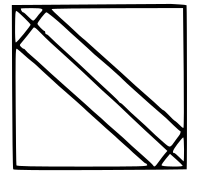
A rectangular plank $$\sqrt{10}$$ metre wide, is placed symmetrically along the diagonal of a square of side 10 metres as shown in the figure. The area of the plank is:

Somesh, Tarun and Nikhil can complete a work separately in 45, 60 and 75 days. They started the work together but Nikhil left after 5 days of start and Somesh left 2 days before the completion of the work. In how many days will the work be completed?

A Pharmaceutical company produces two chemicals X and Y, such that X consists of 5% salt A and 10% salt B and Y consists of 10% salt A and 6% salt b: For producing the chemicals X and Y, the company requires at least 7 gm of Salt A and at least 7 gm of Salt b:If chemical X costs Rs. 10.50 per gm and chemical Y costs Rs. 7.80 per gm, what is the minimum cost at which the company can meet the requirement by using a combination of both types of chemicals?

Suntex Company plans to manufacture a new product line of Razor next year and sell it at a price of Rs. 12 per unit.The variable costs per unit in each production run is estimated to be 50%.of the selling price, and the fixed costs for each production run is estimated to be Rs. 50,400. Based on their estimated costs bow many units of the new product will company Suntex need to manufacture and sell in order for their revenue to be equal to their total costs for each production run?

In a certain sequence the term $$x_{n}$$ is given by formula $$x_{n}=5x_{n-1} - \frac{3}{4}x_{n-2}$$ for $$n\geq2$$. What is the value of $$x_{3}$$, if $$x_{0}=4$$ and $$x_{1}=2?$$

A mobile company that sells two models ACN-I and ACN-II of mobile, reported that·revenues from ACN-I in 2016 were down 12% from 2015 and revenue from ACN-II sales in 2016 were up by 9% from 2015. If the total revenues from sales of both the mobile models ACN-I and ACN-II in 2016 were up by 3% from 2015, what is the ratio of revenue from ACN-I sales in 2015 to revenue from ACN-II sales in 2015?

If $$10^{67}- 87$$ is written as an integer in base 10 notation, what is the sum of digits in that integer? ·

A flag pole on the top of a mall building is 75 m high. The height of the mall building is 325 m. To an observer at a height of 400 m, the mall building and the pole subtend equal angle $$\theta$$. If the horizontal distance of the observer from the pole is 'x', then what is the value of x?

Witrex Brown, an E-commerce company gives home delivery of its valuable products after receiving final order on their website by different modes of transportation like bike, scooter, tempo and truck. The probabilities of using bike, scooter, tempo and truck are respectively 2/9, 1/9, 4/9 and 2/9. The probabilities of his delivering the product late to the destination by using these modes of transport are 3/5, 2/5, 1/5 and 4/5. If the product reach to the destination in time, find the probability that be has used scooter to reach the office.

A pest control person uses a particular machine for his job, it moves along the circumference of a circular hall of radius 49 metres in 148 minutes to finish the pest control. How many minutes more will it take him to move along the perimeter of a hexagon of side 54 metres?

A premier B-school, which is in process of getting an AACSB accreditation, has 360 second year students. To incorporate sustainability into their curriculum, it has offered 3 new elective subjects in the second year namely Green Supply Chain, Global Climate Change & Business and Corporate Governance. Twelve students have taken all the three electives, and 120 students have taken Green Supply Chain. There are twice as many students who study Green Supply Chain and Corporate Governance but not Global Climate Change & Business, as those who study both Green Supply Chain and Global Climate Change & Business but not the Corporate Governance, and 4 times as many who study all the three. 124 students.study Corporate Governance. There are 72 students who could not muster up the courage to take up any of these subjects. The group of students who study both Green Supply Chain and Corporate Governance but not Global Climate Change & Business is exactly the same as the group made up of the students who study both Global Climate Change & Business and Corporate governance. How many students study Global Climate Change & Business only?

Ramesh and Sohan start walking away from each other from a point P at an angle of 120°. Ramesh walks at a speed of 3 km/hour while Sohan walks at a speed of 4 km/hour. What is the distance between them after 90 minutes?

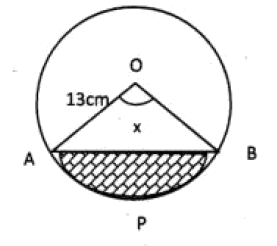
A chord AB of length 24 cm is drawn in a circle of radius 13cm. If $$\angle AOB = x^{\circ}$$, find the area of the shaded portion APB.


x1

Two tangents are drawn from a point P on the circle with centre at O, touching the circle at point Q and T respectively. Another tangent AB touches the circle at point S. If angle QPT =55°, find the angle AOB= ?

The coordinates of a triangle ABC are A(1, 5), B(-2, 3), and C(0,-4); find the equation of the median AD? ·

The Drizzle Pvt. Ltd:, a squash company has 2 cans of juice. The first contains 25% water and the rest is fruit pulp. The second contains 50% water and rest is fruit pulp: How much juice should be mixed from each of the containers so as to get 12 litres of juice such that the ratio of water to fruit pulp is 3:5? 

An overhead tank, which supplies water to a settlement, is filled by three bore wells. First two bore wells operating together fill the tank in the same time as taken by third bore well to fill it. The second bore well fills the tank 10 hours faster then the first one and 8 hours slower than the third one. The time required by the third bore well to fill the tank alone is:

Exhibit I as under provides the data of India's Merchandize Imports (Billion US Dollar) on left axis  and Percentage of Food: Fuel, Manufactures and Ores & Metals lmports of India's on the right axis. Similarly; Exhibit 2 provides data of India's Merchandize Exports (Billion US Dollar) on left axis and Percentage exports of Food, Fuel, Manufactures and Ores & Metals on the right axis. Attempt the questions in the context of information provided as under:

A.Trade Balance = Import Minus Exports
b:Trade Deficit If Imports are more than Exports
c:TradeSurplus= If Exports are more than Imports

Exhibit 1: India's Total Merchandize Imports (US Dollar in Billion) and Percentage Imports of Food, Fuel, Manufacturers and Ores and Metals (2012 - 2016)


Exhibit 2: India's Total Merchandize Exports (US Dollar in Billion) and Percentage Exports of Food, Fuel, Manufacturers and Ores and Metals (2012 - 2016)


What shall be approximate Manufactures exports of India in the year 2016 based on average exports for the period 2012-2016?

What is the proportion of positive and negative Manufactures trade balance in the period 2012-2016 ?

In which year, trade deficit of fuel has been the second lowest?

Assuming India's imports and exportS grow by 10% in 2017 and sectoral share of fuel in both importS andexports grow by 5 percentage basis, what shall be theapproximate deficit of fuel trade in the year 2017?

Assuming India's absolute trade deficit grows by 54 Billion USDollar and exports become 324 Billion US Dollar in the year 2017. What shall be India's absolute imports of food and fuel in 2017 if sectoral composition of food, fuel, manufactures, ores and metals remain· same as that of 2016?

Table as under provides the monthly prices in US Dollars Per Tonne of Barley, Wheat, Maize and Sorghum for the period July2016 to June 2017. Attempt the questions given as under in the context of information provided.

In which of the following month, Wheat has the third highest percentage growth in monthly prices?

How many times, the double digit growth in monthly prices occur across the commodities in the given time period?

India has 13 major ports, out of which 6 ports are located in Eastern Coast and 6 ports are in Western Coast of India. 13th port is at Port Blair, located in Andaman & Nicobar Island, which has negligible cargo traffic: Table below provides the traffic data bandied by 12 major ports (thousand tonnes) of India for the period 2011-12 to 2015-16. Based on the table, answer the questions:


In which year, the average growth of all ports is the highest?

Which of the following port has registered the third highest growth in traffic (000) from year2011-12 to 2015-16?

What shall be the total approximate traffic (000) of Kolkata, Vizag and Cochin Port in 2017-18 if traffic continues to grow at the annual growth rate of 10% per annum in each of these ports?

The table below relates to data on Wholesale Price of India (WPI) for the period 2001-02 to 2015-16. WPI-based inflation is defined as percentage change in the value of the Index. Based on the table, answer the following questions:


What is the approximate percentage change in the WPI of F&P; between 2001-02 and 2015-16?

Between 2001-02 and 2015-16, which of the following components- PA, AC, F&P; and MP - have shown the second highest percentage increase in WPI ?

Between 200I-02 and 2015-16 which year has recorded the smallest percentage increase in WPI on FA? .

If PA has a 40 percent weight-age in the WPI-based inflation calculation in 2005-06, find the corresponding approximate percentage weights assigned to F&P; and MP in the WPl­ based inflation calculation for the same year.

Which component(s) in WPI has registered a decline more than once between two consecutive years?

Refer to the Table below. It provides quarterly output data of a company for four years (1998-2001) and its trend calculated through 4-quarter Moving Average Method:


In which year and which quarter the output has second highest positive deviation from its trend?

In which quarter, on an average there is maximum negative deviation of the output from the average value of trend of that quarter?

Plot the quarterly output and its trend values. Identify the number of times the trend curve intersects the output curve

Join CAT 2026 course by 5-Time CAT 100%iler

Crack CAT 2026 & Other Exams with Cracku!