 91- 6303239042
Identify the correct statement:
Sign in
Please select an account to continue using cracku.in
↓ →
Before the internet, one of the most rapid changes to the global economy and trade was wrought by something so blatantly useful that it is hard to imagine a struggle to get it adopted: the shipping container. In the early 1960s, before the standard container became ubiquitous, freight costs were I0 per cent of the value of US imports, about the same barrier to trade as the average official government import tariff. Yet in a journey that went halfway round the world, half of those costs could be incurred in two ten-mile movements through the ports at either end. The predominant ‘break-bulk’ method, where each shipment was individually split up into loads that could be handled by a team of dockers, was vastly complex and labour-intensive. Ships could take weeks or months to load, as a huge variety of cargoes of different weights, shapes and sizes had to be stacked together by hand. Indeed, one of the most unreliable aspects of such a labour-intensive process was the labour. Ports, like mines, were frequently seething pits of industrial unrest. Irregular work on one side combined with what was often a tight-knit, well - organized labour community on the other.
In 1956, loading break-bulk cargo cost $5.83 per ton. The entrepreneurial genius who saw the possibilities for standardized container shipping, Malcolm McLean, floated his first containerized ship in that year and claimed to be able to shift cargo for 15.8 cents a ton. Boxes of the same size that could be loaded by crane and neatly stacked were much faster to load. Moreover, carrying cargo in a standard container would allow it to be shifted between truck, train and ship without having to be repacked each time.
But between McLean’s container and the standardization of the global market were an array of formidable obstacles. They began at home in the US with the official Interstate Commerce Commission, which could prevent price competition by setting rates for freight haulage by route and commodity, and the powerful International Longshoremen's Association (ILA) labour union. More broadly, the biggest hurdle was achieving what economists call ‘network effects’: the benefit of a standard technology rises exponentially as more people use it. To dominate world trade, containers had to be easily interchangeable between different shipping lines, ports, trucks and railcars. And to maximize efficiency, they all needed to be the same size. The adoption of a network technology often involves overcoming the resistance of those who are heavily invested in the old system. And while the efficiency gains are clear to see, there are very obvious losers as well as winners. For containerization, perhaps the most spectacular example was the demise of New York City as a port.
In the early I950s, New York handled a third of US seaborne trade in manufactured goods. But it was woefully inefficient, even with existing break-bulk technology: 283 piers, 98 of which were able to handle ocean-going ships, jutted out into the river from Brooklyn and Manhattan. Trucks bound‘ for the docks had to fiive through the crowded, narrow streets of Manhattan, wait for an hour or two before even entering a pier, and then undergo a laborious two-stage process in which the goods foot were fithr unloaded into a transit shed and then loaded onto a ship. ‘Public loader’ work gangs held exclusive rights to load and unload on a particular pier, a power in effect granted by the ILA, which enforced its monopoly with sabotage and violence against than competitors. The ILA fought ferociously against containerization, correctly foreseeing that it would destroy their privileged position as bandits controlling the mountain pass. On this occasion, bypassing them simply involved going across the river. A container port was built in New Jersey, where a 1500-foot wharf allowed ships to dock parallel to shore and containers to be lified on and off by crane. Between 1963 - 4 and 1975 - 6, the number of days worked by longshoremen in Manhattan went from 1.4 million to 127,041.
Containers rapidly captured the transatlantic market, and then the growing trade with Asia. The effect of containerization is hard to see immediately in freight rates, since the oil price hikes of the 1970s kept them high, but the speed with which shippers adopted; containerization made it clear it brought big benefits of efficiency and cost. The extraordinary growth of the Asian tiger economies of Singapore, Taiwan, Korea and Hong Kong, which based their development strategy on exports, was greatly helped by the container trade that quickly built up between the US and east Asia. Ocean-borne exports from South Korea were 2.9 million tons in 1969 and 6 million in 1973, and its exports to the US tripled.
But the new technology did not get adopted all on its own. It needed a couple of pushes from government - both, as it happens, largely to do with the military. As far as the ships were concerned, the same link between the merchant and military navy that had inspired the Navigation Acts in seventeenth-century England endured into twentieth-century America. The government's first helping hand was to give a spur to the system by adopting it to transport military cargo. The US armed forces, seeing the efficiency of the system, started contracting McLean’s company Pan-Atlantic, later renamed Sea-land, to carry equipment to the quarter of a million American soldiers stationed in Western Europe. One of the few benefits of America's misadventure in Vietnam was a rapid expansion of containerization. Because war involves massive movements of men and material, it is often armies that pioneer new techniques in supply chains.
The government’s other role was in banging heads together sufficiently to get all companies to accept the same size container. Standard sizes were essential to deliver the economies of scale that came from interchangeability - which, as far as the military was concerned, was vital if the ships had to be commandeered in case war broke out. This was a significant problem to overcome, not least because all the companies that had started using the container had settled on different sizes. Pan- Atlantic used 35- foot containers, because that was the maximum size allowed on the highways in its home base in New Jersey. Another of the big shipping companies, Matson Navigation, used a 24-foot container since its biggest trade was in canned pineapple from Hawaii, and a container bigger than that would have been too heavy for a crane to lift. Grace Line, which largely traded with Latin America, used a foot container that was easier to truck around winding mountain roads.
Establishing a US standard and then getting it adopted internationally took more than a decade. Indeed, not only did the US Maritime Administration have to mediate in these rivalries but also to fight its own turf battles with the American Standards Association, an agency set up by the private sector. The matter was settled by using the power of federal money: the Federal Maritime Board (FMB), which handed out to public subsidies for shipbuilding, decreed that only the 8 x 8-foot containers in the lengths of l0, 20, 30 or 40 feet would be eligible for handouts.
Identify the correct statement:
In the early 1960s, before the standard container became ubiquitous, freight costs were I0 per cent of the value of US imports, about the same barrier to trade as the average official government import tariff. - Option A is incorrect.
From the 5th paragraph, option B is correct.
It has not been mentioned that imports increased Option C is incorrect.
The weight of boxes were the real reason, not the size. Option D is wrong.
Hence, option B is the correct answer.
Identify the false statement:
Loading solution...
The emergence of containerization technology in early seventies resulted in:
Loading solution...
Match the following

Loading solution...
Read the following passage carefully and answer the questions given at the end.
I have tried to introduce into the discussion a number of attributes of consumer behaviour and motivations, which I believe are important inputs into devising a strategy for commercially viable financial inclusion. These related broadly to the (i) the sources of livelihood of the potential consumer segment for financial inclusion (ii) how they spend their money, particularly on non-regular items (iii) their choices and motivations with respect to saving and (iv) their motivations for borrowing and their ability to access institutional sources of finance for their basic requirements. In discussing each of these sets of issues, I spent some time drawing implications for business strategies by financial service providers. In this section, I will briefly highlight, at the risk of some repetition, what I consider to be the key messages of the lecture.
The first message emerges from the preliminary discussion on the current scenario on financial inclusion, both at the aggregate level and across income categories. The data suggest that even savings accounts, the most basic financial service, have low penetration amongst the lowest income households. I want to emphasize that we are not talking about Below Poverty Line households only; Rs. 50,000 per year in 2007, while perhaps not quite middle class, was certainly quite far above the official poverty line. The same concerns about lack of penetration amongst the lowest income group for loans also arise. To reiterate the question that arises from these data patterns: is this because people can’t access banks or other service providers or because they don’t see value in doing so? This question needs to be addressed if an effective inclusion strategy is to be developed.
The second message is that the process of financial inclusion is going to be incomplete and inadequate if it is measured only in terms of new accounts being opened and operated. From the employment and earning patterns, there emerged a sense that better access to various kinds of financial services would help to increase the livelihood potential of a number of occupational categories, which in turn would help reduce the income differentials between these and more regular, salaried jobs. The fact that a huge proportion of the Indian workforce is either self- employed and in the casual labour segment suggests the need for products that will make access to credit easier to the former, while offering opportunities for risk mitigation and consumption smoothing to the latter.
The third message emerges from the analysis of expenditure patterns is the significance of infrequent, but quantitatively significant expenditures like ceremonies and medical costs. Essentially, dealing with these kinds of expenditures requires either low- cost insurance options, supported by a correspondingly low-cost health care system or a low level systematic investment plan, which allows even poor households to create enough of a buffer to deal with these demands as and when they arise. As has already been pointed out, it is not as though such products are not being offered by domestic financial service providers. It is really a matter of extending them to make them accessible to a very large number of lower income households, with a low and possibly uncertain ability to maintain regular contributions.
The fourth message comes strongly from the motivations to both save and borrow, which, as one might reasonably expect, significantly overlap with each other. It is striking that the need to deal with emergencies, both financial and medical, plays such an important role in both sets of motivations. The latter is, as has been said, amenable to a low-cost, mass insurance scheme, with the attendant service provision. However, the former, which is a theme that recurs through the entire discussion on consumer characteristics, certainly suggests that the need for some kind of income and consumption smoothing product is a significant one in an effective financial inclusion agenda. This, of course, raises broader questions about the role of social safety nets, which offer at least some minimum income security and consumption smoothing. How extensive these mechanisms should be, how much security they should offer and for how long and how they should be financed are fundamental policy questions that go beyond the realm of the financial sector. However, to the extent that risk mitigation is a significant financial need, it must receive the attention of any meaningful financial inclusion strategy, in a way which provides practical answers to all these three questions.
The fifth and final message is actually the point I began the lecture with. It is the critical importance of the principle of commercial viability. Every aspect of a financial inclusion strategy — whether it is the design of products and services or the delivery mechanism — needs to be viewed in terms of the business opportunity that it offers and not as a deliverable that has been imposed on the service provider. However, it is also important to emphasize that commercial viability need not necessarily be viewed in terms of immediate cost and profitability calculations. Like in many other products, financial services also offer the prospect of a life-cycle model of marketing. Establishing a relationship with first-time consumers of financial products and services offers the opportunity to leverage this relationship into a wider set of financial transactions as at least some of these consumers move steadily up the income ladder. In fact, in a high growth scenario, a high proportion of such households are likely to move quite quickly from very basic financial services to more and more sophisticated ones. ln other words, the commercial viability and profitability of a financial inclusion strategy need not be viewed only from the perspective of immediacy. There is a viable investment dimension to it as well.
Which of the following statements is incorrect?
Loading solution...
Which of the following statements is correct?
Loading solution...
Identify the correct statement from the following:
Loading solution...
Identify the wrong statement from the following:
Loading solution...
Read the following passage carefully and answer the questions given at the end.
When Ratan Tata moved the Supreme Court, claiming his right to privacy had been violated, he called Harish Salve. The choice was not surprising. The former solicitor general had been topping the legal charts ever since he scripted a surprising win for Mukesh Ambani against his brother Anil. That dispute set the gold standard for legal fees. On Mukesh’s side were Salve, Rohinton Nariman, and Abhishek Manu Singhvi. The younger brother had an equally formidable line-up led by Ram Jethmalani and Mukul Rohatgi.
The dispute dated back three-and-a-half years to when Anil filed case against his brother for reneging on an agreement to supply 28 million cubic metres of gas per day from its Krishna-Godavari basin fields at a rate of $ 2.34 for 17 years. The average legal fee was Rs. 25 lakh for a full day's appearance, not to mention the overnight stays at Mumbai's five-star suites, business class travel, and on occasion, use of the private jet. Little wonder though that Salve agreed to take on Tata’s case pro bono. He could afford philanthropy with one of India’s wealthiest tycoons.
The lawyers’ fees alone, at a conservative estimate, must have cost the Ambanis at least Rs. 15 crore each. Both the brothers had booked their legal teams in the same hotel, first the Oberoi and, after the 26/ ll Mumbai attacks, the Trident. lt’s not the essentials as much as the frills that raise eyebrows. The veteran Jethmalani is surprisingly the most modest in his fees since he does not charge rates according to the strength of the client's purse. But as the crises have multiplied, lawyers‘fees have exploded.
The 50 court hearings in the Haldia Petrochemicals vs. the West Bengal Government cost the former a total of Rs. 25 crore in lawyer fees and the 20 hearings in the Bombay Mill Case, which dragged on for three years, cost the mill owners almost Rs. 10 crore. Large corporate firms, which engage star counsels on behalf of the client, also need to know their quirks. For instance, Salve will only accept the first brief. He will never be the second counsel in a case. Some lawyers prefer to be paid partly in cash but the best are content with cheques. Some expect the client not to blink while picking up a dinner tab of Rs. 1.75 lakh at a Chennai five star. A lawyer is known to carry his home linen and curtains with him while travelling on work. A firm may even have to pick up a hot Vertu phone of the moment or a Jaeger-LeCoutre watch of the hour to keep a lawyer in good humour.
Some are even paid to not appear at all for the other side - Aryama Sundaram was retained by Anil Ambani in the gas feud but he did not fight the case. Or take Raytheon when it was fighting the Jindals. Raytheon had paid seven top lawyers a retainer fee of Rs. 2.5 lakh each just to ensure that the Jindals would not be able to make a proper case on a taxation issue. They miscalculated when a star lawyer fought the case at the last minute. “I don’t take negative retainers”, shrugs Rohatgi, former additional solicitor general. “A Lawyer’s job is to appear for any client that comes to him. lt’s not for the lawyers to judge if a client is good or bad but the court”. Indeed. He is, after all, the lawyer who argued so famously in court that B. Ramalinga Raju did not ‘fudge any account in the Satyam Case. All he did was “window dressing”.
Some high profile cases have continued for years, providing a steady source of income, from the Scindia succession battle which dates to 1989, to the JetLite Sahara battle now in taxation arbitration to the BCCI which is currently in litigation with Lalit Modi, Rajasthan Royals and Kings XI Punjab.
Think of the large law firms as the big Hollywood studios and the senior counsel as the superstar. There are a few familiar faces to be found in most of the big ticket cases, whether it is the Ambani gas case, Vodafone taxation or Bombay Mills case. Explains Salve, “There is a reason why we have more than one senior advocate on a case. When you're arguing, he’s reading the court. He picks up a point or a vibe that you may have missed.” Says Rajan Karanjawala, whose firm has prepared the briefs for cases ranging from the Tata's recent right to privacy case to Karisma Kapoor’s divorce, “The four jewels in the crown today are Salve, Rohatgi, Rohinton Nariman and Singhvi. They have replaced the old guard of Fali Nariman, Soli Sorabjee, Ashok Desai and K.K. Venugopal.” He adds, “The one person who defies the generational gap is Jethmalani who was India's leading criminal lawyer in the 1960s and is so today.”
The demand for superstar lawyers has far outstripped the supply. So a one-man show by, say, Rohatgi can run up billings of Rs. 40 crore, the same as a mid-sized corporate law firm like Titus and Co that employs 28 juniors. The big law filik such as AZB or Amarchand & Mangaldas or Luthra & Luthra have to do all the groundwork for the counsel, from humouring the clerk to ensure the A-lister turns up on the hearing day to sourcing appropriate foreign judgments in emerging areas such as environmental and patent laws. “We are partners in this. There are so few lawyers and so many matters,” points out Diljeet Titus.
As the trust between individuals has broken down, governments have questioned corporates and corporates are questioning each other, and an array of new issues has come up. The courts have become stronger. “The lawyer,” says Sundaram, with the flourish that has seen him pick up many Dhurandhares and Senakas at pricey art auctions, “has emerged as the modern day purohit.” Each purohit is head priest of a particular style. Says Karanjawala, “Harish is the closest example in today's bar to Fali Nariman; Rohinton has the best law library in his brain; Mukul is easily India's busiest lawyer while Manu Singhvi is the greatest multi-tasker.” Salve has managed a fine balancing act where he has represented Mulayam Singh Yadav and Mayawati, Parkash Singh Badal and Amarinder Singh, Lalit Modi and Subhash Chandra and even the Ambani brothers, of course in different cases. Jethmalani is the man to call for anyone in trouble. In judicial circles he is known as the first resort for the last resort. Even Jethmalani’s junior Satish Maneshinde, who came to Mumbai in I993 as a penniless law graduate from Karnataka, shot to fame (and wealth) after he got bail for Sanjay Dutt in 1996. Now he owns a plush office in Worli and has become a one-stop shop for celebrities
in trouble.
Which of the following is not true about Ram Jethmalani?
Loading solution...
Match the following:

Loading solution...
What does a ‘negative retainer’ refer to?
Loading solution...
What does the phrase ‘pro bono’ mean?
Loading solution...
Read the following passage carefully and answer the questions given at the end.
The second issue I want to address is one that comes up frequently - that Indian banks should aim to become global. Most people who put forward this view have not thought through the costs and benefits analytically; they only see this as an aspiration consistent with India’s growing international profile. In its 1998 report, the Narasimham (II) Committee envisaged a three tier structure for the Indian banking sector: 3 or 4 large banks having an international presence on the top, 8-10 mid-sized banks, with a network of branches throughout the country and engaged in universal banking, in the middle, and local banks and regional rural banks operating in smaller regions forming the bottom layer. However, the Indian banking system has not consolidated in the manner envisioned by the Narasimham Committee. The current structure is that India has 81 scheduled commercial banks of which 26 are public sector banks, 21 are private sector banks and 34 are foreign banks. Even a quick review would reveal that there is no segmentation in the banking structure along the lines of Narasimham II.
A natural sequel to this issue of the envisaged structure of the Indian banking system is the Reserve Bank’s position on bank consolidation. Our view on bank consolidation is that the process should be market-driven, based on profitability considerations and brought about through a process of mergers & amalgamations (M&As;). The initiative for this has to come from the boards of the banks concerned which have to make a decision based on a judgment of the synergies involved in the business models and the compatibility of the business cultures. The Reserve Bank’s role in the reorganisation of the banking system will normally be only that of a facilitator.
lt should be noted though that bank consolidation through mergers is not always a totally benign option. On the positive side are a higher exposure threshold, international acceptance and recognition, improved risk management and improvement in financials due to economies of scale and scope. This can be achieved both through organic and inorganic growth. On the negative side, experience shows that consolidation would fail if there are no synergies in the business models and there is no compatibility in the business cultures and technology platforms of the merging banks.
Having given that broad brush position on bank consolidation let me address two specific questions: (i) can Indian banks aspire to global size?; and (ii) should Indian banks aspire to global size? On the first question, as per the current global league tables based on the size of assets, our largest bank, the State Bank of India (SBI), together with its subsidiaries, comes in at No.74 followed by ICICI Bank at No. I45 and Bank of Baroda at 188. It is, therefore, unlikely that any of our banks will jump into the top ten of the global league even after reasonable consolidation.
Then comes the next question of whether Indian banks should become global. Opinion on this is divided. Those who argue that we must go global contend that the issue is not so much the size of our banks in global rankings but of Indian banks having a strong enough, global presence. The main argument is that the increasing global size and influence of Indian corporates warrant a corresponding increase in the global footprint of Indian banks. The opposing view is that Indian banks should look inwards rather than outwards, focus their efforts on financial deepening at home rather than aspiring to global size.
It is possible to take a middle path and argue that looking outwards towards increased global presence and looking inwards towards deeper financial penetration are not mutually exclusive; it should be possible to aim for both. With the onset of the global financial crisis, there has definitely been a pause to the rapid expansion overseas of our banks. Nevertheless, notwithstanding the risks involved, it will be opportune for some of our larger banks to be looking out for opportunities for consolidation both organically and inorganically. They should look out more actively in regions which hold out a promise of attractive acquisitions.
The surmise, therefore, is that Indian banks should increase their global footprint opportunistically even if they do not get to the top of the league table.
Identify the correct statement from the following:
Loading solution...
Identify the correct statement from the following:
Loading solution...
Identify the wrong statement from the following:
Loading solution...
Each sentence below has four underlined words or phrases, marked A, B, C and D. Identify the underlined part that must be change to make the sentence correct.
Neither the examiner (A) nor his assistant (B) were informed (C) about the cancellation of the examination. No Error (D).
Loading solution...
Being (A) a short holiday (B) we had to return (C) without visiting many of the places (D)
Loading solution...
Each question below consists of an incomplete sentence. Four words or pharses marked A, B, C and D are given beneath each sentence. Mark the option that best completes the sentence.
____________made after English settlers came to Jamestown was a map of Virginia by john Smith, the famous adventurer.
Loading solution...
The concept this weekend promises to attract ___________ than attended the last one.
Loading solution...
In the question below, there are two sentences containing underlined homonyms, which may either be mis –spelt or inappropriately used in the context of the sentence. Select the appropriate answer from the option given below:
I. A vote of censur was passed against the Chairman.
II. Before release, every film is passed by the Censor Board.
Loading solution...
I. This behaviour does not compliment his position.
II. He thanked his boss for the complement.
Loading solution...
For each of the following sentences, choose the most appropriate “one word” for the given expressions.
One who is unrelenting and cannot be moved by entreaties :
Loading solution...
The art of cutting trees and bushes into ornamental shapes:
Loading solution...
Match the words in column 1 with their appropriate meaning in column 2.
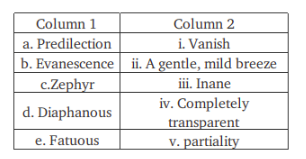
Loading solution...

Loading solution...
Identify antonyms for the following words.
Risible:
Loading solution...
Tenebrous:
Loading solution...
A partially completed paragraph is below, followed by fillers a,b,c. From options A, B, C and D, identify the right combination and order of fillers a,b or c that will best complete the paragraph.
In cultivating team spirit, one should not forget the importance of discipline. _________________ It is the duty of all the numbers of the team to observe discipline in its proper perspective.
a. A proper team spirit can seldom be based on discipline.
b.It is a well known fact that team spirit and discipline can never go hand in hand
c. Discipline in its right perspective would mean sacrificing self to some extent.
Loading solution...
Forests are gifts of nature __________. Yet, with the spread of civilisation, man has not only spurned the forests, but has been ruthlessly destroying them.
a. It is on historical record that the vast sahara desert of today once used to be full of thick forests.
b. A large part of humanity still lives deep inside forests, particularly in the tropical regions of the earth.
c. Human evolution itself has taken place in the forests.
Loading solution...
Given below are the first and last parts of a sentence, and the remaining sentence is broken into four parts p, q, r and s. From A, B, C and D, choose the arrangement of these parts that forms a complete, meaningful sentence.
A number of measures ______________ of the Municipal Corporations.
p.The financial conditions.
q. For mobilisation of resources
r. In order to improve
s. Are being taken by the State Governments
Loading solution...

Which of the following cannot be termed as an ‘oxymoron’?
Loading solution...
In the following question, the options 1, 2, 3 and 4 have a word written in four different ways, of which only one is correct. Identify the correctly spelt word.
Loading solution...
In the following question, a sentence has been broken up into parts, and the parts have been scrambled and numbered. Choose the correct order of these parts from the alternatives 1, 2, 3 and 4.
a. food supply
b. storage, distribution and handling
c. pastoral industry and fishing
d. besides increasing
e. by preventing wastage in
f. the productivity from agriculture
g. can be increased
Loading solution...
Arrange the following letters to form a meaningful word.

Loading solution...

Loading solution...
In each of the following question a sentence is given in “Direct Speech “Identify the right alternative 1 2 3 and 4 which best expresses this sentence in “Indirect Speech”.
He said to her, “Are you coming to the party?”
Loading solution...
The teacher said, “Be quiet, boys.”
Loading solution...
Match the Latin phrases in column 1 with their appropriate meaning in column 2:
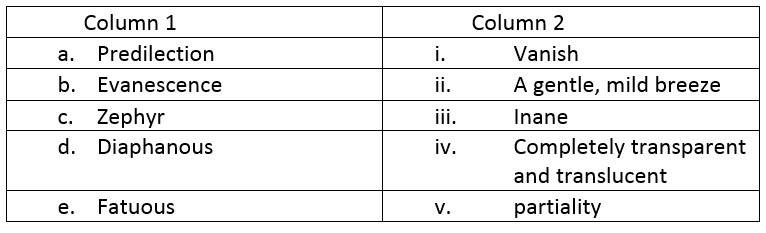
Loading solution...
Mandeep and Jagdeep had gone to visit Ranpur, which is a seaside town and also known for the presence of the historical ruins of an ancient kingdom. They stayed in a hotel which is exactly 250 meters away from the railway station. At the hotel, Mandeep and Jagdeep learnt from a tourist information booklet that the distance between the sea-beach and the gate of the historical ruins is exactly 1 km. Next morning they visited the sea-beach to witness sunrise and afterwards decided to have a race from the beach to the gate of the ruins. Jagdeep defeated Mandeep in the race by 60 meters or 12 seconds. The following morning they had another round of race from the railway station to the hotel. How long did Jagdeep take to cover the distance on the second day?
Loading solution...
Sujoy, Mritunjoy and Paranjoy are three friends, who have worked in software firms Z Solutions, G Software’s and R Mindpower respectively for decade. The friends decided to float a new software firm named XY Infotech in January 2010. However, due to certain compulsions, Mritunjoy and Paranjoy were not able to immediately join the start-up in the appointed time. It was decided between friends that Sujoy will be running the venture as the full time director during 2010, and Mritunjoy and Paranjoy will be able to join the business only in January 2011. In order to compensate Sujoy for his efforts, it was decied that he will receive 10 percent of the profits and in the first year will invest lesser amount as compared to his friends. The remaining profit will be distributed among the friends in line with their contribution. Sujoy invested Rs. 35,000/- for 12 months, Mritunjoy invested Rs. 1,30,000/- for 6 months and Paranjoy invested Rs. 75,000/- for 8 months. If the total profit earned during 2010 was Rs. 4,50,000/-, then Paranjoy earned a profit of:
Loading solution...
In Bilaspur village, 12 men and 18 boys completed construction of a primary health center in 60 days, by working for 7.5 hours a day. Subsequently the residents of the neighbouring Harigarh village also decided to construct a primary health center in their locality, which would be twice the size of the facility build in Bilaspur. If a man is able to perform the work equal to the same done by 2 boys, then how many boys will be required to help 21 men to complete the work in Harigarh in 50 days, working 9 hours a day?
Loading solution...
$$(\sqrt{\frac{225}{729}}-\sqrt{\frac{25}{144}})\div\sqrt{\frac{16}{81}}=?$$
Loading solution...
If $$\frac{x}{y}=\frac{7}{4}$$, find the value of $$\frac{x^{2}-y^{2}}{x^{2}+y^{2}}$$
Loading solution...
While preparing for a management entrance examination Romit attempted to solve three paper, namely Mathematics, Verbal English and Logical Analysis, each of which have the full marks of 100. It is observed that one-third of the marks obtained by Romit in Logical Analysis is greater than half of his marks obtained in Verbal English By 5. He has obtained a total of 210 marks in the examination and 70 marks in Mathematics. What is the difference between the marks obtained by him in Mathematics and Verbal English?
Loading solution...
Aniket and Animesh are two colleagues working in PQ Communications, and each of them earned an investible surplus of Rs. 1, 50, 000/- during a certain period. While Animesh is a risk-averse person, Aniket prefers to go for higher return opportunities. Animesh uses his entire savings in Public Provident Fund (PPF) and National Saving Certificates (NSC). It is observed that one-third of the savings made by Animesh in PPF is equal to one-half of his savings in NSC. On the other hand, Aniket distributes his investible funds in share market, NSC and PPF. It is observed that his investments in share market exceeds his savings in NSC and PPF by Rs. 20,000/- and Rs. 40,000/- respectively. The difference between the amount invested in NSC by Animesh and Aniket is:
Loading solution...
In March 2011, EF Public Library purchased a total of 15 new books published in 2010 with a total expenditure of Rs. 4500. Of these books, 13 books were purchased from MN Distributors, while the remaining two were purchased from UV Publishers. It is observed that one-sixth of the average price of all the 15 books purchased is equal to one-fifth of the average price of the 13 books obtained from MN Distributors. Of the two books obtained from UV Publishers, if one-third of the price of one volume is equal to one-half of the price of the other, then the price of the two books are:
Loading solution...
2 years ago, one-fifth of Amita’s age was equal to one-fourth of the age of Sumita, and the average of their age was 27 years. If the age of Paramita is also considered, the average age of three of them declines to 24. What will be the average age of Sumita and Paramita 3 years from now?
Loading solution...
An old lady engaged a domestic help on the condition that she would pay him Rs. 90 and a gift after service of one year. He served only 9 months and received the gift and Rs. 65. Find the value of the gift.
Loading solution...
There are four prime numbers written in ascending order of magnitude. The product of the first three is 7429 and last three is 12673. Find the first number.
Loading solution...
A rectangular piece of paper is 22 cm. long and 10 cm. wide. A cylinder is formed by rolling the paper along its length. Find the volume of the cylinder.
Loading solution...
Find the value of x from the following equation:
$$\log_{10}{3}+\log_{10}(4x+1)=\log_{10}(x+1)+1$$
Loading solution...
Consider the volumes of the following objects and arrange them in decreasing order:
i. A parallelepiped of length 5 cm, breadth 3 cm and height 4 cm
ii. A cube of each side 4 cm.
iii. A cylinder of radius 3 cm and length 3 cm
iv. A sphere of radius 3 cm
Loading solution...
If x satisfies the inequality $$|x - 1| + |x - 2| + |x - 3| \geq 6$$, then:
Loading solution...
A five digit number divisible by 3 is to be formed using the numerals 0, 1, 2, 3, 4 and 5 without repetition. The total number of ways in which this can be done is:
Loading solution...
If 2, a, b, c, d, e, f and 65 form an arithmetic progression, find out the value of ‘e’.
Loading solution...
A contract is to be completed in 56 days and 104 men are set to work. Each working 8 hours a day, after 30 days, 2/5th of the work is finished. How many additional men may be employed so that work may be completed on time, each man now working 9 hours per day?
Loading solution...
A bag contains 8 red and 6 blue balls. If 5 balls are drawn at random, what is the probability that 3 of them are red and 2 are blue?
Loading solution...
In a circle, the height of an arc is 21 cm and the diameter is 84 cm. Find the chord of ‘half of the arc’
Loading solution...
Mr. and Mrs. Gupta have three children - Pratik, Writtik and Kajol, all of whom were born in different cities. Pratik is 2 years elder to Writtik. Mr. Gupta was 30 years of age when Kajol was born in Hyderabad, while Mrs. Gupta was 28 years of age when Writtik was born in Bangalore. If Kajol was 5 years of age when Pratik was born in Mumbai, then what were the ages of Mr. and Mrs. Gupta respectively at the time of Pratik’s birth?
Loading solution...
Mr. Sinha received a certain amount of money by winning a lottery contest. He purchased a new vehicle with 40 percent of the money received. He then gave 20 percent of the remaining amount to each of his two sons for investing in their business. Thereafter, Mr. Sinha spent half of the remaining amount for renovation of his house. One-fourth of the remaining amount was then used for purchasing a LCD TV and the remaining amount - Rs. 1,35,000/- was deposited in a bank. What was the amount of his cash prize?
Loading solution...
The ratio of number of male and female journalists in a newspaper office is 5:4. The newspaper has two sections, political and sports. If 30 percent of the male journalists and 40 percent of the female journalists are covering political news, what percentage of the journalists (approx.) in the newspaper is currently involved in sports reporting?
Loading solution...
The ratio of ‘metal 1’ and ‘metal 2’ in alloy ‘A’ is 3 :4. In alloy ‘B’ same metals are mixed in the ratio 5:8. If 26 kg of alloy ‘B’ and 14 kg of alloy ‘A’ are mixed then find out the ratio of ‘metal 1’ and ‘metal 2’ in the new alloy.
Loading solution...
Answer the following questions based on the Diagram below, which reports Country XX’s monthly Outward Investment flows to various countries and the World. The FDI figures are reported US$ Million.
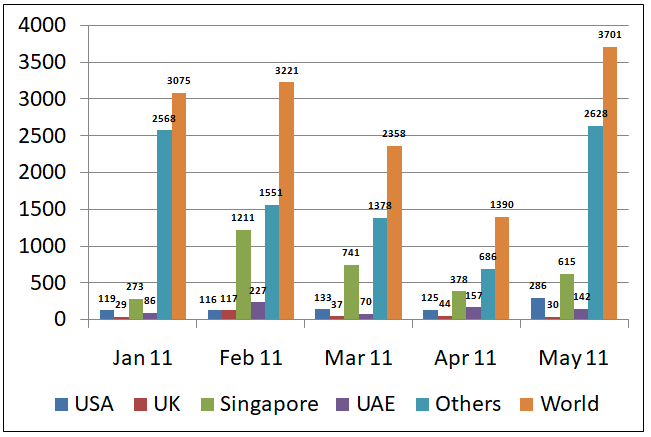
What is the compound average growth rate of Country XX’s overall Outward Investment during the period January 2011 and May 2011?
Loading solution...
In which month Country XX’s Outward Investment to Singapore dropped most and what is the ‘month on month’ growth in that period?
Loading solution...
What is the share of Country XX’s Outward Investment together in USA and UK in February 2011 of its total investment in the world?
Loading solution...
In which month the share of Country XX’s total Outward Investment together in Singapore and UAE achieved the highest level and what is the value?
Loading solution...
Between February 2011 and April 2011, to which country did Outward Investment from XX witness the highest decline?
Loading solution...
Answer the following questions based on the table below, which reports certain data series from National Accounts Statistics of India at Current Prices.

The GDP is sum total of the contributions from primary sector, secondary sector and the tertiary sector. If that be the case, then over 2004-05 to 2009-10, the share of tertiary sector at factor cost in GDP has increased from:
Loading solution...
The annual growth rate in the GNP series at factor cost was highest between;
Loading solution...
Had Gross Domestic Savings (GDS) between 2008-09 and 2009-10 increased by 30 percent, then during 2009-10 GDS expressed as a percentage of GDP at market prices would have been:
Loading solution...
Mark the highest figure from the following:
Loading solution...
Identify the correct Statement:
Loading solution...
Answer the following questions based on the table below, which reports global market share of Leading Exporting and Importing countries for Select Product groups.


Identify the highest number:
Loading solution...
Mark the correct statement:
Loading solution...
Mark the false statement:
Loading solution...
If between 2000 and 2009, India’s export market share in Integrated Circuits and Electronic Components had increased by 600 percent, the rank of the country in terms of market share in 2009 would have been:
Loading solution...
Considering both global export and import market dynamics, China has witnessed highest percentage change in its market share between 2000 and 2009 in the following product groups:
Loading solution...
Suppose the ten countries reported in the above table are arranged according to their continent: North America, EU and Asia. Then in terms of export market share for (i) Chemical Products, (ii) Automotive Products, (iii) Office and Telecom Equipment Products and (iv) Integrated Circuits and Electronic Components respectively, the continent-wise ranking in 2009 would be:
Loading solution...
Read the following instructions and answer the questions.
After the discussion at a high level meeting of government officers, the criteria for issuing of import / export licence to eligible business firms for the year 2011-12 were finalized as follows. The firms must –
I. Have a Grade – ‘A’ certified unit for any products.
II. Not have any legal dispute case against it.
III. Possess minimum asset worth Rs. 40 lakhs.
IV. Submit an environment clearance certificate issued by the Pollution Control Board (PCB) of the state where the firm is located.
V. Deposit the margin money of Rs. 1 lakh.
VI. Arrange for three guarantors with their personal identity cards (IDs).
However, if the firm satisfies all the above mentioned criteria except:
a) Criteria (I), but is a traditional handloom production unit, then the case may be referred to Development Commissioner, Handloom (DCH) of the state.
b) Criteria (IV), but is a local employment provider / thread (input) supplier / cloth supplier, the case may be referred to the Director, Department of Industry of the state.
c) Criteria (V) but can deposit at least Rs. 50000, the firm will be given import licence only and the case may be referred to the Deputy Director, Department of Industry of the state.
Based on the above criteria and information provided on each of the firms in the questions below, you have to decide which course of action should be taken against each firm. Without assuming anything regarding any applicant firm, the decision should be based on the information provided.
Mahalaxmi Weaving Center is a traditional handloom production unit. It has property worth more than Rs. 1 crore. It managed to get three guarantors with their personal IDs. No legal case is there against it. There is no problem submitting an environmental clearance, as the same is already issued to it by the State Pollution Control Board. It is also ready to deposit Rs. 1 lakh.
Loading solution...
Ramayan Enterprise is a textiles firm which possesses assets worth Rs. 50 lakhs and is located in Surat where no firm having any legal dispute is permitted to operate. The firm agreed to deposit Rs. 1 lakh and give details of three guarantors with their personal details as required. It has got grade - A certificate and can submit an environment clearance certificate issued by the Pollution Control Board of the state.
Loading solution...
Hirabhai Handlooms is a Vadodara based traditional Gujarati handloom firm keen to get an export licence. It is ready to pay the required security amount and possesses assets of Rs. 55 lakhs. Hirabhai Chamanlal is the owner of the firm as well as the President of State Handloom Association. Hence getting more than three guarantors with their IDs is not a problem. The firm possesses the environmental clearance certificate from the State Pollution Control Board after it was made mandatory for all handloom firms in the state.
Loading solution...
Each of the questions below starts with a few statements, followed by four conclusions numbered 1, 2, 3 and 4. You have to consider every given statement as true, even if it does not conform to the accepted facts. Read the conclusions carefully and then decide which of the conclusion(s) logically follow(s) from the given statements, disregarding commonly known facts.
Statements:
a. Some boys are scholars
b. Some teachers are boys
c. All scholars are observers
Conclusions:
1. Some scholars are boys
2. Some scholars are not boys
3. Some observers are boys
4. Some teachers are scholars
Loading solution...
Statements:
a. All teachers are professors
b. All professors are researchers
c. All researchers are consultants
Conclusions:
1. Some consultants are teachers
2. All professors are consultants
3. Some researchers are teachers
4. All professors are teachers
Loading solution...
Study the information given below carefully to answer the following questions.
In a certain code language the following lines written as –
‘lop eop aop fop’ means ‘Traders are above laws’
‘fop cop bop gop’ means ‘Developers were above profitable’
‘aop bop uop qop’ means ‘Developers stopped following traders’
‘cop jop eop uop’ means ‘Following maps were laws’
‘Developers are following laws’ would be correctly written as
Loading solution...
‘qop gop cop eop’ would correctly mean:
Loading solution...
In each of the following letter series, some of the letters are missing, which are given below it. Choose the correct alternative.
D_F_DEE_D_EF_DE_F
Loading solution...
_OPO_QOPQ_RQPO_POR_O
Loading solution...
In each of the following questions, find the relationship that can definitely be deduced on the basis of the relations given. The symbols used to define the relationship are as follows:
@ means ‘greater than’
# means ‘less than’
$ means ‘not equal to’
% means ‘equal to’
If it is given that, 3M % 2N and N % 3O, then:
Loading solution...
If it is given that, N @ P, P # O, O @ M and N % M, then:
Loading solution...
In each question given below, a statement is followed by three courses of action numbered 1, 2 and 3. You have to assume everything in the statement to be true, and then decide which of the three suggested courses of action logically follow(s).
Statement: School dropout rate is very high in the rural areas as children support their parents in income earning activities.
Courses of action:
i. Public awareness programme on primary education should be expanded immediately to educate parents.
ii. Compensation should be given to those parents whose children are in the school.
iii. Law on universal education and ban on child labour should be made rigorous.
Loading solution...
Statement: In a recent bulletin the Meteorological Department of India has forecasted severe drought in next cropping season which may cause failure of crops.
Courses of action:
i. The forecast should be widely published in media.
ii. The drought relief team should be ready for relief work.
iii. The people should be advised to go for drought resistant variety.
Loading solution...
Read the following information carefully to answer the questions given below it.
Mr. Malhotra’s family is a traditional joint family from Jalandhar having six persons from three generations. Each member of the family has different food preference and they support different sports / games. Only two couples are there in the family. Rakesh likes continental food and his wife neither likes dry fruits nor supports gymnastics. The person who likes egg supports Rugby and his wife likes traditional food. Mona is mother-in-law of Sonalika and she supports Athletics. Varun is grandfather of Tarun and Tarun, who likes Punjabi food, supports Basketball. Nuri is granddaughter of Mona and she supports Badminton. Nuri’s mother supports horse riding.
Identify the correct pair of two couples from the following:
Loading solution...
Who likes Punjabi food, and what sport / game does he / she support?
Loading solution...
Read the following paragraph and following conditions to answer the questions.
The Vice Chancellor of a University wants to select a team of five member organizing committee for the next convocation of the University to be held in March 2012. The committee members are to be selected from five shortlisted professors (Prof. Ahuja, Prof. Banerjee, Prof. Chakravarty, Prof. Das and Prof. Equbal) and four short listed students (Prakash, Queen, Ravi and Sushil). Some conditions for selection of the committee members are given below:
i. Prof. Ahuja and Sushil have to be together
ii. Prakash cannot be put with Ravi
iii. Prof. Das and Queen cannot go together
iv. Prof. Chakravarty and Prof. Equbal have to be selected
v. Ravi cannot be selected with Prof. Banerjee.
If two members of the committee are students and Prof. Das is one of the members of the committee, who are the other committee members?
Loading solution...
In case Prof. Ahuja and Prof. Chakravarty are members of the committee, which of the following options can't be the list of the remaining three members of the committee?
Loading solution...
If the word ‘EXAMINATION’ is coded as 56149512965, then the word ‘GOVERNMENT’ is coded as:
Loading solution...
In a certain code language ‘HORSE’ is written as 71417184, then the word ‘MONKEY’ is coded as:
Loading solution...
Read the following information carefully and mark the correct answer to the questions given below
Sampada Apartment is a housing society formed by a group of professors of a University. It has six flats on a floor in two rows facing North and South which are allotted to Prof. Purohit, Prof. Qureshi, Prof. Rathor, Prof. Sawant, Prof. Tripathy and Prof. Usman. Prof. Qureshi gets a North facing flat and it is not next to Prof. Sawant’s flat. Prof. Sawant and Prof. Usman get their flats which are diagonally opposite to each other. Prof. Rathor gets a south facing flat which is next to Prof. Usman’s flat. Prof. Tripathy’s flat is North facing.
Which of the following professors get South facing flats?
Loading solution...
If the flats of Prof. Tripathy and Prof. Purohit are interchanged, whose flat will be next to that of Prof. Usman?
Loading solution...
Who won the 2011 FIFA Women’s World Cup Final?
Loading solution...
Match the correct Celebrity Endorser with the Brand of Vests:

Loading solution...
Which of the following is a space mission by ISRO?
Loading solution...
Elzie Crisler Segar is best known as the creator of the cartoon character of _____________.
Loading solution...
Identify the correct match for the Personality with what he/she is known for:

Loading solution...
Which book among the following is not written by Dr. A. P. J. Abdul Kalam?
Loading solution...
In the table below, match the correct Trade Name of medicine with its Generic Name and the name of the pharmaceutical company that manufactures it:

Loading solution...
By what name were the Commonwealth games known when they were first held in 1930 in Ontario, Canada?
Loading solution...
Who did declare, ‘’The only hope for India is from the masses. The upper classes are physically and morally dead’’?
Loading solution...
Which of the following rivers do not flow across Uttarakhand?
Loading solution...
Identify the correct match of the Folk Dances and States given below:

Loading solution...
Which of the following group of countries is not member of the United Nations?
Loading solution...
Match the correct Country with its Capital City and Currency:

Loading solution...
Indian Rupee received a unique symbol "₹" which blends the scripts of ___________
Loading solution...
Which of the following facts is not true about Mahatma Gandhi?
Loading solution...
Mark the correct match of Public Programmes with the Ministry:

Loading solution...
Given below are names of select personalities who have been recently rated among the most powerful women of the world by Forbes. Identify the option that ranks them in the right order (from 1 to 4) as they are ranked in the Forbes list of the world’s 100 most powerful women in 2011:
Angela Merkel; Hillary Clinton; Michelle Obama; Oprah Winfrey; Indira Nooyi; Irene Rosenfeld; Dilma Rousseff
Loading solution...
Which of the following is not an eligibility condition placed in the ‘Draft Guidelines for Licensing of New Banks in the Private Sector’ issued by the Reserve Bank of India on 29th August 2011?
Loading solution...
Match the correct name of the Regulator / Association with the name of its Chairman (as on 31st August 2011):

Loading solution...
Which of the following group of companies have agreed to merge their Liquid-Crystal Display business as at August 2011?
Loading solution...
Match the correct name of the Film with its Lead Actor and Director:

Loading solution...
Start your IIM journey with the right preparation and crack CAT 2026.

Educational materials for CAT preparation
 Share
Share
