91- 6303239042


 Group
Group


 Preferred Source

 Google Discover

How to Analyze Your GMAT Mock Test Results Effectively
Taking a GMAT mock test is only half the work. The real value lies in what you do after you finish. Most test-takers spend hours preparing and then gloss over their results, missing critical insights. If you want to improve your GMAT score, a structured mock test analysis is non-negotiable. This guide walks you through how to review your GMAT practice test results and turn each attempt into a powerful learning tool.
How to Analyze Your GMAT Mock Test Results Effectively
The first step in GMAT mock test analysis is understanding your score report in detail. The official GMAT exam, now available as the GMAT Focus Edition, is scored on a scale of 205 to 805 and covers three sections: Quantitative Reasoning, Verbal Reasoning, and Data Insights. Each section is scored individually, and your total score is a combination of all three.
When you review your mock test, focus on these areas:
Section-wise performance: Where did you score the lowest? Which section needs the most attention?
Time management: Did you run out of time on specific questions or question types?
Accuracy by question type: Were you struggling more with Critical Reasoning, Data Sufficiency, or Multi-Source Reasoning?
Most GMAT prep platforms, including the official GMATPrep software by GMAC, provide a detailed performance breakdown. Use it to identify patterns, not just overall scores. Look at your correct vs. incorrect ratio by topic and difficulty level.
GMAT Study Plan After Practice Tests
Once you know where you went wrong, the next step is to build a targeted GMAT study plan. A generic study schedule rarely works at this stage. What you need is a personalized revision plan based on your actual weak areas.
Here is a practical approach to structuring your study plan:
Prioritize your weakest sections: If Data Insights is your lowest-scoring section, allocate more study hours there before your next mock.
Set specific weekly goals: Instead of broadly studying Quant, aim for something like completing 30 Data Sufficiency questions with at least 80% accuracy.
Revisit concepts before attempting more questions: If you keep making errors on Geometry or Reading Comprehension, go back to the fundamentals first.
Space out your mock tests: Taking a mock every few days without proper review does more harm than good. Give yourself at least one to two weeks between mocks to implement improvements.
A well-structured GMAT study plan after each practice test can meaningfully accelerate your progress and prevent you from repeating the same mistakes.
GMAT Mock Test Analysis Strategy
Having a consistent GMAT mock test analysis strategy is what separates high scorers from average ones. Here is a framework that many GMAT toppers and experienced tutors recommend.
Start with the big picture. Before diving into individual questions, look at your overall section scores and timing data. Identify which section had the biggest gap between your target score and your actual score. This tells you where to focus first.
Then go deeper. Review every incorrect answer, but also review the ones you got right. Sometimes you answered correctly for the wrong reason, or you guessed and got lucky. Understanding your thought process matters as much as the final answer.
Maintain an error log. This is one of the most effective GMAT improvement strategies you can use. An error log is a simple document where you record each mistake, the question type, the concept tested, and the reason you got it wrong. Over time, this log reveals recurring patterns in your thinking that you can address directly. Many high-scoring test-takers credit their error logs as a key part of their preparation.
Step-by-Step Strategy to Improve GMAT Score After Each Mock
Here is a step-by-step process to help you improve your GMAT score after every practice test:
- Review your score report immediately. Do not wait. Go through your section scores and time spent per question right after the test, while everything is fresh in your memory.
- Categorize your mistakes. Group errors by type: conceptual gaps, careless mistakes, or time pressure errors. Each type requires a different fix.
- Spend more time on medium-difficulty wrong answers. If you are missing moderate-level questions consistently, that is often your biggest scoring opportunity since these questions carry significant weight in the adaptive scoring model.
- Reattempt wrong questions without reading the explanation first. Try to solve them again on your own before looking at the solution. This builds genuine problem-solving ability rather than passive understanding.
- Update your error log and study plan. Add new weak areas to your log and adjust your weekly study schedule accordingly.
- Practice targeted drills. After identifying weak topic areas, do focused practice sets on those topics before taking your next full mock.
Repeating this cycle consistently is how most students move from an average score to a competitive one. The GMAT rewards structured preparation, and this step-by-step approach gives you a reliable framework to build on.
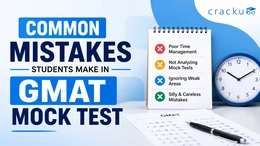
Common Mistakes to Avoid After Taking GMAT Mock Tests
Even motivated students make avoidable mistakes when reviewing their mock tests. Here are the most common ones to watch out for:
Skipping the review entirely. Some students take a mock and jump straight to the next one without reviewing. This wastes valuable diagnostic data and often leads to stagnant scores.
Only reviewing wrong answers. Looking only at incorrect responses misses a big part of the picture. You should also review questions you were unsure about, even if you got them right.
Focusing on the total score, not trends. A score increase does not always mean improvement in the right areas. Break your review down by section and question type for a clearer view of your progress.
Not tracking time per question. If you are spending too long on certain questions, you are likely sacrificing accuracy elsewhere. Time management is as important as content knowledge on the GMAT.
Ignoring the official explanations. GMAC's official explanations are carefully constructed and worth reading thoroughly, even for questions you answered correctly.
Treating mock tests as just a benchmark. A GMAT practice test is not only a performance indicator. It is a diagnostic tool. Your growth depends on how effectively you use the data it provides.
Analyzing your GMAT mock tests effectively is one of the highest-leverage habits you can build during your prep. Every mock test is full of useful data that, when used correctly, can guide your study plan and help you improve your GMAT score over time. Use the strategies outlined in this guide to make every practice attempt count. With a strong analysis framework and a consistent review process, you can turn each mock into a meaningful step toward your target score.
How to Analyze Your GMAT Mock Test Results Effectively : Conclusion
Analyzing your GMAT mock test results effectively is one of the most powerful ways to improve your overall performance. Instead of just focusing on the final score, a detailed review of section-wise performance, timing, and accuracy can reveal valuable insights about your strengths and weaknesses. By consistently tracking your mistakes and understanding the reasoning behind them, you can avoid repeating errors and steadily build your skills.
A structured GMAT mock test analysis strategy, combined with a well-planned study approach, can significantly boost your score over time. Maintaining an error log, revisiting concepts, and practicing targeted questions ensures that every mock test contributes to your improvement. With disciplined analysis and consistent effort, you can turn each practice test into a stepping stone toward achieving your target GMAT score.