
 Group
Group
 Group
Group
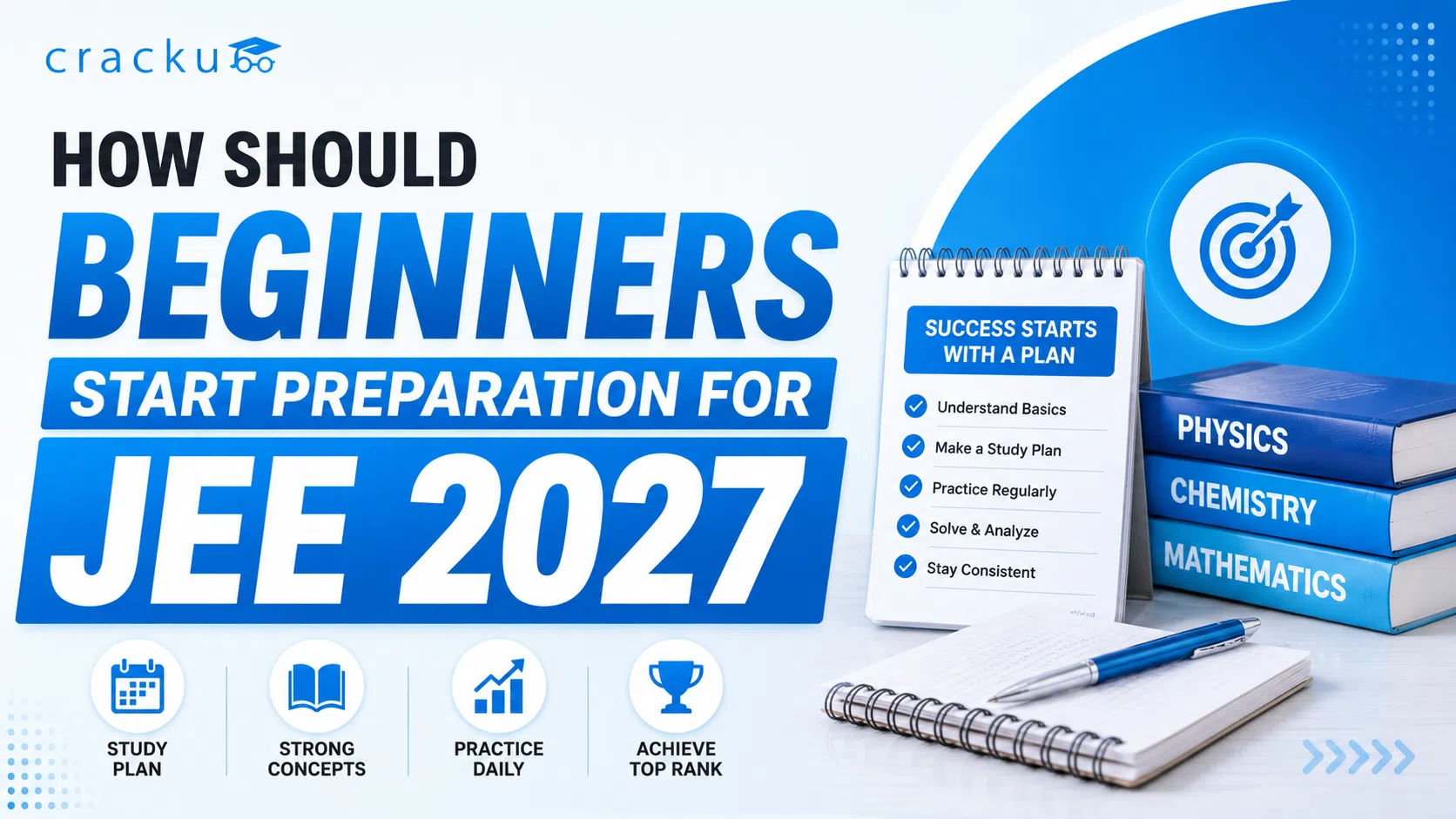
Starting your JEE 2027 preparation early is the single biggest advantage you can give yourself. Before beginning, every student should first understand the complete JEE Mains syllabus 2027 so they know exactly what topics are important in Physics, Chemistry, and Mathematics. This guide covers everything a beginner needs, from where to start and which books to use, to how many hours to study and what mistakes to avoid during preparation.
How Should Beginners Start Preparing for JEE 2027?
Follow these five steps in order and you will have a stronger foundation than most students who begin in Class 12.
Step 1: Read through the full JEE syllabus once
Know the complete syllabus of Physics, Chemistry, and Maths before you start studying.
Step 2: Start with NCERT, not reference books
Every advanced topic in JEE is built on something in NCERT. Skipping it costs you later.
Step 3: Build a written weekly schedule
Divide time across all three subjects every week and write it down. A plan in your head gets broken too easily.
Step 4: Solve problems from day one
After finishing any topic, solve at least 10 to 15 questions before moving to the next one.
Step 5: Keep a mistake log
Write down every question you get wrong and why. Revisiting it weekly is worth more than reading new chapters.
Also Read: Cracku's JEE Foundation WhatsApp Group 2027, Join Now
How to Prepare for JEE 2027?
Break your preparation into four phases rather than treating it as one long stretch.
Phase 1: Foundation and Application (Months 1 to 5)
Cover all Class 11 topics using NCERT and one reference book per subject. Focus on understanding and solving JEE-pattern problems and topic-wise previous year questions. Spend extra time on weak areas.
Phase 2: Mock Tests and Revision (Months 6 to 8)
Take full-length timed mock tests every week and spend more time reviewing them than taking them. During the last month, don’t do new topics. Just revise, practice mocks and focus on high-weightage chapters.
This is where Cracku’s JEE mock tests become useful. They follow the actual JEE Main pattern and the subject-wise performance reports make post-test analysis much faster.
Also Read: Is NCERT Enough for JEE Main and Advanced Preparation?
How Many Hours Should I Study for JEE 2027?
Quality always matters more than hours, but here is a realistic daily benchmark by class level.
Class | Daily Study Hours | Focus Area |
|---|---|---|
Class 9 | 1 to 2 hours | Maths and Science basics |
Class 10 | 2 to 3 hours | Strengthen fundamentals; understand JEE structure |
Class 11 | 4 to 6 hours | Core JEE concepts, NCERT, daily problem practice |
Class 12 | 6 to 8 hours | Revision, full-length mock tests, previous year papers |
Adjust based on school workload that you can manage. The best routine is the one you can follow for months without burning out.
Also Read: Common Mistakes to Avoid in IIT JEE Preparation, Check Now
How to Prepare for JEE 2027 Without Coaching
Coaching provides structure and peer competition. For students preparing for JEE, Cracku covers the two things that are very hard to manage without coaching: structured practice and honest performance tracking. The topic-wise tests, full-length JEE Main mocks, and difficulty-rated previous year question bank give you a clear picture of where you stand at every point in your preparation.
Staying accountable
Set a weekly goal every Sunday, take a mock on a fixed day regardless of how prepared you feel, and review your mistake log at the end of each week.
What you need
- A phase-wise plan and the right books (both covered in this guide)
- A source of mock tests and previous year papers
- A fixed weekly review habit to catch weak areas before they grow
Which Books Are Best for JEE 2027 Preparation?
Pick one foundation book and one practice book per subject. Finish them fully before adding anything else.
Subject | Foundation | Advanced Practice |
|---|---|---|
Physics | NCERT Class 11 and 12, H.C. Verma (Vol 1 and 2) | D.C. Pandey (Arihant), I.E. Irodov (selectively for Advanced) |
Chemistry | NCERT Class 11 and 12 (non-negotiable for Inorganic) | O.P. Tandon (Inorganic and Organic), Narendra Avasthi (Physical) |
Maths | NCERT Class 11 and 12, R.D. Sharma | Vikas Gupta, Pankaj Joshi (Advanced Practice) |
Common Mistakes Beginners Should Avoid in JEE Preparation
Most JEE failures come from habits that look harmless in month one but compound badly by month twelve.
Common Mistake | Better Alternative |
|---|---|
Skipping NCERT and jumping to reference books | NCERT first |
Using four or five books per subject | One foundation book and one practice book per subject |
Studying without a written plan | Written weekly targets with a daily review |
Avoiding mock tests until Class 12 | Section-wise tests in Class 11, full mocks from Class 12 |
Copying a topper's timetable exactly | Build a schedule around your own weak areas and pace |
Moving on after a wrong answer without analysis | Log every mistake and revisit the log weekly |
Neglecting sleep and physical health | 7 to 8 hours of sleep; breaks between study hours |
Skipping hard chapters | Hard chapters are usually high-weightage ones. Do them first. |
How Should Beginners Start Preparation for JEE 2027: Conclusion
Starting early for JEE 2027 gives you a major advantage because it allows enough time to build concepts slowly and steadily. The key is to begin with NCERT, strengthen fundamentals, and practice questions consistently rather than rushing into advanced material. A structured plan with weekly goals ensures that your preparation remains balanced across Physics, Chemistry, and Mathematics.
As you progress, regular mock tests, revision cycles, and a strong mistake-tracking system will shape your performance. JEE success is less about sudden effort and more about long-term consistency. If you follow a disciplined routine, focus on understanding instead of memorizing, and keep improving step by step, you will build a strong foundation for JEE 2027.