91- 6303239042
 CAT WhatsApp Group



Every CAT topper interview sounds the same - "I practiced every single day, consistency was everything," But what does the actual data say?
Cracku analysed performance data from thousands of students who used the CAT Daily Targets feature before their exam. The findings are clear: there is a direct, measurable link between daily practice volume and final CAT percentile - and the numbers might surprise you.
What Is CAT Daily Target and Why Does It Matter?
A CAT Daily Target is a short, structured practice session with a curated mix of CAT-level questions across VARC, DILR, and Quantitative Aptitude. It is not a CAT mock test. It is daily drilling - designed to sharpen accuracy, build speed, and reinforce concepts over time.
Here is the simplest way to think about it:
Parameter | Daily Targets | Mock Tests |
Purpose | Ensures consistent preparation | Measure exam readiness |
Focus | Topic-wise practice | Full exam simulation |
Frequency | Every day | Once a week |
Best used for | Fixing weak areas | Strategy and timing |
Students who rely only on mock tests without consistent daily practice are essentially testing themselves without actually improving. The data backs this up.
Read More: How CAT Toppers Set Daily Targets for 99+ Percentile
How Many Daily Targets Does a CAT 99 Percentiler Attempt?
When Cracku mapped the number of Daily Targets attempted against final CAT percentile scores, one pattern emerged consistently - more practice, higher percentile.
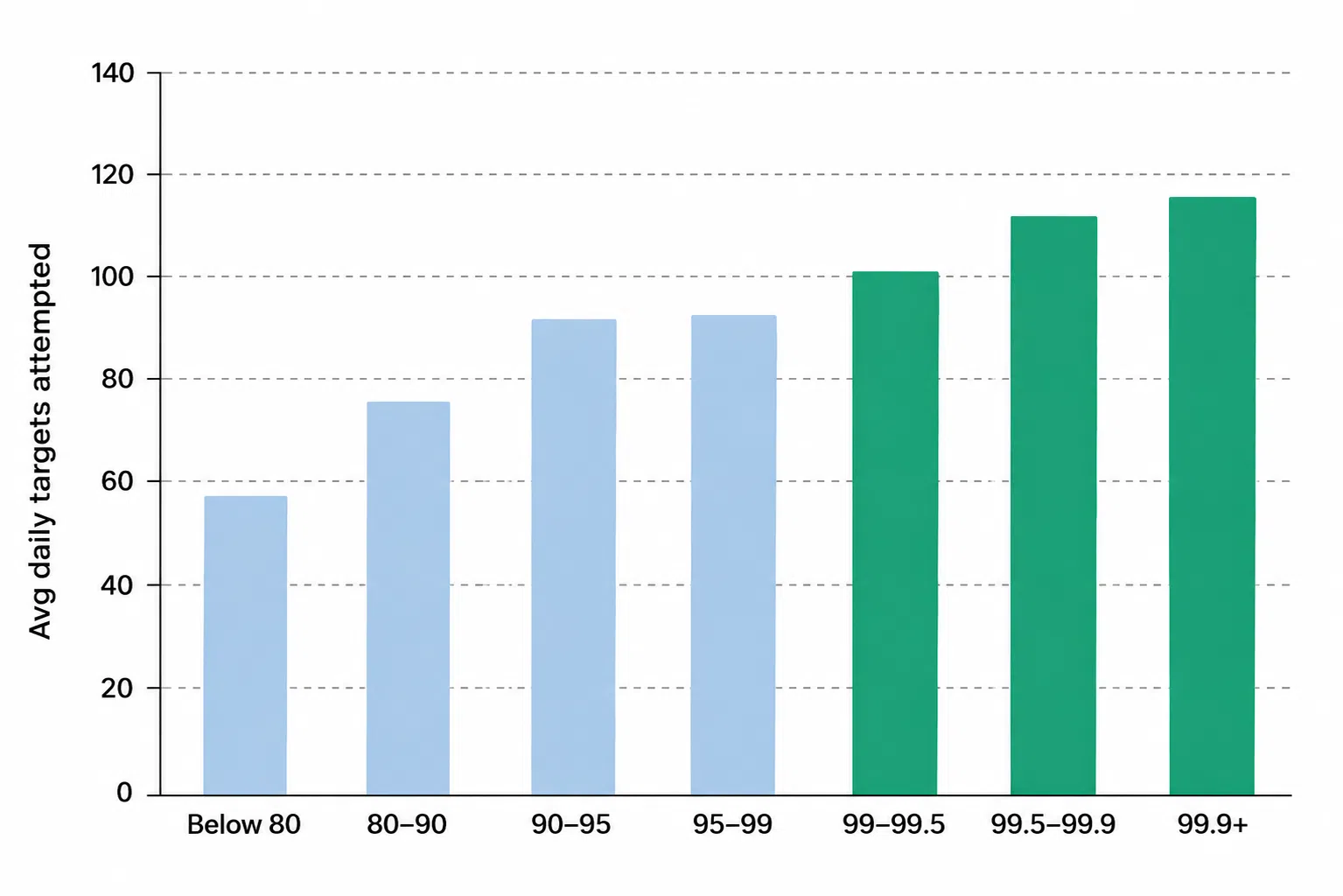
Students who crossed the 99 percentile mark averaged between 103 and 117 daily targets. Students who scored below 80 percentile averaged just 58. That is nearly double the practice volume at the top - and it shows up directly in results.
Why the Gap Between 95-99 and 99+ Percentile Is Smaller Than You Think
This is the part most aspirants in the high 90s need to read carefully.
Students in the 95-99 percentile band averaged 95 daily targets. Students who broke into 99+ averaged 103. That is a gap of roughly 8-10 sessions. These sessions might sound trivial - but over a 4-month preparation window, the compounding effect of those extra sessions adds up to:
- 100+ additional questions solved across all three sections
- Deeper exposure to the trickier, less common question types that appear in the 99+ scoring range
- Faster decision-making on exam day because you have simply seen more patterns
Most students who are stuck at 96-97 percentile assume they have a knowledge gap. The data suggests it is more often a consistency gap.
What the Below 80 vs 99+ Comparison Actually Tells You
The sharpest contrast in this data is between the bottom and top groups. The average student below 80 percentile attempted around 58 daily targets. The average student above 99.9 percentile attempted ~120. That is a 2x difference in practice volume.
This is not a gap in raw intelligence. It is a gap in how often these two groups showed up and did the work. CAT does not test memorised content - it tests reasoning, comprehension, and problem-solving under time pressure. These are skills that only improve through repetition, not through passive studying or watching lecture videos.
The students at the top practiced twice as much. That is the story the data tells.
How Many Daily Targets Should You Attempt Based on Your CAT Percentile Goal?
Use the data as your personal benchmark, not just motivation.
Targeting 99+ percentile: Your floor is 100 daily targets. Realistically, aim for 110-120 to stay ahead of the average. That works out to roughly one session per day across a 4-month prep period - a daily habit, not a monthly sprint.
Targeting 95-99 percentile: Around 90-95 daily targets is both realistic and effective. That is roughly 4-5 sessions per week sustained over 3-4 months.
Targeting 90-95 percentile: Aim for 90 sessions. That is manageable even with a college schedule or a job.
Why Daily Practice Improves CAT Score More Than Last-Minute Cramming
CAT rewards students who think quickly and accurately under pressure. That kind of ability does not develop in the final two weeks before the exam. It develops over months of repeated exposure to the right type of questions.
Here is what consistent daily practice actually does:
It builds pattern recognition: The more CAT-level questions you solve over time, the faster you start recognising question structures, traps, and efficient solution approaches. This is what makes 99 percentilers fast - not just smart.
It compounds over time: Solving daily targets every day for four months gives you 120 sessions and exposure to hundreds of unique question types.
It reduces exam-day errors: Most students who score in the 85-95 range are not losing marks on questions they do not know - they are losing marks on careless mistakes on questions they do know. Consistent daily practice, combined with reviewing mistakes after each session, is the most direct fix for this.
It keeps all three sections in check: CAT has three very different sections. Students who only give mock tests often let one section go cold between tests. Daily targets keep VARC, DILR, and QA all in active practice simultaneously.
The Right Way to Use CAT Daily Targets: Most Students Get This Wrong
Doing 100 daily targets by rushing through them and moving on will not produce 99 percentile results. The volume matters, but so does how you use the sessions.
Here is what actually works:
Attempt honestly: Do not look at solutions mid-session. The discomfort of struggling through a hard question is the actual learning - bypassing it defeats the purpose.
Review every session: After submitting, spend at least as much time reviewing wrong answers as you spent attempting the questions. Understand not just what the right answer was, but why your approach failed.
Track your patterns: Are you consistently losing time in DILR? Making sign errors in QA? Misreading RC questions? Daily targets surface these patterns far faster than mock tests do because you are practicing more frequently.
Start early: The data reflects preparation over 4 months, not 3-4 weeks. Students who start daily targets in June have a fundamentally different preparation base than students who start in September.
Combine with weekly mocks: Daily targets improve your skills. Mock tests measure your readiness. You need both - one without the other is incomplete preparation.
How Many Daily Targets Do CAT 99 Percentilers Attempt: Conclusion
The data from thousands of Cracku students makes one thing clear: the difference between a 95 percentile and a 99 percentile is not a talent gap. It is a practice gap - and a surprisingly small one at that. Students who broke 99 percentile averaged 110+ daily targets. Students below 80 percentile averaged around 60. The entire climb from the bottom to the top of the percentile ladder can be traced, at least in part, to how consistently each group showed up to practice.
If you are serious about 99 percentile in CAT, the question is not whether daily practice works. The data has already answered that. The only question is whether you will start building that habit today.