
 Group
Group
 Group
Group

Good Score in JEE Advanced 2026?
JEE Advanced 2026 was conducted on May 17, 2026, by IIT Roorkee. Every year after the exam, the most common question students ask is: what is a good score in JEE Advanced? The honest answer is that it depends on your target IIT, the branch you want, and your category. However, there are widely accepted benchmarks that can help you set realistic goals.
This blog breaks down exactly what a good score means in JEE Advanced 2026, the expected marks vs rank analysis, category-wise qualifying marks, and how to predict your rank after the exam.
What Is Considered a Good Score in JEE Advanced 2026?
JEE Advanced 2026 carries a total of 360 marks across Paper 1 and Paper 2, with each paper worth 180 marks. There is no single universal answer to what is a good score, but here are the broad benchmarks most experts and coaching institutes use:
- 150+ marks: Generally considered a good score. Opens doors to several IITs in non-CSE branches.
- 200+ marks: A strong score that improves your chances at mid-tier to reputed IITs.
- 250+ marks: A very good score, likely placing you among the top 1,500 ranks.
- 280+ marks: An excellent score, competitive for top IITs and premier branches like CSE and EE.
Keep in mind that what qualifies as a good score also shifts every year based on the difficulty of the paper. In 2025, JEE Advanced was considered tougher than 2024, and the qualifying cutoff dropped significantly as a result.
Also Read: JEE Advanced Marks vs Rank 2026, Previous Year Analysis
JEE Advanced 2026 Marks vs Rank Analysis
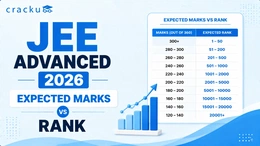
The table below shows the expected marks vs rank correlation for JEE Advanced 2026. These are estimated figures based on past years' official data from IIT Kanpur (2025) and IIT Madras (2024). Actual ranks may vary depending on exam difficulty and overall candidate performance.
Marks (out of 360) | Expected AIR (CRL) | Performance Level |
|---|---|---|
270 – 360 | 1 – 500 | Elite |
240 – 269 | 500 – 1,500 | Very High |
210 – 239 | 1,500 – 3,500 | High |
180 – 209 | 3,500 – 6,000 | Above Average |
150 – 179 | 6,000 – 10,000 | Good |
120 – 149 | 10,000 – 18,000 | Average |
Below 120 | 18,000+ | Below Qualifying |
Note: Even a 5–10 mark difference can shift your rank by several hundred positions, especially in the 150–250 score range. This makes accuracy in the exam extremely critical.
Predict Your JEE Score Here: JEE Advanced Score Calculator
Safe Score for Top IITs and Popular Branches
Knowing the safe score for your target IIT and branch helps you set a focused preparation target. The table below gives a general idea of what scores are typically needed for different IIT groups, based on JoSAA closing rank trends from recent years.
IIT Group | Popular Branches | Safe Score (General) | Expected AIR Range |
|---|---|---|---|
IIT Bombay, Delhi | CSE, EE, Maths & Computing | 290 – 310+ | Top 200 |
IIT Kanpur, Madras, Roorkee | CSE, EE, Mech | 250 – 285 | 200 – 1,000 |
IIT Kharagpur, Guwahati | CSE, EE | 220 – 250 | 1,000 – 2,500 |
IIT Hyderabad, Indore, BHU | CSE, Mech, Civil | 180 – 220 | 2,500 – 5,000 |
Newer IITs | Most branches | 120 – 180 | 5,000 – 12,000 |
These figures are indicative and can vary each year. The actual JoSAA cutoff depends on seat availability, the number of qualified candidates, and round-wise preferences. Always check the official JoSAA counselling data once results are out.
Also Read: JoSAA Counselling 2026, Dates, Registration, Seat Allotment
Category-Wise Good Score in JEE Advanced 2026
JEE Advanced 2026 has different qualifying marks for different categories. The minimum marks required to appear in the rank list (and thus become eligible for JoSAA counselling) vary by category. Below is a comparison based on the last two years of officially released data:
Category | Min. Subject-wise % | 2025 Qualifying Marks (Approx.) | 2024 Qualifying Marks (Approx.) |
|---|---|---|---|
General (CRL) | ~5.83% per subject | ~74 marks (~20.56%) | ~109 marks (~30.34%) |
GEN-EWS | ~5.25% per subject | ~67 marks (~18.50%) | ~98 marks (~27.30%) |
OBC-NCL | ~5.25% per subject | ~67 marks (~18.50%) | ~98 marks (~27.30%) |
SC | ~2.92% per subject | ~37 marks (~10.28%) | ~55 marks (~15.17%) |
ST | ~2.92% per subject | ~37 marks (~10.28%) | ~55 marks (~15.17%) |
PwD | ~2.92% per subject | ~37 marks (~10.28%) | ~55 marks (~15.17%) |
Important: These are minimum marks just to qualify and appear in the rank list. To actually secure a seat in an IIT, candidates need to score well above the qualifying cutoff, depending on their target institute and branch.
A good score for the General category would be 150 or above, while for OBC-NCL/EWS candidates, 130+ is considered competitive. For SC and ST candidates, scoring 100+ marks significantly improves your chances in reputed IITs.
To practice questions across all difficulty levels and improve your category-wise score, try the Cracku JEE Question Bank as it covers topic-wise and year-wise questions to help you prepare smarter.
Is 150, 200, or 250 a Good Score in JEE Advanced 2026?
Students often search for specific score benchmarks. Here is a simple breakdown:
Is 150 a good score in JEE Advanced 2026? Yes, for the General category, 150 marks is considered a good score. It may get you an AIR in the range of 6,000–10,000, opening up admission possibilities in newer IITs across branches like Mechanical, Civil, and Chemical Engineering.
Is 200 a good score in JEE Advanced 2026? Absolutely. A score of 200 places you roughly in the top 3,500–5,000 ranks (for General category) and gives you a reasonable chance at several established IITs beyond the top five. Many core branches at IITs like Guwahati, Roorkee, and BHU become reachable.
Is 250 a good score in JEE Advanced 2026? A score of 250 is excellent. It is likely to fetch you an AIR between 500 and 1,500, putting IIT Kanpur, IIT Roorkee, and IIT Kharagpur CSE within reach, and significantly improving your options at IIT Bombay and IIT Delhi for non-CSE branches.
In 2025, the JEE Advanced topper scored 332 out of 360. Scores of 300 and above are rare and typically place candidates in the top 50 AIR. Aiming for 250+ is a strong and achievable target for students who prepare consistently.
How to Predict Your Rank After JEE Advanced 2026
After the exam, you can get an estimate of your rank even before official results are out. Here are a few practical ways to do it:
- Use official answer keys: IIT Roorkee will release the official JEE Advanced 2026 answer key. Use it to calculate your approximate score first.
- Compare with marks vs rank tables: Match your estimated score against the marks vs rank analysis shared above to get a rough AIR range.
- Use online rank predictors: Several credible platforms offer JEE Advanced rank predictors that use your score, category, and past year data to give an estimated rank.
- Check previous year trends: Since JEE Advanced 2026 results will be announced in June 2026, reviewing JoSAA 2025 closing ranks for your target IIT and branch can give you a realistic picture of your admission chances.
Remember, rankings in JEE Advanced are purely based on aggregate marks. There is no percentile system like JEE Main. A difference of even 5 marks in the critical 150–250 range can shift your rank by hundreds of positions.
To stay on track with your daily preparation and simulation, check out the Cracku JEE Daily Target a structured daily practice tool designed to keep your preparation consistent and exam-ready.
Good Score in JEE Advanced 2026: Conclusion
A good score in JEE Advanced 2026 depends on multiple factors such as your preferred IIT, target branch, reservation category, and the overall difficulty level of the exam. For most General category candidates, scoring 150+ marks is considered a decent performance, while 200+ marks significantly improve IIT admission chances. Students aiming for top IITs and competitive branches like Computer Science Engineering should ideally target 250+ marks for a safer position in the rank list.
Understanding the JEE Advanced 2026 marks vs rank analysis can help candidates set realistic preparation goals and evaluate their admission possibilities after the exam. Since cutoffs and ranks change every year, students should use expected trends only as a reference. Along with score prediction, candidates must also stay updated with JoSAA counselling rounds, IIT closing ranks, and category-wise cutoff trends to make informed admission decisions.