
 Group
Group
 Group
Group


 Preferred Source

 Google Discover
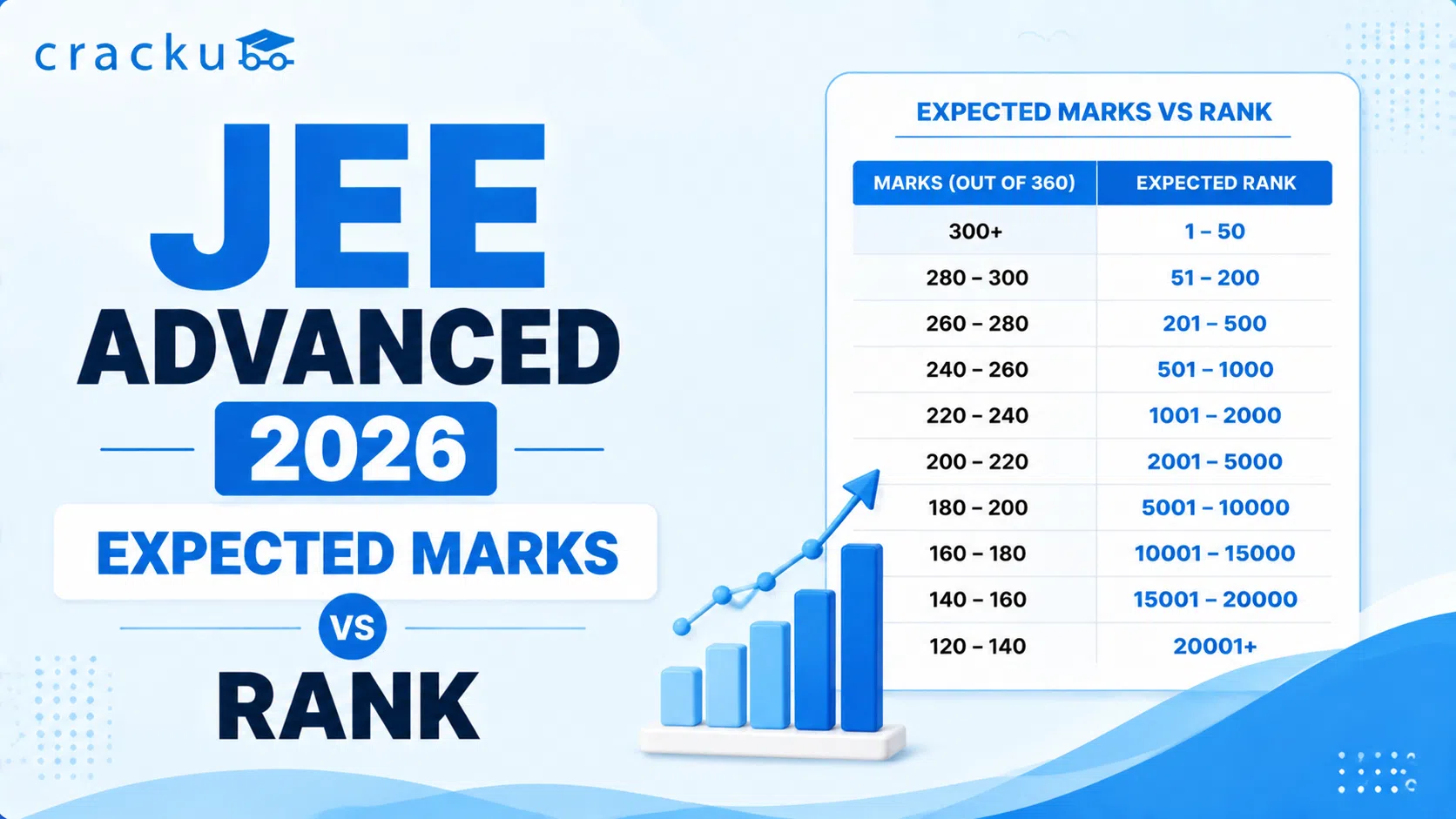
JEE Advanced Expected Marks vs Rank 2026: One of the first things students look up after JEE Advanced is a marks vs rank reference. Knowing where a score approximately places you on the All India Rank (AIR) list is essential for estimating IIT admission chances and planning JoSAA counselling effectively. This blog covers the JEE Advanced 2026 expected marks vs rank projections, indicative rank estimates for key score milestones, guidance on minimum marks for top IIT branches, and a historical trend comparison from 2019 to 2026.
JEE Advanced Expected Marks vs Rank 2026
The marks vs rank relationship in JEE Advanced is not fixed. It shifts every year based on paper difficulty, the number of students appearing, and overall score distribution. The 2026 edition was broadly rated as moderate to difficult by students and coaching experts, which generally keeps scores lower and, in turn, the marks required for a given rank slightly lower than in an easier year.
Based on trend analysis from previous years and the 2026 paper difficulty feedback, some broad expected projections for the General category (CRL) are as follows:
- A score around 264 marks is expected to place a student around the top 100 ranks (tentative).
- Around 201 marks broadly corresponds to the rank 1,000 band (tentative).
- Approximately 150 marks maps to around rank 5,000 (tentative).
- The expected qualifying marks for 2026 are tentatively around 80 out of 360, keeping in line with 2025 trends.
For the complete year-wise marks vs rank breakdown covering ranks 100 through 20,000 from 2016 to 2026, please refer to the attached PDF. The data in the PDF is sourced from Cracku's JEE Advanced analysis. Students who want to further strengthen their preparation can also explore the Cracku JEE Question Bank, which offers comprehensive topic-wise practice with detailed solutions.
JEE Advanced 2026 Marks vs Rank Analysis for Top IITs
For students targeting the most competitive IITs such as IIT Bombay, IIT Delhi, IIT Madras, IIT Kharagpur, IIT Kanpur, and IIT Roorkee, the marks vs rank relationship directly dictates which branches are within reach. Based on the 2026 expected trends and historical patterns, a few broad observations are worth noting.
Scoring above 250 marks broadly places a student in the top 100 to 400 rank range, which is typically where Computer Science and Electrical Engineering branches at the most competitive IITs become accessible. Scores around 200 marks tend to correspond to approximately the rank 1,000 band, where a wider range of branches across older IITs open up. Students scoring in the 150 to 170 range can broadly expect to fall in the rank 3,000 to 5,000 window, where most engineering branches at older IITs and a strong selection at newer IITs remain viable. Below 130 marks but above the qualifying threshold, a student is typically placed beyond rank 10,000, where newer IITs still offer admission depending on branch preference and category.
It must be emphasised that actual branch-wise opening and closing ranks for all IITs are published exclusively through JoSAA counselling after the result is declared. Students must use the official JoSAA portal and previous-year rank data for detailed planning and should not rely solely on marks-based projections.
Also Read: Cracku's JEE Advanced 2026 Toppers List
Expected JEE Advanced Rank for 100, 150, 200 & 250 Marks
The table below maps four commonly referenced score benchmarks to their tentative 2026 rank ranges, derived from the marks vs rank data available in the attached PDF. The closest reference data point from the PDF is included for each score to make the estimates transparent. All projections are tentative and for guidance purposes only.
Score (out of 360) | Expected AIR Range* (2026, Tentative) | Closest Data Point (from Attached PDF) | Indicative IIT Possibility* |
250+ | ~100 to 400 (tentative) | Rank 100 → 264 | Rank 500 → 223 | Top IITs likely accessible; branch subject to JoSAA |
200 | ~1,000 to 1,200 (tentative) | Rank 1,000 → 201 | Good branches across multiple older IITs |
150 | ~4,800 to 5,200 (tentative) | Rank 5,000 → 150 | Newer IITs and select branches; category-dependent |
100 | ~20,000+ (tentative) | Rank 20,000 → 105 | Qualifying → 80 | Near qualifying threshold; rank list inclusion not guaranteed |
For students who did not score at their target level this year and are planning to re-attempt, maintaining consistent daily practice is one of the most effective ways to improve. The Cracku JEE Daily Target offers structured, topic-wise daily practice sets curated specifically for JEE aspirants, helping build both accuracy and problem-solving speed over time.
Also Read: JEE Advanced Marks vs Rank 2026
Minimum Marks Required for Top IIT Branches in 2026
Different branches at different IITs require very different rank levels. The table below offers an illustrative, broad view of approximate mark thresholds for some of the most sought-after IIT branches, derived by mapping past JoSAA closing rank trends against the 2026 expected marks vs rank data. These are not official numbers and are meant only to provide a general orientation for counselling planning.
Branch & IIT (Illustrative) | Approx. Closing Rank* (Past Trends) | Indicative Marks* (2026 Expected) | Basis |
CS Engineering: IIT Bombay, Delhi, Madras | ~100 to 150 | 250+ marks (tentative) | Past JoSAA trends |
CS Engineering: IIT Kharagpur, Kanpur, Roorkee | ~200 to 500 | ~223 to 260 marks (tentative) | Past JoSAA trends |
Electrical / Electronics: IIT Bombay, Delhi | ~300 to 700 | ~210 to 255 marks (tentative) | Past JoSAA trends |
Mechanical / Civil: Older IITs (General) | ~1,500 to 3,500 | ~168 to 195 marks (tentative) | Past JoSAA trends |
CS / Core Engineering: Newer IITs | ~5,000 to 10,000 | ~127 to 150 marks (tentative) | Past JoSAA trends |
A few additional factors that influence final branch allotment through JoSAA are worth keeping in mind. The AIR is just the starting point. A student's category rank (CRL, OBC-NCL, SC, ST, EWS, or PwD) can significantly alter which branches are available. The number of JoSAA rounds and any seat-upgrading strategy during the process also play a role. Students should fill a well-thought-out preference order and track each counselling round carefully rather than locking choices early.
Also Read: JEE Advanced Cutoff 2026
JEE Advanced Marks vs Rank: Previous Year Analysis
Looking at how the marks vs rank relationship has trended over previous years helps contextualise where the 2026 projections stand and what kind of score range has historically been meaningful. The table below shows minimum marks required at selected rank thresholds from 2019 to 2026, drawn from the official historical data included in the attached PDF. The complete data from 2016 onwards is available in the PDF for a more comprehensive view.
Rank | 2026 (Exp.)* | 2025 | 2024 | 2023 | 2022 | 2021 | 2020 | 2019 |
Rank 100 | 264* | 278 | 300 | 285 | 235 | 285 | 281 | 270 |
Rank 1,000 | 201* | 208 | 233 | 218 | 170 | 212 | 210 | 207 |
Rank 5,000 | 150* | 145 | 173 | 153 | 115 | 145 | 147 | 157 |
Rank 10,000 | 127* | 120 | 145 | 125 | 92 | 113 | 118 | 131 |
Qualifying | 80* | 74 | 110 | 86 | 55 | 63 | 69 | 93 |
A few patterns that stand out from this data are worth noting. The year 2022 saw notably low marks across all rank bands, driven by a very difficult paper, with qualifying marks dropping to just 55. By contrast, 2024 shows significantly higher marks at every rank level compared to the years around it, indicating a comparatively easier paper that year. The 2026 expected qualifying mark of 80 sits close to the 2025 official figure of 74, which is consistent with the moderate to difficult paper difficulty reported by students and coaching experts after the exam. These fluctuations make it clear that relying on a single year's data for rank estimation can be misleading. A multi-year view, as provided in the attached PDF, gives a more reliable sense of realistic score ranges for each rank band.
JEE Advanced Important Dates and Official Resources
All 2026 marks vs rank estimates in this blog are projections based on historical trend analysis and are not official. Students must refer to the following confirmed dates and portals for authoritative information:
- Official Answer Key: Expected around May 25, 2026
- JEE Advanced Result, Official Cutoff, and Rank List: June 1, 2026, at jeeadv.ac.in
- JoSAA 2026 Counselling: Begins after result declaration, at josaa.nic.in
All cutoffs, rank lists, and branch-wise closing ranks will be published exclusively by IIT Roorkee and JoSAA on their respective official portals. Candidates are strongly advised to rely only on these sources for final counselling and admission decisions.
Also Read: JEE Advanced 2026 Answer Key Out
JEE Advanced Expected Marks vs Rank 2026: Conclusion
JEE Advanced 2026 expected marks vs rank analysis helps students estimate their All India Rank and potential IIT branch options before official results are announced. Scores above 250 marks broadly correspond to the top 100–400 rank range, giving access to highly competitive branches like CSE and Electrical Engineering at older IITs. Marks around 200 generally place a student near rank 1,000, allowing a wider choice of branches, while scores in the 150–170 band target newer IITs and select branches. Tentative qualifying marks are expected near 80 out of 360, aligning with historical trends.
These projections are meant for preliminary guidance only; actual branch allotment depends on JoSAA counselling, category ranks, and seat availability. Aspirants should use them to strategize their counselling choices, prepare for future attempts if needed, and maintain consistent daily practice to improve accuracy and problem-solving skills. A structured approach, coupled with historical trend analysis, ensures better planning and readiness for top IIT admission opportunities.
.webp)