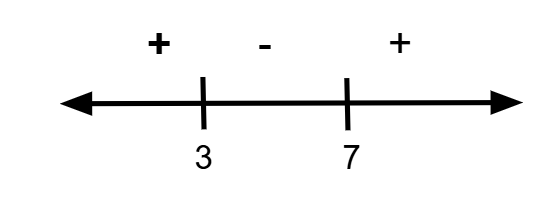
Arrange the critical points in ascending order. $$a<b<c$$
Number line representation:
$$(x-a)(x-b)(x-c) > 0 \Rightarrow x \in (a,b)\cup(c,\infty)$$
Question 1
For how many integers does the following inequality hold true? $$\frac{(X^{2} + 2X -8)}{( X^{2} + X - 42)}$$ < 0
Solution
$$\frac{(X^{2} + 2X -8)}{(X^{2} + X - 42)} < 0$$.
If and only if $$\frac{(X+4)(X-2)}{(X+7)(X-6)} < 0$$.
If and only if $$(X+4)(X-2)(X+7)(X-6) < 0$$.
Integer solutions are {-6, -5, 3, 4, 5}.
So, answer is 5
For how many integral values of x does the following inequality hold true : $$\frac{(x^2+7x-44)}{(x^2+9x-136)} < 0$$
Solution
$$\frac{(x^2+7x-44)}{(x^2+9x-136)}$$ has two quadratic expressions that have to be factorized.
$$(x^2+7x-44)$$ can be factorized into (x+11)(x-4)
$$(x^2+9x-136)$$ can be factorized into (x+17)(x-8)
Here, -11, 4, -17 and 8 are the roots of their respective expressions.
$$\frac{(x^2+7x-44)}{(x^2+9x-136)} < 0$$
=> $$\frac{(x+11)(x-4)}{(x+17)(x-8)} < 0$$
Here the flow diagram is recommended to be used. Draw a number-line marking the roots on them as -17, -11, 4 and 8 in order of their magnitude. Draw a curve as shown in the diagram. The curve must start from right top if the sign before the quadratic expression is positive and from right bottom if the sign before the quadratic is negative. Here the sign is positive and hence the curve starts at the right top. In the region above the number-line, the value of the fraction is positive and in the region below the number line the value of the fraction is negative.
We need the integral values of x where the value of the fraction is negative.
According to the diagram, the value of the fraction is negative in the region (-17,-11) and (4,8). So the value is less than 0 at x = -16, -15, -14, -13, -12, 5, 6 and 7.
Hence there are 8 solutions in total.
Alternate Explanation:
The equation can be factorized as $$\frac{(x-4)(x+11)}{(x-8)(x+17)}$$
The equation is false for all x>8. Between 4 and 8, both values excluded, the inequality will hold true. Between -11 to 4, the inequality will not hold.
Between -11 and -17, again both values excluded, the inequality will be true.
Hence the set of values for which this is true is {-16, -15, -14, -13, -12, 5, 6, 7}.