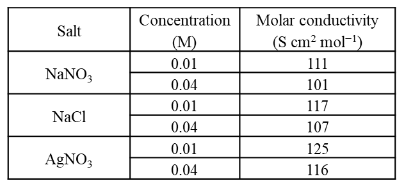
In the context of the data table provided, $$A$$ (sometimes written as $$b$$) represents the Kohlrausch constant in the Debye-Hückel-Onsager relation for strong electrolytes:
$$\Lambda_m=\Lambda_m^\circ-A\sqrt{c}$$
Where:
$$\Lambda_m$$ = Molar conductivity at a given concentration
$$\Lambda_m^\circ$$ = Limiting molar conductivity (at infinite dilution)
$$c$$ = Molar concentration of the solution
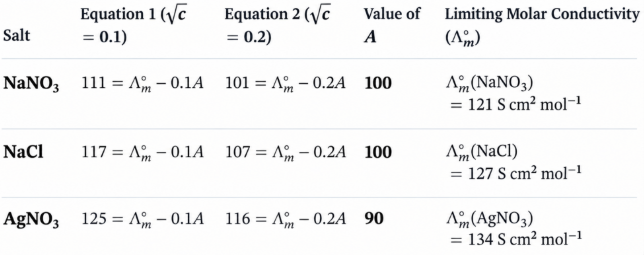
1. Find $$\Lambda_m^\circ$$ for $$\text{AgCl}$$ using Kohlrausch's Law:
$$\Lambda_m^\circ(\text{AgCl})=\Lambda_m^\circ(\text{AgNO}_3)+\Lambda_m^\circ(\text{NaCl})-\Lambda_m^\circ(\text{NaNO}_3)$$
$$\Lambda_m^\circ(\text{AgCl})=134+127-121=140\text{ S cm}^2\text{ mol}^{-1}$$
2. Calculate Molar Solubility ($$X$$):
Using the formula discussed earlier:
$$X=\frac{\kappa\times1000}{\Lambda_m^\circ}=\frac{(1.40\times10^{-6}\text{ S cm}^{-1})\times1000}{140\text{ S cm}^2\text{ mol}^{-1}}=10^{-5}\text{ mol L}^{-1}$$
3. Compute the final log value:
$$X^{-1}=\frac{1}{10^{-5}}=10^5$$
$$\log_{10}(X^{-1})=\log_{10}(10^5)=5$$
 91- 6303239042
 Diwali Dhamaka Sale