91- 6303239042


 Group
Group
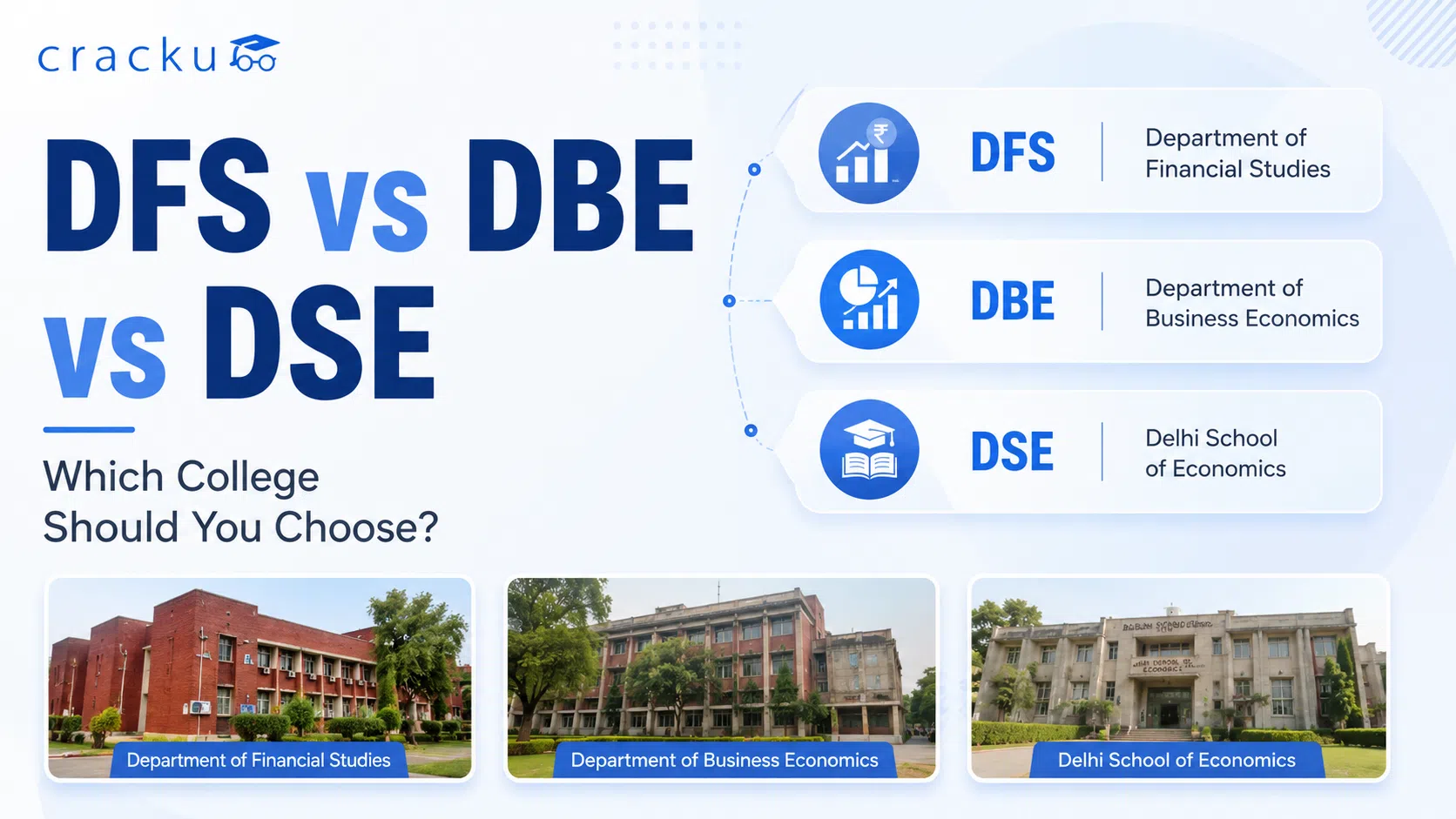
DFS vs DBE vs DSE
The Department of Financial Studies (DFS), Department of Business Economics (DBE), and Delhi School of Economics (DSE) are three of the most underrated yet highly competitive management programmes in India. All three sit under the University of Delhi umbrella, charge a fraction of what private B-schools do, and attract students with top CAT scores every year. If you have cleared the CAT cutoffs for more than one, here is a detailed comparison to help you make the right call.
DFS vs DBE vs DSE: Overview
At a glance, all three programmes share the same university brand and a government-funded, low-fee structure. The core difference lies in their specialisation - Finance, Economics, and IB - which ultimately determines where you will end up working after graduation.
Parameter | DFS | DBE | DSE |
Full Name | Department of Financial Studies | Department of Business Economics | Delhi School of Economics |
Programme | MBA (Finance) | MBA (Business Economics) | MBA (International Business) |
Location | South Campus, Delhi | South Campus, Delhi | North Campus, Delhi |
Duration | 2 Years | 2 Years | 2 Years |
Type | Government (DU) | Government (DU) | Government (DU) |
Specialisation | Finance | Economics & Analytics | International Business |
Also Read, IMT Ghaziabad Vs IMI Delhi, Placements, Cut-off, MBA Fees
DFS vs DBE vs DSE: Rankings
Since all three are departments under the University of Delhi, they share DU's overall institutional ranking. University of Delhi consistently places in the top 5 in NIRF University Rankings. At a programme level, however, DFS carries the strongest individual reputation, driven by its finance-focused placements and industry demand.
Ranking Body | DFS | DBE | DSE |
NIRF | Top 15 (Overall DU Ranking) | ||
Specialisation Strength | Finance - Very High | Economics/Analytics - High | IB - Moderate to High |
Industry Perception | Highest among the three | Strong, growing in consulting | Strong within IB domain |
DFS has the highest recall in the BFSI sector. DBE is steadily building a name in analytics and consulting. DSE holds well for candidates targeting IB and people management careers.
DFS vs DBE vs DSE: Fees
This is where all three programmes genuinely shine. Compared to any private B-school offering similar placements, the fee structure at all three is extraordinarily low. This makes the ROI among the best of any management programme in the country.
Fee Component | DFS | DBE | DSE |
Tuition Fee (Per Year) | 48,500 | 50,420 | 57,279 |
Total Programme Cost (2 Years) | ~ 98,000 | ~ 1 Lakh | ~ 1.1 Lakh |
Hostel (if applicable) | ~ 75k - 80k | ~ 75k - 80k | ~ 75k - 80k |
Estimated Total Cost | Under ₹2 Lakh | Under ₹2 Lakh | Under ₹2 Lakh |
With DFS average placements of 19 LPA against a total programme cost under ₹2 lakh, the ROI is difficult to beat anywhere in India.
Also Read, XIMB vs IMT Ghaziabad, Placements, Fees, Cut-off, Rankings
DFS vs DBE vs DSE: Cutoffs
All three departments are competitive. DFS consistently demands the highest CAT percentile among the three, owing to its placement record and limited seats. DBE and DSE are slightly more accessible but are by no means easy to get into.
Check the table below for expected cut-offs
Entrance Exam | DFS | DBE | DSE |
CAT Percentile | 97 - 98 | 95 - 96 | 91 - 93 |
Accepted Exam | CAT | CAT | CAT |
A strong academic background and clear idea of career goals during the personal interview are important across all three programmes.
DFS vs DBE vs DSE: Admission Process
The admission process follows a similar structure at all three departments - CAT score, followed by shortlisting and a selection round. There are minor differences in how the final selection is weighted.
Step | DFS | DBE | DSE |
Accepted Exam | CAT | CAT | CAT |
Shortlisting Basis | CAT Score + Profile | CAT Score + Academic background | CAT Score + Profile |
Final Selection | CAT Score (60%) + Academics (10%) + PI (25%) + Female Candidates (2.5%) + (2.5%) for specific UG degrees | CAT Score (50%) + Academics (20%) + GD (10%) + PI (20%) | |
Eligibility | Graduation with 50% | ||
Work experience is not a requirement at any of the three, but it can add value to your profile, especially during the interview round.
DFS vs DBE vs DSE: Placements
Placements are where the three programmes differ the most. DFS leads by a clear margin in terms of average package, largely driven by finance and investment banking roles. DBE follows with strong analytics and consulting outcomes. DSE placements are solid but more HR-centric.
Placement Parameter | DFS | DBE | DSE |
Average Package | 19.12 LPA | 15.12 LPA | 13.92 LPA |
Highest Package | 32 LPA | 30.25 LPA | 30 LPA |
Dominant Sectors | BFSI, Investment Banking, Consulting | Consulting, Analytics, | HR Consulting, FMCG, IT |
Top Recruiters | Goldman Sachs, Morgan Stanley, KPMG, Deloitte | Deloitte, American Express, EY | HUL, Deloitte, Wipro, HR Consulting |
Batch Size | 70 (Finance) | 129 (BE) | 100 (IB & HRD) , 78 (BA) |
DFS is the clear leader for anyone targeting high-paying finance roles. DBE is a strong option for consulting and analytics. DSE is the go-to for IB/HR-focused careers.
Also Read, SIBM Pune Vs SCMHRD, Placements, Eligibility, Cut-off, Fees
DFS vs DBE vs DSE: Which One to Choose?
The right programme depends entirely on your career interests, CAT score, and what you want out of your MBA.
Choose DFS if:
- Finance, Investment Banking, or BFSI is your target
- You are chasing the highest average salary among the three
- Your CAT score is 98 percentile or above
- You want a focused, finance-heavy curriculum with top-tier recruiters
Choose DBE if:
- Economics, Analytics, or Consulting excites you
- You want broader exposure than a pure finance programme
- Your CAT percentile is in the 95-96 range
- You are open to roles in strategy or analytics.
Choose DSE if:
- HR/IB or Organisational Behaviour is your clear career choice
- You are comfortable with a slightly lower average package for strong HR-specific roles
- Your CAT percentile is in the 91-93 range
- You value DSE's deep academic legacy and faculty strength in behavioural sciences
Also Read, NMIMS Mumbai Vs SIBM Pune, Eligibility, Fees, Placements
DFS vs DBE vs DSE: Conclusion
DFS, DBE, and DSE are three of the best-value management programmes in the country. All three carry the University of Delhi brand, charge very less fees, and place students in reputed organisations. DFS is the strongest pick for finance-focused candidates and offers the highest average salary of the three. DBE is the right fit for those inclined towards economics, analytics, or consulting, with a slightly lower cutoff and a growing placement track record. DSE suits candidates who are clear about pursuing HR, and who want to study at one of India's most respected academic institutions.
There is no weak option among the three. The best choice is simply the one that aligns with where you want to build your career.