Given below are two statements : One is labelled as Assertion (A) and the other is labelled as Reason (R).
Assertion (A) : Articles are very important words in English and so is their knowledge.
Reasons (R) : Two or more pronouns joined by "and" require a plural verb.
In the light of the above statements, choose the correct answer from the options given below:
CMAT Temporary CMAT Verbal Questions
Option B is the correct answer.
Assertion (A): This is true. Articles (a, an, the) are essential in English grammar for indicating specificity and definiteness. Understanding how to use them is important for fluency and clarity.
Reason (R): This is also true. When subjects (including pronouns) are joined by "and," the verb typically agrees in plural form.
Example: "He and she are going to the market."
Therefore, Both (A) and (R) are true. But, (R) is not the correct explanation for (A).
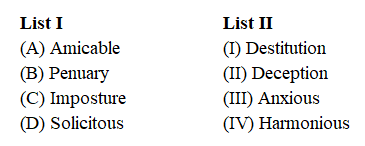
Match List I with List II :
Choose the correct answer from the options given below :
Option D is the correct answer.
A) Amicable means friendly or harmonious → (IV) Harmonious
B) Penuary (correct spelling: penury) means extreme poverty → (I) Destitution
C) Imposture means deception or fraud → (II) Deception
D) Solicitous means showing concern or anxiety → (III) Anxious
Read the following sentences and choose the ones belonging to the domain of complex sentences.
A. That Shankar is clever is certain.
B. I do not know whether the principal is in the office.
C. Rennie is not only kind but also devoted.
D. Can you tell me the reason why Mukti never smiles ?
Choose the correct answer from the options given below :
A complex sentence has a main clause that can stand alone and a subordinate (dependent) clause that cannot stand alone and is connected to the main clause, often introduced by subordinating conjunctions (e.g., "that," "whether," "why") or relative pronouns.
Option A: The clause "That Shankar is clever" is a noun clause acting as the subject of the sentence (dependent clause), and "is certain" is the main clause (independent) . This is a complex sentence because it has a dependent noun clause and an independent clause.
Option B: This is a complex sentence. "I do not know" is the main clause (independent clause), and "whether the principal is in the office" is a noun clause (which is dependent) acting as the object of the verb "know."
Option C: This is a single clause with a compound predicate ("is not only kind but also devoted"). The phrase "not only kind but also devoted" is coordinated by the correlative conjunctions "not only...but also." This is not a complex sentence.
Option D: The main clause is "Can you tell me the reason," (independent) and "why Mukti never smiles" is a relative clause modifying "the reason." This is a complex sentence because it has an independent clause and a dependent relative clause.
Therefore, the sentences that are complex are A, B, and D.