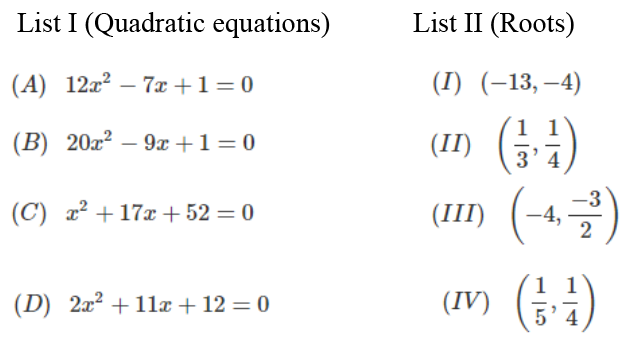
Match List I with List II :
Choose the correct answer from the options given below :
Sign in
Please select an account to continue using cracku.in
↓ →
Match List I with List II :
Choose the correct answer from the options given below :

Given, equation (B) is: $$20x^2-9x+1=0$$
or, $$20x^2-5x-4x+1=0$$
or, $$5x\left(4x-1\right)-1\left(4x-1\right)=0$$
or, $$\left(5x-1\right)\left(4x-1\right)=0$$
or, $$x=\dfrac{1}{5},\dfrac{1}{4}$$
So, the roots are $$\left(\dfrac{1}{5},\dfrac{1}{4}\right)$$
So, for equation (B), the correct choice is (IV)
So, the correct answer will be between option C and option D.
Now, solving equation (D), $$2x^2+11x+12=0$$
or, $$2x^2+8x+3x+12=0$$
or, $$2x\left(x+4\right)+3\left(x+4\right)=0$$
or, $$\left(x+4\right)\left(2x+3\right)=0$$
or, $$x=-4,-\dfrac{3}{2}$$
So, the roots are $$-4,-\dfrac{3}{2}$$
So, for equation (D), the correct choice is (III)
So, the correct answer is option option (D).
If $$x^2 = y + z , y^2 = z + x$$ and $$z^2 = x + y$$ then the value of $$\frac{1}{x + 1} + \frac{1}{y + 1} + \frac{1}{z + 1}$$ is
Given, $$x^2 = y + z$$
So, $$x^2+x=x+y+z$$
or, $$x\left(x+1\right)=x+y+z$$
or, $$\dfrac{1}{x+1}=\dfrac{x}{x+y+z}$$ --->(1)
Similarly, $$y^2 = x + z$$
Adding, $$y$$ to both sides,
$$y^2+y=y+x+z$$
or, $$y\left(y+1\right)=x+y+z$$
or, $$\dfrac{1}{y+1}=\dfrac{y}{x+y+z}$$ --->(2)
Similarly, $$z^2 = y + z$$
So, $$\dfrac{1}{z+1}=\dfrac{z}{x+y+z}$$ --->(3)
Now, adding (1), (2) and (3),
$$\dfrac{1}{x+1}+\dfrac{1}{y+1}+\dfrac{1}{z+1}=\dfrac{x}{x+y+z}+\dfrac{y}{x+y+z}+\dfrac{z}{x+y+z}=\dfrac{x+y+z}{x+y+z}=1$$
So, correct answer is option (B).
Educational materials for CAT preparation