Choose the alternative which best expresses the opposite meaning of the underlined phrase in the following sentence.
At his wits end, he turned to his old trade.
CMAT English Questions
The phrase "at his wits' end" means being completely puzzled or not knowing what to do.
Among the given options, only option A is the exact opposite of this.
Option B is similar in meaning to the given phrase. Option C is unrelated. Option D mentions "confidently," which is not the opposite of being puzzled or confused.
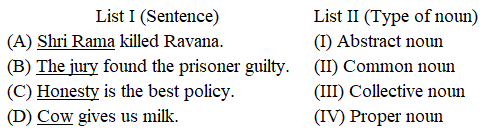
Match List I with List II :
Choose the correct answer from the optiions given below :
I. Proper Noun: A proper noun is the specific name of a particular person, place, or thing. It always begins with a capital letter.
Sentence A has a proper noun → A. Shri Rama killed Ravana. ("Shri Rama" and "Ravana" are specific names of people.)
II. Collective Noun: A collective noun refers to a group of individuals considered as a single unit.
Sentence B has a collective noun → B. The jury found the prisoner guilty. ("Jury" is a group acting as one.)
III. Abstract Noun: An abstract noun names a quality, idea, or state that cannot be perceived by the senses.
Sentence C has an abstract noun → C. Honesty is the best policy. ("Honesty" is a quality, not a tangible thing.)
IV. Common Noun: A common noun refers to a general name for a person, place, or thing, not specific.
Sentence D has a common noun → D. Cow gives us milk. ("Cow" is a general name for an animal.)
Therefore, the correct answer is Option C) A-IV, B-III, C-I, D-II
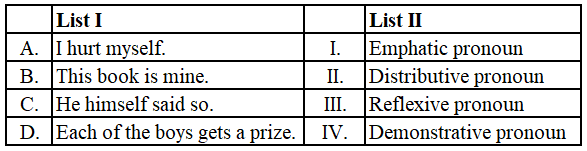
Match List I with List II :
Choose the correct answer from the options given below :
I. Emphatic Pronoun: An emphatic pronoun is used to lay stress or emphasis on the subject of the sentence. It uses words like himself, yourself, themselves for emphasis. Sentence C has an emphatic pronoun → C. He himself said so. ("himself" is emphasizing he.)
II. Distributive Pronoun : A distributive pronoun refers to members of a group individually rather than collectively. Words like each, either, neither are distributive pronouns. Sentence D has a distributive pronoun → D. Each of the boys gets a prize.("Each" treats the boys individually.)
III. Reflexive Pronoun: A reflexive pronoun is used when the subject and the object of the verb are the same person. Reflexive pronouns include myself, yourself, himself, etc. Sentence A has a reflexive pronoun → A. I hurt myself. ("Myself" refers back to the subject I.)
IV. Demonstrative Pronoun: A demonstrative pronoun is used to point to specific things. Examples include this, that, these, and those. Sentence B has a demonstrative pronoun → B. This book is mine.
Therefore, the correct answer is Option C) A-III , B-IV, C-I, D-II