Shruti travels a distance of 224 km in four parts for a total travel time of 3 hours. Her speeds in these four parts follow an arithmetic progression, and the corresponding time taken to cover these four parts follow another arithmetic progression. If she travels at a speed of 960 meters per minute for 30 minutes to cover the first part, then the distance, in meters, she travels in the fourth part is
CAT Time, Speed and Distance Questions
According to question, Shruti travels a distance of 224 km in four parts for a total travel time of 3 hours.
Given, in the first part time required is 30 minutes.
Also, the time taken to cover these four parts follow arithmetic progression.
So, let us say the times be 30 minutes, (30+d) minutes, (30+2d) minutes and (30+3d) minutes
So, $$30+\left(30+d\right)+\left(30+2d\right)+\left(30+3d\right)=180$$
or, $$6d=180-120$$
or, $$6d=60$$
or, $$d=\dfrac{60}{6}=10$$ minutes.
So, the time required in these four parts are 30 minutes, 40 minutes, 50 minutes and 60 minutes respectively.
Now, in the first part, speed is 960 metres per minute.
Speed in the four parts is also in arithmetic progression.
Let's say the speeds be $$(960+x)$$,$$(960+2x)$$,$$(960+3x)$$ metres per minute
So, total distance covered = $$960\times\ 30+\left(960+x\right)\times\ 40+\left(960+2x\right)\times\ 50+\left(960+3x\right)\times\ 60$$ metres
So, $$960\times\ 30+\left(960+x\right)\times\ 40+\left(960+2x\right)\times\ 50+\left(960+3x\right)\times\ 60=224000$$
or, $$960\left(30+40+50+60\right)+40x+\left(2x\right)\left(50\right)+\left(3x\right)\left(60\right)=224000$$
or, $$172800+320x=224000$$
or, $$320x=224000-172800=51200$$
or, $$x=\dfrac{51200}{320}=160$$
So, the speed in the fourth part is $$960+3x=960+3\times\ 160=1440$$ metres per minute
Time in the fourth part is 60 minutes
So, distance covered in the fourth part = $$1440\times\ 60=86400$$ metres
So, option D is the correct answer.
Ankita walks from A to C through B, and runs back through the same route at a speed that is 40% more than her walking speed. She takes exactly 3 hours 30 minutes to walk from B to C as well as to run from B to A. The total time, in minutes, she would take to walk from A to B and run from B to C, is
Let the walking speed of Ankita be $$5x$$, implying that her running speed (which is $$40\%$$ more than her walking speed), is $$1.4\times 5x = 7x$$.
Thus, the ratio of her walking and running speeds is $$5:7$$. Therefore, the ratio of the time taken by Ankita to cover a fixed distance walking and running would by $$7:5$$.
She takes 3 hours 30 minutes, or $$3.5$$ hours to walk from B to C. Since Ankita is running from B to C in the second scenario, her time will reduce inversely to the ratio of her speed. The time taken by her to run from B to C would be $$\dfrac{3.5}{7}\times 5 = 2.5$$ hours.
She takes 3 hours 30 minutes, or $$3.5$$ hours to run from A to B. Since Ankita is walking from A to B in the second scenario, her time will increase inversely to the ratio of her speed. The time taken by her to walk from A to B would be $$\dfrac{3.5}{5}\times 7 = 4.9$$ hours.
Therefore, the total time it takes for Ankita in the second scenario is $$4.9+2.5 = 7.4$$ hours. This gives $$7.4*60 = 444$$ minutes.
Rahul starts on his journey at 5 pm at a constant speed so that he reaches his destination at 11 pm the same day. However, on his way, he stops for 20 minutes, and after that, increases his speed by 3 km per hour to reach on time. If he had stopped for 10 minutes more, he would have had to increase his speed by 5 km per hour to reach on time. His initial speed, in km per hour, was
Let the initial speed of Rahul be $$x$$ kilometres per hour. Since he travels the distance usually in $$6$$ hours, (5 pm to 11 pm), the total distance should be $$6\times x = 6x$$ kilometres.
Let the distance after which Rahul stops for some duration in both scenarios be $$y$$ kilometres.
In the first scenario, he stops for $$20$$ minutes or $$\dfrac{1}{3}$$ hours, therefore, the travel time would be $$6-\dfrac{1}{3} = \dfrac{17}{3}$$ hours. We have,
$$\dfrac{k}{x} + \dfrac{6x-k}{x+3} = \dfrac{17}{3}$$
$$\Rightarrow \dfrac{6x^2+3k}{x^2+3x} = \dfrac{17}{3}$$
$$\Rightarrow 18x^2 + 9k = 17x^2 + 51x$$
$$\Rightarrow x^2 = 51x - 9k$$ .....(1)
Similarly, in the second scenario, he stops for $$20+10=30$$ minutes or $$\dfrac{1}{2}$$ hours, therefore, the travel time would be $$6-\dfrac{1}{2} = \dfrac{11}{2}$$ hours. We have,
$$\dfrac{k}{x} + \dfrac{6x-k}{x+5} = \dfrac{11}{2}$$
$$\Rightarrow \dfrac{6x^2+5k}{x^2+5x} = \dfrac{11}{2}$$
$$\Rightarrow 12x^2 + 10k = 11x^2 + 55x$$
$$\Rightarrow x^2 = 55x - 10k$$ .....(2)
From equations (1) and (2), we have;
$$55x - 10k = 51x - 9k$$ or
$$4x = k$$.
Substituting the value of $$k$$ in equation (1), we have
$$x^2 = 51x - 36x$$ or, since $$x$$ is positive, $$x= 15$$. Therefore, option B is the correct answer.
Rita and Sneha can row a boat at 5 km/h and 6 km/h in still water, respectively. In a river flowing with a constant velocity, Sneha takes 48 minutes more to row 14 km upstream than to row the same distance downstream. If Rita starts from a certain location in the river, and returns downstream to the same location, taking a total of 100 minutes, then the total distance, in km, Rita will cover is
Let the river speed be v km/h. For Sneha still-water speed = 6 km/h:
Upstream speed = (6-v), downstream speed = (6+v).
Given $$\dfrac{14}{(6-v)}-\dfrac{14}{(6+v)}=48$$minutes =0.8 hours.
So, $$\dfrac{14(6+v-6+v)}{36-v^2}=0.8 \Rightarrow \dfrac{28v}{36-v^2}=0.8$$
$$28v=0.8(36-v^2)=28.8-0.8v^2 \Rightarrow 0.8v^2+28v-28.8=0$$
Multiply by 5: $$4v^2+140v-144=0$$
$$v^2+35v-36=0$$
We get v = 1
Thus, the river speed is 1 km/h. For Rita, the still water speed is 5 km/h:
Upstream speed = 5-1=4 km/h, Downstream Speed = (5+1=6) km/h.
If she rows d km upstream and returns d km downstream, the total time
$$ \dfrac{d}{4}+\dfrac{d}{6}=d\Big(\dfrac{1}{4}+\dfrac{1}{6}\Big)=d\cdot\dfrac{5}{12}\ \text{hours}$$
This equals 100 minutes $$=100/60=\dfrac{5}{3}$$ hours.
So, $$d\cdot\dfrac{5}{12}=\dfrac{5}{3}\ \Rightarrow\ d=4\ \text{km}$$
Total distance covered 2d=8 km.
A train travelled a certain distance at a uniform speed. Had the speed been 6 km per hour more, it would have needed 4 hours less. Had the speed been 6 km per hour less, it would have needed 6 hours more. The distance, in km, travelled by the train is
Let us assume that the distance is D, speed of the train is S and time taken by the train is t.
t is nothing but $$\frac{D}{S}$$
Statement 1: Had the speed been 6 km per hour more, it would have needed 4 hours less
$$\frac{D}{S+6}=t-4$$
$$\frac{D}{S+6}=\frac{D}{S}-4$$
$$4=\frac{D}{S}-\frac{D}{S+6}$$
$$\frac{S+6-S}{S\left(S+6\right)}=\frac{4}{D}$$
$$\frac{6}{S\left(S+6\right)}=\frac{4}{D}$$
$$D=\frac{2S\left(S+6\right)}{3}$$
Statement 2: Had the speed been 6 km per hour less, it would have needed 6 hours more
$$\frac{D}{S-6}=t+6$$
$$D\left[\frac{1}{S-6}-\frac{1}{S}\right]=6$$
$$\frac{S-S+6}{S\left(S-6\right)}=6$$
$$D=S\left(S-6\right)$$
Equating the two equations for distance,
$$S\left(S-6\right)=\frac{2S\left(S+6\right)}{3}$$
$$3S-18=2S+12$$
$$S=30$$
Hence the speed is 30 kmph
We know that the distance $$D=S\left(S-6\right)$$ = 30*24 =720 km
A bus starts at 9 am and follows a fixed route every day. One day, it traveled at a constant speed of 60 km per hour and reached its destination 3.5 hours later than its scheduled arrival time. Next day, it traveled two-thirds of its route in one-third of its total scheduled travel time, and the remaining part of the route at 40 km per hour to reach just on time. The scheduled arrival time of the bus is
Let's take the scheduled time taken by the bus to be t
From the first statement (bus travelling at 60 kmph), we can get the total distance travelled by bus to 60(t+3.5)
The second scenario gives us that the bus covered two-thirds of the distance in one-third of the time, meaning that the remaining one-third distance was covered in two-thirds of the time, giving us the relation $$\frac{1}{3}st$$ covered in $$\frac{2}{3}t$$ giving the speed to be $$\frac{s}{2}$$ which is given as 40 km/h, thereby giving the usual speed of the bus to be 80 km/hr
Now the first relation we get 60(t+3.5)=80t
Giving us t=10.5 hours
Thus, the bus usually takes 10.5 hours on its journey.
Staring at 9:00, it will complete the journey at 7:30 pm
Therefore, Option A is the correct answer.
Two places A and B are 45 kms apart and connected by a straight road. Anil goes from A to B while Sunil goes from B to A. Starting at the same time, they cross each other in exactly 1 hour 30 minutes. If Anil reaches B exactly 1 hour 15 minutes after Sunil reaches A, the speed of Anil, in km per hour, is
We can use the formula for when two people moving towards each other and meeting in a straight line. $$t^2=t_1\times\ t_2$$
Where $$t$$ is time taken for them to meet each other. $$t_1$$ is the time taken by person 1 to reach the destination after meeting and
$$t_2$$ is the time taken by person 2 to reach the destination after meeting
We are told they meet each other in 1 and a half hours, that is 90 minutes.
And if Sunil takes X minutes to reach A, Anil will take X+75 minutes
Since it is given that, Anil reaches B exactly 1 hour 15 minutes after Sunil reaches A
$$90^2=x\left(x+75\right)$$
$$8100=x^2+75x$$
$$x^2+75x-8100=0$$
$$\dfrac{\left(-75\pm\sqrt{5625+32400}\right)}{2}$$
$$\dfrac{\left(-75+195\right)}{2}$$
$$x=60$$
Total time of travel of Anil is, $$90\ \min\ +60\ \min\ +75\ \min$$
Total of 225 minutes.
Time in hours will be 3.75 hours.
Speed is $$\dfrac{45}{3.75}=12\ \dfrac{km}{hr}$$
The minor angle between the hours hand and minutes hand of a clock was observed at 8:48 am. The minimum duration, in minutes, after 8.48 am when this angle increases by 50% is
The given time is 8:48 AM.
Angle made by hours hand w.r.t 12 is 8 * 30 (30 degrees in 1 hour) + 0.5 * 48 (0.5 degree in 1 minute) = 240 + 24 = 264 degrees.
Angle made by minutes hands w.r.t 12 is 48 * 6 = 288 degrees.
=> The angle between them is 288 - 264 = 24 degrees.
This should further increase by 12 degrees (50% of 24)
After m minutes, the further increase in angle = (6 - 0.5)*m = $$\dfrac{11}{2}m=12$$ => m = $$\dfrac{24}{11}$$
Ravi is driving at a speed of 40 km/h on a road. Vijay is 54 meters behind Ravi and driving in the same direction as Ravi. Ashok is driving along the same road from the opposite direction at a speed of 50 km/h and is 225 meters away from Ravi. The speed, in km/h, at which Vijay should drive so that all the three cross each other at the same time, is
It is given that the speed of Ravi is 40 kmph, which is equal to $$\frac{100}{9}$$ m/s. It is also known that the speed of Ashok is 50 kmph, which is equal to $$\frac{125}{9}$$ m/s.
It is known that the distance between Ravi and Ashok is 225 meters, and the relative speed of Ravi and Ashok is $$\frac{125}{9}+\frac{100}{9}=25$$ m/s
Hence, they will meet each other in $$\frac{225}{25}=9$$ seconds. The distance traveled by Ravi in these 9 seconds is $$\frac{100}{9}\times\ 9=100$$ meters.
Since Vijay was already 54 meters behind Ravi when they were starting, Vijay must travel (100+54) = 154 meters in these 9 seconds.
Hence, the speed of Vijay is $$\frac{154}{9}$$ m/s, which is equal to $$\frac{154}{9}\times\ \frac{18}{5}\ =\frac{308}{5}=61.6$$ kmph.
The correct option is C
Brishti went on an 8-hour trip in a car. Before the trip, the car had travelled a total of $$x$$ km till then, where $$x$$ is a whole number and is palindromic, i.e., $$x$$ remains unchanged when its digits are reversed. At the end of the trip, the car had travelled a total of 26862 km till then, this number again being palindromic. If Brishti never drove at more than 110 km/h, then the greatest possible average speed at which she drove during the trip, in km/h, was
Given the total number of kilometres travelled, including the trip = is 26862 Km, and the duration of the trip is 8 hrs.
If avg. speed of the car during the trip is 's' => the km travelled till just before the trip is 26862 - 8s, which should also be a palindrome.
=> From the options if s = 110 => The reading will be 26862 - 110*8 = 25982 (Not a palindrome)
=> If s = 100 => The reading will be 26862 - 100*8 = 26062 => It is a palindrome.
=> s = 100 is the correct option.
A boat takes 2 hours to travel downstream a river from port A to port B, and 3 hours to return to port A. Another boat takes a total of 6 hours to travel from port B to port A and return to port B. If the speeds of the boats and the river are constant, then the time, in hours, taken by the slower boat to travel from port A to port B is
Let us assume the speed of the 1st boat is b, the 2nd boat is s, and the river's speed is r.
Let 'd' be the distance between A and B.
=> d = 2(b+r) and d = 3(b-r)
=> b + r = d/2 and b - r = d/3 => r = d/12 (subtracting both equations).
Now, it is given that
$$\dfrac{d}{s+r}+\dfrac{d}{s-r}=6$$
=> $$\dfrac{d}{s+\dfrac{d}{12}}+\dfrac{d}{s-\dfrac{d}{12}}=6$$
=> $$2ds=6\left(s^2-\dfrac{d^2}{144}\right)$$
=> $$144s^2-48ds-d^2=0$$
Solving the quadratic equation, we get:
$$s=d\left(\dfrac{\left(48+\sqrt{\ 48^2+4\left(144\right)}\right)}{2\times\ 144}\right)$$
$$s=d\left(\dfrac{1}{6}+\dfrac{\sqrt{\ 5}}{12}\right)$$
=> Required value of $$\dfrac{d}{s+r}$$
= $$\dfrac{d}{\dfrac{d}{6}+\dfrac{\sqrt{5}d}{12}+\dfrac{d}{12}}$$
= $$\dfrac{12}{3+\sqrt{\ 5}}=\dfrac{\left(12\right)\left(3-\sqrt{\ 5}\right)}{4}$$
= $$3\left(3-\sqrt{\ 5}\right)$$
Arvind travels from town A to town B, and Surbhi from town B to town A, both starting at the same time along the same route. After meeting each other, Arvind takes 6 hours to reach town B while Surbhi takes 24 hours to reach town A. If Arvind travelled at a speed of 54 km/h, then the distance, in km, between town A and town B is
Let us assume the speeds of Arvind and Surbhi are 'a' and 's', respectively.
Let us say they meet after 't' hours
=> Arvind travelled s*t distance in 6 hrs and Surbhi travelled a*t in 24 hrs
=> s*t = a*6 and a*t = s*24 => $$t^2=6\times\ 24$$ => t = 12
Given a = 54 => s*12 = 54*6 => s = 27.
=> Total distance between A and B is (s+a)*t = (54+27)*12 = 81*12 = 972 Kms.
Trains A and B start traveling at the same time towards each other with constant speeds from stations X and Y, respectively. Train A reaches station Y in 10 minutes while train B takes 9 minutes to reach station X after meeting train A. Then the total time taken, in minutes, by train B to travel from station Y to station X is
M - First meeting point
Let the speeds of trains A and B be 'a' and 'b', respectively.
$$\dfrac{x}{a}=\ \dfrac{\ D-x}{b}$$
It is given,
$$\dfrac{D}{a}=10$$ and $$\dfrac{x}{b}=9$$
$$\dfrac{x}{\dfrac{D}{10}}=\ \dfrac{\ D-x}{\dfrac{x}{9}}$$
$$\dfrac{10x}{D}=\ \dfrac{\ 9D-9x}{x}$$
$$10x^2=\ \ 9D^2-9Dx$$
$$10x^2+9Dx-9D^2=\ 0$$
Solving, we get $$x=\dfrac{3D}{5}$$
$$\dfrac{x}{b}=9$$
$$\dfrac{3D}{b\times5}=9$$
$$\dfrac{D}{b}=15$$
The total time taken by train B to travel from station Y to station X is 15 minutes.
The answer is option B
Two ships meet mid-ocean, and then, one ship goes south and the other ship goes west, both travelling at constant speeds. Two hours later, they are 60 km apart. If the speed of one of the ships is 6 km per hour more than the other one, then the speed, in km per hour, of the slower ship is
Let the speeds of two ships be 'x' and 'x+6' km per hour
Distance covered in 2 hours will be 2x and 2x+12
It is given,
$$\left(2x\right)^2+\left(2x+12\right)^2=60^2$$
$$\left(x\right)^2+\left(x+6\right)^2=30^2$$
$$2x^2+12x+36=900$$
$$x^2+6x+18=450$$
$$x^2+6x-432=0$$
Solving, we get x = 18
The speed of slower ship is 18 kmph
The answer is option C.
Two cars travel from different locations at constant speeds. To meet each other after starting at the same time, they take 1.5 hours if they travel towards each other, but 10.5 hours if they travel in the same direction. If the speed of the slower car is 60 km/hr, then the distance traveled, in km, by the slower car when it meets the other car while traveling towards each other, is
Both the cars take 1.5 hrs to meet when they travel towards each other.
It is given, speed of slower car is 60 km/hr
Therefore, distance covered by slower car before they meet = 60*1.5 = 90 km
The answer is option B.
Moody takes 30 seconds to finish riding an escalator if he walks on it at his normal speed in the same direction. He takes 20 seconds to finish riding the escalator if he walks at twice his normal speed in the same direction. If Moody decides to stand still on the escalator, then the time, in seconds, needed to finish riding the escalator is
Let the speed of Moody be 'x' steps/sec and that of the escalator be 'y' steps/sec.
In 30 seconds, Moody will finish riding the escalator when going in the same direction.
Thus, total steps = 30(x+y)
If Moody's speed becomes twice, the time becomes 20 seconds.
Thus, total steps = 20(2x+y)
Or 30x + 30y = 40x + 20y
Or x = y
So, total steps = 60y.
Time taken by only escalator= 60y/y = 60s.
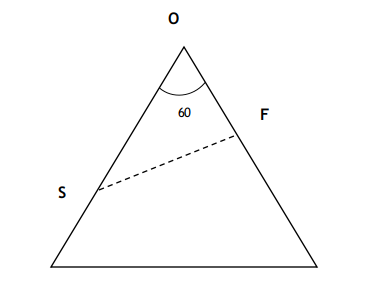
Two ships are approaching a port along straight routes at constant speeds. Initially, the two ships and the port formed an equilateral triangle with sides of length 24 km. When the slower ship travelled 8 km, the triangle formed by the new positions of the two ships and the port became right-angled. When the faster ship reaches the port, the distance, in km, between the other ship and the port will be
Let S be the slower ship and F be the faster ship.
It is given that when S travelled 8 km, the positions of ships with the port is forming a right triangle.
Since one of the angles is 60(since one vertex is still part of the equilateral triangle),
the other two vertexes will have angles of 30 and 90.
The distance between O and S = 24 - 8 = 16
In triangle OFS, $$\cos60^0\ =\ \frac{OF}{OS}$$
Thus, OF = 8.
Thus in the time, S covered 8 km, F will cover 24 - 8 = 16 km.
Thus, the ratio of their speeds is 2:1,
Thus, when F covers 24 km, S will cover 12 km.
The correct option is B.
Two trains cross each other in 14 seconds when running in opposite directions along parallel tracks. The faster train is 160 m long and crosses a lamp post in 12 seconds. If the speed of the other train is 6 km/hr less than the faster one, its length, in m, is
Speed of the faster train = $$\frac{160}{12}=\frac{40}{3}\ $$ m/s
Speed of the slower train = $$\frac{40}{3}-\left(6\times\ \frac{5}{18}\right)=\frac{35}{3}$$ m/s
Sum of speeds (when the trains travel towards each other) = $$\frac{40}{3}+\frac{35}{3}=25$$ m/s
Let the slower train be $$x$$ metres long; then: $$\frac{160+x}{25}=14$$
On solving, $$x=190\ m$$
Two trains A and B were moving in opposite directions, their speeds being in the ratio 5 : 3. The front end of A crossed the rear end of B 46 seconds after the front ends of the trains had crossed each other. It took another 69 seconds for the rear ends of the trains to cross each other. The ratio of length of train A to that of train B is
Considering the length of train A = La, length of train B = Lb.
The speed of train A be 5*x, speed of train B be 3*x.
From the information provided :
The front end of A crossed the rear end of B 46 seconds after the front ends of the trains had crossed each other.
In this case, train A traveled a distance equivalent to the length of train B which is Lb at a speed of 5*x+3*x = 8*x because both the trains are traveling in the opposite direction.
Hence (8*x)*(46) = Lb.
In the information provided :
It took another 69 seconds for the rear ends of the trains to cross each other.
In the next 69 seconds
The train B traveled a distance equivalent to the length of train A in this 69 seconds.
Hence (8*x)*(69) = La.
La/Lb = 69/46 = 3/2 = 3 : 2
Mira and Amal walk along a circular track, starting from the same point at the same time. If they walk in the same direction, then in 45 minutes, Amal completes exactly 3 more rounds than Mira. If they walk in opposite directions, then they meet for the first time exactly after 3 minutes. The number of rounds Mira walks in one hour is
Considering the distance travelled by Mira in one minute = M,
The distance traveled by Amal in one minute = A.
Given if they walk in the opposite direction it takes 3 minutes for both of them to meet. Hence 3*(A+M) = C. (1)
C is the circumference of the circle.
Similarly, it is mentioned that if both of them walk in the same direction Amal completes 3 more rounds than Mira :
Hence 45*(A-M) = 3C. (2)
Multiplying (1)*15 we have :
45A + 45M = 15C.
45A - 45M = 3C.
Adding the two we have A = $$\frac{18C}{90}$$
Subtracting the two M = $$\frac{12C}{90}$$
Since Mira travels $$\frac{12C}{90}$$ in one minute, in one hour she travels :$$\frac{12C}{90}\cdot60\ =\ 8C$$
Hence a total of 8 rounds.
Alternatively,
Let the length of track be L
and velocity of Mira be a and Amal be b
Now when they meet after 45 minutes Amal completes 3 more rounds than Mira
so we can say they met for the 3rd time moving in the same direction
so we can say they met for the first time after 15 minutes
So we know Time to meet = Relative distance /Relative velocity
so we get $$\frac{15}{60}=\frac{L}{a-b}$$ (1)
Now When they move in opposite direction
They meet after 3 minutes
so we get $$\frac{3}{60}=\frac{L}{a+b}$$ (2)
Dividing (1) and (2)
we get $$\frac{\left(a+b\right)}{\left(a-b\right)}=5$$
or 4a =6b
or a = 3b/2
Now substituting in (1)
we get :
$$\frac{L}{b}\times\ 2=\ \frac{15}{60}$$
so $$\frac{L}{b}\ =\frac{1}{8}$$
So we can say 1 round is covered in $$\frac{1}{8}$$ hours
so in 1-hour total rounds covered = 8.
The distance from B to C is thrice that from A to B. Two trains travel from A to C via B. The speed of train 2 is double that of train 1 while traveling from A to B and their speeds are interchanged while traveling from B to C. The ratio of the time taken by train 1 to that taken by train 2 in travelling from A to C is
Let the distance from A to B be "x", then the distance from B to C will be 3x. Now the speed of Train 2 is double of Train 1. Let the speed of Train 1 be "v", then the speed of Train 2 will be "2v" while travelling from A to B.
Time taken by Train 1 = (x/v)
Time taken by Train 2 = (x/2v)
Now from B to C distance is "3x" and the speed of Train 2 is (v) and the speed of Train 1 is (2v).
Time taken by Train 1 = 3x/2v
Time taken by Train 2 = 3x/v
Total time taken by Train 1 = x/v(1+(3/2)) = (5/2)(x/v)
Total time taken by Train 2 = x/v(3+(1/2))= (7/2)(x/v)
Ratio of time taken = $$\frac{5}{\frac{2}{\frac{7}{2}}}=\frac{5}{7}$$
In a car race, car A beats car B by 45 km. car B beats car C by 50 km. and car A beats car C by 90 km. The distance (in km) over which the race has been conducted is
Now car A beats car B by 45km. Let the speed of car A be v(a) and speed of car B be v(b).
$$\frac{v\left(a\right)}{v\left(b\right)}=\frac{m}{m-45}$$ .....(1)where '"m" is the entire distance of the race track.
Moreover $$\frac{v\left(b\right)}{v\left(c\right)}=\frac{m}{m-50}$$.......(2)
and finally $$\frac{v\left(a\right)}{v\left(c\right)}=\frac{m}{m-90}$$......(3)
Multiplying (1) and (2) we get (3). $$\frac{m}{m-90}=\frac{m}{m-45}\left(\frac{m}{m-50}\right)$$
Solving we get m=450 which is the length of the entire race track
Vimla starts for office every day at 9 am and reaches exactly on time if she drives at her usual speed of 40 km/hr. She is late by 6 minutes if she drives at 35 km/hr. One day, she covers two-thirds of her distance to office in one-thirds of her usual total time to reach office, and then stops for 8 minutes. The speed, in km/hr, at which she should drive the remaining distance to reach office exactly on time is
Let distance = d
Given, $$\frac{d}{35}-\frac{d}{40}=\frac{6}{60}$$
=> d = 28km
The actual time taken to travel 28km = 28/40 = 7/10 hours = 42 min.
Given time taken to travel 58/3 km = 1/3 *42 = 14 min.
Then a break of 8 min.
To reach on time, he should cover remaining 28/3 km in 20 min => Speed = $$\frac{\left(\frac{28}{3}\right)}{\frac{20}{60}}=28\ $$ km/hr
A straight road connects points A and B. Car 1 travels from A to B and Car 2 travels from B to A, both leaving at the same time. After meeting each other, they take 45 minutes and 20 minutes, respectively, to complete their journeys. If Car 1 travels at the speed of 60 km/hr, then the speed of Car 2, in km/hr, is
Let the speed of Car 2 be 'x' kmph and the time taken by the two cars to meet be 't' hours.
In 't' hours, Car 1 travels $$\left(60\ \times\ t\right)\ km$$ while Car 2 travels $$\left(x\ \times\ t\right)\ km$$
It is given that the time taken by Car 1 to travel $$\left(x\ \times\ t\right)\ km$$ is 45 minutes or (3/4) hours. $$\therefore\ \frac{\left(x\ \times\ t\right)}{60}\ =\ \frac{3}{4}\ $$ or $$t=\frac{180}{4x}$$....(i)
Similarly, the time taken by Car 2 to travel $$\left(60\ \times\ t\right)\ km$$ is 20 minutes or (1/3) hours. $$\therefore\ \frac{\left(60\times\ t\right)}{x}=\frac{1}{3}$$ or $$\therefore\ t=\frac{x}{180}$$....(ii)
Equating the values in (i) and (ii), and solving for x:
$$\therefore\ \frac{180}{4x}=\frac{x}{180}\ \ \longrightarrow\ \ \ x\ =90\ kmph$$
Hence, Option B is the correct answer.
A and B are two points on a straight line. Ram runs from A to B while Rahim runs from B to A. After crossing each other. Ram and Rahim reach their destination in one minute and four minutes, respectively. if they start at the same time, then the ratio of Ram's speed to Rahim's speed is
Let the speed of Ram be v(r) and the speed of Rahim be v(h) respectively. Let them meet after time "t" from the beginning.
Hence Ram will cover v(r)(t) during that time and Rahim will cover v(h)t respectively.
Now after meeting Ram reaches his destination in 1 min i.e. Ram covered v(h)t in 1 minute or v(r)(1)= v(h)(t)
Similarly Rahim reaches his destination in 4 min i.e. Rahim covered v(r)t in 4 minutes or v(h)(4)= v(r)(t)
Dividing both the equations we get $$\frac{v\left(r\right)}{4v\left(h\right)}=\frac{v\left(h\right)}{v\left(r\right)}\ or\ \frac{v\left(r\right)}{v\left(h\right)}=2$$ Hence the ratio is 2.
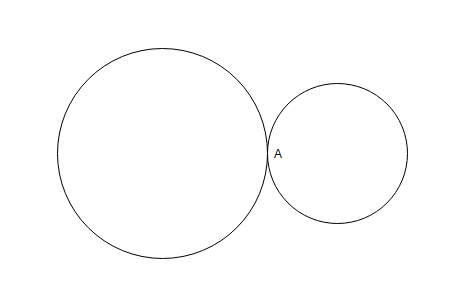
Two circular tracks T1 and T2 of radii 100 m and 20 m, respectively touch at a point A. Starting from A at the same time, Ram and Rahim are walking on track T1 and track T2 at speeds 15 km/hr and 5 km/hr respectively. The number of full rounds that Ram will make before he meets Rahim again for the first time is
To complete one round Ram takes 100m/15kmph and Rahim takes 20m/5kmph
They meet for the first time after L.C.M of (100m/15kmph , 20m/5kmph) = 100m/5kmph=20m/kmph.
Distance traveled by Ram =20m/kmph * 15kmph =300m.
So, he must have ran 300/100=3 rounds.
Note:
CAT gave both 2 and 3 as correct answers because of the word 'before'.
A and B are two railway stations 90 km apart. A train leaves A at 9:00 am, heading towards B at a speed of 40 km/hr. Another train leaves B at 10:30 am, heading towards A at a speed of 20 km/hr. The trains meet each other at
The distance travelled by A between 9:00 Am and 10:30 Am is 3/2*40 =60 km.
Now they are separated by 30 km
Let the time taken to meet =t
Distance travelled by A in time t + Distance travelled by B in time t = 30
40t + 20t =30 => t=1/2 hour
Hence they meet at 11:00 AM
Leaving home at the same time, Amal reaches the office at 10:15 am if he travels at 8 km/hr, and at 9:40 am if he travels at 15 km/hr. Leaving home at 9.10 am, at what speed, in km/hr, must he travel so as to reach office exactly at 10 am?
The difference in the time take to traverse the same distance $$'d'$$ at two different speeds is 35 minutes. Equating this: $$\frac{d}{8}-\frac{d}{15}\ =\ \frac{35}{60}$$
On solving, we obtain $$d = 10 kms$$. Let $$x kmph$$ be the speed at which Amal needs to travel to reach the office in 50 minutes; then
$$\frac{10}{x}=\frac{50}{60}\ or\ x\ =\ 12\ kmph$$.Hence, Option B is the correct answer.
A train travelled at one-thirds of its usual speed, and hence reached the destination 30 minutes after the scheduled time. On its return journey, the train initially travelled at its usual speed for 5 minutes but then stopped for 4 minutes for an emergency. The percentage by which the train must now increase its usual speed so as to reach the destination at the scheduled time, is nearest to
Let the total distance be 'D' km and the speed of the train be 's' kmph. The time taken to cover D at speed d is 't' hours. Based on the information: on equating the distance, we get $$s\ \times\ t\ =\ \frac{s}{3}\times\ \left(t+\frac{1}{2}\right)$$
On solving we acquire the value of $$\ t\ =\frac{1}{4}$$ or 15 mins. We understand that during the return journey, the first 5 minutes are spent traveling at speed 's' {distance traveled in terms of s = $$\ \frac{s}{12}$$}. Remaining distance in terms of 's' = $$\ \frac{s}{4}-\frac{s}{12}\ =\frac{s}{6}$$
The rest 4 minutes of stoppage added to this initial 5 minutes amounts to a total of 9 minutes. The train has to complete the rest of the journey in $$15 - 9 = 6 mins$$ or {1/10 hours}. Thus, let 'x' kmph be the new value of speed. Based on the above, we get $$\frac{s}{\frac{6}{x}}\ =\frac{1}{10}\ or\ x\ =\frac{10s}{6}$$
Since the increase in speed needs to be calculated: $$\frac{\left(\frac{10s}{6}\ -s\right)}{s}\times\ 100\ =\frac{200}{3}\approx\ 67\%$$ increase.
Hence, Option C is the correct answer.
Anil, Sunil, and Ravi run along a circular path of length 3 km, starting from the same point at the same time, and going in the clockwise direction. If they run at speeds of 15 km/hr, 10 km/hr, and 8 km/hr, respectively, how much distance in km will Ravi have run when Anil and Sunil meet again for the first time at the starting point?
Anil and Sunil will meet at a first point after LCM ( $$\frac{3}{15},\frac{3}{10}$$) = 3/5 hr
In the mean time, distance travelled by ravi = 8 * 3/5 = 4.8 km
Two persons are walking beside a railway track at respective speeds of 2 and 4 km per hour in the same direction. A train came from behind them and crossed them in 90 and 100 seconds, respectively. The time, in seconds, taken by the train to cross an electric post is nearest to
Let the length of the train be $$ l kms$$ and speed be $$ s kmph$$. Base on the two scenarios presented, we obtain:
$$\frac{l}{s-2}=\frac{90}{3600}$$....(i) and $$\frac{l}{s-4}=\frac{100}{3600}$$...(ii)
On dividing (ii) by (i) and simplifying we acquire the value of $$s$$ as $$22 kmph$$. Substituting this value in (i), we have $$l=\frac{90}{3600}\times\ 20\ kms$$ {keeping it in km and hours for convenience}
Since we need to find $$\frac{l}{s}$$, let this be equal to $$x$$. Then, $$x\ =\ 90\times\frac{20}{22}\ =81.81\ \approx\ 82\ \sec onds\ $$
Hence, Option B is the correct choice.
Two cars travel the same distance starting at 10:00 am and 11:00 am, respectively, on the same day. They reach their common destination at the same point of time. If the first car travelled for at least 6 hours, then the highest possible value of the percentage by which the speed of the second car could exceed that of the first car is
Let the speed of cars be a and b and the distance =d
Minimum time taken by 1st car = 6 hours,
For maximum difference in time taken by both of them, car 1 has to start at 10:00 AM and car 2 has to start at 11:00 AM.
Hence, car 2 will take 5 hours.
Hence a= $$\ \frac{\ d}{6}$$ and b = $$\ \frac{\ d}{5}$$
Hence the speed of car 2 will exceed the speed of car 1 by $$\ \dfrac{\ \ \frac{\ d}{5}-\ \frac{\ d}{6}}{\ \frac{\ d}{6}}\times\ 100$$ = $$\ \dfrac{\ \ \frac{\ d}{30}}{\ \frac{\ d}{6}}\times\ 100$$ = 20
Two ants A and B start from a point P on a circle at the same time, with A moving clock-wise and B moving anti-clockwise. They meet for the first time at 10:00 am when A has covered 60% of the track. If A returns to P at 10:12 am, then B returns to P at
When A and B met for the first time at 10:00 AM, A covered 60% of the track.
So B must have covered 40% of the track.
It is given that A returns to P at 10:12 AM i.e A covers 40% of the track in 12 minutes
60% of the track in 18 minutes
B covers 40% of track when A covers 60% of the track.
B covers 40% of the track in 18 minutes.
B will cover the rest 60% in 27 minutes, hence it will return to B at 10:27 AM
The wheels of bicycles A and B have radii 30 cm and 40 cm, respectively. While traveling a certain distance, each wheel of A required 5000 more revolutions than each wheel of B. If bicycle B traveled this distance in 45 minutes, then its speed, in km per hour, was
Distance covered by A in 1 revolution = 2$$\pi\ $$*30 = 60$$\pi\ $$
Distance covered by B in 1 revolution = 2$$\pi\ $$*40 = 80$$\pi\ $$
Now, (5000+n)60$$\pi\ $$ = 80$$\pi\ $$n
=> 15000= 4n-3n =>n=15000
Then distance travelled by B = 15000*80$$\pi\ $$ cm = 12$$\pi\ $$ km
Hence, the speed = $$\ \frac{\ 12\pi\times\ 60\ }{45}$$ = 16$$\pi\ $$
In a race of three horses, the first beat the second by 11 metres and the third by 90 metres. If the second beat the third by 80 metres, what was the length, in metres, of the racecourse?
Assuming the length of race course = x and the speed of three horses be a,b and c respectively.
Hence, $$\ \frac{\ x}{a}=\ \frac{\ x-11}{b}$$......(1)
and $$\ \frac{\ x}{a}=\ \frac{\ x-90}{c}$$......(2)
Also, $$\ \frac{\ x}{b}=\ \frac{\ x-80}{c}$$......(3)
From 1 and 2, we get, $$\ \frac{\ x-11}{b}=\ \frac{\ x-90}{c}$$ .....(4)
Dividing (3) by (4), we get, $$\ \frac{\ x-11}{x}=\ \frac{\ x-90}{x-80}$$
=> (x-11)(x-80)=x(x-90)
=> 91x-90x=880 => x=880
One can use three different transports which move at 10, 20, and 30 kmph, respectively to reach from A to B. Amal took each mode of transport for $$\frac{1}{3}^{rd}$$ of his total journey time, while Bimal took each mode of transport for $$\frac{1}{3}^{rd}$$ of the total distance. The percentage by which Bimal’s travel time exceeds Amal’s travel time is nearest to
Assume the total distance between A and B as d and time taken by Amal = t
Since Amal travelled $$\frac{1}{3}^{rd}$$ of his total journey time in different speeds
d = $$\ \frac{\ t}{3}\times\ 10+\ \frac{\ t}{3}\times\ 20+\frac{\ t}{3}\times\ 30\ \ =\ 20t$$
$$\text{Total time taken by Bimal} = \ \frac{d_1}{s_1}+\frac{d_2}{s_2}+\frac{d_3}{s_3}$$
$$=\ \frac{20t}{3}\times\ \frac{1}{10}+\frac{20t}{3}\times\ \frac{1}{20}+\frac{20t}{3}\times\ \frac{1}{30}\ \ =\frac{20t\left(6+3+2\right)}{3\ \times30}\ =\frac{11}{9}t$$
Hence, the ratio of time taken by Bimal to time taken by Amal = $$\frac{\frac{11t}{9}}{t}=\frac{11}{9}$$
Therefore, Bimal will exceed Amal's time by $$\ \ \ \frac{\ \ \frac{\ 11t}{9}-t}{t}\times\ 100 = 22.22%$$
A cyclist leaves A at 10 am and reaches B at 11 am. Starting from 10:01 am, every minute a motorcycle leaves A and moves towards B. Forty-five such motorcycles reach B by 11 am. All motorcycles have the same speed. If the cyclist had doubled his speed, how many motorcycles would have reached B by the time the cyclist reached B?
It is given that starting from 10:01 am, every minute a motorcycle leaves A and moves towards B.
Forty-five such motorcycles reach B by 11 am.
It means that the forty-fifth motorcycle starts at 10:45 AM at A and reaches B by 11:00 AM i.e 15 minutes.
Since the speed of all the motorcycles is the same, all the motorcycles will take the same duration i.e 15 minutes.
If the cyclist doubles the speed, then he will reach B by 10:30 AM. (Since if the speed is doubled, time is reduced by half)
Since each motorcycle takes 15 minutes to reach B, 15 motorcycles would have reached B by the time the cyclist reaches B
John jogs on track A at 6 kmph and Mary jogs on track B at 7.5 kmph. The total length of tracks A and B is 325 metres. While John makes 9 rounds of track A, Mary makes 5 rounds of track B. In how many seconds will Mary make one round of track A?
Speed of John = 6kmph
Speed of Mary = 7.5 kmph
Lengths of tracks A and B = 325 m
Let the length of track A be a, then the length of track B = 325-a
9 rounds of John on track A = 5 rounds of Mary on track B
$$\ \frac{\ 9\times\ a}{6\ \times\ \ \frac{\ 5}{18}}\ =\ \ \frac{\ 5\cdot\left(325-a\right)}{7.5\times\ \ \frac{\ 5}{18}}$$
On solving we get , 13a=1300
a=100
The length of track A = 100m, track B = 225m
Mary makes one round of track A = $$\ \frac{\ 100}{7.5\times\ \ \frac{\ 5}{18}}$$
= 48 sec
Points A, P, Q and B lie on the same line such that P, Q and B are, respectively, 100 km, 200 km and 300 km away from A. Cars 1 and 2 leave A at the same time and move towards B. Simultaneously, car 3 leaves B and moves towards A. Car 3 meets car 1 at Q, and car 2 at P. If each car is moving in uniform speed then the ratio of the speed of car 2 to that of car 1 is
Car 3 meets car 1 at Q, which is 200 km from A.
Therefore, at the time of their meeting car 1 must have travelled 200 km and car 3 must have travelled 100 km.
As the time is same, ratio of speed of car 1 to speed of car 3 = 2 : 1.
Car 3 meets car 2 at P, which is 100 km from A.
Therefore, at the time of their meeting car 2 must have travelled 100 km and car 3 must have travelled 200 km.
As the time is same, ratio of speed of car 2 to speed of car 3 = 1 : 2.
Speed of car 1 : speed of car 3 = 2 : 1
And speed of car 2 : speed of car 3 = 1 : 2
So, speed of car 1 : speed of car 2 : speed of car 3 = 4 : 1 : 2
Hence, option D is the correct answer.
Point P lies between points A and B such that the length of BP is thrice that of AP. Car 1 starts from A and moves towards B. Simultaneously, car 2 starts from B and moves towards A. Car 2 reaches P one hour after car 1 reaches P. If the speed of car 2 is half that of car 1, then the time, in minutes, taken by car 1 in reaching P from A is
Let the distance between A and B be 4x.
Length of BP is thrice the length of AP.
=> AP = x and BP = 3x
Let the speed of car 1 be s and the speed of car 2 be 0.5s.
Car 2 reaches P one hour (60 minutes) after Car 1 reaches P.
=> x/s + 60 = 3x/0.5s
x/s + 60 = 6x/s
5x/s = 60
x/s = 12
Time taken by car 1 in reaching P from A = x/s = 12 minutes.
Therefore, 12 is the correct answer.
Train T leaves station X for station Y at 3 pm. Train S, traveling at three quarters of the speed of T, leaves Y for X at 4 pm. The two trains pass each other at a station Z, where the distance between X and Z is three-fifths of that between X and Y. How many hours does train T take for its journey from X to Y?
Train T starts at 3 PM and train S starts at 4 PM.
Let the speed of train T be t.
=> Speed of train S = 0.75t.
When the trains meet, train t would have traveled for one more hour than train S.
Let us assume that the 2 trains meet x hours after 3 PM. Trains S would have traveled for x-1 hours.
Distance traveled by train T = xt
Distance traveled by train S = (x-1)*0.75t = 0.75xt-0.75t
We know that train T has traveled three fifths of the distance. Therefore, train S should have traveled two-fifths the distance between the 2 cities.
=> (xt)/(0.75xt-0.75t) = 3/2
2xt = 2.25xt-2.25t
0.25x = 2.25
x = 9 hours.
Train T takes 9 hours to cover three-fifths the distance. Therefore, to cover the entire distance, train T will take 9*(5/3) = 15 hours.
Therefore, 15 is the correct answer.
Points A and B are 150 km apart. Cars 1 and 2 travel from A to B, but car 2 starts from A when car 1 is already 20 km away from A. Each car travels at a speed of 100 kmph for the first 50 km, at 50 kmph for the next 50 km, and at 25 kmph for the last 50 km. The distance, in km, between car 2 and B when car 1 reaches B is
Time taken to cover first 50 km at 100 km/hr = $$\frac{1}{2}$$ hr.
Time taken to cover second 50 km at 50 km/hr = 1 hr.
Time taken to cover last 50 km at 25 km/hr = 2 hr.
When car 2 starts, car 1 has already covered 20 km.
So, time taken by car 1 to reach B after car 1 starts = total time - time required to travel first 20 km
= 3 hr 30 min - 12 min = 3 hr 18 min
Distance travelled by car 2 = (50 + 50 + 45) = 145 km
Distance from B = (150 - 145) km = 5 km
Hence, 5 is the correct answer.
The distance from A to B is 60 km. Partha and Narayan start from A at the same time and move towards B. Partha takes four hours more than Narayan to reach B. Moreover, Partha reaches the mid-point of A and B two hours before Narayan reaches B. The speed of Partha, in km per hour, is
Let the time taken by Partha to cover 60 km be x hours.
Narayan will cover 60 km in x-4 hours.
Speed of Partha = $$\frac{60}{x}$$
Speed of Narayan = $$\frac{60}{x-4}$$
Partha reaches the mid-point of A and B two hours before Narayan reaches B.
=> $$\dfrac{30}{\frac{60}{x}} + 2 = \dfrac{60}{\frac{60}{(x-4)}}$$
$$\frac{x}{2} + 2 = x-4$$
$$\frac{x+4}{2}=x-4$$
$$x+4=2x-8$$
$$x=12$$
Partha will take 12 hours to cross 60 km.
=> Speed of Partha = $$\frac{60}{12}=5$$ Kmph.
Therefore, option D is the right answer.
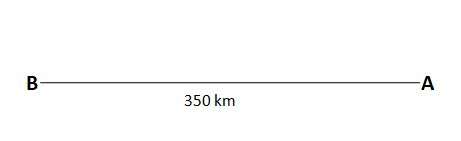
On a long stretch of east-west road, A and B are two points such that B is 350 km west of A. One car starts from A and another from B at the same time. If they move towards each other, then they meet after 1 hour. If they both move towards east, then they meet in 7 hrs. The difference between their speeds, in km per hour, is
Let 'a' and 'b' be the speed (in km/hr) of cars starting from both A and B respectively.
If they both move in east direction, then B will catch A if and only if b > a.
Relative speed of both the cars when they move in east direction = (b - a) km/hr
It takes them 7 hours to meet. i.e. they travel 350 km in 7 hours with a relative speed of (b-a) km/hr.
Hence, (b - a) = $$\dfrac{350}{7}$$ = 50 km/hr.
In a 10 km race, A, B, and C, each running at uniform speed, get the gold, silver, and bronze medals, respectively. I f A beats B by 1 km and B beats C by 1 km, then by how many metres does A beat C?
By the time A traveled 10 KM, B traveled 9 KM
Hence $$Speed_A : Speed_B = 10:9$$
Similarly $$Speed_B : Speed_C = 10:9$$
Hence $$Speed_A : Speed_B : Speed_C = 100:90:81$$
Hence by the time A traveled 10 KMs , C should have traveled 8.1 KMs
So A beat C by 1.9 KMs = 1900 Mts
A man leaves his home and walks at a speed of 12 km per hour, reaching the railway station 10 minutes after the train had departed. If instead he had walked at a speed of 15 km per hour, he would have reached the station 10 minutes before the train's departure. The distance (in km) from his home to the railway station is
We see that the man saves 20 minutes by changing his speed from 12 Km/hr to 15 Km/hr.
Let d be the distance
Hence,
$$\frac{d}{12} - \frac{d}{15} = \frac{1}{3}$$
$$\frac{d}{60} = \frac{1}{3}$$
d = 20 Km.
Arun drove from home to his hostel at 60 miles per hour. While returning home he drove half way along the same route at a speed of 25 miles per hour and then took a bypass road which increased his driving distance by 5 miles, but allowed him to drive at 50 miles per hour along this bypass road. If his return journey took 30 minutes more than his onward journey, then the total distance traveled by him is
Let the distance between the home and office be $$2x$$ miles
Time taken for going in the morning = $$\frac{2x}{60}$$ hrs
Time taken for going back in the evening = $$\frac{x}{25} + \frac{x+5}{50}$$. hrs
It is given that he took 30 minutes (0.5 hrs) more in the evening
Hence $$\frac{2x}{60}$$ hrs + 0.5 = $$\frac{x}{25} + \frac{x+5}{50}$$
Solving for x, we get x = 15 miles.
Total distance traveled = 2x + x + x + 5 = 4x + 5 = 65 Miles
A man travels by a motor boat down a river to his office and back. With the speed of the river unchanged, if he doubles the speed of his motor boat, then his total travel time gets reduced by 75%. The ratio of the original speed of the motor boat to the speed of the river is
Let the speed of the river be $$x$$ and the speed of the boat be $$u$$. Let $$d$$ be the one way distance and $$t$$ be the initial time taken.
Given,
$$t = \frac{d}{u - x} + \frac{d}{u + x}$$ ... i
Also,
$$\frac{t}{4} = \frac{d}{2u - x} + \frac{d}{2u + x}$$
$$t = \frac{4d}{2u - x} + \frac{4d}{2u + x}$$ ... ii
Equating both i and ii,
$$\dfrac{d}{u - x}$$+ $$\dfrac{d}{u + x}$$ = $$\dfrac{4d}{2u - x} + \dfrac{4d}{2u + x}$$
$$\dfrac{2u}{u^2 - x^2} = \dfrac{16u}{4u^2 - x^2}$$
$$4u^2 - x^2 = 8u^2 - 8x^2$$
$$\frac{u^2}{x^2} = \frac{7}{4}$$
$$\frac{u}{x} = \frac{\sqrt{7}}{2}$$
A motorbike leaves point A at 1 pm and moves towards point B at a uniform speed. A car leaves point B at 2 pm and moves towards point A at a uniform speed which is double that of the motorbike. They meet at 3:40 pm at a point which is 168 km away from A. What is the distance, in km, between A and B7
Let the distance traveled by the car be x KMs
Distance traveled by the bike = 168 KMs
Speed of car is double the speed of bike
=> $$\frac{x}{3:40 - 2:00}$$ = $$2 \times \frac{168}{3:40 - 1:00}$$
=> $$\frac{x}{100}$$ = $$2 \times \frac{168}{160}$$
=> x = 210
Hence the distance between A and B is x + 168 = 378 KMs
Rahim plans to drive from city A to station C, at the speed of 70 km per hour, to catch a train arriving there from B. He must reach C at least 15 minutes before the arrival of the train. The train leaves B, located 500 km south of A, at 8:00 am and travels at a speed of 50 km per hour. It is known that C is located between west and northwest of B, with BC at 60° to AB. Also, C is located between south and southwest of A with AC at 30° to AB. The latest time by which Rahim must leave A and still catch the train is closest to

According to given conditions angle between AC and AB is 30 degrees and between AB and BC is 60 degrees. So the triangle formed is a 30-60-90 triangle.
Hence, $$\angle\ ABC=60^{\circ\ }$$, $$\angle\ CAB=30^{\circ\ }$$, which implies $$\angle\ ACB=180^{\circ\ }-\left(30^{\circ\ }+60^{\circ\ }\right)=90^{\circ\ }$$
Therefore, The triangle is a right-angled triangle with base = BC, height = AC, and hypotenuse = AB.
We know that $$\cos\ \angle\ ABC\ =\ \frac{\ BC}{AB}=>\ \cos60^{\circ\ }=\frac{BC}{500}\ =>\ 500\times\ \frac{1}{2}=250\ km$$
Similarly, $$\sin\ \angle\ ABC\ =\ \frac{\ AC}{AB}=>\ \sin60^{\circ\ }=\frac{AC}{500}\ =>\ 500\times\ \frac{\sqrt{\ 3}}{2}=250\sqrt{\ 3}\ km$$
So, total time taken by train to travel B to C is is (250/50) = 5 hrs, hence the train reaches at 1 pm. Accordingly, Rahim has to reach C fifteen minutes before i.e. at 12:45 PM.
Time taken by Rahim to travel by car is around $$\ \frac{\ 250\sqrt{\ 3}}{70}=6.19$$ hrs (Around 6.2 hrs = 6 hrs 12 minutes). So, the latest time by which Rahim must leave A and still be able to catch the train is 6:30 am.
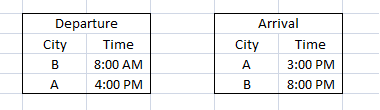
Directions for the following two questions: Cities A and B are in different time zones. A is located 3000 km east of B. The table below describes the schedule of an airline operating non-stop flights between A and B. All the times indicated are local and on the same day.
Assume that planes cruise at the same speed in both directions. However, the effective speed is influenced by a steady wind blowing from east to west. It reduces or increases the speed of plane by 50 km per hour depending on direction of flight.

What is the time difference between A and B?
Let the speed of the plane be p Kmph.
So the speed of plane from A to B will be 'p+50' and the speed from B to A will be 'p-50'.
We notice that the plane goes from B to A stays there for 1 hr and again come back to B with total time duration 12 hrs.
So we have $$\frac{3000}{p-50} + 1 + \frac{3000}{p+50} = 12$$.
We can clearly see that speed of the plane is 550 which satisfies the above equation.
So for the journey of B to A, the plane takes $$\frac{3000}{550-50} = 6$$ hrs.
So time at B when plane reaches at A is 2 pm .
Hence the time difference between A and B is 1 hr.
Alternatively,
Let speed of flight be s,
Since A is to the east of B, A is ahead of be in time
Let A be ahead of B in time by a hours
Departure from A = 4PM, Arrival at B = 8PM
Travel time = 8 - 4 +a = 4 + a
Since City B is behind city A by 'a' hours, the actual travel time is 'a' hours more than the difference of local times.
Similarly when one travels from B to A, since B is ahead of A by 'a' hrs, actual travel time is 'a' hours less than total
i.e. B->A Travel time = (3PM - 8AM) - a = 7 -a
Total distance travelled = Speed $$\times$$ Time taken ....(1)
From A to B, the wind is favourable / in same direction as flight
Hence from (1), we have
A->B >>> $$3000 = (s+50)(4+a) => 3000(7-a) = (s+50)(4+a)(7-a)$$ ...(2)
B->A >>> $$3000 = (s-50)(7-a) => 3000(4+a) = (s-50)(7-a)(4+a)$$ ...(3)
(2) - (3) => $$3000(3-2a) = 100(7-a)(4+a) => a^2-63a+62=0 => a=1/62$$
Hence the time difference between A and B is 1 hr.
Directions for the following two questions: Cities A and B are in different time zones. A is located 3000 km east of B. The table below describes the schedule of an airline operating non-stop flights between A and B. All the times indicated are local and on the same day.
Assume that planes cruise at the same speed in both directions. However, the effective speed is influenced by a steady wind blowing from east to west. It reduces or increases the speed of plane by 50 km per hour depending on direction of flight.

What is the plane’s cruising speed in km per hour?
Let the speed of the plane be p Kmph.
So the speed of plane from A to B will be 'p+50' and the speed from B to A will be 'p-50'.
We notice that the plane goes from B to A stays there for 1 hr and again come back to B with total time duration 12 hrs.
So we have $$\frac{3000}{p-50} + 1 + \frac{3000}{p+50} = 12$$.
On substituting the options, we can clearly see that speed of the plane is 550 which satisfies the above equation.
Arun, Barun and Kiranmala start from the same place and travel in the same direction at speeds of 30, 40 and 60 km per hour respectively. Barun starts two hours after Arun. If Barun and Kiranmala overtake Arun at the same instant, how many hours after Arun did Kiranmala start?
Let the distance be D.
Time taken by Arun = D/30
Time taken by Barun = D/40
Now, D/40 = D/30 - 2
=> 3D = 4D - 240
=> D = 240
Therefore time taken by Arun to cover 240 km = 240/30 = 8 hr
Time Kiranmala takes to cover 240 km = 240/60 = 4 hr
So, Kiranmala has to start 4 hours after Arun.
Ram and Shyam run a race between points A and B, 5 km apart. Ram starts at 9 a.m. from A at a speed of 5 km/hr, reaches B, and returns to A at the same speed. Shyam starts at 9:45 a.m. from A at a speed of 10 km/hr, reaches B and comes back to A at the same speed.
At what time do Ram and Shyam first meet each other?
Let the time at which they meet be t minutes past 10.
So, distance run by Ram + distance run by Shyam = 10 km
=> (60+t)5/60 [t+60 because he would have traveled for 9 am to 10 am and t minutes more before meeting Shyam]+ (15+t)*10/60 [15+t because he would have traveled from 9:45 to 10:00 and t minutes more]= 10
=> 300+5t+150+10t = 600 => t = 10
So, they meet at 10.10 am
Ram and Shyam run a race between points A and B, 5 km apart. Ram starts at 9 a.m. from A at a speed of 5 km/hr, reaches B, and returns to A at the same speed. Shyam starts at 9:45 a.m. from A at a speed of 10 km/hr, reaches B and comes back to A at the same speed.
At what time does Shyam overtake Ram?
Let the time at which Shyam overtakes Ram be t minutes past 10.
So, distance run by both of them is the same till that moment.
(60+t)5 = (15+t)10 => 300 + 5t = 150 + 10t => 5t = 150 => t = 30 min.
So, at 10.30 am, Shyam overtakes Ram
If a man cycles at 10 km/hr, then he arrives at a certain place at 1 p.m. If he cycles at 15 km/hr, he will arrive at the same place at 11 a.m. At what sped must he cycle to get there at noon?
Let the distance to be travelled be D.
In the first case, D/10 = t
In the second case, D/15 = t-2
=> D/15 = D/10 - 2
=> 2D = 3D - 60
=> D = 60 km and T = 6 hours
Therefore, to get there at noon, he has to travel at 60/5 = 12 km/hr
A sprinter starts running on a circular path of radius r metres. Her average speed (in metres/minute) is $$\pi$$ r during the first 30 seconds, $$\pi$$ r/2 during next one minute, $$\pi$$ r/4 during next 2 minutes, $$\pi$$ r/8 during next 4 minutes, and so on. What is the ratio of the time taken for the nth round to that for the previous round?
Let radius be 1 units and p = 3.14 or $$\pi$$ . So circumference is $$2*\pi$$.
According to given condition distance covered in first 1/2 mins = $$\pi$$/2 km, distance covered in next 1 min = $$\pi$$/2 km, distance covered in next 2 mins = $$\pi/2$$ km and finally distance covered in next 4 minutes = $$\pi/2$$ km.
Time taken to cover first round = 1/2 + 1 + 2 + 4 = 7.5 minutes.
Now time taken to cover $$\pi/2$$ is in GP.
For the second round the time taken is = 8+16+32+64 = 120
Ratio = 120/7.5 = 16
Karan and Arjun run a 100-meter race, where Karan beats Arjun 10 metres. To do a favour to Arjun, Karan starts 10 metres behind the starting line in a second 100 metre race. They both run at their earlier speeds. Which of the following is true in connection with the second race?
The speeds of Karan and Arjun are in the ratio 10:9. Let the speeds be 10s and 9s.
Time taken by Karan to cover 110 m = 110/10s = 11/s
Time taken by Arjun to cover 100 m = 100/9s = 11.11/s
Therefore, Karan reaches the finish line before Arjun. From the options, the only possible answer is d).
Two boats, traveling at 5 and 10 kms per hour, head directly towards each other. They begin at a distance of 20 kms from each other. How far apart are they (in kms) one minute before they collide.
The relative speed is 15 km/hr = 15 km/60 min = 0.25 km/min = 250 m/min.
Therefore, one minute before they collide, they are at a distance of 250m.
In a 4000 meter race around a circular stadium having a circumference of 1000 meters, the fastest runner and the slowest runner reach the same point at the end of the 5th minute, for the first time after the start of the race. All the runners have the same starting point and each runner maintains a uniform speed throughout the race. If the fastest runner runs at twice the speed of the slowest runner, what is the time taken by the fastest runner to finish the race?
Let A , B and f,s be the distance traveled and speed of the fastest and the slowest person respectively. Also f=2s so in the given time A=2B. Since the ration of the speeds is 2:1, they will meet at 2-1 points = 1 pont.
Both meet each other for first time at starting point . let b travel distance equal to 1 circumference i.e. 1000m so A=2000m . Both meet after 5 min so speed of slowest is 1000/5=200m/min . So speed of the fastest is 400m/min. So time taken by A to complete race 4000/400 = 10 min
DIRECTIONS for the following three questions: Answer the questions on the basis of the information given below.
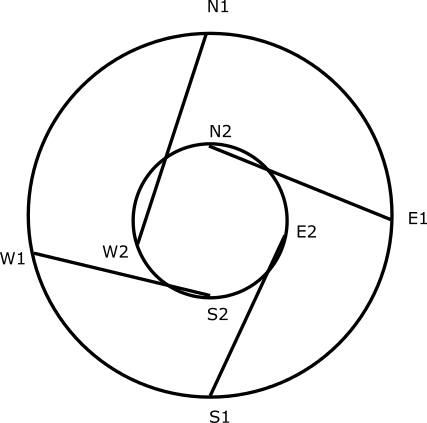
A city has two perfectly circular and concentric ring roads, the outer ring road (OR) being twice as long as the inner ring road (IR). There are also four (straight line) chord roads from E1, the east end point of OR to N2, the north end point of IR; from N1, the north end point of OR to W2, the west end point of IR; from W1, the west end point of OR, to S2, the south end point of IR; and from S1 the south end point of OR to E2, the east end point of IR. Traffic moves at a constant speed of $$30\pi$$ km/hr on the OR road, 20$$\pi$$ km/hr on the IR road, and 15$$\sqrt5$$ km/hr on all the chord roads.
Amit wants to reach E2 from N1 using first the chord N1 - W2 and then the inner ring road. What will be his travel time in minutes on the basis of information given in the above question?
Let the radii of 2 circles be R and r respectively such that R=2*r. Triangle $$ON_2E_1$$ and all the other 3 similar triangles form a right angle at the centre. So, using Pythagoras theorem, the value of chords comes out to be $$\sqrt{\ 5}\times\ \dfrac{R}{2}$$ . Hence, the total distance travelled is $$\sqrt{\ 5}\times\ \dfrac{R}{2}$$ + $$0.5\ \times\ R\ \times\ \pi\ $$. The total time required can be calculated by distance/speed, which comes out to be 3.5 * R. Among options, only 105 is an integral multiple of 3.5.
DIRECTIONS for the following three questions: Answer the questions on the basis of the information given below.
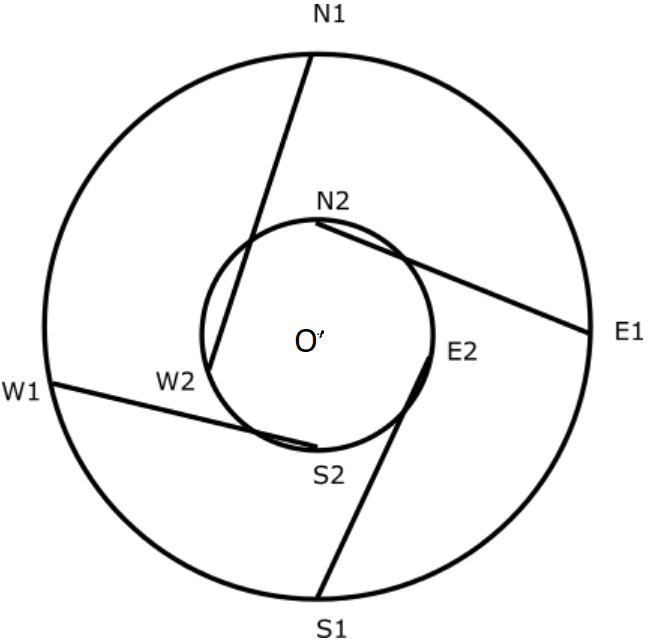
A city has two perfectly circular and concentric ring roads, the outer ring road (OR) being twice as long as the inner ring road (IR). There are also four (straight line) chord roads from E1, the east end point of OR to N2, the north end point of IR; from N1, the north end point of OR to W2, the west end point of IR; from W1, the west end point of OR, to S2, the south end point of IR; and from S1 the south end point of OR to E2, the east end point of IR. Traffic moves at a constant speed of $$30\pi$$ km/hr on the OR road, 20$$\pi$$ km/hr on the IR road, and 15$$\sqrt5$$ km/hr on all the chord roads.
The ratio of the sum of the lengths of all chord roads to the length of the outer ring road is
Let the radius of outer circle be 2R and the centre of both the circles be O.

Triangle $$ON_2E_1$$and all the other 3 similar triangles form a right angle at the centre.
Let the radius of the inner ring road be R
The radius of outer will be 2R as the circumference of the outer ring road is double that of the inner ring road.
So, in triangle $$ON_2E_1$$ using Pythagoras theorem the value of chords come out to be $$\sqrt5$$ * R so the total length of the chords 4 * $$\sqrt5$$ * R and circumference is equal to 2 *Pi*2R. The ratio gives option C.
DIRECTIONS for the following three questions: Answer the questions on the basis of the information given below.
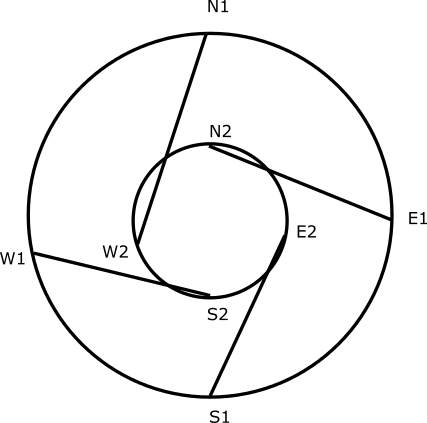
A city has two perfectly circular and concentric ring roads, the outer ring road (OR) being twice as long as the inner ring road (IR). There are also four (straight line) chord roads from E1, the east end point of OR to N2, the north end point of IR; from N1, the north end point of OR to W2, the west end point of IR; from W1, the west end point of OR, to S2, the south end point of IR; and from S1 the south end point of OR to E2, the east end point of IR. Traffic moves at a constant speed of $$30\pi$$ km/hr on the OR road, 20$$\pi$$ km/hr on the IR road, and 15$$\sqrt5$$ km/hr on all the chord roads.
Amit wants to reach N2 from S1. It would take him 90 minutes if he goes on minor arc S1 - E1 on OR, and then on the chord road E1 - N2. What is the radius of the outer ring road in kms?
We know that the total time taken is 1.5 hrs. Calculating the individual time taken and the adding and then equating to 1.5.
Let R be the radius of the outer-ring road.
$$\frac{\pi*R}{2*30*\pi} + \frac{\sqrt{5}*R}{2*15*\sqrt{5}}$$ = 1.5 solving we get R=30.
Only a single rail track exists between stations A and B on a railway line. One hour after the northbound super fast train N leaves station A for station B, a south-bound passenger train S reaches station A from station B. The speed of the super fast train is twice that of a normal express train E, while the speed of a passenger train S is half that of E. On a particular day, N leaves for B from A, 20 min behind the normal schedule. In order to maintain the schedule, both N and S increased their speeds. If the super fast train doubles its speed, what should be the ratio (approximately) of the speeds of passenger train to that of the super fast train so that the passenger train S reaches exactly at the scheduled time at A on that day?
Let the speed of an express train be 4x, normal train be 2x and passenger train be x.
Let the distance between the 2 stations be D.
Since there is only 1 railway track, train N must reach station B before train S leaves.
Therefore, D/4x + D/x = 60
5D/4x = 60
D/x = 48
Train N leaves 20 minutes late. Therefore, the 2 trains must have covered the distance within 40 minutes on this particular day.
Train N doubles its speed. Therefore, speed of train N will be 8x. Let the new speed of the passenger train be y.
D/8x + D/y = 40
48/8 + D/y = 40
D/y = 34.
Speed of super fast train = D/8x = 6
Speed of passenger train = D/y = 34
Ratio of the speeds = 6/34 = 3/17.
The ratio is approximately equal to 1:6. Therefore, option D is the right answer.
On a 20 km tunnel, connecting two cities A and B, there are three gutters (1, 2 and 3). The distance between gutters 1 and 2 is half the distance between gutters 2 and 3. The distance from city A to its nearest gutter, gutter 1, is equal to the distance of city B from gutter 3. On a particular day, the hospital in city A receives information that an accident has happened at gutter 3. The victim can be saved only if an operation is started within 40 min. An ambulance started from city A at 30 km/hr and crossed gutter 1 after 5 min. If the driver had doubled the speed after that, what is the maximum amount of time would the doctor get to attend to the patient at the hospital.
Assume that a total of 1 min is elapsed for taking the patient into and out of the ambulance?
Let the distance between gutter 1 and A be x and between gutter 1 and 2 be y.
Hence, x + y + 2y + x = 20 => 2x+3y=20
Also x = 30kmph * 5/60 = 2.5km
Hence, y = 5km
After the ambulance doubles its speed it goes at 60kmph i.e. 1km per min. Hence, time taken for the rest of the journey = 15*2 + 2.5 = 32.5
It takes 1 min to load and unload the patient.
Hence, total time = 5 + 32.5 + 1 = 38.5 mins
So, the doctor would get 1.5 min to attend to the patient.
A train approaches a tunnel AB. Inside the tunnel is a cat located at a point that is 3/8 of the distance AB measured from the entrance A. When the train whistles the cat runs. If the cat moves to the entrance of the tunnel A, the train catches the cat exactly at the entrance. If the cat moves to the exit B, the train catches the cat at exactly the exit. What is the ratio of speed of train and cat ?
Let the length of the tunnel be x and distance of the train to entrance A be y. Let the speeds of train and cat be t and c respectively.
Hence, when the cat runs 3x/8, the train covers y.
=> (3x/8)/c = y/t --- (1)
When the cat runs 5x/8 to the other end, the train covers x+y
=>(5x/8)/c = (x+y)/t ---(2)
Taking ratio of (1) to (2)
3/5 = y/(x+y) => 3x = 2y ---(3)
Substituting (3) in (1)
(2y/8)/c = y/t
=> t = 4c
Hence the ratio t:c is 4:1.
At his usual rowing rate, Rahul can travel 12 miles downstream in a certain river in 6 hr less than it takes him to travel the same distance upstream. But if he could double his usual rowing rate for this 24 miles round trip, the downstream 12 miles would then take only 1 hr less than the upstream 12 miles. What is the speed of the current in miles per hour?
$$12/(R - S) = T$$
$$12/(R + S) = T - 6$$
$$12/(2R - S) = t$$
$$12/(2R + S) = t - 1$$
=> $$12/(R - S) - 12/(R + S) = 6$$ and $$12/(2R - S) - 12/(2R + S) = 1$$
=> $$12R + 12S - 12R + 12S = 6R^2 - 6S^2$$ and $$24R + 12S - 24R + 12S = 4R^2 - S^2$$
=> $$24S = 6R^2 - 6S^2 and 24S = 4R^2 - S^2$$
=> $$6R^2 - 6S^2 = 4R^2 - S^2$$
=> $$2R^2 = 5S^2$$
=> $$24S = 10S^2 - S^2 = 9S^2$$
=> $$S = 24/9 = 8/3$$
Shyama and Vyom walk up an escalator (moving stairway). The escalator moves at a constant speed. Shyama takes three steps for every two of Vyom’s steps. Shyama gets to the top of the escalator after having taken 25 steps, while Vyom (because his slower pace lets the escalator do a little more of the work) takes only 20 steps to reach the top. If the escalator were turned off, how many steps would they have to take to walk up?
Let the number of steps on the escalator be x.
So, by the time Shyama covered 25 steps, the escalator moved 'x-25' steps.
Hence, the ratio of speeds of Shyama and escalator = 25:(x-25)
Similarly, the ratio of speeds of Vyom and escalator = 20:(x-20)
But the ratio is 3:2
Ratio of speeds of Shyama and Vyom = 25(x-20)/20*(x-25) = 3/2
=> 10(x-20) = 12(x-25)
=> 2x = 100 => x = 50
Train X departs from station A at 11 a.m. for station B, which is 180 km so far. Train Y departs from station B at 11 a.m. for station A. Train X travels at an average speed of 70 km/hr and does not stop anywhere until it arrives at station B. Train Y travels at an average speed of 50 km/hr, but has to stop for 15 min at station C, which is 60 km away from station B enroute to station A. Ignoring the lengths of the trains, what is the distance, to the nearest kilometre, from station A to the point where the trains cross each other?
Distance between A-B , A-C, C-B is 180, 120 and 60 km respectively.
Let x be the distance from A where the 2 trains meet.
According to given condition we have
$$\frac{x}{70}=\frac{60}{50} + \frac{1}{4} + \frac{120-x}{50}$$.
Solving the equation we get x around 112 km.
Three runners A, B and C run a race, with runner A finishing 12 m ahead of runner B and 18 m ahead of runner C, while runner B finishes 8 m ahead of runner C. Each runner travels the entire distance at a constant speed. What was the length of the race?
Let x be the required distance.
Let a,b,c be speed of the A,B and C respectively.
From the given conditions we have,
$$\frac{a}{b}=\frac{x}{x-12}$$ and $$\frac{a}{c}=\frac{x}{x-18}$$ and $$\frac{b}{c}=\frac{x}{x-8}$$ . From first 2 equations we can deduce $$\frac{b}{c}=\frac{x-12}{x-18}$$.
$$\frac{b}{c}=\frac{x-12}{x-18} = \frac{x}{x-8}$$
x = 48 satisfy the equation.
A truck travelling at 70 kilometres per hour uses 30% more diesel to travel a certain distance than it does when it travels at the speed of 50 kilometres per hour. If the truck can travel 19.5 kilometres on a litre of diesel at 50 kilometres per hour, how far can the truck travel on 10 litres of diesel at a speed of 70 kilometres per hour?
If the truck is being driven at 70 kmph, it takes 1.3 liters of diesel to travel 19.5 km.
Therefore, with 10 liters of diesel, the truck can travel 10/1.3 * 19.5 km = 150 km.
Directions for the next 2 questions: There are five machines A, B, C, D, and E situated on a straight line at distances of 10 metres, 20 metres, 30 metres, 40 metres and 50 meters respectively from the origin of the line. A robot is stationed at the origin of the line. The robot serves the machines with raw material whenever a machine becomes idle. All the raw material is located at the origin. The robot is in an idle state at the origin at the beginning of a day. As soon as one or more machines become idle, they send messages to the robot- station and the robot starts and serves all the machines from which it received messages. If a message is received at the station while the robot is away from it, the robot takes notice of the message only when it returns to the station. While moving, it serves the machines in the sequence in which they are encountered, and then returns to the origin. If any messages are pending at the station when it returns, it repeats the process again. Otherwise, it remains idle at the origin till the next message (s) is received.
Suppose on a certain day, machines A and D have sent the first two messages to the origin at the beginning of the first second, and C has sent a message at the beginning of the 5th second and B at the beginning of the 6th second, and E at the beginning of the 10th second. How much distance in metres has the robot travelled since the beginning of the day, when it notices the message of E? Assume that the speed of movement of the robot is 10 metres per second.
At the beginning, the robot gets the message from both A and D. So it will cated A and D in the same trip.
Distance travelled= 40*2=80m
Time taken=8 sec
At the beginning of 9th second,it recieves message from both B and C and hence caters to them in the same trip.
Distance travelled=30*2=60m
Total distance travelled= (60+80)= 140m
Directions for the next 2 questions: There are five machines A, B, C, D, and E situated on a straight line at distances of 10 metres, 20 metres, 30 metres, 40 metres and 50 meters respectively from the origin of the line. A robot is stationed at the origin of the line. The robot serves the machines with raw material whenever a machine becomes idle. All the raw material is located at the origin. The robot is in an idle state at the origin at the beginning of a day. As soon as one or more machines become idle, they send messages to the robot- station and the robot starts and serves all the machines from which it received messages. If a message is received at the station while the robot is away from it, the robot takes notice of the message only when it returns to the station. While moving, it serves the machines in the sequence in which they are encountered, and then returns to the origin. If any messages are pending at the station when it returns, it repeats the process again. Otherwise, it remains idle at the origin till the next message (s) is received.
Suppose there is a second station with raw material for the robot at the other extreme of the line which is 60 metres from the origin, that. is, 10 meters from E. After finishing the services in a trip, the robot returns to the nearest station. If both stations are equidistant, it chooses the origin as the station to return to. Assuming that both stations receive the messages sent by the machines and that all the other data remains the same, what would be the answer to the above question?
Since the machine recieves the message from A and D, it will cater to them in the same trip.In return journey,it will go to the point which is 10 m away from E.
Distance travelled=40+20=60m
Now it recieves the message from B and C and caters them in the single journey.In return journey,it will go to origin.
Distance travelled=40+20=60m
Total distance travelled=60m+60m=120m
Navjivan Express from Ahmedabad to Chennai leaves Ahmedabad at 6:30 am and travels at 50km per hour towards Baroda situated 100 kms away. At 7:00 am Howrah - Ahmedabad express leaves Baroda towards Ahmedabad and travels at 40 km per hour. At 7:30 Mr. Shah, the traffic controller at Baroda realises that both the trains are running on the same track. How much time does he have to avert a head-on collision between the two trains?
The distance between Ahmedabad and Baroda is 100 Km
Navjivan express starts at 6:30 am at 50 Km/hr and Howrah expresses starts at 7:00 am at 40 Km/hr.
Distance covered by Navjivan express in 30 minutes (by 7 am) is 25 Km/hr.
So, at 7 am, the distance between the two trains is 75 Kms and they are travelling towards each other a relative speed of 50+40=90 Km/hr.
So, time taken them to meet is 75/90*60 = 50 minutes.
As, Mr. Shah realizes the problem after thirty minutes, time left to avoid collision is 50-30 = 20 minutes
The speed of a railway engine is 42 Km per hour when no compartment is attached, and the reduction in speed is directly proportional to the square root of the number of compartments attached. If the speed of the train carried by this engine is 24 Km per hour when 9 compartments are attached, the maximum number of compartments that can be carried by the engine is:
The function of the speed of the train = 42 - k$$\sqrt{n}$$ where n is the number of compartments and k is a constant.
42 - k$$\sqrt{9}$$ = 24
=> 3k = 18 => k = 6
=> Function of speed = 42 - 6$$\sqrt{n}$$
Speed is 0 when 42 - 6$$\sqrt{n}$$ = 0
=> 42 = 6$$\sqrt{n}$$
=> n = 49
=> So, with a positive speed, the train can carry 48 compartments.
DIRECTIONS for the following three questions
These questions are based on the situation given below:
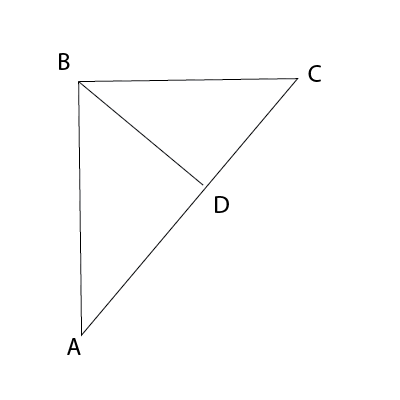
A road network (shown in the figure below) connects cities A, B, C and D. All road segments are straight lines. D is the midpoint on the road connecting A and C. Roads AB and BC are at right angles to each other with BC shorter than AB. The segment AB is 100 km long. Ms. X and Mr. Y leave A at 8:00 am, take different routes to city C and reach at the same time. X takes the highway from A to B to C and travels at an average speed of 61.875 km per hour. Y takes the direct route AC and travels at 45 km per hour on segment AD. Y's speed on segment DC is 55 km per hour.

What is the average speed of Y in km per hour?
Y takes the direct route AC and travels at 45 km per hour on segment AD. Y's speed on segment DC is 55 km per hour.
AD=DC =a(D is the midpoint on the road connecting A and C.)
The time taken by Y to reach D= a/45
Further, the time taken by Y to reach C= a/55
Y has travelled equal distances are constant speed.
=> Average speed = $$\frac{2a}{\frac{a}{45}+\frac{a}{55}}$$=$$\frac{2*45*55}{100}$$ = 49.5 kmph
DIRECTIONS for the following three questions
These questions are based on the situation given below:
A road network (shown in the figure below) connects cities A, B, C and D. All road segments are straight lines. D is the midpoint on the road connecting A and C. Roads AB and BC are at right angles to each other with BC shorter than AB. The segment AB is 100 km long. Ms. X and Mr. Y leave A at 8:00 am, take different routes to city C and reach at the same time. X takes the highway from A to B to C and travels at an average speed of 61.875 km per hour. Y takes the direct route AC and travels at 45 km per hour on segment AD. Y's speed on segment DC is 55 km per hour.

The total distance traveled by Y during the journey is approximately
$$BC^2$$ + 10000 = $$AC^2$$.
$$\frac{BC+100}{61.875}$$ = $$\frac{AC}{49.5}$$ => $$\frac{BC+100}{AC}$$ = 1.25 = > BC = 1.25AC - 100
On solving these equations, we get AC as 105 and BC a 31.
=> Y traveled 105 km.
DIRECTIONS for the following three questions
These questions are based on the situation given below:
A road network (shown in the figure below) connects cities A, B, C and D. All road segments are straight lines. D is the midpoint on the road connecting A and C. Roads AB and BC are at right angles to each other with BC shorter than AB. The segment AB is 100 km long. Ms. X and Mr. Y leave A at 8:00 am, take different routes to city C and reach at the same time. X takes the highway from A to B to C and travels at an average speed of 61.875 km per hour. Y takes the direct route AC and travels at 45 km per hour on segment AD. Y's speed on segment DC is 55 km per hour.

What is the length of the road segment BD?
$$BC^2$$ + 10000 = $$AC^2$$.
$$\frac{BC+100}{61.875}$$ = $$\frac{AC}{49.5}$$ => $$\frac{BC+100}{AC}$$ = 1.25 = > BC = 1.25AC - 100
On solving these equations, we get AC as 105 and BC a 31.
Let the point B be (0,0) => A = (0, -100) and C = (31,0)
D = Mid point of AC = (15.5, -50)
BD = $$\sqrt{15.5^2+50^2}$$ = 52.5 (approximately).
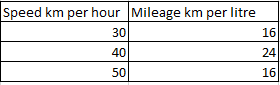
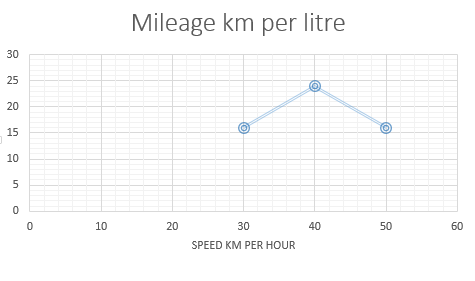
DIRECTIONS for the following questions: These questions are based on the situation given below: Rajiv reaches city B from city A in 4 hours, driving at the speed of 35 km per hour for the first 2 hours and at 45 km per hour for the next two hours. Aditi follows the same route, but drives at three different speeds: 30, 40 and 50 km per hour, covering an equal distance in each speed segment. The two cars are similar with petrol consumption characteristics (km per litre) shown in the figure below.
The amount of petrol consumed by Aditi for the journey is
Total distance = 35*2 + 45*2 = 160 km
Distance traveled by Aditi at each constant speed value = $$\frac{160}{3}$$
Total petrol consumed by Aditi = $$\frac{160/3}{16}$$ + $$\frac{160/3}{24}$$ + $$\frac{160/3}{16}$$ = $$\frac{10}{3}$$ + $$\frac{20}{9}$$ + $$\frac{10}{3}$$ = 6.67 + 2.22 = 8.9 litres
DIRECTIONS for the following questions: These questions are based on the situation given below: Rajiv reaches city B from city A in 4 hours, driving at the speed of 35 km per hour for the first 2 hours and at 45 km per hour for the next two hours. Aditi follows the same route, but drives at three different speeds: 30, 40 and 50 km per hour, covering an equal distance in each speed segment. The two cars are similar with petrol consumption characteristics (km per litre) shown in the figure below.
Zoheb would like to drive Aditi's car over the same route from A to B and minimize the petrol consumption for the trip. The amount of petrol required by him is
To minimize the petrol consumption, he must travel at 40kmph constantly through out the 160 km.
Total petrol consumed = $$\frac{160}{24}$$ = 6.67 litres.
Distance between A and B is 72 km. Two men started walking from A and B at the same time towards each other. The person who started from A travelled uniformly with average speed of 4 km/hr. While the other man travelled with varying speed as follows: in the first hour his speed was 2 km/hr, in the second hour it was 2.5 km/hr, in the third hour it was 3 km/hr, and so on. When will they meet each other?
In the first hour, they cover 6km. In the second hour they cover 6.5km. In the third hour, they cover 7km and so on.
Finally, they cover 72km in 9 hours.
Distance covered by A in 9 hours = 4*9 = 36km
=> They meet mid-way between A and B.
Three wheels can complete 60, 36 and 24 revolutions per minute. There is a red spot on each wheel that touches the ground at time zero. After how much time, all these spots will simultaneously touch the ground again?
The first wheel completes a revolution in $$\frac{60}{60}=1$$ second
The second wheel completes a revolution in $$\frac{60}{36}=1\frac{2}{3}$$ second
The third wheel completes a revolution in $$\frac{60}{24}=2\frac{1}{2}$$ second
The three wheels touch the ground simultaneously at time which are multiples of the above three times.
Hence, the required number is $$LCM(1,\frac{5}{3},\frac{5}{2}) = 5$$ seconds.
So, the correct option is option (c)
I started climbing up the hill at 6 a.m. and reached the top of the temple at 6 p.m. Next day I started coming down at 6 a.m. and reached the foothill at 6 p.m. I walked on the same road. The road is so short that only one person can walk on it. Although I varied my pace on my way, I never stopped on my way. Then which of the following must be true?
The total time taken for both the journeys is the same. So, a) is incorrect. If he goes with the same speed both ways, he would've been at the same point at noon on both days. So, d) is incorrect. If he does not travel with the same speed in both the directions, he need not be at the same spot at noon. So, option b) is incorrect. Option c) is the correct answer.
An express train travelling at 80 km/hr overtakes a goods train, twice as long and going at 40 km/hr on a parallel track, in 54 s. How long will the express train take to cross a platform of 400 m long?
Let's say length of express train = $$x$$
So length of goods train = $$2x$$
Total length travelled by express train = $$3x = ((80-40) \times \frac{5}{18}) \times 54 $$ (Where $$(80-40) \times \frac{5}{18})$$ = relative velocity of express train w.r.t. goods train in meter/sec.)
So $$x =200$$ meter.
Now crossing a plateform of length 400 m., total length travelled by train = 600 m=$$t\times(80 \times \frac{5}{18})$$
$$t = 27$$ sec.
At what time did X catch the thief?
Time taken to catch the thief = $$\frac{d}{v}$$ (Where d is relative distance achieved in 15 min. = 15km. and v is relative velocity of poiliceman i.e. = 65-60 = 5 kmph)
So time taken = 3hr.
Hence he will catch thief at 3:15 pm
If another policeman had started the same chase along with X, but at a speed of 60 km/hr, then how far behind was he when X caught the thief?
As relative velocity of other poilceman will be 0 , hence distance remain same as starting i.e. = 15 km.
If his journey, including stoppage, is covered at an average speed of 180 mph during the journey from Frankfurt to India, what is the distance between Frankfurt and India?
X leaves Frankfurt at 6 PM and reaches Boston at 10 AM, which is 6 AM in Frankfurt => 12-hour journey
Leaves Boston at 12 PM ad reaches India at 1 AM, which is 11 PM in Boston => 11-hour journey
=> Total time = 12 + 2 + 11 = 25 hours
Average speed = 180 mph
=> Distance = 25 * 180 = 4500 miles
If X had started the return journey from India at 2.55 a.m. on the same day that he reached there, after how much time would he reach Frankfurt?
X leaves Frankfurt at 6 PM and reaches Boston at 10 AM, which is 6 AM in Frankfurt => 12-hour journey
Leaves Boston at 12 PM ad reaches India at 1 AM, which is 11 PM in Boston => 11-hour journey
=> Total time = 12 + 2 + 11 = 25 hours
Return journey is 1 hour lesser => 25 - 1 = 24 hours.
What is X's average speed for the entire journey (to and fro)?
Distance is not known to find the average speed.
=> Data insufficient
A certain race is made up of three stretches: A, B and C, each 2 km long, and to be covered by a certain mode of transport. The following table gives these modes of transport for the stretches, and the minimum and maximum possible speeds (in km/hr) over these stretches. The speed over a particular stretch is assumed to be constant. The previous record for the race is 10 min.
Anshuman travels at minimum speed by car over A and completes stretch B at the fastest speed. At what speed should he cover stretch C in order to break the previous record?
Anshuman travels at a minimum speed by car over A, so the time taken = $$\frac{2}{40}$$*60= 3 min
Anshuman travels stretch B at the fastest speed, so the time taken = $$\frac{2}{50}$$*60= 12/5 min
So in order to break the record, he has to cover the three stretches in less than 10 min
10-(3+$$\frac{12}{5}$$) = $$\frac{23}{5}$$
So the time taken to cover stretch C should be less than $$\frac{23}{5}$$ min.
Let x kmph be the speed at which he covers stretch C
$$\frac{2}{x}$$*60 < $$\frac{23}{5}$$
x > 26.08 kmph but the maximum speed at which he can cover stretch C is 20 kmph.
Hence it is not possible for him to break his previous record.
C is the correct answer.
A certain race is made up of three stretches: A, B and C, each 2 km long, and to be covered by a certain mode of transport. The following table gives these modes of transport for the stretches, and the minimum and maximum possible speeds (in km/hr) over these stretches. The speed over a particular stretch is assumed to be constant. The previous record for the race is 10 min.
Mr Hare completes the first stretch at the minimum speed and takes the same time for stretch B. He takes 50% more time than the previous record to complete the race. What is Mr Hare's speed for the stretch C?
Total time taken by Mr. Hare to complete the race = 50% more of (10 min.) = 15 min.= $$\frac{1}{4}$$ hr.
Or $$\frac{1}{4} = \frac{2}{40} + \frac{2}{40} + \frac{2}{v}$$ ( i.e. complete time for strech A,B and C Where v is velocity at strech C)
Or v= 13.3 km./hr
A certain race is made up of three stretches: A, B and C, each 2 km long, and to be covered by a certain mode of transport. The following table gives these modes of transport for the stretches, and the minimum and maximum possible speeds (in km/hr) over these stretches. The speed over a particular stretch is assumed to be constant. The previous record for the race is 10 min.
Mr Tortoise completes the race at an average speed of 20 km/hr. His average speed for the first two stretches is four times that for the last stretch. Find the speed over stretch C.
Average speed to cover complete race = 20 km/hr = $$\frac{2+2+2}{t_1 + t_2 + t_3}$$ (Where $$t_1$$ is time taken to cover the distance A, $$t_2$$ is time taken to cover the distance B and $$t_3$$ is time taken to cover the distance C)
So total time =$$ t_1 + t_2 + t_3 = 18$$ min.
Avg. speed for first two streches = $$\frac{4}{t_1 + t_2}$$
Avg. speed for last strech = $$\frac{2}{t_3}$$
Given: $$\frac{4}{t_1 + t_2} = 4 \times \frac{2}{t_3}$$
Or $$2t_1 + 2t_2 = t_3$$
Or $$t_3 = 12$$ min.
So $$V_3 = \frac{2}{12} \times 60$$ = 10 km/hr
In a mile race, Akshay can be given a start of 128 m by Bhairav. If Bhairav can give Chinmay a start of 4 m in a 100 m dash, then who out of Akshay and Chinmay will win a race of one and half miles, and what will be the final lead given by the winner to the loser? (One mile is 1,600 m.)
Akshay can complete 1600 - 128 = 1472 m and Bhairav can completer 1600 m in the same time.
Bhairav can complete 100 m and Chinmay can complete 96 m in the same time.
=> Bhairav can complete 1600 m and Chinmay can complete 1536 m in the same time.
=> Akshay can complete 1472 m and Chinmay can complete 1536 m in the same time.
1.5 miles => 2400 m
Distance travelled by Akshay by the time Chinmay completes 1.5 miles = $$\frac{1472}{1536}*2400$$ = 2300 m
=> Akshay lost by 100 m, which is $$\frac{1}{16}th$$ of a mile.
A man travels three-fifths of a distance AB at a speed 3a, and the remaining at a speed 2b.If he goes from B to A and return at a speed 5c in the same time, then
$$\frac{\frac{3x}{5}}{3a} + \frac{\frac{2x}{5}}{2b} = \frac{2x}{5c}$$
(Where x is distance between A and B; $$\frac{\frac{3x}{5}}{3a}$$ = time taken to cover the distance with speed 3a ; $$\frac{\frac{2x}{5}}{2b}$$ = time taken to cover the distance with speed 2b; $$\frac{2x}{5c}$$ = time taken to cover the distance x from B to A then return.)
$$\frac{\frac{3x}{5}}{3a} + \frac{\frac{2x}{5}}{2b} = \frac{2x}{5c}$$
Or $$\frac{1}{a} + \frac{1}{b} = \frac{2}{c}$$
A man travels from A to B at a speed x km/hr. He then rests at B for x hours. He then travels from B to C at a speed 2x km/hr and rests for 2x hours. He moves further to D at a speed twice as that between B and C. He thus reaches D in 16 hr. If distances A-B, B-C and C-D are all equal to 12 km, the time for which he rested at B could be
Total time taken to reach at D:
$$\frac{12}{x} + x + \frac{12}{2x} + 2x + \frac{12}{4x} = 16$$
Or $$3x^2 - 16x + 21 = 0$$
From the options we can see that only, $$x$$ = 3hr satisfies the equation. Thus, A is the right choice.
In a watch, the minute hand crosses the hour hand for the third time exactly after every 3 hr 18 min and 15s of normal time. What is the time gained or lost by this watch in one day?
In a normal watch, the minute hand crosses the hour's hand after every 1 hour 5 minutes and 27 seconds.
So, the third time the hour's hand crosses the minute's hand is after 3 hours 16 minutes and 21 seconds.
In this watch, the time taken for this to happen is 3 hours 18 minutes and 15 seconds.
Hence, the watch loses 1 minute and 54 seconds after every 3 hours 18 minutes and 15 seconds.
18 minutes and 15 seconds = 1095 seconds = 1095/3600 $$\approx$$ .304 hours.
=> 3 hours 18 minutes and 15 seconds = 3.304 hours
So, time lost in a day is $$1\frac{54}{60}*\frac{24}{3.304} = \frac{114}{60}*\frac{24}{3.304} \approx 13.8$$
So, the time lost by the watch in a day is approximately equal to 13 minutes and 48 seconds.
Every day Neera's husband meets her at the city railway station at 6.00 p.m. and drives her to their residence. One day she left early from the office and reached the railway station at 5.00 p.m. She started walking towards her home, met her husband coming from their residence on the way and they reached home 10 minutes earlier than the usual time. For how long did she walk?
Since we know that Neera's husband drives at a uniform speed to and from his residence.
If he saved 10 mins overall travel time, he should have driven 5 mins less towards railway station and 5 mins less while driving towards residence.
If he saved 5 minutes in his return journey, he should have started to return 5 minutes before his actual return time.
When the husband met Neera, he should have met her 5 minutes before the actual meeting time i.e. at 5.55 PM.
So, Neera must have walked for 55 minutes from 5PM.
A car after traveling 18 km from a point A developed some problem in the engine and speed became 4/5 of its original speed As a result, the car reached point B 45 minutes late. If the engine had developed the same problem after traveling 30 km from A, then it would have reached B only 36 minutes late. The original speed of the car (in km per hour) and the distance between the points A and B (in km.) is
Time difference, when second time car's engine failed at a distance of 30 km., is of 9 min.
Hence putting this in equation:
$$\frac{12}{\frac{4v}{5}} - \frac{12}{v} = \frac{9}{60}$$ hr. (Because difference of time is considered with extra travelling of 12 km. in second case)
We will get $$v (velocity) = 20$$ km/hr.
Now for distance $$ \frac{d-18}{16} + \frac{18}{20} - \frac{d}{20} = \frac{45}{60}$$ hr. (As car is 45 min. late after engine's faliure in first case)
So $$d$$ = 78 km.
Hence none of these will be our answer.
Two trains are traveling in opposite direction at uniform speed 60 and 50 km per hour respectively. They take 5 seconds to cross each other. If the two trains had traveled in the same direction, then a passenger sitting in the faster moving train would have overtaken the other train in 18 seconds. What are the lengths of trains (in metres)?
let's $$l_s$$ is length of slower train and $$l_f$$ is length of faster train.
So according to second condition when two trains are moving in same direction
$$l_s = v_{fs} \times t$$ (where $$v_{fs}$$ is relative velocity of faster train w.r.t. slower train and t is time taken to cross it)
or $$l_s = \frac{(60-50) \times 5}{18} \times 18$$ = 50 meter
Only option which has length of slower train as 50 is C.
Frequently Asked Questions
Video solutions can be a helpful resource for candidates preparing for CAT Time Distance Work questions. They can provide a step-by-step explanation of how to solve the problem, helping candidates better understand the concept and formula.