A value of $$c$$ for which the minimum value of $$f(x)=x^{2}-4cx+8c$$ is greater than the maximum value of $$g(x)=-x^{2}+3cx-2c$$, is
CAT Quadratic Equations Questions
First function $$f\left(x\right)=x^2-4cx+8$$
For this function $$a>0$$, so minimum value will occur at $$x=-\dfrac{b}{2a}=-\left(-\dfrac{4c}{2}\right)=2c$$
So, the minimum value of the function is = $$2c^2-4c\left(2c\right)+8c=-4c^2+8c$$
Second function $$g(x)=-x^{2}+3cx-2c$$
For this function $$a<0$$, so maximum value will occur at $$x=-\dfrac{b}{2a}=-\dfrac{\left(-3c\right)}{2}=\dfrac{3c}{2}$$
So, the maximum value of the function is = $$-\left(\dfrac{3c}{2}\right)^2+3c\left(\dfrac{3c}{2}\right)-2c=\dfrac{9c^2}{4}-2c$$
So, as per the given condition,
$$\dfrac{9c^2}{4}-2c<-4c^2+8c$$
or, $$\dfrac{9c^2}{4}+4c^2<8c+2c$$
or, $$\dfrac{25c^2}{4}<10c$$
or, $$\dfrac{5c^2}{4}<2c$$
or, $$5c^2<8c$$
or, $$5c^2-8c<0$$
or, $$c\left(c-\dfrac{8}{5}\right)<0$$
or, $$0<c<\dfrac{8}{5}$$
So, the value of $$c$$ which lies in this range is $$\dfrac{1}{2}$$
If $$9^{x^{2}+2x-3}-4(3^{x^{2}+2x-2})+27=0$$ then the product of all possible values of x is
Let's assume that $$x^{2}+2x-3 = t$$
$$9^{x^{2}+2x-3}-4(3^{x^{2}+2x-2})+27=0$$ can be written as $$9^t-4(3^{t+1})+27=0$$
$$3^{2t}-12(3^t)+27=0$$
Let's assume that $$3^t = y$$
$$y^2-12y+27=0$$
$$(y-9)(y-3)=0$$
y = 3 or 9 $$\Rightarrow$$ t = 1 or 2
Let's solve when t = 1
$$x^{2}+2x-3 = 1 \Rightarrow x^{2}+2x-4 = 0$$
$$b^2-4ac\ =\ 4+16\ =\ 20$$
Positive, so the equation has real roots.
Product of possible value of x = -4
Let's solve for t = 2
$$x^{2}+2x-3 = 2 \Rightarrow x^{2}+2x-5 = 0$$
$$b^2-4ac\ =\ 4+20\ =\ 24$$
Positive, so the equation has real roots.
Product of possible value of x = -5
The product of all values = 20
The equations $$3x^{2}-5x+p=0$$ and $$2x^{2}-2x+q=0$$ have one common root. The sum of the other roots of this equations is
Let's assume that the common root is r.
The sum of the roots of the first equation is 5/3 and that of the second equation is 1.
We want the sum of the other two roots:
$$
\text{Sum} = \left(\frac{5}{3}-r\right) + (1-r) = \frac{8}{3}-2r$$
We now need to express r in terms of p and q.
Since r is a common root, it satisfies:
$$3r^2 - 5r + p = 0 \quad (1)$$
$$
2r^2 - 2r + q = 0 \quad (2)$$
Eliminate $$ r^2$$ .
Multiply (2) by 3:
$$ 6r^2 - 6r + 3q = 0$$
Multiply (1) by 2:
$$ 6r^2 - 10r + 2p = 0$$
Subtract:
$$ (6r^2 - 6r + 3q) - (6r^2 - 10r + 2p) = 0$$
$$ 4r + 3q - 2p = 0$$
$$ r = \frac{2p - 3q}{4}$$
Now substitute into $$ \frac{8}{3} - 2r$$ :
$$ \frac{8}{3} - 2\left(\frac{2p - 3q}{4}\right)$$
$$ = \frac{8}{3} - \frac{2p - 3q}{2}$$
$$ = \frac{8}{3} - p + \frac{3}{2}q$$
If $$\left( x^{2}+\frac{1}{x^{2}} \right)=25$$ and $$x>0$$, then the value of $$\left( x^{7}+\frac{1}{x^{7}} \right)$$ is
$$\left(x+\dfrac{1}{x}\right)^2 = x^2+\dfrac{1}{x^2} + 2 = 25+2 = 27$$
Therefore, $$\left(x+\dfrac{1}{x}\right) = \sqrt{27} = 3\sqrt{3}$$
Also, $$\left(x+\dfrac{1}{x}\right)^3 = x^3 + \dfrac{1}{x^3} + 3\left(x+\dfrac{1}{x}\right)$$
Therefore, $$x^3 + \dfrac{1}{x^3} = (3\sqrt{3})^3 - 9\sqrt{3} = 72\sqrt{3}$$
Also, $$\left(x^2+\dfrac{1}{x^2}\right)^2 = x^4 + \dfrac{1}{x^4} + 2$$
Therefore, $$x^4 + \dfrac{1}{x^4} = (25)^2 - 2 = 623$$
Lastly, $$\left(x^4+\dfrac{1}{x^4}\right)\left(x^3+\dfrac{1}{x^3}\right) = x^7+\dfrac{1}{x^7} + x + \dfrac{1}{x}$$
Therefore, $$x^7+\dfrac{1}{x^7} = 623*( 72\sqrt{3}) - 3\sqrt{3} = 44853\sqrt{3}$$
Option A is the correct answer.
The number of non-negative integer values of k for which the quadratic equation $$x^{2}-5x+k=0$$ has only integer roots, is
The given quadratic equation is $$x^2-5x+k=0$$
Now, discriminant $$D=5^2-4k=25-4k$$
Now, it is given the equation must have integer roots.
So, $$25-4k$$ has to be a perfect square.
We need to find non-negative integer values of $$k$$
Now, for $$k=0$$, $$D=25-4\times\ 0=25$$, is a perfect square
For $$k=4$$, $$D=25-4\times4=25-16=9$$, is a perfect square
For $$k=6$$, $$D=25-4\times\ 6=1$$, is a perfect square
So, there are three non negative integer values of $$k$$.
So, correct answer is $$3$$.
Let $$x, y,$$ and $$z$$ be real numbers satisfying
$$4(x^{2}+y^{2}+z^{2})=a,$$
$$4(x-y-z)=3+a$$
The a equals
We have two equations,
$$4(x^{2}+y^{2}+z^{2}) = a$$ ---(1)
$$4(x - y - z) = 3 + a$$ ---(2)
Substituting the value of a from equation 1 in equation 2, we get,
$$4\left(x\ -\ y\ -\ z\right)\ =\ 3\ +\ 4(x^2\ +\ y^2\ +\ z^2)$$
$$\ 3\ +\ 4(x^2\ +\ y^2\ +\ z^2)\ -4\left(x\ -\ y\ -\ z\right)\ =\ 0$$
$$\ 3\ +\ 4x^2\ +\ 4y^2\ +\ 4z^2\ -4x\ \ +\ 4y\ +\ 4z\ =\ 0$$
It can be written as,
$$4x^2\ -4x\ +\ 1+\ 4y^2\ +\ 4y\ +\ 1\ +\ 4z^2\ +\ 4z\ +\ 1\ =\ 0$$
$$\left(2x\ -\ 1\right)^2\ +\ \left(2y\ +\ 1\right)^2\ +\ \left(2z\ +\ 1\right)^2\ \ =0$$
We know that if the sum of the squares of terms is 0, then all the terms must be equal to 0
2x - 1 = 0
x = $$\dfrac{1}{2}$$
2y + 1 = 0
y = $$-\dfrac{1}{2}$$
2z + 1 = 0
z = $$-\dfrac{1}{2}$$
Substituting the values in equation 2, we get,
$$4\left(\dfrac{1}{2}\ -\ \left(-\dfrac{1}{2}\right)\ -\ \left(-\dfrac{1}{2}\right)\right)\ =\ 3\ +\ a$$
$$4\left(\dfrac{3}{2}\right)\ =\ 3\ +\ a$$
$$6\ =\ 3\ +\ a$$
$$\ a\ =\ 3$$
Therefore, the correct answer is option A.
lf the equations $$x^{2}+mx+9=0, x^{2}+nx+17=0$$ and $$x^{2}+(m+n)x+35=0$$ have a common negative root, then the value of $$(2m+3n)$$ is
When given more than one equations, stating the fact that there is a common root,
We need to equate the two equations to get discernible values for $$x$$
Here, we are given three equations with the values of $$m$$, $$n$$
$$x^2+mx+9=x^2+\left(m+n\right)x+35$$
$$mx+9=mx+nx+35$$
$$nx=-26$$
Similarly, we can do it for the other equation as well,
$$x^2+nx+17=x^2+\left(m+n\right)x+35$$
$$mx=-18$$
Substituting the value of either $$mx$$ or $$nx$$ in the original equations, we get
$$x^2-18+9=0$$
$$x^2=9$$
$$x=\pm\ 3$$
Since we are given that the root is negative, $$x=-3$$
$$n=-\dfrac{26}{-3}$$
$$m=-\dfrac{18}{-3}$$
$$3n=26$$
$$2m=12$$
$$2m+3n=38$$
The roots $$\alpha, \beta$$ of the equation $$3x^2 + \lambda x - 1 = 0$$, satisfy $$\cfrac{1}{\alpha^2} + \cfrac{1}{\beta^2} = 15$$.
The value of $$(\alpha^3 + \beta^3)^2$$, is
From the sum and product of roots, we get: $$\alpha\ +\beta\ =-\dfrac{\lambda}{3}$$ and $$\alpha\ \beta\ =-\dfrac{1}{3}$$
Simplifying the expression given in the question, we get: $$\dfrac{\alpha^2+\beta^2\ }{\alpha^2\beta^2\ }=15$$
and substituting the denominator's value as 1/9, we get:$$\alpha^2+\beta^2\ =\dfrac{15}{9}$$
We want the expression $$\alpha^3+\beta^3\ $$, so multiplying both sides by $$\alpha+\beta$$, we get:
$$\alpha^3+\beta^3+\alpha\beta\left(a+\beta\ \right)=\dfrac{15}{9}\left(\alpha\ +\beta\ \right)$$
$$\alpha^3+\beta^3+\dfrac{\lambda}{9}\ =\dfrac{15}{9}\left(-\dfrac{\lambda}{3}\ \right)$$
$$\alpha^3+\beta^3+\dfrac{\lambda}{9}\ =-\dfrac{5\lambda}{9}-\dfrac{\lambda}{9}=-\dfrac{2\lambda\ }{3}\ \ $$
We would still need to find the value of $$\lambda$$
This we can do from the initial relation we had:
$$\alpha^2+\beta^2\ =\dfrac{15}{9}$$
$$\alpha^2+\beta^2\ =\left(\alpha+\beta\right)^2-2\alpha\ \beta\ \ \ =\dfrac{15}{9}$$
$$\dfrac{\lambda^2}{9}+\frac{2}{3}\ \ \ =\dfrac{15}{9}$$
$$\dfrac{\lambda^2}{9}\ =\dfrac{15-6}{9}=\dfrac{9}{9}=1$$
This would finally give us $$\lambda^2=9$$
Using this in our required expression, we get:
$$\left(\alpha^3+\beta^3\right)^2=\left(-\dfrac{2\lambda}{3}\ \ \right)^2=\dfrac{4\times\ 9}{9}=4$$
Therefore, Option B is the correct answer.
If x and y are real numbers such that $$4x^2 + 4y^2 - 4xy - 6y + 3 = 0$$, then the value of $$(4x + 5y)$$ is
In such questions, we should be trying to complete the squares.
We see a $$xy$$ term; we need to accommodate that in a square that has both x and y terms.
Since there is only one other term with x, we also need to have it entirely in the square.
$$\left(2x-y\right)^{^2}=4x^2+y^2-4xy$$
Using this in the given equation, we are left with $$\left(2x-y\right)^{^2}+3y^2+3-6y$$
This can be written as $$\left(2x-y\right)^{^2}+3\left(y^2+1-2y\right)$$
$$\left(2x-y\right)^{^2}+3\left(y-1\right)^2=0$$
Since both the squares add up to 0, this is only possible when the squares themselves are 0
This would give us y=1 from the second term, and using that, we get x= 1/2 from the first term.
Therefore the value of 4x+5y will be 2+5 = 7
Hence, 7 is the correct answer.
The sum of all possible values of x satisfying the equation $$2^{4x^{2}}-2^{2x^{2}+x+16}+2^{2x+30}=0$$, is
It is given that $$2^{4x^{2}}-2^{2x^{2}+x+16}+2^{2x+30}=0$$, which can be written as:
=>$$\left(2^{2x^2}\right)^2-2^{2x^2}\cdot2^{x+15}\cdot2^1+\left(2^{x+15}\right)^{^2}=0$$
=> $$\left(2^{2x^2}-2^{x+15}\right)^{^2}=0$$
=> $$2^{2x^2}-2^{x+15}=0$$ (Since $$\left(a-b\right)^2\ =\ 0\ =>\ a-b\ =0$$)
=> $$2x^2\ =\ x+15$$
=> $$2x^2-x-15=0$$
=> $$2x^2-6x+5x-15=0$$
=> $$2x\left(x-3\right)+5\left(x-3\right)=0$$
=> $$\left(2x+5\right)\left(x-3\right)\ =\ 0$$
Hence, the possible values of x are $$-\frac{5}{2}$$, and $$3$$, respectively.
Therefore, the sum of the possible values is $$\left(3-\frac{5}{2}\right)=\frac{1}{2}$$
The correct option is D
The equation $$x^{3} + (2r + 1)x^{2} + (4r - 1)x + 2 =0$$ has -2 as one of the roots. If the other two roots are real, then the minimum possible non-negative integer value of r is
Given that -2 is a root of the given cubic equation.
=> Dividing the given equation by (x + 2), Using the Horners method of synthetic division:
coefficient of $$x^2$$ is 1, and coefficient of x is (2r+1)-2 = 2r-1 and the constant term = (4r-1)-2(2r-1) = 1.
=> The quadratic obtained by dividing the cubic = $$x^2+\left(2r-1\right)x+1=0$$, Since, this equation has 2 real roots => Discriminant should be greater than 0
=> $$\left(2r-1\right)^2>4$$ => 2r-1 > 2 or 2r-1 < -2 => r > 3/2 or r < -1/2.
=> Minimum possible non-negative integer value of r is 2.
A quadratic equation $$x^2 + bx + c = 0$$ has two real roots. If the difference between the reciprocals of the roots is $$\frac{1}{3}$$, and the sum of the reciprocals of the squares of the roots is $$\frac{5}{9}$$, then the largest possible value of $$(b + c)$$ is
It is given that $$x^2 + bx + c = 0$$ has two real roots. Let the roots of the equation be $$\alpha\ ,\beta\ $$. ($$\alpha\ \ >\ \beta\ $$)
Then, we can say that $$\frac{1}{\alpha\ }-\frac{1}{\beta\ }=\frac{1}{3}$$ .... Eq(1)
Similarly, $$\frac{1}{\alpha\ ^2}+\frac{1}{\beta^2\ }=\frac{5}{9}$$ .... Eq (2)
Eq(2) can be written as $$\left(\frac{1}{\alpha\ }-\frac{1}{\beta\ }\right)^{^2}+2\cdot\frac{1}{\alpha\ }\cdot\frac{1}{\beta\ }=\frac{5}{9}$$
=> $$\left(\frac{1}{3}\right)^{^2}+2\cdot\frac{1}{\alpha\ }\cdot\frac{1}{\beta\ }=\frac{5}{9}$$
=> $$\frac{2}{\alpha\ \cdot\beta\ }=\frac{4}{9}=>\ \frac{1}{\alpha\ \cdot\beta\ }=\frac{2}{9}$$
=> $$\alpha\ \cdot\beta\ =\frac{9}{2}$$
We know that the product of the roots is equal to c, which implies$$c=\frac{9}{2}$$
We also know that the sum of the roots is equal to -b.
=> $$\frac{1}{\alpha\ ^2}+\frac{1}{\beta\ ^2}=\left(\frac{1}{\alpha\ }+\frac{1}{\beta\ }\right)^{^2}-\frac{2}{\alpha\ \beta\ }=\frac{5}{9}$$
=> $$\left(\ \frac{\ \alpha\ +\beta\ }{\alpha\ \beta\ }\right)^{^2}-\frac{4}{9}=\frac{5}{9}$$
=> $$\left(\ \frac{\ \alpha\ +\beta\ }{\alpha\ \beta\ }\right)^{^2}=\left(1\right)^2$$
=> $$\alpha\ +\beta\ \ =\ \pm\ \alpha\ \beta\ $$
Hence, the maximum value of b is $$\frac{9}{2}$$.
Hence, the maximum value of (b+c) is 9
Let $$\alpha$$ and $$\beta$$ be the two distinct roots of the equation $$2x^{2} - 6x + k = 0$$, such that ( $$\alpha + \beta$$) and $$\alpha \beta$$ are the distinct roots of the equation $$x^{2} + px + p = 0$$. Then, the value of 8(k - p) is
Given a and b are the distinct roots of the equation $$2x^{2} - 6x + k = 0$$
=> a + b = -(-6/2) = 3 (Sum of the roots)
=> ab = k/2 (Product of the roots)
Now, (a+b) and ab are the roots of the quadratic equation $$x^{2} + px + p = 0$$
=> a + b + ab = -p => 3 + k/2 = -p ---(1)
=> (a + b)(ab) = p => 3(k/2) = p ---(2)
$$3+\dfrac{k}{2}=-\dfrac{3k}{2}$$ => 2k = -3 => k = $$-\dfrac{3}{2}$$
p = $$\dfrac{3k}{2}=\dfrac{3}{2}\left(-\dfrac{3}{2}\right)=-\dfrac{9}{4}$$
=> 8(k-p) = $$8\left(-\frac{3}{2}+\frac{9}{4}\right)=-12+18=6$$
Let k be the largest integer such that the equation $$(x-1)^{2}+2kx+11=0$$ has no real roots. If y is a positive real number, then the least possible value of $$\frac{k}{4y}+9y$$ is
It is given that $$\left(x-1\right)^2+2kx+11=0$$ has no real roots. (Where k is the largest integer)
$$\left(x-1\right)^2+2kx+11=0$$, which can be written as:
=> $$x^2-2x+1+2kx+11=0$$
=> $$x^2+2\left(k-1\right)x+12=0$$
We know that for no real roots, D < 0 => b^2 -4ac < 0
Hence, $$\left\{2\left(k-1\right)\right\}^2-4\cdot1\cdot12\ <0$$
=> $$4\left(k-1\right)^2<48$$
=> $$\left(k-1\right)^2<12$$
Since k is an integer, it implies (k-1) is also an integer.
Therefore, from the above inequality, we can say that the largest possible value of (k-1) = 3 => The largest possible value of k is 4.
Now we need to calculate the least possible value of $$\frac{k}{4y}+9y$$.
$$\frac{k}{4y}+9y$$ can be written as $$\frac{4}{4y}+9y\ =\ \frac{1}{y}+9y$$
The least possible value of $$9y\ +\frac{1}{y}$$ can be calculated using A.M-G.M inequality.
Using A.M-G.M inequality, we get:
$$\ \frac{\ 9y+\frac{1}{y}}{2}\ge\ \sqrt{\ 9y\times\ \frac{1}{y}}$$
=> $$\ \frac{\ 9y+\frac{1}{y}}{2}\ge\ \sqrt{\ 9}$$
=> $$\ \frac{\ 9y+\frac{1}{y}}{2}\ge3$$
=> $$\ \ 9y+\frac{1}{y}\ge6$$
Hence, the least possible value is 6
Suppose k is any integer such that the equation $$2x^{2}+kx+5=0$$ has no real roots and the equation $$x^{2}+(k-5)x+1=0$$ has two distinct real roots for x. Then, the number of possible values of k is
$$2x^{2}+kx+5=0$$ has no real roots so D<0
$$k^2-40\ <0$$
$$\left(k-\sqrt{40}\right)\left(k+\sqrt{40}\right)<0$$
$$k\in\left(-\sqrt{40},\sqrt{40}\right)$$
$$x^{2}+(k-5)x+1=0$$ has two distinct real roots so D>0
$$\left(k-5\right)^2-4>0$$
$$k^2-10k+21>0$$
$$\left(k-3\right)\left(k-7\right)>0$$
$$k\in\left(-\infty\ ,3\right)∪\left(7,\infty\ \right)$$
Therefore possibe value of k are -6, -5, -4, -3, -2, -1, 0, 1, 2
In 9 total 9 integer values of k are possible.
If $$(3+2\sqrt{2})$$ is a root of the equation $$ax^{2}+bx+c=0$$ and $$(4+2\sqrt{3})$$ is a root of the equation $$ay^{2}+my+n=0$$ where a, b, c, m and n are integers, then the value of $$(\frac{b}{m}+\frac{c-2b}{n})$$ is
a, b, c, m and n are integers so if one root is $$3+2\sqrt{2}$$ then the other root is $$3-2\sqrt{2}$$
Sum of roots = 6 = -b/a or b= -6a
Product of roots = 1 = c/a or c=a
a, b, c, m and n are integers so if one root is $$4+2\sqrt{3}$$ then the other root is $$4-2\sqrt{3}$$
Sum of roots = 8 = -m/a or m = -8a
product of roots = 4 = n/a or n = 4a
$$(\frac{b}{m}+\frac{c-2b}{n})$$
= $$\frac{6a}{8a}+\frac{\left(a+12a\right)}{4a}=\frac{3}{4}+\frac{13}{4}=\frac{16}{4}=4$$
Let r and c be real numbers. If r and -r are roots of $$5x^{3} + cx^{2} - 10x + 9 = 0$$, then c equals
Let the roots of the given equation $$5x^{3} + cx^{2} - 10x + 9 = 0$$ be r, -r and p
r - r + p = $$-\frac{c}{5}$$
p = $$-\frac{c}{5}$$ ...... (1)
$$-r^2-pr+pr=-2$$
$$r^2=2$$ ...... (2)
$$-r^2p=-\frac{9}{5}$$
$$p=\frac{9}{10}$$ ...... (3)
Substituting p in (1), we get
$$\frac{9}{10}=-\frac{c}{5}$$
$$-\frac{9}{2}=c$$
The answer is option A.
Let a, b, c be non-zero real numbers such that $$b^2 < 4ac$$, and $$f(x) = ax^2 + bx + c$$. If the set S consists of all integers m such that f(m) < 0, then the set S must necessarily be
$$b^2 < 4ac$$ means that the discriminant is less than 0. Therefore, f(x)>0 for all x if the coefficient of $$x^2$$ is positive, and f(x)<0 for all x if the coefficient of $$x^2$$ is negative.
We are given that f(m)<0 and m is an integer.
So the set containing values of m will either be empty if the coefficient of $$x^2$$ is positive, or it will be a set of all integers if the coefficient of $$x^2$$ is negative.
The minimum possible value of $$\frac{x^{2} - 6x + 10}{3-x}$$, for $$x < 3$$, is
Let $$\frac{x^2-6x+10}{3-x}=p$$
$$x^2-6x+10=3p-px$$
$$x^2-\left(6-p\right)x+10-3p=0$$
Since the equation will have real roots,
$$\left(6-p\right)^2-4\times\left(10-3p\right)\ge0$$
$$p^2-12p+12p+36-40\ge0$$
$$p^2\ge4$$
$$p\ge2\ ,\ p\le-2$$
Now, when $$p=-2$$, $$x = 4$$. Since it is given that $$x<3$$, thus this value will be discarded.
Now, $$\frac{1}{2}$$ and $$-\frac{1}{2}$$ do not come in the mentioned range.
when $$p=2$$, $$x = 2$$
Thus, the minimum possible value of p will be 2.
Thus, the correct option is B.
Alternate explanation:
Since $$x<3$$,
$$3-x>0$$
Let $$3-x=y$$. So, $$y>0$$.
Now, $$\frac{x^2-6x+10}{3-x}=\frac{x^2-6x+9+1}{3-x}$$
=> $$\frac{\left(3-x\right)^2+1}{3-x}$$
Since $$3-x=y$$, the equation will transform to $$\frac{y^2+1}{y}$$ or $$y+\frac{1}{y}$$
The minimum value of the expression $$y+\frac{1}{y}$$ for $$y>0$$ will at $$y=1$$
i.e., Minimum value = $$1+1=2$$
Thus, the correct option is B.
Suppose one of the roots of the equation $$ax^{2}-bx+c=0$$ is $$2+\sqrt{3}$$, Where a,b and c are rational numbers and $$a\neq0$$. If $$b=c^{3}$$ then $$\mid a\mid$$ equals.
Given a, b, c are rational numbers.
Hence a, b, c are three numbers that can be written in the form of p/q.
Hence if one both the root is 2+$$\sqrt{\ 3}$$ and considering the other root to be x.
The sum of the roots and the product of the two roots must be rational numbers.
For this to happen the other root must be the conjugate of $$2+\sqrt{\ 3}$$ so the sum and the product of the roots are rational numbers which are represented by: $$-\frac{b}{a},\ \frac{c}{a}$$
Since the quadratic equation has negative b, it will cancel the negative sign of the sum of the roots. Hence, the sum of the roots and the products of the roots will be represented by $$-\frac{b}{a},\ \frac{c}{a}$$
Hence the sum of the roots is 2+$$\sqrt{\ 3}+2-\sqrt{\ 3}$$ = 4.
The product of the roots is $$\left(2+\sqrt{\ 3}\right)\cdot\left(2-\sqrt{\ 3}\right)\ =\ 1$$
b/a = 4, c/a = 1.
b = 4*a, c= a.
Since b = $$c^3$$
4*a = $$a^3$$
$$a^2=\ 4.$$
a = 2 or -2.
|a| = 2
For all real values of x, the range of the function $$f(x)=\frac{x^{2}+2x+4}{2x^{2}+4x+9}$$ is:
$$f(x)=\frac{x^{2}+2x+4}{2x^{2}+4x+9}$$
If we closely observe the coefficients of the terms in the numerator and denominator, we see that the coefficients of the $$x^2$$ and x in the numerators are in ratios 1:2. This gives us a hint that we might need to adjust the numerator to decrease the number of variables.
$$f(x)=\frac{x^2+2x+4}{2x^2+4x+9}=\frac{x^2+2x+4.5-0.5}{2x^2+4x+9}$$
= $$\frac{x^2+2x+4.5}{2x^2+4x+9}-\frac{0.5}{2x^2+4x+9}$$
= $$\frac{1}{2}-\frac{0.5}{2x^2+4x+9}$$
Now, we only have terms of x in the denominator.
The maximum value of the expression is achieved when the quadratic expression $$2x^2+4x+9$$ achieves its highest value, that is infinity.
In that case, the second term becomes zero and the expression becomes 1/2. However, at infinity, there is always an open bracket ')'.
To obtain the minimum value, we need to find the minimum possible value of the quadratic expression.
The minimum value is obtained when 4x + 4 = 0 [d/dx = 0]
x=-1.
The expression comes as 7.
The entire expression becomes 3/7.
Hence, $$[\frac{3}{7},\frac{1}{2})$$
Suppose hospital A admitted 21 less Covid infected patients than hospital B, and all eventually recovered. The sum of recovery days for patients in hospitals A and B were 200 and 152, respectively. If the average recovery days for patients admitted in hospital A was 3 more than the average in hospital B then the number admitted in hospital A was
Let the number of Covid patients in Hospitals A and B be x and x+21, respectively. Then, it has been given that:
$$\dfrac{200}{x}-\dfrac{152}{x+21}=3$$
$$\dfrac{\left(200x+4200-152x\right)}{x\left(x+21\right)}=3$$
$$\dfrac{\left(48x+4200\right)}{x\left(x+21\right)}=3$$
$$16x+1400=x\left(x+21\right)$$
$$x^2+5x-1400=0$$
(x+40)(x-35)=0
Hence, x=35.
Consider the pair of equations: $$x^{2}-xy-x=22$$ and $$y^{2}-xy+y=34$$. If $$x>y$$, then $$x-y$$ equals
We have :
$$x^2-xy-x\ =22\ \ \ \ \ \ \left(1\right)$$
And $$y^2-xy+y\ =34\ \ \ \ \ \ \left(2\right)$$
Adding (1) and (2)
we get $$x^2-2xy+y^2-x+y\ =56$$
we get $$\left(x-y\right)^2-\ \left(x-y\right)\ =56$$
Let (x-y) =t
we get $$t^2-t=56$$
$$t^2-t-56=0$$
(t-8)(t+7) =0
so t=8
so x-y =8
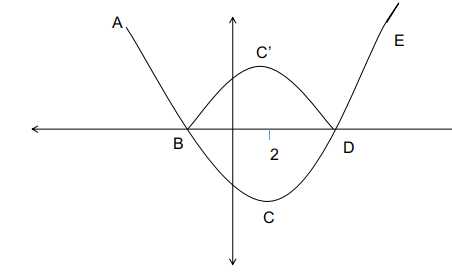
If r is a constant such that $$\mid x^2 - 4x - 13 \mid = r$$ has exactly three distinct real roots, then the value of r is
The quadratic equation of the form $$\mid x^2 - 4x - 13 \mid = r$$ has its minimum value at x = -b/2a, and hence does not vary irrespective of the value of x.
Hence at x = 2 the quadratic equation has its minimum.
Considering the quadratic part : $$\left|x^2-4\cdot x-13\right|$$. as per the given condition, this must-have 3 real roots.
The curve ABCDE represents the function $$\left|x^2-4\cdot x-13\right|$$. Because of the modulus function, the representation of the quadratic equation becomes :
ABC'DE.
There must exist a value, r such that there must exactly be 3 roots for the function. If r = 0 there will only be 2 roots, similarly for other values there will either be 2 or 4 roots unless at the point C'.
The point C' is a reflection of C about the x-axis. r is the y coordinate of the point C' :
The point C which is the value of the function at x = 2, = $$2^2-8-13$$
= -17, the reflection about the x-axis is 17.
Alternatively,
$$\mid x^2 - 4x - 13 \mid = r$$ .
This can represented in two parts :
$$x^2-4x-13\ =\ r\ if\ r\ is\ positive.$$
$$x^2-4x-13\ =\ -r\ if\ r\ is\ negative.$$
Considering the first case : $$x^2-4x-13\ =r$$
The quadraticequation becomes : $$x^2-4x-13-r\ =\ 0$$
The discriminant for this function is : $$b^2-4ac\ =\ 16-\ \left(4\cdot\left(-13-r\right)\right)=68+4r$$
SInce r is positive the discriminant is always greater than 0 this must have two distinct roots.
For the second case :
$$x^2-4x-13+r\ =\ 0$$ the function inside the modulus is negaitve
The discriminant is $$16\ -\ \left(4\cdot\left(r-13\right)\right)\ =\ 68-4r$$
In order to have a total of 3 roots, the discriminant must be equal to zero for this quadratic equation to have a total of 3 roots.
Hence $$\ 68-4r\ =\ 0$$
r = 17, for r = 17 we can have exactly 3 roots.
Let m and n be positive integers, If $$x^{2}+mx+2n=0$$ and $$x^{2}+2nx+m=0$$ have real roots, then the smallest possible value of $$m+n$$ is
To have real roots the discriminant should be greater than or equal to 0.
So, $$m^2-8n\ge0\ \&\ 4n^2-4m\ge0$$
=> $$m^2\ge8n\ \&\ n^2\ge m$$
Since m,n are positive integers the value of m+n will be minimum when m=4 and n=2.
.'. m+n=6.
How many disticnt positive integer-valued solutions exist to the equation $$(x^{2}-7x+11)^{(x^{2}-13x+42)}=1$$ ?
$$(x^{2}-7x+11)^{(x^{2}-13x+42)}=1$$
if $$(x^{2}-13x+42)$$=0 or $$(x^{2}-7x+11)$$=1 or $$(x^{2}-7x+11)$$=-1 and $$(x^{2}-13x+42)$$ is even number
For x=6,7 the value $$(x^{2}-13x+42)$$=0
$$(x^{2}-7x+11)$$=1 for x=5,2.
$$(x^{2}-7x+11)$$=-1 for x=3,4 and for X=3 or 4, $$(x^{2}-13x+42)$$ is even number.
.'. {2,3,4,5,6,7} is the solution set of x.
.'. x can take six values.
The number of distinct real roots of the equation $$(x+\frac{1}{x})^{2}-3(x+\frac{1}{x})+2=0$$ equals
Let $$a=x+\frac{1}{x}$$
So, the given equation is $$a^2-3a+2=0$$
So, $$a$$ can be either 2 or 1.
If $$a=1$$, $$x+\frac{1}{x}=1$$ and it has no real roots.
If $$a=2$$, $$x+\frac{1}{x}=2$$ and it has exactly one real root which is $$x=1$$
So, the total number of distinct real roots of the given equation is 1
The number of integers that satisfy the equality $$(x^{2}-5x+7)^{x+1}=1$$ is
$$\left(x^2-5x+7\right)^{x+1}=1$$
There can be a solution when $$\left(x^2-5x+7\right)=1$$ or $$x^2-5x\ +6=0$$
or x=3 and x=2
There can also be a solution when x+1 = 0 or x=-1
Hence three possible solutions exist.
The product of the distinct roots of $$\mid x^2 - x - 6 \mid = x + 2$$ is
We have, $$\mid x^2 - x - 6 \mid = x + 2$$
=> |(x-3)(x+2)|=x+2
For x<-2, (3-x)(-x-2)=x+2
=> x-3=1 =>x=4 (Rejected as x<-2)
For -2$$\le\ $$x<3, (3-x)(x+2)=x+2 =>x=2,-2
For x$$\ge\ $$3, (x-3)(x+2)=x+2 =>x=4
Hence the product =4*-2*2=-16
Let A be a real number. Then the roots of the equation $$x^2 - 4x - log_{2}{A} = 0$$ are real and distinct if and only if
The roots of $$x^2 - 4x - log_{2}{A} = 0$$ will be real and distinct if and only if the discriminant is greater than zero
16+4*$$log_{2}{A}$$ > 0
$$log_{2}{A}$$ > -4
A> 1/16
The quadratic equation $$x^2 + bx + c = 0$$ has two roots 4a and 3a, where a is an integer. Which of the following is a possible value of $$b^2 + c$$?
Given,
The quadratic equation $$x^2 + bx + c = 0$$ has two roots 4a and 3a
7a=-b
12$$a^2$$ = c
We have to find the value of $$b^2 + c = 49a^2+ 12a^2=61a^2$$
Now lets verify the options
61$$a^2$$ = 3721 ==> a= 7.8 which is not an integer
61$$a^2$$ = 361 ==> a= 2.42 which is not an integer
61$$a^2$$ = 427 ==> a= 2.64 which is not an integer
61$$a^2$$ = 549 ==> a= 3 which is an integer
The number of solutions to the equation $$\mid x \mid (6x^2 + 1) = 5x^2$$ is
For x <0, -x($$6x^2+1$$) = $$5x^2$$
=> ($$6x^2+1$$) = -5x
=> ($$6x^2 + 5x+ 1$$) = 0
=>($$6x^2 + 3x+2x+ 1$$) = 0
=> (3x+1)(2x+1)=0 =>x=$$\ -\frac{\ 1}{3}$$ or x=$$\ -\frac{\ 1}{2}$$
For x=0, LHS=RHS=0 (Hence, 1 solution)
For x >0, x($$6x^2+1$$) = $$5x^2$$
=> ($$6x^2 - 5x+ 1$$) = 0
=>(3x-1)(2x-1)=0 =>x=$$\ \frac{\ 1}{3}$$ or x=$$\ \frac{\ 1}{2}$$
Hence, the total number of solutions = 5
If $$U^{2}+(U-2V-1)^{2}$$= −$$4V(U+V)$$ , then what is the value of $$U+3V$$ ?
Given that $$U^{2}+(U-2V-1)^{2}$$= −$$4V(U+V)$$
$$\Rightarrow$$ $$U^{2}+(U-2V-1)(U-2V-1)$$= −$$4V(U+V)$$
$$\Rightarrow$$ $$U^{2}+(U^2-2UV-U-2UV+4V^2+2V-U+2V+1)$$ = −$$4V(U+V)$$
$$\Rightarrow$$ $$U^{2}+(U^2-4UV-2U+4V^2+4V+1)$$ = −$$4V(U+V)$$
$$\Rightarrow$$ $$2U^2-4UV-2U+4V^2+4V+1=−4UV-4V^2$$
$$\Rightarrow$$ $$2U^2-2U+8V^2+4V+1=0$$
$$\Rightarrow$$ $$2[U^2-U+\dfrac{1}{4}]+8[V^2+\dfrac{V}{2}+\dfrac{1}{16}]=0$$
$$\Rightarrow$$ $$2(U-\dfrac{1}{2})^2+8(V+\dfrac{1}{4})^2=0$$
Sum of two square terms is zero i.e. individual square term is equal to zero.
$$U-\dfrac{1}{2}$$ = 0 and $$V+\dfrac{1}{4}$$ = 0
U = $$\dfrac{1}{2}$$ and V = $$-\dfrac{1}{4}$$
Therefore, $$U+3V$$ = $$\dfrac{1}{2}$$+$$\dfrac{-1*3}{4}$$ = $$\dfrac{-1}{4}$$. Hence, option C is the correct answer.
If a and b are integers such that $$2x^2−ax+2>0$$ and $$x^2−bx+8≥0$$ for all real numbers $$x$$, then the largest possible value of $$2a−6b$$ is
Let f(x) = $$2x^2−ax+2$$. We can see that f(x) is a quadratic function.
For, f(x) > 0, Discriminant (D) < 0
$$\Rightarrow$$ $$(-a)^2-4*2*2<0$$
$$\Rightarrow$$ (a-4)(a+4)<0
$$\Rightarrow$$ a $$\epsilon$$ (-4, 4)
Therefore, integer values that 'a' can take = {-3, -2, -1, 0, 1, 2, 3}
Let g(x) = $$x^2−bx+8$$. We can see that g(x) is also a quadratic function.
For, g(x)≥0, Discriminant (D) $$\leq$$ 0
$$\Rightarrow$$ $$(-b)^2-4*8*1<0$$
$$\Rightarrow$$ $$(b-\sqrt{32})(b+\sqrt{32})<0$$
$$\Rightarrow$$ b $$\epsilon$$ (-$$\sqrt{32}$$, $$\sqrt{32}$$)
Therefore, integer values that 'b' can take = {-5, -4, -3, -2, -1, 0, 1, 2, 3, 4, 5}
We have to find out the largest possible value of $$2a−6b$$. The largest possible value will occur when 'a' is maximum and 'b' is minimum.
a$$_{max}$$ = 3, b$$_{min}$$ = -5
Therefore, the largest possible value of $$2a−6b$$ = 2*3 - 6*(-5) = 36.
If $$x+1=x^{2}$$ and $$x>0$$, then $$2x^{4}$$ is
We know that $$x^2 - x - 1=0$$
Therefore $$x^4 = (x+1)^2 = x^2+2x+1 = x+1 + 2x+1 = 3x+2$$
Therefore, $$2x^4 = 6x+4$$
We know that $$x>0$$ therefore, we can calculate the value of $$x$$ to be $$\frac{1+\sqrt{5}}{2}$$
Hence, $$2x^4 = 6x+4 = 3+3\sqrt{5}+4 = 3\sqrt{5}+7$$
If the roots of the equation $$x^3 - ax^2 + bx - c = 0$$ are three consecutive integers, then what is the smallest possible value of b?
b = sum of the roots taken 2 at a time.
Let the roots be n-1, n and n+1.
Therefore, $$b = (n-1)n + n(n+1) + (n+1)(n-1) = n^2 - n + n^2 + n + n^2 - 1$$
$$b = 3n^2 - 1$$. The smallest value is -1.
A quadratic function f(x) attains a maximum of 3 at x = 1. The value of the function at x = 0 is 1. What is the value of f (x) at x = 10?
Let the function be $$ax^2 + bx + c$$.
We know that x=0 value is 1 so c=1.
So equation is $$ax^2 + bx + 1$$.
Now max value is 3 at x = 1.
So after substituting we get a + b = 2.
If f(x) attains a maximum at 'a' then the differential of f(x) at x=a, that is, f'(a)=0.
So in this question f'(1)=0
=> 2*(1)*a+b = 0
=> 2a+b = 0.
Solving the equations we get a=-2 and b=4.
$$ -2x^2 + 4x + 1$$ is the equation and on substituting x=10, we get -159.
For which value of k does the following pair of equations yield a unique solution for x such that the solution is positive?
$$x^2 - y^2 = 0$$
$$(x-k)^2 + y^2 = 1$$
From 1st equation we know that $$(x)^2 = y^2 $$
Substituting this in 2nd equation. we get , $$2*x^2 - 2*x*k + k^2-1 =0 $$ and for unique solution $$b^2-4ac=0$$ must satisfy.
This is possible only when k = $$\sqrt{2}$$
Let p and q be the roots of the quadratic equation $$x^2 - (\alpha - 2) x - \alpha -1= 0$$ . What is the minimum possible value of $$p^2 + q^2$$?
Let $$\alpha $$ be equal to k.
=> f(x) = $$x^2-(k-2)x-(k+1) = 0$$
p and q are the roots
=> p+q = k-2 and pq = -1-k
We know that $$(p+q)^2 = p^2 + q^2 + 2pq$$
=> $$ (k-2)^2 = p^2 + q^2 + 2(-1-k)$$
=> $$p^2 + q^2 = k^2 + 4 - 4k + 2 + 2k$$
=> $$p^2 + q^2 = k^2 - 2k + 6$$
This is in the form of a quadratic equation.
The coefficient of $$k^2$$ is positive. Therefore this equation has a minimum value.
We know that the minimum value occurs at x = $$\frac{-b}{2a}$$
Here a = 1, b = -2 and c = 6
=> Minimum value occurs at k = $$\frac{2}{2}$$ = 1
If we substitute k = 1 in $$k^2-2k+6$$, we get 1 -2 + 6 = 5.
Hence 5 is the minimum value that $$p^2+q^2$$ can attain.
The number of real roots of the equation $$A^2/x + B^2/(x-1) = 1$$ , where A and B are real numbers not equal to zero simultaneously, is
The given equation can be written as : $$A^2 * (x-1) + B^2 * x = x^2 - x$$
=> $$x^2 + x(-1 - A^2 - B^2) + A^2 = 0$$
Discriminant of the equation = $$ (-1 - A^2 - B^2) ^2 - 4A^2$$
=$$ A^4 + B^4 + 1 - 2A^2 + 2B^2 + 2A^2B^2$$
= $$ A^4 + B^4 + 1 - 2A^2 - 2B^2 + 2A^2B^2 + 4B^2$$
= $$ (A^2 + B^2 - 1)^2 + 4B^2$$
>= 0, 0 when B =0 and A =1
Hence, the number of roots can be 1 or 2.
Option d) is the correct answer.
Davji Shop sells samosas in boxes of different sizes. The samosas are priced at Rs. 2 per samosa up to 200 samosas. For every additional 20 samosas, the price of the whole lot goes down by 10 paise per samosa. What should be the maximum size of the box that would maximise the revenue?
Let the optimum number of samosas be 200+20n
So, price of each samosa = (2-0.1*n)
Total price of all samosas = (2-0.1*n)*(200+20n) = $$400 - 20n + 40n - 2n^2$$ = $$400 + 20n - 2n^2$$
This quadratic equation attains a maximum at n = -20/2*(-2) = 5
So, the number of samosas to get the maximum revenue = 200 + 20*5 = 300
Ujakar and Keshab attempted to solve a quadratic equation. Ujakar made a mistake in writing down the constant term. He ended up with the roots (4, 3). Keshab made a mistake in writing down the coefficient of x. He got the roots as (3, 2). What will be the exact roots of the original quadratic equation?
We know that quadratic equation can be written as $$x^2$$-(sum of roots)*x+(product of the roots)=0.
Ujakar ended up with the roots (4, 3) so the equation is $$x^2$$-(7)*x+(12)=0 where the constant term is wrong.
Keshab got the roots as (3, 2) so the equation is $$x^2$$-(5)*x+(6)=0 where the coefficient of x is wrong .
So the correct equation is $$x^2$$-(7)*x+(6)=0. The roots of above equations are (6,1).
If the equation $$x^3 - ax^2 + bx - a = 0$$ has three real roots, then it must be the case that,
It can be clearly seen that if b=1 then $$x^2(x - a) + (x - a) = 0$$ an the equation gives only 1 real value of x
If the roots $$x_1$$ and $$x_2$$ are the roots of the quadratic equation $$x^2 -2x+c=0$$ also satisfy the equation $$7x_2 - 4x_1 = 47$$, then which of the following is true?
$$x_1 + x_2 = 2$$
and $$7x_2 - 4x_1 = 47$$
So $$x_1 = -3$$ and $$x_2 = 5$$
And $$c = x_1 \times x_2 = -15$$
Given the quadratic equation $$x^2 - (A - 3)x - (A - 2)$$, for what value of $$A$$ will the sum of the squares of the roots be zero?
For summation of square of roots to be zero, individual roots should be zero.
Hence summation should be zero i.e. A-3=0 ; A = 3
And product of roots will also be zero i.e. A-2 = 0 ; A =2
So there is no unique value of A which can satisfy above equation.
The value of $$\frac{(1-d^3)}{(1-d)}$$ is
$$\frac{(1-d^3)}{(1-d)}$$ = $$1+d^2+d$$ (where $$d \neq 1$$)
Let's say $$f(d)=1+d^2+d$$
Now $$f(d)$$ will always be greater than 0 and have its minimum value at d = -0.5. The value is $$\frac{3}{4}$$.
For $$d<-1$$ ; $$f(d) >1$$
$$-1<d<0$$ ; $$\frac{3}{4} <f(d)<1$$
$$0<d<1$$ ; $$1<f(d)<3$$
$$d>1$$ ; $$f(d)>3$$
So, for d > 1, f(d) > 3. Option b) is the correct answer.
The roots of the equation $$ax^{2} + 3x + 6 = 0$$ will be reciprocal to each other if the value of a is
If roots of given equation are reciprocal to each other than product of roots should be equal to 1.
i.e. $$\frac{6}{a} = 1$$
hence a=6
If $$xy + yz + zx = 0$$, then $$(x + y + z)^2$$ equals
$$(x+y+z)^2 = x^2 + y^2 + z^2 + 2(xy + yz + xz)$$
as $$xy+yz+xz = 0$$
so equation will be resolved to $$x^2 + y^2 + z^2$$
Frequently Asked Questions
Quadratic Equations are a core Algebra topic and frequently appear in CAT, often testing concepts like roots, inequalities, and factorization.
Focus on roots of equations, nature of roots, relationships between roots and coefficients, and factorization techniques.
Start with basic problems, then move to application-based and mixed questions. Regular practice helps improve speed and confidence.
Not always. Many questions can be solved using logic, factorization, or properties of roots without lengthy calculations.
Algebra has a consistent presence in CAT, and Quadratic Equations are a frequently tested subtopic.
Avoid sign errors, incorrect factorization, and misinterpreting the nature of roots. Practice helps reduce such errors.