The monthly sales of a product from January to April were 120, 135, 150 and 165 units, respectively. The cost price of the product was Rs. 240 per unit, and a fixed marked price was used for the product in all the four months. Discounts of 20%, 10% and 5% were given on the marked price per unit in January, February and March, respectively, while no discounts were given in April. If the total profit from January to April was Rs. 138825, then the marked price per unit, in rupees, was

CAT Percentages Questions
The total number of products is $$120+135+150+165= 570$$. Therefore, the total cost must have been $$570\times 240 = 136800$$
Let the marked price for the products be $$X$$. The January, February, March, and April, selling prices would respectively be $$0.8X$$, $$0.9X$$, $$0.95X$$, and $$X$$; based on the discounts given on each of the months.
The revenue earned from selling the products in each of the months would be: $$120*0.8X + 135*0.9X + 150*0.95X + 165*X = 525X$$.
The profit earned would be: Revenue - Cost, and therefore,
$$525X - 136800 = 138825$$
$$525X = 275625$$
$$X = \dfrac{275625}{525} = 525$$
The correct answer is option B, Rs. 525.
In a class, there were more than 10 boys and a certain number of girls. After 40% of the girls and 60% of the boys left the class, the remaining number of girls was 8 more than the remaining number of boys. Then, the minimum possible number of students initially in the class was
Let say number of girls be $$g$$ and number of boys be $$b$$.
If 40% of the girls left, remaining number of girls = $$0.6g$$
Also if 60% of the boys left, remaining number of boys = $$0.4b$$
or, $$0.6g=0.4b+8$$
or, $$6g=4b+80$$
or, $$3g=2b+40$$
So, the possible values of (b,g) are: (13,22),(16,24),(19,26),(22,28),(25,30),.....
Now, $$0.6g$$ and $$0.4b$$ has to be an integer.
So, for this $$g$$ and $$b$$ has to be a multiple of 5
So, $$b=25$$ and $$g=30$$
So, minimum possible number of students = $$25+30=55$$
Kamala divided her investment of Rs 100000 between stocks, bonds, and gold. Her investment in bonds was 25% of her investment in gold. With annual returns of 10%, 6%, 8% on stocks, bonds, and gold, respectively, she gained a total amount of Rs 8200 in one year. The amount, in rupees, that she gained from the bonds, was
Let the amounts invested in Stocks be S, Bonds B, and, Gold be G
Given that $$S + B + G = 100000, B = 0.25G$$
$$0.10S + 0.06B + 0.08G = 8200$$
Substitute S = 100000 - B - G = 100000 - 1.25G
$$0.10(100000 - 1.25G) + 0.06(0.25G) + 0.08G = 8200$$
$$10000 - 0.125G + 0.015G + 0.08G = 8200$$
$$10000 - 0.03G = 8200$$
$$ 0.03G = 1800 \Rightarrow G = 60000$$
$$B = 0.25G = 15000$$
Gain from bonds = $$0.06 \times 15000 = 900$$
A certain amount of money was divided among Pinu, Meena, Rinu and Seema. Pinu received 20% of the total amount and Meena received 40% of the remaining amount. If Seema received 20% less than Pinu, the ratio of the amounts received by Pinu and Rinu is
Let the total amount be 100 units (taking 100 makes percentage calculations easy).
Pinu receives 20% of the total, so Pinu gets 20 units.
The amount left after giving Pinu his share is 100 - 20 = 80 units.
Meena receives 40% of this remaining amount, so Meena gets 40% of 80 = 32 units.
Now, the amount left for Rinu and Seema together is 80 - 32 = 48 units.
Seema receives 20% less than Pinu. Since Pinu gets 20 units, Seema gets
20 - 20% of 20 = 20 - 4 = 16 units.
Out of the 48 units left for Rinu and Seema, Seema’s share is 16 units, so Rinu gets
48 - 16 = 32 units.
Therefore, Pinu receives 20 units, and Rinu gets 32 units.
The required ratio of the amounts received by Pinu : Rinu = 20 : 32 = 5 : 8.
In a group of 250 students, the percentage of girls was at least 44% and at most 60%.The rest of the students were boys. Each student opted for either swimming or running or both. If 50% of the boys and 80% of the girls opted for swimming while 70%of the boys and 60% of the girls opted for running, then the minimum and maximum possible number of students who opted for both swimming and running, are
Total number of students is 250, and we are told that, The percentage of girls was at least 44% and at most 60%.
So the number of girls range from, $$0.44\left(250\right)\le Girls\le0.6\left(250\right)$$
$$110\le Girls\le150$$
Statement 1:
If 50% of the boys and 80% of the girls opted for swimming, that means if the total number of Boys is B, Girls is G where B+G=250.
Swimming is: 0.5B+0.8G
Statement 2:
If 70%of the boys and 60% of the girls opted for running, that means
Running is 0.7B+0.6G
Total number of enrolments for swimming and running together will be
(0.7B+0.6G)+(0.5B+0.8G)=1.2B+1.4G
Using the overlapping principle, where I represents people who have enrolled only for one activity and II represents number of people who have enrolled for two activities.
We know that, $$I+II=250=B+G$$
$$I+2II=1.2B+1.4G$$
Subtracting the two equations,
$$II=0.2B+0.4G$$
$$II=0.2\left(B+2G\right)$$
Using B+G=250
$$II=0.2\left(250+G\right)$$
G can at-most be 150 and at least 110.
So maximum value of II will be $$0.2\left(250+150\right)=80$$
Minimum value of II will be $$0.2\left(250+110\right)=72$$
In September, the incomes of Kamal, Amal and Vimal are in the ratio 8 ∶ 6 ∶ 5. They rent a house together, and Kamal pays 15%, Amal pays 12% and Vimal pays 18% of their respective incomes to cover the total house rent in that month. In October, the house rent remains unchanged while their incomes increase by 10%, 12% and 15%, respectively. In October, the percentage of their total income that will be paid as house rent, is nearest to
We are told that, the incomes of Kamal, Amal and Vimal are in the ratio 8 ∶ 6 ∶ 5
Lets assume them to be 80X, 60X, 50X respectively.
Money that each one of them pays towards rent,
Kamal 15% which comes to 12X
Amal 12% which comes to 7.2X
Vimal 18% which comes to 9X
Total Rental expenditure will be, 28.2X
Their incomes increase by 10%, 12% and 15% respectively,
Kamal 10% which comes to 88X
Amal 12% which comes to 67.2X
Vimal 15% which comes to 57.5X
Total income will be 212.7X
We are told the rent is the same, so it will be 28.2X
Percentage of income going towards rent in October will be, $$\frac{28.2X}{212.7X}=0.13258$$
Hence, the answer is 13.26%
In a company, 20% of the employees work in the manufacturing department. If the total salary obtained by all the manufacturing employees is one-sixth of the total salary obtained by all the employees in the company, then the ratio of the average salary obtained by the manufacturing employees to the average salary obtained by the nonmanufacturing employees is
Let the number of total employees in the company be 100x, and the total salary of all the employees be 100y.
It is given that 20% of the employees work in the manufacturing department, and the total salary obtained by all the manufacturing employees is one-sixth of the total salary obtained by all the employees in the company.
Hence, the total number of employees in the manufacturing department is 20x, and the total salary received by them is (100y/6)
Average salary in the manufacturing department = (100y/6*20x) = 5y/6x
Similarly, the total number of employees in the nonmanufacturing department is 80x, and the total salary received by them is (500y/6)
Hence, the average salary in the nonmanufacturing department = (500y/6*80x) = 25y/24x
Hence, the ratio is:- (5y/6x): (25y/24x)
=> 120: 150 = 4:5
The correct option is B
The salaries of three friends Sita, Gita and Mita are initially in the ratio 5 : 6 : 7, respectively. In the first year, they get salary hikes of 20%, 25% and 20%, respectively. In the second year, Sita and Mita get salary hikes of 40% and 25%, respectively, and the salary of Gita becomes equal to the mean salary of the three friends. The salary hike of Gita in the second year is
Given, the salaries of Sita, Gita and Mita are initially in the ratio 5 : 6 : 7, respectively, Let us assume their salaries are 5p, 6p and 7p.
They get salary hikes of 20%, 25% and 20%, respectively.
=> Their salaries are 6/5 * 5p, 5/4 * 6p and 6/5 * 7p => 6p, 7.5p, 8.4p
Now, Sita and Mita get salary hikes of 40% and 25%, respectively
=> Sita's salary = 1.4 * 6p = 8.4p and Mita's salary = 1.25 * 8.4p = 10.5p
Let Gita's salary be 'g' after hike
=> 3g = 8.4p + g + 10.5p => 2g = 18.9p => g = 9.45p
=> Hike % = $$\dfrac{\left(9.45-7.5\right)}{7.5}\times\ 100$$ = 26%
In an election, there were four candidates and 80% of the registered voters casted their votes. One of the candidates received 30% of the casted votes while the other three candidates received the remaining casted votes in the proportion 1 : 2 : 3. If the winner of the election received 2512 votes more than the candidate with the second highest votes, then the number of registered voters was
Let the number of registered votes be 100x
The number of votes casted = 80x
Votes received by one of the candidates = $$\frac{30}{100}\times80x$$ = 24x
Remaining votes = 80x - 24x = 56x
Votes received by other three candidates is $$\frac{56x}{6},\frac{2\times56x}{6},\ \frac{\ 3\times56x}{6}$$
It is given,
28x - 24x = 2512
4x = 2512
x = 628
The number of registered votes = 100x = 62800
The answer is option D.
In a tournament, a team has played 40 matches so far and won 30% of them. If they win 60% of the remaining matches, their overall win percentage will be 50%. Suppose they win 90% of the remaining matches, then the total number of matches won by the team in the tournament will be
Initially number of matches = 40
Now matches won = 12
Now let remaining matches be x
Now number of matches won = 0.6x
Now as per the condition :
$$\frac{\left(12+0.6x\right)}{40+x}=\frac{1}{2}$$
24 +1.2x=40+x
0.2x=16
x=80
Now when they won 90% of remaining = 80(0.9) =72
So total won = 84
The total of male and female populations in a city increased by 25% from 1970 to 1980. During the same period, the male population increased by 40% while the female population increased by 20%. From 1980 to 1990, the female population increased by 25%. In 1990, if the female population is twice the male population, then the percentage increase in the total of male and female populations in the city from 1970 to 1990 is
Let us solve this question by assuming values(multiples of 100) and not variables(x).
Since we know that the female population was twice the male population in 1990, let us assume their respective values as 200 and 100.
Note that while assuming numbers, some of the population values might come out as a fraction(which is not possible, since the population needs to be a natural number). However, this would not affect our answer, since the calculations are in ratios and percentages and not real values of the population in any given year.
Now, we know that the female population became 1.25 times itself in 1990 from what it was in 1980.
Hence, the female population in 1980 = 200/1.25 = 160
Also, the female population became 1.2 times itself in 1980 from what it was in 1970.
Hence, the female population in 1970 = 160/1.2 = 1600/12 = 400/3
Let the male population in 1970 be x. Hence, the male population in 1980 is 1.4x.
Now, the total population in 1980 = 1.25 times the total population in 1970.
Hence, 1.25 (x + 400/3) = 1.4x + 160
Hence, x = 400/9.
Population change = 300 - 400/9 - 400/3 = 300 - 1600/9 = 1100/9
percentage change = $$\frac{\frac{1100}{9}}{\frac{1600}{9}}\times\ 100\ =\ \frac{1100}{16}\%=68.75\%$$
If a certain weight of an alloy of silver and copper is mixed with 3 kg of pure silver, the resulting alloy will have 90% silver by weight. If the same weight of the initial alloy is mixed with 2 kg of another alloy which has 90% silver by weight, the resulting alloy will have 84% silver by weight. Then, the weight of the initial alloy, in kg, is
Let the alloy contain x Kg silver and y kg copper
Now when mixed with 3Kg Pure silver
we get $$\frac{\left(x+3\right)}{x+y+3}=\frac{9}{10}$$
we get 10x+30 =9x+9y+27
9y-x=3 (1)
Now as per condition 2
silver in 2nd alloy = 2(0.9) =1.8
so we get$$\frac{\left(x+1.8\right)}{x+y+2}=\frac{21}{25}$$
we get 21y-4x =3 (2)
solving (1) and (2) we get y= 0.6 and x =2.4
so x+y = 3
A box has 450 balls, each either white or black, there being as many metallic white balls as metallic black balls. If 40% of the white balls and 50% of the black balls are metallic, then the number of non-metallic balls in the box is
Let the number of white balls be x and black balls be y
So we get x+y =450 (1)
Now metallic black balls = 0.5y
Metallic white balls = 0.4x
From condition 0.4x=0.5y
we get 4x-5y=0 (2)
Solving (1) and (2) we get
x=250 and y =200
Now number of Non Metallic balls = 0.6x+0.5y = 150+100 = 250
The strength of an indigo solution in percentage is equal to the amount of indigo in grams per 100 cc of water. Two 800 cc bottles are filled with indigo solutions of strengths 33% and 17%, respectively. A part of the solution from the first bottle is thrown away and replaced by an equal volume of the solution from the second bottle. If the strength of the indigo solution in the first bottle has now changed to 21% then the volume, in cc, of the solution left in the second bottle is
Let Bottle A have an indigo solution of strength 33% while Bottle B have an indigo solution of strength 17%.
The ratio in which we mix these two solutions to obtain a resultant solution of strength 21% : $$\frac{A}{B}=\frac{21-17}{33-21}=\frac{4}{12}or\ \frac{1}{3}$$
Hence, three parts of the solution from Bottle B is mixed with one part of the solution from Bottle A. For this process to happen, we need to displace 600 cc of solution from Bottle A and replace it with 600 cc of solution from Bottle B {since both bottles have 800 cc, three parts of this volume = 600cc}.As a result, 200 cc of the solution remains in Bottle B.
Hence, the correct answer is 200 cc.
Identical chocolate pieces are sold in boxes of two sizes, small and large. The large box is sold for twice the price of the small box. If the selling price per gram of chocolate in the large box is 12% less than that in the small box, then the percentage by which the weight of chocolate in the large box exceeds that in the small box is nearest to
Let the selling price of the Large and Small boxes of chocolates be Rs.200 and Rs.100 respectively. Let us consider that the Large box has $$L$$ grams of chocolate while the Small box has $$S$$ grams of chocolate.
The relation between the selling price per gram of chocolate can be represented as: $$\frac{200}{L}=0.88\times\ \frac{100}{S}$$
On solving we obtain the ratio of the amount of chocolate in each box as: $$\frac{L}{S}=\frac{25}{11}$$
The percentage by which the weight of chocolate in the large box exceeds that in the small box = $$\left(\frac{25}{11}-1\right)\times\ 100\approx\ 127\%$$
Two alcohol solutions, A and B, are mixed in the proportion 1:3 by volume. The volume of the mixture is then doubled by adding solution A such that the resulting mixture has 72% alcohol. If solution A has 60% alcohol, then the percentage of alcohol in solution B is
Initially let's consider A and B as one component
The volume of the mixture is doubled by adding A(60% alcohol) i.e they are mixed in 1:1 ratio and the resultant mixture has 72% alcohol.
Let the percentage of alcohol in component 1 be 'x'.
Using allegations , $$\frac{\left(72-60\right)}{x-72}=\frac{1}{1}$$ => x= 84
Percentage of alcohol in A = 60% => Let's percentage of alcohol in B = x%
The resultant mixture has 84% alcohol. ratio = 1:3
Using allegations , $$\frac{\left(x-84\right)}{84-60}=\frac{1}{3}$$
=> x= 92%
The strength of a salt solution is p% if 100 ml of the solution contains p grams of salt. Each of three vessels A, B, C contains 500 ml of salt solution of strengths 10%, 22%, and 32%, respectively. Now, 100 ml of the solution in vessel A is transferred to vessel B. Then, 100 ml of the solution in vessel B is transferred to vessel C. Finally, 100 ml of the solution in vessel C is transferred to vessel A. The strength, in percentage, of the resulting solution in vessel A is
Each of three vessels A, B, C contains 500 ml of salt solution of strengths 10%, 22%, and 32%, respectively.
The amount of salt in vessels A, B, C = 50 ml, 110 ml, 160 ml respectively.
The amount of water in vessels A, B, C = 450 ml, 390 ml, 340 ml respectively.
In 100 ml solution in vessel A, there will be 10ml of salt and 90 ml of water
Now, 100 ml of the solution in vessel A is transferred to vessel B. Then, 100 ml of the solution in vessel B is transferred to vessel C. Finally, 100 ml of the solution in vessel C is transferred to vessel A
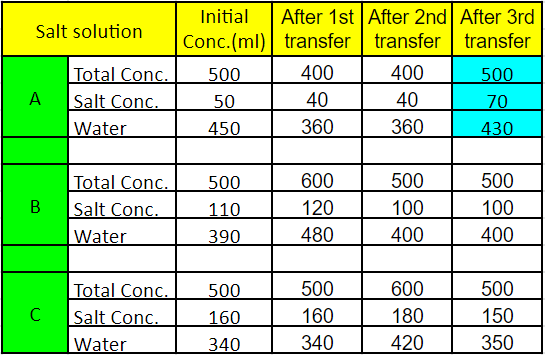
i.e after the first transfer, the amount of salt in vessels A, B, C = 40, 120, 160 ml respectively.
after the second transfer, the amount of salt in vessels A, B, C =40, 100, 180 ml respectively.
After the third transfer, the amount of salt in vessels A, B, C = 70, 100, 150 respectively.
Each transfer can be captured through the following table.
Percentage of salt in vessel A =$$\ \frac{\ 70}{500}\times\ 100$$
=14%
In a class, 60% of the students are girls and the rest are boys. There are 30 more girls than boys. If 68% of the students, including 30 boys, pass an examination, the percentage of the girls who do not pass is
Assuming the number of students =100x
Hence, the number of girls = 60x and the number of boys = 40x
We have, 60x-40x=30 => x=1.5
The number of girls = 60*1.5=90
Number of girls that pass = 68x-30=68*1.5-30 = 102-30=72
The number of girls who do not pass = 90-72=18
Hence the percentage of girls who do not pass = 1800/90=20
John gets Rs 57 per hour of regular work and Rs 114 per hour of overtime work. He works altogether 172 hours and his income from overtime hours is 15% of his income from regular hours. Then, for how many hours did he work overtime?
It is given that John works altogether 172 hours i.e including regular and overtime hours.
Let a be the regular hours, 172-a will be the overtime hours
John's income from regular hours = 57*a
John's income for working overtime hours = (172-a)*114
It is given that his income from overtime hours is 15% of his income from regular hours
a*57*0.15 = (172-a)*114
a=160
The number of hours for which he worked overtime = 172-160=12 hrs
In an examination, the score of A was 10% less than that of B, the score of B was 25% more than that of C, and the score of C was 20% less than that of D. If A scored 72, then the score of D was
Let the score of D = 100d
The score of C = 20% less than that of D = 80d
The score of B = 25% more than C = 100d
The score of A = 10% less than B =90d
90d=72
100d= 72*100/90
= 80
The salaries of Ramesh, Ganesh and Rajesh were in the ratio 6:5:7 in 2010, and in the ratio 3:4:3 in 2015. If Ramesh’s salary increased by 25% during 2010-2015, then the percentage increase in Rajesh’s salary during this period is closest to
Let the salaries of Ramesh, Ganesh and Rajesh in 2010 be 6x, 5x, 7x respectively
Let the salaries of Ramesh, Ganesh and Rajesh in 2015 be 3y, 4y, 3y respectively
It is given that Ramesh’s salary increased by 25% during 2010-2015,3y = 1.25*6x
y=2.5x
Percentage increase in Rajesh's salary = 7.5-7/7=0.07
=7%
In an examination, the maximum possible score is N while the pass mark is 45% of N. A candidate obtains 36 marks, but falls short of the pass mark by 68%. Which one of the following is then correct?
Total marks = N
Pass marks = 45% of N = 0.45N
Marks obtained = 36
It is given that, obtained marks is 68% less than that pass marks
=>the obtained marks is 32% of the pass marks.
So, 0.32 * 0.45N = 36
On solving, we get N = 250
Hence, option B is the correct answer.
A 20% ethanol solution is mixed with another ethanol solution, say, S of unknown concentration in the proportion 1:3 by volume. This mixture is then mixed with an equal volume of 20% ethanol solution. If the resultant mixture is a 31.25% ethanol solution, then the unknown concentration of S is
Let the volume of the first and the second solution be 100 and 300.
When they are mixed, quantity of ethanol in the mixture
= (20 + 300S)
Let this solution be mixed with equal volume i.e. 400 of third solution in which the strength of ethanol is 20%.
So, the quantity of ethanol in the final solution
= (20 + 300S + 80) = (300S + 100)
It is given that, 31.25% of 800 = (300S + 100)
or, 300S + 100 = 250
or S = $$\frac{1}{2}$$ = 50%
Hence, 50 is the correct answer.
Arun's present age in years is 40% of Barun's. In another few years, Arun's age will be half of Barun's. By what percentage will Barun's age increase during this period?
Let Arun's current age be A. Hence, Barun's current age is 2.5A
Let Arun's age be half of Barun's age after X years.
Therefore, 2*(X+A) = 2.5A + X
Or, X = 0.5A
Hence, Barun's age increased by 0.5A/2.5A = 20%
The number of girls appearing for an admission test is twice the number of boys. If 30% of the girls and 45% of the boys get admission, the percentage of candidates who do not get admission is
Let the number of girls be 2x and number of boys be x.
Girls getting admission = 0.6x
Boys getting admission = 0.45x
Number of students not getting admission = 3x - 0.6x -0.45x = 1.95x
Percentage = (1.95x/3x) * 100 = 65%
In a village, the production of food grains increased by 40% and the per capita production of food grains increased by 27% during a certain period. The percentage by which the population of the village increased during the same period is nearest to
Let initial population and production be x,y and final population be z
Final production = 1.4y, final percapita = 1.27 times initial percapita
=> $$\frac{1.4y}{z} $$ = $$ 1.27 \times \frac{y}{x}$$
=> $$\frac{z}{x} = \frac{1.4}{1.27} \approx 1.10$$
Hence the percentage increase in population = 10%
Let A and B be two solid spheres such that the surface area of B is 300% higher than the surface area of A. The volume of A is found to be k% lower than the volume of B. The value of k must be
Surface area of sphere A (of radius a) is $$4\pi*a^2$$
Surface area of sphere B (of radius b) is $$4\pi*b^2$$
=> $$4\pi*a^2$$/$$4\pi*b^2$$ = 1/4 => a:b = 1:2
Their volumes would be in the ratio 1:8
Therefore, k = 7/8 * 100% = 87.5%
Flights A and B are scheduled from an airport within the next one hour. All the booked passengers of the two flights are waiting in the boarding hall after check-in. The hall has a seating capacity of 200, out of which 10% remained vacant. 40% of the waiting passengers are ladies. When boarding announcement came, passengers of flight A left the hall and boarded the flight. Seating capacity of each flight is two-third of the passengers who waited in the waiting hall for both the flights put together. Half the passengers who boarded flight A are women. After boarding for flight A, 60% of the waiting hall seats became empty. For every twenty of those who are still waiting in the hall for flight B, there is one air hostess in flight A. What is the ratio of empty seats in flight B to the number of air hostesses in flight A?
Out of 200 of the seating capacity, 180 seats are filled out of which 108 are males and 72 are females. Remaining 20 seats are vacant. According to given condition seating capacity in both the planes is 120 . Considering flight A - we can find that 100 passenger in waiting hall will be taking fight A . So 80 people remain in in the waiting hall who will be taking flight B . Now for every 20 people taking flight B we have a air hostess in flight A . So in total there are 4 air hostess in flight A. Flight B having 120 as seating capacity, 40 remain vacant. So required ratio 40:4 = 10:1 .
A college has raised 75% of the amount it needs for a new building by receiving an average donation of Rs. 600 from the people already solicited. The people already solicited represent 60% of the people the college will ask for donations. If the college is to raise exactly the amount needed for the new building, what should be the average donation from the remaining people to be solicited?
Let there be total 100 people whom the college will ask for donation. Out of these 60 people have already given average donation of 600 Rs. Thus total amount generated by 60 people is 36000. This is 75% of total amount required . so the amount remaining is 12000 which should be generated from remaining 40 people. So average amount needed is 12000/40 = 300
Fresh grapes contain 90% water by weight while dried grapes contain 20% water by weight and the remaining proportion being pulp. What is the weight of dry grapes available from 20 kg of fresh grapes?
Fresh grapes contain 90% water so water in 20kg of fresh pulp = (90/100)x20= 18kg.
In 20kg fresh grapes, the weight of water is 18kg and the weight of pulp is 2kg.
The concept that we apply in this question is that the weight of pulp will remain the same in both dry and fresh grapes. If this grape is dried, the water content will change but pulp content will remain the same.
Suppose the weight of the dry grapes be D.
80% of the weight of dry grapes = weight of the pulp = 2 kg
(80/100) x D =2 kg.
D = 2.5 kg
A student took five papers in an examination, where the full marks were the same for each paper. His marks in these papers were in the proportion of 6 : 7 : 8 : 9 : 10. In all papers together, the candidate obtained 60% of the total marks. Then the number of papers in which he got more than 50% marks is
Let the marks in the five papers be 6k, 7k, 8k, 9k and 10k respectively.
So, the total marks in all the 5 papers put together is 40k. This is equal to 60% of the total maximum marks. So, the total maximum marks is 5/3 * 40k
So, the maximum marks in each paper is 5/3 * 40k / 5 = 40k/3 = 13.33k
50% of the maximum marks is 6.67k
So, the number of papers in which the student scored more than 50% is 4
Forty percent of the employees of a certain company are men, and 75 percent of the men earn more than Rs. 25,000 per year. If 45 percent of the company's employees earn more than Rs. 25,000 per year, what fraction of the women employed by the company earn Rs. 25,000 year or less'?
Let the number of employees be 100.
=> 40 men and 60 women.
Number of men getting more than 25000 = 30
Number of people getting more than 25000 = 45
Number of women getting more than 25000 = 45 - 30 = 15
Fraction of women getting less than 25000 = $$\frac{45}{60}$$ = $$\frac{3}{4}$$
Fresh grapes contain 90% water while dry grapes contain 20% water. What is the weight of dry grapes obtained from 20 kg fresh grapes?
Let the total weight of fresh grapes be 100 gm.
=> Fresh grapes have 90 gm of water and 10 gm of fruit.
When these grapes are dried, the amount of fruit does not change.
=> 10 grams will become 80% of the content in dry grapes
=> Weight of dry grapes = $$\frac{10}{0.8}$$ = 12.5 gm
So, the weight of fresh grapes reduces to 1/8th of its original weight.
=> 20 kg of fresh grapes give 2.5 kg of dry grapes.