In a class, there were more than 10 boys and a certain number of girls. After 40% of the girls and 60% of the boys left the class, the remaining number of girls was 8 more than the remaining number of boys. Then, the minimum possible number of students initially in the class was
CAT Averages, Ratio and Proportion Questions
Let say number of girls be $$g$$ and number of boys be $$b$$.
If 40% of the girls left, remaining number of girls = $$0.6g$$
Also if 60% of the boys left, remaining number of boys = $$0.4b$$
or, $$0.6g=0.4b+8$$
or, $$6g=4b+80$$
or, $$3g=2b+40$$
So, the possible values of (b,g) are: (13,22),(16,24),(19,26),(22,28),(25,30),.....
Now, $$0.6g$$ and $$0.4b$$ has to be an integer.
So, for this $$g$$ and $$b$$ has to be a multiple of 5
So, $$b=25$$ and $$g=30$$
So, minimum possible number of students = $$25+30=55$$
The average salary of 5 managers and 25 engineers in a company is 60000 rupees. If each of the managers received 20% salary increase while the salary of the engineers remained unchanged, the average salary of all 30 employees would have increased by 5%. The average salary, in rupees, of the engineers is
Let the average salary of managers be $$x$$ and let the average salary of engineers be $$y$$. The total salary of all the employees will be $$(5+25)*60000 = 1800000$$
We have, $$5x+25y = 1800000$$ .... (1)
If the average salary of all the employees increases by $$5\%$$, the total salary of all the employees will also increase by $$5\%$$, because the total number of employees remains the same. The new total salary will be, $$1800000\times 1.05 = 1890000$$
Also, the average salary of all the managers has increased by $$20\%$$ and has become $$1.2x$$, we have
$$5*1.2x + 25y = 1890000$$, or $$6x + 25y = 1890000$$ .... (2)
Subtracting equation (1) from equation (2), we get,
$$x = 90000$$
Which gives $$25y = 1800000 - 90000*5$$ or $$y = \dfrac{1350000}{25} = 54000$$
Therefore, the correct answer is option C.
The ratio of expenditures of Lakshmi and Meenakshi is 2 : 3, and the ratio of income of Lakshmi to expenditure of Meenakshi is 6 : 7. If excess of income over expenditure is saved by Lakshmi and Meenakshi, and the ratio of their savings is 4 : 9, then the ratio of their incomes is
Let Lakshmi's income = A and expenditure = B.
Let Meenakshi's income = C and expenditure = D.
From B:D = 2:3, take B = 2k and D = 3k.
From A:D = 6:7, $$A = \tfrac{6}{7} D = \tfrac{6}{7}\cdot 3k = \tfrac{18}{7}k$$.
Lakshmi's saving = $$A - B = \tfrac{18}{7}k - 2k = \tfrac{4}{7}k$$.
Let Meenakshi's saving $$= C - D = C - 3k$$. Given the savings ratio $$\frac{\frac{4k}{7}}{C-3k} = \tfrac{4}{9}$$.
Solve: $$\dfrac{4}{7}k\cdot\dfrac{9}{4} = C - 3k \Rightarrow \dfrac{9}{7}k = C - 3k \Rightarrow C = \dfrac{30}{7}k$$
So incomes ratio $$A:C = \dfrac{18}{7}k : \dfrac{30}{7}k = 18:30 = 3:5.$$
The ratio of the number of students in the morning shift and afternoon shift of a school was 13 : 9. After 21 students moved from the morning shift to the afternoon shift, this ratio became 19 : 14. Next, some new students joined the morning and afternoon shifts in the ratio 3 : 8 and then the ratio of the number of students in the morning shift and the afternoon shift became 5 : 4. The number of new students who joined is
Let M=13k, A=9k.
After 21 students were moved $$\frac{13k-21}{9k+21}=\frac{19}{14}\Rightarrow 14(13k-21)=19(9k+21)$$
So $$182k-294=171k+399\Rightarrow 11k=693\Rightarrow k=63$$
So, the number of students in the morning and afternoon shifts are $$819-21=798, 567+21=588$$ respectively.
Let's assume that $$3t$$ and $$8t$$ students joined the respective sessions.
$$\dfrac{798+3t}{588+8t}=\dfrac{5}{4}\Rightarrow 4(798+3t)=5(588+8t)$$
So $$3192+12t=2940+40t\Rightarrow 28t=252\Rightarrow t=9$$
Number of new students $$=11t=99$$
The ratio of the number of coins in boxes A and B was 17:7. After 108 coins were shifted from box A to box B, this ratio became 37:20. The number of coins that needs to be shifted further from A to B, to make this ratio 1:1, is
Let the initial total number of coins in box A be $$17x$$, since the ratio of the number of coins in boxes A and B is $$17:7$$, the initial total number of coins in box B would be $$7x$$.
After $$108$$ coins are shifted from box A to box B, the number of coins in box A would be $$17x-108$$ and in box B would be $$7x+108$$. We have,
$$\dfrac{17x-108}{7x+108} = \dfrac{37}{20}$$
$$\Rightarrow 340x - 2160 = 259x + 3996$$
$$\Rightarrow 81x = 6156$$ or $$x= 76$$
Therefore, the total number of coins in the two boxes combined are $$(17+7)*76 = 1824$$, half of which is $$912$$. The number of coins in box B currently is $$7*76+108 = 640$$. The number of coins needed to make the coins equal in both the boxes is, $$912-640 = 272$$.
Thus, $$272$$ coins will be transferred from box A to box B to make the number of coins equal (1:1) in both the boxes.
A certain amount of money was divided among Pinu, Meena, Rinu and Seema. Pinu received 20% of the total amount and Meena received 40% of the remaining amount. If Seema received 20% less than Pinu, the ratio of the amounts received by Pinu and Rinu is
Let the total amount be 100 units (taking 100 makes percentage calculations easy).
Pinu receives 20% of the total, so Pinu gets 20 units.
The amount left after giving Pinu his share is 100 - 20 = 80 units.
Meena receives 40% of this remaining amount, so Meena gets 40% of 80 = 32 units.
Now, the amount left for Rinu and Seema together is 80 - 32 = 48 units.
Seema receives 20% less than Pinu. Since Pinu gets 20 units, Seema gets
20 - 20% of 20 = 20 - 4 = 16 units.
Out of the 48 units left for Rinu and Seema, Seema’s share is 16 units, so Rinu gets
48 - 16 = 32 units.
Therefore, Pinu receives 20 units, and Rinu gets 32 units.
The required ratio of the amounts received by Pinu : Rinu = 20 : 32 = 5 : 8.
In a group of 250 students, the percentage of girls was at least 44% and at most 60%.The rest of the students were boys. Each student opted for either swimming or running or both. If 50% of the boys and 80% of the girls opted for swimming while 70%of the boys and 60% of the girls opted for running, then the minimum and maximum possible number of students who opted for both swimming and running, are
Total number of students is 250, and we are told that, The percentage of girls was at least 44% and at most 60%.
So the number of girls range from, $$0.44\left(250\right)\le Girls\le0.6\left(250\right)$$
$$110\le Girls\le150$$
Statement 1:
If 50% of the boys and 80% of the girls opted for swimming, that means if the total number of Boys is B, Girls is G where B+G=250.
Swimming is: 0.5B+0.8G
Statement 2:
If 70%of the boys and 60% of the girls opted for running, that means
Running is 0.7B+0.6G
Total number of enrolments for swimming and running together will be
(0.7B+0.6G)+(0.5B+0.8G)=1.2B+1.4G
Using the overlapping principle, where I represents people who have enrolled only for one activity and II represents number of people who have enrolled for two activities.
We know that, $$I+II=250=B+G$$
$$I+2II=1.2B+1.4G$$
Subtracting the two equations,
$$II=0.2B+0.4G$$
$$II=0.2\left(B+2G\right)$$
Using B+G=250
$$II=0.2\left(250+G\right)$$
G can at-most be 150 and at least 110.
So maximum value of II will be $$0.2\left(250+150\right)=80$$
Minimum value of II will be $$0.2\left(250+110\right)=72$$
A fruit seller has a stock of mangoes, bananas and apples with at least one fruit of each type. At the beginning of a day, the number of mangoes make up 40% of his stock. That day, he sells half of the mangoes, 96 bananas and 40% of the apples. At the end of the day, he ends up selling 50% of the fruits. The smallest possible total number of fruits in the stock at the beginning of the day is
(Note: This was a repeated question that appeared in both CAT 2023 and CAT 2024)
Let us assume the initial stock of all the fruits is S.
Let us take we have 'b' and 'a' mangoes initially.
Stock of Mangoes = 40% of S = 2S/5
The total number of fruits sold are Mangoes Sold + Apples Sold + Bananas Sold
= 2S/10 + 96 + 4a/10 = S/2 (Given)
=> S/5 + 96 + 2a/5 = S/2
=> S = $$\dfrac{\left(4a+960\right)}{3}$$
=> $$\dfrac{4a}{3}+320$$
'a' has to be a multiple of 3 for the above term to be an integer.
But 'a' has to be a multiple of 5 for 4a/10 to be an integer.
=> The smallest value of 'a' satisfying both conditions is 15.
=> $$\dfrac{4a}{3}+320=\dfrac{4\left(15\right)}{3}+320$$ = 340
Therefore, 340 is the correct answer.
When Rajesh's age was same as the present age of Garima, the ratio of their ages was 3 : 2. When Garima's age becomes the same as the present age of Rajesh, the ratio of the ages of Rajesh and Garima will become
Let's take Rajesh and Garima's ages to be R and G, respectively
From the given ratio, we can see that Rajesh is older than Garima, so let's take R=G+x
When Rajesh was of age G, which was x years ago, Garima was of G-x years old
Giving the ratio as $$\frac{G}{G-x}=\frac{3}{2}$$
This gives us G as 3x, which in turn gives R as 4x
We are asked the ratio when Gramia becomes 4x years old.
By that time, Rajesh will be 5x years old.
Giinv their ratio as $$\frac{5x}{4x}=5:4$$
Therefore, Option C is the correct answer.
In September, the incomes of Kamal, Amal and Vimal are in the ratio 8 ∶ 6 ∶ 5. They rent a house together, and Kamal pays 15%, Amal pays 12% and Vimal pays 18% of their respective incomes to cover the total house rent in that month. In October, the house rent remains unchanged while their incomes increase by 10%, 12% and 15%, respectively. In October, the percentage of their total income that will be paid as house rent, is nearest to
We are told that, the incomes of Kamal, Amal and Vimal are in the ratio 8 ∶ 6 ∶ 5
Lets assume them to be 80X, 60X, 50X respectively.
Money that each one of them pays towards rent,
Kamal 15% which comes to 12X
Amal 12% which comes to 7.2X
Vimal 18% which comes to 9X
Total Rental expenditure will be, 28.2X
Their incomes increase by 10%, 12% and 15% respectively,
Kamal 10% which comes to 88X
Amal 12% which comes to 67.2X
Vimal 15% which comes to 57.5X
Total income will be 212.7X
We are told the rent is the same, so it will be 28.2X
Percentage of income going towards rent in October will be, $$\frac{28.2X}{212.7X}=0.13258$$
Hence, the answer is 13.26%
A company has 40 employees whose names are listed in a certain order. In the year 2022, the average bonus of the first 30 employees was Rs. 40000, of the last 30 employees was Rs. 60000, and of the first 10 and last 10 employees together was Rs. 50000. Next year, the average bonus of the first 10 employees increased by 100%, of the last 10 employees increased by 200% and of the remaining employees was unchanged. Then, the average bonus, in rupees, of all the 40 employees together in the year 2023 was
We can divide the list into 4 elements: the first 10 as a, the next 10 as b, the next 10 as c, and the last 10 as d
From the relations we are given, we can form the equations: $$\frac{a+b+c}{3}=40,000$$
$$\frac{b+c+d}{3}=60,000$$ and $$\frac{a+d}{2}=50,000$$
Adding the first two equations, we get $$a+2\left(b+c\right)+d=300,000$$
We can substitute the value of a+d as 100,000 to get b+c as 100,000
Using this value in the first and second equation would give a and d as 20,000 and 80,000, respectively.
We are told that the average of the first 10 employees increases by 100%, that is, it changes from 20,000 to 40,000
The average of the last 10 increases by 200%; that is, it changes from 80,000 to 240,000
The total of all the four elements would be 40,000+100,000+240.000 = 380,000
Giving the average to be $$\frac{380,000}{4}=95,000$$
Therefore, Option A is the correct answer.
A fruit seller has a total of 187 fruits consisting of apples, mangoes and oranges. The number of apples and mangoes are in the ratio 5 : 2. After she sells 75 apples, 26 mangoes and half of the oranges, the ratio of number of unsold apples to number of unsold oranges becomes 3 : 2. The total number of unsold fruits is
The number of apples and mangoes are in the ratio 5 : 2.
Let us write the number of apples as 5X and number of mangoes as 2X
This means oranges will be 187-7X.
After selling the remaining fruits,
Apples: 5X-75
Mangoes: 2X-26
Oranges: (187-7X)/2
Unsold Apples to Unsold oranges is 3:2
$$\frac{2\left(5x-75\right)}{187-7x}=\frac{3}{2}$$
$$20x-300=561-21x$$
$$41x=861$$
$$x=21$$
Total number of unsold fruits will be,
Apples: 30
Mangoes: 16
Oranges: 20
Total is 66.
There are four numbers such that average of first two numbers is 1 more than the first number, average of first three numbers is 2 more than average of first two numbers, and average of first four numbers is 3 more than average of first three numbers. Then, the difference between the largest and the smallest numbers, is
Let us assume the four numbers to be a, b, c and d in ascending order.
Average of first two numbers is 1 more than the first number
$$\frac{\left(a+b\right)}{2}=a+1$$
$$b-a=2$$
$$b=a+2$$
Average of first three numbers is 2 more than average of first two numbers
$$\frac{\left(a+b+c\right)}{3}=\frac{\left(a+b\right)}{2}+2$$
$$2c=a+b+12$$
Substituting the value for b
$$2c=a+a+2+12$$
$$2c=2a+14$$
$$c=a+7$$
Average of first four numbers is 3 more than average of first three numbers.
$$\frac{\left(a+b+c+d\right)}{4}=\frac{\left(a+b+c\right)}{3}+3$$
$$3d=a+b+c+36$$
Substituting the value of b and c
$$3d=a+a+2+a+7+36$$
$$3d=3a+45$$
$$d=a+15$$
d is the largest and a is the smallest and we know that d=a+15
Hence the difference between the smallest and the largest values is 15.
Rajesh and Vimal own 20 hectares and 30 hectares of agricultural land, respectively, which are entirely covered by wheat and mustard crops. The cultivation area of wheat and mustard in the land owned by Vimal are in the ratio of 5 : 3. If the total cultivation area of wheat and mustard are in the ratio 11 : 9, then the ratio of cultivation area of wheat and mustard in the land owned by Rajesh is
We are told that Rajesh manages 20 hectares and Vimal manages 30 hectares
For Vimal, we know the distribution of the land between Wheat and Mustard, 5:3
So, wheat area will be, $$\frac{5}{8}\left(30\right)$$
Mustard area will be, $$\frac{3}{8}\left(30\right)$$
Similarly, let us assume that the distribution of crops between Wheat and Mustard to be k:1
Wheat will be, $$\frac{k}{k+1}\left(20\right)$$
Mustard will be, $$\frac{1}{k+1}\left(20\right)$$
We are told that total area of Wheat and Mustard is in the ratio 11:9
Adding them up we get,
$$\dfrac{\left(\frac{150}{8}+\frac{20k}{k+1}\right)}{\left(\frac{90}{8}+\frac{20}{k+1}\right)}=\dfrac{11}{9}$$
$$\dfrac{\left(\frac{15}{8}+\frac{2k}{k+1}\right)}{\left(\frac{9}{8}+\frac{2}{k+1}\right)}=\dfrac{11}{9}$$
$$\frac{135}{8}+\frac{18k}{k+1}=\frac{99}{8}+\frac{22}{k+1}$$
$$\frac{36}{8}=\frac{22-18k}{k+1}$$
$$44-36k=9k+9$$
$$45k=35$$
$$k=\frac{7}{9}$$
Hence the ratio of distribution of area between Wheat and Mustard for Rajesh is $$\dfrac{7}{9}$$
A shop wants to sell a certain quantity (in kg) of grains. It sells half the quantity and an additional 3 kg of these grains to the first customer. Then, it sells half of the remaining quantity and an additional 3 kg of these grains to the second customer. Finally, when the shop sells half of the remaining quantity and an additional 3 kg of these grains to the third customer, there are no grains left. The initial quantity, in kg, of grains is
Let us say the quantity of grains is X
For the first customer he sells $$\frac{X}{2}+3$$
Remaining is $$\frac{X}{2}-3$$
Second customer he sells: $$\frac{X}{4}-\frac{3}{2}+3=\frac{X}{4}+\frac{3}{2}$$
Remaining will be $$\frac{X}{4}-\frac{9}{2}$$
Third customer he sells: $$\frac{X}{8}-\frac{9}{4}+3$$ = $$\frac{X}{8}+\frac{3}{4}$$
Remaining will be $$\frac{X}{8}-\frac{21}{4}$$
Now, this is said to be 0,
$$\frac{X}{8}-\frac{21}{4}=0$$
X=42
The price of a precious stone is directly proportional to the square of its weight. Sita has a precious stone weighing 18 units. If she breaks it into four pieces with each piece having distinct integer weight, then the difference between the highest and lowest possible values of the total price of the four pieces will be 288000. Then, the price of the original precious stone is
it is given that the price of a precious stone is directly proportional to the square of its weight. Let the price be denoted by C and the weight is denoted by W.
Hence, $$C\ ∝\ W^2$$ => $$C\ =kw^2$$ (where k is the proportional constant)
Now, Sita has a precious stone weighing 18 units.
Therefore, $$C\ =kw^2=k\cdot18^2\ =\ 324$$
If she breaks it into four pieces with each piece having a distinct integer weight, then the difference between the highest and lowest possible values of the total price of the four pieces will be 288000.
To get the lowest possible value of C, we will get the weight of the four-piece as close as possible (3,4,5,6). To get the highest value we will try to take three pieces as low as possible, and one is as high as possible (1, 2, 3, 12).
Hence, the maximum cost = $$k(12^2+1^2+2^2+3^2) = 158k$$, and the minimum cost is $$k(3^2+4^2+5^2+6^2) = 86k$$
Hence, the difference is $$(158k - 86k) = 72k$$, which is equal to 288000.
=> $$72k = 288000$$
=> $$k = 4000$$
Hence, the price of the original stone is $$324k = 324\times\ 4000\ =\ 1296000$$
The correct option is D
There are three persons A, B and C in a room. If a person D joins the room, the average weight of the persons in the room reduces by x kg. Instead of D, if person E joins the room, the average weight of the persons in the room increases by 2x kg. If the weight of E is 12 kg more than that of D, then the value of x is
Let us assume that A, B, C, D, and E weights are a, b, c, d, and e.
1st condition
$$\frac{\left(a+b+c\right)}{3}-\frac{\left(a+b+c+d\right)}{4}=x$$
2nd condition
$$\frac{\left(a+b+c+e\right)}{4}-\frac{\left(a+b+c\right)}{3}=2x$$
Adding both the equations, we get:
$$\frac{\left(e-d\right)}{4}=3x$$
=> $$\frac{\left(e-d\right)}{4}=3x$$ => e - d = 12x
Given that 12x = 12 => x = 1.
In a company, 20% of the employees work in the manufacturing department. If the total salary obtained by all the manufacturing employees is one-sixth of the total salary obtained by all the employees in the company, then the ratio of the average salary obtained by the manufacturing employees to the average salary obtained by the nonmanufacturing employees is
Let the number of total employees in the company be 100x, and the total salary of all the employees be 100y.
It is given that 20% of the employees work in the manufacturing department, and the total salary obtained by all the manufacturing employees is one-sixth of the total salary obtained by all the employees in the company.
Hence, the total number of employees in the manufacturing department is 20x, and the total salary received by them is (100y/6)
Average salary in the manufacturing department = (100y/6*20x) = 5y/6x
Similarly, the total number of employees in the nonmanufacturing department is 80x, and the total salary received by them is (500y/6)
Hence, the average salary in the nonmanufacturing department = (500y/6*80x) = 25y/24x
Hence, the ratio is:- (5y/6x): (25y/24x)
=> 120: 150 = 4:5
The correct option is B
The salaries of three friends Sita, Gita and Mita are initially in the ratio 5 : 6 : 7, respectively. In the first year, they get salary hikes of 20%, 25% and 20%, respectively. In the second year, Sita and Mita get salary hikes of 40% and 25%, respectively, and the salary of Gita becomes equal to the mean salary of the three friends. The salary hike of Gita in the second year is
Given, the salaries of Sita, Gita and Mita are initially in the ratio 5 : 6 : 7, respectively, Let us assume their salaries are 5p, 6p and 7p.
They get salary hikes of 20%, 25% and 20%, respectively.
=> Their salaries are 6/5 * 5p, 5/4 * 6p and 6/5 * 7p => 6p, 7.5p, 8.4p
Now, Sita and Mita get salary hikes of 40% and 25%, respectively
=> Sita's salary = 1.4 * 6p = 8.4p and Mita's salary = 1.25 * 8.4p = 10.5p
Let Gita's salary be 'g' after hike
=> 3g = 8.4p + g + 10.5p => 2g = 18.9p => g = 9.45p
=> Hike % = $$\dfrac{\left(9.45-7.5\right)}{7.5}\times\ 100$$ = 26%
In a village, the ratio of number of males to females is 5 : 4. The ratio of number of literate males to literate females is 2 : 3. The ratio of the number of illiterate males to illiterate females is 4 : 3. If 3600 males in the village are literate, then the total number of females in the village is
In the question, it is given that the ratio of number of literate males to literate females is 2 : 3.
Given, the number of literate males = 3600
The number of literate females = $$\frac{3600}{2}\times3$$ = 5400
Males : Females = 5 : 4
Let the number of males be 5y and the number of females be 4y
Illiterate males = 5y - 3600
Illiterate females = 4y - 5400
It is given,
$$\ \frac{\ 5y-3600}{4y-5400}=\frac{4}{3}$$
15y - 10800 = 16y - 21600
y = 10800
Number of females = 4y = 4*10800 = 43200
The average weight of students in a class increases by 600 gm when some new students join the class. If the average weight of the new students is 3 kg more than the average weight of the original students, then the ratio of the number of original students to the number of new students is
Let the original number of students be 'n' whose average weight is 'x'
Let the number of students added be 'm' and the average weight will be x + 3
We need to find the value of n : m
It is given, average weight of students in a class increased by 0.6 after new students are added.
Therefore,
$$\ \frac{\ nx+m\left(x+3\right)}{n+m}=x+0.6$$
$$\ \ nx+mx+3m=mx+nx+0.6n+0.6m$$
$$2.4m=0.6n$$
$$4m=n$$
$$\frac{n}{m}=\frac{4}{1}$$
The answer is option C.
Manu earns ₹4000 per month and wants to save an average of ₹550 per month in a year. In the first nine months, his monthly expense was ₹3500, and he foresees that, tenth month onward, his monthly expense will increase to ₹3700. In order to meet his yearly savings target, his monthly earnings, in rupees, from the tenth month onward should be
Savings target in a year = 550*12 = Rs 6600
Saving in first 9 months = 9(4000-3500) = Rs 4500
Saving for remaining 3 months should be 6600-4500, i.e. Rs 2100
Savings for each month in last 3 months = $$\frac{2100}{3}$$ = Rs 700
It is given, monthly expenses in last 3 months = Rs 3700
This implies, his monthly earnings from 10th month should be 3700+700, i.e. Rs 4400
The answer is option A.
In an election, there were four candidates and 80% of the registered voters casted their votes. One of the candidates received 30% of the casted votes while the other three candidates received the remaining casted votes in the proportion 1 : 2 : 3. If the winner of the election received 2512 votes more than the candidate with the second highest votes, then the number of registered voters was
Let the number of registered votes be 100x
The number of votes casted = 80x
Votes received by one of the candidates = $$\frac{30}{100}\times80x$$ = 24x
Remaining votes = 80x - 24x = 56x
Votes received by other three candidates is $$\frac{56x}{6},\frac{2\times56x}{6},\ \frac{\ 3\times56x}{6}$$
It is given,
28x - 24x = 2512
4x = 2512
x = 628
The number of registered votes = 100x = 62800
The answer is option D.
In an examination, the average marks of students in sections A and B are 32 and 60, respectively. The number of students in section A is 10 less than that in section B. If the average marks of all the students across both the sections combined is an integer, then the difference between the maximum and minimum possible number of students in section A is
Let the number of students in section A and B be a and b, respectively.
It is given, a = b - 10
$$\ \ \dfrac{\ 32a+60b}{a+b}$$ is an integer
$$\ \ \dfrac{\ 32a+60\left(a+10\right)}{a+a+10}=k$$
$$\ \ \dfrac{\ 46a+300}{a+5}=k$$
$$k=\ \dfrac{\ 46\left(a+5\right)}{a+5}+\dfrac{70}{a+5}$$
$$k=\ \ 46+\dfrac{70}{a+5}$$
a can take values 2, 5, 9, 30, 65
Difference = 65 - 2 = 63
The average of three integers is 13. When a natural number n is included, the average of these four integers remains an odd integer. The minimum possible value of n is
It is given that average of three numbers is 13.
Sum = 3*13 = 39
It is given, $$\ \frac{\ 39+n}{4}$$ is a odd number.
Minimum value $$\ \frac{\ 39+n}{4}$$ can take such that n is a natural number is 11
$$\ \frac{\ 39+n}{4}=11$$
n = 5
The answer is option C.
If a and b are non-negative real numbers such that a+ 2b = 6, then the average of the maximum and minimum possible values of (a+ b) is
a + 2b = 6
From the above equation, we can say that maximum value b can take is 3 and minimum value b can take is 0.
a + b + b = 6
a + b = 6 - b
a + b is maximum when b is minimum, i.e. b = 0
Maximum value of a + b = 6 - 0 = 6
a + b is minimum when b is maximum, i.e. b = 3
Minimum value of a + b = 6 - 3 = 3
Average = $$\ \frac{\ 6+3}{2}$$ = 4.5
The answer is option D.
Five students, including Amit, appear for an examination in which possible marks are integers between 0 and 50, both inclusive. The average marks for all the students is 38 and exactly three students got more than 32. If no two students got the same marks and Amit got the least marks among the five students, then the difference between the highest and lowest possible marks of Amit is
The average marks for all the students is 38.
Sum = 5*38 = 190
To find the minimum marks scored by Amit, we need to maximise the score of remaining students.
Maximum scores sum of remaining students = 50 + 49 + 48 + 32 = 179
Minimum possible score of Amit = 190 - 179 = 11
It is given, Amit scored least. This implies maximum possible score of Amit is 31.
Difference = 31 - 11 = 20
The answer is option D.
Pinky is standing in a queue at a ticket counter. Suppose the ratio of the number of persons standing ahead of Pinky to the number of persons standing behind her in the queue is 3 : 5. If the total number of persons in the queue is less than 300, then the maximum possible number of persons standing ahead of Pinky is
Let the number of persons standing ahead and behind of Pinky be 3a and 5a.
Total number of persons = 3a + 5a + 1(including pinky) = 8a + 1
8a + 1 < 300
8a < 299
a < 37.375
Maximum value a can take is 37.
The maximum possible number of persons standing ahead of Pinky = 3a = 3*37 = 111
In a tournament, a team has played 40 matches so far and won 30% of them. If they win 60% of the remaining matches, their overall win percentage will be 50%. Suppose they win 90% of the remaining matches, then the total number of matches won by the team in the tournament will be
Initially number of matches = 40
Now matches won = 12
Now let remaining matches be x
Now number of matches won = 0.6x
Now as per the condition :
$$\frac{\left(12+0.6x\right)}{40+x}=\frac{1}{2}$$
24 +1.2x=40+x
0.2x=16
x=80
Now when they won 90% of remaining = 80(0.9) =72
So total won = 84
The amount Neeta and Geeta together earn in a day equals what Sita alone earns in 6 days. The amount Sita and Neeta together earn in a day equals what Geeta alone earns in 2 days. The ratio of the daily earnings of the one who earns the most to that of the one who earns the least is
Let the amounts Neeta, Geeta, and Sita earn in a day be n, g, and s respectively.
Then, it has been given that:
n+g=6s -i
s+n=2g -ii
ii-i, we get: s-g = 2g-6s
7s = 3g.
Let g be 7a. Then s earns 3a.
Then n earns 6s-g = 18a-7a = 11a.
Thus, the ratio is 11a:3a = 11:3
Onion is sold for 5 consecutive months at the rate of Rs 10, 20, 25, 25, and 50 per kg, respectively. A family spends a fixed amount of money on onion for each of the first three months, and then spends half that amount on onion for each of the next two months. The average expense for onion, in rupees per kg, for the family over these 5 months is closest to
Let us assume the family spends Rs. 100 each month for the first 3 months and then spends Rs. 50 in each of the next two months.
Then amount of onions bought = 10, 5, 4, 2, 1, for months 1-5 respectively.
Total amount bought = 22kg.
Total amount spent = 100+100+100+50+50 = 400.
Average expense = $$\frac{400}{22}=Rs.18.18\approx\ 18$$
The total of male and female populations in a city increased by 25% from 1970 to 1980. During the same period, the male population increased by 40% while the female population increased by 20%. From 1980 to 1990, the female population increased by 25%. In 1990, if the female population is twice the male population, then the percentage increase in the total of male and female populations in the city from 1970 to 1990 is
Let us solve this question by assuming values(multiples of 100) and not variables(x).
Since we know that the female population was twice the male population in 1990, let us assume their respective values as 200 and 100.
Note that while assuming numbers, some of the population values might come out as a fraction(which is not possible, since the population needs to be a natural number). However, this would not affect our answer, since the calculations are in ratios and percentages and not real values of the population in any given year.
Now, we know that the female population became 1.25 times itself in 1990 from what it was in 1980.
Hence, the female population in 1980 = 200/1.25 = 160
Also, the female population became 1.2 times itself in 1980 from what it was in 1970.
Hence, the female population in 1970 = 160/1.2 = 1600/12 = 400/3
Let the male population in 1970 be x. Hence, the male population in 1980 is 1.4x.
Now, the total population in 1980 = 1.25 times the total population in 1970.
Hence, 1.25 (x + 400/3) = 1.4x + 160
Hence, x = 400/9.
Population change = 300 - 400/9 - 400/3 = 300 - 1600/9 = 1100/9
percentage change = $$\frac{\frac{1100}{9}}{\frac{1600}{9}}\times\ 100\ =\ \frac{1100}{16}\%=68.75\%$$
The arithmetic mean of scores of 25 students in an examination is 50. Five of these students top the examination with the same score. If the scores of the other students are distinct integers with the lowest being 30, then the maximum possible score of the toppers is
Let sum of marks of students be x
Now therefore x = 25*50 =1250
Now to maximize the marks of the toppers
We will minimize the marks of 20 students
so their scores will be (30,31,32.....49 )
let score of toppers be y
so we get 5y +$$\frac{20}{2}\left(79\right)$$=1250
we get 5y +790=1250
5y=460
y=92
So scores of toppers = 92
One part of a hostel’s monthly expenses is fixed, and the other part is proportional to the number of its boarders. The hostel collects ₹ 1600 per month from each boarder. When the number of boarders is 50, the profit of the hostel is ₹ 200 per boarder, and when the number of boarders is 75, the profit of the hostel is ₹ 250 per boarder. When the number of boarders is 80, the total profit of the hostel, in INR, will be
Profit per boarder = Total profit / Number of boarders.
Let the number of boarders be n.
Profit/boarder = 1600 - (Total cost/n)
Let the total cost be a + bn, where a = fixed, and b is the variable additional cost per boarder.
Profit/boarder = 1600 - (a + bn)/n
Profit/boarder = 1600 - a/n - b
1600 - a/50 - b = 200
1600 - a/75 - b = 250
Solving, we get a = 7500, and b = 1250
Hence, total profit with 80 people = 80 ( 1600 - 7500/80 - 1250) = 80 (350 - 7500/80) = 28000 - 7500 = Rs. 20500
A tea shop offers tea in cups of three different sizes. The product of the prices, in INR, of three different sizes is equal to 800. The prices of the smallest size and the medium size are in the ratio 2 : 5. If the shop owner decides to increase the prices of the smallest and the medium ones by INR 6 keeping the price of the largest size unchanged, the product then changes to 3200. The sum of the original prices of three different sizes, in INR, is
Let price of smallest cup be 2x and medium be 5x and large be y
Now by condition 1
we get $$2x\ \times\ \ 5x\ \times\ y\ =800$$
we get $$x^2y\ =80$$ (1)
Now as per second condition ;
$$\left(2x+6\right)\times\ \left(5x+6\right)\ y\ =3200$$ (2)
Now dividing (2) and (1)
we get $$\frac{\left(\left(2x+6\right)\times\ \left(5x+6\right)\right)}{x^2}=40$$
we get $$10x^2+42x+36\ =\ 40x^2$$
we get $$\ 30x^2-42x-36=0$$
$$5x^2-7x-6=0$$
we get x=2
So 2x=4 and 5x=10
Now substituting in (1) we get y =20
Now therefore sum = 4+10+20 =34
A box has 450 balls, each either white or black, there being as many metallic white balls as metallic black balls. If 40% of the white balls and 50% of the black balls are metallic, then the number of non-metallic balls in the box is
Let the number of white balls be x and black balls be y
So we get x+y =450 (1)
Now metallic black balls = 0.5y
Metallic white balls = 0.4x
From condition 0.4x=0.5y
we get 4x-5y=0 (2)
Solving (1) and (2) we get
x=250 and y =200
Now number of Non Metallic balls = 0.6x+0.5y = 150+100 = 250
In a football tournament, a player has played a certain number of matches and 10 more matches are to be played. If he scores a total of one goal over the next 10 matches, his overall average will be 0.15 goals per match. On the other hand, if he scores a total of two goals over the next 10 matches, his overall average will be 0.2 goals per match. The number of matches he has played is
Let Total matches played be n and in initial n-10 matches his goals be x
so we get $$\frac{\left(x+1\right)}{n}=0.15$$
we get x+1 =0.15n (1)
From condition (2) we get :
$$\frac{\left(x+2\right)}{n}=0.2$$
we get x+2 = 0.2n (2)
Subtracting (1) and (2)
we get 1 =0.05n
n =20
So initially he played n-10 =10 matches
Identical chocolate pieces are sold in boxes of two sizes, small and large. The large box is sold for twice the price of the small box. If the selling price per gram of chocolate in the large box is 12% less than that in the small box, then the percentage by which the weight of chocolate in the large box exceeds that in the small box is nearest to
Let the selling price of the Large and Small boxes of chocolates be Rs.200 and Rs.100 respectively. Let us consider that the Large box has $$L$$ grams of chocolate while the Small box has $$S$$ grams of chocolate.
The relation between the selling price per gram of chocolate can be represented as: $$\frac{200}{L}=0.88\times\ \frac{100}{S}$$
On solving we obtain the ratio of the amount of chocolate in each box as: $$\frac{L}{S}=\frac{25}{11}$$
The percentage by which the weight of chocolate in the large box exceeds that in the small box = $$\left(\frac{25}{11}-1\right)\times\ 100\approx\ 127\%$$
A batsman played n + 2 innings and got out on all occasions. His average score in these n + 2 innings was 29 runs and he scored 38 and 15 runs in the last two innings. The batsman scored less than 38 runs in each of the first n innings. In these n innings, his average score was 30 runs and lowest score was x runs. The smallest possible value of x is
Given, $$\frac{\text{sum of scores in n matches+38+15}}{n+2}=29$$
Given, $$\frac{\text{sum of scores in n matches}}{n}=30$$
=> 30n + 53 = 29(n+2) => n=5
Sum of the scores in 5 matches = 29*7 - 38-15 = 150
Since the batsmen scored less than 38, in each of the first 5 innings. The value of x will be minimum when remaining four values are highest
=> 37+37+37+37 + x = 150
=> x = 2
A sum of money is split among Amal, Sunil and Mita so that the ratio of the shares of Amal and Sunil is 3:2, while the ratio of the shares of Sunil and Mita is 4:5. If the difference between the largest and the smallest of these three shares is Rs.400, then Sunil’s share, in rupees, is
Let the amount of money with Amal and Sunil be 6x and 4x. Now the amount of money with Mita be 5x. Difference between the largest and smallest amount is ₹400 i.e. 6x-4x=400 or 2x=400 or x=200 . Amount of money with Sunil is 200(4)=₹800
In an examination, Rama's score was one-twelfth of the sum of the scores of Mohan and Anjali. After a review, the score of each of them increased by 6. The revised scores of Anjali, Mohan, and Rama were in the ratio 11:10:3. Then Anjali's score exceeded Rama's score by
Let the scores of Rama, Anjali and Mohan be r, a, m.
It is given that Rama's score was one-twelfth of the sum of the scores of Mohan and Anjali
r=$$\ \frac{\ m+a}{12}$$ ———-(1)
The scores of Rama, Anjali and Mohan after review = r+6, a+6, m+6
a+6:m+6:r+6 = 11:10:3
Let a+6 = 11x => a= 11x-6
m+6=10x => m=10x-6
r+ 6 =3x => r = 3x-6
Substituting these values in equation (1), we get
3x-6=$$\ \frac{\ 21x-12}{12}$$
12(3x-6) = 21x-12
x=4
Anjali's score exceeds Rama's score by (a-r)=8x=32
The average of 30 integers is 5. Among these 30 integers, there are exactly 20 which do not exceed 5. What is the highest possible value of the average of these 20 integers?
It is given that the average of the 30 integers = 5
Sum of the 30 integers = 30*5=150
There are exactly 20 integers whose value is less than 5.
To maximise the average of the 20 integers, we have to assign minimum value to each of the remaining 10 integers
So the sum of 10 integers = 10*6=60
The sum of the 20 integers = 150-60= 90
Average of 20 integers = $$\ \frac{\ 90}{20}$$ = 4.5
Amala, Bina, and Gouri invest money in the ratio 3 : 4 : 5 in fixed deposits having respective annual interest rates in the ratio 6 : 5 : 4. What is their total interest income (in Rs) after a year, if Bina's interest income exceeds Amala's by Rs 250?
Assuming the investment of Amala, Bina, and Gouri be 300x, 400x and 500x, hence the interest incomes will be 300x*6/100=18x, 400x*5/100=20x and 500x*4/100 = 20x
Given, Bina's interest income exceeds Amala by 20x-18x=2x=250 => x=125
Now, total interest income = 18x+20x+20x=58x = 58*125 = 7250
In a class, 60% of the students are girls and the rest are boys. There are 30 more girls than boys. If 68% of the students, including 30 boys, pass an examination, the percentage of the girls who do not pass is
Assuming the number of students =100x
Hence, the number of girls = 60x and the number of boys = 40x
We have, 60x-40x=30 => x=1.5
The number of girls = 60*1.5=90
Number of girls that pass = 68x-30=68*1.5-30 = 102-30=72
The number of girls who do not pass = 90-72=18
Hence the percentage of girls who do not pass = 1800/90=20
John gets Rs 57 per hour of regular work and Rs 114 per hour of overtime work. He works altogether 172 hours and his income from overtime hours is 15% of his income from regular hours. Then, for how many hours did he work overtime?
It is given that John works altogether 172 hours i.e including regular and overtime hours.
Let a be the regular hours, 172-a will be the overtime hours
John's income from regular hours = 57*a
John's income for working overtime hours = (172-a)*114
It is given that his income from overtime hours is 15% of his income from regular hours
a*57*0.15 = (172-a)*114
a=160
The number of hours for which he worked overtime = 172-160=12 hrs
Ramesh and Gautam are among 22 students who write an examination. Ramesh scores 82.5. The average score of the 21 students other than Gautam is 62. The average score of all the 22 students is one more than the average score of the 21 students other than Ramesh. The score of Gautam is
Assume the average of 21 students other than Ramesh = a
Sum of the scores of 21 students other than Ramesh = 21a
Hence the average of 22 students = a+1
Sum of the scores of all 22 students = 22(a+1)
The score of Ramesh = Sum of scores of all 22 students - Sum of the scores of 21 students other than Ramesh = 22(a+1)-21a=a+22 = 82.5 (Given)
=> a = 60.5
Hence, sum of the scores of all 22 students = 22(a+1) = 22*61.5 = 1353
Now the sum of the scores of students other than Gautam = 21*62 = 1302
Hence the score of Gautam = 1353-1302=51
In an examination, the score of A was 10% less than that of B, the score of B was 25% more than that of C, and the score of C was 20% less than that of D. If A scored 72, then the score of D was
Let the score of D = 100d
The score of C = 20% less than that of D = 80d
The score of B = 25% more than C = 100d
The score of A = 10% less than B =90d
90d=72
100d= 72*100/90
= 80
The salaries of Ramesh, Ganesh and Rajesh were in the ratio 6:5:7 in 2010, and in the ratio 3:4:3 in 2015. If Ramesh’s salary increased by 25% during 2010-2015, then the percentage increase in Rajesh’s salary during this period is closest to
Let the salaries of Ramesh, Ganesh and Rajesh in 2010 be 6x, 5x, 7x respectively
Let the salaries of Ramesh, Ganesh and Rajesh in 2015 be 3y, 4y, 3y respectively
It is given that Ramesh’s salary increased by 25% during 2010-2015,3y = 1.25*6x
y=2.5x
Percentage increase in Rajesh's salary = 7.5-7/7=0.07
=7%
In an examination, the maximum possible score is N while the pass mark is 45% of N. A candidate obtains 36 marks, but falls short of the pass mark by 68%. Which one of the following is then correct?
Total marks = N
Pass marks = 45% of N = 0.45N
Marks obtained = 36
It is given that, obtained marks is 68% less than that pass marks
=>the obtained marks is 32% of the pass marks.
So, 0.32 * 0.45N = 36
On solving, we get N = 250
Hence, option B is the correct answer.
The scores of Amal and Bimal in an examination are in the ratio 11 : 14. After an appeal, their scores increase by the same amount and their new scores are in the ratio 47 : 56. The ratio of Bimal’s new score to that of his original score is
Let the score of Amal and Bimal be 11k and 14k
Let the scores be increased by x
So, after increment, Amal's score = 11k + x and Bimal's score = 14k + x
According to the question,
$$\dfrac{\text{11k + x}}{\text{14k + x}}$$ = $$\dfrac{47}{56}$$
On solving, we get x = $$\dfrac{42}{9}$$k
Ratio of Bimal's new score to his original score
= $$\dfrac{\text{14k + x}}{\text{14k}}$$
=$$\dfrac{14k +\frac{42k}{9}}{14k}$$
=$$\dfrac{\text{168k}}{\text{14*9k}}$$
=$$\dfrac{4}{3}$$
Hence, option A is the correct answer.
Raju and Lalitha originally had marbles in the ratio 4:9. Then Lalitha gave some of her marbles to Raju. As a result, the ratio of the number of marbles with Raju to that with Lalitha became 5:6. What fraction of her original number of marbles was given by Lalitha to Raju?
Let the number of marbles with Raju and Lalitha initially be 4x and 9x.
Let the number of marbles that Lalitha gave to Raju be a.
It has been given that (4x+a)/(9x-a) = 5/6
24x + 6a = 45x - 5a
11a = 21x
a/x = 21/11
Fraction of original marbles given to Raju by Lalitha = a/9x (Since Lalitha had 9x marbles initially).
a/9x = 21/99
= 7/33.
Therefore, option D is the right answer.
In an apartment complex, the number of people aged 51 years and above is 30 and there are at most 39 people whose ages are below 51 years. The average age of all the people in the apartment complex is 38 years. What is the largest possible average age, in years, of the people whose ages are below 51 years?
The possible average age of people whose ages are below 51 years will be maximum if the average age of the number of people aged 51 years and above is minimum. Hence, we can say that that there are 30 people having same age 51 years.
Let 'x' be the maximum average age of people whose ages are below 51.
Then we can say that,
$$\dfrac{51*30+39*x}{30+39} = 38$$
$$\Rightarrow$$ $$1530+39x = 2622$$
$$\Rightarrow$$ $$x = 1092/39 = 28$$
Hence, we can say that option D is the correct answer.
A CAT aspirant appears for a certain number of tests. His average score increases by 1 if the first 10 tests are not considered, and decreases by 1 if the last 10 tests are not considered. If his average scores for the first 10 and the last 10 tests are 20 and 30, respectively, then the total number of tests taken by him is
Let the total number of tests be 'n' and the average by 'A'
Total score = n*A
When 1st 10 tests are excluded, decrease in total value of scores = (nA - 20 * 10) = (nA - 200)
Also, (n - 10)(A + 1) = (nA - 200)
On solving, we get 10A - n = 190..........(i)
When last 10 tests are excluded, decrease in total value of scores = (nA - 30 * 10) = (nA - 300)
Also, (n - 10)(A - 1) = (nA - 300)
On solving, we get 10A + n = 310..........(ii)
From (i) and (ii), we get n = 60
Hence, 60 is the correct answer.
Arun's present age in years is 40% of Barun's. In another few years, Arun's age will be half of Barun's. By what percentage will Barun's age increase during this period?
Let Arun's current age be A. Hence, Barun's current age is 2.5A
Let Arun's age be half of Barun's age after X years.
Therefore, 2*(X+A) = 2.5A + X
Or, X = 0.5A
Hence, Barun's age increased by 0.5A/2.5A = 20%
An elevator has a weight limit of 630 kg. It is carrying a group of people of whom the heaviest weighs 57 kg and the lightest weighs 53 kg. What is the maximum possible number of people in the group?
It is given that the maximum weight limit is 630. The lightest person's weight is 53 Kg and the heaviest person's weight is 57 Kg.
In order to have maximum people in the lift, all the remaining people should be of the lightest weight possible, which is 53 Kg.
Let there be n people.
53 + n(53) + 57 = 630
n is approximately equal to 9.8. Hence, 9 people are possible.
Therefore, a total of 9 + 2 = 11 people can use the elevator.
Out of the shirts produced in a factory, 15% are defective, while 20% of the rest are sold in the domestic market. If the remaining 8840 shirts are left for export, then the number of shirts produced in the factory is
Let the total number of shirts be x.
Hence number of non defective shirts = x - 15% of x = 0.85x
Number
of shirts left for export = No of non defective shirts - number of
shirts sold in domestic market
= No of non defective shirts - 20% of No of non defective shirts
= 80% of No of non defective shirts
Hence 8840 = 0.8 * (0.85x) .
Solving for x we get, x = 13000
The average height of 22 toddlers increases by 2 inches when two of them leave this group. If the average height of these two toddlers is one-third the average height of the original 22, then the average height, in inches, of the remaining 20 toddlers is
Let the average height of 22 toddlers be 3x.
Sum of the height of 22 toddlers = 66x
Hence average height of the two toddlers who left the group = x
Sum of the height of the remaining 20 toddlers = 66x - 2x = 64x
Average height of the remaining 20 toddlers = 64x/20 = 3.2x
Difference = 0.2x = 2 inches => x = 10 inches
Hence average height of the remaining 20 toddlers = 3.2x = 32 inches
The number of girls appearing for an admission test is twice the number of boys. If 30% of the girls and 45% of the boys get admission, the percentage of candidates who do not get admission is
Let the number of girls be 2x and number of boys be x.
Girls getting admission = 0.6x
Boys getting admission = 0.45x
Number of students not getting admission = 3x - 0.6x -0.45x = 1.95x
Percentage = (1.95x/3x) * 100 = 65%
A stall sells popcorn and chips in packets of three sizes: large, super, and jumbo. The numbers of large, super, and jumbo packets in its stock are in the ratio 7 : 17 : 16 for popcorn and 6 : 15 : 14 for chips. If the total number of popcorn packets in its stock is the same as that of chips packets, then the numbers of jumbo popcorn packets and jumbo chips packets are in the ratio
The ratio of L, S, J for popcorn = 7 : 17 : 16
Let them be 7$$x$$, 17$$x$$ and 16$$x$$
The ratio of L, S, J for chips = 6 : 15 : 14
Let them 6$$y$$, 15$$y$$ and 14$$y$$
Given, 40$$x$$ = 35$$y$$, $$x = \frac{7y}{8}$$
Jumbo popcor = 16$$x$$ = 16 * $$\frac{7y}{8}$$= 14$$y$$
Hence, the ratio of jumbo popcorn and jumbo chips = 1 : 1
In a village, the production of food grains increased by 40% and the per capita production of food grains increased by 27% during a certain period. The percentage by which the population of the village increased during the same period is nearest to
Let initial population and production be x,y and final population be z
Final production = 1.4y, final percapita = 1.27 times initial percapita
=> $$\frac{1.4y}{z} $$ = $$ 1.27 \times \frac{y}{x}$$
=> $$\frac{z}{x} = \frac{1.4}{1.27} \approx 1.10$$
Hence the percentage increase in population = 10%
If a, b, c are three positive integers such that a and b are in the ratio 3 : 4 while b and c are in the ratio 2:1, then which one of the following is a possible value of (a + b + c)?
a : b = 3:4 and b : c = 2:1 => a:b:c = 3:4:2
=> a = 3x, b = 4x , c = 2x
=> a + b + c = 9x
=> a + b + c is a multiple of 9.
From the given options only, option C is a multiple of 9
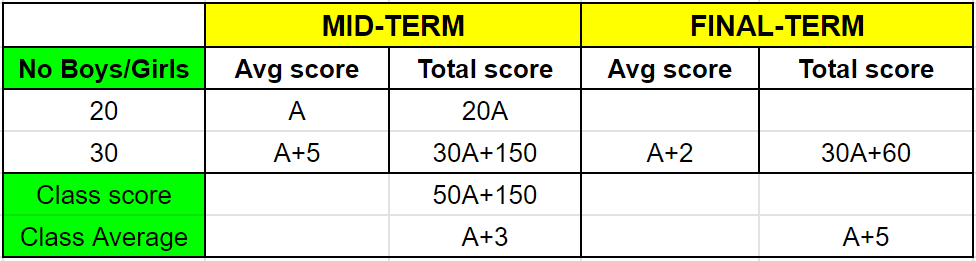
A class consists of 20 boys and 30 girls. In the mid-semester examination, the average score of the girls was 5 higher than that of the boys. In the final exam, however, the average score of the girls dropped by 3 while the average score of the entire class increased by 2. The increase in the average score of the boys is
Let, the average score of boys in the mid semester exam is A.
Therefore, the average score of girls in the mid semester exam be A+5.
Hence, the total marks scored by the class is $$20\times (A) + 30\times (A+5) = 50\times A + 150$$
The average score of the entire class is $$\dfrac{(50\times A + 150)}{50} = A + 3$$
wkt, class average increased by 2, class average in final term $$= (A+3) + 2 = A + 5$$
Given, that score of girls dropped by 3, i.e $$(A+5)-3 = A+2$$
Total score of girls in final term $$= 30\times(A+2) = 30A + 60$$
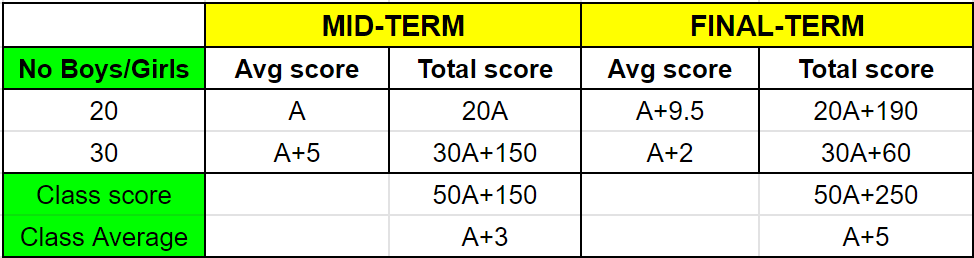
Total class score in final term $$= (A + 5)\times50 = 50A + 250$$
the total marks scored by the boys is $$(50A + 250) - (30A - 60) = 20A + 190$$
Hence, the average of the boys in the final exam is $$\dfrac{(20G + 190)}{20} = A + 9.5$$
Hence, the increase in the average marks of the boys is $$(A+9.5) - A = 9.5$$
Consider the set S = {2, 3, 4, ...., 2n+1}, where n is a positive integer larger than 2007. Define X as the average of the odd integers in S and Y as the average of the even integers in S. What is the value of X - Y ?
The odd numbers in the set are 3, 5, 7, ...2n+1
Sum of the odd numbers = 3+5+7+...+(2n+1) = $$n^2 + 2n$$
Average of odd numbers = $$n^2 + 2n$$/n = n+2
Sum of even numbers = 2 + 4 + 6 + ... + 2n = 2(1+2+3+...+n) = 2*n*(n+1)/2 = n(n+1)
Average of even numbers = n(n+1)/n = n+1
So, difference between the averages of even and odd numbers = 1
Ten years ago, the ages of the members of a joint family of eight people added up to 231 years. Three years later, one member died at the age of 60 years and a child was born during the same year. After another three years, one more member died, again at 60, and a child was born during the same year. The current average age of this eight-member joint family is nearest to
Ten years ago, the total age of the family is 231 years.
Seven years ago, (Just before the death of the first person), the total age of the family would have been 231+8*3 = 231+24 = 255.
This is because, in 3 years, every person in the family would have aged by 3 years,
Total change in age = 231+24 = 255
After the death of one member, the total age is 255-60 = 195 years.
Since a child takes birth in the same year, the number of members remain the same i.e. (7+1) = 8
Four years ago, (i.e. 6 years after start date) one of the member of age 60 dies,
therefore, total age of the family is 195+24-60 = 159 years.
Since a child takes birth in the same year, the number of members remain the same i.e. (7+1) = 8
After 4 more years, the current total age of the family is = 8x4 + 159 = 191 years
The average age is 191/8 = 23.875 years = 24 years (approx)
Alternatively,
Since the number of members is always the same throughout
The 2 older members dropped their age by 60
So, after 10yrs, total age = 231 + 8*10 - 2*60 = 191
Average age = 191/8 = 23.875 $$\simeq$$ 24
Let A and B be two solid spheres such that the surface area of B is 300% higher than the surface area of A. The volume of A is found to be k% lower than the volume of B. The value of k must be
Surface area of sphere A (of radius a) is $$4\pi*a^2$$
Surface area of sphere B (of radius b) is $$4\pi*b^2$$
=> $$4\pi*a^2$$/$$4\pi*b^2$$ = 1/4 => a:b = 1:2
Their volumes would be in the ratio 1:8
Therefore, k = 7/8 * 100% = 87.5%
At the end of year 1998, Shepard bought nine dozen goats. Henceforth, every year he added p% of the goats at the beginning of the year and sold q% of the goats at the end of the year where p > 0 and q > 0. If Shepard had nine dozen goats at the end of year 2002, after making the sales for that year, which of the following is true?
By the end of the year 2002, Shepard bought 4 times and sold 4 times. He is left with the initial number of goats that he had in 1998. If the percentage of goats bought is equal to or lesser than the percentage of goats sold, then there would be a net decrease in the total number of goats. For the number of goats to remain the same, p has to be greater than q, because p% is being calculated in a lesser number and q% is being calculated on a greater number. Hence, p > q.
Amol was asked to calculate the arithmetic mean of 10 positive integers, each of which had 2 digits. By mistake, he interchanged the 2 digits, say a and b, in one of these 10 integers. As a result, his answer for the arithmetic mean was 1.8 more than what it should have been. Then |b - a| equals
Let the actual average be n. So, the new average is n + 1.8
Actual total = 10n
New total = 10n + 18
Let the number which was miswritten = ab(a is the tenth's digit and b is the units digit) = 10a+b
and reversed number ba = 10b+a
So, 10b + a - (10a + b) = 18
=> 9(b-a) = 18
=> b-a = 2
Flights A and B are scheduled from an airport within the next one hour. All the booked passengers of the two flights are waiting in the boarding hall after check-in. The hall has a seating capacity of 200, out of which 10% remained vacant. 40% of the waiting passengers are ladies. When boarding announcement came, passengers of flight A left the hall and boarded the flight. Seating capacity of each flight is two-third of the passengers who waited in the waiting hall for both the flights put together. Half the passengers who boarded flight A are women. After boarding for flight A, 60% of the waiting hall seats became empty. For every twenty of those who are still waiting in the hall for flight B, there is one air hostess in flight A. What is the ratio of empty seats in flight B to the number of air hostesses in flight A?
Out of 200 of the seating capacity, 180 seats are filled out of which 108 are males and 72 are females. Remaining 20 seats are vacant. According to given condition seating capacity in both the planes is 120 . Considering flight A - we can find that 100 passenger in waiting hall will be taking fight A . So 80 people remain in in the waiting hall who will be taking flight B . Now for every 20 people taking flight B we have a air hostess in flight A . So in total there are 4 air hostess in flight A. Flight B having 120 as seating capacity, 40 remain vacant. So required ratio 40:4 = 10:1 .
A college has raised 75% of the amount it needs for a new building by receiving an average donation of Rs. 600 from the people already solicited. The people already solicited represent 60% of the people the college will ask for donations. If the college is to raise exactly the amount needed for the new building, what should be the average donation from the remaining people to be solicited?
Let there be total 100 people whom the college will ask for donation. Out of these 60 people have already given average donation of 600 Rs. Thus total amount generated by 60 people is 36000. This is 75% of total amount required . so the amount remaining is 12000 which should be generated from remaining 40 people. So average amount needed is 12000/40 = 300
Three classes X, Y and Z take an algebra test.
The average score in class X is 83.
The average score in class Y is 76.
The average score in class Z is 85.
The average score of all students in classes X and Y together is 79.
The average score of all students in classes Y and Z together is 81.
What is the average for all the three classes?
Let x , y and z be no. of students in class X, Y ,Z respectively.
From 1st condition we have
83*x+76*y = 79*x+79*y which give 4x = 3y.
Next we have 76*y + 85*z = 81(y+z) which give 4z = 5y .
Now overall average of all the classes can be given as $$\frac{83x+76y+85z}{x+y+z}$$
Substitute the relations in above equation we get,
$$\frac{83x+76y+85z}{x+y+z}$$ = (83*3/4 + 76 + 85*5/4)/(3/4 + 1 + 5/4) = 978/12 = 81.5
A set of consecutive positive integers beginning with 1 is written on the blackboard. A student came along and erased one number. The average of the remaining numbers is $$\frac{602}{17}$$. What was the number erased?
Since the number starts from 1 if there are n numbers then initial average = $$\dfrac{n+1}{2}$$.
Average of N natural number can be either an integer {ab} or {ab.50} type. For example average of first 10 number = 5.5 whereas the average of first 11 natural numbers is 6.
Even if we erased the largest number change in average will be always less than 0.5.
Here we are given the average is 602/17 or 35$$\frac{7}{17}$$ Hence we can say that average must have been 35.5 or 35 before.
Case 1: If the average was 35.5 before the erasing process.
We know that average of 1st N natural number = $$\dfrac{N+1}{2}$$
35.5 = $$\dfrac{N+1}{2}$$
N = 70.
Sum of these 70 numbers = 70*71/2 = 35*71 = 2485.
Sum of the 69 numbers which we are left with after removing a number = (602/17)*69 = 2443.41. Which is not possible as the sum of natural numbers will always be an integer. Hence, we can say that case is not possible.
Case 1: If the average was 35 before the erasing process.
We know that average of 1st N natural number = $$\dfrac{N+1}{2}$$
35 = $$\dfrac{N+1}{2}$$
N = 69.
Sum of these 69 numbers = 69*70/2 = 35*69 = 2415.
Sum of the 68 numbers which we are left with after removing a number = (602/17)*68 = 2408.
Hence, we can say that the erased number = 2415 - 2408 = 7.
A student took five papers in an examination, where the full marks were the same for each paper. His marks in these papers were in the proportion of 6 : 7 : 8 : 9 : 10. In all papers together, the candidate obtained 60% of the total marks. Then the number of papers in which he got more than 50% marks is
Let the marks in the five papers be 6k, 7k, 8k, 9k and 10k respectively.
So, the total marks in all the 5 papers put together is 40k. This is equal to 60% of the total maximum marks. So, the total maximum marks is 5/3 * 40k
So, the maximum marks in each paper is 5/3 * 40k / 5 = 40k/3 = 13.33k
50% of the maximum marks is 6.67k
So, the number of papers in which the student scored more than 50% is 4
Consider a sequence of seven consecutive integers. The average of the first five integers is n. The average of all the seven integers is:
The first five numbers could be n-2, n-1, n, n+1, n+2. The next two number would then be, n+3 and n+4, in which case, the average of all the 7 numbers would be $$\frac{(5n+2n+7)}{7}$$ = n+1
A shipping clerk has five boxes of different but unknown weights each weighing less than 100 kgs. The clerk weighs the boxes in pairs. The weights obtained are 110, 112, 113, 114, 115, 116, 117, 118, 120 and 121 kgs. What is the weight, in kgs, of the heaviest box?
Let the individual weights be a,b,c,d,e in increasing order such that e is max and a is min. Adding all the addition of weight together we get 4*(a+b+c+d+e) = 1156 so a+b+c+d+e = 289 . Out of these a+b will be lowest sum and d+e will be the max . so a+b=110 and d+e=121 so we get value of c as 58 . now c have the 3rd highest weight so addition of c and e must give the second largest total i.e 120 . hence e = 120-58 = 62
Total expenses of a boarding house are partly fixed and partly varying linearly with the number of boarders. The average expense per boarder is Rs. 700 when there are 25 boarders and Rs. 600 when there are 50 boarders. What is the average expense per boarder when there are 100 boarders?
Let the fixed income be x and the number of boarders be y.
x + 25y = 17500
x + 50y = 30000
=> y = 500 and x = 5000
x + 100y = 5000 + 50000 = 55000
Average expense = $$\frac{55000}{100}$$ = Rs.550.
Forty percent of the employees of a certain company are men, and 75 percent of the men earn more than Rs. 25,000 per year. If 45 percent of the company's employees earn more than Rs. 25,000 per year, what fraction of the women employed by the company earn Rs. 25,000 year or less'?
Let the number of employees be 100.
=> 40 men and 60 women.
Number of men getting more than 25000 = 30
Number of people getting more than 25000 = 45
Number of women getting more than 25000 = 45 - 30 = 15
Fraction of women getting less than 25000 = $$\frac{45}{60}$$ = $$\frac{3}{4}$$
One bacterium splits into eight bacteria of the next generation. But due to environmental condition only 50% survives and remaining 50% dies. If the seventh generation number is 4,096 million, what is the number in first generation?
let's say x is the initial number of bacterias :
So in 2nd generation no. of bacterias = $$\frac{8x}{2} = 4x$$
In 3rd generation, it will be = 16x
4th gen. = 64x
5th gen. = 256x
6th gen. = 1024x
7th gen. = 4096x
Hence x = 1 million
You can collect as many rubies and emeralds as you can. Each ruby is worth Rs. 4 crore and each emerald is worth Rs. 5 crore. Each ruby weighs 0.3 kg. And each emerald weighs 0.4 kg. Your bag can carry at the most 12 kg. What should you collect to get the maximum wealth?
Let's say number of rubbies are x and emeralds are y.
So 0.3x + 0.4y = 12
And total wealth = 4x+5y
Now putting value of x from eq.1 to eq.2
i.e. total wealth = 4(12-0.4y)/0.3 + 5y
Now for maximizing total wealth y should be equal to zero.
Hence x = 40
I have one-rupee coins, 50-paisa coins and 25-paisa coins. The number of coins are in the ratio 2.5 : 3 : 4. If the total amount with me is Rs. 210, find the number of one-rupee coins.
Let's say number of coins are 2.5x , 3x and 4x
So total amount will be = 2.5x + 3x(0.5) + 4x(0.25) = 210
So x = 42
And number of 1 rs. coins = 2.5x = 105
A student gets an aggregate of 60% marks in five subjects in the ratio 10 : 9 : 8 : 7 : 6. If the passing marks are 50% of the maximum marks and each subject has the same maximum marks, in how many subjects did he pass the examination?
Let's say he scored marks as $$10x,9x,8x,7x,6x$$ or total of $$40x$$ which is 60% of total maximum marks(T).
$$\frac{T \times 60}{100}=40x$$
So T (total maximum marks)=$$\frac{400x}{6}$$
Or Individual max. marks = $$\frac{T}{5}=\frac{80x}{6}$$
Passing marks =50% of individual max. marks =$$\frac{40x}{6}=6.66x$$
Hence he scored more than passing marks in four subjects as $$10x,9x,8x$$ and $$7x$$ and failed in one subject as scoring $$6x$$ marks which is less than passing marks of $$6.66x$$
The average marks of a student in 10 papers are 80. If the highest and the lowest scores are not considered, the average is 81. If his highest score is 92, find the lowest.
Total marks = 80 x 10 = 800
Total marks except highest and lowest marks = 81 x 8 = 648
So Summation of highest marks and lowest marks will be = 800 - 648 = 152
When highest marks is 92, lowest marks will be = 152-92 = 60
The value of each of a set of coins varies as the square of its diameter, if its thickness remains constant, and it varies as the thickness, if the diameter remains constant. If the diameter of two coins are in the ratio 4 : 3, what should be the ratio of their thickness' be if the value of the first is four times that of the second?
Value of coin = $$k (2r)^2 t$$ (where k is proportionality constant, 2r is diameter and t is thickness)
So (value of first coin) = 4 (value of second coin)
$$k (2r_1)^2 t_1 = 4 \times (k(2r_2)^2 t_2)$$
or $$\frac{t_1}{t_2} = \frac{9}{4}$$ (As ratio of diameters 2r will be 9:4)
What is the average weight of the students in group D?
As data regarding weights of people is not given, hence we can't determine the avg. weight of people in group D
If one student from group A is shifted to group B, which of the following will be true?
As data regarding weights is not available, hence we can't say about the increment or decrement in group A an B
But avg. weight for overall class will remain same as no student went out or came inside to make any changes in total weight or total number of students.
If all the students of the class have the same weight, then which of the following is false?
Except option C, all are correct because if everyone has same weight than avg. weight of all groups remain same.
So avg. weight of D will be equal to avg. weight of A.
Gopal went to a fruit market with certain amount of money. With this money he can buy either 50 oranges or 40 mangoes. He retains 10% of the money for taxi fare. If he buys 20 mangoes, then the maximum number of oranges he can buy is
Let's say the amount of money Gopal has is 100x rs. With this money he can buy either 50 oranges or 40 mangoes.
Hence, the cost of 1 orange = $$\dfrac{100x}{50}$$ = Rs. 2x
Similarly, the cost of 1 mango = $$\dfrac{100x}{40}$$ = Rs. 2.5x
Taxi fare = 0.1*100x = 10x
Remaining money with Gopal = 90x
Cost incurred in buying 20 mangoes = 2.5*20 = 50x
Hence, the amount of money left with Gopal = 100x - 10x - 50x = 40x
Therefore, we can say that with this much money he can but a maximum of $$\dfrac{40x}{2x}$$ = 20 oranges.
An outgoing batch of students wants to gift PA system worth Rs.4200 to their school. If the teachers offer to pay 50% more than the students, and an external benefactor gives three times teachers contribution. How much should the teachers donate?
Let's, say students contributed x rs.
So teachers contributed = $$\frac{3x}{2}$$
And external benefactor contributed = $$\frac{9x}{2}$$
Summation of all contribution = 4200 = $$7x$$
or $$x=600$$
Hence, teachers contributed = 900
In a stockpile of products produced by three machines M1, M2 and M3, 40% and 30% were manufactured by M1 and M2 respectively. 3% of the products of M1 are defective, 1% of products of M2 defective, while 95% of the products of M3 are not defective. What is the percentage of defective in the stockpile?
Let's say total products maufactured by M1, M2 and M3 are 100.
So M1 produced 40, M2 produced 30 and M3 produced 30
Defective pieces for M1 = $$\frac{120}{100}$$
Defective pieces for M2 = $$\frac{30}{100}$$
Defective pieces for M3 = $$\frac{150}{100}$$
So total defective pieces are $$\frac{150+30+120}{100}$$ = $$\frac{300}{100}$$ = 3% of total products.
If equal numbers of people are born on each day, find the approximate percentage of the people whose birthday will fall on 29th February. If we are to consider people born in 20th century (1901-2000) and assuming no deaths.
Assume one person is born every day. In 100 years, there will be 25 leap years. So 25*1 additional people will be born on these days.
So, total people born will be = $$365 \times 100 \times 1 + 25 \times 1$$
And people born on 29th february = $$25 \times 1$$
Hence percentage will be = $$\frac{25 \times 1}{365 \times 100 \times 1 + 25 \times 1} \times 100$$ = 0.0684
Frequently Asked Questions
Video solutions can be a helpful resource for candidates preparing for CAT Averages, Ratios and Proportions questions. They can provide a step-by-step explanation of how to solve the problem, helping candidates better understand the concept and formula.
These topics are core parts of Arithmetic and frequently appear in CAT. They test conceptual clarity and calculation speed, making them highly scoring areas.
Start with basic formulas, then practice different question types like weighted averages and mixtures. Regular mock tests help improve speed and accuracy.
Focus on understanding relationships rather than memorizing formulas. Practice diverse questions and learn shortcut techniques for faster calculations.
They are essential but not sufficient. Combine them with mock tests and sectional practice to cover all difficulty levels.
Ideally, begin early in your preparation cycle. Arithmetic forms the base for many advanced topics, so mastering it early gives an advantage.
Both are equally important. Strong concepts help solve tricky questions, while practice ensures speed and accuracy under exam pressure.