91- 6303239042




 Preferred Source

 Google Discover
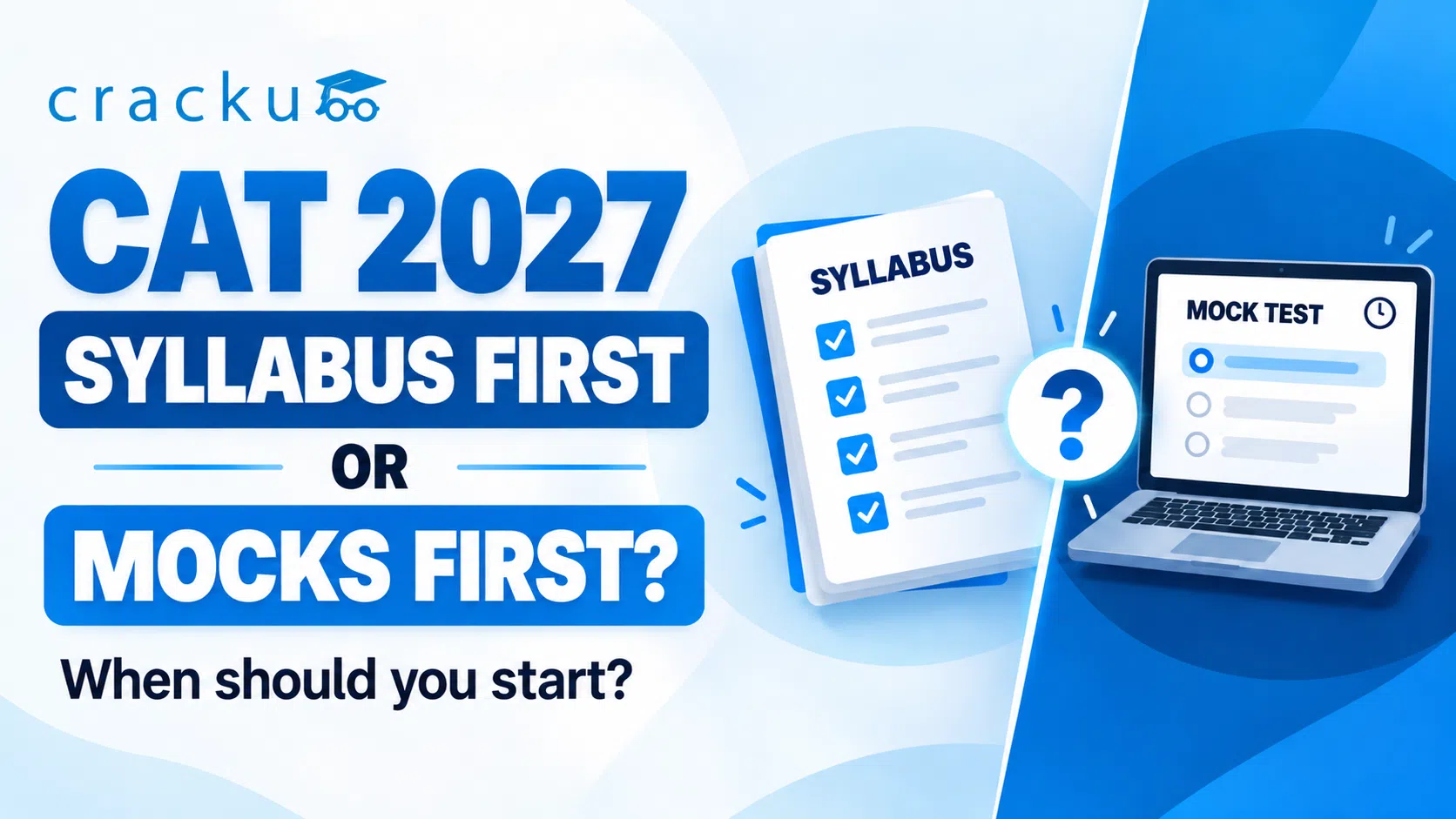
CAT 2027 Mocks Before Syllabus?
Should You Complete the CAT 2027 Syllabus Before Taking Mocks? Starting early can help you understand the CAT exam pattern, identify weak areas and develop effective time-management skills. While building conceptual clarity is essential, waiting until you finish every topic may leave you with limited time to practise under exam conditions.
The ideal approach is to balance learning with testing. Begin with a diagnostic mock to assess your current level, use CAT sectional tests as you complete individual topics, and gradually introduce full-length CAT Mock Tests. Your initial scores may be low, especially if you are starting from scratch, but they can help you plan your preparation more effectively. Focus on analysing mistakes and improving consistently rather than waiting for complete CAT syllabus coverage.
Why Should You Start CAT Mock Tests Before Completing the Syllabus?
Starting CAT Mock Tests before completing the syllabus helps you understand the exam's demands early in your preparation. You can identify topics that require more attention, become familiar with question formats and learn to manage time across sections.
Here are the main benefits of attempting mocks during CAT syllabus preparation:
- Identify weak areas: Discover which topics and question types you find difficult.
- Understand the exam pattern: Familiarise yourself with the structure, sectional time limits and variety of questions.
- Improve question selection: Learn to distinguish between questions you can solve quickly and those that may consume too much time.
- Track your progress: Use mock results to understand whether your conceptual understanding and accuracy are improving.
- Reduce exam anxiety: Early exposure to timed tests can make the actual exam environment feel more familiar.
When Should You Take Your First CAT 2027 Mock Test?
You can take your first CAT 2027 mock test early in your preparation, even if you have not completed the syllabus. Ideally, attempt a diagnostic mock after familiarising yourself with the exam pattern and section structure.
If you are starting from scratch, you can begin with a diagnostic test to understand the types of questions asked. You do not need to prepare every topic before attempting it. If a full-length test feels overwhelming, start with sectional tests and gradually move to complete mocks.
Your first mock should help you answer three questions:
- Which topics can you already solve confidently?
- Which concepts require more attention?
- How effectively can you manage time and select questions?
Also Read: When is the Right Time to Start Taking CAT Mocks?
How Much CAT Syllabus Should You Cover Before Taking Mocks?
There is no fixed percentage of the CAT Syllabus that you must complete before taking mocks. Your preparation level and familiarity with the exam matter more than a specific completion target.
Preparation stage | Recommended practice |
Just starting | Take a diagnostic test to understand the exam pattern and assess your baseline. |
Building fundamentals | Attempt topic-wise tests and occasional sectional tests alongside concept learning. |
Partially through the syllabus | Introduce full-length mocks to practise question selection and time management. |
Most topics covered | Increase the frequency of full-length mocks and focus on detailed analysis and revision. |
For example, if you have completed arithmetic but have not started algebra or geometry, you can still practise arithmetic questions and take sectional tests. A full-length mock can also help you understand how questions from unfamiliar topics affect your overall strategy.
How Many CAT 2027 Mocks Should You Take?
The number of CAT 2027 Mocks you should attempt depends on how much time you have available and how well you understand the concepts. During the initial stages, prioritise learning and topic-wise practice instead of taking too many full-length tests.
A practical approach is to begin with one diagnostic mock, followed by sectional tests as you complete topics. Once you have developed a reasonable understanding of the three sections, introduce full-length mocks at regular intervals.
As your preparation advances, you can increase the frequency of CAT 2027 Mocks. During the final phase, many students benefit from taking around two or three full-length mocks per week, provided they have enough time to analyse each test and revise their weak areas.
Also Read: How Many CAT Mock Tests Do 99%ilers Take? Check now
How to Analyse CAT Mocks When Your Syllabus Is Incomplete?
Analysing mocks is particularly important when you have not completed the CAT 2027 Syllabus. Instead of focusing only on your score or percentile, examine why you could or could not solve each question.
Follow these steps after every mock:
Separate unfamiliar topics from conceptual mistakes
Mark questions you could not solve because you had not studied the topic. Separately identify questions you attempted but answered incorrectly despite knowing the underlying concepts.
Review incorrect answers
Understand whether the mistake occurred because of a conceptual gap, a calculation error, a misinterpretation of the question or poor time management.
Identify questions you could have solved
Review unattempted questions and determine whether you skipped any easy or manageable questions. This can help you improve your question-selection strategy.
Maintain an error log
Record recurring mistakes, difficult concepts and questions worth revisiting. Review this log regularly to avoid repeating the same errors.
Use the analysis to plan your next study session
If your mock reveals weak arithmetic fundamentals, revisit those concepts before attempting similar questions. If you struggle with reading comprehension, increase your regular practice and review the reasoning behind each answer.
Also Read: How to Analyse CAT Mock Test: Free Mock Analysis Excel Sheet
CAT Syllabus Vs CAT Mocks: Conclusion
You do not need to complete the entire CAT Syllabus before starting mock tests. The most effective approach to CAT 2027 Syllabus vs Mocks is to combine concept-building with regular testing and detailed analysis. Begin with a diagnostic mock, use sectional tests while learning new topics and gradually introduce full-length tests as your preparation improves.
If you are considering CAT 2027 Mocks Before Syllabus completion, remember that early scores are meant to reveal gaps, not define your potential. Focus on understanding mistakes, strengthening weak concepts and improving question selection. A balanced preparation strategy will help you use mocks effectively and approach CAT 2027 with greater confidence.