How many goals were scored in Match 7?
Sign in
Please select an account to continue using cracku.in
↓ →
The following facts are known about the goals scored by these four players only. All the questions refer only to the goals scored by these four players.
The management of a university hockey team was evaluating performance of four women players - Amla, Bimla, Harita and Sarita for their possible selection in the university team for next year. For this purpose, the management was looking at the number of goals scored by them in the past 8 matches, numbered 1 through 8. The four players together had scored a total of 12 goals in these matches. In the 8 matches, each of them had scored at least one goal. No two players had scored the same total number of goals.
1. Only one goal was scored in every even numbered match.
2. Harita scored more goals than Bimla.
3. The highest goal scorer scored goals in exactly 3 matches including Match 4 and Match 8.
4. Bimla scored a goal in Match 1 and one each in three other consecutive matches.
5. An equal number of goals were scored in Match 3 and Match 7, which was different from the number of goals scored in either Match 1 or Match 5.
6. The match in which the highest number of goals was scored was unique and it was not Match 5.
How many goals were scored in Match 7?
A total of 12 goals were scored in 8 matches and each player scored atleast one goal and no of goals scored by each one of them is distinct so the possible number of goals scored by the players can be (1,2,3,6) or (1,2,4,5).
From statement 4 we know that Bimal scored 4 goals and since Harita scored more goals than Bimal so we can say that Harita scored 5 goals and the only case possible for total goals scored by each of the players is (1,2,4,5).
Now using statement 1, statement 3 and statement 4 we can say that the three consecutive matches in which Bimal scored will be 5th, 6th and 7th matches as Harita scored in 4th and 8th matches and we get the following table:
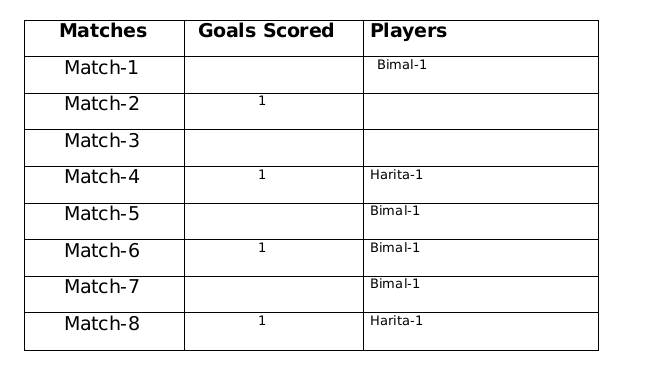
From statement 5 and 6, we can conclude that the highest number of goals were scored in Match 1.
Let the no. of goals scored in 3rd and 7th match be a each and no. of goals scored in 1st and 5th match be b and c respectively.
Therefore, 2a+b+c= 8
If a=1, then b+c=6 therefore possible solutions for b and c will be 2 and 4 only
If a=2, then b+c=4 therefore possible solution for b and c will be 1 and 3 only but since highest goals scored is in Match 1 so then no. of goals scored in match 1 must be 3 and Harita must have scored 3 goals in match 1 as Harita scored 5 goals in exactly 3 matches. Therefore, we can see this is not possible because then the no. of goals scored in Match 1 becomes 4.
Therefore the only possible solution is a=1, b=4 and c=2
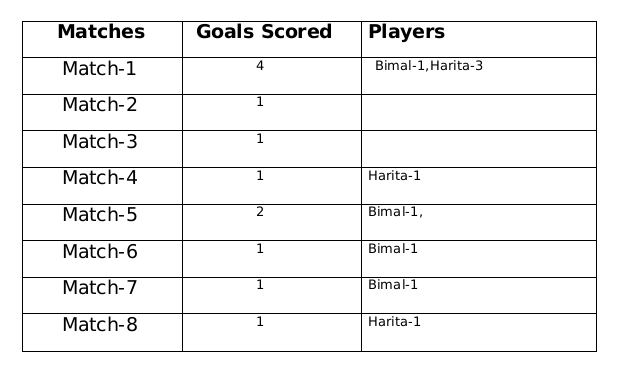
The remaining 3 goals were scored in the match 2, 3 and 5 by Amla and Sarita in some order.
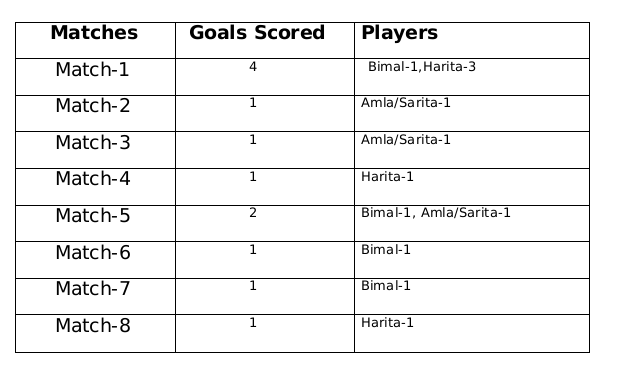
Which of the following is the correct sequence of goals scored in matches 1, 3, 5 and 7?
A total of 12 goals were scored in 8 matches and each player scored atleast one goal and no of goals scored by each one of them is distinct so the possible number of goals scored by the players can be (1,2,3,6) or (1,2,4,5).
From statement 4 we know that Bimal scored 4 goals and since Harita scored more goals than Bimal so we can say that Harita scored 5 goals and the only case possible for total goals scored by each of the players is (1,2,4,5).
Now using statement 1, statement 3 and statement 4 we can say that the three consecutive matches in which Bimal scored will be 5th, 6th and 7th matches as Harita scored in 4th and 8th matches and we get the following table:
From statement 5 and 6, we can conclude that the highest number of goals were scored in Match 1.
Let the no. of goals scored in 3rd and 7th match be a each and no. of goals scored in 1st and 5th match be b and c respectively.
Therefore, 2a+b+c= 8
If a=1, then b+c=6 therefore possible solutions for b and c will be 2 and 4 only
If a=2, then b+c=4 therefore possible solution for b and c will be 1 and 3 only but since highest goals scored is in Match 1 so then no. of goals scored in match 1 must be 3 and Harita must have scored 3 goals in match 1 as Harita scored 5 goals in exactly 3 matches. Therefore, we can see this is not possible because then the no. of goals scored in Match 1 becomes 4.
Therefore the only possible solution is a=1, b=4 and c=2
The remaining 3 goals were scored in the match 2, 3 and 5 by Amla and Sarita in some order.
Which of the following statement(s) is/are true?
Statement-1: Amla and Sarita never scored goals in the same match.
Statement-2: Harita and Sarita never scored goals in the same match.
A total of 12 goals were scored in 8 matches and each player scored atleast one goal and no of goals scored by each one of them is distinct so the possible number of goals scored by the players can be (1,2,3,6) or (1,2,4,5).
From statement 4 we know that Bimal scored 4 goals and since Harita scored more goals than Bimal so we can say that Harita scored 5 goals and the only case possible for total goals scored by each of the players is (1,2,4,5).
Now using statement 1, statement 3 and statement 4 we can say that the three consecutive matches in which Bimal scored will be 5th, 6th and 7th matches as Harita scored in 4th and 8th matches and we get the following table:
From statement 5 and 6, we can conclude that the highest number of goals were scored in Match 1.
Let the no. of goals scored in 3rd and 7th match be a each and no. of goals scored in 1st and 5th match be b and c respectively.
Therefore, 2a+b+c= 8
If a=1, then b+c=6 therefore possible solutions for b and c will be 2 and 4 only
If a=2, then b+c=4 therefore possible solution for b and c will be 1 and 3 only but since highest goals scored is in Match 1 so then no. of goals scored in match 1 must be 3 and Harita must have scored 3 goals in match 1 as Harita scored 5 goals in exactly 3 matches. Therefore, we can see this is not possible because then the no. of goals scored in Match 1 becomes 4.
Therefore the only possible solution is a=1, b=4 and c=2
The remaining 3 goals were scored in the match 2, 3 and 5 by Amla and Sarita in some order.
Which of the following statement(s) is/are false?
Statement-1: In every match at least one player scored a goal.
Statement-2: No two players scored goals in the same number of matches.
A total of 12 goals were scored in 8 matches and each player scored atleast one goal and no of goals scored by each one of them is distinct so the possible number of goals scored by the players can be (1,2,3,6) or (1,2,4,5).
From statement 4 we know that Bimal scored 4 goals and since Harita scored more goals than Bimal so we can say that Harita scored 5 goals and the only case possible for total goals scored by each of the players is (1,2,4,5).
Now using statement 1, statement 3 and statement 4 we can say that the three consecutive matches in which Bimal scored will be 5th, 6th and 7th matches as Harita scored in 4th and 8th matches and we get the following table:
From statement 5 and 6, we can conclude that the highest number of goals were scored in Match 1.
Let the no. of goals scored in 3rd and 7th match be a each and no. of goals scored in 1st and 5th match be b and c respectively.
Therefore, 2a+b+c= 8
If a=1, then b+c=6 therefore possible solutions for b and c will be 2 and 4 only
If a=2, then b+c=4 therefore possible solution for b and c will be 1 and 3 only but since highest goals scored is in Match 1 so then no. of goals scored in match 1 must be 3 and Harita must have scored 3 goals in match 1 as Harita scored 5 goals in exactly 3 matches. Therefore, we can see this is not possible because then the no. of goals scored in Match 1 becomes 4.
Therefore the only possible solution is a=1, b=4 and c=2
The remaining 3 goals were scored in the match 2, 3 and 5 by Amla and Sarita in some order.
If Harita scored goals in one more match as compared to Sarita, which of the following statement(s) is/are necessarily true?
Statement-1: Amla scored goals in consecutive matches.
Statement-2: Sarita scored goals in consecutive matches.
A total of 12 goals were scored in 8 matches and each player scored atleast one goal and no of goals scored by each one of them is distinct so the possible number of goals scored by the players can be (1,2,3,6) or (1,2,4,5).
From statement 4 we know that Bimal scored 4 goals and since Harita scored more goals than Bimal so we can say that Harita scored 5 goals and the only case possible for total goals scored by each of the players is (1,2,4,5).
Now using statement 1, statement 3 and statement 4 we can say that the three consecutive matches in which Bimal scored will be 5th, 6th and 7th matches as Harita scored in 4th and 8th matches and we get the following table:
From statement 5 and 6, we can conclude that the highest number of goals were scored in Match 1.
Let the no. of goals scored in 3rd and 7th match be a each and no. of goals scored in 1st and 5th match be b and c respectively.
Therefore, 2a+b+c= 8
If a=1, then b+c=6 therefore possible solutions for b and c will be 2 and 4 only
If a=2, then b+c=4 therefore possible solution for b and c will be 1 and 3 only but since highest goals scored is in Match 1 so then no. of goals scored in match 1 must be 3 and Harita must have scored 3 goals in match 1 as Harita scored 5 goals in exactly 3 matches. Therefore, we can see this is not possible because then the no. of goals scored in Match 1 becomes 4.
Therefore the only possible solution is a=1, b=4 and c=2
The remaining 3 goals were scored in the match 2, 3 and 5 by Amla and Sarita in some order.
There are 15 girls and some boys among the graduating students in a class. They are planning a get-together, which can be either a 1-day event, or a 2-day event, or a 3-day event. There are 6 singers in the class, 4 of them are boys. There are 10 dancers in the class, 4 of them are girls. No dancer in the class is a singer.
Some students are not interested in attending the get-together. Those students who are interested in attending a 3-day event are also interested in attending a 2-day event; those who are interested in attending a 2-day event are also interested in attending a 1-day event.
The following facts are also known:
1. All the girls and 80% of the boys are interested in attending a 1-day event. 60% of the boys are interested in attending a 2-day event.
2. Some of the girls are interested in attending a 1-day event, but not a 2-day event; some of the other girls are interested in attending both.
3. 70% of the boys who are interested in attending a 2-day event are neither singers nor dancers. 60% of the girls who are interested in attending a 2-day event are neither singers nor dancers.
4. No girl is interested in attending a 3-day event. All male singers and 2 of the dancers are interested in attending a 3-day event.
5. The number of singers interested in attending a 2-day event is one more than the number of dancers interested in attending a 2-day event.
How many boys are there in the class?
No. of girls = 15
Let the no. of boys be x
No. of singers = 6
No of boys who are singers = 4
Therefore, no of girls who are singers = 2
No of dancers = 10
No of boys who are dancers = 6
Therefore, no. of girls who are dancers = 4
No. of boys who are neither singers nor dancers = x-10
No. of girls who are neither singers nor dancers = 9
Now we fill the above table,
using statements 1 and 2, we get the following table
Let the number of girls who are interested in attending a 2-day event be a and the number of girls who are dancers and are interested in 2-day event be b.
Now using statements 3 and 4, we get
$$2\le0.18x-4\le6$$
$$6\le0.18x\le10$$
0.18x should be integer for which x should be a multiple of 50, and 0.18x lies between 6 and 10; therefore, the only possible value of x is 50.
From statement 5, we can say that,
4+ 0.4a - b = 5+b +1
or, 0.4a = 2+2b
or, a = 5(1+b)
a should be a multiple of 5 as b is a whole number. So possible values of a can be 5, 10 or 15. Now, as the maximum value of b can be 4 and the maximum value of 0.4a-b can be 2, so the only possible value of a satisfying the conditions above is 5. If a= 5 then b=1.
Which of the following can be determined from the given information?
I. The number of boys who are interested in attending a 1-day event and are neither dancers nor singers.
II. The number of female dancers who are interested in attending a 1-day event.
No. of girls = 15
Let the no. of boys be x
No. of singers = 6
No of boys who are singers = 4
Therefore, no of girls who are singers = 2
No of dancers = 10
No of boys who are dancers = 6
Therefore, no. of girls who are dancers = 4
No. of boys who are neither singers nor dancers = x-10
No. of girls who are neither singers nor dancers = 9
Now we fill the above table,
using statements 1 and 2, we get the following table
Let the number of girls who are interested in attending a 2-day event be a and the number of girls who are dancers and are interested in 2-day event be b.
Now using statements 3 and 4, we get
$$2\le0.18x-4\le6$$
$$6\le0.18x\le10$$
0.18x should be integer for which x should be a multiple of 50, and 0.18x lies between 6 and 10; therefore, the only possible value of x is 50.
From statement 5, we can say that,
4+ 0.4a - b = 5+b +1
or, 0.4a = 2+2b
or, a = 5(1+b)
a should be a multiple of 5 as b is a whole number. So possible values of a can be 5, 10 or 15. Now, as the maximum value of b can be 4 and the maximum value of 0.4a-b can be 2, so the only possible value of a satisfying the conditions above is 5. If a= 5 then b=1.
What fraction of the class are interested in attending a 2-day event?
No. of girls = 15
Let the no. of boys be x
No. of singers = 6
No of boys who are singers = 4
Therefore, no of girls who are singers = 2
No of dancers = 10
No of boys who are dancers = 6
Therefore, no. of girls who are dancers = 4
No. of boys who are neither singers nor dancers = x-10
No. of girls who are neither singers nor dancers = 9
Now we fill the above table,
using statements 1 and 2, we get the following table
Let the number of girls who are interested in attending a 2-day event be a and the number of girls who are dancers and are interested in 2-day event be b.
Now using statements 3 and 4, we get
$$2\le0.18x-4\le6$$
$$6\le0.18x\le10$$
0.18x should be integer for which x should be a multiple of 50, and 0.18x lies between 6 and 10; therefore, the only possible value of x is 50.
From statement 5, we can say that,
4+ 0.4a - b = 5+b +1
or, 0.4a = 2+2b
or, a = 5(1+b)
a should be a multiple of 5 as b is a whole number. So possible values of a can be 5, 10 or 15. Now, as the maximum value of b can be 4 and the maximum value of 0.4a-b can be 2, so the only possible value of a satisfying the conditions above is 5. If a= 5 then b=1.
Total students interested in 2-day event = 30+5 = 35
Total students = 15 + 50 = 65
Fraction = $$\frac{35}{65}=\frac{7}{13}$$
What BEST can be concluded about the number of male dancers who are interested in attending a 1-day event?
No. of girls = 15
Let the no. of boys be x
No. of singers = 6
No of boys who are singers = 4
Therefore, no of girls who are singers = 2
No of dancers = 10
No of boys who are dancers = 6
Therefore, no. of girls who are dancers = 4
No. of boys who are neither singers nor dancers = x-10
No. of girls who are neither singers nor dancers = 9
Now we fill the above table,
using statements 1 and 2, we get the following table
Let the number of girls who are interested in attending a 2-day event be a and the number of girls who are dancers and are interested in 2-day event be b.
Now using statements 3 and 4, we get
$$2\le0.18x-4\le6$$
$$6\le0.18x\le10$$
0.18x should be integer for which x should be a multiple of 50, and 0.18x lies between 6 and 10; therefore, the only possible value of x is 50.
From statement 5, we can say that,
4+ 0.4a - b = 5+b +1
or, 0.4a = 2+2b
or, a = 5(1+b)
a should be a multiple of 5 as b is a whole number. So possible values of a can be 5, 10 or 15. Now, as the maximum value of b can be 4 and the maximum value of 0.4a-b can be 2, so the only possible value of a satisfying the conditions above is 5. If a= 5 then b=1.
How many female dancers are interested in attending a 2-day event?
No. of girls = 15
Let the no. of boys be x
No. of singers = 6
No of boys who are singers = 4
Therefore, no of girls who are singers = 2
No of dancers = 10
No of boys who are dancers = 6
Therefore, no. of girls who are dancers = 4
No. of boys who are neither singers nor dancers = x-10
No. of girls who are neither singers nor dancers = 9
Now we fill the above table,
using statements 1 and 2, we get the following table
Let the number of girls who are interested in attending a 2-day event be a and the number of girls who are dancers and are interested in 2-day event be b.
Now using statements 3 and 4, we get
$$2\le0.18x-4\le6$$
$$6\le0.18x\le10$$
0.18x should be integer for which x should be a multiple of 50, and 0.18x lies between 6 and 10; therefore, the only possible value of x is 50.
From statement 5, we can say that,
4+ 0.4a - b = 5+b +1
or, 0.4a = 2+2b
or, a = 5(1+b)
a should be a multiple of 5 as b is a whole number. So possible values of a can be 5, 10 or 15. Now, as the maximum value of b can be 4 and the maximum value of 0.4a-b can be 2, so the only possible value of a satisfying the conditions above is 5. If a= 5 then b=1.
Comprehension:
Adhara, Bithi, Chhaya, Dhanavi, Esther, and Fathima are the interviewers in a process that awards funding for new initiatives. Every interviewer individually interviews each of the candidates individually and awards a token only if she recommends funding. A token has a face value of 2, 3, 5, 7, 11, or 13. Each interviewer awards tokens of a single face value only.
Once all six interviews are over for a candidate, the candidate receives a funding that is Rs.1000 times the product of the face values of all the tokens. For example, if a candidate has tokens with face values 2, 5, and 7, then they get a funding of Rs.1000 × (2 × 5 × 7) = Rs.70,000.
Pragnyaa, Qahira, Rasheeda, Smera, and Tantra were five candidates who received funding. The funds they received, in descending order, were Rs.390,000, Rs.210,000, Rs.165,000, Rs.77,000, and Rs.66,000.
The following additional facts are known:
1. Fathima awarded tokens to everyone except Qahira, while Adhara awarded tokens to no one except Pragnyaa.
2. Rashida received the highest number of tokens that anyone received, but she did not receive one from Esther.
3. Bithi awarded a token to Smera but not to Qahira, while Dhanavi awarded a token to Qahira but not to Smera.
How many tokens did Qahira receive?
From statement 1 we can deduce that Fatima gave token 3 and Adhara gave token 13 and therefore from this we can say that Qahira received a funding of 77,000 and Pragnyaa received a funding of 390,000.
From statement 2, we know that Rashida received highest number of tokens and we already concluded that Pragnyaa received a funding of 390,000 so we can say that Rashida received a funding of 210,000.
Rashida did not received a token from Esther so we can also conclude that Esther gave the token number 11.
From statement 3 we can conclude that Dhanavi gave a token of 7, and Bethi Gave a token of either 2 or 5 and similarly Chhaya also gave a token of 2 or 5.
Alternate Explanation:
$$390=2\times3\times5\times13$$
$$210=2\times3\times5\times7$$
$$165=3\times5\times11$$
$$77=7\times11$$
$$66=2\times3\times11$$
From the above information we can conclude that the number of times a particular token was given, therefore we get the following table,
We know that there are five people who received the token and there are 6 people who awarded the token.
From, statement 1 we know that Fatima gave token to 4 people except Qahira so the token number given by Fatima is 3, and Adhara gave token only to Pragnyaa so the token number given by Adhara is 13. Therefore we can also say that Pragnyaa received 390,000 and Qahira received 77,000.
From statement 2, we know that Rashida received highest number of tokens and we already concluded that Pragnyaa received a funding of 390,000 so we can say that Rashida received a funding of 210,000. Rashida did not received a token from Esther so we can also conclude that Esther gave the token number 11.
From statement 3, we can conclude that Dhanavi gave a token of 7, and Bethi Gave a token of either 2 or 5 and similarly Chhaya also gave a token of 2 or 5.
Ans:2
Who among the following definitely received a token from Bithi but not from Dhanavi?
From statement 1 we can deduce that Fatima gave token 3 and Adhara gave token 13 and therefore from this we can say that Qahira received a funding of 77,000 and Pragnyaa received a funding of 390,000.
From statement 2, we know that Rashida received highest number of tokens and we already concluded that Pragnyaa received a funding of 390,000 so we can say that Rashida received a funding of 210,000.
Rashida did not received a token from Esther so we can also conclude that Esther gave the token number 11.
From statement 3 we can conclude that Dhanavi gave a token of 7, and Bethi Gave a token of either 2 or 5 and similarly Chhaya also gave a token of 2 or 5.
Alternate Explanation:
$$390=2\times3\times5\times13$$
$$210=2\times3\times5\times7$$
$$165=3\times5\times11$$
$$77=7\times11$$
$$66=2\times3\times11$$
From the above information we can conclude that the number of times a particular token was given, therefore we get the following table,
We know that there are five people who received the token and there are 6 people who awarded the token.
From, statement 1 we know that Fatima gave token to 4 people except Qahira so the token number given by Fatima is 3, and Adhara gave token only to Pragnyaa so the token number given by Adhara is 13. Therefore we can also say that Pragnyaa received 390,000 and Qahira received 77,000.
From statement 2, we know that Rashida received highest number of tokens and we already concluded that Pragnyaa received a funding of 390,000 so we can say that Rashida received a funding of 210,000. Rashida did not received a token from Esther so we can also conclude that Esther gave the token number 11.
From statement 3, we can conclude that Dhanavi gave a token of 7, and Bethi Gave a token of either 2 or 5 and similarly Chhaya also gave a token of 2 or 5.
Ans:A
How many tokens did Chhaya award?
From statement 1 we can deduce that Fatima gave token 3 and Adhara gave token 13 and therefore from this we can say that Qahira received a funding of 77,000 and Pragnyaa received a funding of 390,000.
From statement 2, we know that Rashida received highest number of tokens and we already concluded that Pragnyaa received a funding of 390,000 so we can say that Rashida received a funding of 210,000.
Rashida did not received a token from Esther so we can also conclude that Esther gave the token number 11.
From statement 3 we can conclude that Dhanavi gave a token of 7, and Bethi Gave a token of either 2 or 5 and similarly Chhaya also gave a token of 2 or 5.
Alternate Explanation:
$$390=2\times3\times5\times13$$
$$210=2\times3\times5\times7$$
$$165=3\times5\times11$$
$$77=7\times11$$
$$66=2\times3\times11$$
From the above information we can conclude that the number of times a particular token was given, therefore we get the following table,
We know that there are five people who received the token and there are 6 people who awarded the token.
From, statement 1 we know that Fatima gave token to 4 people except Qahira so the token number given by Fatima is 3, and Adhara gave token only to Pragnyaa so the token number given by Adhara is 13. Therefore we can also say that Pragnyaa received 390,000 and Qahira received 77,000.
From statement 2, we know that Rashida received highest number of tokens and we already concluded that Pragnyaa received a funding of 390,000 so we can say that Rashida received a funding of 210,000. Rashida did not received a token from Esther so we can also conclude that Esther gave the token number 11.
From statement 3, we can conclude that Dhanavi gave a token of 7, and Bethi Gave a token of either 2 or 5 and similarly Chhaya also gave a token of 2 or 5.
Ans:3
How many tokens did Smera receive?
From statement 1 we can deduce that Fatima gave token 3 and Adhara gave token 13 and therefore from this we can say that Qahira received a funding of 77,000 and Pragnyaa received a funding of 390,000.
From statement 2, we know that Rashida received highest number of tokens and we already concluded that Pragnyaa received a funding of 390,000 so we can say that Rashida received a funding of 210,000.
Rashida did not received a token from Esther so we can also conclude that Esther gave the token number 11.
From statement 3 we can conclude that Dhanavi gave a token of 7, and Bethi Gave a token of either 2 or 5 and similarly Chhaya also gave a token of 2 or 5.
Alternate Explanation:
$$390=2\times3\times5\times13$$
$$210=2\times3\times5\times7$$
$$165=3\times5\times11$$
$$77=7\times11$$
$$66=2\times3\times11$$
From the above information we can conclude that the number of times a particular token was given, therefore we get the following table,
We know that there are five people who received the token and there are 6 people who awarded the token.
From, statement 1 we know that Fatima gave token to 4 people except Qahira so the token number given by Fatima is 3, and Adhara gave token only to Pragnyaa so the token number given by Adhara is 13. Therefore we can also say that Pragnyaa received 390,000 and Qahira received 77,000.
From statement 2, we know that Rashida received highest number of tokens and we already concluded that Pragnyaa received a funding of 390,000 so we can say that Rashida received a funding of 210,000. Rashida did not received a token from Esther so we can also conclude that Esther gave the token number 11.
From statement 3, we can conclude that Dhanavi gave a token of 7, and Bethi Gave a token of either 2 or 5 and similarly Chhaya also gave a token of 2 or 5.
Ans:3
Which of the following could be the amount of funding that Tantra received?
(a) Rs. 66,000
(b) Rs. 165,000
From statement 1 we can deduce that Fatima gave token 3 and Adhara gave token 13 and therefore from this we can say that Qahira received a funding of 77,000 and Pragnyaa received a funding of 390,000.
From statement 2, we know that Rashida received highest number of tokens and we already concluded that Pragnyaa received a funding of 390,000 so we can say that Rashida received a funding of 210,000.
Rashida did not received a token from Esther so we can also conclude that Esther gave the token number 11.
From statement 3 we can conclude that Dhanavi gave a token of 7, and Bethi Gave a token of either 2 or 5 and similarly Chhaya also gave a token of 2 or 5.
Alternate Explanation:
$$390=2\times3\times5\times13$$
$$210=2\times3\times5\times7$$
$$165=3\times5\times11$$
$$77=7\times11$$
$$66=2\times3\times11$$
From the above information we can conclude that the number of times a particular token was given, therefore we get the following table,
We know that there are five people who received the token and there are 6 people who awarded the token.
From, statement 1 we know that Fatima gave token to 4 people except Qahira so the token number given by Fatima is 3, and Adhara gave token only to Pragnyaa so the token number given by Adhara is 13. Therefore we can also say that Pragnyaa received 390,000 and Qahira received 77,000.
From statement 2, we know that Rashida received highest number of tokens and we already concluded that Pragnyaa received a funding of 390,000 so we can say that Rashida received a funding of 210,000. Rashida did not received a token from Esther so we can also conclude that Esther gave the token number 11.
From statement 3, we can conclude that Dhanavi gave a token of 7, and Bethi Gave a token of either 2 or 5 and similarly Chhaya also gave a token of 2 or 5.
Ans:D
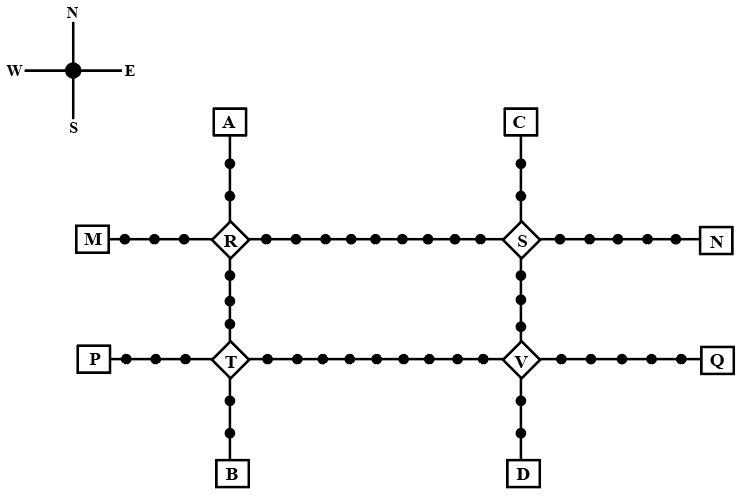
Given above is the schematic map of the metro lines in a city with rectangles denoting terminal stations (e.g. A), diamonds denoting junction stations (e.g. R) and small filled-up circles denoting other stations. Each train runs either in east-west or north-south direction, but not both. All trains stop for 2 minutes at each of the junction stations on the way and for 1 minute at each of the other stations. It takes 2 minutes to reach the next station for trains going in east-west direction and 3 minutes to reach the next station for trains going in northsouth direction. From each terminal station, the first train starts at 6 am; the last trains leave the terminal stations at midnight. Otherwise, during the service hours, there are metro service every 15 minutes in the north-south lines and every 10 minutes in the east-west lines. A train must rest for at least 15 minutes after completing a trip at the terminal station, before it can undertake the next trip in the reverse direction. (All questions are related to this metro service only. Assume that if someone reaches a station exactly at the time a train is supposed to leave, (s)he can catch that train.)
If Hari is ready to board a train at 8:05 am from station M, then when is the earliest that he can reach station N?
In the east-west direction, a train starts from station M every 10 minutes.
Now the first train leaving station M is at 6:00 am.
Since every 10 minutes trains are available in east-west direction, the train timings leaving from M will be like 6:10 am, 6:20 am, 6:30 am and so on.
Given, Hari has reached station M by 8:05 am.
So the earliest by which Hari can catch a train from station M is 8:10 am.
Now there are 19 stations between M and n, out of which two stations are junctions.
Time taken to travel between two stations in the east-west direction is 2 minutes.
Therefore, the time for which the train was running between M and N (excluding the stoppage time) = $$20\times2=40$$ minutes
Stoppage time at a junction is 2 minutes, while at the rest of the stations, it is 1 minute each.
Stoppage time for the train running between M and N = $$\left(17\times1\right)+\left(2\times2\right)=\ 21$$ minutes
Therefore, total travel time = 40+21 = 61 minutes.
So the time by which Hari reaches N is 8:10 am + 61 minutes = 9:11 am
If Priya is ready to board a train at 10:25 am from station T, then when is the earliest that she can reach station S?
Priya can reach S from T via R or V.
Case 1:- T-V-S
In the east-west direction, the first train from P arrives at T at time = 6 am + $$\left(4\times2\right)+\left(3\times1\right)=\ 11$$ minutes = 6:11 am
Since T is a junction so this train will halt for 2 minutes at T and leave at 6:13.
Priya boards a east-west train then Priya will board a train for V from T at 10:33 am.
There are 9 stations between T and V
Travelling time between T and V = $$\left(10\times2\right)+\left(9\times1\right)=29\ $$ minutes
Therefore, Priya will reach V latest by 10:33 am + 29 minutes = 11:02 am
In the north-south direction, the first train from D arrives at V at time = 6 am + $$\left(3\times3\right)+\left(2\times1\right)=\ 11$$ minutes = 6:11 am
Since V is a junction so this train will halt for 2 minutes at V and leave at 6:13.
Since every 15 minutes, a train starts from D in the north-south direction, so the latest by which Priya will be able to board such a train from V is at 11:13 am.
There are 3 stations between V and S
Travelling time between R and S =$$\left(4\times3\right)+\left(\left(3\times1\right)\right)=\ 15$$ minutes
Time by which she reaches S = 11:13 +15 minutes = 11:28 am
Case 2:- T-R-S
In the north-south direction, the first train from B arrives at T at time = 6 am + $$\left(3\times3\right)+\left(2\times1\right)=\ 11$$ minutes = 6:11 am
Since T is a junction so this train will halt for 2 minutes at T and leave at 6:13.
Since every 15 minutes a train starts from P in the east-west direction so the latest by which Priya will be able to board such a train is at 10:28 am.
Now since she will be able to board a north-south train earlier than the east-west train so Priya will board a train for R from T at 10:28 am.
There are 3 stations between T and R
Travelling time between T and R = $$\left(4\times3\right)+\left(\left(3\times1\right)\right)=\ 15$$ minutes
Therefore, Priya will reach R latest by 10:43 am
In the east-west direction, the first train from M arrives at R at time = 6 am + $$\left(4\times2\right)+\left(3\times1\right)=\ 11$$ minutes = 6:11 am
Since R is a junction so this train will halt for 2 minutes at R and leave at 6:13.
Since every 10 minutes, a train starts from M in the east-west direction, so the latest by which Priya will be able to board such a train is at 10:43 am.
There are 9 stations between R and S
Travelling time between R and S = $$\left(10\times2\right)+\left(9\times1\right)=29\ $$ minutes
Time by which she reaches S = 10:43 +29 minutes = 11:12 am
We are getting shorter time in case 2. So 11:12 am is the answer
Haripriya is expected to reach station S late. What is the latest time by which she must be ready to board at station S if she must reach station B before 1 am via station R?
Travelling time between S and R = $$\left(10\times2\right)+\left(9\times1\right)=29\ $$ minutes
There is a stoppage of 2 minutes at R
Travelling time between R and B = $$\left(7\times3\right)+\left(1\times2\right)+\left(5\times1\right)=28$$ minutes
In the north-south direction, the first train from A arrives at R at time = 6 am +$$\left(3\times3\right)+\left(2\times1\right)$$ = 6:11 am.
Since R is a junction so this train will halt for 2 minutes at R and leave at 6:13.
Every 15 minutes, a train starts from A in the north-south direction.
The last train that leaves A will be at 12:00 am and it will leave R at 12:13 am, so Haripriya must reach R till 12:13 am.
Travelling time between S and R = $$\left(10\times2\right)+\left(9\times1\right)=29\ $$ minutes
So Haripriya must board the train at S by 11:44 pm
In the east-west direction, the first train from N arrives at S at time = 6 am +$$\left(6\times2\right)+\left(5\times1\right)$$ = 6:17 am.
Since S is a junction so this train will halt for 2 minutes at S and leave at 6:19.
Every 10 minutes, a train starts from N in the east-west direction.
Therefore, Haripriya should board the train which leaves S at 11:39.
What is the minimum number of trains that are required to provide the service on the AB line (considering both north and south directions)?
Travel time between A and B = $$\left(10\times3\right)+\left(7\times1\right)+\left(2\times2\right)=41$$ minutes
After completing a journey, a train must rest for 15 minutes at least before starting again.
So if a train starts from 6 am from A to B, then the latest by which that train will start from B to A will be at 7 am, as in the north-south direction, a train starts from A and B every 15 minutes.
So the total no. of trains required = $$\left(\frac{60}{15}\right)\times2=8$$
What is the minimum number of trains that are required to provide the service in this city?
Travel time between A and B = $$\left(10\times3\right)+\left(7\times1\right)+\left(2\times2\right)=41$$ minutes
After completing a journey, a train must rest for 15 minutes at least before starting again.
So if a train starts from 6 am from A to B, then the latest by which that train will start from B to A will be at 7 am, as in the north-south direction, a train starts from A and B every 15 minutes.
So the total no. of trains required for the north-south lines =$$\left(\frac{60}{15}\right)\times2\times2=16$$
Travel time between M and N = $$\left(20\times2\right)+\left(17\times1\right)+\left(2\times2\right)=61$$ minutes
After completing a journey, a train must rest for 15 minutes at least before starting again.
So if a train starts from 6 am from M to N, then the latest by which that train will start from N to M will be at 7:20 am, as in the east-west direction, a train starts from M and N every 15 minutes.
So the total no. of trains required for the east-west lines= $$\left(\frac{80}{10}\right)\times2\times2=32$$
Total no. of trains required to service the city = 16+32 = 48
Educational materials for CAT preparation