
Join Our JEE Preparation Group
Prep with like-minded aspirants; Get access to free daily tests and study material.
Sign in
Please select an account to continue using cracku.in
↓ →
Join Our JEE Preparation Group
Prep with like-minded aspirants; Get access to free daily tests and study material.
If the curves, $$x^2 - 6x + y^2 + 8 = 0$$ and $$x^2 - 8y + y^2 + 16 - k = 0$$, $$(k \gt 0)$$ touch each other at a point, then the largest value of $$k$$ is ___________.
Correct Answer: 36
We have two curves
$$x^{2}-6x+y^{2}+8=0$$
and
$$x^{2}-8y+y^{2}+16-k=0,\qquad k\gt 0.$$
Each of these equations represents a circle. To see their centres and radii we first write each circle in standard form by completing the square.
For the first curve, isolate the terms in $$x$$:
$$x^{2}-6x = (x-3)^{2}-9.$$
Substituting this into the first equation gives
$$\bigl[(x-3)^{2}-9\bigr] + y^{2}+8 = 0.$$
Simplifying,
$$(x-3)^{2}+y^{2} -1 = 0,$$
or equivalently,
$$(x-3)^{2}+y^{2}=1.$$
Thus the first circle has centre
$$C_{1} = (3,\,0)$$
and radius
$$r_{1} = 1.$$
Now we treat the second curve. Complete the square in $$y$$:
$$y^{2}-8y = (y-4)^{2}-16.$$
Substituting back,
$$x^{2} + \bigl[(y-4)^{2}-16\bigr] + 16 - k = 0.$$
The constants $$-16$$ and $$+16$$ cancel, so we obtain
$$x^{2} + (y-4)^{2} - k = 0,$$
or
$$x^{2} + (y-4)^{2} = k.$$
Hence the second circle has centre
$$C_{2} = (0,\,4)$$
and radius
$$r_{2} = \sqrt{k}.$$
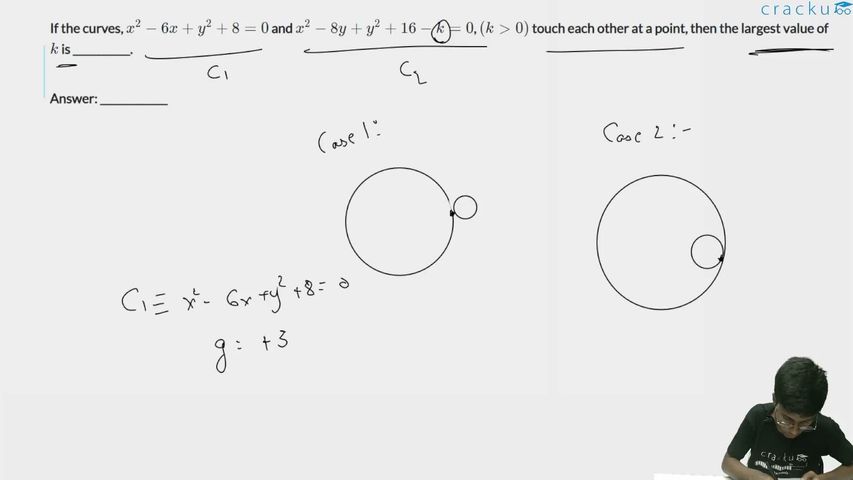
When two circles touch each other, the distance $$d$$ between their centres satisfies one of the following standard conditions:
• External tangency: $$d = r_{1} + r_{2}.$$
• Internal tangency: $$d = |\,r_{1} - r_{2}\,|.$$
First we compute the centre-centre distance. Using the distance formula,
$$d = \sqrt{(3-0)^{2} + (0-4)^{2}} = \sqrt{9 + 16} = 5.$$
Now we analyse the two possible tangencies.
External tangency. Here
$$r_{1} + r_{2} = d \;\Longrightarrow\; 1 + \sqrt{k} = 5.$$
So
$$\sqrt{k} = 4 \;\Longrightarrow\; k = 16.$$
Internal tangency. Here
$$|\,r_{1} - r_{2}\,| = d.$$
Because $$r_{2} \gt r_{1}$$ (otherwise the left side would be negative), we write
$$r_{2} - r_{1} = 5 \;\Longrightarrow\; \sqrt{k} - 1 = 5.$$
Therefore
$$\sqrt{k} = 6 \;\Longrightarrow\; k = 36.$$
Between the two admissible values $$k = 16$$ and $$k = 36$$, the question asks for the largest value. Clearly,
$$k_{\max} = 36.$$
Hence, the correct answer is Option D.
Was this solution helpful?
Click on the Email ☝️ to Watch the Video Solution
Create a FREE account and get:
_1.webp)

Educational materials for JEE preparation

Ask our AI anything

AI can make mistakes. Please verify important information.
AI can make mistakes. Please verify important information.
